
Alternator Wholesale: What the Rating Does Not Say
 ·
Updated October 15, 2026
·
14 min read
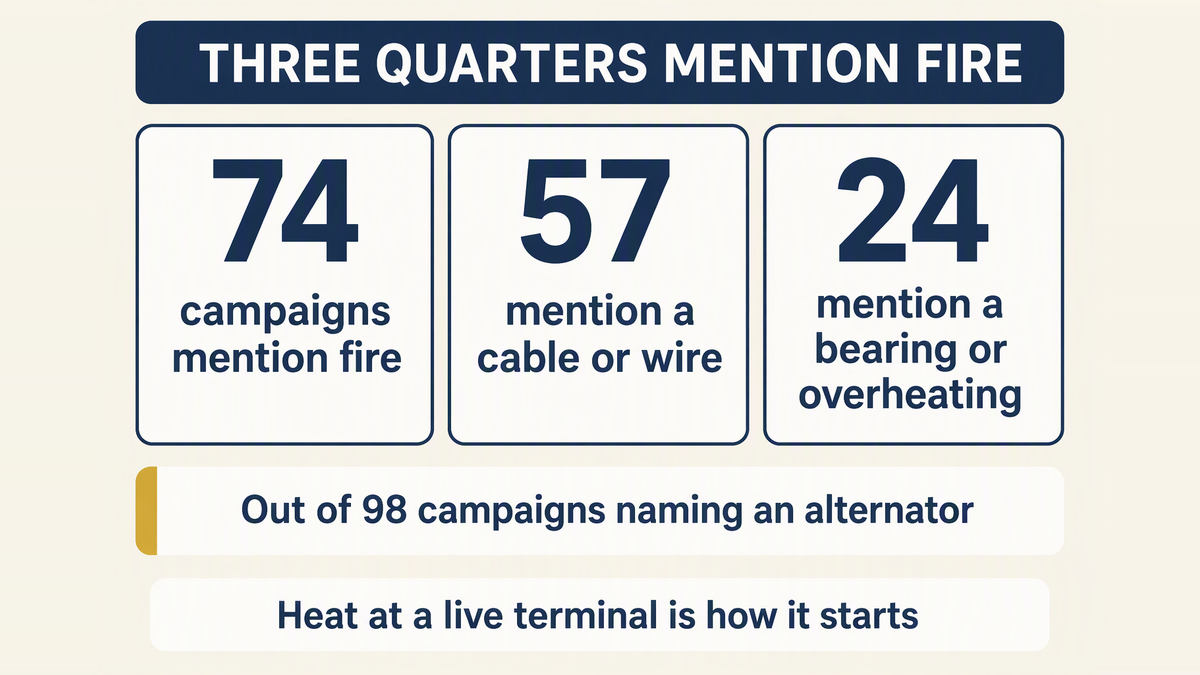
An alternator is sold on one number, and that number is defined in an international standard that is unusually precise about what it means. Read the definitions and two things become clear: the headline figure is a warmed-up figure at a speed the engine rarely reaches, and it is a statistical floor rather than a typical output. Then read the federal record, and the second surprise is what actually goes wrong. Across 98 campaigns naming an alternator, the great majority of the failures are in the cable, the connector and the routing around it — and three quarters of those campaigns mention fire.
1. What an Alternator Has to Be
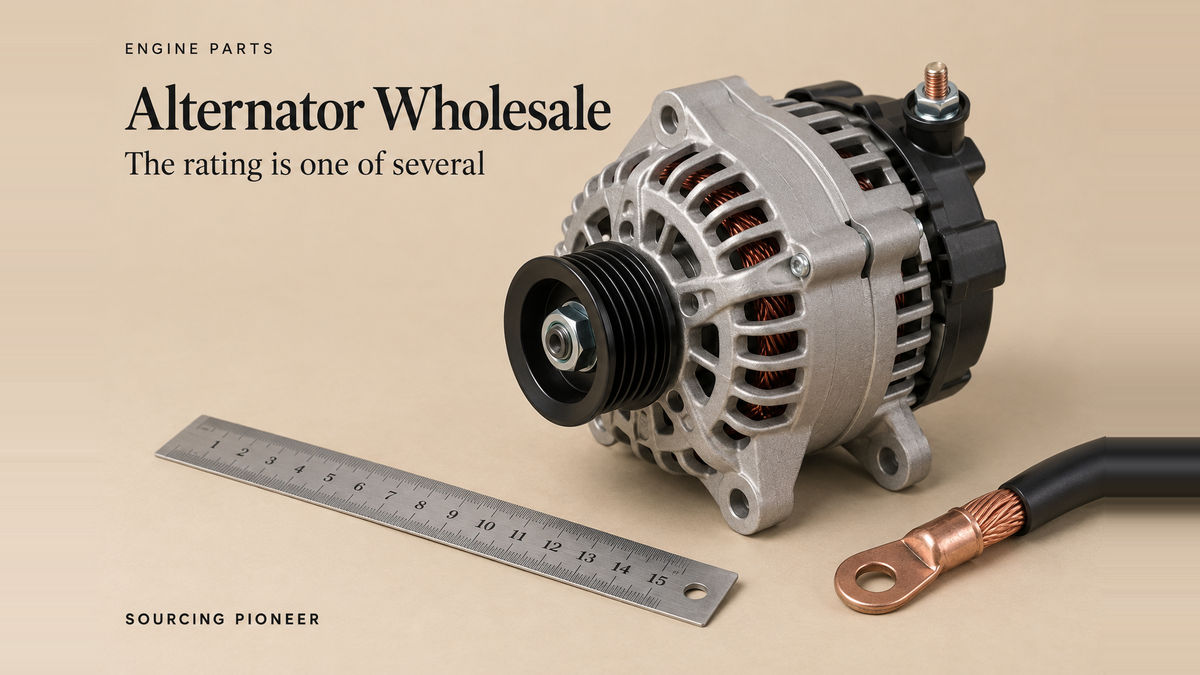
An alternator does two jobs at once. It supplies the car's electrical load while the engine runs, and it recharges the battery so the next start is possible. Unlike the parts before it in this series, it is a generator of current as well as a machine that rotates — so its specification is electrical first and mechanical second.
That is why a single figure can never describe one. An alternator has an output that changes with speed, a regulated voltage that has to stay inside a band, a rectifier that turns alternating current into direct current, bearings that have to survive continuous rotation, a pulley that may or may not have a one-way clutch in it, and a terminal through which the whole of that current passes.
| The element | What it decides | What a vague quote hides |
|---|---|---|
| Output at idle speed | Whether the car keeps running in traffic | The current at engine idling speed, warmed up |
| Output at rated speed | The number printed on the box | The speed it is quoted at, and whether it is a floor |
| Regulated voltage | Whether the battery charges without being cooked | The band, and how it varies with temperature |
| The rectifier | Whether the output is usable direct current | Which diodes, and how they are cooled |
| Bearings and the housing | Whether it survives continuous rotation | The bearing class, and the vibration it was tested at |
| The pulley | Whether the belt drives it, and how hard | The diameter, and whether it carries a one-way clutch |
| The output terminal and the cable | Whether the current reaches the battery | The stud size, the torque, and the cable behind it |
What this guide covers
- What an alternator has to be
- Twenty-two sections, and none covers charging
- What the rating means, in the standard's own words
- What the federal record says about this part
- The cable is the part that fails
- Three quarters of the campaigns mention fire
- The same cars, recalled twice
- What a cheap alternator quote drops
- Six checks and where the price comes from
- Frequently asked questions
2. Twenty-Two Sections, and None Covers Charging
The in-use inspection standard is short enough to read in full, and doing so settles the question. It has 22 sections. For vehicles up to 10,000 pounds they are scope, purpose, applicability, definitions, service brake system, brake power unit, steering systems, suspension systems, tires and wheel assemblies. For heavier vehicles they are scope, purpose, applicability, definitions, hydraulic brake system, vacuum brake assist unit and vacuum brake system, air brake system and air-over-hydraulic brake subsystem, electric brake system, service brake system, steering system, suspension system, tires and wheel assemblies.
That list contains one electrical item — the electric brake system, which is about how a trailer brakes, not about how a car charges. There is no charging section, no alternator section and no battery section. An alternator therefore has no federal figure to be measured against once the vehicle is in service, which is the same position as every other part in this series — but here it is worth stating precisely, because the number that is quoted for an alternator comes from somewhere else entirely.
3. What the Rating Means, in the Standard's Own Words
That somewhere else is ISO 8854, "Road vehicles — Alternators with regulators — Test methods and general requirements". Its scope is narrow and clear: it specifies the test methods and general requirements for determining the electrical characteristic data of alternators for road vehicles, and it applies to alternators cooled according to the supplier's instructions and mounted on internal combustion engines.
What makes it useful to a buyer is the definitions. They are short, and together they explain why a single number on a box is not enough.
minimum application current — current, in amperes, which is delivered by a warmed-up alternator at test voltage and minimum application speed
minimum application speed — alternator rotational frequency which corresponds approximately to the idling speed of the engine
rated current — minimum current, in amperes, which the warmed-up alternator shall supply at a speed of 6 000 min−1 and at test voltage
NOTE The mean value minus twice the standard deviation should be stated unless the customer has requested otherwise.
ISO 8854, terms and definitions 2.4 to 2.6 and the note to 2.6
Three things follow from that, and each one is a question worth asking a supplier.
First, the headline rating is taken warm and fast. It is the current a warmed-up alternator supplies at 6,000 revolutions per minute. A car at idle is nowhere near that speed, and a cold alternator on a winter morning is not a warmed-up one. So the number on the box and the current available at the traffic lights are two different quantities, and the standard keeps a separate term for the second one.
Second, the stated figure is a floor, not an average. The standard attaches a note to the definition of rated current — it is quoted in full above — requiring the figure to be stated as the sample's mean reduced by twice its spread, unless the customer asks for something else. A rating quoted that way is a number the sample nearly always beats, which is a sensible way to guarantee a minimum and a poor way to describe what the part actually does.
Third, cut-in speed is not a fixed constant. The standard defines it as the speed at which the alternator first begins to supply current, and then lists what it depends on: pre-exciting power, the rate at which speed is changing, battery voltage, the residual flux density of the rotor, and the regulator's characteristics. Five variables, only one of which is the alternator.
Two further definitions round out the picture. Efficiency is calculated from measured voltage, current, speed and torque — and the standard distinguishes a plain efficiency from a weighted one, which is the figure that matters over a real driving cycle rather than at a single point. And the test conditions are themselves defined, including ambient temperature, air pressure, sense of rotation, load current control and measuring accuracy. An alternator figure quoted without those conditions has left out the part that makes it comparable.
4. What the Federal Record Says About This Part
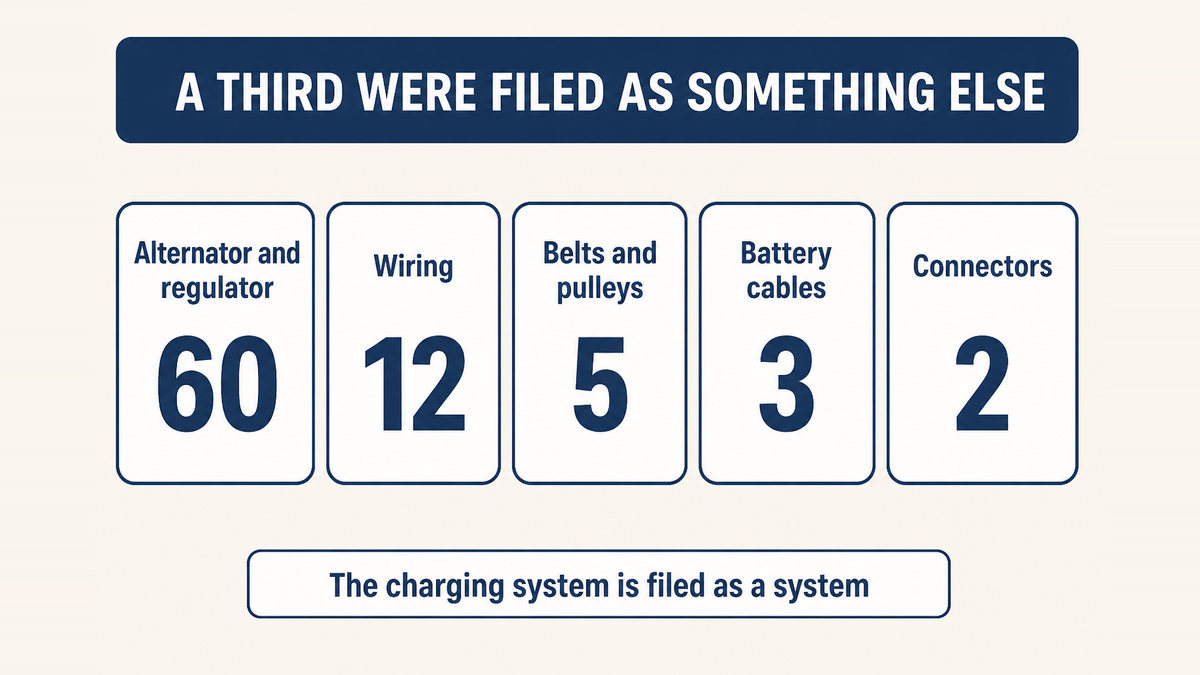
Search the same federal recall file used throughout this series and the alternator comes back with 2,965 records belonging to 98 campaigns — the largest count of any part in the cluster so far.
The way those campaigns were filed is more informative than the number. Sixty of them carry the component string ELECTRICAL SYSTEM:ALTERNATOR/GENERATOR/REGULATOR. Twelve are filed under ELECTRICAL SYSTEM:WIRING. Five sit under BELTS AND ASSOCIATED PULLEYS, three under BATTERY:CABLES, two under the starter assembly, and two under WIRING:CONNECTORS/PLUGS/RECEPTACLES.
So even in the filing system, a third of the alternator campaigns are recorded under something other than the alternator. The charging system is filed as a system, and its parts appear under whichever one of them gave way.
5. The Cable Is the Part That Fails
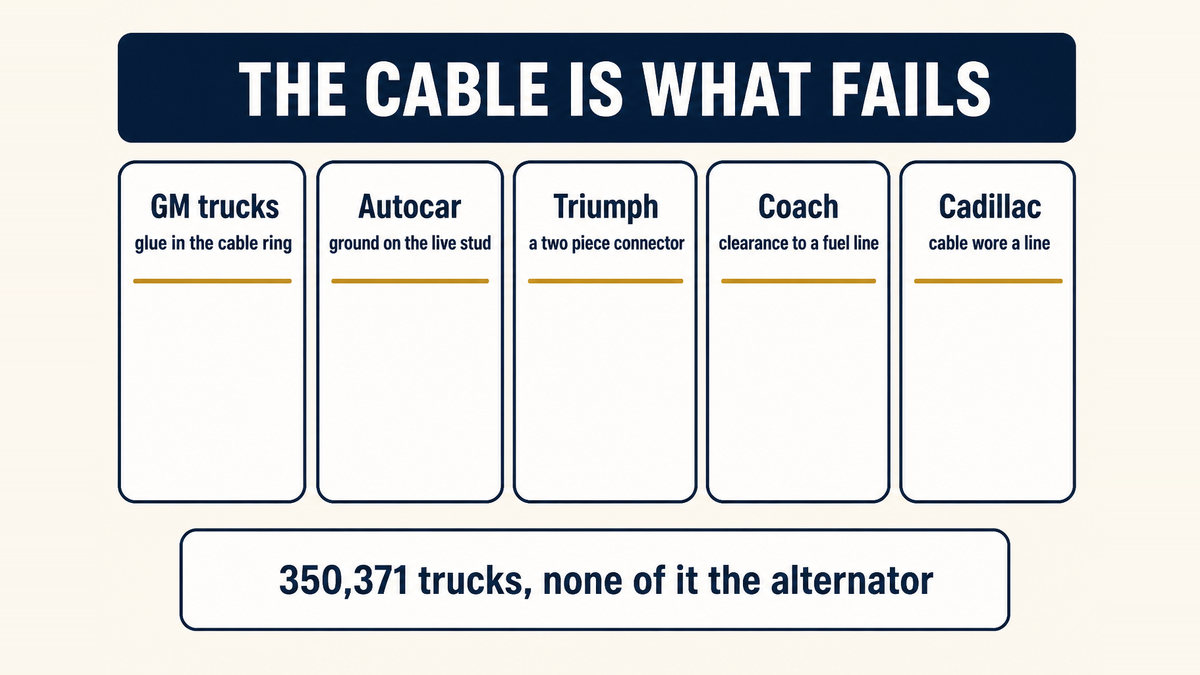
Count the causes across the 98 campaigns and the pattern is blunt. 57 of the 98 mention a cable, a wire, a harness or a connector. Electronics, software or the regulator appear in 17. Belts, tensioners and pulleys appear in 11. Bearings or overheating appear in 24. Brackets, bolts and mounts appear in 21.
The largest single campaigns make the point better than the counts. General Motors' 19V888000, covering 350,371 Silverado and Sierra trucks, was about a battery positive cable whose ring terminals "may have been manufactured with excessive glue", producing an intermittent connection between the cable and the alternator. An intermittent connection can stall a moving truck.
Autocar's 25V258000 concerns an alternator ground cable that may be misrouted and touching the alternator's positive stud — a ground wire against a live terminal, which is a short circuit waiting to happen. Triumph's 26V078000 covering 8,849 motorcycles was about the wiring between the alternator and the main harness, and the remedy was to replace a two-piece connector body with a single in-line crimped connector on each of the three wires. Coach and Equipment's 25V895000 found that the alternator could contact and damage a fuel line, and the fix was to check clearance and add brackets.
Go back to the biggest campaign of all and the same theme appears from the other direction. General Motors' 10V553000, covering 13,780 Cadillacs and Buicks, was about the starter or alternator cable contacting the power steering return line. The cable could wear through the line, causing a power steering fluid leak — and a leak onto hot engine parts could start an engine compartment fire.
None of that is a failure of the alternator. It is a failure of where the cable was routed, how the terminal was crimped, whether the ground path was clear of the positive stud, and whether the housing had enough clearance. Those are decisions made at the bench, not in the winding shop, and they are invisible on a photograph of the part.
6. Three Quarters of the Campaigns Mention Fire
The figure worth pausing on is this one. Across the 98 campaigns, 74 mention fire somewhere in the record — in the summary, the consequence or the remedy. That is not 74 fires; it is 74 occasions on which the agency's own text raises fire as the outcome of a charging system fault.
The mechanism is easy to see once it is written down. An alternator terminal carries the entire output current of the car, and a poor joint there does not fail quietly. It has resistance, resistance makes heat, and heat at a live terminal next to oil, fuel lines and plastic is the definition of an engine compartment fire. That is why the largest alternator campaign of all closes with a sentence about short circuits and fire risk rather than about a flat battery.
For a buyer, that reframes the whole part. The alternator's most consequential failure is not a car that will not start in the morning — it is a hot joint at a live terminal. And the parts of the assembly that decide whether that joint is sound are the stud, the crimp, the plating and the torque.
7. The Same Cars, Recalled Twice
Two pairs of campaigns in the record deserve their own section, because they show what happens when a charging system fix does not hold.
Chrysler recalled overlapping populations twice. Campaign 14V634000, filed in October 2014, covered 435,081 Chrysler 300, Dodge Charger, Challenger and Durango and Jeep Grand Cherokee vehicles built between April 2010 and January 2014 with a 3.6-litre engine and a 160 amp alternator. Campaign 17V435000, filed in July 2017, covered 442,214 of the same family across 2011 to 2014. In both, if the alternator fails the vehicle may stall without warning, and in the later one the record adds that the alternator may also short circuit, increasing the risk of a fire.
Hyundai recalled the same Veracruz population twice as well. Campaign 14V415000 covered 61,122 vehicles where oil could leak from a valve cover gasket onto the alternator, damaging it; the record notes that when the alternator is damaged the charging system warning lamp illuminates and the engine eventually stops running. Campaign 20V705000, six years later, covers 60,097 vehicles and says in its own words that it applies to vehicles previously recalled under the earlier campaign.
That is the same shape as earlier articles in this series — the Subaru coil campaign on 466,205 vehicles recalled twice, the camshaft and crankshaft pairs. A charging system fault is often a fault of routing, clearance or environment, and a fix that changes one of those can leave another one live. It is also the reason a buyer should care about the whole assembly rather than the alternator alone: the second recall is usually about the part nobody changed.
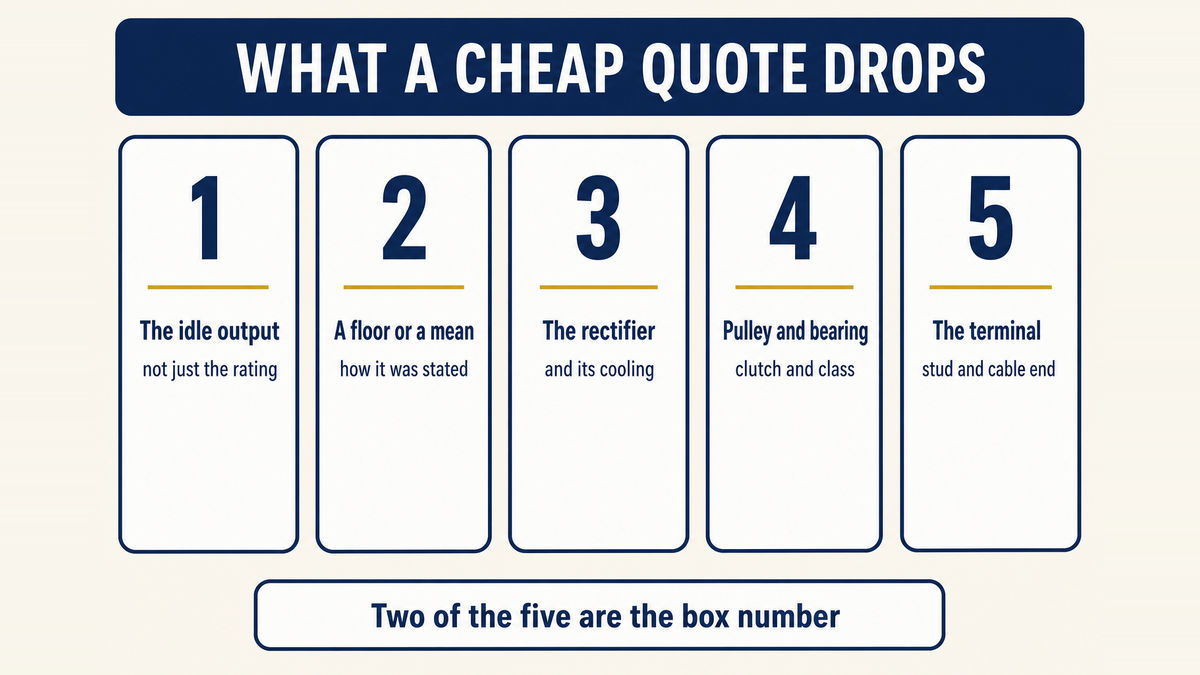
8. What a Cheap Alternator Quote Drops
An alternator's cost is in copper, diodes, bearings, the housing and the testing. Five places a low quotation comes from:
The idle output. A quote that gives one number has given the 6,000 rpm figure. The number that decides whether the car survives a traffic jam at night is the current at idle, warmed up — and it is the one the standard keeps a separate term for.
Whether the figure is a floor. The standard's own note requires the stated value to be the sample's mean reduced by twice its spread. Two suppliers can quote the same number while their samples differ enormously.
The rectifier and its cooling. Diodes are the part of an alternator that fails from heat first, and how they are mounted and cooled is not visible from outside.
The pulley and the bearing. Whether the pulley carries a one-way clutch, and what class the bearings are. A failed pulley on a secondary alternator was enough to cost a motorhome its power brakes and power steering.
The terminal stud and the cable behind it. The largest campaigns in the record failed here — a stud, a crimp, a ring terminal with too much glue, a ground cable routed against a live terminal. None of it is visible and all of it is specified.
9. Six Checks and Where the Price Comes From
Six checks cover an alternator before it is ordered.
- The minimum application current — what it delivers warmed up at roughly engine idling speed, not at 6,000 revolutions per minute.
- The rated current and its speed, with a statement of whether the figure is a guaranteed minimum and on what sample.
- The regulated voltage band, and how it moves with temperature.
- The rectifier: the diode type, and how the assembly is cooled.
- The pulley and bearings: diameter, one-way clutch or plain, and the bearing class.
- The output terminal and the cable end: stud size, terminal plating, crimp method and the tightening torque.
On the factory side the questions are about who makes what: whether the diodes, the regulator and the bearings are bought in, how the rotor and stator are wound and varnished, whether every unit is tested across its speed range or only at one point, and whether the test reports are kept. Our sequence is in the factory audit checklist, and the metal side is covered in metal stamping and machined parts. Where a supplier also holds a social or ethical audit, the scheme behind the certificate is worth reading — see social audit schemes compared.
An alternator's price is built from the copper in the stator and rotor, the diodes, the regulator, the bearings, the housing and the pulley, and then the testing. Copper and diodes set the base. The end-of-line test and the quality of the terminal are the two lines that reduce most easily without changing how the part looks, and they are the two the record points at.
An alternator is dense and awkward — heavy for its size, with a pulley and a terminal stud that dent and bend — so it is packed in moulded trays rather than loose: see export packaging quality control and carton drop test standards. Because it moves largely on mass, the chargeable weight method is set out in how volume decides what a shipment is charged. How the goods are described for entry is covered in how an HTS code is assigned, and the origin paperwork in the certificate of origin guide.
10. Frequently Asked Questions
Does an alternator fall under any federal inspection standard?
No. The in-use inspection standard has 22 sections and none of them covers charging, the alternator or the battery. Up to 10,000 pounds they cover brakes, brake power unit, steering, suspension, tires and wheel assemblies; above that they add the hydraulic, vacuum, air and electric brake systems. The only electrical section concerns the electric brake system, which is about braking, not charging.
What does the alternator rating actually mean?
Under ISO 8854, rated current is the minimum current a warmed-up alternator shall supply at 6,000 revolutions per minute. The standard also defines a separate term for the current delivered at roughly engine idling speed, which is much lower. Its note on the rating requires the stated value to be the sample's mean reduced by twice its spread, so the printed figure is a guaranteed floor rather than a typical output.
What does the federal record show about alternators?
2,965 records in 98 campaigns — the largest count in this series. A third of those campaigns were filed under something other than the alternator: twelve as wiring, five as belts and pulleys, three as battery cables and two as wiring connectors. Of the 98, 57 mention a cable, wire, harness or connector, and 74 mention fire somewhere in the record.
Why do so many alternator campaigns involve fire?
Because the alternator terminal carries the whole output current of the car. A poor joint there has resistance, resistance makes heat, and a hot live terminal sitting near oil, fuel lines and plastic is how an engine compartment fire starts. The record reaches that outcome at a cable ring terminal with excess glue, at a ground cable misrouted against the positive stud, and at a starter or alternator cable wearing through a power steering line.
What should an alternator quotation state?
The output at engine idling speed warmed up, as well as the rated figure; whether the rated figure is a guaranteed minimum and on what sample size; the regulated voltage band and its temperature behaviour; the rectifier type and cooling; the pulley diameter and whether it carries a one-way clutch; the bearing class; and the output terminal stud size, plating, crimp method and tightening torque.
The Charge Cable Gets Its Own Page
We return the output curve at the stated rpm, then the cable gauge and run length, because the record shows that is what fails.
Send Me the Cable Page
Questions & Comments
We read every one and reply within 24 hoursAn alternator quote arrives with one output figure, usually at the wrong speed. Send the engine and the idle rpm, and we will ask for the curve at both ends and the regulator's set point.