
How to Choose Trekking Poles: Six Decisions Before Price
 ·
Updated November 4, 2026
·
9 min read
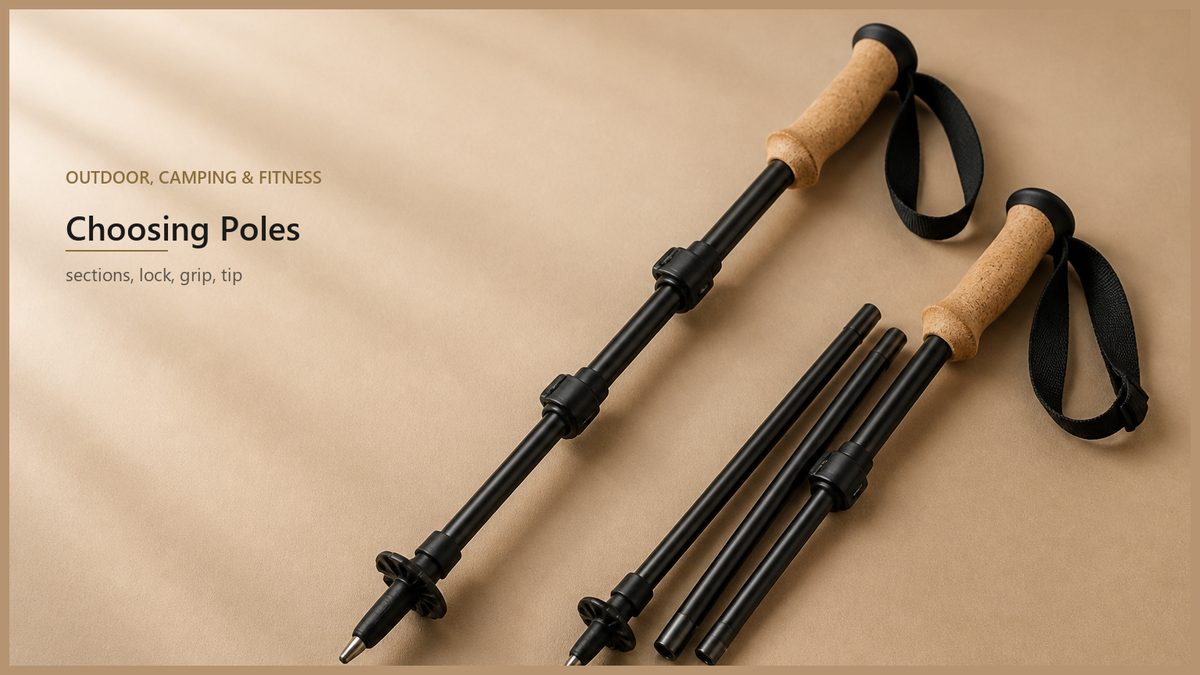
A trekking pole is three sections, one lock, one grip and one tip. The price sits in how those four parts are made.
Most buying guides start with the benefit, and the benefit is real. Poles give rhythm, they steady a crossing and they take strain off the knees on a descent.
Six Decisions, and One That Sets the Rest
Six choices decide a pole, and the first one decides what the other five can be. That is the number of sections.
Two or three sections fix the folded length, the lock count and the number of joints that can slip. A folded three section pole fits inside a day pack. A two section pole is lighter and stiffer, and it hangs outside.
The other five are the material, the grip, the strap, the tip and the length range. Each one is a cost decision before it is a comfort decision.
| Decision | The two usual answers | What it changes |
|---|---|---|
| Sections | Two or three | Folded length, joints, weight |
| Material | Aluminium or carbon fibre | Worn weight, failure mode |
| Lock | Flip lever or internal twist | Glove use, freezing |
| Grip | Cork, foam or rubber | Sweat, blisters |
| Tip and basket | Carbide or rubber | Grip on rock, trail damage |
| Length range | Fixed or adjustable | Who can use the pole |
Sections, Locks and the 135 cm Ceiling
Modern poles are made in two or three sections, and the maximum length is usually 135 cm, which is 54 inches. That ceiling is a standard rather than a law, and it is what most ranges are built around.
Two lock systems dominate. The internal twist lock uses a thread inside the tube that cams against the outer section. The external lever, the type Black Diamond popularised as Flicklock, clamps the tube from outside.
The difference shows up in winter. A guide who used twist locks for years reports that the internal screw mechanism freezes in cold. He has also had poles stop working while locked. The same writer switched to levers and never went back, because they work with gloves on.
A third design arrived later. The folding pole, usually called a Z pole, borrows its layout from an avalanche probe. The sections join on an internal cable, like the shock cord in a tent pole. The pole folds into a short bundle instead of sliding inside itself.
Folding poles are quick to deploy and have no external adjusters to catch on branches. The first versions had a fixed length, which costs the user adjustability. Many current models keep one short adjustable section near the grip. That solves most of the problem.
For a buyer, the section count sets the size run. A fixed length pole has to be ordered in sizes, and every size is its own line. An adjustable pole covers a range with one line, so a small shop can hold three lines instead of seven.
Aluminium Against Carbon Fibre
Poles are usually made from aluminium or carbon fibre, and the choice is not about prestige. It is about how each one fails.
Aluminium is the standard for a reason. A three section aluminium pole is heavy by modern standards and very hard to break. The common failure is a bend, and a bent pole still gets the walker home.
Carbon fibre is lighter and stiffer for the same weight. It also fails differently: it cracks or snaps, and a snapped pole is a stick with no load path.
A guide who has broken poles writes about the failures he saw. Each one came when a pole caught between two rocks and saved the walker from a fall. He recommends aluminium for anyone starting out, and carbon for the weight saving once the habit is set.
Weight is worth stating in the right unit. A pole is carried in the hand, not in the pack, so the figure that matters is the weight per pole. Two poles at 250 grams add half a kilo to what the arms carry on every step.
Wall thickness is the number behind that. A thin wall saves grams and gives up the bend that keeps a pole usable after a fall, so the figure belongs on the spec sheet.
One feature to avoid on a cheap pole is the spring-loaded section. It adds weight and noise, and the published view is that the benefit is small against both costs.
The Grip: Cork, Foam and Hard Plastic
The grip is where a cheap pole announces itself within an hour.
Cork and foam both absorb sweat and stay usable when wet. Cork shapes itself to a hand over a season, and foam dries faster between days.
Hard plastic is the material that turns up on economy poles. It does not absorb anything, and it gets slick with sweat. The moulded ridges that are supposed to sit between the fingers press in the wrong places.
A guide describes exactly that on a pair bought on the Camino. The plastic grips raised blisters, to the point where athletic tape went on them to cut the friction.
Grip length matters for the same reason. A short grip forces the hand into one position on a climb, while an extended grip lets it slide down for a short section of steep ground.
The Strap and the Leash
The strap does more work than most buyers expect, because a correctly used strap carries the push through the heel of the hand.
Cheap straps are thick, stiff and welded at the edge. The melted edge is a sharp line that digs in over a long day, and a stiff strap will not sit flat across the wrist.
The better version is thin, soft and pliable, with a sewn edge rather than a cut one. It costs more to make and it is the first place a low quote is found.
Leashes divide opinion. A guide who prefers no leash wants to let go of a pole without dragging an arm. He also wants to swap a single pole between hands. Where support is wanted, he prefers a leash that can be removed.
For a buyer that is a design line, not a taste. A removable leash is a small part with its own tooling, and a fixed one is a sewing operation on every pole.
The Tip, the Basket and the Trail
The tip is the smallest part and the one that decides whether the pole grips.
Carbide is the trail standard. It bites into rock, roots and frozen ground, and it lasts for years. It also leaves white scratches on rock, which is the most common complaint about pole use.
Rubber is quieter and gentler on stone. Economy poles often ship with rubber tips because they suit pavement, and those tips should come off for real trail use.
Baskets come in two common forms. A small plastic basket is pressed onto the tip, and a wider one screws on. The pressed version is cheaper and is the one that disappears in deep snow.
Baskets exist to stop the pole sinking into soft ground, and they are not needed on rock. The Appalachian Trail Conservancy recommends removing them unless the hiker is in snow, and using rubber tips where scratch marks matter.
The same guidance asks hikers to put the poles away on level ground or in sensitive areas. That is a rule about impact, and it belongs on the packaging rather than only in a blog post.
Demand is bigger than the trail count suggests. The conservancy estimates that pole use on the Appalachian Trail runs at about 90 percent among thru-hikers, against 10 to 15 percent among day hikers.
Where Cheap Poles Fail
Six faults come back on returns, and most are found in a workshop before a carton ships.
A lock that slips under load. The clamp force is set by a screw that works loose, and a pole that shortens mid-step is a fall.
A twist lock that freezes. The internal mechanism seizes in cold and wet conditions, which is exactly when a pole is needed.
A ferrule that cracks. The plastic seat at the tip splits, the carbide insert drops out, and the pole is a blunt stick.
A basket that falls off. The thread is moulded too thin, and the basket is gone in the first snow of the season.
A strap that tears at the stitch. The seam is the weak point, and a melted edge hides a short stitch line.
Sections that seize. Grit and water get between the tubes, and the pole will not collapse for the walk home.
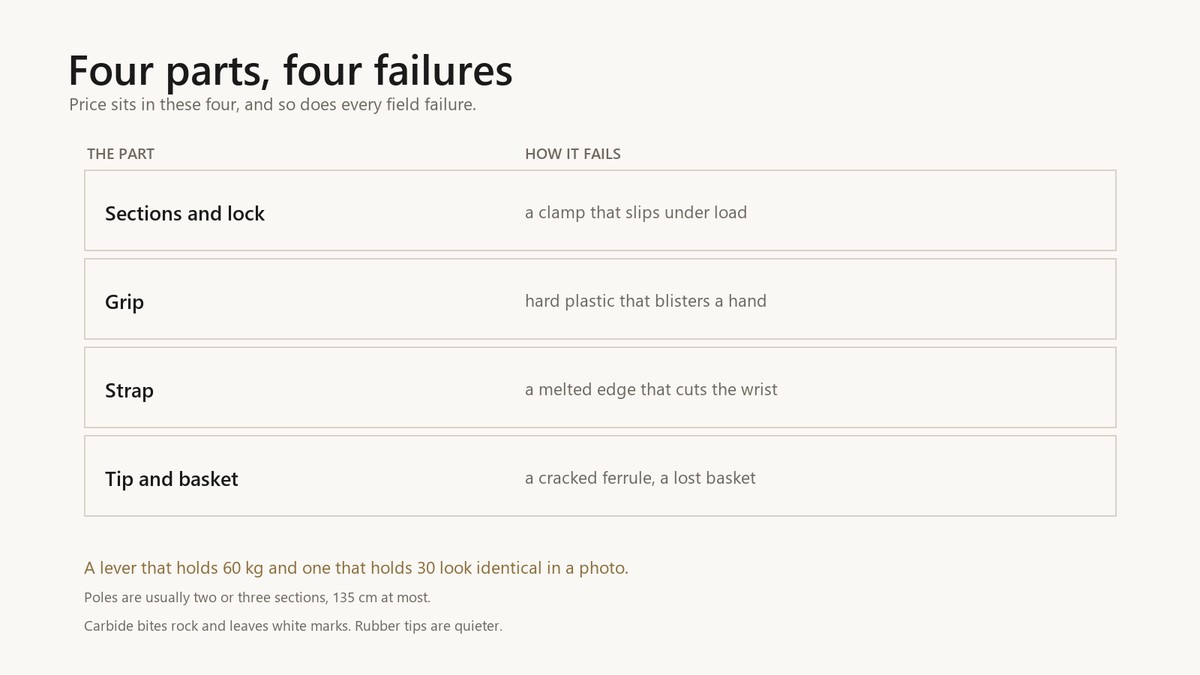
Only the first and the last show up on arrival, and both are settled by a cycle test. What a lock-cycle test can show is worth agreeing before a run starts.
Six Lines for a Pole Order
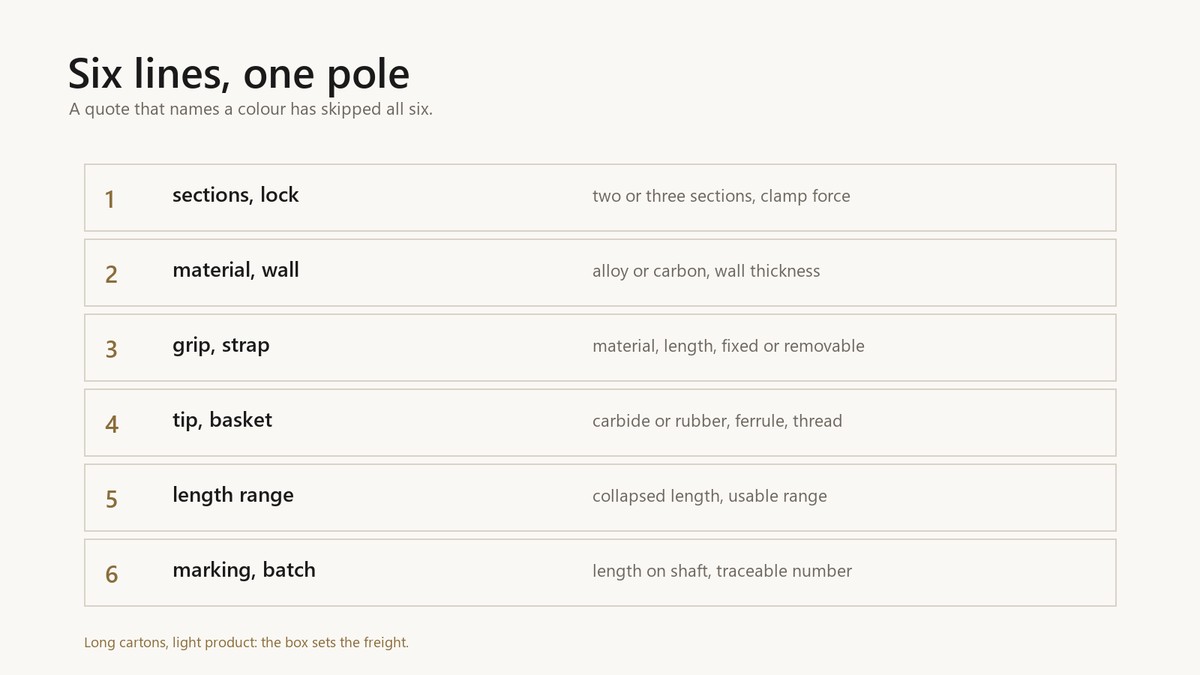
An order that can be checked is written in six lines, and it reads as a pole spec a tube mill can quote. Each line is where two quotes match on price and differ on the product.
Sections and lock. Two or three sections, the lock type, and the clamp force the lever has to hold.
Material and wall. The alloy or the carbon grade, and the wall thickness of each section.
Grip and strap. The grip material, the grip length, and whether the leash is fixed or removable.
Tip and basket. Carbide or rubber, the ferrule material, and the basket thread.
Length range. The collapsed length and the usable range, with the marked length printed on the shaft.
Marking and batch. The label content, the traceable batch number and the packaging drop test.
| Line | Example of a stated value | What it protects |
|---|---|---|
| Sections, lock | Three sections, flip lever, 60 kg clamp | Slipping under load |
| Material, wall | 7075 aluminium, 0.9 mm wall | Bend against break |
| Grip, strap | Cork, 200 mm, removable leash | Blisters and returns |
| Tip, basket | Tungsten carbide, threaded basket | Grip and basket loss |
| Length range | 65 cm collapsed, 110 to 135 cm | Fit across a size run |
| Marking, batch | Length on shaft, batch number | Claims and sorting |
One line does not fit on a pole and still costs money. Poles ship in long cartons. That is why the carton weight a pole order bills is usually set by the length of the box, and not by the kilos inside it.
When a lock fails on a delivered run, the claim when a lock slips turns on whether a clamp force was written down at all.
The 135 cm ceiling, the two and three section construction and the two materials come from the entry on the trekking pole. So do the spring-loaded sections and the Appalachian Trail usage figures.
The carbide scratch complaint and the advice to remove baskets and use rubber tips come from the same page.
The six buying criteria and the aluminium three section claim come from a guide company’s buying piece. So do the cork and foam grips, the strap and the tip advice. The twist-lock freezing, the lever change and the folding pole come from a mountaineering instructor’s field notes.
Questions Buyers Ask
How long should trekking poles be?
Most ranges top out at 135 cm. Set the length so the elbow sits near a right angle with the tip on the ground, then use a longer setting on a descent.
Are carbon poles better than aluminium?
Carbon is lighter and stiffer. Aluminium bends where carbon snaps, which is why guides often recommend aluminium for new users.
Flip lever or twist lock?
A lever clamps from outside, works with gloves and does not freeze. A twist lock is compact and can seize in cold or wet conditions.
Do I need two poles or one?
Two give rhythm and take load off both knees. One suits a walker who needs a hand free for a map, a compass or an axe.
Why do my poles scratch the rock?
Carbide tips bite, and they leave white marks. Rubber tips and removing the baskets reduce it, and the trail guidance asks for both on sensitive ground.
What should a pole spec include?
Sections and lock type, a clamp force figure, material and wall thickness, grip and strap, tip and basket, the length range and a batch number.
The Short Version
Fix the sections first, because everything else follows from how the pole folds. Then choose the lock that suits the season and the material that suits the user.
For a buyer, the clamp force is the number that separates a quote from a product. A lever that holds 60 kilos and a lever that holds 30 look identical in a photograph.
A Lever Is Not a Spec
Two poles with the same lever, the same cork grip and the same tip can differ by half the clamp force. Send the sections, the alloy and the length range you need, and we will say which lines a cycle test can settle before the carton is packed.
Send the Brief
Questions & Comments
We read every one and reply within 24 hoursFour parts decide a pole: sections, lock, grip and tip. Two levers that look alike can differ by half the clamp force. Send the range you need and we will test it.