
Dropshipping Toys: The Age Line, and Why It Decides What You Can Sell
 ·
Updated October 13, 2026
·
16 min read
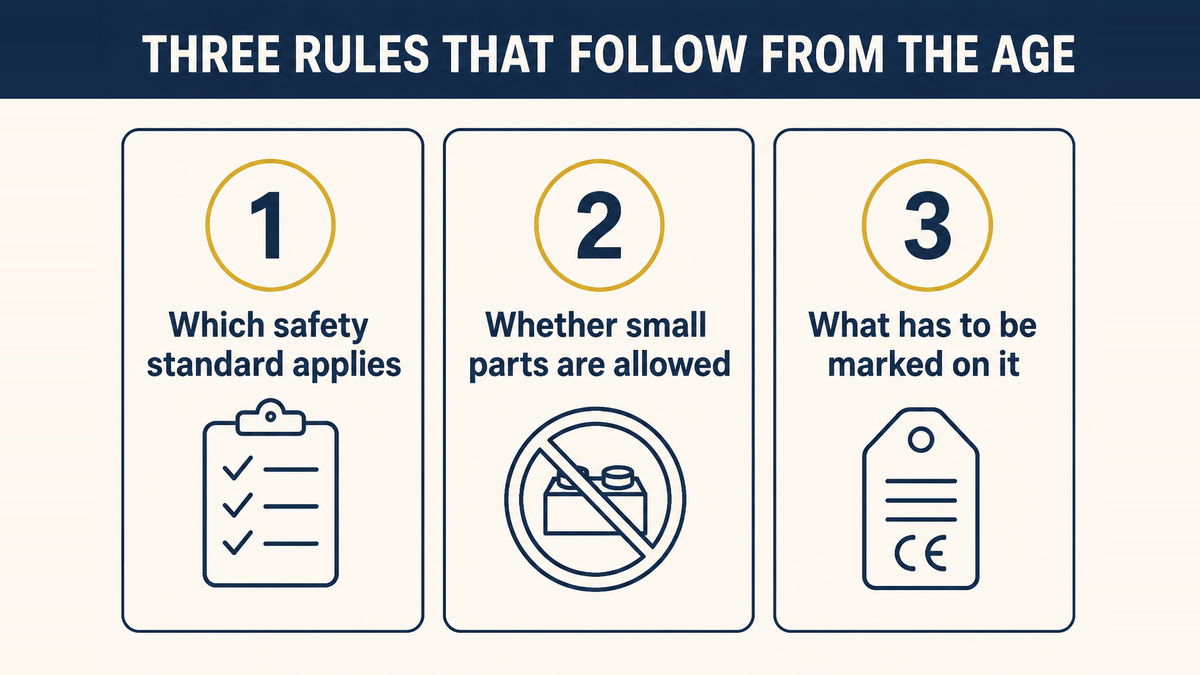
Toys are the category where the rules attach to the product rather than to the seller, and where a single number decides most of them. That number is the age the toy is meant for. It decides which safety tests apply, whether small parts are allowed at all, and what has to be marked on the item you ship. Get it wrong and nothing about the store is at fault, but the product cannot legally be sold for that age.

Three Rules That Follow From the Age
| What it decides | The rule behind it |
|---|---|
| Which safety standard applies | A toy must meet the mandatory toy safety standard, and it applies to the toy rather than to the shop. |
| Whether small parts are allowed at all | A toy meant for a child under three with a small parts risk is treated as a banned hazardous substance. |
| What has to be marked on the item | A children's product needs a permanent mark on the product and its packaging that identifies where and when it was made. |
What this guide covers
1. Why Do Toys Carry the Most Obligations?
Because the buyer and the user are not the same person, and the user cannot read a warning. A parent chooses and pays, and a small child receives. Almost every rule in this category exists because of that gap, and it is why toys sit closer to food and cosmetics than to the rest of a general store.
The comparison with a normal dropshipping range is stark. A phone case carries effectively no product rules at all. A lamp carries some electrical rules. A toy carries a mandatory safety standard, a ban that applies below a certain age, a testing and certification duty, and a permanent marking duty on the item itself. That is more obligations per unit than almost anything else a small store will sell.
The important part is that these obligations attach to the product as placed on the market, which means they do not disappear because the seller is small, or because the seller never touched the item, or because the factory is overseas. A store that lists a toy is placing that toy on the market.
2. Is the Toy Safety Standard Optional?
No. In the United States the toy safety standard is written into the regulations as a requirement rather than offered as good practice, and the wording leaves no room for interpretation.
Each toy must comply with all applicable provisions of ASTM F963-23.
16 CFR 1250.2(a), Safety standard mandating ASTM F963 for toys
Two practical consequences follow. The first is that a supplier claiming a toy is "safe" has told you nothing, because the relevant question is whether it was tested against the standard and whether the test report covers the version of the standard now in force. A report against an older edition is not the same document.
The second is that the standard is not only about sharp edges and small parts. It covers mechanical hazards, flammability and certain chemical limits, and it is updated from time to time, so a requirement can appear that did not exist when a product was first sourced. The most recent amendments added warning requirements for products containing water beads, including that the warning must be permanent and must sit on the display panel rather than only on paperwork.
If your range includes electronic or battery toys, a second layer of testing applies on top of the toy standard, and our guide to testing electronics for the EU and UK markets covers how that layer works alongside the toy rules.
3. What Is the Line at Three Years Old?
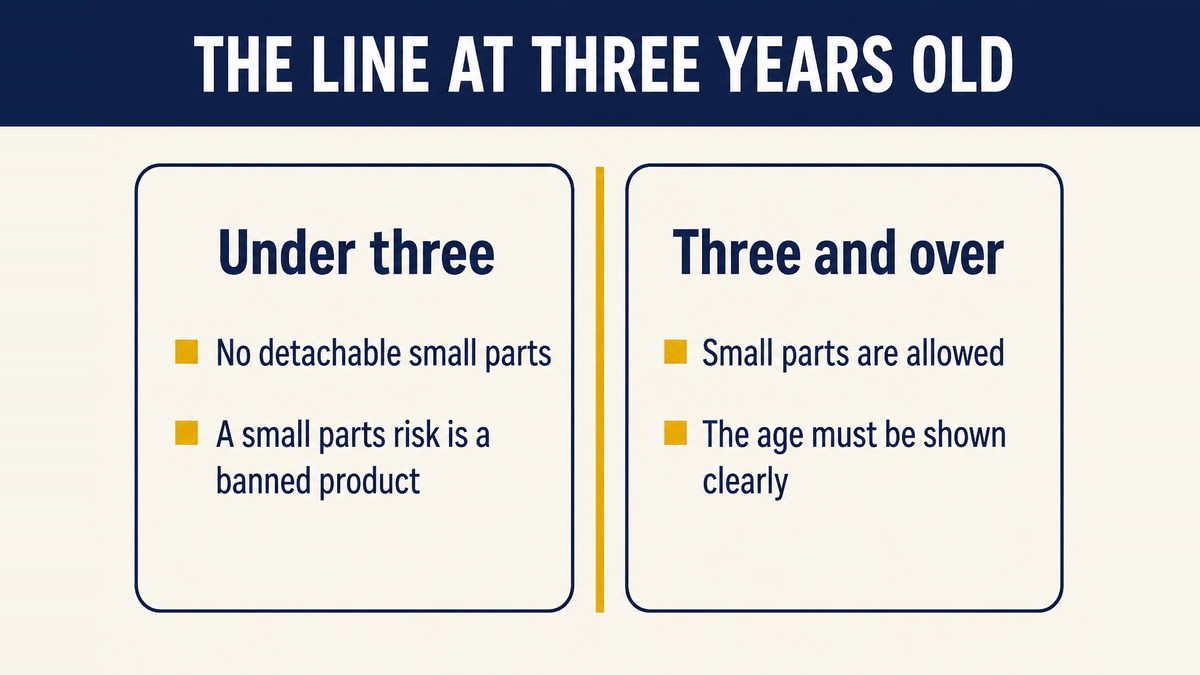
It is the most consequential line in the category, and it is drawn by the age the toy is intended for rather than by any property of the toy itself. Below it, a choking risk does not make a toy unsuitable. It makes the toy a banned hazardous substance.
Section 1500.18(a)(9) of this chapter classifies as a banned hazardous substance any toy or other article intended for use by children under 3 years of age that presents a choking, aspiration, or ingestion hazard because of small parts.
16 CFR 1501.1, Identifying toys intended for children under 3 that present choking hazards
Read the phrase intended for use by children under 3 carefully, because it is doing all the work. The rule is not triggered by the toy alone. It is triggered by the toy and the age it is meant for, taken together. The same set of magnetic blocks is perfectly lawful as a toy for a six-year-old and a banned item as a toy for a two-year-old.
The test that decides whether a small parts risk exists is physical rather than a matter of judgement. The toy is examined for any part that can be detached, and a part that fits entirely inside the Commission's test cylinder counts as a small part. There is no argument to be had about whether a piece is too small to worry about, because the cylinder settles it.
Do not treat the age on the listing as marketing. If a product page shows a toddler playing with a toy that has detachable parts, or says it is suitable from eighteen months, you have told the market the toy is intended for a child under three. That statement is what brings the ban into play, whatever the small print says elsewhere.
4. How Does Age Grading Decide the Range?
Because the age is not a label added at the end of a listing, it is the design decision that every other decision follows from. Choose the age and you have chosen the catalogue.
An age grade below three commits you to a range with no detachable small parts anywhere in it. That rules out the pieces most toy suppliers are best at: puzzles with small pieces, marble runs, magnetic building sets, miniature figure sets and most construction kits. Not because those products are dangerous in themselves, but because you have told the market they are for a child under three, and below that line a small parts risk is not a labelling problem.
An age grade of three and over opens all of that up and imposes a different discipline: the range must never be presented as suitable for younger children. That is harder than it sounds, because the imagery does the talking. A photograph of a toddler holding the toy makes an age claim louder than any line of text, and the same is true of a product name that uses the word toddler, or a review that mentions a two-year-old enjoying it.
So the useful way to plan a toy range is to pick the age line first and then choose products that fit underneath it, rather than choosing attractive products and hoping the age will follow. Two stores buying from the same factory can end up with completely different catalogues for exactly this reason.
There is a commercial reason to take the age line seriously as well as a legal one. Parents shop by age, so the grade you print is also the shelf your product sits on. A toy graded three and over competes with everything else aimed at that age, in a market that is crowded but enormous. A toy graded eighteen months competes in a much smaller and more anxious market, where buyers read every word and return anything that looks risky. Choosing the lower age does not automatically mean a smaller fight, only a different one.
Print the intended age on the product itself, not only in the listing. A mark on the item travels with the item into the customer's home, and it is the clearest evidence of the age you intended. It also stops the two versions of the same toy from being confused once they leave the warehouse.
5. Which Mark Can a Catalogue Product Not Carry?
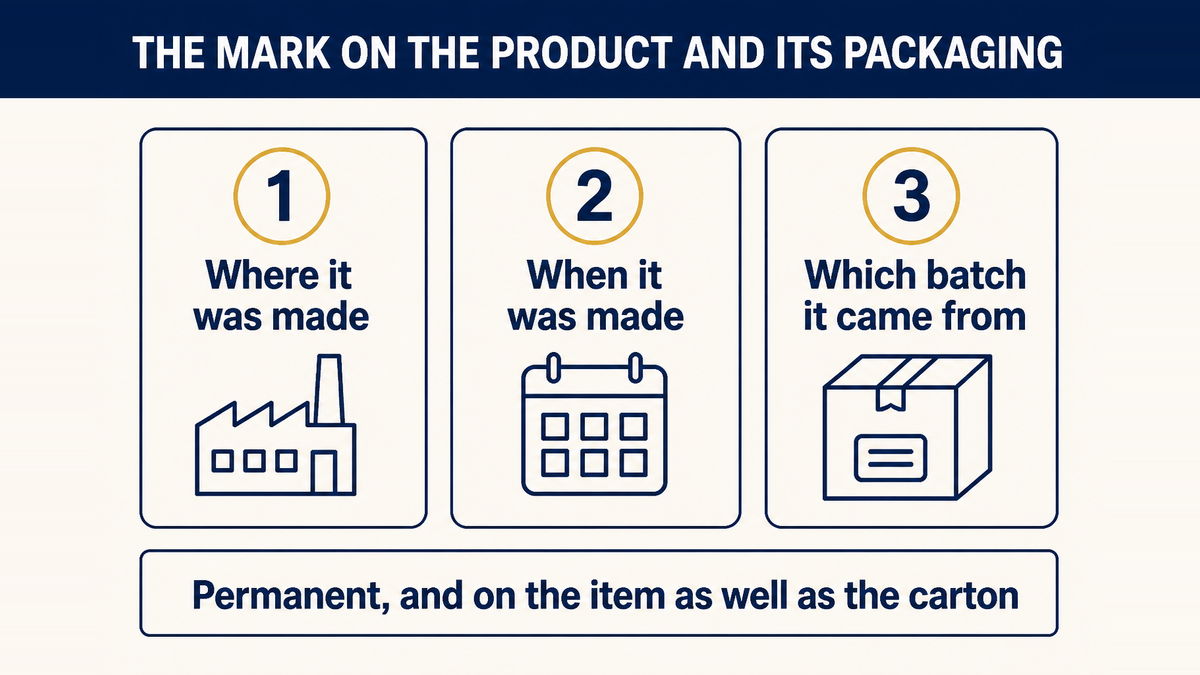
A permanent identifying mark on the product and on its packaging. It is the least discussed of the toy duties and the one that most often ends a dropshipping plan, because it is the one that attaches to the physical item rather than to the paperwork.
The manufacturer of a children's product shall place permanent, distinguishing marks on the product and its packaging, to the extent practicable, that will enable the manufacturer to ascertain the location and date of production of the product, cohort information (including the batch, run number, or other identifying characteristic) and any other information determined by the manufacturer to facilitate ascertaining the specific source of the product by reference to those marks.
15 U.S.C. 2063(a)(5)(A), tracking marks for children's products
Notice what the mark has to carry. It is not a logo and it is not a brand name. It has to let the maker work out where and when the item was produced and which batch it belonged to, which means the mark is a traceability device rather than a badge.
This is where a catalogue product and a sourced product part company. When you buy from a general dropshipping catalogue, the item arrives carrying whatever marking the factory put on it, or none. That marking identifies the factory's own chain, and it does not say anything about your business. The certificate that goes with a children's product belongs to the company that certifies the product as it is placed on the market, so a certificate issued to a platform's supplier is not yours to rely on for a product you are selling under your own store.
There is a route through this, and it is the same route that fixes the label problem in most categories: buy the item as a custom order rather than as a catalogue line, so the mark is applied for you and the test report names the product you are actually selling.
Treat the marking as a line item in the order rather than as a favour. Give the factory the exact text you want on the item and on the carton, say that it has to survive handling, and look at it on the first batch before the rest is packed. A mark that rubs off in transit is not a permanent distinguishing mark, and a factory that cannot keep a mark on a product is worth asking about the parts that matter more.
6. What Can You Actually Dropship?
Sort a toy range by the age line and by how much marking and testing the item needs, and the picture is clearer than a list of trending products suggests.
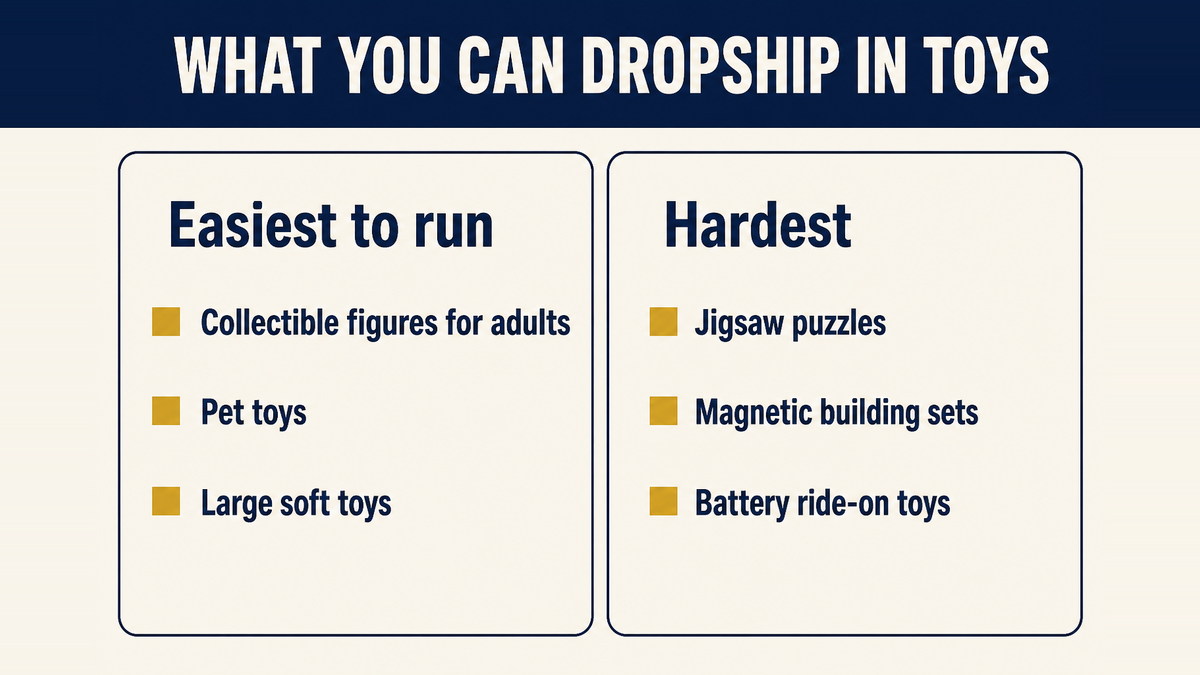
| Item | Age line | Small parts | Where it sits |
|---|---|---|---|
| Collectible figure sold to adults | Not a children's product when it is presented that way. | Not the deciding question. | Easiest to run |
| Pet toy | Outside the children's product rules while it is sold as a pet product. | Not the deciding question. | Easiest to run |
| Large soft toy, no detachable parts | Can be graded below three if nothing detaches. | Must pass the cylinder test. | Works with testing |
| Oversized wooden blocks | Can be graded below three if each piece is over the cylinder size. | Must pass the cylinder test. | Works with testing |
| Small wooden blocks | Three and over only. | Present, and that is what sets the line. | Only above the line |
| Jigsaw puzzle | Three and over only. | Present. | Only above the line |
| Magnetic building set | Three and over only, with additional magnet rules on top. | Present, and magnets carry their own hazard. | Only above the line |
| Battery ride-on or hoverboard | Any age grade still carries the full duty. | Varies. | Hardest |
Two things stand out. The first is that the easiest items in this category are frequently not toys at all in the legal sense, because they are aimed at adults or at pets, and the whole set of children's product duties falls away with the audience. The second is that the hardest items are not the most dangerous ones, they are the ones that combine a battery, a motor and a child user, because then every duty applies at once.
For anything that stays a toy, the practical work is the same as in any other category, only with more of it. Test the product against the current standard rather than accepting a supplier's summary, and check the report names the exact item you are buying. Our guide to CPSIA testing and certificates covers the documentation, and our breakdown of toy safety testing shows what each test looks at. Before the goods ship, a pre-shipment inspection is also worth running, because the batch that is inspected is the batch you can describe. If you are still choosing between suppliers, our notes on buying squishy and soft toys in quantity and on sourcing puzzles from a factory show how the practical questions change between product types, and our guide to pet toy materials and testing covers the adjacent route out of the children's product rules. The general demand-side view is in our notes on picking a product that sells.
7. Frequently Asked Questions
Do toy dropshippers need safety certificates?
In the United States, yes, for products meant for children. A children's product has to be tested and covered by a Children's Product Certificate, and toys must meet ASTM F963, which is a mandatory standard rather than a voluntary one.
What is the age line for toys?
It is the line between toys meant for children under three and toys meant for older children. Anything intended for a child under three is a banned hazardous substance if it presents a choking risk from small parts, so the intended age decides which products are allowed at all.
Why can a toy not be sold to toddlers if it has small parts?
Because a toy intended for a child under three is treated as a banned hazardous substance when a part can fit entirely inside the Commission's test cylinder. The product is not simply mislabelled in that case. It is a product that may not be sold for that age at all.
What has to be marked on a children's product?
A permanent distinguishing mark on the product and on its packaging, so far as it is practicable, that lets the maker work out where and when it was made and which batch it came from.
Can I dropship toys from a marketplace catalogue?
Only for items where the maker's own marking and certificate already match what you are selling. The mark and the certificate belong to the company that places the product on the market, so a generic catalogue listing usually cannot answer for them on your behalf.
Which Mark a Catalogue Item Cannot Carry
We return the certification path for each age band, the mark your product may not print, and the detachable-part test that decides it.
Check My Marks
Questions & Comments
We read every one and reply within 24 hoursUnclear which age you should grade a toy at, been offered a catalogue item with no test report, or trying to work out whether the marking on your product is enough? Post the product, the age you want to sell to and what paperwork the supplier gave you, and our team will help you work out which duty still applies.