
Dropshipping Pet Products: The Two Costs That Decide the Category
 ·
Updated October 13, 2026
·
15 min read
Pet products look like an easy category and are not. The usual reason given is demand, and demand is genuinely good. The real difficulty is that this category has two costs the others do not: a pet chews and swallows what you sell it, and an unusually large share of pet products are mostly air in a box. One of those costs is a liability, the other is a shipping bill, and both are decided long before you pick a supplier.

The Two Costs, and What They Kill
| Cost | Why it exists here | What it rules out |
|---|---|---|
| Safety of materials | A pet chews, licks and swallows the item, and harms itself rather than returning it. | Anything that can break into pieces, and the whole food, treat and supplement shelf. |
| Shipping volume | Many pet products are light and enormous, so the courier charges for the space. | Beds, crates, cat trees, large litter boxes and anything that ships as air. |
What this guide covers
1. Why Is This Category Not Like the Others?
Because the customer is not the user. A person buys the product and an animal destroys it, so the normal signals you would use to judge a product do not work. Your customer will never tell you the material felt cheap, because the pet chewed through it in an afternoon. They will tell you the pet got sick, or cut its mouth, and at that point the problem is no longer a customer service issue.
That single fact changes two things at once. It raises the stakes of a quality failure well above the price of the item, and it puts a hard floor under the material standard you can accept. A weak plastic that would be a mild complaint in another category is a danger here, which means the cheapest version of a pet item is usually the most expensive one to sell.
The second difference is physical rather than emotional. Pet owners buy large objects, because the things a pet uses take up space: beds, crates, trees, litter trays. Large and light is the worst combination for a courier, and it is the combination this category is full of.
2. Cost One: A Pet Chews and Swallows
Think about what happens to the product when nobody is watching. It is pulled, chewed, licked, carried and sometimes swallowed. So the checks that matter are not the ones you would apply to a decorative item, and they are worth applying before you list rather than after the first complaint.
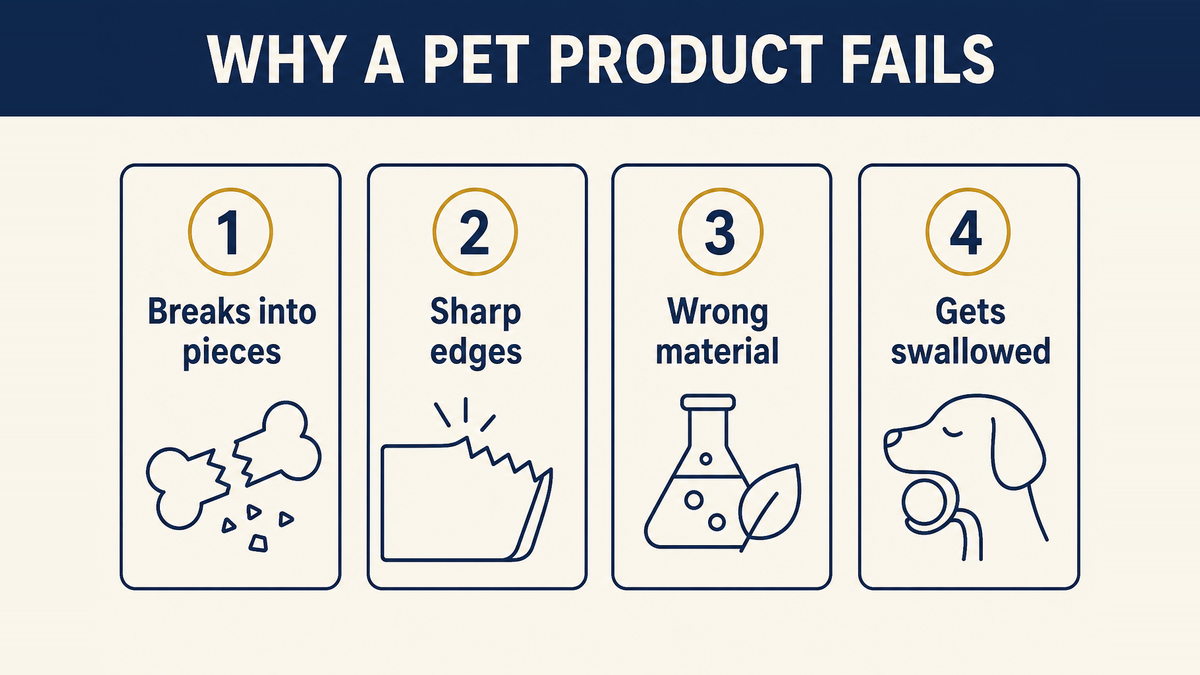
- Can it break into small pieces? A toy that comes apart is a choking risk, and the smaller the pet the worse it is. Ask what the item is tested against and whether the joints and eyes are fixed or glued.
- Does it have edges or thin corners? Materials that crack leave sharp lines, and mouths and paws find them. Softness on arrival is not the same as softness after a month.
- What is it made of, exactly? Anything a pet chews, wears against skin or eats from should be asked about rather than assumed. Vague answers such as "safe material" are not answers.
- Will a pet actually swallow part of it? That is the question for food, treats and anything edible, and it is the reason those shelves are a different business rather than another product line.
Do not treat safety as something the supplier will handle for you. A supplier's job is to make what you describe, and if your description is vague the item you receive will match it. The rules on what a product may contain and what must appear on it are set by the market you sell into rather than by the factory, and the UK's guidance on placing manufactured goods on the market in Great Britain is a clear illustration of how specific those rules become once a product is intended for an animal.
3. Cost Two: The Parcel Is Mostly Air
Couriers do not charge only for weight. They charge for the space a parcel occupies, converted into a billable weight using a formula agreed with the carrier. A light parcel in a large box is charged on the size of the box, so a product can be cheap to buy and expensive to send at the same time.
This is the single most common way a pet product loses money, and it is invisible in a supplier list, because lists show the cost of the goods and not the cost of the box. A bed that costs a few dollars in the catalogue is a large, soft, awkward parcel on the way out, and the parcel is what you are billed for.
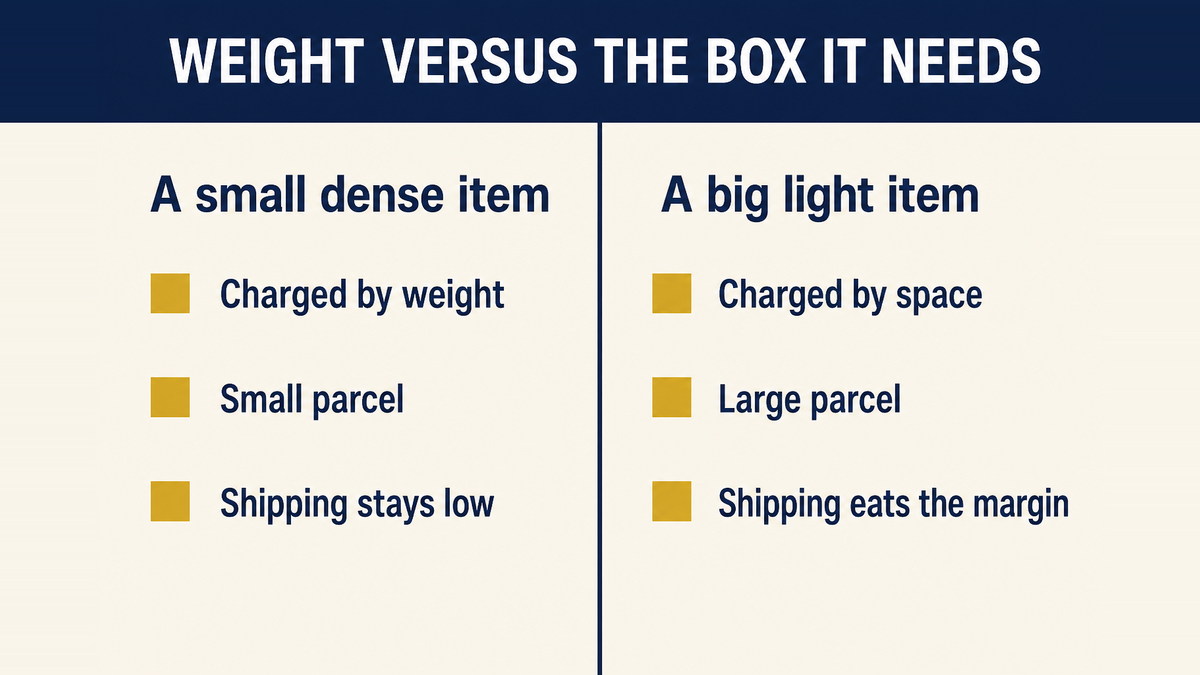
So the test for a pet product is not only what it costs. It is what it costs divided by the size of the parcel it needs, and that number is the one to compare against the price you can charge. Two products with the same unit cost can differ by several times in shipping, and the difference has nothing to do with quality.
Because the divisor depends on the carrier, the service and the destination, treat any figure you are given as a starting point rather than a rule. Confirm the formula with the carrier you will actually use, then apply it to the exact box you intend to ship, because the difference between folding a bed flat and shipping it open is the difference between a viable product and a loss-making one.
Apply the parcel test before the product test. Take the item, work out the smallest box it can travel in, and only then decide whether it can sell. Doing it in that order removes most of this category's bad options in an afternoon, and it costs nothing, because you are deciding from measurements rather than from samples.
4. What Should You Not Ship at All?
Some parts of this category are not difficult, they are simply a different business, and dropshipping is the wrong vehicle for them. Being blunt about that saves more money than any product tip.
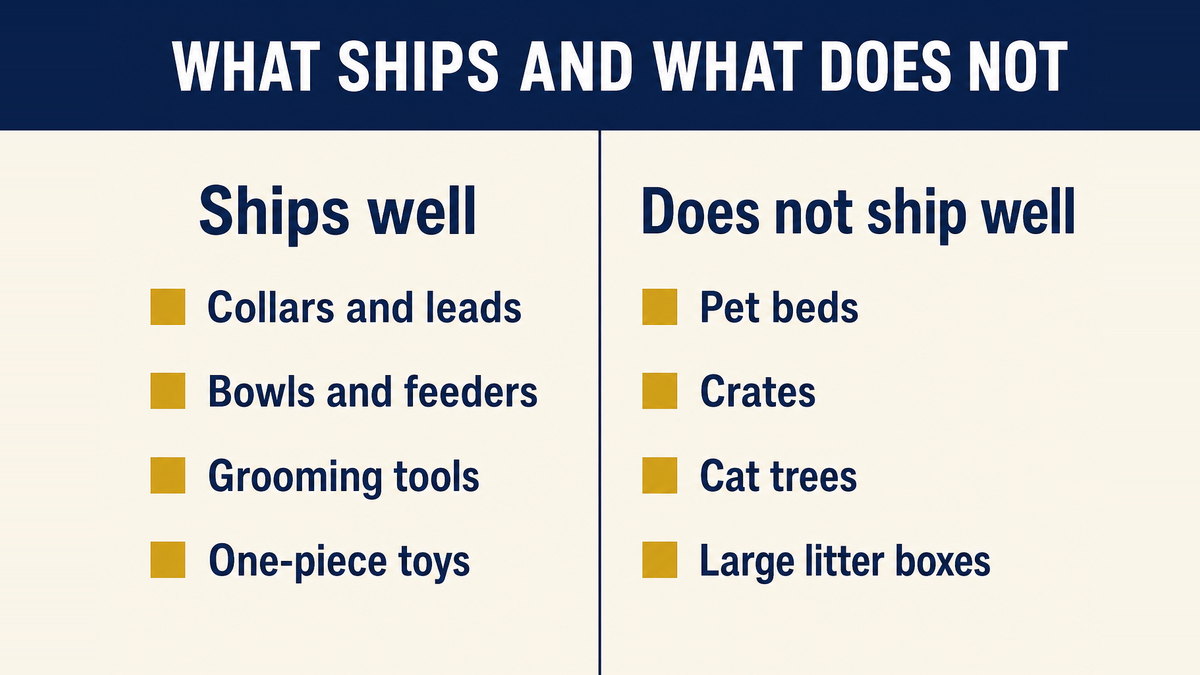
Food, treats and anything edible. These carry shelf life, ingredient statements, rules on what may be sold where, and import restrictions that vary by market. A mistake does not produce an annoyed customer, it produces a harmed animal, and the liability is not proportional to the price of the order.
Supplements and anything making a health claim. The moment a product claims to help an animal's joints, coat or digestion, it stops being a pet accessory and starts being a regulated item. The words on your product page become part of the claim, so the risk is not only in the product you bought.
Very large items. Beds, crates, cat trees and large litter boxes lose money on shipping and come back at a high rate because sizing is difficult to get right. If you want to sell these, the honest route is to hold stock in the market you sell to so the parcel becomes domestic, which is the trade-off covered in our guide to moving from dropshipping to wholesale.
Anything that only works with an animal inside it. Carriers, travel crates and safety gear are bought in a hurry and need to fit on the first attempt. A wrong size is a return, and a return of a large item is expensive enough to erase the margin on several good orders.
There is a second reason the large items go wrong, and it is not about shipping at all. A bed or a crate is bought for a specific animal, and the buyer has to guess a size from a photograph. Pet owners are bad at this in both directions: they buy too small for a growing puppy and too large for a small breed, and they find out only when the parcel is open. That is a return you cannot argue with, because the product is not faulty, it is simply the wrong shape for the animal in front of them.
Compare that with a collar or a lead. Those are also bought by size, but the buyer can measure a neck or a chest in a few seconds, and the item is cheap enough that a wrong guess is a minor annoyance rather than a task. Same category, same customer, completely different return rate — and the difference is how easy it is for the buyer to be right on the first attempt. That is a useful way to test any pet product you are considering: if the customer needs the animal in front of them to order correctly, expect the parcel to come back.
5. What Three Filters Leave You With a Product That Works?
Run every candidate through these three in order, and stop at the first one it fails. Most bad options fail on the second, and that is where the money is saved.
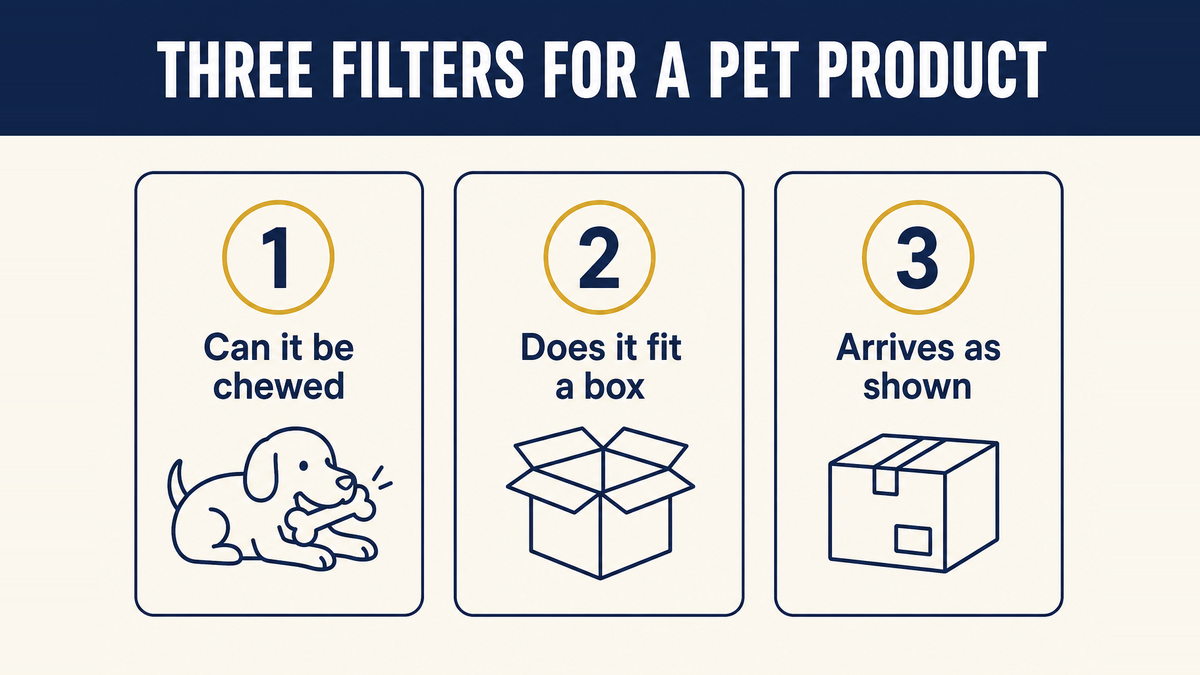
- Can it survive being chewed? Not "is it strong" but "if it fails, does it fail into small pieces". A product that fails safely is acceptable; one that fails into fragments is not, whatever it costs.
- Does it fit a parcel charged by weight? Small and reasonably dense is what you want. If the smallest possible box is much bigger than the item, the shipping cost rather than the product is what you are selling.
- Will it arrive indistinguishable from the photo? Pet accessories are bought for a specific animal, so colour, size and shape are not decoration. Anything that arrives slightly different gets returned, and returns in this category are expensive because the item is often bulky.
What survives all three is a narrow but genuinely good list: collars, leads and harnesses in standard sizes, bowls and slow feeders, grooming brushes and nail clippers, single-piece toys, tag and accessory sets, and small training aids. None of them is exciting. All of them ship as a compact parcel and break safely if they break at all.
6. How Should You Brief a Supplier?
A brief that names the animal is worth more than a brief that names the product, because the animal is what makes this category different. Five points are enough, and a supplier that pushes back on any of them is telling you something useful.
- Say which animal and which size range. A toy for a small dog and a toy for a large dog are different products with different failure points, and a supplier that treats them as one will ship you the weaker version.
- Ask what the item is made of, in specific terms. Not "safe material". A named material with a stated grade is something you can check and something a test can confirm.
- Ask for the test documents, or say that you do not need them. If the market you sell into requires testing for the material or the category, get the paperwork before you list rather than after a complaint.
- Ask for the packed dimensions, not the product dimensions. The number you need is the size of the smallest box it can travel in, because that is what the courier bills.
- Ask what the fault rate is on the item. A supplier that has made it hundreds of times knows. The answer tells you whether the design has a weak point, and it is a better predictor than any sample you could hold.
Two habits apply to any product you eventually buy. Have the first batch checked before it ships rather than after it sells, which is what an independent quality inspection is for, and check how the item is classified for duty before you price it, because pet products do not all fall under one code. The USITC Harmonized Tariff Schedule is where that starts, and the rate you find belongs in your cost before you set a price rather than after.
7. Frequently Asked Questions
Can I dropship pet food and treats?
Treat it as a different business rather than a product line. Food and treats carry shelf life, labelling duties and rules on what may be sold where, and a spoiled or mislabelled item harms an animal rather than annoying a customer. Most dropshippers are better served by accessories, where a mistake is a return rather than a sick pet.
What is dimensional weight, and why does it matter for pet products?
It is the practice of charging for the space a parcel takes up rather than only for what it weighs. A pet bed is light and enormous, so the courier charges for the box, not the contents. That is why a bulky item can look profitable in a supplier list and lose money on every order once shipping is added.
Which pet products are safe to dropship?
Small, solid items that a pet cannot break into pieces or swallow, and that fit in a box the courier charges by weight rather than by volume. Collars, leads, bowls, grooming tools, toys in one piece and small accessories all fit. Beds, crates, cat trees and large litter boxes do not, and not because of the product.
Do pet products need safety testing?
Some do and some do not, and the answer depends on the market and on what the item touches. The safe assumption is that anything a pet chews, wears against its skin or eats from is subject to rules about what it may contain. Ask the supplier for the test documents before you list, not after a customer complains.
Why are pet beds bad for dropshipping?
Because the parcel is mostly air. A bed is cheap to buy and expensive to ship, and the shipping cost is set by the size of the box rather than by the price of the goods. Add a high return rate, since beds are often the wrong size for the pet, and the category usually loses money per order.
What Share of the Carton Is Air
We return dimensional weight against actual weight, the items worth dropping, and the three filters that leave a workable range.
Measure My Air Ratio
Questions & Comments
We read every one and reply within 24 hoursSelling pet products and losing money on shipping, unsure whether the material claims from your supplier are enough, or wondering whether a particular pet item can be dropshipped at all? Post the product, the animal it is for and the box size you would ship, and our team will tell you whether it survives the two costs.