
Car Battery Manufacturer: What the Record Calls the Part
 ·
Updated October 15, 2026
·
13 min read
Every part in this series is named somewhere in law. The brake rotor, the ignition coil, the catalytic converter — each one has a document that describes it in its own words. A car battery has four documents, and not one of them uses your word for it. The international standard calls it a starter battery. The transport rule calls it a wet battery, or a non-spillable one, depending on two tests. The federal recall record calls it a battery of 12, 24 or 48 volts. And the phrase “car battery” appears exactly once in 245,845 recall records — filed by a battery maker, as a piece of equipment, not by a car maker as a vehicle part.
1. What a Car Battery Is Made of, and Which Part Decides What
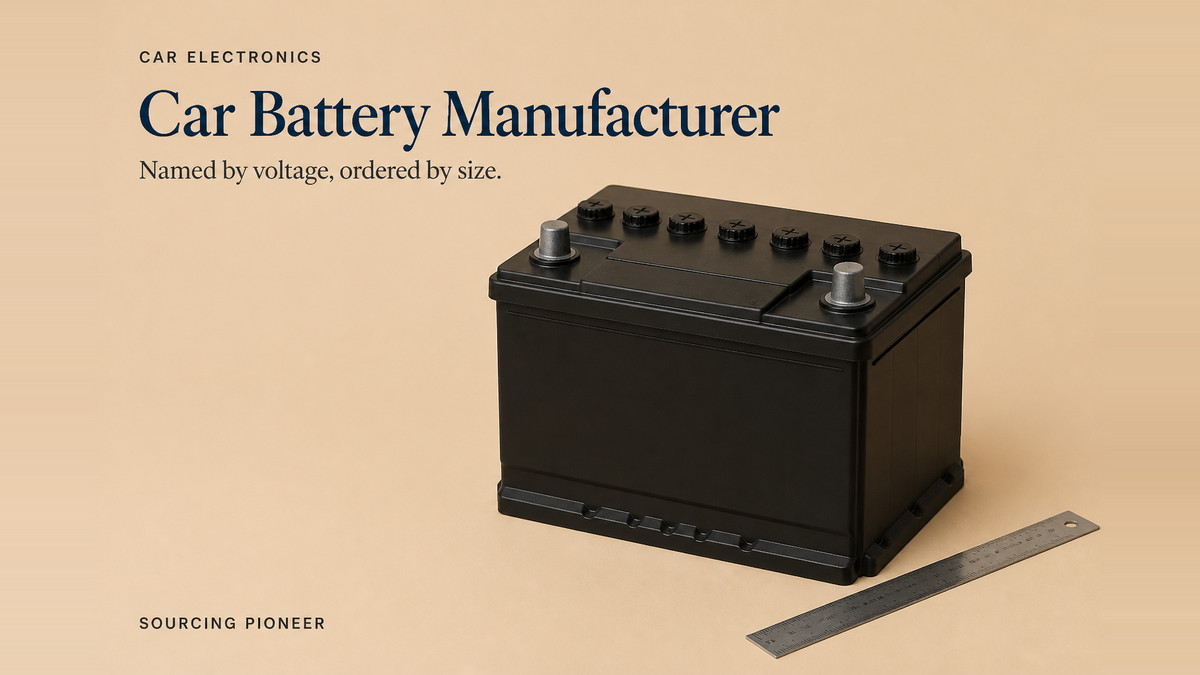
A car battery is six lead grids, coated in a paste, held apart by envelopes, standing in acid inside a plastic case, closed by a lid that carries two terminals and a vent. That is the whole part. A buyer who has seen one cut open has seen everything that decides its price and its life.
Two numbers travel with a battery: how much charge it holds, and how much current it can push out when the engine and the weather are cold. Both are decided inside the case, and both are decided before the lid is sealed.
| The element | What it decides | What a vague quote hides |
|---|---|---|
| The grid alloy | How many charge cycles the plate survives before it corrodes away | Whether it is lead-calcium or lead-antimony, and the tin content |
| The paste and its weight | The capacity figure, because capacity is active material | Grams of paste per plate, not the amp-hour number on the lid |
| The separator | Whether the plates short against each other as the battery ages | The material, its thickness, and whether it is an envelope |
| The acid and its density | The state of charge the battery is in when it reaches the buyer | The density figure, and whether the unit ships dry-charged |
| The case and the lid | Whether it survives vibration and engine heat without cracking | The material, the wall thickness, and how the lid is joined |
| The terminals | Whether it can be connected to this car at all | The terminal type, its size, and how the polarity is marked |
| The vent or the valve | Whether gas leaves the battery safely instead of staying in | Whether it is a vented battery or a valve-regulated one |
What this guide covers
- What a car battery is made of
- The record names the part by voltage
- What the standard is for, and what it leaves out
- How the two numbers are actually measured
- The safety label has two versions, and both are valid
- The interface is a box, a terminal and a tray
- What has to be bolted to it
- How a wet battery is shipped
- What the recall record shows
- Where the fault actually sits
- The one record that names the product
- What happens to the core
- Six checks and where the price comes from
- Frequently asked questions
2. The Record Names the Part by Voltage
Search the federal recall file used throughout this series and the word battery appears in 7,436 records across 594 campaigns — more campaigns than any other part covered so far, and naming 13,399,486 vehicles and equipment units filed between January 2010 and October 2026.
Then read how they are filed. The label the agency puts on this part is not “car battery”. It is ELECTRICAL SYSTEM:12V/24V/48V BATTERY, and that single string covers a 12-volt passenger car, a 24-volt truck and a 48-volt mild hybrid at the same time. The agency has used it on 173 campaigns, covering 5,504,723 units.
The second most common name is TRACTION BATTERY — the large pack in an electric car — at 159 campaigns and 1,415,040 units. In 260 campaigns the word battery does not appear in the component field at all; the part is only mentioned in the description, as a symptom or a neighbour.
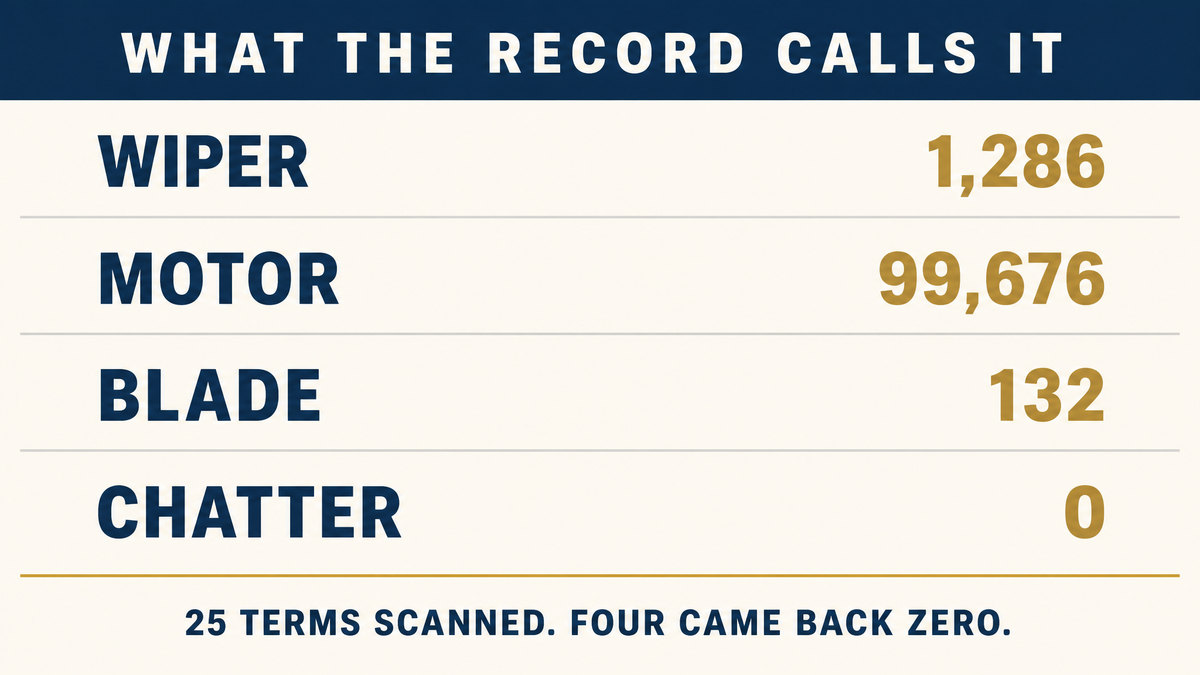
The words a buying team uses are close to absent. The phrase “car battery” appears in one record out of 245,845. “Starter battery” appears in three. “Lead-acid”, the chemistry, appears in twelve records, all of them inside one campaign about a battery disconnect bracket. And “battery vent” appears in none at all — the feature that exists to let gas out of the case has never been the named subject of a federal recall.
3. What the Standard Is For, and What It Leaves Out
The international standard for this part is IEC 60095-1, Lead-acid starter batteries — Part 1: General requirements and methods of test. Its eighth edition was published in November 2018 and a corrected version in February 2026. Its scope is worth reading word for word, because it draws the boundary of the product for you.
The standard is sold rather than given away, but the publisher’s own preview sets out the full contents page, which is enough to see what the document promises and what it leaves to the parties.
“This part of IEC 60095 is applicable to lead-acid batteries with a nominal voltage of 12 V, used primarily as a power source for the starting of internal combustion engines, lighting, and for auxiliary equipment of internal combustion engine vehicles. These batteries are commonly called ‘starter batteries’. This document is applicable to batteries for the following purposes: batteries for passenger cars; batteries for commercial and industrial vehicles. This document is not applicable to batteries for other purposes, such as the starting of railcar internal combustion engines or for motorcycles and other power sport vehicles.”
Two sentences do a lot of work there. The standard covers passenger cars and commercial vehicles in one document, because the job is the same in both. And it puts motorcycles and other power sport vehicles outside, altogether. A motorcycle battery and a car battery are not the same product to this standard even where they look alike and both say 12 volts on the lid.
A second part handles the physical side. IEC 60095-2 covers the dimensions of the batteries and the dimensions and marking of the terminals, and applies to 12-volt batteries used for starting, lighting and ignition on passenger cars and light vehicles. A third, IEC 60095-4, covers batteries for heavy trucks.
What the standard does give you is the list of what has to be written on the product. Clause 6.1 is titled Identification, labelling, and it calls for the maker or supplier, the voltage, the capacity or reserve capacity together with the cranking current, a production date code, a safety label, a recycling label, and a separate marking on a valve-regulated battery. Clause 6.2 covers marking the polarity. Clause 6.3 covers how the battery is fastened.
What it does not give you is the capacity, the cranking figure or the size of the box. Those are absent because they are not the standard’s to give. They belong to the customer’s vehicle, which is exactly why two suppliers can both be right about a 12-volt battery and still send you the wrong one.
4. How the Two Numbers Are Actually Measured
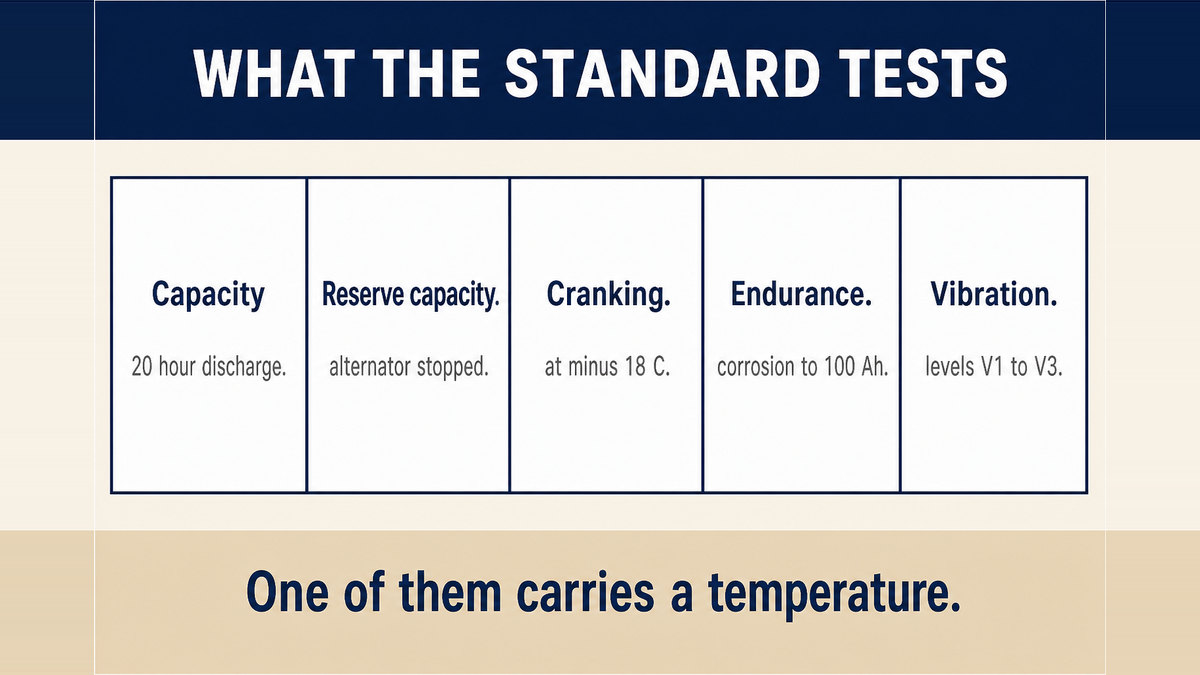
The test list in part 9 is the most useful page for a buying team. A 20-hour capacity check gives the capacity figure. A reserve-capacity check gives the figure a car can run on if the alternator stops. A cranking test gives the cold-start figure at a stated temperature of −18 °C, with a second version in the standard for very cold climates and a third high-current discharge test at low temperature. Then come charge acceptance, charge retention, endurance — which includes a corrosion test plus an optional cycle test for passenger car batteries of up to 100 Ah — water consumption, vibration resistance and electrolyte retention.
Two details in that list are worth pinning to the wall. The cranking test carries its temperature, so a cold-cranking number quoted without one is not a number. And the endurance cycle test is described as optional and limited to batteries of 100 Ah and below, which tells you what the standard thinks a passenger car battery is.
Vibration is graded rather than passed or failed. The standard runs from level V1 to level V3, so “vibration tested” on a specification sheet means nothing until somebody says which level, and on which table.
5. The Safety Label Has Two Versions, and Both Are Valid
The label is the part most likely to be wrong on a delivered shipment, and it is the part buyers ask about last. The standard’s Annex C defines six coloured symbols and ties them to ISO 7010, the international register of safety signs. It then gives two versions of the label for the North American market: a former version, which is still valid, and a new version.
There is one change in the eighth edition that a supplier should know about. The safety labelling annex moved from normative to informative. In plain terms, it stopped being a clause you must meet to say you meet the standard. That does not make the label optional in practice, because a distributor who asks for it is now the one setting the requirement — which is where requirements on this part have always come from anyway.
The same clause list also asks for a recycling label, and it is easy to see why. A lead-acid battery is the one part on the car that is designed to come back.
6. The Interface Is a Box, a Terminal and a Tray
IEC 60095-2 covers the box and the terminals. A car asks for more than that. Between the battery and the vehicle sit a tray, a clamp, a hold-down bracket and a terminal cover, and those are the parts that turn up in the record again and again.
Toyota’s campaign 23V734000 is the largest single battery campaign in the file: 1,853,568 RAV4s. Read the cause rather than the number. Certain replacement 12-volt batteries “may not fit properly in the battery tray, allowing the battery to move and contact the hold-down bracket, possibly causing a short circuit.” The consequence is a fire. And the remedy is not a battery — it is the battery clamp sub-assembly, the battery tray and the positive terminal cover. Owner letters went out in phases, the second beginning in May 2025 and the third later that year.
That is an uncomfortable lesson for a buyer who thinks of a battery as a box. A unit that is the right size can still be the wrong unit, because the clamp is part of the fit. Ask what the tray holds and what the clamp grips, and ask for the drawing rather than the model name.
Fleetwood’s 17V584000 makes the same point from the other side. In 934 motorhomes the welds holding the battery tray were too weak, and the tray could separate from the chassis. The agency’s own words for the result are “a battery acid leak or an electrical short” — two different risks from one failing weld.
7. What Has to Be Bolted to It
A second cluster of campaigns is not about the battery at all. It is about the things a battery has to be connected to, and those things are chosen by the car, not by the battery.
Honda’s campaign 17V418000, covering 1,148,550 Accords, is about the battery sensor. The case of the sensor, which is part of the battery management system, could let water in and cause an electrical short. Honda replaced the sensor and, as an interim step, applied a sealant to the case.
Ford’s campaign 19V805000, 135,725 F-150s, is about the joint at the positive terminal, where the power distribution box cable and the battery monitoring system eyelets share one fastener. The fault was excess sealant adhesive left in that joint, which could loosen it — and a resistive short is a fire risk. The remedy was to clean the joint and tighten the fastener again.
Chrysler’s 19V348000, 198,731 Pacificas with stop-start systems, found a loose battery ground connection that could cause an intermittent loss of power steering assist and a stall. Ford’s 19V809000 found the positive cable harness could contact the transmission shifter cable bracket. Honda’s 23V844000 found a 12-volt battery cable routed outside the body frame with no fuse on the power circuit, so the cable could short or overheat in a crash. And Altec’s 18V434000 found the positive stud on a lead-acid battery disconnect bracket could touch the hood.
None of those is a battery defect. Every one of them is a reason a battery has to arrive with the right cable length, the right terminal orientation and the right stud position. The vehicle will not be changed to suit the box.
8. How a Wet Battery Is Shipped
A lead-acid battery contains acid, so it is a regulated shipment. In the United States the governing section is 49 CFR 173.159, and its first paragraph is a short list of things the packaging has to prevent.
“Electric storage batteries, containing electrolyte acid or alkaline corrosive battery fluid (wet batteries), may not be packed with other materials except as provided in paragraphs (g) and (h) of this section and in §§ 173.220 and 173.222; and any battery or battery-powered device must be prepared and packaged for transport in a manner to prevent: (1) A dangerous evolution of heat… (2) Short circuits… (3) Damage to terminals.”
Paragraph (a) then spells out three ways to prevent a short: putting each battery in a fully enclosed inner packaging made of a material that does not conduct, separating batteries so they cannot touch each other or any metal, or protecting the exposed terminals with non-conductive caps or tape. Paragraph (b) adds the air rule: an acid-proof or alkali-proof liner, or a supplementary packaging strong enough and sealed well enough to hold the electrolyte if it spills.
The rest of the section is a packaging menu. Paragraph (c) authorises a set of specification packagings by code: wooden boxes 4C1, 4C2, 4D and 4F; fibreboard box 4G; plywood drum 1D; fibre drum 1G; plastic drum 1H2; plastic jerrican 3H2; plastic box 4H2.
Paragraph (d) then gives non-specification packagings, and this is where the numbers a factory actually has to hit are written. A single battery of up to 34 kg (75 lb) may go in a five-sided slip cover or a closed fibreboard box of at least 91 kg (200 lb) Mullen test, and the finished package must have an inside clearance of at least 1.3 cm (0.5 in) above the terminals and filler caps, with the bottom edges of the cover coming to within 2.5 cm (1 in) of the bottom of the battery. It must then take a top-to-bottom compression test of 225 kg (500 lb) without damage to the terminal caps or filler caps.
Above 34 kg the requirements change shape. The box must be double-wall corrugated of at least 181 kg (400 lb) test; cushioning plus the wall must be not less than 1.3 cm (0.5 in); the bottom must be protected by an excelsior pad or a double-wall corrugated pad; the top must be protected by a wooden frame or corrugated tray; and no more than one battery may go in one box, to a maximum gross weight of 91 kg (200 lb). Gross weight is also what a freight quote is built on, so it is worth quoting it beside the volumetric weight rather than on its own. Paragraph (d) also sets three smaller ladders: one to three batteries of not over 11.3 kg in a strong outer box to 34 kg gross; not more than four of not over 7 kg to 30 kg gross; and not more than five of not over 4.5 kg to 30 kg gross.
Then there is the route that saves the most money. A battery may be treated as non-spillable if it passes two tests without leaking. The first is a vibration test at 0.8 mm amplitude between 10 Hz and 55 Hz, with the whole range and the return traversed in 95 minutes give or take five, in each of three positions at right angles to one another, including one with the fill openings and vents upside down. The second is a pressure differential test, holding the battery for six hours at 24 °C plus or minus 4 °C under a pressure difference of at least 88 kPa, again in three positions.
Pass both, and 49 CFR 173.159a lets the shipment travel under far lighter rules. Two conditions come with it. The battery and the outer packaging must be “plainly and durably marked NON-SPILLABLE”, and at 55 °C (131 °F) the battery must hold no unabsorbed free-flowing liquid and must be built so that electrolyte will not flow out of a case that has been cracked or ruptured.
So the only word United States transport law makes you print on a car-battery package is NON-SPILLABLE, and you may only print it if you can produce the two test reports behind it. Everything else on the box comes from the standard’s clause 6.1, not from the law. Keeping those two lists apart is worth the effort, because a supplier who sends a roll of labels and calls it certification has answered neither.
9. What the Recall Record Shows
Method first, so the numbers can be repeated. The federal file holds 245,845 records and no header row, so every field of every record is scanned rather than trusting a column map. Two control terms prove the scan works: brake appears in 28,639 records and air bag in 16,162.
Against that background, battery appears in 7,436 records across 594 campaigns, naming 13,399,486 vehicles and equipment units. Fire is named in the consequence field of 379 of those campaigns — 63.8 per cent.
Grouped by the language the record uses, the pattern is not one a battery maker would choose. Fire or overheating language appears in 394 campaigns (66.3 per cent). Cable, terminal or connector language in 160 (26.9 per cent). No-start and stall language in 182 (30.6 per cent). Software in 112 (18.9 per cent). Mounting, bracket or tray language in 76 (12.8 per cent). Corrosion in 30 (5.1 per cent), and leaked acid or electrolyte in 27 (4.5 per cent).
Read that list again as a buying team. Nearly a third of the campaigns describe a car that would not start. More than a quarter describe a cable or a terminal. And the largest group, two thirds of them, describe heat where heat should not be.
10. Where the Fault Actually Sits
Sort the campaigns by size and the picture stays consistent: the battery is usually the thing being discussed and rarely the thing that failed.
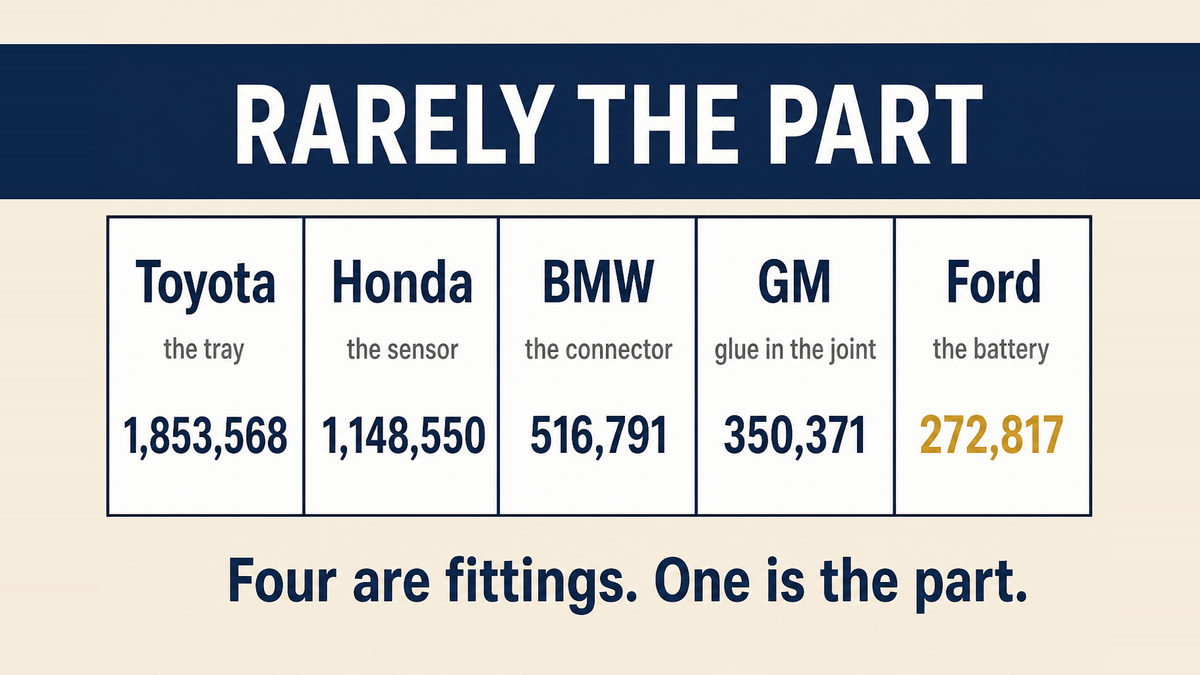
BMW’s campaign 13V044000 shows how these grow. BMW first recalled 504,545 vehicles, then told the agency it was adding 12,094 more, for a total of 516,791. The defect sits in the connector on the positive battery cable and the matching terminal on the fuse box, which degrade until resistance and heat break the connection and the car loses electrical power while it is moving. The remedy is a new connector, secured a better way.
General Motors’ 19V888000, 350,371 Silverados and Sierras, found the battery positive cable rings were “manufactured with excessive glue”, which could make the connection intermittent — a stall, or arcing that generates heat.
Ford appears twice on the same vehicles, and the sequence is worth following. Campaign 24V267000, 456,565 Bronco Sports and Mavericks, found the body and power train control modules could fail to detect a change in the 12-volt battery state of charge, so a battery running down would go unreported; the remedy was a recalibration. Then campaign 25V019000, 272,817 of the same vehicles, found the 12-volt battery itself could “experience degradation and suddenly fail”, costing the driver the hazard lights and possibly the drive. The remedy that time was to inspect and replace the battery. And the record says plainly that vehicles already repaired under the first campaign will need to have the new remedy completed. Software did not save the battery, and the battery change came second.
The electric cars tell a third story. Hyundai’s 24V868000, 145,642 Ioniq 5 and Ioniq 6 and Genesis electric models, and Kia’s 24V867000 and 24V200000, another 111,104 EV6s, describe one fault between them: the integrated charging control unit fails and stops charging the 12-volt battery that runs the car’s computers. In all three the remedy is a new control unit, a new fuse and new software. The battery being charged is the car battery; the part at fault never is.
Three more campaigns show how little the battery has to do with the case. Nissan’s 22V024000, 664,779 Rogues, is about an under-dash connector that corrodes when water and road salt reach it, and names battery drainage as one of the results. Peterbilt and Kenworth’s 20V199000, 460,515 trucks, found that if the anti-lock brake controller lost battery or ignition power, the warning lamp would not light — which fails two federal standards, one for air brakes and one for stability control. And Toyota’s 11V539000, 420,326 vehicles, is the crankshaft pulley campaign already covered in the crankshaft article of this series. Its only mention of a battery is that the fault could light the battery discharge indicator on the dashboard.
11. The One Record That Names the Product
After 594 campaigns, exactly one record in 245,845 contains the phrase “car battery”. It is East Penn Manufacturing’s 23E044000, filed against a product called a Deka car battery, model 648MF. The defect is short: the electrical connection between the internal cell and the external terminal may be incomplete, which can cause a spark.
Read the shape of that filing rather than its text, because the shape is the lesson. It carries an E number, which means equipment rather than a vehicle. It was filed by the company that makes the battery. Its model year is listed as 9999, the convention for a part with no vehicle attached to it. When a car battery fails, it is recalled by whoever made it, as equipment. When a car maker recalls something with the word battery in it, the failing part is almost always a cable, a tray, a sensor or a control unit — not the box.
And the three things a buyer actually specifies are the three things the record does not carry. The chemistry is written down twelve times in 245,845 records. The vent is written down none. The group size appears in the remedy of one campaign and nowhere else: Ioxus’s 19E078000, 7,892 units, told owners to take out its battery support module and fit “a conventional G31 lead acid battery” instead.
12. What Happens to the Core
A lead-acid battery is the one part on the car with a settled return leg, and that leg is written in law rather than agreed between the parties. In the United States the section is 40 CFR 266.80, spent lead-acid batteries being reclaimed.
The rule is a table of ten situations, and the answer depends on two facts about you: whether the battery is reclaimed through regeneration, such as by replacing the electrolyte, and what your part in the chain is.
- Reclaimed through regeneration. You are outside parts 262 (except the waste determination at 262.11), 263, 264, 265, 266, 268, 270 and 124, and outside the notification requirement of section 3010 of the waste statute. You remain inside part 261 and inside 262.11.
- Reclaimed another way, and you generate, collect or transport the batteries. The same set of provisions falls away, and the applicable parts of 268 come in.
- Reclaimed another way, and you store them before reclaiming. The exemptions do not apply, and 266.80(b) sets out what a permitted or interim status facility has to do.
- Exported for reclamation in a foreign country. That leg is subject to part 262, subpart H and to the identification number rule at 262.18, whichever way the batteries travel and however they are reclaimed.
There is also a simpler route for a business that collects rather than reclaims: 40 CFR part 273, the universal waste rule, is written for exactly this kind of collected, single-purpose item.
The commercial reading is short. A core has value, and the paperwork begins the moment it crosses a border. If your supply arrangement includes buying cores back, the export leg is a licensed activity rather than a freight choice, and that belongs in the quote rather than in a footnote on the invoice. It is also a different document from the certificate of origin that travels with any export shipment, and both can be asked for before the order is placed.
13. Six Checks and Where the Price Comes From
A battery quote usually arrives as one line: a group size and a price. Five things are missing from that line, and four of them are documents.
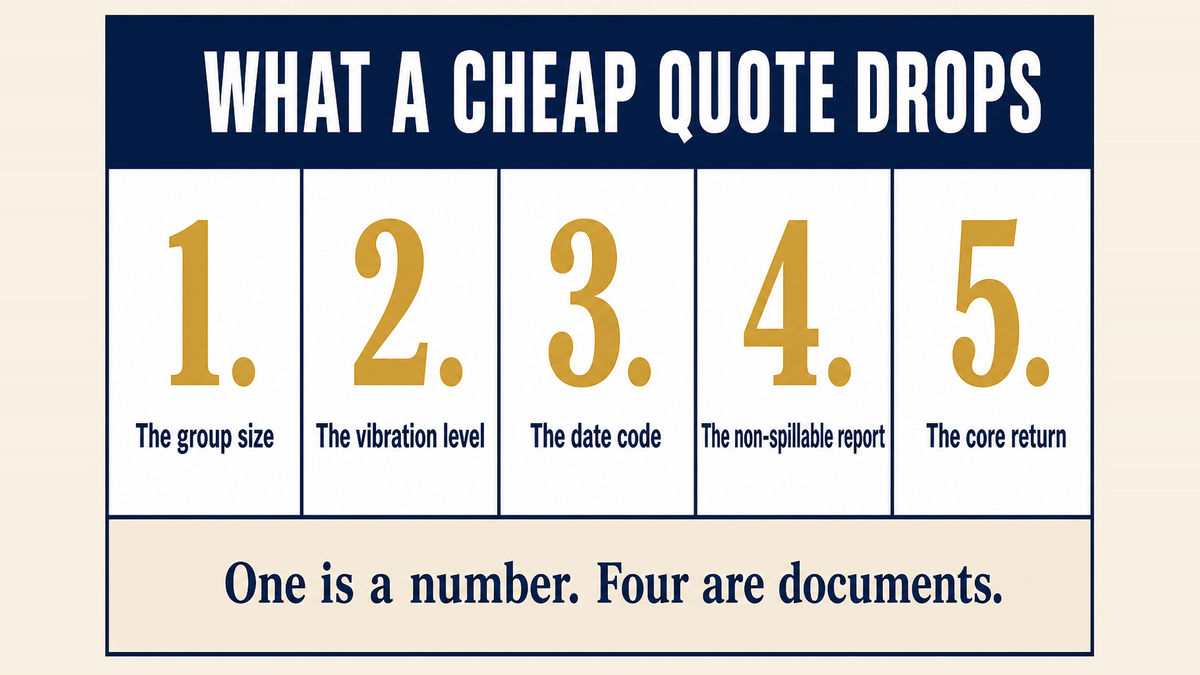
The group size is the one item on the list a buyer can check with a tape measure. The other four are the ones that decide whether the shipment is usable: which tests were run and at what level, the production date code that shows how long the stock has been sitting, the non-spillable evidence if the unit will travel in a way that needs it, and the terms for taking the core back.
Six questions carry most of the value:
- Which group size, and what does the tray drawing say? The battery has to be held, not just fit.
- Which capacity and which cold-cranking figure, and at what temperature? A cranking number without a temperature is not a number.
- Which vibration level — V1, V2 or V3? The standard grades it; a specification sheet usually does not.
- What is the production date code on this batch? Lead-acid stock ages on the shelf.
- Is there a non-spillable test report, and is the packaging marked to match? The mark is only allowed with the reports behind it.
- What are the core return terms, and who handles the export paperwork? The return leg is regulated, and it has a price.
Those are the questions a factory audit puts to a supplier in person. All of them can be asked on paper first, and it is cheaper to ask them before the deposit than after the container.
Then there is the matter of the name. You will search for a car battery manufacturer, and the industry will understand you. The standard calls the product a lead-acid starter battery. The transport rule calls it a wet battery, or a non-spillable battery, depending on two tests. The recall record calls it a battery of 12, 24 or 48 volts, which is a range and not a product. None of those four names is wrong, and none of them is complete. The one that decides whether the shipment works is the one on the drawing your supplier is quoting from.
Frequently Asked Questions
What is the difference between a car battery and a starter battery?
Nothing, in ordinary speech. In the international standard they are the same thing: IEC 60095-1 applies to lead-acid batteries of 12 volts used for starting, lighting and auxiliary equipment on internal combustion engine vehicles, and says these are commonly called starter batteries. What the standard does separate is the vehicle class. It covers passenger cars and commercial and industrial vehicles, and it puts motorcycles and other power sport vehicles outside, even though those are also 12-volt lead-acid batteries.
Does a car battery have to meet any United States safety standard for the car itself?
Not in the way brakes or lighting do. There is no federal motor vehicle safety standard that specifies a battery. What exists instead is a transport rule, 49 CFR 173.159, which governs how a battery containing acid is packaged and marked for shipment, and a set of packaging exceptions at 173.159a for units that can pass a vibration test and a pressure differential test and be marked NON-SPILLABLE. That is why the evidence a supplier should be asked for is a test report and a marked package, not a certificate for the part.
Why do recalls mention car batteries if the battery is rarely at fault?
Because the battery sits at the centre of the electrical system, so almost anything electrical that goes wrong is described in terms of it. In the federal recall file the word battery appears in 7,436 records, but in 260 of the 594 campaigns that name it the word is not in the component field at all. The failures are cables, trays, sensors, ground straps and control units. Mounting and bracket language appears in 76 campaigns and cable, terminal or connector language in 160.
How is the capacity of a car battery measured?
By discharge under stated conditions, not by reading the label. IEC 60095-1 sets out a 20-hour capacity check, a separate reserve capacity check that gives the figure a car can run on if the alternator stops, and a cranking test carried out at minus 18 degrees Celsius, with a second version for very cold climates. There are also tests for charge acceptance, charge retention, endurance including a corrosion test, water consumption, vibration at levels V1 to V3, and electrolyte retention.
What has to be printed on a car battery?
The standard’s labelling clause asks for the maker or supplier, the voltage, the capacity or reserve capacity together with the cranking current, a production date code, a safety label, a recycling label, and a separate marking on a valve-regulated battery. Polarity has to be marked as well. Separately, if the battery is shipped as non-spillable, the battery and its outer packaging must be plainly and durably marked NON-SPILLABLE, and that mark is only permitted when the two tests in 49 CFR 173.159 have been passed.
What happens to the old battery?
In the United States a spent lead-acid battery sent for reclamation is handled under 40 CFR 266.80, which exempts most of the chain from hazardous waste rules but keeps the export leg inside part 262 subpart H and the identification number rule at 262.18. Businesses that collect rather than reclaim can instead use the universal waste rule at 40 CFR part 273. The standard also asks for a recycling label on the product, so the promise on the case and the paperwork behind it are two different things.
Four documents name a car battery and none of them agrees on what the thing is. Four documents name it, none of them agrees, and the record shows that when something goes wrong the box is usually the last thing to blame.
Ask for the group size, the tray drawing, the test levels, the date code and the return terms — and treat the name on the lid as the least useful piece of information in the whole deal.
Both Versions of the Safety Label, Compared
We return the two label wordings side by side, the reserve capacity test condition, and which of them your market's inspector reads.
Compare My Labels
Questions & Comments
We read every one and reply within 24 hoursFour documents name a car battery and none of them agrees, so the order has to choose one. Send the group size and the market, and we will line up the test levels, the date code and the tray drawing.