
Bull Bar Manufacturer: Five Names, Zero Records
 ·
Updated October 22, 2026
·
11 min read
This part has five common names in English, and the federal defect file contains none of them. Not one record under any spelling. Meanwhile the guard at the other end of the vehicle is regulated to the millimetre, with a test force written down to the newton.
That contrast is the useful thing in this article. A buyer sourcing a bull bar is not buying an unregulated version of a regulated product; they are buying something the rulebook has never described, while the object it bolts to the opposite end of is specified in more detail than most parts in this series.
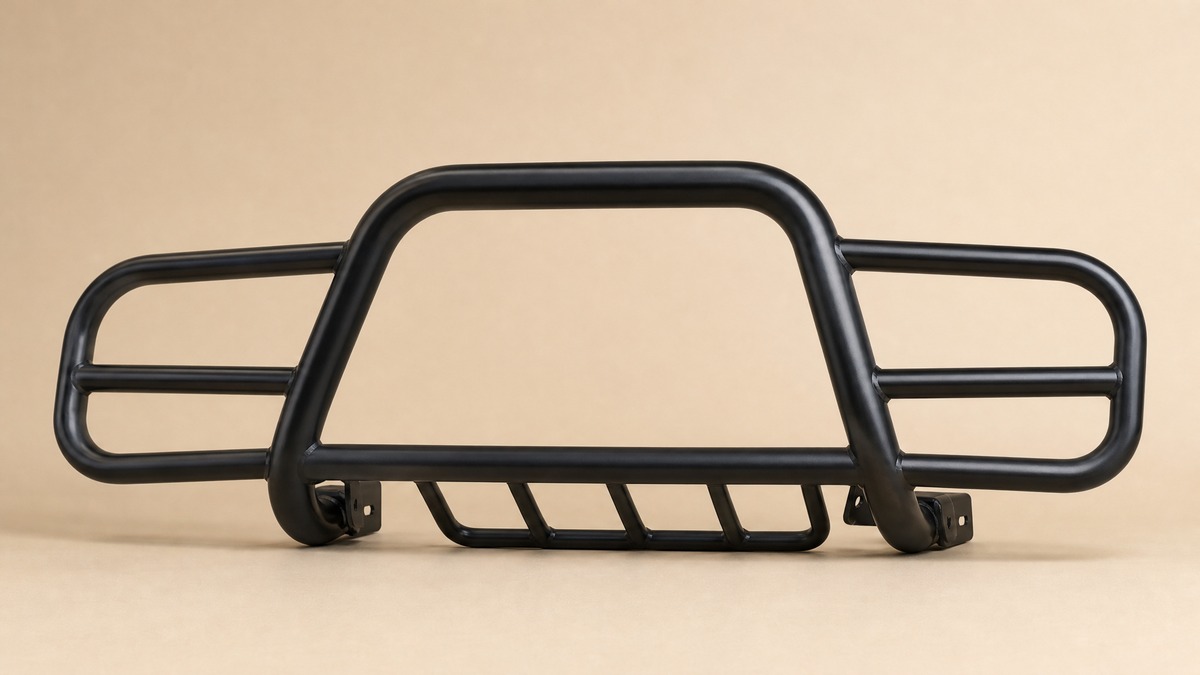
1. Five Names, Zero Records
Method unchanged. The federal recall file holds 245,845 records across 15,305 campaigns, no header row, every field scanned. Controls: brake 28,639, air bag 16,162.
| Term | Records | Campaigns |
|---|---|---|
bull bar | 0 | 0 |
bullbar | 0 | 0 |
grille guard | 0 | 0 |
brush guard | 0 | 0 |
push bar | 0 | 0 |
nudge bar | 0 | 0 |
rear impact guard | 217 | 22 |
winch | 524 | 40 |
Six spellings, six zeros. For comparison, the parts in the previous rows of this series never went below five records — and that five was an air spring. This is the first product in the batch with a genuinely empty column.
Note the two rows underneath it. The rear guard has 217 records and the winch has 524. Both are objects that attach to a vehicle, both sit in the same file, and both are named constantly. The bull bar is not missing because the file is thin. It is missing because nothing about it has ever been reported as a defect that triggers a recall.
2. The Other End Is Specified to the Millimetre
Part 571 has two standards for the guard at the back, and reading them next to this product is instructive. Standard No. 223 covers the guard itself and Standard No. 224 covers its installation, for trailers of 4,536 kg GVWR or more.
| Requirement | Value | Where |
|---|---|---|
| Vertical height of the horizontal member | at least 100 mm | 223, S5.1 |
| Position, forward of the rear extremity | not more than 305 mm | 223, S5.1 |
| Force at test point P1 or P2 | 50,000 N | 223, S5.2.1 |
| Deflection allowed at that force | not more than 125 mm | 223, S5.2.1 |
| Uniform distributed force | at least 350,000 N | 223, S5.2.1(c) |
| Guard width, inboard of the side planes | within 100 mm | 224, S5.1.1 |
| Bottom edge above the ground | not more than 560 mm | 224, S5.1.2 |
| Rounded corner rise, from the side planes | within 255 mm | 224, S5.1.2 |
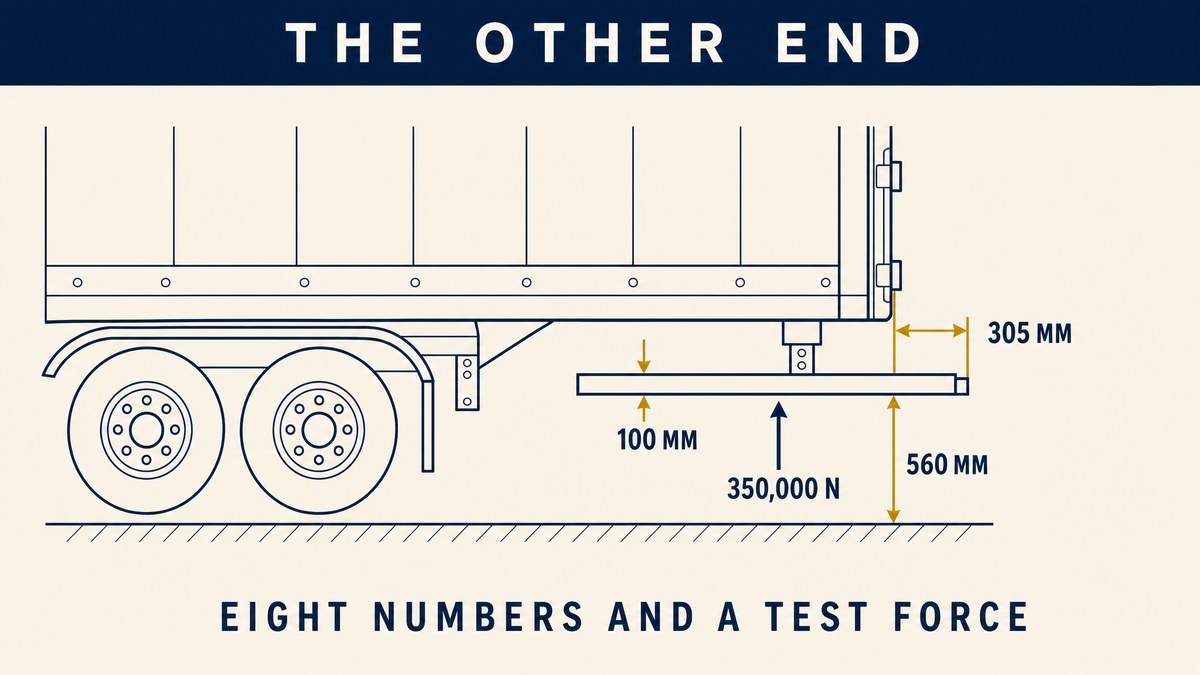
Those are not design suggestions. They are pass or fail, measured on a fixture, at a force given in newtons, with a deflection limit. The same appendix that carries the commercial inspection adds its own dimensions for the guard on older vehicles: 762 mm above the ground, 457 mm in from each side, 610 mm forward of the rear extremity.
Then search the same part for the front device and there is nothing: no height, no width, no force, no deflection, no test. Whatever a bull bar is, no federal document in this series has described it.
3. Why the Asymmetry Exists
The rear standard exists for a specific harm: a light vehicle sliding under the back of a trailer. The purpose sentence of 223 says exactly that — to reduce deaths and serious injuries when light duty vehicles collide with the rear end of trailers and semitrailers. A guard that stops underride is protecting the people in the other vehicle.
A bull bar is bought to protect the vehicle it is bolted to, and the harm it can do falls on whoever is hit. That is a different regulatory problem, and the file reflects it: pedestrian appears in 812 records, and not one of them is about this product. The mechanism is understood well enough to be regulated in other markets; in this one, it has never been the subject of a defect campaign.
For a supplier the commercial reading is simple. Nobody will ask you for a certificate, because there is no standard to certify against, and nobody will recall your bar for a dimension. The specification is entirely the buyer's, and the failure that matters is the one that ends with the bar on the road.
4. What the Bar Actually Is
A bull bar is a tube bent into a shape, welded to brackets, and bolted to the chassis. Five things decide whether it survives a pothole, never mind an impact.
The tube. Diameter and wall thickness. A 76 mm tube with a 2 mm wall looks the same in a photograph as one with a 4 mm wall and behaves nothing like it. Wall thickness is the first number a quotation should carry and the first one a photo cannot show.
The bends. Mandrel bending keeps the wall thickness through the bend; crush bending thins the outside of the curve. Every bend is a place where the wall is thinner or the section is oval, and a bar is only as strong as its weakest bend.
The welds. Tube to bracket, and bracket to mounting plate. This is where aftermarket bars fail, and there is a recall in this file that shows exactly how: a winch bar, prone to fracture at the weld, 10,816 units, identified by part number and colour.
The brackets. Plate thickness, the number of bolts, and whether the bracket picks up existing chassis holes or adds new ones. A bar that mounts on three bolts instead of five distributes the same load into a smaller area of the frame.
The finish. Powder coat outside, and what happens inside. A tube that is coated on the outside and bare inside rusts from the middle out, and the first sign is a stain at a weld.
5. The Winch Changes the Load
Most bars in this category are sold to carry a winch, and that is a different structure. A bar holds a tube; a winch plate takes a pull of several tonnes, and the pull arrives as a bending moment at the brackets.
The file has 524 records across 40 campaigns for winches and winch hardware, which is a hundred times the traffic of the bar itself. The clearest one is an aftermarket combination winch bar — part numbers 10032 in black and 10033 in chrome, 10,816 units — recalled because a manufacturing anomaly left it prone to fracture at the weld.
Read that recall as a specification document, because it is the only one this product family has. It tells you where the failure was: a weld. It tells you the consequence was serious enough to recall ten thousand units. And it tells you the identification was by part number and finish, not by a standard.
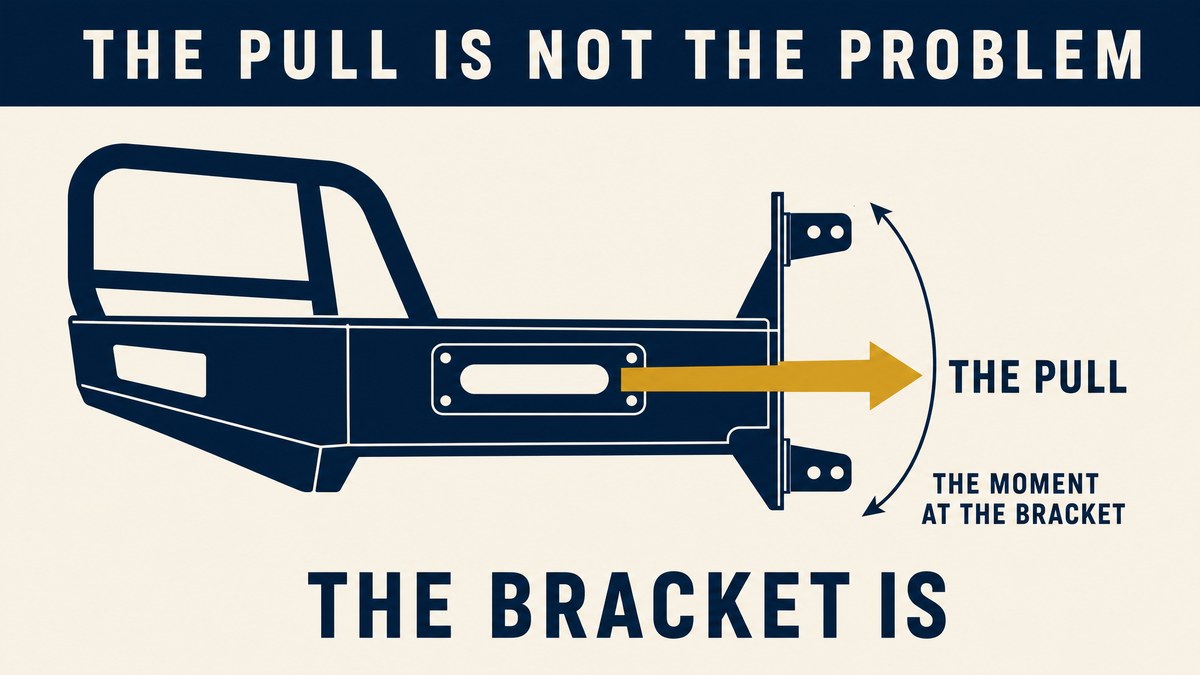
So the question to ask is not whether the bar fits a winch. It is whether the winch plate is a separate part welded to the bar or a plate that continues into the chassis mounts, and what the assembly was rated to pull. A rating is a number a factory can state and a buyer can write into an order; a photograph of a finished bar is not.
6. The Question Nobody Can Answer With a Document
A bar changes what happens in the first few centimetres of a frontal impact. It adds mass ahead of the crush structure, it changes how the load path starts, and on a modern vehicle the front sensors that decide airbag timing sit in that same zone.
No federal text in this series addresses that interaction for this product, and this article will not pretend otherwise. What can be said is what a buyer should ask: whether the mounting kit was developed against a specific vehicle's sensor layout, or whether it is a bracket that fits the bolt holes. Those are different products at different prices, and only one of them has a reason to exist.
7. Fitment Is Where the Returns Come From
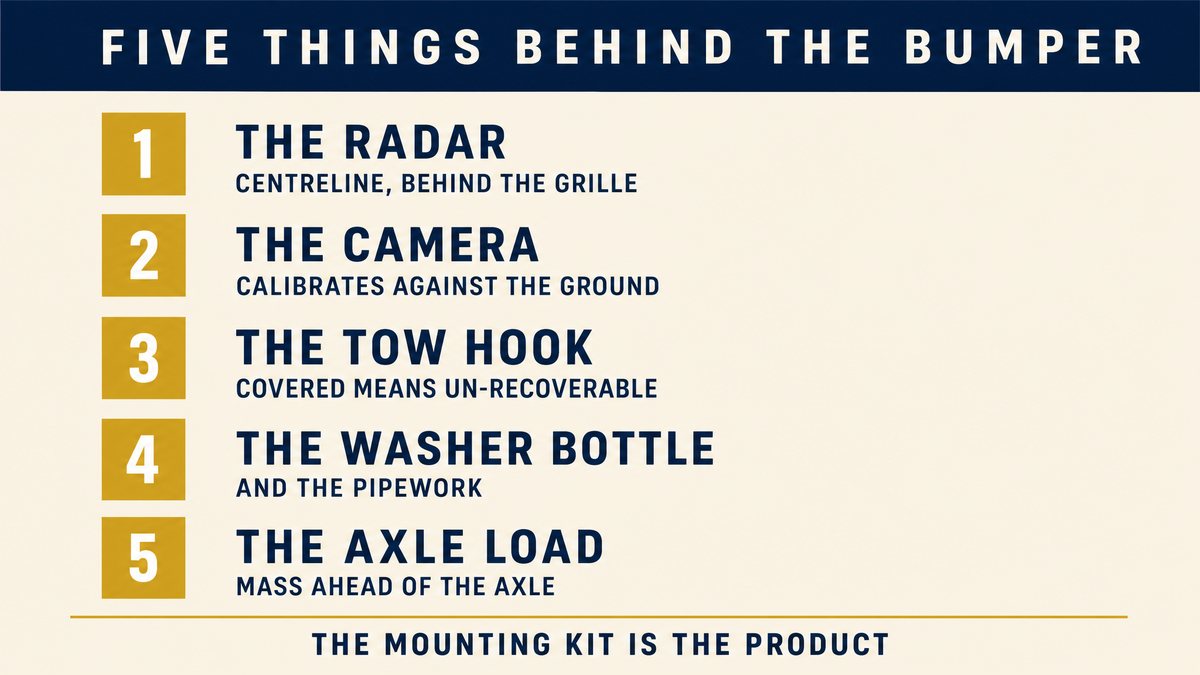
A bar that fits the bolt holes can still be the wrong bar, because the front of a modern vehicle is not empty behind the bumper. Five things sit in the space a bar covers, and each one turns a fitment into a return.
The radar. Adaptive cruise and automatic braking put a radar module behind the grille or behind the bumper cover, on the centreline. A bar with a centre hoop or a winch plate in front of it does two things: it blocks the field, and if it is metal it reflects. The vehicle then reports a fault, and the fault is attributed to the bar.
The camera. Forward-facing cameras sit at the top of the windscreen, so a bar rarely blocks them, but a bar that changes the visible ground plane in front of the vehicle can confuse a lane-keeping system that calibrates against it.
The recovery points. A bar that covers the factory tow hook makes the vehicle un-recoverable, which is a strange outcome for a product sold as recovery equipment.
The washer bottle and the pipework. Headlamp washers, intercooler ducting and the washer reservoir often sit exactly where a bracket wants to go. A bracket that pushes a pipe against a seam wears through it in a year.
The front axle load. A steel bar plus a winch plus a plate is a mass hung ahead of the front axle. On a light vehicle that is a spring and alignment question, and on a vehicle with a plated front axle rating it is a paperwork question.
The commercial lesson is that the mounting kit, not the bar, is the product. Two suppliers will quote the same shape at different prices and the difference is usually whether anyone measured the space behind the bumper on the actual vehicle.
8. Where the Price Difference Sits
Wall thickness. The single largest variable and the least visible.
Bend method. Mandrel or crush. One keeps the section, the other saves a step.
Weld quality and whether it is checked. A weld that is ground smooth and painted looks identical to one that was inspected first. Weld inspection is a process, and a process is what a factory audit can look at.
Internal protection. Bare steel inside a sealed tube is a corrosion cell with a slow clock.
Bracket plate and bolt count. Cheaper to make with thinner plate and fewer fixings; the load per bolt goes up.
Freight. A bar is mostly air: the carton is billed on the volume around a shape that will not nest, which is why the CBM calculation decides the landed cost more than the tube does.
Hardware. Grade of the bolts in the box. It is the cheapest place to lose a customer and the most common.
9. Seven Questions, Six Lines
There is no standard to point at, so the questions are the standard.
- Tube diameter and wall thickness, stated in millimetres, for every section?
- Bend method, and whether wall thinning at the bends was measured?
- Weld inspection: visual only, or a sample tested to destruction?
- Internal coating, and how the inside of the tube is protected before capping?
- Bracket plate thickness and bolt count, and whether the mount uses existing chassis holes?
- Winch plate rating, if fitted, and whether the plate continues into the chassis mounts?
- Two prices: as quoted, and with the six lines below written into it.
- Wall thickness and bend method.
- Weld inspection method.
- Internal corrosion protection.
- Bracket plate and bolt count.
- Winch rating and load path.
- Two prices: as quoted, and with the five items above written into it.
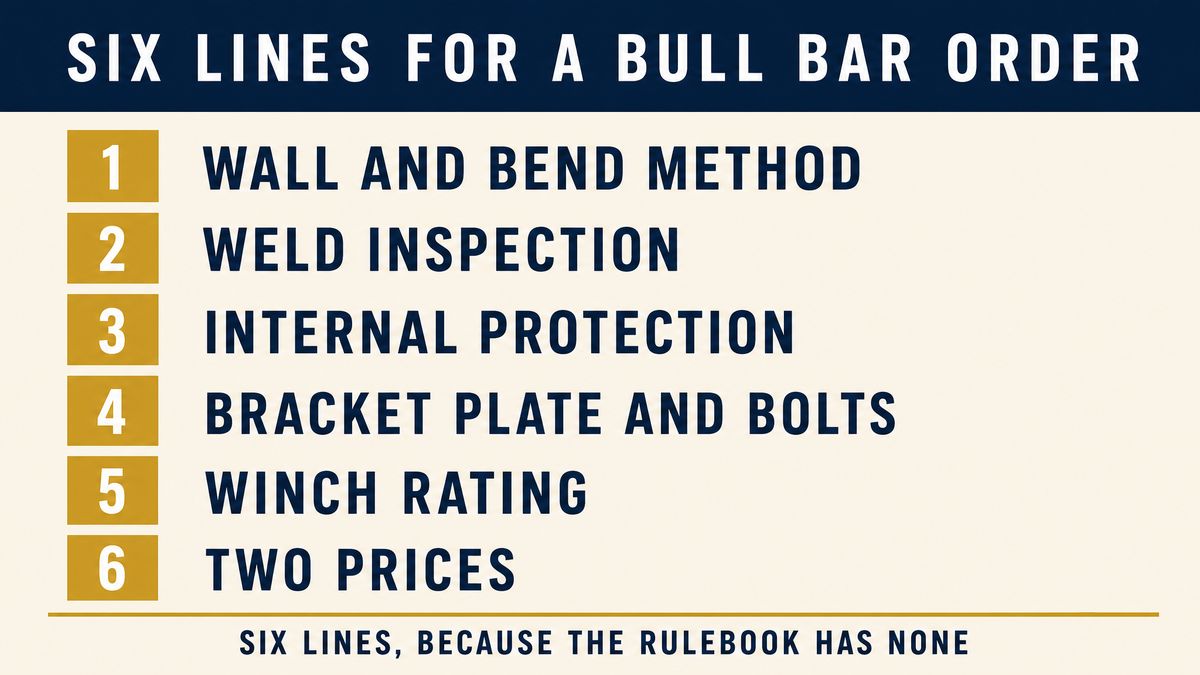
Six names, zero records. The product that protects the front of a vehicle has never been recorded as a defect under any of the words used to sell it, while the guard at the other end has eight dimensions and a test force measured in kilonewtons.
That asymmetry is the whole brief. With no clause to lean on, the tube wall, the bend method, the weld inspection and the bracket plate become the specification, and the winch rating has to be decided before the plate is designed.
A Mount Drawing With the Load Cases Marked
We return the plate thickness, the bolt pattern and the two load cases, so the bar ordered matches what hangs off it.
Draw My Mount PlateFrequently Asked Questions
Is there a federal standard for bull bars?
No. Six common names for the product return zero records in the recall file, and no standard in Part 571 describes it. The rear impact guard on the same vehicle has two standards and eight dimensions.
Why does the recall file have no records for it?
Because a bar that cracks is a repair, not a defect campaign. The nearest thing in the file is a winch bar recall: 10,816 units, part numbers 10032 and 10033, prone to fracture at the weld.
What does the rear guard standard actually require?
A horizontal member at least 100 mm high, not more than 305 mm forward of the rear extremity, resisting 50,000 N at either test point without deflecting more than 125 mm, and 350,000 N distributed.
Does a bull bar affect airbag deployment?
It changes the front-end load path and adds mass ahead of the crush structure, and front sensors sit in that zone. No federal text in this series addresses the interaction, so the answer is a question for the supplier about how the mount was developed.
Which specification matters most?
Wall thickness, then bend method, then weld inspection. A photograph shows the shape and none of the three.
Why does internal corrosion matter on a coated bar?
Powder coat covers the outside. A tube that is bare inside rusts from the middle out, and the first visible sign is a stain at a weld, by which point the section has already been lost.
Questions & Comments
We read every one and reply within 24 hoursNo federal text names a bull bar under any of its six trade names, so the numbers have to come from the buyer. Send the vehicle and the winch, and we will rate tube and bracket.