
Ozone Generator Manufacturer: Four Verbs Decide the Label
 ·
Updated October 22, 2026
·
12 min read
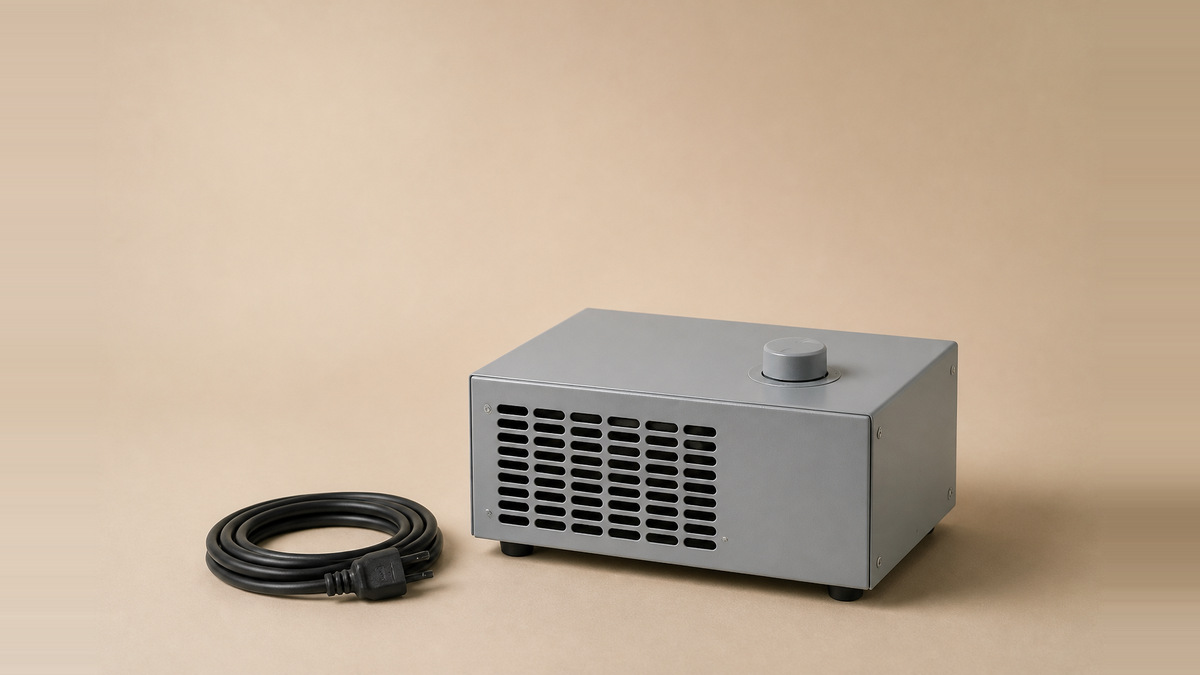
An ozone generator is a box with a fan, a high-voltage plate or a lamp, a timer and a plug. Nothing in that list is regulated. What is regulated is a sentence: the one on the box, in the listing and in the manual, that says what the machine does to something alive. Four verbs in a federal definition decide whether your product is a machine or a device, and the two words carry different duties, different paperwork and a different number on the packaging. This article reads the definitions in 7 U.S.C. § 136 and the rules that hang off them in 40 CFR Part 152, Part 156 and Part 167. The finding is narrow and it decides money: the words removes odours and kills mould are not two ways of saying the same thing. They put the same box in two different rulebooks.
1. Four Verbs Decide
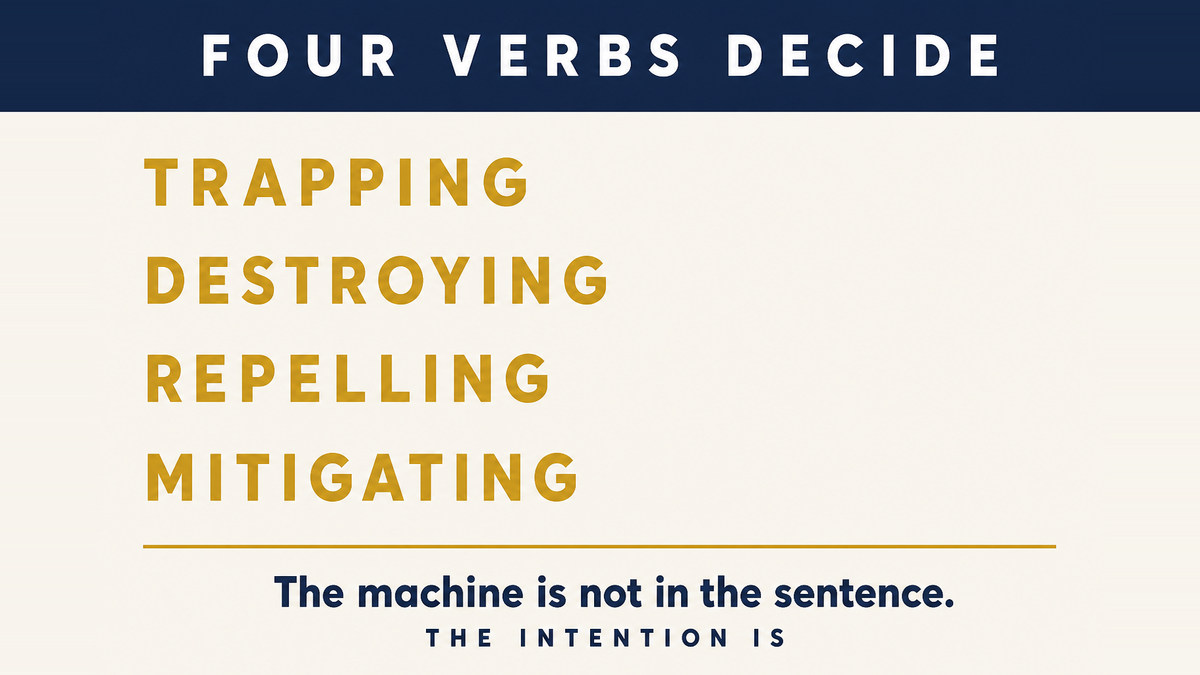
The federal definition of a device is one sentence, and it is built on intent rather than on engineering:
“The term ‘device’ means any instrument or contrivance (other than a firearm) which is intended for trapping, destroying, repelling, or mitigating any pest or any other form of plant or animal life (other than man and other than bacteria, virus, or other microorganism on or in living man or other living animals); but not including equipment used for the application of pesticides when sold separately therefrom.” — 7 U.S.C. § 136(h)
Read the four verbs again, because they are the whole mechanism. A product is a device when it is intended for trapping, destroying, repelling or mitigating a pest. There is no power rating in the sentence, no ozone output in grams per hour, no reference to the chemistry. The test looks past the machine to the intention behind it, and the intention is recorded in the only place a buyer or a regulator can read it: the advertising, the packaging, the listing copy and the manual.
That is why the definition is best understood as a list of four verbs with a trigger, and why the same appliance can be sold twice under two very different sets of duties. Sell it as a machine that produces ozone to oxidise odour molecules in an empty car, and the four verbs are untouched. Sell it as a machine that kills bacteria or destroys mould on the evaporator, and you have used two of the four verbs in your own marketing, and the product is a device.
The rest of the sentence narrows and widens the scope at the same time, and both halves matter for a supplier brief.
It is wider than the word pest suggests. The definition covers not only a pest but “any other form of plant or animal life”, which is why devices aimed at weeds, algae and other growth are covered even where nobody would use the word pest in a brochure.
It excludes two things. First, man, and microorganisms “on or in living man or other living animals”. That carve-out is not a curiosity, and section 2 below shows what it does: it moves a claim about a person's body into a completely different regime. Second, equipment used to apply pesticides when it is sold separately from them. A machine that sprays a pesticide is not a device; a machine that is the pesticide's own action is.
What this guide covers
- Four verbs decide
- What counts as a pest
- What the word device does not require, and what it does
- The number on the box that means less than it looks
- The numbers nobody puts in a brief
- What the record says
- Five questions an ozone generator quote should answer
- Six lines to put in the order
- Frequently asked questions
2. What Counts as a Pest
The device definition hangs on a word that most buyers never define, so the next clause to read is the one that defines it. It has two branches, and the split is not academic:
“The term ‘pest’ means (1) any insect, rodent, nematode, fungus, weed, or (2) any other form of terrestrial or aquatic plant or animal life or virus, bacteria, or other micro-organism (except viruses, bacteria, or other micro-organisms on or in living man or other living animals) which the Administrator declares to be a pest …” — 7 U.S.C. § 136(t)
The first branch is automatic: an insect, a rodent, a nematode, a fungus or a weed is a pest, full stop. The second branch requires a declaration by the Administrator before the thing named in it counts. The parenthetical exclusion reappears in both the device definition and this one, in almost the same words.
Now the sentence that decides most car care claims. The Act defines fungus separately, and it does not leave the common words to the reader:
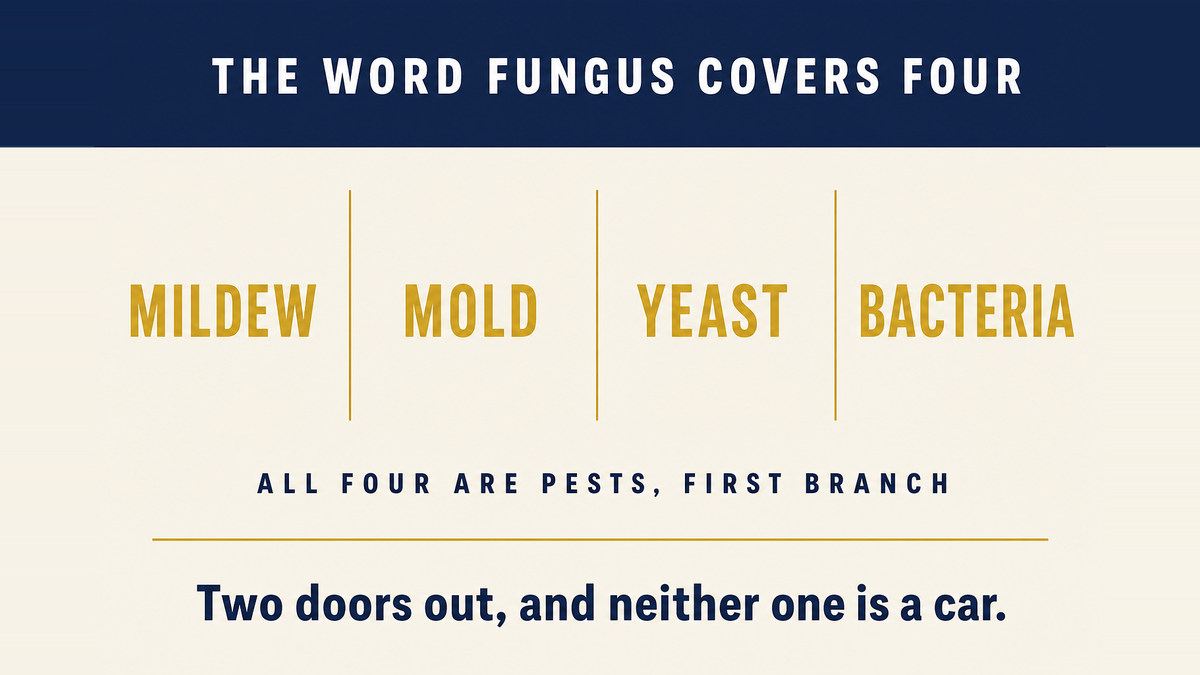
“The term ‘fungus’ means any non-chlorophyll-bearing thallophyte (that is, any non-chlorophyll-bearing plant of a lower order than mosses and liverworts), as for example, rust, smut, mildew, mold, yeast, and bacteria, except those on or in living man or other animals and those on or in processed food, beverages, or pharmaceuticals.” — 7 U.S.C. § 136(k)
Four of the words a car care listing reaches for most often — mildew, mold, yeast and bacteria — are written into the definition of a fungus. Fungus sits in the first branch of the pest definition, the branch that needs no declaration by anybody. So a claim against mildew in a car interior, mould on an evaporator, yeast in a drain line or bacteria in a ventilation duct is a claim against a pest, in the Act's own vocabulary, on the Act's own page.
The two exclusions at the end of that sentence are worth reading twice, because they are the only doors out, and both are narrow.
The first door is on or in living man or other animals. Fungi on a person are not pests in this scheme. That single phrase is why a device sold to treat a human body sits in a different system altogether — the medical one — while the same technology aimed at the air, a surface, a duct or a cabin sits here. Two listings can differ by one preposition and end up before two different agencies.
The second door is processed food, beverages or pharmaceuticals. Micro-organisms in or on those are excluded too. Neither door mentions a car, a cabin, a duct, an evaporator or a drain pan. So a mould claim about the hardware is inside the Act, and it stays inside it no matter how carefully the manual is worded, because it is the claim that is measured and not the machine.
There is one more reading that matters when the words are being chosen. Nothing in the definition asks for proof. The test is whether the device is intended for one of the four verbs, and intention is established by what you published: the box, the listing, the advert, the manual, the video. A supplier who adds kills 99 percent of bacteria to a product page has created the intention, and the intention is the trigger. This is the same mechanism that runs through this series wherever a seller's own copy decides the route — the difference here is that the copy does not merely change a labelling duty, it changes which law applies.
3. What the Word Device Does Not Require, and What It Does
The first sentence a supplier will quote back at you is the relieving one, and it is true. It is also the first of nine lines rather than the only one:
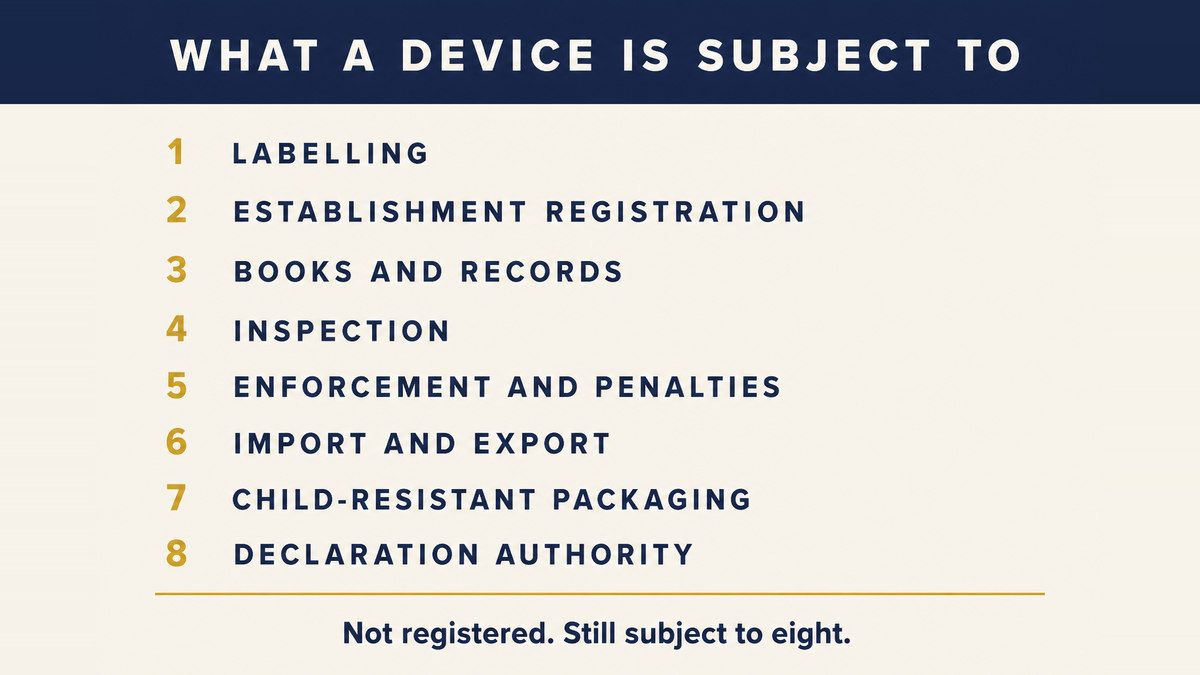
“(b) A device is not required to be registered under FIFRA sec. 3. … A device is subject to the requirements set forth in: (1) FIFRA sec. 2(q)(1) and part 156 of this chapter, with respect to labeling; (2) FIFRA sec. 7 and part 167 of this chapter, with respect to establishment registration and reporting; (3) FIFRA sec. 8 and part 169 of this chapter, with respect to books and records; (4) FIFRA sec. 9, with respect to inspection of establishments; (5) FIFRA sec. 12, 13, and 14, with respect to violations, enforcement activities, and penalties; (6) FIFRA sec. 17, with respect to import and export of devices; (7) FIFRA sec. 25(c)(3), with respect to child-resistant packaging; and (8) FIFRA sec. 25(c)(4) …” — 40 CFR § 152.500(b)
So the honest summary is that a device sits outside product registration and inside eight other things. A quote sheet that mentions only the first half has told you what you do not have to pay for and omitted what you do.
The one that lands hardest on a factory is the second. The word establishment is defined for the purpose of the registration rule, and the definition was written with a foreign producing site in plain view:
“‘Establishment’ means any site where a pesticidal product, active ingredient, or device is produced, regardless of whether such site is independently owned or operated, and regardless of whether such site is domestic and producing a pesticidal product for export only, or whether the site is foreign and producing any pesticidal product for import into the United States.” — 40 CFR § 167.3
Three things follow from that sentence, and each one changes what an order document should say.
A device is a pesticidal product. The same section defines “pesticidal product” as “a pesticide, active ingredient, or device” — three things, one phrase. So the establishment rule does not look past a device because it is not a chemical.
A foreign site is an establishment. The definition says a foreign site producing for import into the United States is an establishment, and it says it twice, once for the factory that makes goods for export only and once for the factory that makes goods for import. An assembly plant in Zhejiang that prints a mould claim on the manual has an establishment obligation of its own, and it does not sit with the importer alone.
The reporting unit is the retail unit. The definitions fix the amount of a pesticidal product for reporting purposes in pounds, gallons, or — in the case of devices — “the number of individual retail units”. A device report is counted in boxes, not in kilograms, which is a strong hint about how the reporting is expected to work in practice and about how the records have to be kept.
The other line worth carrying into a brief is the widest one. Under the same part, “produce” includes to “package, repackage, label, relabel, or otherwise change the container” of a device. A brand owner who imports an unlabelled unit, puts it in its own carton with its own manual and its own claim has produced it in the sense of that definition, which is why the establishment question is not automatically the factory's alone.
Finally, remember what labeling covers, because it is broader than the sticker. The Act defines label as the written, printed or graphic matter on or attached to the device or its containers or wrappers, and labeling as all labels plus all other written, printed or graphic matter “accompanying the pesticide or device at any time”, plus material to which the label or the accompanying literature refers. The manual folded into the box is labeling. The insert is labeling. The leaflet referenced on the carton is labeling. If the website is referenced from the label, the referenced page is in scope too. All of it has to agree with the claim, and the claim is what put you in this part in the first place.
4. The Number on the Box That Means Less Than It Looks
Two labelling clauses form a pair that is easy to misread in a listing, and the confusion is worth clearing before a supplier uses the number as a selling point.
The first clause covers the producing establishment's number: the number, preceded by the phrase “EPA Est.”, “may appear in any suitable location on the label or immediate container” and must appear on the wrapper or outside container of the package if the number on the immediate container cannot be clearly read through it. The second covers the product registration number, and adds a restriction on how it may be presented: it “shall not appear in such a manner as to suggest or imply recommendation or endorsement of the product by the Agency”. — 40 CFR § 156.10(e) and (f)
Then read the environmental agency's own sentence about this exact product category, because it settles the question a buyer will ask:
“Several brands of ozone generators have EPA establishment number on their packaging. This number helps EPA identify the specific facility that produces the product. The display of this number does not imply EPA endorsement or suggest in any way that EPA has found the product to be either safe or effective.” — US EPA, Ozone Generators that are Sold as Air Cleaners
So the number on the box does one job: it tells the agency which facility produced the unit. It is not a certification, it is not a safety finding and the agency declines to certify air cleaning devices at all. That matters commercially in two directions. A buyer who reads it as approval has been misled by whoever presented it, and a listing that presents it as approval is exposed on a different clause again — the one that treats a label as misbranded where its labeling “bears any statement, design, or graphic representation … which is false or misleading in any particular”. The safest line for a product page is the plain one: this number identifies the producing facility.
5. The Numbers Nobody Puts in a Brief
Four agencies publish an ozone level, and none of them publishes the same one. They are worth having in front of you when a supplier quotes an output figure, because they are the only numbers in this category that are stated against a unit of air rather than a unit of machine.
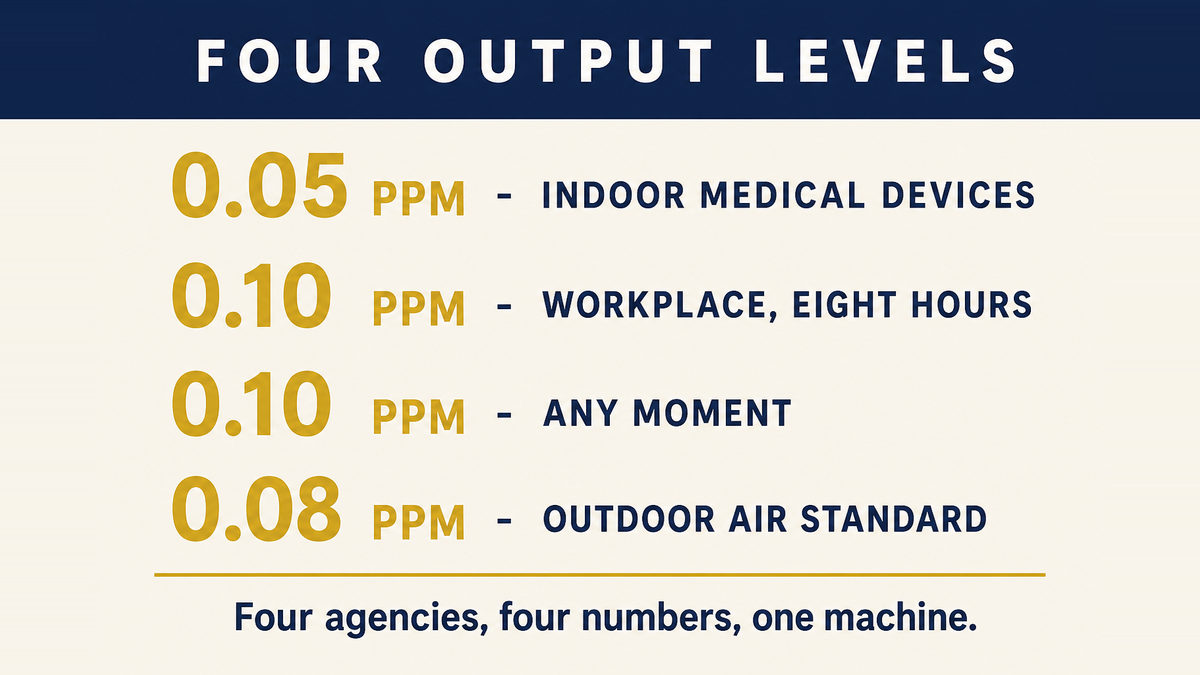
| Level | Set by | What it applies to |
|---|---|---|
| 0.05 ppm | Food and Drug Administration | The ozone output of indoor medical devices |
| 0.10 ppm | Occupational Safety and Health Administration | Worker exposure, average over eight hours |
| 0.10 ppm | National Institute for Occupational Safety and Health | An upper limit recommended not to be exceeded at any time |
| 0.08 ppm | Environmental Protection Agency | The national ambient air quality standard, as an eight-hour average outdoors |
Read the four together and a pattern shows. The lowest figure of the four belongs to the medical route, not to air cleaning. The two occupational figures describe a person who is in the room while the machine runs. The outdoor figure is a public health standard for the air above a city. None of them is a limit on a box that is sold as a car care accessory, and all four of them describe a concentration in air — which is the figure a supplier rarely quotes, because the datasheet habit is to quote output in grams per hour.
Those two numbers are not substitutes. Output is what the machine makes; concentration is what a person breathes, and concentration is a function of output, the volume of the space and how long the machine has been running. A unit rated at five grams an hour in a closed 3 cubic metre car interior and the same unit in a 300 cubic metre workshop are the same product with two completely different exposures. So the useful brief asks for both — the output and the treatment volume it is rated for — and then for the third item, which is the instruction that keeps the two apart: whether the space must be unoccupied during the cycle, and for how long after it before somebody is allowed back in.
One line from the agency's own document belongs in the same paragraph, because it is the sentence a distributor will eventually be asked about. After reviewing the literature, including material supplied by a leading manufacturer of the devices, the agency's summary states that some sellers suggest these devices have been approved by the federal government for use in occupied spaces, and that the opposite is the case: no agency of the federal government has approved these devices for use in occupied spaces. A supplier who understands that sentence will not print safe to use in occupied rooms on a carton, and the buyer who knows it will not accept a listing that implies it.
6. What the Record Says
Method first. The federal recall file holds 245,845 records and has no header row, so every field is scanned rather than trusting a column map. Controls: brake appears in 28,639 records and air bag in 16,162. Every term is counted with its own pattern.
| Term | Records | Campaigns |
|---|---|---|
ozone | 0 | 0 |
ionizer | 0 | 0 |
ultraviolet | 0 | 0 |
disinfect | 0 | 0 |
sanitize | 0 | 0 |
sterilize | 0 | 0 |
bacteria | 0 | 0 |
virus | 0 | 0 |
microbe | 0 | 0 |
germ | 0 | 0 |
mildew | 0 | 0 |
fumigation | 0 | 0 |
odour | 0 | 0 |
mould | 0 | 0 |
odor | 72 | 10 |
smell | 9 | 3 |
mold | 128 | 19 |
cabin | 264 | 55 |
smoke | 523 | 76 |
evaporator | 537 | 39 |
hvac | 1,297 | 92 |
filter | 1,748 | 209 |
generator | 2,651 | 200 |
corrosion | 3,294 | 342 |
air | 65,740 | 2,116 |
Fourteen of the twenty-five terms are zero, and eight of those are the words of the claim. The product's own name, ozone, does not appear in 245,845 records. Neither does ionizer or ultraviolet. And every verb the copy would use — disinfect, sanitize, sterilize — is absent, along with every microbiological word except one: bacteria, virus, microbe, germ and mildew are all zero. The two spellings that do not appear, odour and mould, are the British ones, while their American forms odor and mold are present at 72 and 128 records. The file is written in American English, which is why the same pair of words behaves the same way here as it did in the two previous articles in this segment.
What the file does carry is the vocabulary of the machine's parts, and of a fault. air reaches 65,740 records across 2,116 campaigns, and the largest of them by an enormous distance are the inflator campaigns: a Takata PSDI campaign at 17,600,000 units, a second Takata PSDI campaign at 10,000,000, a PSPI campaign at 8,500,000 and an SPI campaign at 7,700,000, followed by an Acura MDX campaign at 6,281,043 and a Chevrolet Impala ignition campaign at 5,877,718. In this file air means an air bag. filter reaches 1,748 records, and its biggest campaigns are fuel pumps and restraint modules rather than cabin filters: a Toyota Corolla campaign at 2,891,976 units, a Toyota Tundra fuel pump campaign at 1,830,752, a 4Runner fuel pump campaign at 1,525,742 and a Corolla Matrix air bag campaign at 1,006,849. cabin, at 264 records across 55 campaigns, mostly means a curtain air bag or the crew cabin of a recreational vehicle.
The symptom words behave the same way. odor reaches 10 campaigns, and the three largest are power window device campaigns — an Isuzu Ascender campaign at 278,174 units, a Saab 9-7X campaign at 193,652 and a Buick Rainier campaign at 184,611 — where the odour is a sign of an electrical fault rather than a benefit to be sold. mold reaches 19 campaigns, and its largest are a child seat tether campaign at 23,273 units and tyre campaigns at 14,194 and 11,728 units; in this file mold is a manufacturing noun attached to moulded rubber, never a biological condition inside a vehicle.
Put the two halves together. The record knows every part this machine is pointed at — the filter, the evaporator, the duct, the cabin, the air — and every symptom a buyer would name, including odour, smell, smoke and the corrosion that follows moisture. It does not know the product, and it does not know a single word of its claim. That is worth remembering the next time a supplier offers to put a kill rate on the carton: the only document on the table that would record the claim is the one that puts you inside a rulebook, and nothing in a quarter of a million safety records shows the category ever needed it.
7. Five Questions an Ozone Generator Quote Should Answer
A quote for one of these units usually carries an output in grams per hour, a treatment volume, a cycle time, a housing material, a warranty period and a price. Two of those lines touch the law, and only if you ask about them.
- What exactly does the copy say the machine does to something alive? This is the first question, not the last, because the answer decides everything below it. Removes odours, neutralises smoke and oxidises organic molecules describe an effect on chemistry. Kills bacteria, destroys mould and eliminates mildew use the four verbs, and from that point the product is a device with an establishment obligation attached.
- If a pest claim is on the carton, which establishment number will be printed, and which site does it belong to? The number identifies a facility, so it has to match the plant that actually produced the unit. A number that belongs to a trading company, an importer or a sister factory is a mismatch that shows up in an inspection rather than in a photo.
- What is the ozone output, and at what treatment volume? Ask for both in the same line, in grams per hour and in cubic metres, because an output without a volume cannot be compared with anything. Then ask which cycle time the pair is rated for.
- Does the manual require the space to be empty, and for how long afterwards? The occupancy rule is the one instruction that turns a powerful oxidiser into a usable tool for a detailer. If the manual does not state it, the buyer is writing it — and the buyer is then the one who owns the instruction.
- Which printed pieces exist, and do they agree? Label, carton, manual and insert are all labeling in the Act's own sense, and material referenced from them is drawn in as well. Ask for the full set as final artwork in one file, and read the claim sentence in each one against the others. The mismatch almost always sits between the carton, which was written first, and the manual, which was written last.
8. Six Lines to Put in the Order
Everything above collapses into six lines that belong in the order document rather than in a conversation, because each one is a fact that can be checked when the goods arrive or when a listing is reviewed.
| Line | What to write | Why it is on the list |
|---|---|---|
| 1 | The exact claim sentence for the carton, the listing and the manual | Four verbs decide which rulebook applies to the whole product |
| 2 | The ozone output in grams per hour, with the treatment volume | An output without a volume cannot be checked against anything |
| 3 | The occupancy instruction and the re-entry time | It is the control that makes the output usable |
| 4 | The establishment number and the site it belongs to, if a pest claim is made | The number identifies the producing facility |
| 5 | The complete printed set as final artwork: label, carton, manual, insert | All of it is labeling, and all of it has to agree |
| 6 | The party named on the label, and who holds the establishment registration | The named party is the one the rulebook reaches |
Two of those lines are measurements and four are decisions, which is the same split the last article in this segment found. The difference is where the decision sits. Here it is not a figure on a sheet or a package that was chosen for you — it is a sentence somebody will write, and the sentence is the product's legal character. That is why this one belongs early: a claim written into a manual in the third week of a project is expensive to unpick, while the same claim reviewed before the artwork exists costs a phone call. If you want the sentence and the artwork read against each other before print, a factory audit checklist is not the tool for it and a pre-shipment inspection will only confirm what has already been printed. The check happens where the copy is approved, and it is closer to the arithmetic of the volumetric basis than to an inspection: a short list of statements, each of which either agrees with the others or does not.
Frequently Asked Questions
Is an ozone generator a pesticide?
The machine is not, but a device is a pesticidal product for the purposes of the establishment rules, and the definition of pesticidal product covers “a pesticide, active ingredient, or device”. The unit is a device when it is intended for trapping, destroying, repelling or mitigating a pest. If the copy makes no such claim, none of this part applies to it.
Does an ozone generator need EPA registration?
Not product registration. A device is expressly not required to be registered as a pesticide. It is, however, subject to labelling requirements, to establishment registration and reporting, to books and records requirements, to inspection, to the import and export provisions, and to the child-resistant packaging provision. The exemption everyone quotes is one line of a list of nine.
Does saying the machine removes odours make it a device?
No. Removing an odour is a claim about a molecule, not about a pest, and none of the four verbs is used. The line that changes the position is a claim about something alive: killing bacteria, destroying mould, eliminating mildew, repelling insects. That is why the two sentences are not interchangeable in a listing even though they describe the same machine doing the same job.
Which words should we keep out of the listing?
Any wording that makes the product intended to trap, destroy, repel or mitigate a pest or another form of plant or animal life. In this category the words that do it most often are kills bacteria, destroys mould, eliminates mildew, sterilises, disinfects and sanitises. The Act names mildew, mould, yeast and bacteria as examples of a fungus, and a fungus is a pest without anybody having to declare it one.
What is the EPA establishment number on the box?
It is the registration number of the producing establishment, printed with the phrase “EPA Est.”, and its only job is to identify the facility that produced the unit. The agency states directly, in its own document on ozone generators, that displaying the number does not imply endorsement and does not mean the product has been found safe or effective. It is not a certification and it should never be presented as one.
Is there a limit on how much ozone these devices may produce?
There are four published levels and they belong to four different purposes: 0.05 ppm for the ozone output of indoor medical devices, 0.10 ppm as an eight-hour workplace average, 0.10 ppm recommended as a level not to be exceeded at any moment, and 0.08 ppm as the eight-hour outdoor air standard. None of them is written as a cap on a car care accessory, and all four describe a concentration in air rather than an output from a machine.
An ozone generator is not classified by what it does to the air in a room. It is classified by what the carton says it does, and the labelling rule turns on four verbs. Two of them put the unit in one category; the other two put it in another. The cell, the housing and the cord do not change.
That is why the artwork is the last thing to approve and the first thing to read. Once the verbs are settled the rest is ordinary sourcing work. Until they are settled, every component on the drawing is a guess with a tooling cost attached to being wrong.
Which of the Four Verbs Your Copy Uses
We return the verb in your current copy, the label duty it triggers, and the output figure that means less than the box implies.
Rule My Verbs
Questions & Comments
We read every one and reply within 24 hoursIf your ozone generator's carton copy uses one verb where it should use another, the whole label changes. Send the draft and the destination market, and we will name the clause it lands under.