
Ceramic Coating Manufacturer: The Flash Point Decides
 ·
Updated October 16, 2026
·
12 min read
A ceramic coating is bought on a chemistry claim and labelled on a hazard test. The bottle says 9H, graphene-infused or 80 percent SiO2, and none of those words appears anywhere in the rulebook that decides what has to be printed on the label. What decides it is a number on the safety data sheet — the flash point — and the shape of the container the liquid is sold in. This article reads the five sections of 16 CFR Part 1500 that set that label: the definition of a hazardous substance, the three flash point tiers, the self-pressurized container rule, the list of statements that must appear, and the exemptions. The finding is uncomfortable in a useful way. The exemptions that would let a coating print less all name a physical form the coating is not — a paste, an absorbed carrier, a product thick enough to sit still when its tin is turned upside down.
1. What Decides This Label Is Not the Name
Part 1500 does not name products. There is no entry for a coating, a sealant, a polish or a wax in the section that decides which statements have to be printed, because that section does not work that way. It works from the hazard, and the words it uses are the words of the hazard.
The starting point is the definition of a hazardous substance. Read it in full, because the trigger is wider than most suppliers expect:
“Any substance or mixture of substances which is toxic, corrosive, an irritant, a strong sensitizer, flammable or combustible, or generates pressure through decomposition, heat, or other means, if such substance or mixture of substances may cause substantial personal injury or substantial illness during or as a proximate result of any customary or reasonably foreseeable handling or use, including reasonably foreseeable ingestion by children.” — § 1500.3(b)(4)(i)(A)
In plain words: a product is in this rulebook when it carries one of those hazard properties and can hurt somebody during normal handling or a foreseeable misuse. Two of the listed properties cover almost every ceramic coating on the market. The first is flammable. A coating is a solvent with solids dissolved in it, and the solvent is what burns. The second is pressure, which arrives with the packaging rather than the chemistry: the moment the coating is put in an aerosol can, the product has a hazard that has nothing to do with what is inside it.
Note also irritant and strong sensitizer. A coating that leaves a rash on the hand of the person applying it is inside the definition even if it will not burn. That matters later, because several of the relief provisions in Part 1500 switch off as soon as there is more than one hazard.
What is required to be named is set out separately, and it is not the product's marketing name. The label has to carry the common or usual name or the chemical name of the hazardous substance, or of each component that contributes substantially to its hazard. So the rulebook does not ask what the bottle is called. It asks what is in it that can hurt somebody. A supplier who answers a labelling question with a product name has answered a different question.
There is a second reason the name tells you nothing. The word ceramic already means something else in this category. On this site it is a brake pad friction family — a formulation with no coefficient attached to the name. Here it is a coating with a resin in it. The same eight letters describe two unrelated products, and neither use of the word is a legal category. That is the whole point of this section: the name is a marketing decision, and the label is a hazard decision.
What this guide covers
- What decides this label is not the name
- The first decision is a number: the flash point
- The container adds a paragraph
- What must be named, and what can be dropped
- Every exemption names a form the coating is not
- What the record says
- Five questions a ceramic coating quote should answer
- Six lines to put in the order
- Frequently asked questions
2. The First Decision Is a Number: The Flash Point
Part 1500 sorts every liquid into one of three named groups using a single measured value. The measurement is the flash point — the temperature at which the liquid gives off enough vapour to catch fire — and the rules say which test to use for it.
“(i) The term extremely flammable shall apply to any substance which has a flashpoint at or below 20 °F (−6.7 °C) … (ii) The term flammable shall apply to any substance having a flashpoint above 20 °F (−6.7 °C) and below 100 °F (37.8 °C) … (iii) The term combustible shall apply to any substance having a flashpoint at or above 100 °F (37.8 °C) to and including 150 °F (65.6 °C) …” — § 1500.3(c)(6)
Three lines, drawn at 20 °F, 100 °F and 150 °F. Every solvent-based coating falls into one of them, and which one decides the word printed in the largest type on the label:
| Flash point | What the rule calls it | Signal word required | Typical in this category |
|---|---|---|---|
| At or below 20 °F | Extremely flammable | DANGER | Solvent-heavy formulas built on light naphtha or acetone |
| Above 20 °F, below 100 °F | Flammable | WARNING or CAUTION | The common case: an alcohol-based coating in a dropper bottle |
| 100 °F to 150 °F | Combustible | WARNING or CAUTION | Slower solvents, and products cut back with water |
| Above 150 °F | None of the three | Not from this section | A true water-based formula with no solvent load |
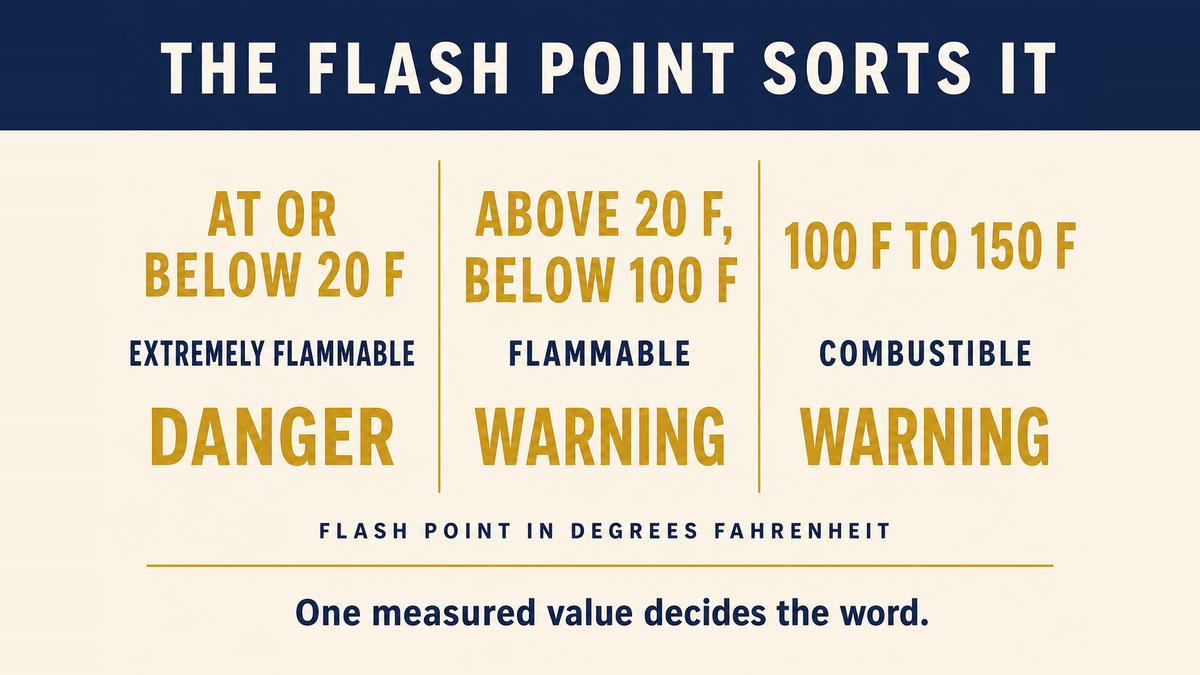
The signal word column comes from the list of statements a hazardous substance must carry. The rule names DANGER as the word for substances that are extremely flammable, corrosive or highly toxic, and WARNING or CAUTION for all other hazardous substances. So the difference between a DANGER label and a WARNING label is often a few degrees on a test result, not a marketing choice — and it is measured, not argued.
Two carve-outs in the same paragraph decide most real coating formulas, and both are worth knowing before a factory writes the back of your bottle.
The first is the 99 percent rule. A mixture in which one component or more, with a flash point at or above 100 °F, makes up at least 99 percent of the total volume is not treated as flammable at all. That is a formula test, not a feel test: a coating that is 99 percent water and glycol with a trace of fragrance is out of the flammable group on paper, even though the fragrance in the bottle is not.
The second is the alcohol line at 24 percent. A mixture containing 24 percent or less of water-miscible alcohols, by volume, in water solution is not considered combustible if it does not present a significant flammability hazard. Alcohol is the volatile that carries most DIY ceramic coatings: it evaporates fast and leaves the resin behind. Cut the alcohol below that line and the coating leaves the combustible group; keep it above and it does not. A formula change of a few percent decides whether the label carries a flammability warning at all.
This is the practical reason to ask for a flash point and not for a promise. “Non-flammable” on a spec sheet is a conclusion. The flash point is the input, and it is the only thing the rule reads. When you ask a supplier, ask for the value and the test method behind it, and ask for both on the same document as the formula you are approving. A value on one sheet and a formula on another cannot be checked against each other, and the label is where the gap shows up.
3. The Container Adds a Paragraph
Put the same liquid in an aerosol can and a second rulebook section switches on. It does not care what the liquid is. It cares that the package holds pressure.
The section opens by saying that a self-pressurized container which does not carry an adequate warning statement can be treated as misbranded — that is, wrongly labelled in the legal sense — and then gives the exact wording that is accepted when pressure is the only hazard:
WARNING—CONTENTS UNDER PRESSURE
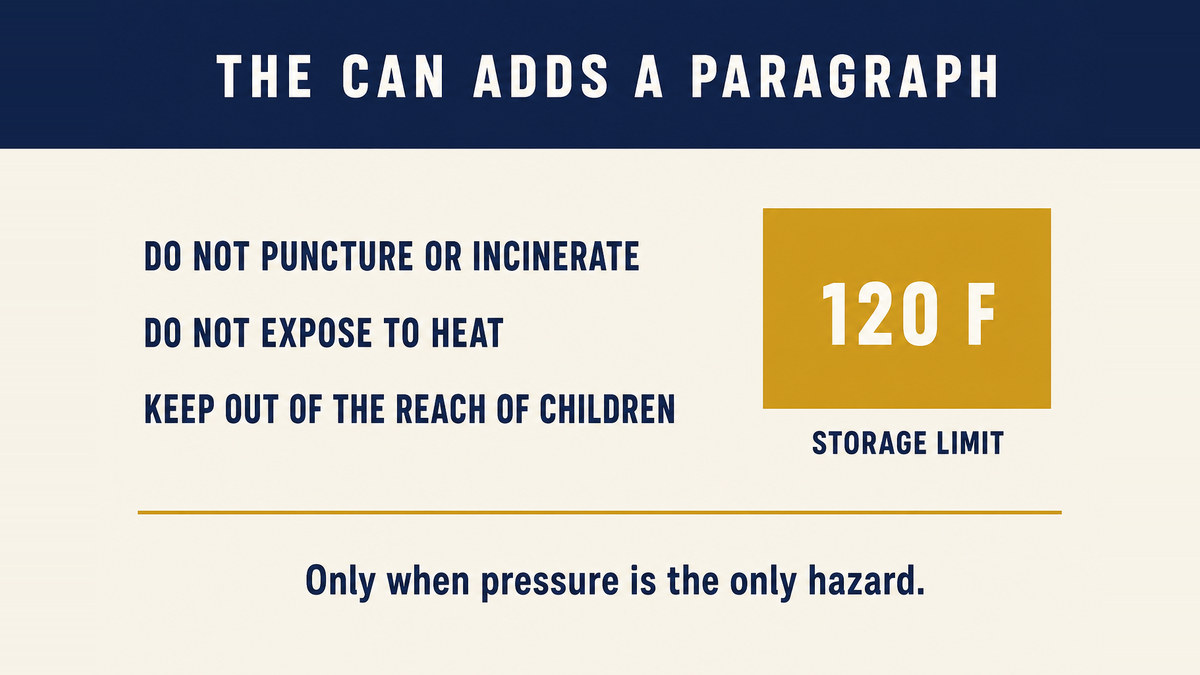
“Do not puncture or incinerate container. Do not expose to heat or store at temperatures above 120 °F. Keep out of the reach of children.” — § 1500.130(b)
Three statements, in that order, and one number: 120 °F. The same paragraph allows the word CAUTION in place of WARNING, and allows a practical equivalent of the last line.
Placement is set in the next paragraph. The part of the statement that is written in capital letters — the words CONTENTS UNDER PRESSURE with the signal word in front of them — is to be printed on the main (front) panel, in capital letters, at the letter height required by § 1500.121(c). The rest of the statements may sit together on another panel, but only if the front panel also carries a line pointing the reader there, in the form “Read carefully other cautions on ____ panel.”
Here is the part that catches aerosol coatings. The canned wording above is accepted only when pressure is the sole hazard. The following paragraph says that if the article has additional hazards — skin or eye irritation, toxicity, or flammability among them — then additional front and rear panel statements are required as well. An alcohol-based coating in an aerosol has a flash point and it has an effect on skin. So the pressure paragraph is the floor, not the whole label, and a supplier who lifts that block of text onto a spray can and stops there has produced a label that is short of what the rules ask for.
Then the text has to be sized, and sizing starts from geometry rather than from taste. The area of the front panel is defined first, and for a container that is round the calculation has its own rule: for a cylindrical or nearly cylindrical container or tube where the panel is on the side, the area to be measured is 40 percent of the height multiplied by the circumference. The letter height required for the warning text is then fixed by that area, through a table in the same section.
Two practical results follow. A 500 ml cylindrical can gives you a bigger panel than a 30 ml dropper bottle, so the same required sentences have to be printed larger on the can. And a supplier who shrinks the lettering to fit a crowded back label is not making a design decision — the minimum height is set by the panel the text sits on, and the check is arithmetic rather than opinion. Ask for the panel dimensions and the letter height in the same email, in millimetres, and the answer is either consistent or it is not.
4. What Must Be Named, and What Can Be Dropped
The list of statements a hazardous substance has to carry is the spine of this label. It is worth reading once in the regulation's own words, because almost every argument with a factory about the back of a bottle is an argument about one line of it.
“(A) The name and place of business of the manufacturer, packer, distributor, or seller; (B) The common or usual name or the chemical name … of the hazardous substance or of each component which contributes substantially to its hazard … (C) The signal word ‘DANGER’ on substances which are extremely flammable, corrosive, or highly toxic; (D) The signal word ‘WARNING’ or ‘CAUTION’ on all other hazardous substances; (E) An affirmative statement of the principal hazard or hazards, such as ‘Flammable,’ ‘Combustible,’ ‘Vapor Harmful,’ ‘Causes Burns’ … (F) Precautionary measures describing the action to be followed or avoided … (G) Instruction, when necessary or appropriate, for first-aid treatment … (I) Instructions for handling and storage of packages which require special care in handling or storage; and (J) The statement ‘Keep out of the reach of children’ or its practical equivalent …” — § 1500.3(b)(14)(i)
The same paragraph adds where the statements have to sit and how they must look: they have to be located prominently and be in the English language in conspicuous and legible type in contrast by typography, layout, or color with the other printing on the label. In plain words, the warning cannot be the paragraph that nobody notices. If the front of the bottle is a black label with gold lettering, the warning still has to stand apart from it.
Now the part suppliers do not expect. A statement does not count as being on the label because it is printed on the bottle. The definition of label in the same section says a required statement is treated as appearing on the label only if it also appears on the outside container or wrapper — unless it can be read easily through that wrapper — and on all accompanying literature where there are directions for use. That means the instruction leaflet folded into the box is inside the rule. If the insert tells the buyer how much to apply, how long to wait and how to keep the surface dry, then the insert also has to carry the hazard statements. A retail carton with a leaflet that describes the process but omits the warnings is not a small omission, and it is the single most common gap in a coating kit assembled for export.
Then comes the relief. Section 1500.83 opens with a list of exemptions, and the first of them removes an item from the list above:
“When the sole hazard from a substance in a self-pressurized container is that it generates pressure or when the sole hazard from a substance is that it is flammable or extremely flammable, the name of the component which contributes the hazards need not be stated.” — § 1500.83(a)(1)
Read that carefully, because the condition is doing all the work. Where flammability is the only hazard on the sheet, item (B) drops off the label: the solvent does not have to be named. Add a second hazard — skin irritation, or pressure alongside a flash point — and the exemption no longer reads on the product, and the component that contributes the hazard goes back on. This is why a formulator's decision about fragrance, or about a surfactant that dries out the hands, changes the label content more than the base chemistry does.
5. Every Exemption Names a Form the Coating Is Not
Section 1500.83 is titled as exemptions for small packages, minor hazards and special circumstances, which sounds like the place to look for relief on a coating. It has twenty-one numbered items. Read them for a car care range and a pattern appears: the relief is granted to a physical form, and the coating is never the form named.
The clearest example is the one that names your product category by name and then describes a product you are not selling. Item (8) covers containers of paste shoe waxes, paste auto waxes, and paste furniture and floor waxes that contain toluene, xylene, petroleum distillates or turpentine. Those containers are exempt from certain labelling otherwise required for those solvents if the product is thick enough that it will not flow from its opened container when the container is turned upside down and left for five minutes at 80 °F. They are also exempt from carrying a flammability warning if the flammability comes only from solvents with flash points above 80 °F.
Two things are worth taking from that sentence. First, the only car care product named in the whole exemption list is a paste — a tin of wax. Not a coating, not a sealant, not a spray. Second, the test is not a chemistry test at all: it is a five-minute flow test at a stated temperature. The rule does not ask what is in the tin. It asks whether the tin can be turned over without the contents moving.
The same shape appears twice more. Item (11) exempts polishing and cleaning products that consist of a solid particulate or fibrous carrier, where the solvent is fully held by the carrier and cannot be pressed out of it under foreseeable handling — the pad decides, not the liquid. Item (13) exempts viscous liquids such as paints, varnishes, lacquers and roof coatings from a petroleum distillate warning where the viscosity is not less than 100 Saybolt universal seconds at 100 °F — a number again, and one measured at a temperature the buyer never mentions in a brief.
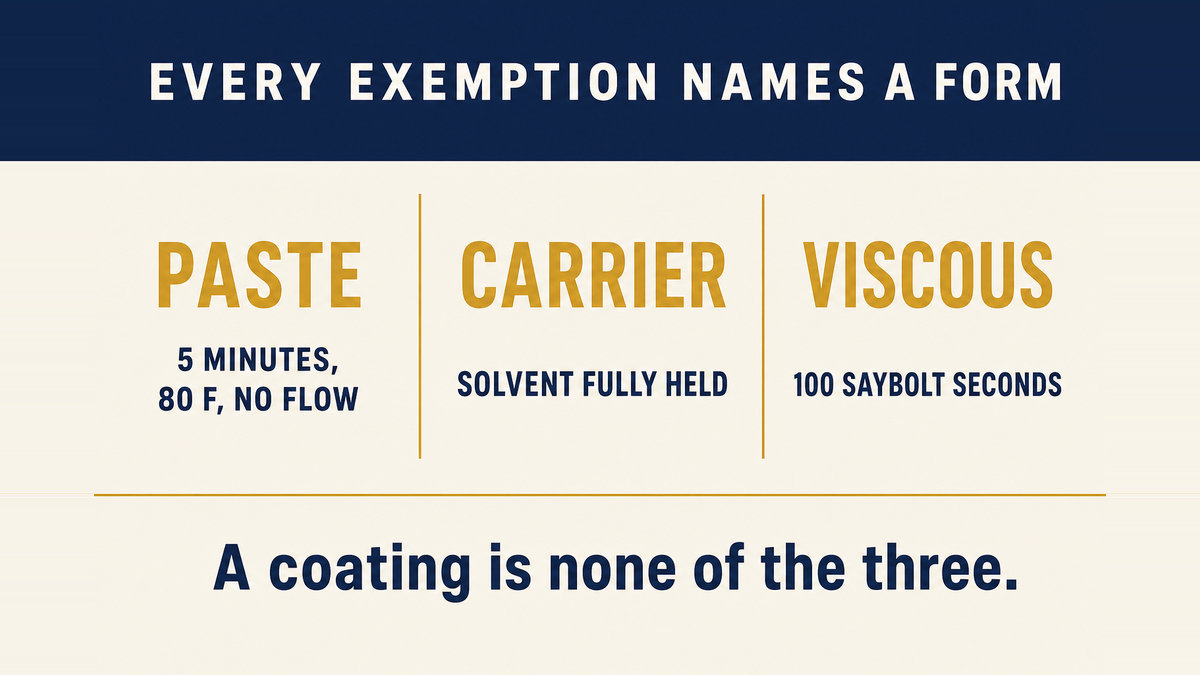
Now line those three up against what a coating is. A ceramic coating is a liquid that has to flow out of a dropper, wet a panel and level itself before it flashes off. It is not a paste that holds its shape in an inverted tin. It is not a solvent locked inside a fibrous carrier. It is not a product measured in Saybolt seconds because it is thin by design. The property that makes the coating work is the property that keeps every one of these exemptions out of reach. And the applications where a coating is sold in an aerosol can are covered by one item only — the one in the previous section, which lets the component name drop but requires the pressure statement, and requires more statements the moment a second hazard is present.
There is a commercial reading of this too. The relief in this section is not something a supplier can promise, because it is not a claim about paperwork. It is a claim about the physical behaviour of the product, and it is granted or refused on how the product behaves in a container. A factory that answers a labelling cost question with “we do not need those warnings” has not told you which exemption it believes applies. Ask for the item number, and then check whether the product in your hand is the product that item describes.
One more line of the list is worth knowing for a different reason, because it sets a boundary on how far a small container can carry a big claim. Where the only hazard is pressure, the label may substitute CAUTION for WARNING and may shorten the last statement. Nothing in the part lets a supplier drop the statement of principal hazard, the precautionary measures, or the first-aid instruction, and nothing lets a supplier move them off the label and into a leaflet that does not repeat them. The relief is narrow, it is written down, and it is testable — which is the useful part.
6. What the Record Says
Method first. The federal recall file holds 245,845 records and has no header row, so every field is scanned rather than trusting a column map. Controls: brake appears in 28,639 records and air bag in 16,162. Every term is counted with its own pattern.
| Term | Records | Campaigns |
|---|---|---|
ceramic | 67 | 7 |
coating | 389 | 38 |
coatings | 0 | 0 |
coated | 26 | 12 |
clearcoat | 51 | 6 |
sealant | 268 | 32 |
seal | 1,457 | 213 |
wax | 89 | 7 |
polish | 4 | 2 |
polishing | 0 | 0 |
buffing | 0 | 0 |
glaze | 159 | 1 |
graphene | 0 | 0 |
nano | 25 | 5 |
spray | 159 | 28 |
aerosol | 0 | 0 |
solvent | 4 | 2 |
thinner | 18 | 3 |
alcohol | 2 | 1 |
gloss | 5 | 3 |
hydrophobic | 0 | 0 |
detail | 3 | 1 |
paint | 225 | 20 |
resin | 271 | 6 |
film | 63 | 9 |
Six terms are zero, and three of them are the ones that sell the product. graphene does not appear in 245,845 records. Neither does hydrophobic, which is the benefit every coating brand prints on the front of the box. Neither does aerosol, which is the package this product so often arrives in — and that one matters for a different reason, because it is the word that switches on the entire section described in section 3 above. The other three zeros are coatings, polishing and buffing: the plural, and the two words for the act of applying the product by hand.
The one word that is present is a brake word. ceramic appears 67 times across 7 campaigns, and the campaigns are brakes. An Alfa Romeo Giulia campaign at 719 units, a Bentley Continental Flying Spur at 469, a Lamborghini Murcielago at 404 and a Lamborghini Gallardo at 263 are all filed under hydraulic service brakes, with the foundation components named in the field. The only two that are not are a Ford Ranger campaign at 11,405 filed under rear-view display function, and a Lucid all-weather floor mat campaign at 4,294 filed under the accelerator pedal. So in this file, ceramic is a material that is pressed against a spinning disc. It is the same sense of the word that the brake pad guide on this site uses, and it is not the sense in which a coating brand uses it.
coating is the heaviest term in the whole table and it points the same way. It reaches 389 records across 38 campaigns, and its biggest campaigns are a Bosch restraint control module campaign at 1,073,320 units, a Ford Escape seat belt campaign at 746,842, a Chevrolet Equinox child seat latch campaign at 668,187, a Ford Fusion front seat belt campaign at 603,392, a Ford F-450 back-over prevention sensor campaign at 277,040 and an Acura ILX driveshaft campaign at 248,358. In this record a coating is what sits on a restraint part, a sensor or a shaft. It is never a panel, and it is never something a buyer polishes.
The neighbours agree. sealant reaches 268 records across 32 campaigns, and its largest are a Honda CR-V temporary spare tyre campaign at 1,048,613 and a Toyota Tacoma seat belt campaign at 342,451 — the sealant in this file is a tyre, a brake or an electrical connector. wax is a brake word as well: a Subaru WRX STI campaign at 461,338, a Subaru Legacy at 274,402 and a Subaru WRX at 200,064, all under hydraulic service brakes. And polish, at just 4 records in 2 campaigns, appears where a polishing product would belong — a Volvo VNL wheel and an Alcoa aluminum wheel, 22 units each.
Put the two halves together and the record says one thing. A 245,845-record safety file knows the word ceramic as a brake material and the word coating as a surface on a part that failed. It does not know this product at all: the packaging word, the performance word and the material word that the category sells on are all absent. That is worth remembering the next time a supplier answers a labelling question with the name on the bottle. The name is the one thing neither document carries.
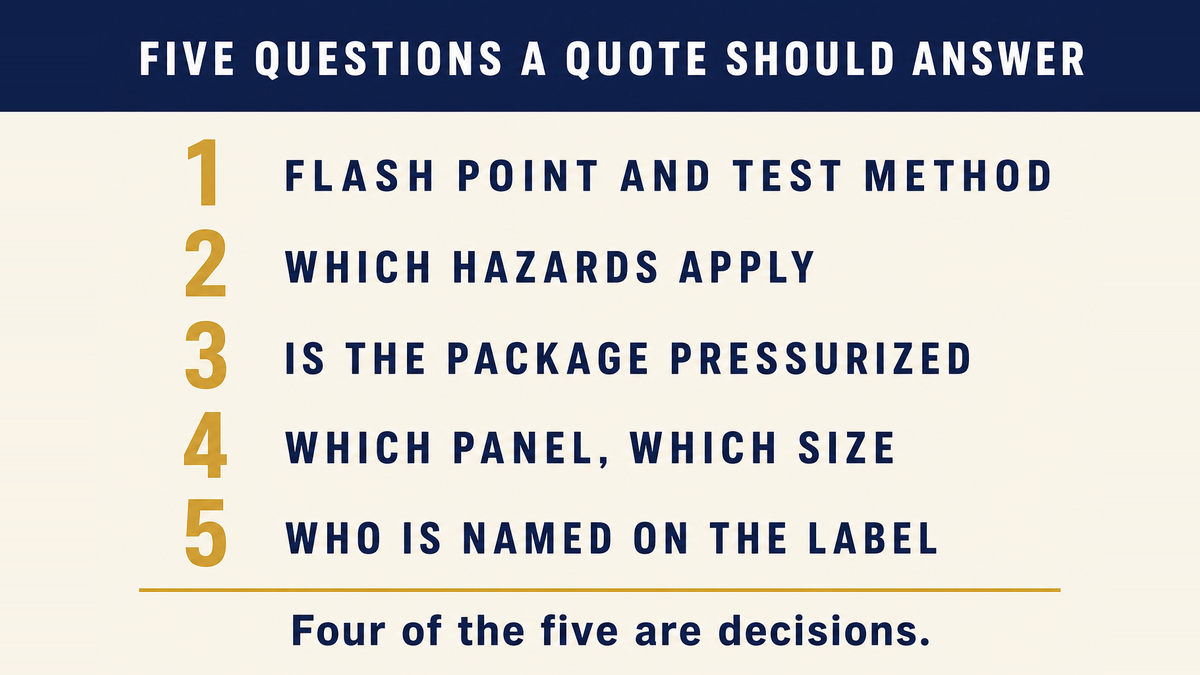
7. Five Questions a Ceramic Coating Quote Should Answer
A coating quote usually carries a solids content, a cure time, a hardness number, a bottle size, a colour and a price. Only two of those lines touch the label, and the label is the part that stops a shipment at a port or a listing at a marketplace. These five questions get the rest.
- What is the flash point, and by which test method? The flash point decides which of the three named groups the liquid sits in, and the group decides whether the label carries a flammability warning and which signal word comes with it. Ask for the value and the method on the same sheet as the formula being approved. A flash point on one document and a formula on another cannot be checked against each other.
- What is the complete list of hazards on the sheet? Flammability, skin or eye irritation, toxicity, and pressure are separate entries with separate consequences. The single most expensive mistake in this category is a supplier who reads one hazard off the sheet, prints the label for that one, and leaves a second one undeclared — because the relief provisions switch off the moment there is more than one hazard.
- Is the package a self-pressurized container, and does it have a second hazard? If it is a can, the pressure statement is required, and it is only enough on its own where pressure is the sole hazard. For an alcohol-based spray that is almost never true, so the front and rear panels need more than the canned paragraph.
- Which panel will the warnings sit on, and what letter height? The panel area is measured rather than chosen — on a round container it is 40 percent of height times circumference — and the minimum letter height follows from that area. Ask for the panel dimensions and the intended letter height in millimetres in the same message, and ask for the artwork as a print-ready file so the two can be checked against each other.
- Whose name goes in the identification line, and who accepts responsibility for the label? The line can carry the manufacturer, the packer, the distributor or the seller, and a brand owner who puts its own name there has taken the position of the party named on the label. Decide that before the artwork is drawn, not after a marketplace asks you to explain the back of your own bottle.
8. Six Lines to Put in the Order
Everything above collapses into six lines that belong in the order document rather than in a conversation, because each one is a fact that can be checked when the goods arrive.
| Line | What to write | Why it is on the list |
|---|---|---|
| 1 | Flash point, and the test method it was measured by | It decides the named group, the warning and the signal word |
| 2 | The full hazard list, not the convenient one | A second hazard removes most of the relief provisions |
| 3 | Whether the package is pressurized, and whether it carries a second hazard | The pressure statement is the floor, not the whole label |
| 4 | Panel dimensions in millimetres, and the intended letter height | The letter height follows from the panel area |
| 5 | The name and address that will be printed in the identification line | The named party is the one the rulebook holds |
| 6 | Which exemption item, if any, the supplier is relying on | An exemption is a claim about a physical form, so it can be checked |
Two of those lines are about the product and four are about decisions. That split is the useful part of this article. A buyer who negotiates on price and lets the supplier choose the label text has handed over four decisions that the factory has no way of making on the buyer's behalf — and the two lines that stay unchecked are exactly the two that decide whether the carton clears a marketplace review. If you want a second pair of eyes on the artwork before it goes to print, a factory audit checklist is the wrong tool for this and a pre-shipment inspection will only confirm what is already printed. The check belongs earlier, at the point where the formula and the label are approved together, and it is closer to the arithmetic of the volumetric basis than to an inspection: a short list of numbers, each of which either agrees with the others or does not.
Frequently Asked Questions
Does a ceramic coating need a hazard label?
It needs one if it carries a hazard property and can hurt somebody during normal handling or a foreseeable misuse. In practice two things put almost every coating in this rulebook: it is flammable, or it is sold in a container that holds pressure. A water-based formula with a low solvent load and no aerosol can may sit outside all three flammable groups — but that is a conclusion you reach from a measured flash point, not from the word ceramic on the label.
What makes a ceramic coating flammable — the ceramic or the solvent?
The solvent. The ceramic content in a coating is a solid or a resin that stays on the panel; the part that catches fire is the carrier that evaporates. This is why the same coating solids at two different solvent levels can land in two different named groups, and why the flash point is the input the rule reads rather than the solids content the marketing sheet leads with.
Can a supplier claim the coating is non-flammable without a test?
It can write the words, but the words are a conclusion and the rule reads a measurement. The three groups are defined by a flash point value, and the flash point is obtained by a described test method. Two formula carve-outs can also remove a product from a group without any argument: a mixture where a component at or above 100 °F makes up at least 99 percent of the volume, and a mixture containing 24 percent or less of water-miscible alcohols by volume in water solution where there is no significant flammability hazard. Ask which one applies, and ask for the test report.
Does an aerosol coating need more than the pressure warning?
Usually yes. The standard pressure statement — the contents-under-pressure heading, the instruction not to puncture or incinerate, the storage limit of 120 °F and the line about children — is accepted only where pressure is the sole hazard. Add flammability or skin irritation and the rule asks for additional statements on the front and rear panels. An alcohol-based spray has both.
Do the warnings have to be repeated on the leaflet inside the box?
Yes, if the leaflet carries directions for use. A required statement counts as being on the label only if it also appears on the outside container or wrapper and on all accompanying literature where there are directions for use. A coating kit whose insert explains the application process but omits the hazard statements is missing a required statement even though the bottle itself is correct.
Which exemptions could reduce the label on a coating?
Almost none, and that is the finding of this article. The exemption list is written around physical forms: a paste wax that will not flow from an inverted container in five minutes at 80 °F; a polishing or cleaning product whose solvent is fully held by a solid or fibrous carrier; a viscous liquid measuring not less than 100 Saybolt universal seconds at 100 °F. A coating is a thin liquid by design, so it is none of the three. The one item that reliably applies to this category is the exemption that lets the component name drop where flammability or pressure is the only hazard.
Ceramic coating is sold on a chemistry and regulated on a hazard, and the label follows the hazard. The label is not decided by the name on the bottle: the name ceramic is not a legal category here, and in the 245,845-record safety file it is a brake material. The label is decided by one measured number, which sorts the liquid into extremely flammable, flammable or combustible and prints DANGER or WARNING accordingly, and by the container, which adds the pressure statement when the product ships in a can — and which only lets that statement stand alone where pressure is the only hazard.
The statements themselves are a short list, and a required statement counts only if the outer carton and the leaflet inside the box repeat it. The relief provisions exist, but every one of them describes a paste, an absorbed carrier or a liquid thick enough to sit still in an inverted tin, which is the opposite of what a coating is for. So get the flash point and the method, get the full hazard list, measure the panel, name the party, and settle which exemption the supplier believes applies before the artwork goes to print.
A Proof You Can Send to the Printer
The four mandatory statements set in reading order, the container clause beside them, and the batch number in the footer.
Proof My Label
Questions & Comments
We read every one and reply within 24 hoursCeramic coating is sold on a chemistry and regulated on a hazard, and the two documents rarely match. Send the range and the market, and we will read the safety sheet against the claims on the carton.