
Microfiber Towel Manufacturer: The List Names Towels
 ·
Updated October 16, 2026
·
11 min read
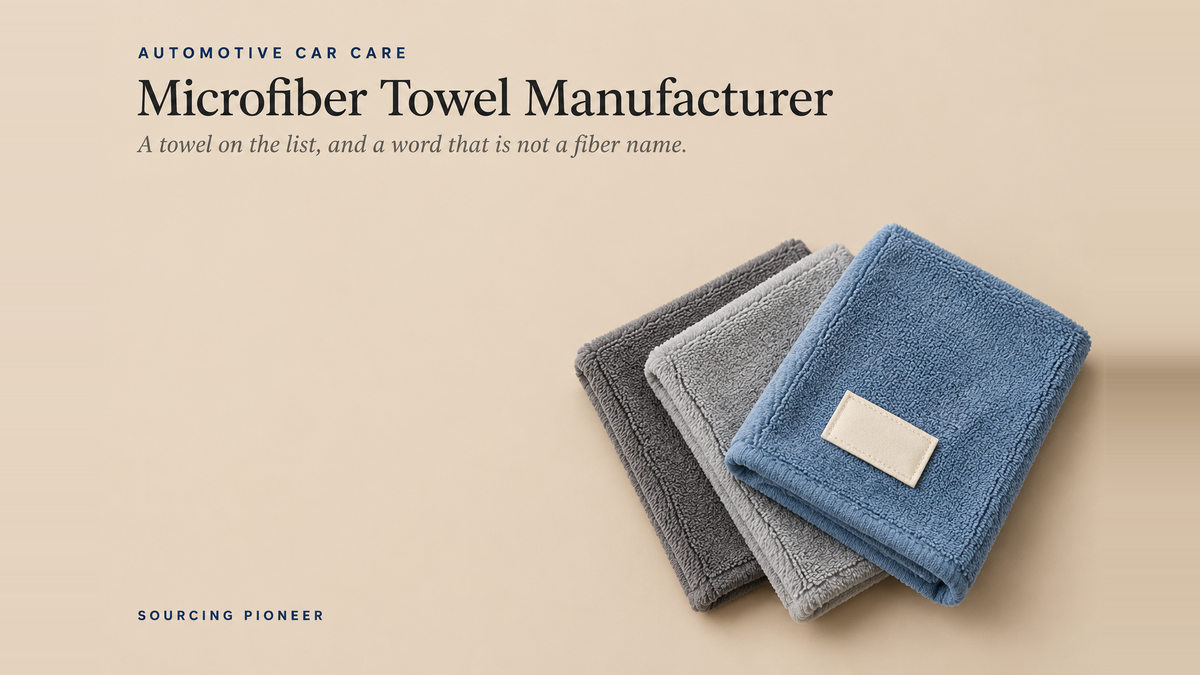
Three articles ago this series found a car cover that the federal textile labelling rules excluded, and the only thing that could bring it inside was a sentence written by whoever built the carton. This article is the other side of the same page. The rules are 16 CFR Part 303, the rules under the Textile Fiber Products Identification Act, and they work by naming products on a list and excluding everything else. For a car cover, the list did not name it. For a detailing towel, the list has an entry that reads, in full, “(9) Towels;”. So the labelling duty here is not switched on by marketing copy. It applies on the day the product is first sold, to the fiber statement, the identification and the country of origin, on a label that has to be legible, conspicuous and accessible. And there is a second finding waiting behind it: the word the trade writes on the packaging — microfibre — is not one of the names the rules recognise.
1. What the Product Is: A Cloth Sold as a Towel
This is the first product in the series whose regulation turns on the noun on the packaging rather than on the construction of the part.
| Product | What it is made of | What it is called | Is it on the list? |
|---|---|---|---|
| The drying towel | Microfibre, usually polyester and polyamide | A towel | Yes — item (9), Towels |
| The wash and glass cloth | Usually the same cloth at a lower weight | A cloth | No — a cloth is not on the list |
| The applicator pad | The same fiber, a smaller and thicker cut | A pad | No — not on the list |
| The wash mitt | The same fiber, sewn into a glove | A mitt | No — not on the list |
| The disposable wipe | Non-woven, sold in a roll for one use | A wipe | Excluded separately — see section 3 |
Every product in that table can come off the same line, from the same fiber, on the same day. One of them is inside the Act, one of them is outside by an exclusion that cannot be undone, and three of them are outside until somebody makes a claim about fiber content. Nothing about the material changes. The noun changes, and the noun is the regulation. A supplier who quotes a “microfibre set” as one line item has quoted four different regulatory positions and a fifth that cannot be moved.
What this guide covers
- What the product is: a cloth sold as a towel
- The list, and the word that puts you on it
- The same factory, three positions, and one that cannot be changed
- The fiber name: microfibre is not a fiber name
- What the label must carry, and in what order
- What the record says
- Five questions a microfiber towel quote should answer
- Six checks before you order
- Frequently asked questions
2. The List, and the Word That Puts You On It
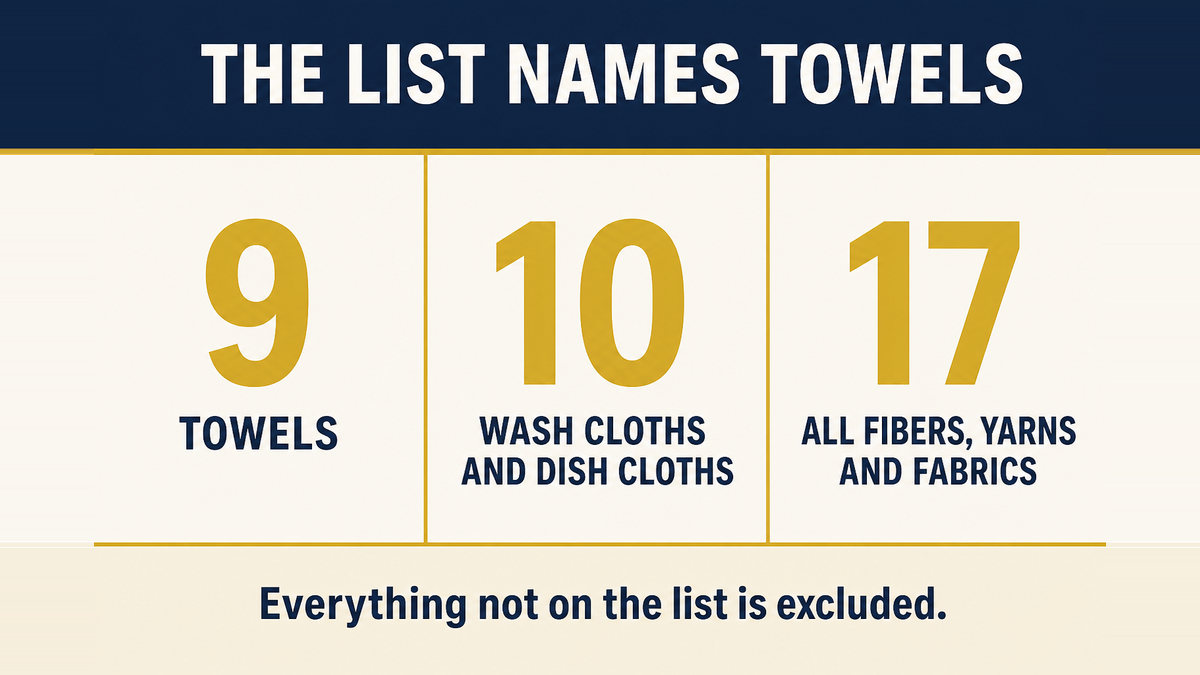
Part 303 does not define a towel. It lists products by name, and the list is a closed set of twenty-three entries. The relevant ones, read in order, are these:
“(4) Beddings; (5) Curtains and casements; (6) Draperies; (7) Tablecloths, napkins, and doilies; (8) Floor coverings; (9) Towels; (10) Wash cloths and dish cloths; (11) Ironing board covers and pads; (12) Umbrellas and parasols; (13) Batts; … (16) Cushions; (17) All fibers, yarns and fabrics (including narrow fabrics except packaging ribbons); … (23) Dresser and other furniture scarfs.” — § 303.45(a)
The section then closes the set in the paragraph that follows.
“Pursuant to section 12(b) of the Act, all textile fiber products other than those identified in paragraph (a) of this section, and the following textile fiber products, are excluded from the Act’s requirements …” — § 303.45(b)
So there are two ways to be covered, and both of them apply to this product family. Entry (9) Towels catches the drying towel by its ordinary name. Entry (17) All fibers, yarns and fabrics catches the fabric itself, and would catch a cloth sold as fabric. What entries (9) and (17) do not catch is the pad, the mitt and the sponge, which are finished articles with names of their own and no place on the list.
There is one more entry worth knowing because it decides the wash cloth. Entry (10) Wash cloths and dish cloths is written as a separate item from towels, which tells a supplier something useful about how the list was drawn: the drafter named the cloth. A wash cloth is on the list. A cloth is not, and a microfibre cloth sold without the word wash in front of it falls outside by the sweep in paragraph (b). Whether that is a loophole or an accident is not for this article to say, and it is not a position a serious seller should build a product on — the same fabric is one word away from being inside the Act, and the buyer is the one who chooses the word.
3. The Same Factory, Three Positions, and One That Cannot Be Changed
The exclusions in paragraph (b) are not all of the same kind, and the difference matters commercially.
Three of them are conditional. The paragraph excludes products outside the list, and then the next paragraph takes the exclusion away again in two situations.
“The exclusions provided for in paragraph (b) of this section shall not be applicable: (1) if any representations as to the fiber content of such products are made on any label or in any advertisement without making a full and complete fiber content disclosure … with the exception of those products excluded by paragraph (b)(5) of this section; or (2) If any false, deceptive, or misleading representations are made as to the fiber content of such products.” — § 303.45(c)
Read the parenthesis in the first item carefully, because it is the most commercially useful sentence in the section. It carves paragraph (b)(5) out of the switch, and (b)(5) reads: “Non-woven products of a disposable nature intended for one-time use only.”
So the positions separate cleanly:
- Inside by default, and cannot be switched off. The towel. It is on the list in paragraph (a), so it needs the full statement whether or not the packaging says a word about fiber.
- Outside until a claim is made. The applicator pad, the mitt and the plain cloth. Each is off the list, so each needs nothing — until a fiber representation appears on a label or in any advertisement, at which point the exclusion stops applying to that product and a full and complete fiber content statement becomes required.
- Outside, and it stays outside. The disposable non-woven wipe. It is excluded by (b)(5), and (b)(5) is the one exclusion the switch in paragraph (c) expressly does not reach. A supplier can print whatever fiber claim it likes on a one-time-use non-woven wipe and the labelling duty does not attach.
That third position is the one most often got wrong in both directions. A seller who assumes everything in a car care range is inside the rules over-labels a disposable product and pays for artwork nobody needed. A seller who assumes everything in the range is outside misses the towel, which is the item that carries the brand on the shelf.
4. The Fiber Name: Microfibre Is Not a Fiber Name
Now the word on the packaging. Microfibre — or microfiber in the American spelling — is a description of how fine a fiber is. It is not one of the names the rules recognise as a fiber, and in the whole of Part 303 the string microfibre and the string microfiber appear nowhere. What does appear is a definition with a number in it.
“(c) Polyester. A manufactured fiber in which the fiber-forming substance is any long chain synthetic polymer composed of at least 85 percent by weight of an ester of a substituted aromatic carboxylic acid …” — § 303.7(c)
So the generic name on a microfibre towel is polyester, or polyester and polyamide where the blend includes a polyamide, and the percentages are by weight of the fiber. The question a supplier then asks is the good one: may the packaging still say microfibre? The answer is in a paragraph of the labelling section that most people never read, and it is a qualified yes.
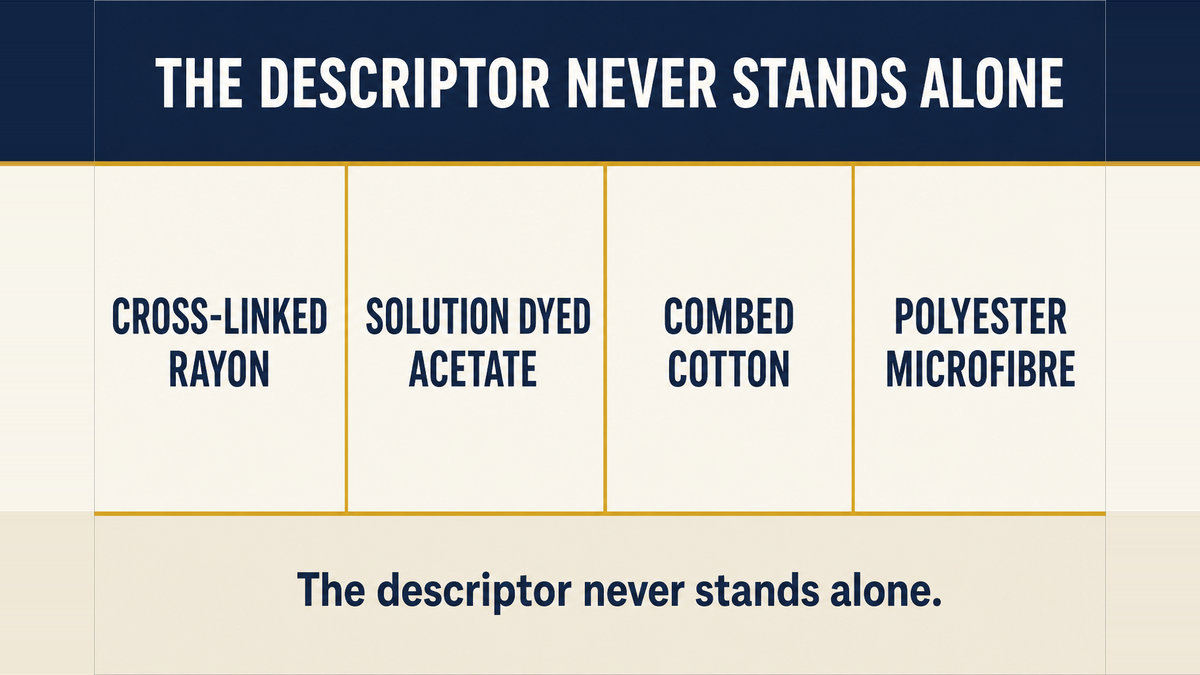
“Non-deceptive terms which are properly and truthfully descriptive of a fiber may be used in conjunction with the generic name of such fiber; as for example: ‘100 percent cross-linked rayon,’ ‘100 percent solution dyed acetate,’ ‘100 percent combed cotton,’ ‘100 percent nylon 66,’ etc.” — § 303.16(d)
Read the four examples as a pattern rather than as four cases. Each one is a descriptive term attached to a generic name: cross-linked describes rayon; solution dyed describes acetate; combed describes cotton; 66 describes nylon. In none of them does the descriptive term stand alone. The phrase in conjunction with the generic name is the operative condition, and it is what makes “100 percent microfibre” a defective fiber statement: the descriptor is doing the work, and the generic name is missing. The form the paragraph supports is “100 percent polyester microfibre” or “100 percent microfibre polyester” — both names present, in a sentence a customer can still read.
Two mechanical rules sit alongside that one and both are easy to break on a car care label. The fiber statement has to be “in type or lettering of equal size and conspicuousness”, so a large “MICROFIBRE” above a small “100% polyester” is not the required form even though both names are present. And “words or terms shall not be designated by ditto marks or appear in footnotes referred to by asterisks or other symbols”, with abbreviations barred except as permitted elsewhere in the part — which rules out the common habit of putting a small “*polyester” at the foot of the card.
5. What the Label Must Carry, and In What Order
The required information is three items, and the paragraph that lists them also says where they may sit and how they must look.
“The required information shall include the following: (1) The generic names and percentages by weight of the constituent fibers present in the textile fiber product, excluding permissive ornamentation, in amounts of 5 percent or more … shall appear in order of predominance by weight with any percentage of fiber or fibers required to be designated as ‘other fiber’ or ‘other fibers’ appearing last. (2) The name, provided for in § 303.19, or registered identification number issued by the Commission, of the manufacturer or of one or more persons marketing or handling the textile fiber product. (3) The name of the country where such product was processed or manufactured, as provided for in § 303.33.” — § 303.16(a)
Three consequences for a car care range, in the order they will bite.
The order is fixed. Predominance by weight, largest first, and anything that has to be called other fiber goes last. A blend of 80 percent polyester and 20 percent polyamide is written in that order and cannot be written the other way round to suit a design.
The five percent line changes the wording, not just the number. A fiber under 5 percent is not named at all; it is aggregated as other fiber, or other fibers when there is more than one, subject to a stated exception for a fiber with a “clearly established and definite functional significance” at that amount, for which the regulation's own example is a composition of 96 percent Acetate and 4 percent Spandex. A supplier who has been printing a full list of named fibers has been printing something the rules would not accept.
The identification can be the manufacturer or the marketer, and that is a choice with consequences. Item (2) allows the name of the manufacturer or of one or more persons marketing or handling the product, and § 303.20(b) allows a registered identification number in lieu of the required name. So the brand owner may be the named party, which is often what a private-label buyer wants — but § 303.2(d) adds that a person who causes or directs a processor or finisher to label a product “shall be responsible under the Act and regulations for any failure to follow the rules” by reason of any statement or omission in that label. Naming yourself on the label is the same act as taking responsibility for it.
Two smaller provisions complete the set. Everything must be “set out in the English language”, with a translation permitted alongside rather than instead. And the required information is expressly allowed to share a label with the care label required by 16 CFR part 423 — which is a reminder that care labelling is a separate rule with a separate scope, and one that does not reach a towel on its own terms.
6. What the Record Says: Two Zeros, and Two Words Taken
Method first. The federal recall file holds 245,845 records and has no header row, so every field is scanned rather than trusting a column map. Controls: brake appears in 28,639 records and air bag in 16,162. Every term is counted with its own pattern.
| Term | Records | Campaigns |
|---|---|---|
towel | 0 | 0 |
towels | 0 | 0 |
microfiber | 0 | 0 |
microfibre | 0 | 0 |
micro fiber | 0 | 0 |
cloths | 0 | 0 |
sponge | 0 | 0 |
mitt | 0 | 0 |
applicator | 0 | 0 |
buffing | 0 | 0 |
polishing | 0 | 0 |
chamois | 0 | 0 |
rag | 0 | 0 |
wipes | 0 | 0 |
lint | 0 | 0 |
laundry | 0 | 0 |
swirl | 0 | 0 |
absorbent | 1 | 1 |
detailing | 6 | 1 |
wipe | 8 | 2 |
wash | 16 | 3 |
scratch | 18 | 1 |
cloth | 26 | 5 |
fiber | 15 | 6 |
fabric | 624 | 37 |
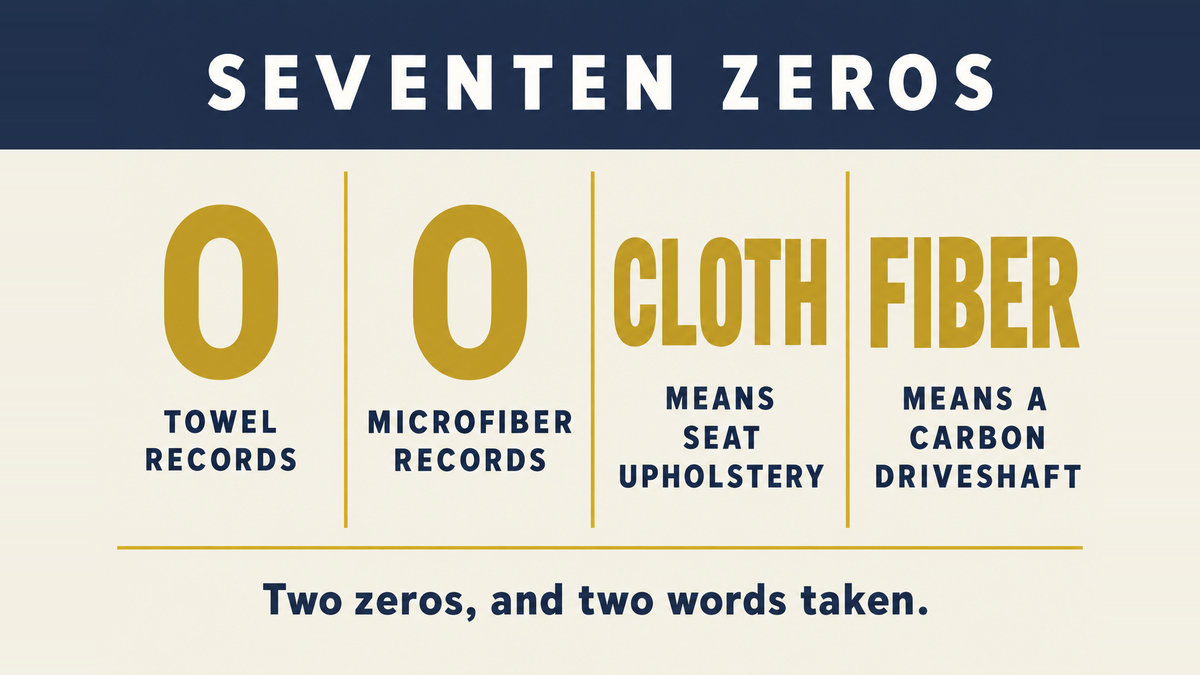
Seventeen zeros, and the first two are the ones that matter. towel does not appear in 245,845 records, and neither does towels. Neither does microfiber, microfibre or micro fiber. So the word that puts this product inside the labeling rules, and the word the trade prints on the package, are both absent from the vehicle safety record — and the second of them is absent from the labeling rules as well. This is the first article in the series where the regulatory word and the trade word are missing from two different documents for two different reasons.
And the record’s own three words mean three other things. cloth appears 26 times across 5 campaigns, and every campaign in the sample is seat upholstery: a Nissan Rogue mid and rear seat assembly campaign at 47,098 units, a Ford Ranger child seat latch anchor at 37,625, an Audi Q4 e-tron air bag campaign at 5,224, a Range Rover Evoque seat campaign at 66, and a Prevost entertainer coach equipment campaign at 15. In this file, cloth is what a seat is covered in.
fabric appears 624 times across 37 campaigns and is the largest of the three, and it is a different product range again: a Lippert retractable awning at 73,230 units, a Forest River Wildwood at 49,295, a pair of Auto XS heated car seat campaigns at 41,412 and 33,444, a Babideal Storm Booster child seat label campaign at 28,800. These are textile products, and they are the nearest thing in the file to a car care cloth — an awning and a heated seat cover. Neither is a towel.
Then fiber, which is the sharpest of the three. It appears 15 times across 6 campaigns, and three of those campaigns are Mercedes-AMG GT driveshaft campaigns at 1,522, 1,002 and 136 units, alongside a Tesla Roadster battery cable campaign at 439 and a Pagani Utopia air bag campaign at 8. A driveshaft that fails on a GT is a carbon fibre driveshaft. So the record’s fiber is a structural material in a rotating shaft, and the labeling rules’ fiber is the thing the label has to name and put a percentage against. Same word, and the two documents mean opposite things by it: one is a material that must not come apart, the other is a word that must appear in the right order.
The two terms that did appear in a car care sense are the two smallest. wipe appears 8 times across 2 campaigns and both are Cottrell car carriers at 878 and 40 units, filed under exterior lighting — so even the record’s wipe is about a lamp, not a cloth. And detailing reaches 6 records in a single campaign and absorbent exactly 1, which is the level at which a word stops being a category and becomes one document.
7. Five Questions a Microfiber Towel Quote Should Answer
A towel quote usually carries a weight in grams per square metre, a blend ratio, a size, a colour, an edge finish and a price. The blend ratio is the only one of those that touches the law, and it touches it in three separate ways. These five questions do the rest.
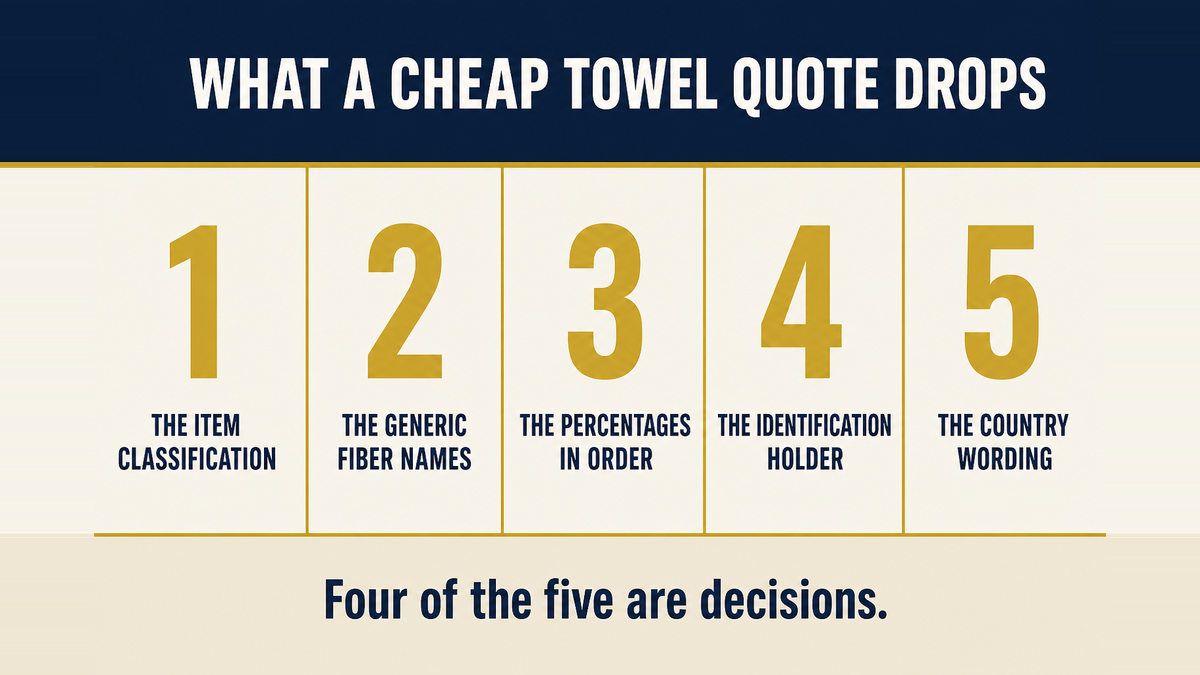
- Which items in this range are towels and which are not? A line sold as a “microfibre set” can contain a towel, a cloth, a pad, a mitt and a disposable wipe, and those five items are in three different regulatory positions. The classification is a decision, not an observation.
- What are the generic fiber names, and in what order do the percentages go? Generic names from the established list, percentages by weight in order of predominance, and anything that has to be called other fiber last.
- Does anyone in your channel write a fiber claim on the pads, the mitts and the plain cloths? Those items may be sold with no statement at all. One fiber claim on a carton or in a listing turns that off and requires the full statement instead.
- Whose name or registered number goes in the identification, and who is accepting responsibility for the label? These are the same question, because the person who directs a processor or finisher to label the product is the person answerable for what the label says.
- What is the country wording, and does it match the making route? If the cloth is knitted in one country, dyed in a second and cut and sewn in a third, more than one honest answer exists and the buyer picks.
8. Six Checks Before You Order
- The range classified item by item — towel, cloth, pad, mitt, disposable — written down, because the noun decides which rule applies and nobody writes it down by default.
- The generic fiber names taken from the established list, not from the mill’s trade name and not from the marketing language.
- The percentages by weight, in order of predominance, with every fiber under five percent aggregated and placed last rather than named.
- The descriptor checked against the conjunction rule, and the two type sizes compared on the artwork: the fiber content must be in lettering of equal size and conspicuousness, so a large trade word above a small generic name is not the required form.
- The identification decided in writing — a name or a registered number — with the responsibility for the label acknowledged by whoever is named.
- The English text proofread for the mechanical rules: no abbreviations, no ditto marks, and no asterisk footnotes carrying the generic name.
Items one and five are decisions on site, so they belong in a factory audit. Item four is the one a pre-shipment inspection should photograph, because type size and placement are decided on the artwork and cannot be corrected once the labels are printed. And because a towel set is bulky rather than heavy, the freight on it turns on volume rather than weight — the same volumetric basis that decides most large, light textile goods.
A car cover can fall outside the textile labelling rules; a towel cannot, and that difference decides the label. A car cover was excluded from the federal textile labeling rules, and the only thing that could bring it in was a fiber claim written by whoever built the carton. A detailing towel is included, and the reason is two words in a list: item (9), towels. That single entry puts the fiber statement, the identification and the country of origin on the label from the first sale, with the fiber content in lettering of equal size and conspicuousness and anything under five percent aggregated as other fiber and placed last.
The same factory’s applicator pads, mitts and plain cloths are outside the rules until somebody makes a fiber claim, and its disposable non-woven wipes are outside permanently, because the paragraph that lifts the exclusion expressly excepts them. And the trade’s own word never appears — not in the rulebook, where microfibre is absent from all of Part 303, and not in the vehicle record, where towel and microfiber are both zero across 245,845 records and the words that are present mean seat upholstery, an awning and a carbon driveshaft. The descriptor may be printed, but only in conjunction with the generic name; the generic name is the one with a definition attached to it, and the definition has a number in it. So classify the range, take the names from the established list, put the percentages in order, and settle who is named on the label before the artwork goes to print.
Frequently Asked Questions
Does a microfiber towel need a fiber content label?
Yes, by default. The labeling rules under 16 CFR Part 303 work by naming products on a closed list of twenty-three entries and excluding every textile fiber product that is not on it. Item (9) of that list reads, in full, Towels. A detailing towel sold as a towel is therefore inside the Act from the first sale, and needs the fiber statement, the identification and the country of origin whether or not the packaging says anything about fiber.
Is “microfibre” allowed on a label?
Only in conjunction with the generic name. Part 303 states that non-deceptive terms which are properly and truthfully descriptive of a fiber may be used in conjunction with the generic name of such fiber, and gives the examples 100 percent cross-linked rayon, 100 percent solution dyed acetate, 100 percent combed cotton and 100 percent nylon 66. In every example the descriptive term is attached to a generic name. A label reading 100 percent microfibre uses the descriptor alone and is therefore missing the generic name. The forms the paragraph supports are 100 percent polyester microfibre or 100 percent microfibre polyester.
What percentage must be stated on a towel label?
The required information includes the generic names and percentages by weight of the constituent fibers present in amounts of 5 percent or more, in order of predominance by weight, with anything that has to be designated as other fiber or other fibers appearing last. A fiber present in an amount under 5 percent is not named at all but aggregated as other fiber, or other fibers where more than one is present, subject to a stated exception for a fiber with a clearly established and definite functional significance at that amount, whose worked example is 96 percent acetate and 4 percent spandex.
Do applicator pads and wash mitts need fiber labels?
Not by default, because they are not on the list. The list names towels, and names wash cloths and dish cloths as a separate item, but it does not name a pad, a mitt or a plain cloth, and the paragraph that follows excludes all textile fiber products other than those on the list. The position changes the moment a fiber representation is made on a label or in any advertisement, because the same part removes the exclusion in that situation and a full and complete fiber content statement then becomes required.
Do disposable non-woven wipes need a fiber label?
No, and unlike the pad and the mitt they cannot be brought in. The exclusion list includes non-woven products of a disposable nature intended for one-time use only, and the paragraph that removes the exclusion where a fiber claim is made expressly excepts that item. So a disposable one-time-use non-woven wipe stays outside the labeling duty even if the packaging makes a claim about fiber.
Who can be named on the label?
The required identification may be the name of the manufacturer or of one or more persons marketing or handling the textile fiber product, or a registered identification number issued by the Commission may be used in lieu of the required name. A brand owner may therefore be the named party, which is usually what a private label buyer wants. The same part adds that a person who causes or directs a processor or finisher to label a product is responsible under the Act for any failure to follow the rules by reason of any statement or omission in that label, so naming yourself and taking responsibility are the same act.
The Order the Label Must Carry
We return the composition, origin and care statement in the sequence the rule requires, with the word that puts you on the list.
Order My Label
Questions & Comments
We read every one and reply within 24 hoursA microfiber towel falls under textile labelling even when it is sold as car care. Send the blend and the market, and we will confirm the fibre names, the origin line and the care text.