
Mud Flaps Manufacturer: Mandatory Here, Permitted There
 ·
Updated October 16, 2026
·
10 min read
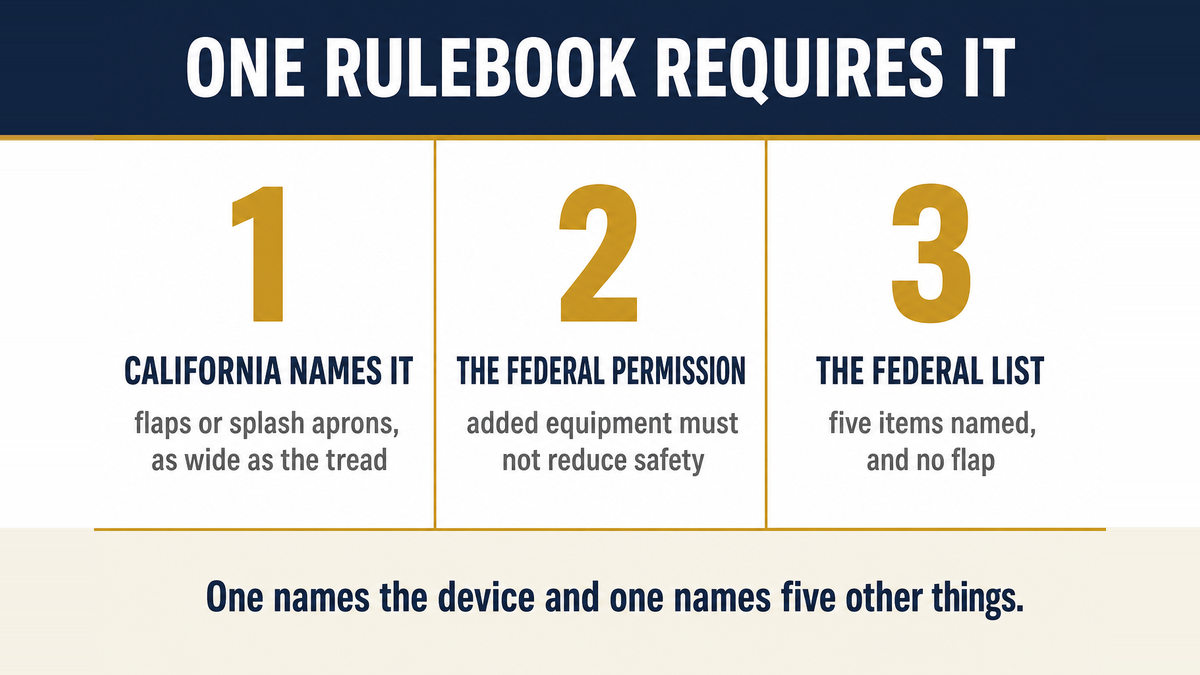
Almost every part in this series protects the vehicle it is fitted to. A mud flap does not. It is fitted behind a wheel to stop water and mud reaching the vehicle behind you, and the rule that requires it is written that way: California orders that a motor vehicle must not be operated unless it is equipped with fenders, covers or devices, “including flaps or splash aprons”, or is otherwise protected “to effectively minimize the spray or splash of water or mud to the rear of the vehicle” — and adds a dimension, that all such equipment shall be at least as wide as the tire tread. Then the same product meets a second rulebook in which it is not required at all: the federal commercial vehicle regulations run from section 393.1 to 393.209 and contain no section for mud flaps, splash guards or spray suppression. Their only clause about added equipment is a permission, and their list of parts that must be securely attached does not include this one.
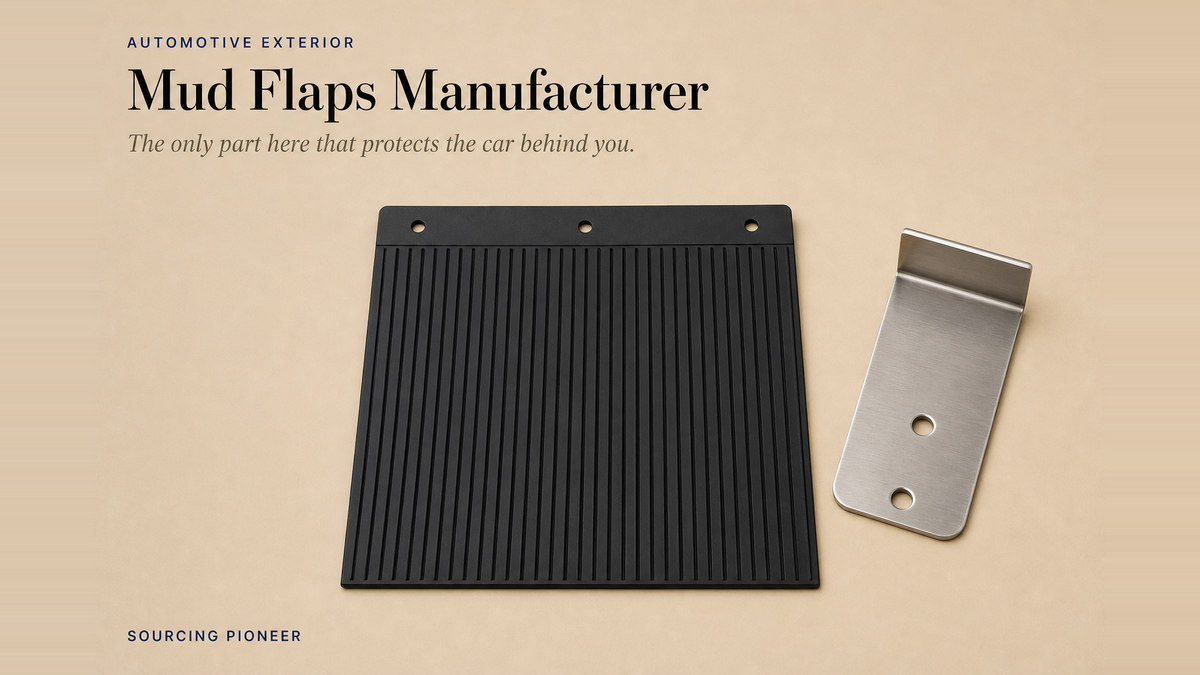
1. What the Product Is: A Part for the Vehicle Behind
A mud flap is one of the simplest mouldings in the catalogue and one of the hardest to quote correctly, because the two things that matter about it are not on the drawing.
| Part | What it decides | Who it protects |
|---|---|---|
| The sheet — rubber, thermoplastic or a rigid moulding | Whether it stays flat and whether it survives a kerb | The vehicle behind, and the panel behind it on your own vehicle |
| The width | Whether it covers the whole tread | The vehicle behind — and this is the one dimension a rule names |
| The drop below the wheel centre | How much of the spray is caught | The vehicle behind |
| The bracket or the push clip | Whether it is still there after a winter | Everyone — because a flap that leaves the vehicle is a road hazard |
Read the third column down and the product is unusual in a way that changes how it is sold. Everywhere else in this series the buyer’s argument for a part is that it protects their own vehicle, and the sale is a quality argument. Here the regulation itself is written in terms of a duty to other road users, which means the buyer’s argument is an argument about the rules and the specification is not theirs to choose. That is worth knowing before the negotiation, because a supplier who understands it will quote the width first and the material second.
What this guide covers
- What the product is: a part for the vehicle behind
- California: the only rule that requires it
- The dimension, and the two exemptions
- The federal rule has no section for it
- What the federal rule does say, and the list it is missing from
- What the record says: the flap that carries the tape
- Three zeros, and a tire counted twenty-nine thousand times
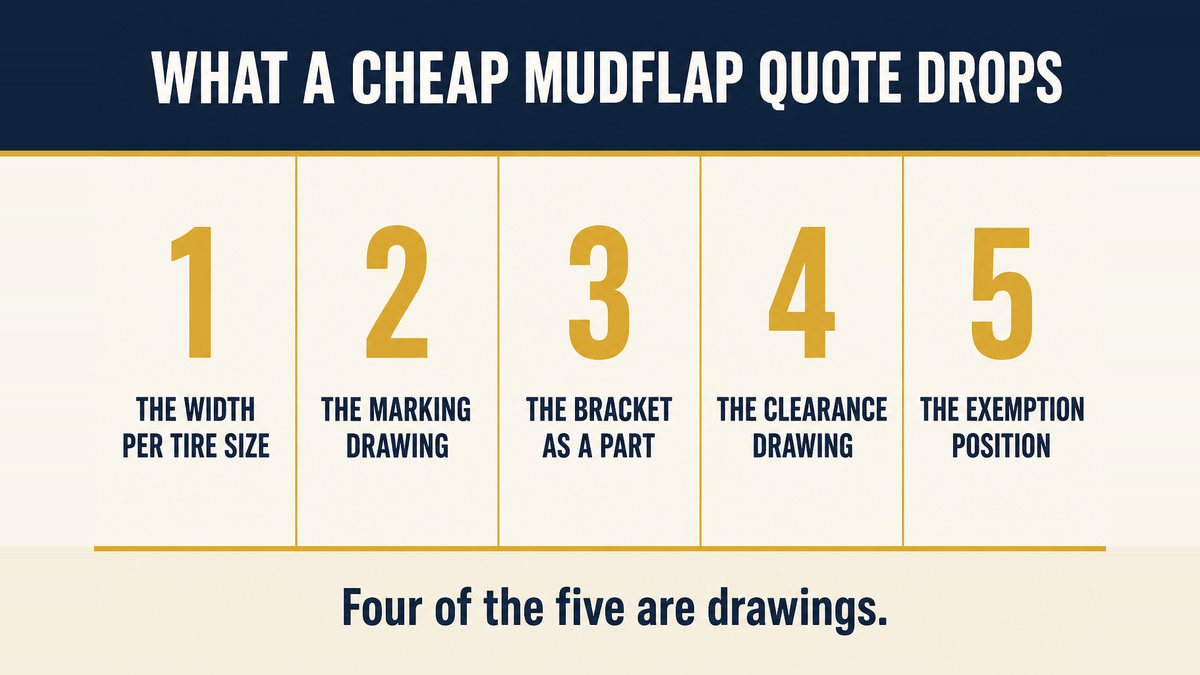
- Five questions a mud flap quote should answer
- Six checks before you order
- Frequently asked questions
2. California: The Only Rule That Requires It
The section is Vehicle Code 27600, and it is written as a prohibition on operating a vehicle rather than as a requirement to fit a device — which is the same drafting shape this series met with windscreen obstructions and window deflectors, used here to opposite effect.
“No person shall operate any motor vehicle having three or more wheels, any trailer, or semitrailer unless equipped with fenders, covers, or devices, including flaps or splash aprons, or unless the body of the vehicle or attachments thereto afford adequate protection to effectively minimize the spray or splash of water or mud to the rear of the vehicle and all such equipment or such body or attachments thereto shall be at least as wide as the tire tread.” — Vehicle Code 27600
Four things in that sentence are a specification, and only one of them is a shape.
- The product is named, in the alternative. Flaps and splash aprons are the two named devices, offered alongside fenders and covers. A supplier is not selling an accessory here; it is selling one of the two devices the section names.
- The purpose is the test, not the part. The alternative route is that the body or its attachments afford adequate protection to effectively minimize the spray or splash. That is a performance outcome, so a vehicle with a well-designed rear body can pass without a flap, and a flap that does not catch the spray does not satisfy the section merely by existing.
- The direction is stated. The clause is about spray or splash to the rear of the vehicle — the road user behind, not the driver.
- One dimension is given. All such equipment shall be at least as wide as the tire tread.
The width requirement is the item to take into a quotation, because it is the only figure in the section and it is stated as a minimum relative to a second part rather than as a measurement. A flap meets the width rule only in relation to a particular tire on a particular vehicle. That means the same moulding can be correct on one fitment and short on another, and a supplier who has been quoting a single width across a model range has been selling a partly wrong part without knowing it.
3. The Dimension, and the Two Exemptions
The section closes with two carve-outs, and both of them are about weight rather than about the product.
“This section does not apply to those vehicles exempt from registration, trailers and semitrailers having an unladen weight of under 1,500 pounds, or any vehicles manufactured and first registered prior to January 1, 1971, having an unladen weight of under 1,500 pounds.” — Vehicle Code 27600
So the carve-outs turn on 1,500 pounds of unladen weight, and the third one adds a model-year line of 1 January 1971 on top of the same weight. The amendment note reads “Amended by Stats. 1970, Ch. 215” — which means the 1971 date and the 1,500-pound figure are the ones the legislature settled on in 1970 and has not revisited since. A dimension and a weight limit written fifty-six years ago are still the operative text.
For a supplier the two exemptions divide the market cleanly. Anything under 1,500 pounds unladen is out of scope for the trailer and semitrailer rule, which is most of the light towing market, while the first clause — vehicles exempt from registration — is a separate class again. A buyer selling into California should know which side of those lines the fitment sits on before the mould is cut, because the answer decides whether the width requirement is a legal requirement or a marketing claim.
4. The Federal Rule Has No Section for It
The second rulebook is 49 CFR Part 393, Parts and Accessories Necessary for Safe Operation, the part that lists what a commercial motor vehicle must carry. Its own section list runs from 393.1 to 393.209, and it is organised into ten subparts. Reading that list in full, there is no section for mud flaps, splash guards, splash aprons or spray suppression anywhere in it.
| Subpart | Subject | Sections |
|---|---|---|
| A | General | 393.1 – 393.7 |
| B | Lamps, Reflective Devices, and Electrical Wiring | 393.9 – 393.33 |
| C | Brakes | 393.40 – 393.55 |
| D | Glazing and Window Construction | 393.60 – 393.63 |
| E | Fuel Systems | 393.65 – 393.69 |
| F | Coupling Devices and Towing Methods | 393.70 – 393.71 |
| G | Miscellaneous Parts and Accessories | 393.75 – 393.94 |
| H | Emergency Equipment | 393.95 |
| I | Protection Against Shifting and Falling Cargo | 393.100 – 393.136 |
| J | Frames, Cab and Body Components, Wheels, Steering, and Suspension Systems | 393.201 – 393.209 |
Subpart G is the one that would hold it — Miscellaneous Parts and Accessories — and its twenty sections cover tyres, sleeper berths, heaters, windscreen wiping and washing, defrosting, mirrors, the horn, the speedometer, exhaust systems, floors, rear impact guards, warning flags, television receivers, bus driveshaft protection, bus standee lines and aisle seats, seats and seat belts, and interior noise levels. There is no mud flap section among them. Subpart D, Glazing and Window Construction, contains three sections and covers glazing, truck and truck tractor window construction, and bus emergency exits — which is the subpart that governed the previous article in this series, and it does not reach a wheel.
So the federal commercial vehicle rulebook, which does state a tread depth for tyres and does require a rear impact guard, states nothing at all about spray behind a wheel. That is the finding of this article, and it inverts the pattern of the previous one: at article 39 the state rule was the narrower of the two and the federal rule reached further on tint; here the state rule is the only one that requires the product.
5. What the Federal Rule Does Say, and the List It Is Missing From
Two clauses come close to the product without reaching it, and both are worth reading for what they omit.
The first is the general permission for added equipment.
“The use of additional equipment or accessories in a manner that decreases the safety of operation of a commercial motor vehicle in interstate commerce is prohibited. Nothing contained in this subchapter shall be construed to prohibit the use of additional equipment and accessories, not inconsistent with or prohibited by this subchapter, provided such equipment and accessories do not decrease the safety of operation of the motor vehicles on which they are used.” — 49 CFR 393.3, source note 78 FR 58484, September 24, 2013
That is a permission with a condition attached, and it is the whole of the federal position on a mud flap. You may fit one. It must not make the vehicle less safe. Nothing in it requires one, and nothing in it sets a width, a material or a mounting method.
The second clause is the more interesting of the two, because it is a list.
“(a) The cab compartment doors or door parts used as an entrance or exits shall not be missing or broken … (b) Bolts or brackets securing the cab or the body of the vehicle to the frame shall not be loose, broken, or missing. (c) The hood must be securely fastened. (d) All seats must be securely mounted. (e) The front bumper must not be missing, loosely attached, or protruding beyond the confines of the vehicle so as to create a hazard.” — 49 CFR 393.203, Cab and body components
Five items are named and required to be secure or present: the doors, the bolts and brackets holding the cab or body to the frame, the hood, the seats, and the front bumper. Then the list stops. A mud flap is not on it, and neither is any other body attachment behind a wheel. The front bumper gets its own sentence — it must not be missing, loosely attached, or protruding — and the flap bolted a metre behind it gets nothing.
Read those two clauses together and the commercial consequence is clear. In the federal rulebook a mud flap is optional equipment that must not reduce safety, and the mounting hardware is not on the list of parts whose security is checked. In California the same product is one of two named devices that a vehicle must carry, with a width relative to the tyre. The requirement is a state requirement, and the federal document that lists everything a truck must have is silent. A supplier whose only reading of the rules has been a federal summary has never seen the clause that actually governs the sale.
6. What the Record Says: The Flap That Carries the Tape
Method first. The federal recall file holds 245,845 records and has no header row, so every field is scanned rather than trusting a column map. Controls: brake appears in 28,639 records and air bag in 16,162. Every term is counted with its own pattern, because a combined search that lists a short word before a longer phrase containing it will consume the text and report the longer phrase as zero.
This product breaks the run of eleven articles before it. The part is named in the record — not once, and not as a passing reference. It is named in 15 records across 4 campaigns as mud flap, and in a further 89 records in a single campaign as mudflap. And the sentence that names it is the one that changes this article, because it is a sentence about reflective tape.
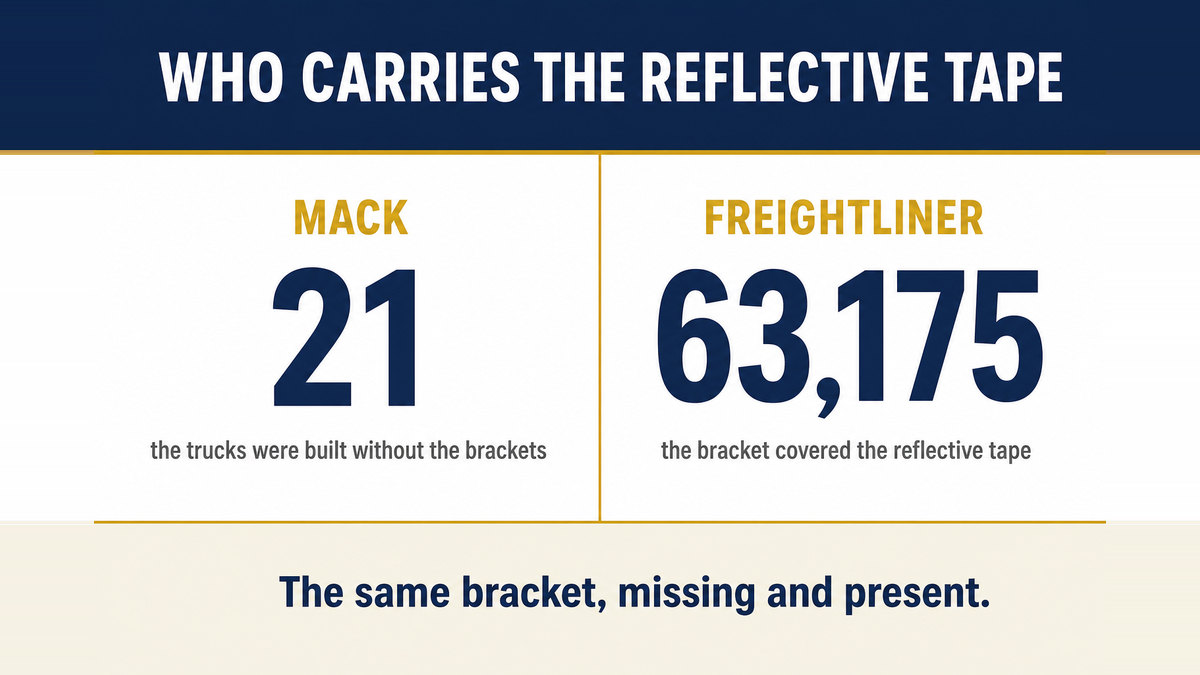
“Mack Trucks is recalling certain model year 2011 CHU and CXU, heavy trucks manufactured from July 13, 2010, through August 13, 2010, without rear mud flap hanger brackets. These vehicles fail to comply with the requirements of Federal Motor Vehicle Safety Standard No. 108, ‘Lamps, reflective devices, and associated equipment.’ The rear conspicuity treatment typically found on the mud flap …” — campaign 10V537000, Mack, 21 units
“The rear reflective tape may be partially covered by the mudflap hanger bracket, which may reduce the vehicle’s visibility to other drivers on the road. As such, these vehicles fail to comply with the requirements of Federal Motor Vehicle Safety Standard (FMVSS) Number 108 …” — campaign 20V214000, Freightliner and Western Star, 63,175 units
Read those two together and the federal position on this product is no longer an absence. It is a mirror pair. In the first campaign the bracket is missing and the vehicle fails the lighting standard because the conspicuity treatment that normally sits on the flap is not there. In the second the bracket is present and the vehicle fails the same standard because the bracket partially covers the reflective tape. The same small steel part, at the same end of the same vehicle, is the reason for a failure to meet Standard 108 whether it is fitted or not.
That is the finding of this article, and it is not about spray. A mud flap is not regulated as a splash device in the federal rulebook, because there is no such section. It is regulated as the thing the reflective tape is stuck to. When the trade sells a flap, it sells a moulding; when the engineer signing the vehicle off looks at it, they see the substrate for a conspicuity marking and a bracket that can hide it.
The product also fails physically, in three ways
The rest of the named campaigns are conventional defects, and each of them is about clearance rather than about spray.
- The bracket weld gives up. Utility Trailer 17V483000, 35 units: “the weld that secures the mud flap bracket to the suspension beam may allow the mud flap bracket to detach. If the mud flap detaches during trailer use, it could become a road hazard, increasing the risk of a crash.”
- The flap wears through something behind it. Kenworth T680 22V582000, 630 units: “the mud flap may contact the fuel tank while the vehicle is in motion, creating wear on the fuel tank over time. Excessive wear of the fuel tank may allow fuel to spill on the roadway.”
- The flap rubs the tyre it hangs behind. Holiday Rambler 16V278000, 49 units: “a section of framework that may rub, or cause the mud flap to rub, against the front passenger-side tire, resulting in excessive tire wear. Additionally, steering may be restricted.”
Three failures, three different neighbours — a suspension beam, a fuel tank, a tyre — and in all three the flap is doing the rubbing or coming loose. There is no campaign in this file where a mud flap failed to reduce spray. The part is only ever recorded for what it touches.
7. Three Zeros, and a Tire Counted Twenty-Nine Thousand Times
| Term | Records | Campaigns |
|---|---|---|
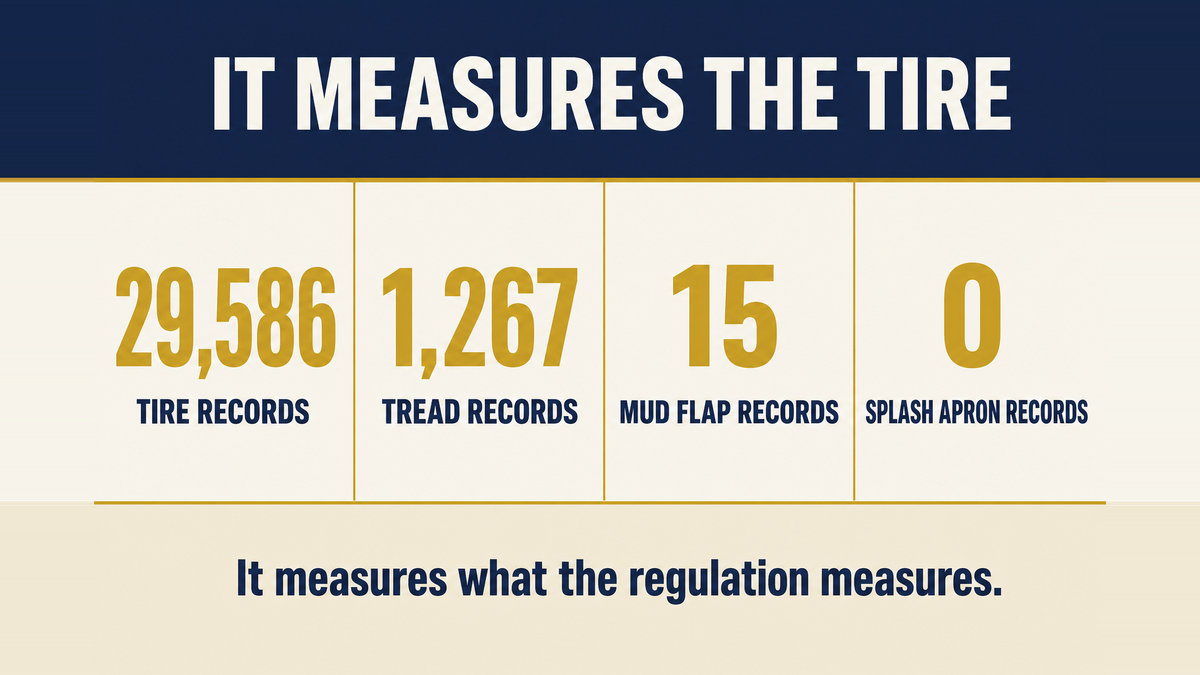
mud flap | 15 | 4 |
mud flaps | 0 | 0 |
mudflap | 89 | 1 |
mudflaps | 4 | 1 |
splash guard | 0 | 0 |
splash guards | 0 | 0 |
splash apron | 0 | 0 |
spray suppression | 0 | 0 |
flap | 78 | 13 |
flaps | 0 | 0 |
fender | 431 | 34 |
wheel well | 502 | 29 |
guard | 383 | 50 |
debris | 1,049 | 105 |
road debris | 174 | 25 |
stone | 181 | 12 |
pebble | 6 | 1 |
gravel | 0 | 0 |
quarter panel | 0 | 0 |
rocker panel | 6 | 1 |
tire | 29,586 | 1,048 |
tread | 1,267 | 151 |
road hazard | 6,247 | 618 |
detach | 14,411 | 1,100 |
The zeros are all the other names. Mud flaps in the plural does not appear, in 245,845 records, although the singular does. Splash guard, splash guards, splash apron and spray suppression are all zero, and flaps as a plural is zero. That last group matters more than it looks: California’s own section names the device as “flaps or splash aprons”, so the record uses one of the two phrases from the statute zero times, while the trade’s other common name — splash guard — is also absent. The part is in the file. Almost none of the words the trade would search for are.
And the tire is counted twenty-nine thousand times. tire appears in 29,586 records across 1,048 campaigns and tread in 1,267 records across 151 campaigns, against 15 records across 4 campaigns for the flap. That ratio is not an accident of recording. It is the rulebook showing through: 49 CFR 393.75 states a required tread depth and forbids operating on a tyre with a tread or sidewall separation, and no section of Part 393 states anything about a flap. The record measures what the regulation measures. For a supplier this is the single most useful number in the article, because it explains why a summary of the rules will always look thin on this product: the part was never on the federal list in the first place.
Three of the trade’s words are other parts. flap appears 78 times across 13 campaigns and the largest is a Mercedes-Benz Metris tyre campaign at 24,359 units, followed by a Ford Bronco frontal air bag campaign at 2,272 and an Audi S8 frontal air bag campaign at 1,047 — so in this file a flap is a piece of tyre tread coming apart, or an air bag flap, not a sheet bolted behind a wheel. fender appears 431 times across 34 campaigns and is always about chafing: an inner fender liner rubbing a brake tube at 287,653 Jeep Wranglers, power cables wearing on an unprotected edge of the passenger-side inner fender on Thomas Built school buses, a wiring harness pinched between the rear subframe and the rear fender on a Kawasaki. And guard appears 383 times across 50 campaigns and is a footrest guard, a chain guard, a tree guard and a bus seat guard — not one splash guard.
The debris words close the same loop. debris appears 1,049 times across 105 campaigns, and the largest campaigns are a Toyota Corolla Matrix power window at 1,814,284 units, a Ram 1500 curtain air bag at 1,021,279, a Nuna child seat harness adjuster at 608,786 and a Toyota Tacoma axle at 381,199. stone appears 181 times, and the campaign to read is a Kawasaki Concours 14: “due to a gap between the brake pedal and guard, small stone or debris can become trapped, creating a brake drag.” In this file, debris and stones are things that get into a mechanism and stop it working. None of them is a stone thrown by a wheel at the car behind, which is the entire purpose of the product.
8. Five Questions a Mud Flap Quote Should Answer
A mud flap quote usually carries a material, a thickness, a height, a colour, a fixings pack and a price. None of those answers the two things that make this product different from every other moulding. These five do.
- What width does each fitment need, measured against the tire tread it has to cover? The statute states the width relative to a second part, so one width across a model range is a partly wrong answer even when every piece is well made.
- Does the flap carry reflective tape or conspicuity treatment, and is the marking still fully visible once the bracket is fitted? This is the question the record answers twice and in opposite directions, and it is decided by the bracket drawing rather than by the flap.
- What holds the bracket on, and is the weld or the fastener specified as a part? Two of the named campaigns are about the bracket or its weld, not about the sheet.
- What does the flap clear behind the wheel at full suspension travel? The named failures are a suspension beam, a fuel tank and a tyre — three neighbours, and the clearance is a drawing rather than a claim.
- Which side of the exemptions does each fitment sit on? The California carve-outs turn on 1,500 pounds of unladen weight and a first-registration date, so the answer is a property of the vehicle, not of the flap.
9. Six Checks Before You Order
- The fitment list with a width per tire size, rather than one width quoted for a range — and the width stated against the tread it covers.
- If the flap carries a marking, a drawing that shows the tape unobscured once the bracket is mounted, dimensioned from the bracket rather than from the flap edge.
- The bracket and its weld or fastener specified as parts, with the retention method named and the material grade stated.
- A clearance drawing against everything behind the wheel: the tyre at full articulation, the fuel tank, the suspension beam and the body frame.
- The exemption position in writing — unladen weight and first registration date per fitment — so the buyer knows whether the width requirement is a legal duty or a selling point on each line.
- The instruction sheet and the fixings pack, because on this product the customer fits the bracket, and a bracket fitted without the marking in view is the fault that produced the largest campaign in this article.
Items three and four are on site questions, so they belong in a factory audit rather than in an email. Item six is the one a pre-shipment inspection should photograph, since the fixings pack and the sheet are the last things anyone looks at and the first things the customer needs. And because a flap set is large and light rather than dense, the freight on it turns on volume rather than weight — the same volumetric basis that decides most large, light mouldings.
Two rulebooks point in opposite directions from the same sheet of rubber, and one of them names California. California requires it: no vehicle with three or more wheels, and no trailer or semitrailer, may be operated unless it is equipped with fenders, covers or devices, including flaps or splash aprons, to effectively minimize the spray or splash of water or mud to the rear of the vehicle, with every such fitting at least as wide as the tire tread — and the 1,500-pound and 1971 lines were settled in 1970. The federal commercial vehicle part, read from its complete section list of 393.1 to 393.209, has no section for it at all: it permits added equipment only if it does not decrease safety, and its list of body components that must be securely attached names the doors, the cab bolts, the hood, the seats and the front bumper, and stops. Yet the same federal record holds a mirror pair in which the mud flap bracket is the reason for a failure to meet Standard 108 — once because the bracket was missing and the conspicuity treatment that lives on the flap went with it, once because the bracket partly covered the reflective tape on 63,175 trucks.
The part is not regulated as a splash device. It is regulated as the thing the tape is stuck to. So specify the width per tyre, put the marking and the bracket on the same drawing, name the weld as a part, and check the clearance to whatever sits behind the wheel.
Frequently Asked Questions
Are mud flaps required by law?
In California they are one of the named routes to meeting the rule. The vehicle code says no person shall operate a motor vehicle having three or more wheels, any trailer or semitrailer unless equipped with fenders, covers or devices including flaps or splash aprons, or unless the body of the vehicle or attachments to it afford adequate protection to effectively minimize the spray or splash of water or mud to the rear of the vehicle. A flap is therefore named in the alternative rather than required by name, and a vehicle with a well designed rear body can satisfy the section without one.
How wide must a mud flap be?
The same section states that all such equipment, or the body or attachments relied on instead, shall be at least as wide as the tire tread. That is the only dimension in the section, and it is stated relative to a second part rather than as a measurement in inches, which means the same moulding can be correct on one fitment and short on another.
Do federal rules require mud flaps on commercial vehicles?
The federal commercial vehicle part, 49 CFR Part 393, runs from section 393.1 to 393.209 across ten subparts, and its section list contains no section for mud flaps, splash guards, splash aprons or spray suppression. Subpart G, Miscellaneous Parts and Accessories, covers tyres, sleeper berths, heaters, windscreen wiping and washing, defrosting, mirrors, the horn, the speedometer, exhaust systems, floors, rear impact guards, warning flags, television receivers, bus driveshaft protection, bus standee lines and aisle seats, seats and seat belts, and interior noise levels.
What does the federal rule say about added equipment?
It permits it with a condition. Section 393.3 says the use of additional equipment or accessories in a manner that decreases the safety of operation of a commercial motor vehicle in interstate commerce is prohibited, and that nothing in the subchapter shall be construed to prohibit the use of additional equipment and accessories, not inconsistent with or prohibited by the subchapter, provided they do not decrease the safety of operation. That is a permission and not a requirement, and it sets no width, material or mounting method.
Why does the recall file mention mud flaps?
Because on heavy trucks the flap is what carries the rear conspicuity treatment. A Mack campaign of 21 vehicles was recalled because the trucks were built without rear mud flap hanger brackets and the conspicuity treatment typically found on the mud flap was therefore missing, which failed Federal Motor Vehicle Safety Standard No. 108. A Freightliner and Western Star campaign of 63,175 units was recalled for the same standard because the rear reflective tape could be partially covered by the mudflap hanger bracket.
Which vehicles are exempt from the California requirement?
Three classes: vehicles exempt from registration, trailers and semitrailers having an unladen weight of under 1,500 pounds, and any vehicles manufactured and first registered prior to January 1, 1971, having an unladen weight of under 1,500 pounds. Two of the three turn on 1,500 pounds of unladen weight and the third adds a model year line on top of the same weight. The section was amended by Stats. 1970, Ch. 215.
Which States Require It, Which Only Permit It
We return the states that mandate the flap, the dimension and its two exemptions, and the federal list that never names it.
Map My States
Questions & Comments
We read every one and reply within 24 hoursA mud flap is mandatory in one state and permitted in another, from the same sheet of rubber. Send the fitment list and the states, and we will set width, bracket and marking.