
Car Air Freshener Wholesale: A Chemical, Not a Car Part
 ·
Updated October 16, 2026
·
10 min read
Every product in this series so far has been judged as a component of a vehicle. This one is not judged as a vehicle part at all. A car air freshener is a chemically formulated consumer product, and the rules that bind it are air-quality and toxics rules. That is why the federal recall file holds 245,845 records and mentions the phrase air freshener in none of them — along with fragrance, scent, perfume, aroma, incense, odour, odorant, deodoriser and vent clip. Fifteen of the seventeen nouns this product is sold under do not appear in the file at all. The other two were a smell complaint and an airbag inflator.

1. What It Is Made Of, and Why It Is Not a Car Part
The physical product is a housing, a scent delivery method and a formula. The housing may be a vent clip, a hanging card, a small bottle for an air vent, a tin of gel, or a can. The delivery method is a wick, a porous pad, a membrane, a gel, or a propellant. The formula is a mixture of fragrance oils and a carrier — usually a solvent, sometimes water, sometimes neither.
Everything that decides whether the product may be sold is in that third item, and the third item is chemistry.
| Part | What it decides | Which regime sees it |
|---|---|---|
| The fragrance oil | The scent, and the flash point of the blend | The shipping rules, via one measured number |
| The carrier or solvent | How it evaporates, and how flammable it is | The shipping rules and the VOC limits |
| The propellant, if any | Whether it is an aerosol | Both the shipping rules and the greenhouse gas rules |
| The named compounds | Whether it may be sold in California at all | Three separate prohibition lists |
| The label | Whether the customer knows what is in it | The consumer product rules, and the marketplace |
| The housing | How it is fitted, and whether it fits | Nobody, and that is the point |
What this guide covers
- What it is made of, and why it is not a car part
- The prohibition lists that name it
- The VOC regime: over 130 categories
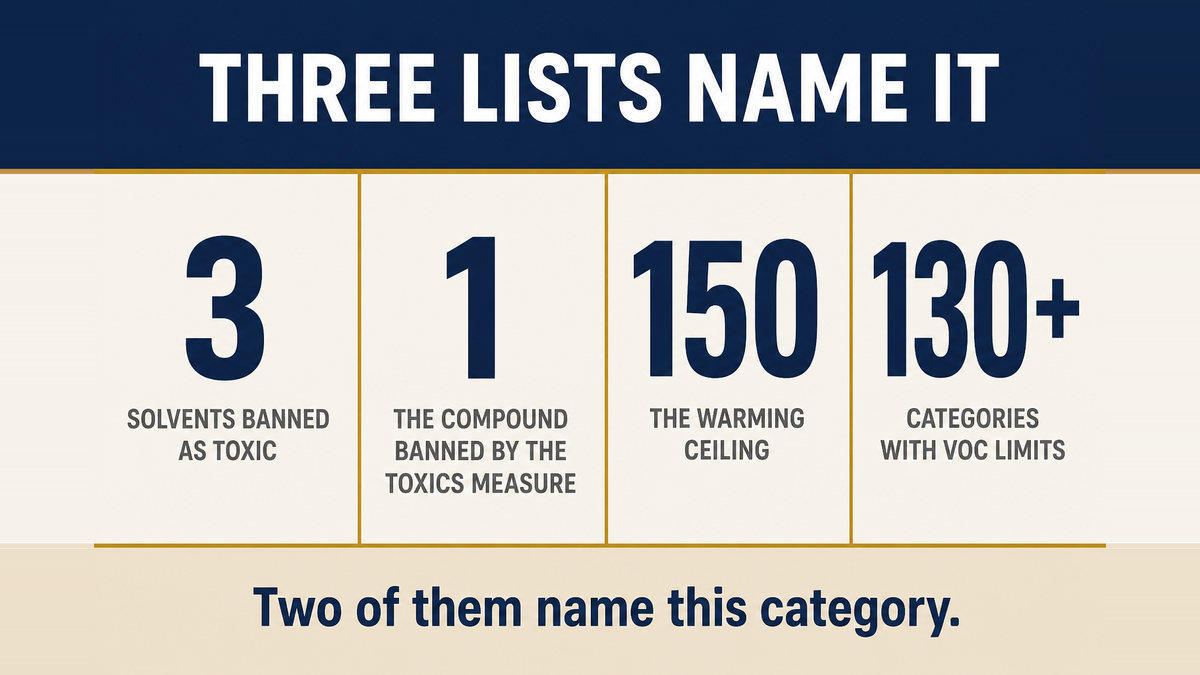
- The three compounds that may not be in it
- The greenhouse gas ceiling of 150
- The flash point, and the shipping class
- The mixture rule that sets the flash point
- What the record says: fifteen zeros
- The word that means something else
- How a formulator answers a limit
- Five questions a quote should answer
- Six checks before you order
- Frequently asked questions
2. The Prohibition Lists That Name It
The regime that catches this product is run by the California Air Resources Board, and the reason it exists is worth stating because it explains why a scent product has an air-quality regulator. Volatile organic compounds emitted from consumer products react with other pollutants in sunlight to form ground-level ozone and fine particulate matter — the ingredients of smog. The state regulates how much of those compounds a product may contain.
CARB’s own definition of the products it covers is broad, and it names the automotive aisle explicitly. A consumer product means a chemically formulated product used by household and institutional consumers, including detergents, cleaning compounds, polishes, cosmetics, personal care products, home and garden products, disinfectants, aerosol paints, and automotive specialty products.
Within that remit, the Air Freshener category is named on prohibition lists in two places, and a third prohibition is one CARB ties to the product in its own words.
| The list | What it prohibits | Is Air Freshener named? |
|---|---|---|
| Toxic air contaminants | Perchloroethylene, methylene chloride and trichloroethylene may not be used in the listed categories | Yes — Air Freshener is named in it |
| Air toxics control measure | Para-dichlorobenzene, a potential human carcinogen | Not as a category, but CARB records that it has been used in air fresheners |
| Greenhouse gas prohibitions | Compounds with a global warming potential of 150 or greater | Yes — Air Freshener is on that list too |
The first list is the one to read carefully, because it is a list of chlorinated solvents. Perchloroethylene is dry-cleaning fluid; methylene chloride is a paint stripper; trichloroethylene is a degreaser. Those three compounds are prohibited from use in an Air Freshener, and the same prohibition covers an engine degreaser and a brake cleaner, which tells you the regulator treats the categories as one family of formulations with one family of hazards.
The greenhouse gas list is the most interesting for a formulator, because its purpose is to stop a loophole. As CARB puts it, the prohibitions exist so that reformulation strategies adopted in response to lower VOC standards do not move to high global warming potential compounds that are otherwise exempt from the VOC definition. A propellant that is VOC-exempt can still be forbidden.
3. The VOC Regime: Over 130 Categories
The main body of the rules is the California Consumer Products Regulations, and its general article is the Regulation for Reducing Emissions from Consumer Products, sections 94507 to 94517, known as the General Consumer Products Regulation. Three regulations together have set volatile organic compound limits for more than 130 consumer product categories, and CARB records that they reduced emissions by about 50 per cent between 1990 and 2020 relative to uncontrolled levels.
Two features of that regime matter commercially more than the individual figures.
The first is that the limits are set per category and per product form. The state’s clean air law requires CARB to confirm that each new rule is commercially and technically workable and does not eliminate a product form, and the Attorney General has issued an opinion on what a product form is. The practical consequence is that a spray and a hanging card are not the same product for the purposes of a limit, which is why product form is a design decision and not just a packaging choice.
The second is that the limits are enforced by a test method rather than by a declaration. Consumer Product Test Method 310 is the method, published with its own standard operating procedures, and whether a product is within the rules is answered by running it.
4. The Three Compounds That May Not Be in It
For a buyer, the three prohibited solvents are the single most useful thing in this article, and the reason is that they are cheap. Perchloroethylene, methylene chloride and trichloroethylene are effective solvents with long industrial histories, and a formula built around one of them would perform. What a buyer needs is not a total ban on their use anywhere in the factory; it is a written statement that they are not in this formula, because a car air freshener sold into California may not contain them.
The request is unusually easy to specify. Ask for the formula’s ingredient declaration and check three names against it. A supplier who is asked for a safety data sheet will supply one; a supplier who is asked whether these three specific compounds are present is being asked a question that cannot be answered with a generic document.
5. The Greenhouse Gas Ceiling of 150
The greenhouse gas rule is worth its own section because it is the one a supplier is most likely not to have considered. The prohibition applies to compounds with a global warming potential of 150 or greater, and the Air Freshener category is on the list alongside aerosol adhesives, insecticide categories, furniture maintenance products, hair care products, lubricants, metal polishes, multi-purpose solvents, paint thinners, personal fragrance products, pressurised gas dusters, spot removers and wasp or hornet insecticides.
Notice what most of those categories have in common: they are aerosol products. The greenhouse gas prohibition is aimed at propellants, and it exists precisely because the VOC rules pushed formulators towards propellant options that were VOC-exempt. For a car air freshener the question is therefore not only what is in the liquid but what is in the can, and a propellant chosen for its VOC status can still fail on its warming potential. That is the trap the rule was written to close, and the reason a supplier’s VOC statement is not the same as a formulation review.
6. The Flash Point, and the Shipping Class
The other regime that binds this product does so for a completely different reason, and it lives in the transport rules. A fragrance blend is largely a solvent, so it has a flash point, and the flash point decides whether the shipment is dangerous goods. The definitions live in 49 CFR 173.120.
“A flammable liquid (Class 3) means a liquid having a flash point of not more than 60 °C (140 °F)… A combustible liquid means any liquid that does not meet the definition of any other hazard class specified in this subchapter and has a flash point above 60 °C (140 °F) and below 93 °C (200 °F).”
Three consequences follow for a sourcing conversation, and they are all about one measurement.
One number decides the paperwork. At or below 60 °C the product is a Class 3 flammable liquid and the full hazardous materials regime applies to it. Above 60 °C and below 93 °C it is a combustible liquid, which is a different and lighter conversation. At 93 °C and above it is neither. A supplier who cannot state the flash point of a finished blend cannot tell you which of those three the shipment is.
The flash point belongs to the blend, not to the fragrance. A fragrance house’s flash point figure describes the fragrance concentrate, and the finished product is a dilution of it. The number that decides the shipping class is measured on what is actually in the bottle.
The exceptions are narrow and specific. The rule sets out five ways a liquid escapes the flammable definition, and three of them turn on measurements rather than opinions: a mixture in which components with a flash point of 60 °C or higher make up at least 99 per cent of the total volume; a liquid with a flash point above 35 °C that does not sustain combustion when tested to the prescribed method; and a liquid with a flash point above 35 °C and a fire point above 100 °C by the prescribed method. Adopting one of those routes means holding the test result, not the argument.
7. The Mixture Rule That Sets the Flash Point
There is one clause in the flash point rules that a formulator should read before the first sample, because it makes blends behave worse than their ingredients suggest.
“For a liquid that is a mixture of compounds that have different volatility and flash points, its flash point shall be determined… on the material in the form in which it is to be shipped. If it is determined by this test that the flash point is higher than −7 °C (20 °F) a second test shall be made… The liquid shall be allowed to evaporate under ambient pressure and temperature for a period of 4 hours or until 10 percent by volume has evaporated, whichever comes first. A flash point is then run on a portion of the liquid remaining in the evaporation container and the lower of the two flash points shall be the flash point of the material.”
Read that as a sourcing instruction and it says something a formulator may not expect: a blend can become more dangerous as it ages. The volatile fraction leaves first, and the rule assumes it, which is why the figure that governs the shipment is measured on liquid that has been allowed to lose its lightest ten per cent. A blend built to sit just above the line on the day it is mixed may sit below it after four hours in an open container.
That is also the reason a car interior is a difficult place for a fragrance product. The product is designed to evaporate, it is placed in the warmest part of a vehicle, and the fraction that evaporates first is the fraction that decides the flash point. The chemistry of the delivery is the chemistry of the hazard.
8. What the Record Says: Fifteen Zeros
Method first. The federal recall file holds 245,845 records and no header row, so every field of every record is scanned rather than trusting a column map. Controls: brake appears in 28,639 records and air bag in 16,162. Every term is matched on a word boundary and every figure is a de-duplicated record count.
| Term | Records | Campaigns |
|---|---|---|
air freshener | 0 | 0 |
air fresheners | 0 | 0 |
freshener | 0 | 0 |
fragrance | 0 | 0 |
scent | 0 | 0 |
perfume | 0 | 0 |
aroma | 0 | 0 |
incense | 0 | 0 |
odour | 0 | 0 |
odorant | 0 | 0 |
deodoriser | 0 | 0 |
vent clip | 0 | 0 |
atomizer | 0 | 0 |
deodorizer | 1 | 1 |
odor | 72 | 10 |
diffuser | 123 | 6 |
Fifteen of the seventeen terms appear in none of the 245,845 records. That is a stronger result than any previous article in this series, and it has a different cause. The products before this one were vehicle parts that the file had no shelf for. This product is not in the file because it is not part of a vehicle at all. It is a consumer chemical product, and the recall file is a vehicle safety file.
The two rows that are not zero are worth reading, because neither is the product.
“Odor” appears 72 times across 10 campaigns, and every one of them is a symptom rather than a product: fuel odour from a leaking line, an exhaust smell inside a cabin, a burning smell from an electrical fault. The file uses the word to describe something a driver noticed, not something a driver bought.
“Diffuser” appears 123 times across 6 campaigns, and that is the finding of this article in a single word.
9. The Word That Means Something Else
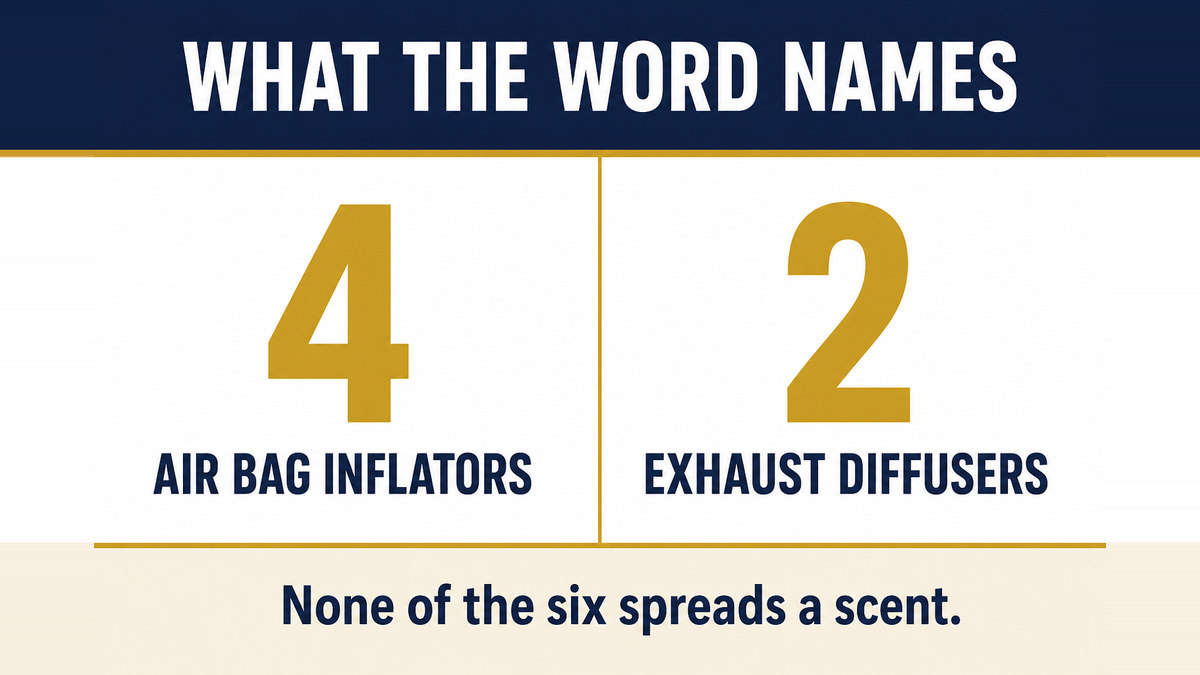
“Diffuser” is the second row that is not zero, and reading the six campaigns behind it changes what this article is arguing. Not one of them is a scent device.
| Campaign | Units | What the diffuser is |
|---|---|---|
| 20E061000 (ZF) | 1,401 | A curtain air bag inflator part that may detach as the bag inflates |
| 20V446000 (GMC) | 769 | A roof-rail air bag inflator diffuser that was not crimped properly |
| 13V497000 | 206 | An exhaust diffuser above the cab; excessive heat could result in a fire |
| 20V374000 (Ram) | 114 | A side curtain air bag diffuser that was not crimped properly |
| 24V645000 (Autocar) | 80 | A horizontal exhaust diffuser that vented exhaust toward a fuel tank |
| 20V415000 (Ford) | 68 | A side curtain air bag diffuser that was not crimped properly |
In all six, the word names a solid part whose job is to spread a gas or heat across a surface and send it where it is meant to go. The part is metal or composite, it is held by a crimp or a bracket, and the failure mode is that it comes loose or points the wrong way. On the two exhaust campaigns the consequence is a fire; on the four air bag campaigns the consequence is a bag that does not inflate as designed.
That is the same idea the fragrance trade means by diffuser — a thing that spreads a vapour rather than releasing it in one place. It is the same word for the same function, and the file puts it on the one version of that function which is safety-critical. So the trade’s name for the delivery mechanism is a word the vehicle safety record already uses for a part that fails.
Compare this with article 33 in this series, where the standard says fog lamp and the file says fog light seventeen times and fog lamp never. There the problem was a word the record does not use. Here it is the harder case: a word the record does use, for something else. A buyer who writes car diffuser in a sourcing brief is using a product noun that, in the one public dataset recording what goes wrong in vehicles, means four air bag inflators and two exhaust parts.
10. How a Formulator Answers a Limit
The rule this product lives under is a limit on a category rather than a ban on a product. CARB states that three regulations have set VOC limits for over 130 consumer product categories, and that those three have cut VOC emissions by about 50 per cent between 1990 and 2020 against uncontrolled levels. A limit set that way is a number a formula has to meet, and meeting it is a design problem.
Three things about how the number is set matter to a buyer.
The regulator publishes its own test methods. The consumer products programme keeps a laboratory test methods page, and Method 310 is named in its own rulemaking record. A composition figure without a named method behind it is an opinion.
Whether a limit is workable is checked by survey, not by argument. The programme surveys manufacturers that sell products in California before it sets a limit, to decide whether the limit is technically and commercially workable. Those surveys also update the emission inventory. So a brand selling into that market may be asked for its own numbers, and the numbers have to come from somewhere.
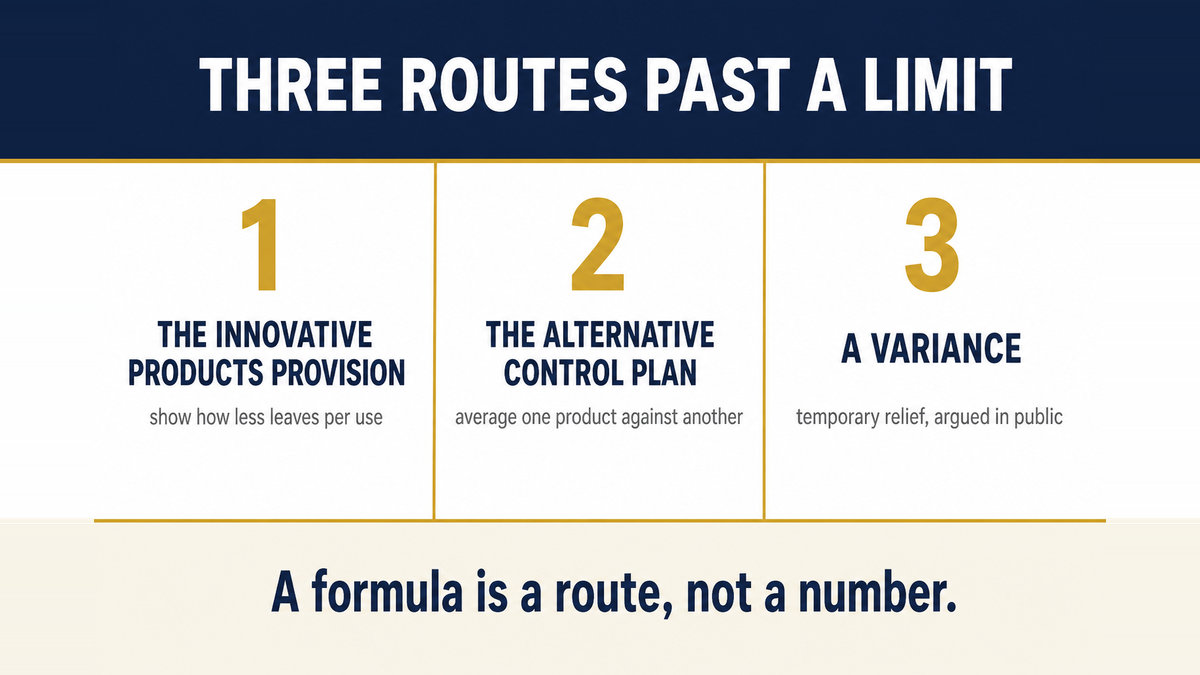
A formula that misses the number has formal routes. Three are published in full on the programme’s own pages:
- The Innovative Products Provision lets a manufacturer go above a performance limit if it can show alternative ways of lowering emissions. The example the programme gives is putting more active ingredient in and changing the dispenser, so that less VOC leaves per use. The limit is on what is emitted, not only on what is in the bottle.
- The Alternative Control Plan lets a manufacturer average, or “bubble”, emissions from products that do not meet the standard with those from products that more than meet it. The total must come out at or below what it would have been had every product met the limit. One product can carry another.
- Variances give temporary relief, and the manufacturer must show in a public hearing that it cannot meet the limit for reasons beyond its control.
There is a fourth way of being legal, and it is the one that most often confuses a quote. CARB has published a category where two different routes both work: for multi-purpose lubricants, the 2018 amendments added an option to meet 25 per cent by weight VOC together with a reactivity limit of 0.45 grams of ozone per gram of product, as an alternative to a 10 per cent by weight VOC limit. Reactivity is the ozone-forming potential of a compound, and for aerosol coatings the limits are set on the maximum incremental reactivity scale. So a product can be within the rules by being lower in mass or by being less reactive, and those are not the same product.
Read all of that from a buyer’s chair and the conclusion is narrow and useful. A formula is a route, not a number. Two suppliers can quote two different formulas, both legally on the market, and neither is lying. What makes them comparable is not the description on the label. It is the composition sheet, the VOC figure and a statement of which limit the figure was measured against.
One structural point is worth keeping, because it is written into the law. California requires that each new consumer product regulation be workable and not eliminate a product form, and the programme publishes an opinion of the Attorney General on product form behind that requirement. So “they have banned air fresheners” is the wrong reading, and “reformulation is impossible” is the wrong reading too. The category is protected; the formula is not.
11. Five Questions a Car Air Freshener Quote Should Answer
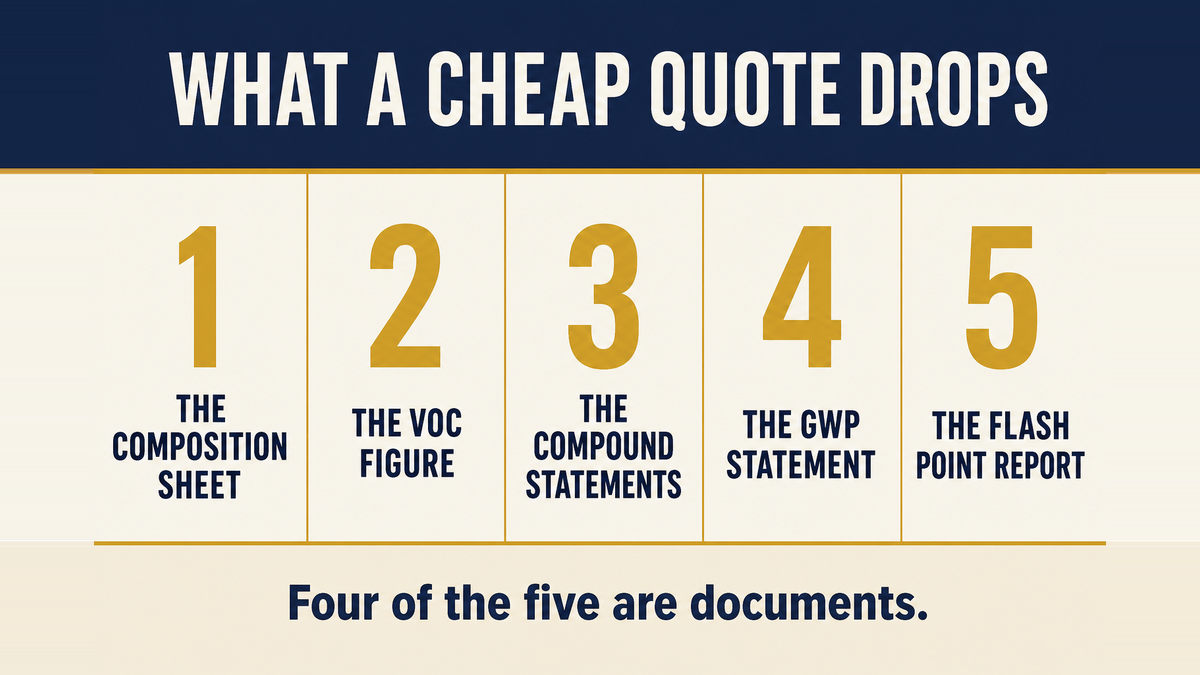
A quote for this product usually carries a scent name, a housing, a unit price and a minimum order. None of those tells you whether the product can be sold. These five do.
- The composition sheet, with percentages. Not a fragrance name. The number the shipping rules use is measured on the finished product, and a fragrance name is a mixture inside a mixture.
- The VOC figure, and the limit it was measured against. A percentage with no category and no limit beside it cannot be checked, and does not say which route the formula is on.
- A written statement on the three named toxic compounds — perchloroethylene, methylene chloride and trichloroethylene. The programme has banned them from this category, and the ban is compound-level, so a fragrance name does not answer it.
- A written statement on global warming potential for every propellant and every compound offered as VOC-free. The rule is on compounds with a GWP of 150 or greater, and this category is on the list.
- The flash point of the finished product as shipped, with the test method and the report. Not the flash point of the concentrate, and not a figure from the fragrance house’s data sheet.
12. Six Checks Before You Order
- The formula, line by line, with percentages that add up to a hundred, rather than a trade name and a claim.
- The VOC figure with its category and its limit, so the number can be checked against a published route.
- The compound statement, covering the three toxic compounds and para-dichlorobenzene, the compound the toxics measure for this category names.
- The GWP statement, including anything described as VOC-exempt, because exempt is a statement about ozone rather than about warming.
- The flash point report on the blend as shipped, which is the only measurement that decides the shipping class.
- The label and the housing together, read as one thing: what the customer must be told, and where the product will sit while it is being used.
That list is what a factory audit turns into questions on site, and what a pre-shipment check confirms from documents rather than from a photograph. On this product the documents are the product. A carton of car air fresheners can look and smell exactly right and still be the wrong formula for the market it is going to.
An air freshener is a chemical product that happens to be sold in the car aisle, and the file that records car defects has almost nothing to say about it. This one has no such test to offer, and the absence is the finding. The federal recall file holds 245,845 records and the product is in none of them — not the phrase, not the category word, not the scent vocabulary — because it is not a vehicle part and never enters that system.
Its rules are written somewhere else entirely, in limits on what may evaporate into the air, in a short list of compounds that may not be used at all, in a ceiling on warming potential, and in one measured flash point that decides whether a shipment is dangerous goods. The trade’s own word for the delivery mechanism has been taken by an air bag part. So ask for the composition sheet with percentages, the VOC figure with its limit, the statement on the named compounds, the GWP statement, and the flash point of the blend as shipped.
Frequently Asked Questions
Do car air fresheners have to meet VOC limits?
They are treated as consumer products rather than vehicle parts, and the state’s definition of a consumer product names automotive specialty products in its own list. Three California regulations have set limits on volatile organic compounds for over 130 consumer product categories, and the category this product sits in is one of them. The limit is a number on the formula, so the thing a buyer needs is a composition figure and the limit it was measured against — not a description of how the product smells.
Which chemicals are banned in car air fresheners?
Two rules land on this category by name. The first bans three toxic air contaminants — perchloroethylene, methylene chloride and trichloroethylene — from use in a list of categories, and air freshener is on that list. The second is an air toxics measure that bans para-dichlorobenzene, described by the programme as a compound that has been used in air fresheners and in toilet and urinal deodorant blocks. A third rule covers compounds with a global warming potential of 150 or greater, and air freshener is on that list as well.
Why does a car air freshener have a flash point?
Because most of what is in it is a solvent. Under the transport rules a flammable liquid is a liquid with a flash point of not more than 60 °C, and a combustible liquid is one with a flash point above 60 °C and below 93 °C. That single measured number decides whether a shipment travels as dangerous goods or as ordinary freight, and the number belongs to the finished blend rather than to the fragrance concentrate that went into it.
Is a car air freshener dangerous goods for shipping?
It depends on one measurement. At or below a flash point of 60 °C the blend is a Class 3 flammable liquid and the hazardous materials rules apply to it in full. Above 60 °C and below 93 °C it is a combustible liquid, which is a lighter set of duties. At 93 °C and above it is neither. There are also narrow exceptions, including a mixture in which components with a flash point of 60 °C or higher make up at least 99 per cent of the total volume, and a liquid that does not sustain combustion when tested to the prescribed method.
What does diffuser mean on a car air freshener?
In the trade it means the part that spreads scent — a wick, a pad, a membrane, a gel or a small bottle. In the federal recall file the same word appears 123 times across six campaigns, and not one of them is a scent device: four are air bag inflator diffusers that were not crimped properly, and two are exhaust diffusers whose position or shape caused a fire risk. It is the same function named twice, and the version the safety record keeps is the safety-critical one.
Why is there nothing about air fresheners in the recall file?
Because the file records defects in vehicles, and this product is not part of one. Across 245,845 records, the phrase air freshener does not appear, and neither do the words fragrance, scent, perfume, aroma, incense, odour, odorant, deodoriser or vent clip. Fifteen of the seventeen nouns this product is sold under are absent. The only two that appear are a symptom — odour, which the file uses for smells a driver noticed from a fault — and the diffuser row above.
Three Banned Compounds, Checked by Name
We return the ingredient list screened against the three named compounds, plus the ceiling figure your market actually enforces.
Screen My Formula
Questions & Comments
We read every one and reply within 24 hoursAn air freshener is a chemical in a car-shaped package, and the label follows the chemistry. Send the fragrance and the market, and we will ask for the VOC figure, the named compounds and the flash point as shipped.