
GPS Tracker Wholesale: A Radio, Not a Car Part
 ·
Updated October 16, 2026
·
11 min read
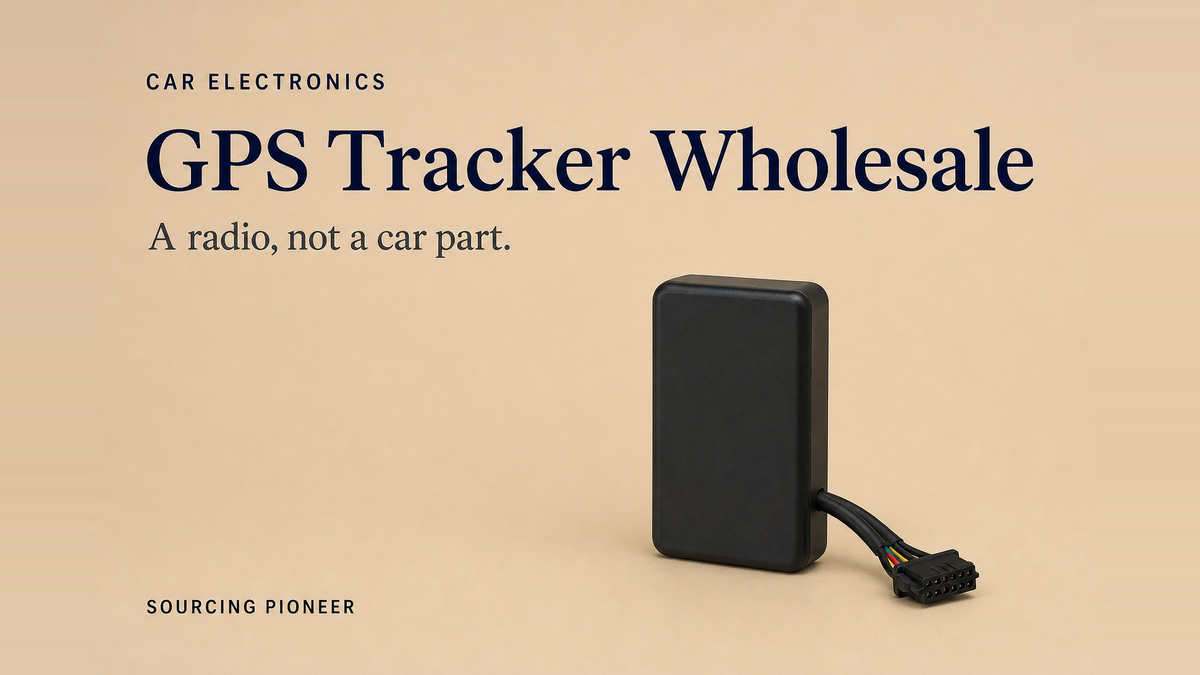
Every other part in this series is judged as a part. A GPS tracker is judged as a radio. It has a transmitter, an antenna and an identification number issued by a telecoms regulator, and that number has to appear on the product in capital letters on a single line, at a size that can be read without a magnifying glass. The federal safety record, meanwhile, never once uses the phrase “GPS tracker” in 245,845 records. The two facts explain each other.
1. What a Tracker Is Made Of, and Which Half Is Regulated
Open a vehicle tracker and you find four things: a positioning receiver that listens to satellites, a cellular module that talks to a network, a small processor and power supply, and a mounting arrangement. Some units add a battery, a motion sensor, or an input for an ignition wire.
Two of those four are regulated, and neither of them is the one a buyer usually asks about.
| Part of the tracker | What it decides | Who regulates it |
|---|---|---|
| The transmitter and antenna | Whether the unit may legally transmit at all | The telecoms regulator, by equipment authorization |
| The module | Whose approval number appears on the label | The module maker’s grant, plus your own obligations |
| The mounting | Whether it stays where it was fitted | Nobody, until something falls off |
| The battery | Whether the unit is a fire risk on a hot dashboard | The transport rules, if it ships with the unit |
| The data service | Whether the customer can see anything after month one | Nobody, and this is the one that ends the relationship |
What this guide covers
- What a tracker is made of
- What the record never calls it
- The line at twenty centimetres
- The label rule
- The module trap
- Four campaigns, one battery
- The one that stopped giving a location
- Four campaigns about where it is fitted
- The antenna and the install sheet
- The data side
- Five questions a tracker quote should answer
- Six checks before you order
- Frequently asked questions
2. What the Record Never Calls It
Method first. The federal recall file holds 245,845 records and no header row, so every field of every record is scanned rather than trusting a column map. Controls: brake appears in 28,639 records and air bag in 16,162.
Then search for the product. The phrase “GPS tracker” appears in none of the 245,845 records. Nor does “stolen vehicle”. Nor, and this is the one that matters for a radio, does “FCC ID”.
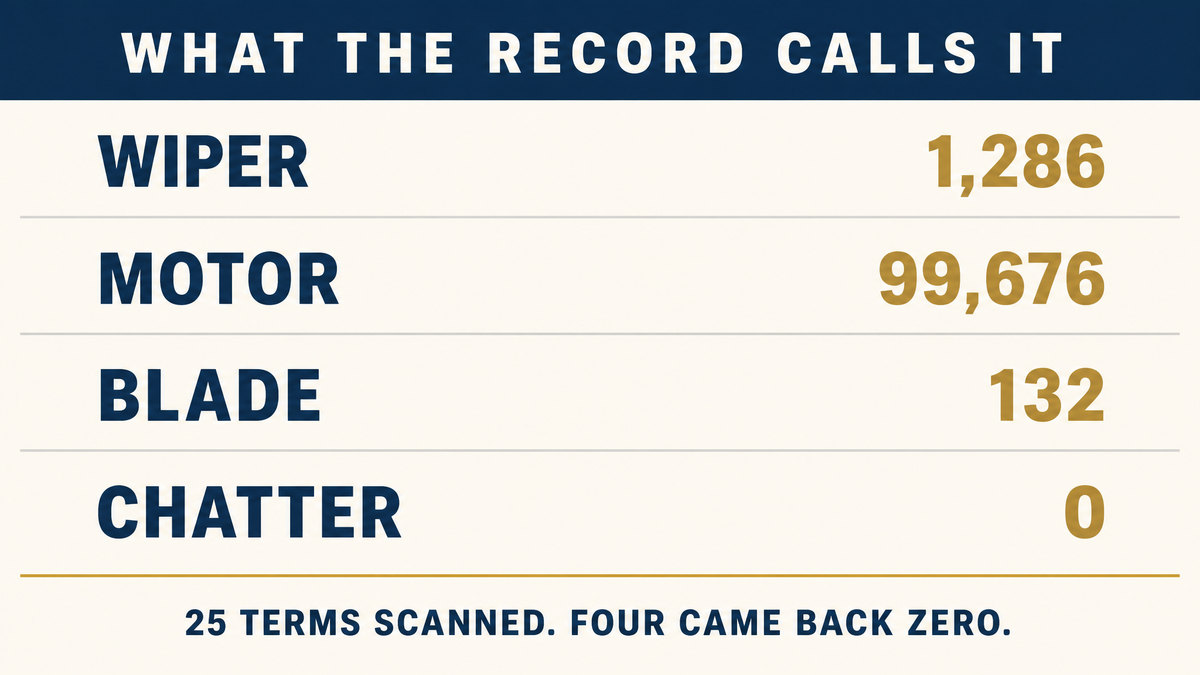
What the record does use is a long taxonomy string that describes the job rather than the product: EQUIPMENT:ELECTRICAL:NAVIGATIONAL SYSTEM(GLOBAL POSITIONING SYSTEM). Three campaigns use it. The word antenna appears in 32 records and OBD in four.
There is also a model-name trap that catches anyone counting this category by keyword, and it is the same trap that the charger article ran into. The word “GPS” appears in 12 campaigns, and three of those are a travel-trailer model called the Starcraft GPS, with the rest being an instrument cluster, an oven and a wiring fault. If you measure the tracker market by searching for its own name, you get a smaller and stranger number than you expect.
3. The Line at Twenty Centimetres
The American rule that decides how much radio testing a tracker needs turns on one distance, and it is a distance that depends on where the product is fitted rather than on how it was designed. The section for mobile devices defines the term as follows.
“A mobile device is defined as a transmitting device designed to be used in other than fixed locations and to generally be used in such a way that a separation distance of at least 20 centimeters is normally maintained between the RF source’s radiating structure(s) and the body of the user or nearby persons.”
The companion section, for portable devices, defines a portable device as one generally used with the radiating structure within 20 centimetres of the body of the user. The two definitions are the same rule read in opposite directions, and a tracker can land on either side of it.
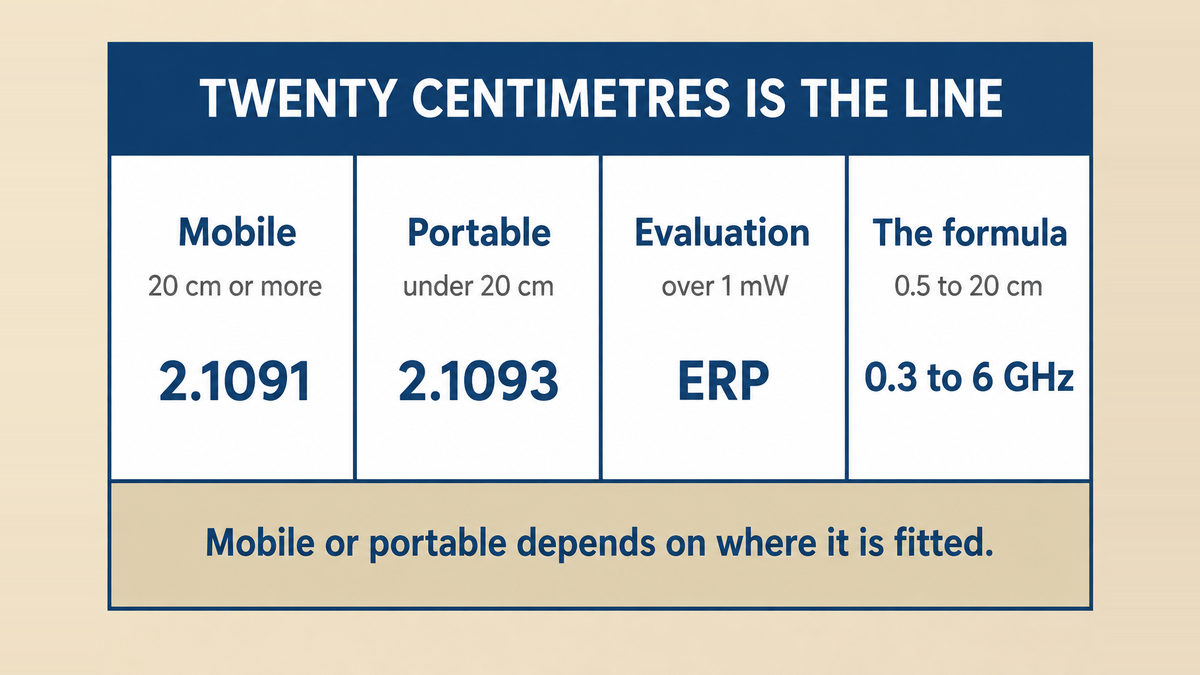
In both cases the evaluation is triggered by a power figure. Where the device has a single radio source, an evaluation is called for when the source has more than an available maximum time-averaged power of 1 mW, or more than the listed effective radiated power, whichever is greater. For portable devices, the supporting formula applies at distances from 0.5 centimetres to 20 centimetres and frequencies from 0.3 GHz to 6 GHz, and it solves for the minimum separation distance from any part of the antenna to the body of the user.
Both sections also say what to do when a device cannot be classified cleanly. The wording for mobile devices notes that in cases such as modular or desktop transmitters, the conditions of use may not allow easy classification, and in those cases the applicant is responsible for working out the minimum distances for the intended use and installation, using specific absorption rate, field strength or power density as appropriate.
For a sourcing decision this becomes a question about the product’s intended position, not its paperwork. A tracker bolted under a dashboard, behind a panel or on a chassis rail is at least 20 centimetres from anybody, so it is a mobile device. A tracker that goes in a pocket, a lanyard or a wristband is within 20 centimetres and is a portable device. The same electronics in a different housing can move from one section of the rules to the other, and the buyer is the one who decides which, by choosing how to sell it.
4. The Label Rule
The identification rule is short, and it is worth reading in full because it is the single most commonly broken requirement on imported trackers.
“Each equipment covered in an application for equipment authorization shall bear a label listing the following: FCC Identifier consisting of the two elements in the exact order specified in § 2.926. The FCC Identifier shall be preceded by the term FCC ID in capital letters on a single line, and shall be of a type size large enough to be legible without the aid of magnification.”
Three things follow, and each one has been the reason a shipment was held. The letters FCC ID have to be there, in capitals, on a single line, ahead of the identifier. The identifier itself has to be in the exact order the rules specify, which is grantee code first and product code second. And the type size has to be readable without a magnifier.
The same section allows the information to be provided electronically under a later provision, which is how a sealed unit with no visible face can still meet the rule. And it deals with a device that contains several radio sections: where the sections sit in one enclosure with shared frequency control, a single identifier is assigned; where they sit on separate boards with independent frequency control, they may carry separate identifiers, and then the transmitter section is preceded by TX FCC ID, the receiver section by RX FCC ID, and any remaining section by plain FCC ID.
A tracker that both receives satellite signals and transmits on a cellular network has at least two radio functions, so this is not a hypothetical. The labelling decision follows the hardware layout, and by the time a supplier is asked about it the enclosure is usually already moulded.
5. The Module Trap
Most trackers are not built radio-first. They use a cellular module bought from a module maker, and that maker holds an approval covering the module. The natural assumption is that the approval travels with the module into your product. The actual rule is narrower, and § 15.212 sets out what a module approval does and does not give you.
To begin with, a module is approved with an antenna. The antenna has to be permanently attached, or every connection between the module and the antenna, including the cable, has to use a unique coupler. The rules also state that the professional-installation provision does not apply to modules — so “our installer knows what he is doing” is not an answer on a module. And the module has to be tested in a stand-alone configuration, not inside another device, with any connected lines at their typical length or at least ten centimetres.
Then come the two requirements that decide whether a tracker shipment is safe.
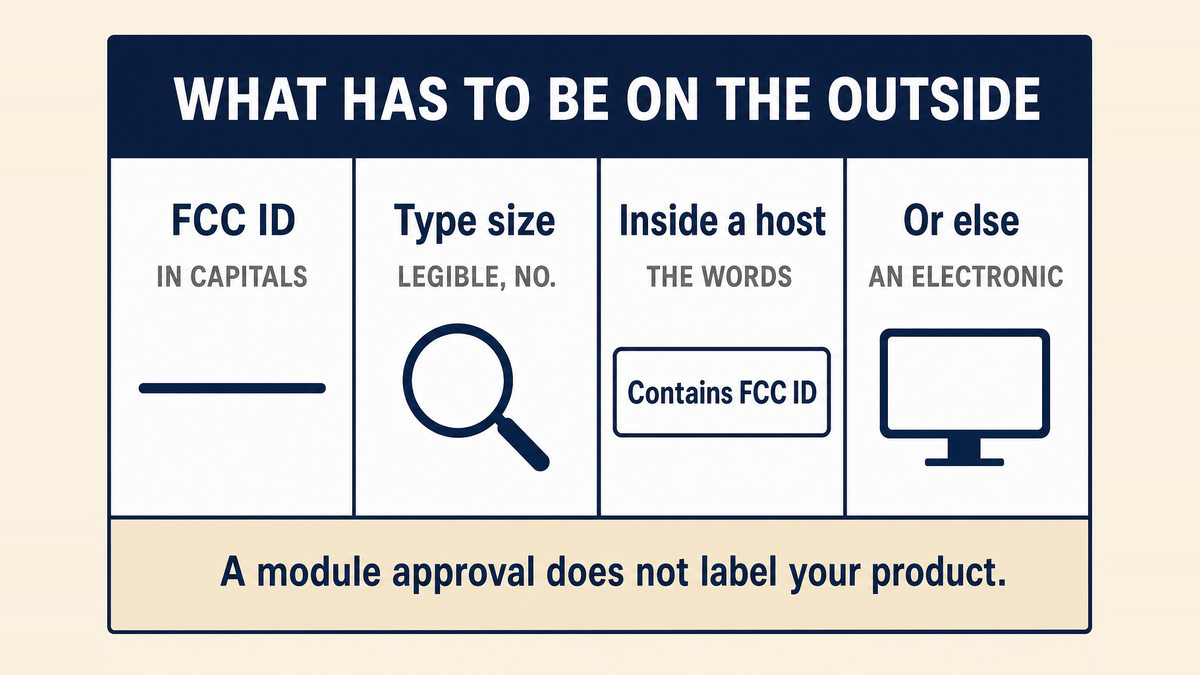
The first is the exterior label. Where the module carries its own label but that label is not visible once the module is inside the device, the outside of the device must also display a label referring to the enclosed module. The rule even gives the wording: “Contains Transmitter Module FCC ID: XYZMODEL1” or “Contains FCC ID: XYZMODEL1”, or any similar wording with the same meaning. Where the module displays its identifier electronically instead, the outside of the host still needs a label, and the user manual has to explain how to reach the display. In both cases the label artwork has to be filed with the authorisation application.
The second is the sentence that catches almost everybody. The modular transmitter must meet the applicable exposure limits in its final configuration, and the application has to include a statement to that effect. A module tested on a bench does not settle the question of what happens when it is enclosed in a plastic box and bonded to a steel chassis rail a few centimetres away.
There is a third route worth knowing about, because it explains the cheap quotes. Where a module does not meet every requirement — its radio elements are not shielded, its inputs are not buffered, its power supply is not regulated — a limited modular approval may still be granted, provided the applicant shows by other means that the module meets the rules in the conditions it will actually be used in. Limited approval is also available where exposure limits have been shown for particular product configurations only. In that case the applicant has to state how control of the end product will be kept, so that the conditions stay met.
That last sentence is the whole article in miniature. A limited approval is a promise that the host product will not change. If your supplier has one and you have never read it, you do not know what you are not allowed to do to the design.
6. Four Campaigns, One Battery
Now to the safety record, which is smaller and more specific than most people expect. Start with the largest GPS recall in the file, and follow it.
Garmin, campaign 10E039000, 736,343 units: certain nüvi portable automotive GPS products, “sold for use as aftermarket equipment and sold and installed as original equipment in certain passenger vehicles”, contained third-party lithium-ion batteries made in a certain date range, and in rare circumstances those batteries could overheat. Note the shape of that filing. It is an E number, filed by the accessory maker, as equipment.
Then three car makers appear in the same file, for the same reason:
- Suzuki, campaign 10V392000, 20,692 vehicles — 2008 to 2010 SX4, 2010 Grand Vitara and 2009 to 2010 Equator, equipped with a Garmin nüvi 750, 760 or 765. The batteries in the affected units could overheat.
- Nissan, campaign 10V401000, 7,948 vehicles equipped with a nüvi 750. Same fault, same words.
- Volvo, campaign 10V566000, 416 vehicles equipped with a Garmin 760. Same fault.
Four recalls, roughly 765,000 units across them, and the defect in every one is a battery inside a device that somebody else made. The car makers are in the file because they installed the accessory, not because they built it. The component field for the Suzuki and Nissan campaigns is EQUIPMENT:ELECTRICAL:NAVIGATIONAL SYSTEM(GLOBAL POSITIONING SYSTEM) — the vehicle’s taxonomy, holding an accessory’s problem.
For a supplier, that is the shape of the risk. If you sell a tracker to a car maker or a fleet builder for installation at the factory, the battery inside it becomes their recall, with their name on it. The cell specification is therefore not a cost detail. It is the reason a large customer will ask you for the cell supplier, the date range and the transport test file.
7. Two Campaigns Where It Stopped Talking
The second cluster is about the data path, and it produces the sharpest safety point in the whole record. Both campaigns describe the same failure: the unit is still there, still powered, and no longer reaching anybody.
Volvo, campaign 18V800000, 17,548 vehicles covering the XC90, S90, V60, V60 Cross Country, V90, XC40, XC60 and V90 Cross Country from 2017 to 2019: the software in the Vehicle Connectivity Module had an error that caused the telematics and driver support systems to function improperly. The stated result is the one that matters: the GPS will not provide location information to emergency personnel in the event of an emergency.
Mercedes-Benz and Daimler Vans, campaign 22V360000, 19,937 units of the Freightliner Sprinter, Mercedes-Benz Sprinter and Mercedes-Benz Metris from 2019 to 2021: an error in the communication module’s SIM card software could cause a mobile network connection failure, disabling the emergency call system. The remedy was a software update, delivered over the air or by a dealer.
Read those two together and the commercial lesson is not about GPS at all. A tracker has two jobs, and only one of them is tracking. The first is to know where the vehicle is. The second is to say so, and the second job depends on a network connection, a module and a line of code. Both of the campaigns above are failures of the second job, and both were fixed by software rather than by hardware.
This is what the last sentence of section 5 predicted. The over-the-air update is the cheapest kind of remedy and the kind that leaves no physical evidence in a warehouse. Two units that look identical can carry different firmware, and only one of them still reaches the network. Ask what firmware a batch carries, and how it will be updated once the customer owns it.
8. Four Campaigns About Where It Is Fitted
The third cluster is the physical one, and it is the largest by count. In four separate campaigns the tracker itself worked; what failed was the act of fixing it to a vehicle.
- Autocar, campaign 21V966000, 251 units of the 2021 to 2022 Xpeditor: the GPS module may have been improperly mounted under the dashboard and could come loose or disconnect entirely.
- Volvo Bus, campaign 22V917000, 20 units of the 2022 9700 bus: the GPS devices may have been installed incorrectly, which can cause an accelerator pedal sensor malfunction and lead to an unexpected loss of drive power.
- CFMOTO, campaign 24V108000, 1,700 units of the 2023 450SS motorcycle: the telematics box may fall onto the front steering forks, which can cause a loss of steering control.
- Arcimoto, campaign 20V031000, 50 units of the 2019 FUV: electrical interference within the harnesses and modules made the instrument cluster display intermittently go blank, which the agency treats as a failure to meet a federal standard for motorcycle controls and displays.
Two of those are small in volume and enormous in consequence. A box that falls onto a steering fork, or a device whose installation disturbs an accelerator pedal signal, turns an accessory into a steering or powertrain fault. The volume figures — 20 units, 50 units, 251 units — are exactly why these recalls do not make the news and exactly why a supplier should read them anyway.
There is a pattern in all four, and it is the same one that ran through the two articles before this one. The defect is in the interface: the mounting, the harness, the bracket, the routing. A tracker is designed by people who understand radios and installed by people who understand vehicles, and the recall file is what happens in the gap between them.
9. The Antenna and the Install Sheet
Two requirements in the module rule reach beyond the module and into the installation, which is why they belong in a sourcing conversation rather than in an engineering one.
The first is the antenna. A module is approved with an antenna, and the rule is that the antenna must either be permanently attached or that every connection between the module and the antenna, including the cable, must use a unique coupler. The professional-installation route is expressly not available for modules. So a supplier who ships a module with a standard connector, on the understanding that the installer will fit a better antenna, has built a product that cannot be shipped under that module approval as described.
The second is the advisory. The mobile-device section says that awareness of exposure can be handled through visual advisories — labelling, embossing, or an equivalent electronic display — together with information about minimum separation distances and proper antenna installation.
“Visual advisories shall be legible and clearly visible to the user from the exterior of the device.”
And the sample of the advisory, showing where it sits on the device, has to be filed with the authorisation application, along with any instructional material meant to accompany the device when it is sold. So the install sheet is not marketing copy. It is part of the authorisation file, and it is checkable.
That gives a buyer three cheap questions with unusually firm answers. Where is the advisory on the product, and can it be read from outside? What does the install sheet say about minimum separation and antenna fitting? And does the artwork for those two things match what the supplier filed with the authorisation?
10. What the Record Counts, and Why It Matters Here
One more measurement point is worth making before the checklist, because this product is the worst in the series for counting by keyword.
The phrase “SIM card” appears in 13,794 records out of 245,845. That sounds like a large body of evidence about connected devices. It is two campaigns — the Mercedes-Benz one above, and a sibling filing by the same group — repeated across thousands of model and year rows. A record count and a campaign count differ by a factor of nearly seven thousand here.
Then take the other direction. “GPS” appears in 12 campaigns, three of which are a travel-trailer model name, one of which is an oven and one of which is a wiring fault. Narrow to campaigns about a tracker or a navigation unit and you are left with a handful. And the two phrases a supplier would use to describe the product — GPS tracker and stolen vehicle recovery — appear in zero records.
This is the third article in a row to land on the same structural fact, so it is worth stating as a rule: the federal recall file describes components, not products. It has a taxonomy for the part that failed inside the vehicle, and it has an equipment branch for accessories that were sold separately. It does not have a shelf labelled with the name on your carton. Any competitor or market analysis built by searching for your product name in this file will return a number that is wrong in both directions at once.
11. Five Questions a Tracker Quote Should Answer
A tracker quote usually carries a network technology, a positioning accuracy and a price. None of those three decides whether the product may be sold, and the first of those three is the one that changes every year.
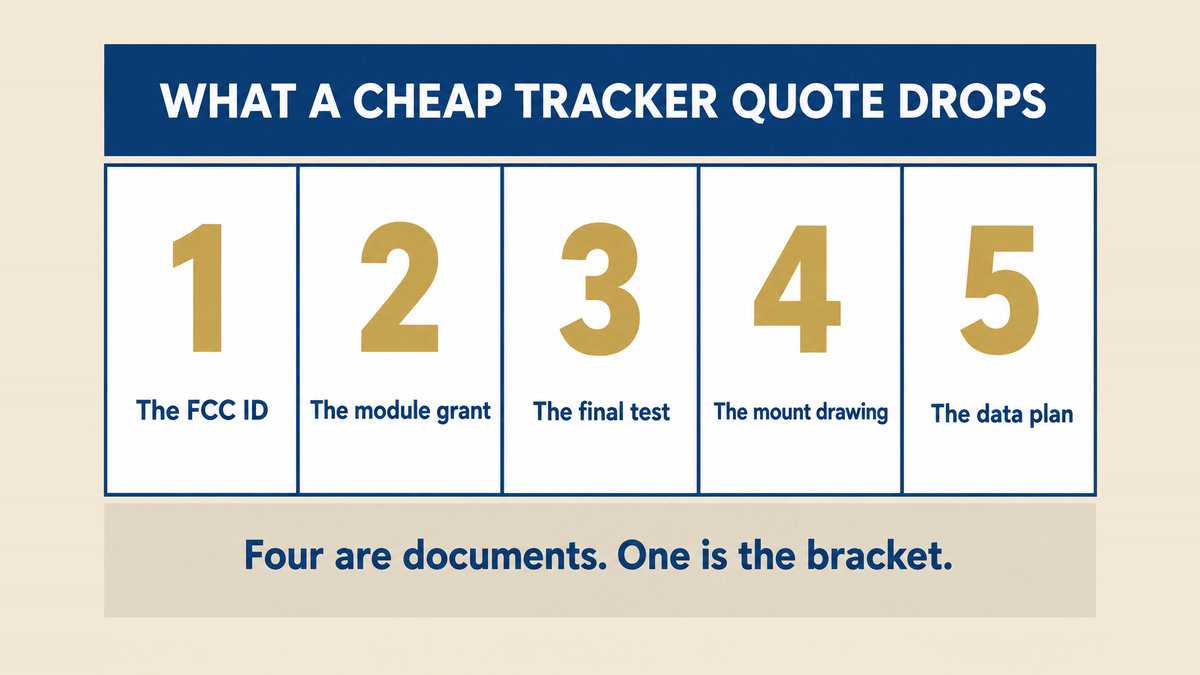
- Who holds the authorisation, and what is the identifier? Not “it is certified”. The grantee code, the product code, and confirmation that the identifier printed on your product is the one that was granted, in the right order, preceded by the letters FCC ID in capitals on one line.
- Is the radio a module, and can I see the grant? If it is a module, the approval belongs to the module maker and carries conditions. If it is a limited modular approval, the conditions are the interesting part, because they say what the host is not allowed to change.
- Was the exposure evaluation done in the final configuration? A bench test of a module is not the question. The question is the assembled unit in its housing, at the distance it will actually sit from a person, and the answer has to name that distance.
- Where does it mount, and what does the bracket attach to? Ask for the mounting drawing. Four campaigns in the record are about nothing else, and two of them involved steering and accelerator pedals.
- What carries the data, and what happens in year two? The network technology, the SIM arrangement, who pays for the subscription, and how firmware reaches a unit already in a customer’s hands.
12. Six Checks Before You Order
- The label artwork, checked against the identification rule: the letters, the capitals, the single line, the order of the two elements, and a type size that survives being printed on a curved plastic case.
- The exterior label for an enclosed module, if the module’s own identifier will not be visible after assembly — including the “Contains FCC ID” wording and whether the paperwork says the label or the instructions carry it.
- The exposure answer in the final configuration, with the separation distance stated in centimetres.
- The antenna arrangement, and whether the connection to it satisfies the permanently-attached or unique-coupler condition.
- The mounting drawing, and what the bracket is fastened to. This is the single most productive document to ask for on this product.
- The firmware and update route, because two of the campaigns in this article were fixed by a line of code and one of them was delivered over the air.
That list is what a factory audit turns into a conversation and a pre-shipment check turns into a photograph. On this product it is worth doing both, because the failure that costs the most is not a rejected unit. It is a label that was right on the sample and wrong on the production run, discovered at a border.
Frequently Asked Questions
Does a GPS tracker need FCC approval?
If it transmits, yes. A tracker contains at least one radio, and radio equipment placed on the American market goes through an equipment authorisation. What that produces is an identifier, and the identification rule requires the product to bear a label carrying the letters FCC ID in capital letters on a single line, ahead of the identifier, at a size legible without a magnifying glass. Most trackers use a cellular module from a module maker, and that changes who holds the approval rather than removing the requirement.
My supplier says the module is already certified. Is that enough?
No, for two reasons that the module rule states directly. First, if the module’s own identifier is not visible once it is installed inside your product, the outside of your product has to carry a label referring to the enclosed module, with wording such as Contains FCC ID followed by the identifier. Second, the module has to meet the exposure limits in its final configuration, and the authorisation application has to say so. A module tested on a bench does not answer the question of what happens inside your housing, next to your chassis.
Is a tracker a mobile device or a portable device?
That depends on where it is fitted, not on how it was designed. A device used with at least 20 centimetres of separation between the radiating structure and the body of the user or nearby persons is a mobile device, and the section that applies is 2.1091. A device generally used with the radiating structure within 20 centimetres of the body is a portable device, and the section that applies is 2.1093. A unit bolted under a dashboard is on one side of that line; the same electronics in a lanyard is on the other.
What triggers an RF exposure evaluation?
For a device with a single radio source, the trigger is more than 1 mW of available maximum time-averaged power, or more than the listed effective radiated power, whichever is greater. For portable devices the supporting formula applies at distances from 0.5 to 20 centimetres and frequencies from 0.3 to 6 GHz, and it solves for the minimum separation distance from any part of the antenna to the body of the user. Both sections also allow for devices that cannot be classified cleanly, such as modules, and put the responsibility for working out the distances on the applicant.
What is a limited modular approval, and why does it matter to a buyer?
It is a module approval granted where the module does not meet every requirement of the ordinary route, such as its own shielding, buffered data inputs or its own power supply regulation, provided the applicant shows by other means that it meets the rules in the conditions where it will be used. It is also available where exposure limits have been shown for particular product configurations only. In that case the applicant has to state how control of the end product will be maintained so the conditions stay met. For a buyer that means the approval carries restrictions on what you may change, and you should read them before you change anything.
Why are trackers recalled for mounting rather than for tracking?
Because that is where the record is. In the federal recall file the tracker itself rarely fails. Autocar recalled 251 trucks because the GPS module could come loose under the dashboard; Volvo Bus recalled 20 buses because incorrectly installed GPS devices could disturb an accelerator pedal sensor; CFMOTO recalled 1,700 motorcycles because a telematics box could fall onto the front steering forks. Two of those involve steering or accelerator pedals. The bracket is the cheapest part of the product and the one that generates the recalls.
With a GPS tracker the paperwork is the product; the safety record is about brackets and batteries that somebody else decided. The safety record is about brackets and batteries, both of which are decided by somebody else; the legal record is about an identifier that has to be printed in capitals on a single line, an exterior label for a module hidden inside, and an exposure answer that has to be given for the assembled unit rather than the radio on its own.
Ask who holds the authorisation, ask to see the module grant, ask for the mounting drawing, and ask how firmware reaches a unit already in a customer’s hands.
A Card the Installer Keeps in the Vehicle
Wiring diagram, antenna placement, and the warning text that stays visible after fitting, printed on one A5 card.
Print My Install Card
Questions & Comments
We read every one and reply within 24 hoursWith a GPS tracker the approval is the product; the bracket and the battery are what get recalled. Send the model and the market, and we will check the radio approval against the battery test.