
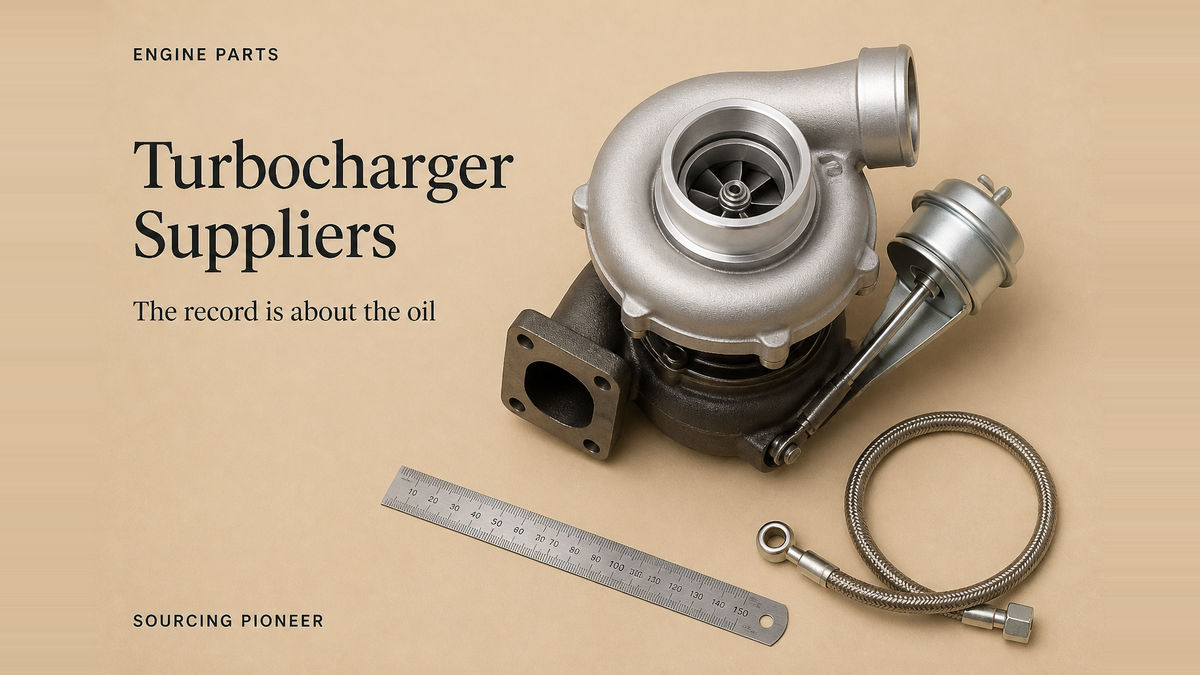
Turbocharger Suppliers: The Record Is About the Oil
 ·
Updated October 15, 2026
·
13 min read
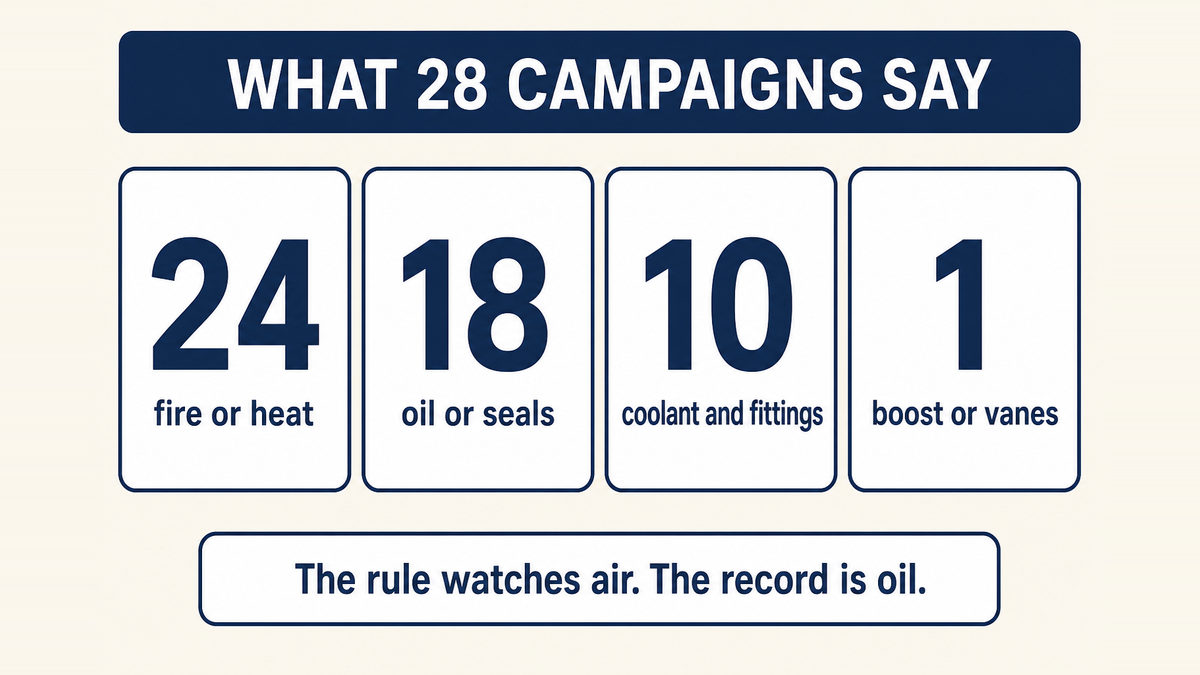
This is the clearest case in the series of a rule and a record pointing in opposite directions. On heavy-duty engines, a federal regulation requires the turbocharger's air to be watched: four specific boost and cooling faults must be detectable. The recall record is about something else entirely. Of the 28 campaigns that name a turbocharger, fire or heat appears in 24 and an oil leak or seal in 18 — while boost control, wastegates and vanes appear in one. Most of what actually fails is not the turbo. It is the pipe that feeds it oil.
1. What a Turbocharger Has to Be
A turbocharger is two wheels on one shaft. Exhaust gas spins a turbine, and the turbine turns a compressor that pressurises the air going into the engine. The shaft runs at speeds that would destroy an ordinary bearing, and the turbine end sits in the exhaust stream, so the two ends of the same shaft live in very different conditions.
That has three consequences for how the part is specified. It needs oil — a pressurised feed into the bearing housing and a drain back to the sump, because the bearings are hydrodynamic and the oil is also what carries heat away. It often needs coolant, because after the engine stops the turbo is still hot and the oil flow has stopped with it. And it needs control, in the form of a wastegate or a set of variable vanes and the actuator that moves them.
| The element | What it decides | What a vague quote hides |
|---|---|---|
| The compressor and turbine wheels | How much air, and how efficiently | The trim, the materials, and what they were balanced to |
| The shaft and bearings | Whether it survives at speed | The bearing type, and the balance and runout limits |
| The oil feed and drain | Whether the bearings get oil, and whether it gets out | The restrictor size, the pipe bore and the drain angle |
| The coolant connections | Whether the housing survives heat soak | Whether it is water-cooled at all, and how |
| The actuator and vanes | Whether boost is controlled | The actuator type, and how the vane mechanism is made |
| The housings | Whether the exhaust and the heat stay inside | The material, and the temperature it was rated for |
| The heat shield | Whether the heat is kept off everything else | Whether one is fitted, and how it is fixed on |
What this guide covers
- What a turbocharger has to be
- The inspection standard does not cover the turbo
- The rule that watches the turbo's air
- What the federal record says about this part
- Four monitors of air, and a record full of oil
- The pipe, not the turbo
- The turbo as somebody else's ignition source
- What a cheap turbocharger quote drops
- Six checks and where the price comes from
- Frequently asked questions
2. The Inspection Standard Does Not Cover the Turbo
The in-use inspection standard has 22 sections, covering brakes, brake power unit, steering, suspension, tires and wheel assemblies plus the heavier-vehicle brake systems. There is no engine section and no turbocharger section, so a turbo has no federal figure to be measured against once the vehicle is in service.
But on a heavy-duty engine, a different regulation reaches the turbo directly — not to inspect it, but to make the engine watch it.
3. The Rule That Watches the Turbo's Air
40 CFR 86.010-18 is the onboard diagnostics rule for engines used in vehicles over 14,000 pounds. It requires the engine to be able to monitor all emission-related systems, and it then devotes a subsection to the turbocharger alone.
(g)(4) Turbo boost control system monitoring.
(i) General. The OBD system must monitor the boost pressure control system (e.g., turbocharger) on engines so equipped for under and over boost malfunctions. For engines equipped with variable geometry turbochargers (VGT), the OBD system must monitor the VGT system for slow response malfunctions. For engines equipped with charge air cooler systems, the OBD system must monitor the charge air cooling system…
40 CFR 86.010-18(g)(4)(i)
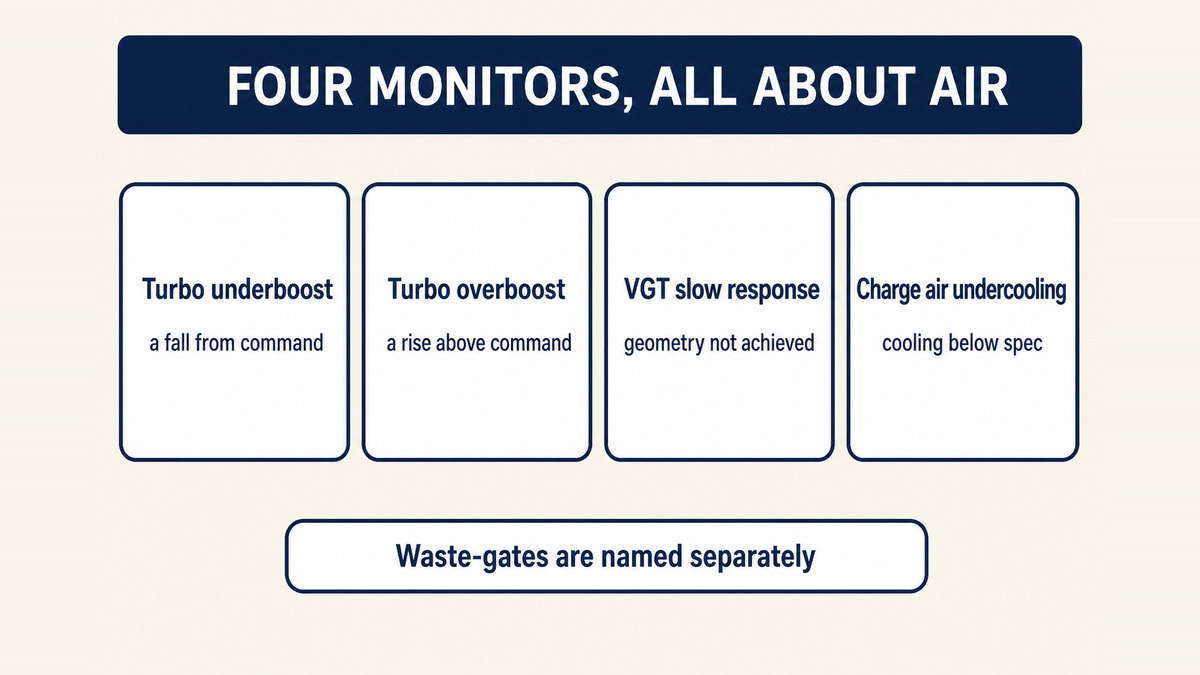
The four malfunctions it names are then defined one by one, and they are an instructive list:
- Turbo underboost — the system must detect a malfunction before a fall from the commanded boost pressure that would take emissions past the rule's limit for other monitors.
- Turbo overboost — the same, for a rise above the commanded pressure.
- VGT slow response — for variable geometry turbos, a deterioration in achieving the commanded geometry within a stated time.
- Charge air undercooling — for engines with a charge air cooler, a fall in the cooling rate below what the maker specified.
And the wastegate is named separately. In the section on components the rule requires to be monitored, the example given for a monitored output component is, in its own words, "turbocharger waste-gates".
So on a heavy-duty engine a turbocharger is not treated as a performance accessory. Four of its failure modes are named obligations, the engine must report them through a warning light and a stored code, and the rule adds that the diagnostics may not be programmed to switch themselves off with age or mileage.
One more detail belongs with it. The section applies to engines in vehicles above 14,000 pounds, and it states that the requirements of a later part, 40 CFR 1036.110, apply from model year 2027. The direction of travel is towards more monitoring, not less.
4. What the Federal Record Says About This Part
Search the same federal recall file used throughout this series and the word turbocharger appears in 193 records across 28 campaigns. The shorter form, turbo, appears in 1,948 records across 89.
The filing splits in a way that already hints at the story. Eleven of the 28 sit under ENGINE:GASOLINE:TURBO/SUPERCHARGER and five under the equivalent for other fuel types. But four are filed not under the turbo at all, but under ENGINE:OIL/LUBRICATION:PIPES, HOSES, AND FITTINGS, and three more under the exhaust system. A quarter of the record is about the hardware around the turbo.
5. Four Monitors of Air, and a Record Full of Oil
Count what the 28 campaigns actually describe, and the contrast with the rule above is complete. Fire or heat appears in 24 of the 28. Oil leaks or seal problems appear in 18. Coolant, hoses and fittings appear in 10. Stalling or loss of power appears in 6.
And boost control, wastegates or variable vanes appear in one.
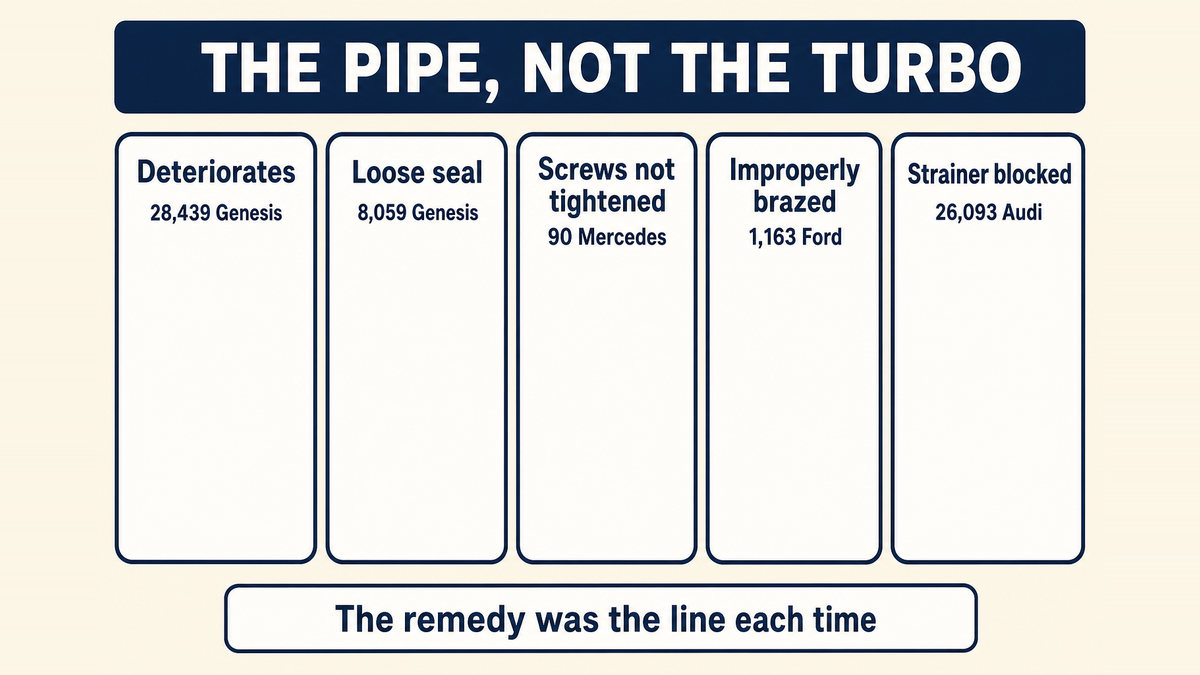
That one campaign is worth naming, because it is the only place in the record where the turbo's own mechanism failed — and even there, the cause was oil. Audi's campaign 22V178000, covering 26,093 A8, S6, S7, S8 and RS7 vehicles, concerns a turbocharger oil supply strainer that can become blocked. Starved of oil, the bearings wear, and a worn bearing lets the turbine wheel touch the housing or the shaft break. The remedy was to replace the strainer and change the oil.
So the regulation that governs the turbo is a rule about air, and the record that describes its failures is a record about oil. That is not a contradiction; it is what happens when a rule is written for one purpose and a failure record is written for another. The rule exists to keep emissions within limits, so it watches boost and cooling. The record exists because somebody's car caught fire, so it is full of oil.
6. The Pipe, Not the Turbo
Read the oil campaigns in a row and the same part keeps appearing: the pipe that carries oil into the turbocharger, and the joint at each end of it.
- Hyundai and Genesis, 24V191000, 28,439 vehicles. The left turbocharger oil feed pipe may deteriorate and leak oil, on 3.3-litre V6 turbocharged Genesis models. Remedy: replace the pipe.
- Genesis, 19V538000, 8,059 vehicles. The turbocharger oil supply pipe may have a loose seal, letting oil leak onto the exhaust manifold. Same remedy.
- Mercedes-Benz, 20V364000, 90 vehicles. The screws retaining the turbocharger oil feed and return lines may not have been properly tightened. The remedy was to inspect and tighten them.
- Mercedes-AMG, 20V048000, 2,518 vehicles. The oil feed line to the turbocharger, across a list of 4.0-litre V8 AMG models. Remedy: replace the feed line.
- Ford, 16V925000, 1,163 vehicles. Improperly brazed turbocharger oil supply tubes. A manufacturing process on a tube, not a defect in the turbo.
- Kia, 22V202000, 26 vehicles, and Hyundai, 22V197000, 16 vehicles. In both, the oil supply pipe to the turbocharger may crack.
- Ford, 23V597000, 10 vehicles. The turbocharger oil supply line may be damaged. The remedy note tells owners to park and shut off the engine if they see an oil pressure warning light or smoke from the engine compartment.
- Ferrari, 2025 296 GTS and GTB. The nut securing the oil filter connection to the turbocharger oil feed pipes was tightened incorrectly. Owners were advised not to drive until repaired, and the fix was to check the tightness and retighten the nut.
- A heavy-duty engine maker's own campaign found that a turbocharger oil supply line could interfere with something else, and the remedy was to eliminate the interference and replace the line.
Thirteen or so campaigns, and the failed item is a pipe, a nut, a screw, a seal, a braze or a strainer. In almost every case the remedy was to replace the line rather than the turbocharger.
That has a consequence worth stating plainly, because it affects who gets blamed. If you supply turbochargers, the failure most likely to be attributed to your part in the first instance is a pipe or a joint that may not be inside your scope at all. The specification for a turbocharger is therefore not complete without the oil plumbing: which pipe, what bore, what restrictor, what seal at each end, and what torque on the fasteners.
7. The Turbo as Somebody Else's Ignition Source
Four campaigns in the record involve a turbocharger that was not defective in any way. In each, something else leaked and the turbo was the hot object that set it off.
A bus with a wheelchair ramp. Campaign 10V538000, covering 217 transit buses, was about a hydraulic fitting for the ramp that could crack in the engine compartment. The record's own consequence sentence says that hydraulic fluid leaking into the engine compartment can be ignited by the hot turbocharger. The turbo was the ignition source, not the fault.
87,431 Ram pickups. Campaign 20V043000 concerns a transmission fluid leak from the dipstick tube on 2019 and 2020 Ram 2500 and 3500 trucks, caused by pressure and heat inside the transmission. The leaking fluid may contact the turbocharger or another ignition source. This is the largest campaign in the article, and the turbo is not the subject of it at all.
A Range Rover whose coolant escaped. Campaign 23V221000, 2,881 plug-in hybrids, began with a water pump drive belt that could fail and let the engine overheat. The overheat could rupture a coolant elbow, and the record's consequence is that coolant leaking onto the turbocharger heat shield increases the risk of a fire.
And one campaign is about the shield alone. Autocar's 21V095000, 577 vehicles, concerns a turbocharger heat shield that may fail and detach — which the record lists as a road hazard rather than a fire risk.
Put those four together and they say something a specification should reflect. A turbocharger's surface temperature is a design output, and its heat shield is a safety component. Two of the largest campaigns in the article are about other people's fluids finding the turbo.
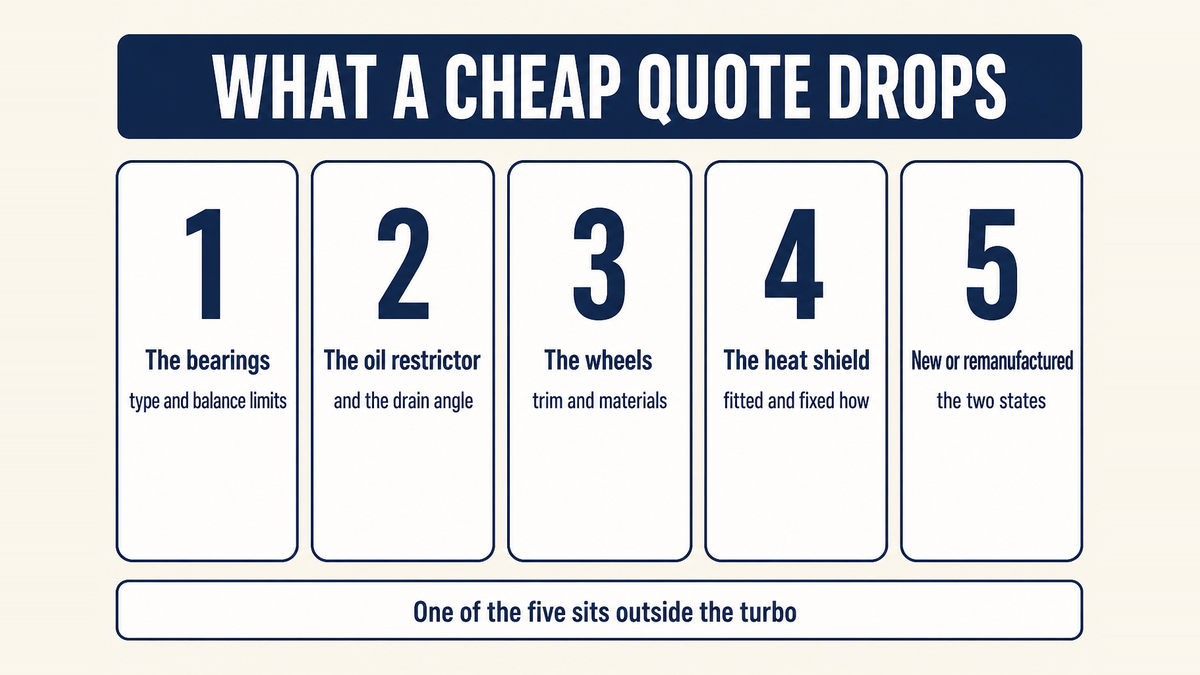
8. What a Cheap Turbocharger Quote Drops
A turbo's cost is in the wheels, the shaft and bearings, the housings and the balancing. Five places a low quotation comes from:
The bearings and what they were balanced to. Balance and runout limits are the figures that decide whether a shaft survives at speed, and they are the figures a cheaper unit leaves out. The Audi campaign above shows how quickly a bearing problem becomes a broken shaft.
The oil restrictor and the drain. The restrictor decides how much oil reaches the bearings and the drain decides whether it leaves. Getting either wrong produces smoke, oil consumption, or a leak onto a hot surface — the failure mode that dominates the record.
The wheel trim and materials. The compressor and turbine wheels are where the airflow is decided, and the turbine wheel is also what lives in the exhaust stream. Their material is not visible in a photograph.
The heat shield. Whether one is supplied and how it is fixed on. One campaign in this article is nothing but a detached shield, and another is coolant landing on one.
New or remanufactured. The remanufactured turbocharger is a normal and large part of this market, and a rebuilt unit is not a problem in itself. What matters is that its state is declared, because a rebuild can restore the outside and leave the bearing and the balance as they were.
9. Six Checks and Where the Price Comes From
Six checks cover a turbocharger before it is ordered.
- The wheel trim and materials, for both the compressor and the turbine.
- The bearing type, with the balance and runout limits stated as figures.
- The oil restrictor size, the feed bore and the drain angle.
- The coolant connections, and whether the unit is water-cooled.
- The actuator or vane mechanism, with the boost it is set to hold.
- The heat shield: whether one is supplied, its material, and how it is fixed.
On the factory side the questions are about the bench: whether every unit is balanced and the report kept, whether the actuator is calibrated and tested, and where the bearings, wheels and housings come from. Our sequence is in the factory audit checklist, and the machining side is covered in metal stamping and machined parts. Where a supplier also holds a social or ethical audit, the scheme behind the certificate is worth reading — see social audit schemes compared.
A turbo's price is built from the two wheels, the shaft and bearing cartridge, the housings, the actuator, and the balancing and testing. The cartridge and the wheels set the base, and the balancing time is the line that goes first — because an unbalanced unit still spins, and often only fails after it has been fitted and paid for.
A turbo is heavy, its housings are brittle and its wheels are easily bent, so it travels in a moulded carton with the inlet and outlet capped: see export packaging quality control and carton drop test standards. Because it moves largely on mass rather than volume, the chargeable weight method is set out in how volume decides what a shipment is charged. How the goods are described for entry is covered in how an HTS code is assigned, and the origin paperwork in the certificate of origin guide.
10. Frequently Asked Questions
Does a turbocharger fall under any federal inspection standard?
No. The in-use inspection standard has 22 sections covering brakes, brake power unit, steering, suspension, tires and wheel assemblies, with no engine or turbocharger section. A turbocharger has no federal figure to be measured against once the vehicle is in service.
Is a turbocharger monitored by emissions rules?
On heavy-duty engines, yes, and in some detail. 40 CFR 86.010-18(g)(4) requires the boost pressure control system to be monitored for underboost and overboost, variable geometry turbos to be monitored for slow response, and charge air coolers for undercooling, with each fault to be detected before emissions would exceed the rule's limit. Turbocharger waste-gates are named separately as a component whose output must be monitored. The section applies to engines in vehicles over 14,000 pounds GVWR, and from model year 2027 the requirements of 40 CFR 1036.110 apply.
What does the federal record show about turbochargers?
193 records in 28 campaigns. Fire or heat appears in 24 of them, oil leaks or seal problems in 18, coolant and fittings in 10, and stalling in 6. Boost control, wastegates and vanes appear in one campaign — and that one was caused by a blocked oil supply strainer, not by a boost fault. A quarter of the campaigns are filed not under the turbo but under oil lines or the exhaust system.
Why do so many turbo campaigns concern an oil pipe?
Because the pipe and its joints are what fail. Around thirteen campaigns concern a turbocharger oil feed or supply pipe that cracked, deteriorated, was damaged, had a loose seal, was improperly brazed, or was held by screws or a nut that had not been tightened properly. In almost every case the remedy was to replace the line rather than the turbocharger, which means the part most likely to be blamed in the first instance may not be the part that was supplied.
What should a turbocharger quotation state?
The compressor and turbine wheel trim and materials; the bearing type with balance and runout limits stated as figures; the oil restrictor size, feed bore and drain angle; the coolant connections and whether the unit is water-cooled; the actuator or vane mechanism and the boost it holds; the heat shield and how it is fixed; and whether the unit is new or remanufactured.
A Matrix of What the Car Must Notice
Four monitors down the side, the sensor each depends on across the top, and a mark where your part sits in that chain.
Draw My Monitor Matrix
Questions & Comments
We read every one and reply within 24 hoursTrying to get a supplier to quote the bearing and balance limits instead of a part number, working out whether the oil restrictor and drain angle were designed for your engine, or checking how the heat shield is fixed on? Send us the engine and the market, and our team will put the specification in writing.