
Ignition Coil Manufacturers: The Faults Around the Coil
 ·
Updated October 15, 2026
·
13 min read
This is the first part in the series that the engine's monitoring system watches for its own reasons. An ignition coil is what makes a spark, and a coil that stops making sparks produces a misfire — and a misfire is one of the faults a car is required to notice and report. That single fact changes what a coil is worth: its failure is measured not only in the part, but in what the misfire does downstream. Then there is the record, which says something unexpected about where coil problems actually start.

1. What an Ignition Coil Has to Be
A coil turns the battery's twelve volts into the tens of thousands needed to jump a plug's gap. Inside it are two windings — a primary and a secondary — wound around an iron core, and the spark comes from switching the primary current off and letting the magnetic field collapse. On most modern engines the coil sits directly on top of the plug, which puts it in the hottest and most vibration-prone place in the engine bay.
So a coil is an electrical part with numbers attached, and almost none of them can be seen. That is the whole difficulty of buying one: a photograph shows a plastic housing and a connector, and everything that decides whether the engine runs properly is inside.
| The element | What it decides | What a vague quote hides |
|---|---|---|
| Primary resistance | Whether the driver circuit sees the load it expects | The figure, and how far it may vary |
| Secondary resistance and turns | Whether the coil can fire a plug as it wears | The figure, and the spark energy behind it |
| The insulation | Whether the coil arcs where it should not | The material, and the test it passed |
| Dwell time and energy | Whether the coil charges enough at high engine speed | The figures, and how they were measured |
| The connector and the ground | Whether the circuit closes reliably | Terminal plating, the seal, and the ground path |
| Heat and vibration | Whether it survives sitting on a plug | The temperature class, and how the housing is potted |
What this guide covers
- What an ignition coil has to be
- The inspection standard has no ignition section
- Misfire is not an optional monitor
- What a misfire costs beyond the coil
- What the federal record calls this part
- Five campaigns, and none of them is a coil
- The two things a photograph cannot show
- What a cheap ignition coil quote drops
- Six checks and where the price comes from
- Frequently asked questions
2. The Inspection Standard Has No Ignition Section
Nothing in the in-use inspection standard covers ignition coils. The standard is built as one section per system, and it deals with brakes, brake power unit, steering, suspension, tyres and wheel assemblies. There is no engine or ignition section, so a coil has no federal figure to be measured against once the car is on the road.
What does exist is something the earlier articles in this series did not have: a federal rule that requires the vehicle to watch the coil's effect, and says so in writing.
3. Misfire Is Not an Optional Monitor
The rule is 40 CFR 86.1806-17, and its opening paragraph sets the duty plainly.
Model year 2017 and later vehicles must have onboard diagnostic (OBD) systems as described in this section. OBD systems must generally detect malfunctions in the emission control system, store trouble codes corresponding to detected malfunctions, and alert operators appropriately.
40 CFR 86.1806-17, onboard diagnostics
Two sentences later the same section says something a buyer should read closely. Rather than writing its own monitoring requirements, the federal rule adopts California's: vehicles must comply with the 2013 OBD requirements adopted for California, which live in Title 13, section 1968.2 of the California Code of Regulations. The federal requirement and the California one are, for practical purposes, the same document.
And then the section lists what a manufacturer may not ask to be excused from. When a maker applies for a deficiency — permission to fall short on one requirement — the agency draws a line:
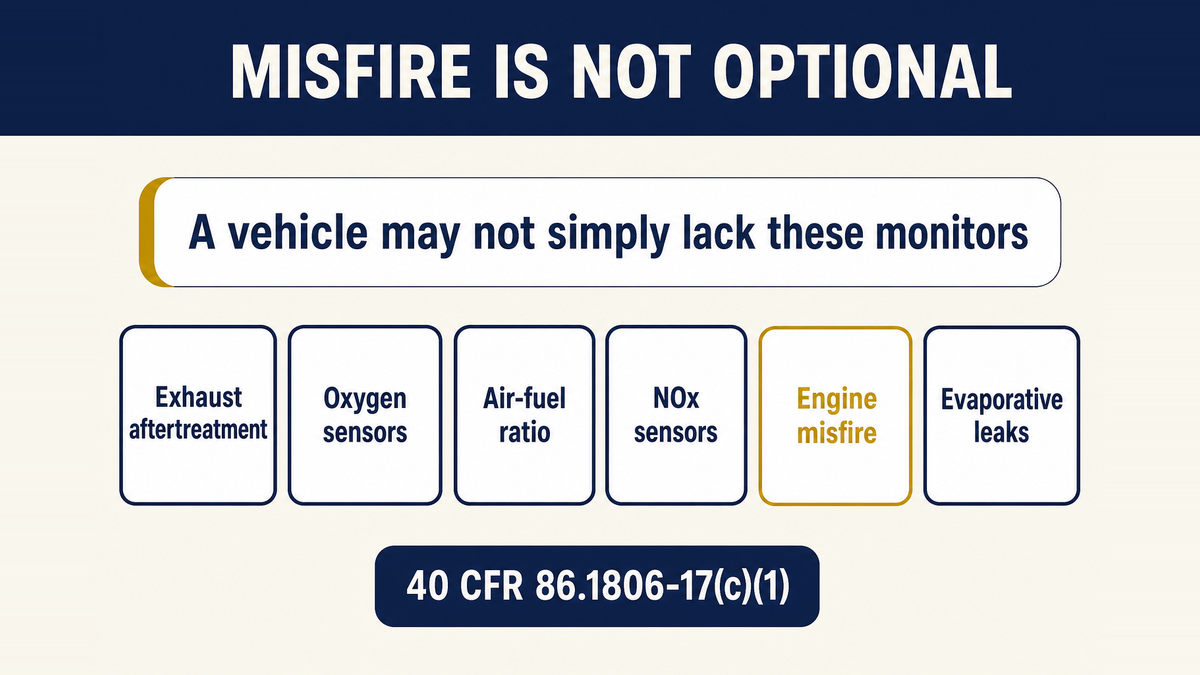
… we will not approve a deficiency that involves the complete lack of a major diagnostic monitor, such as monitors related to exhaust aftertreatment devices, oxygen sensors, air-fuel ratio sensors, NOX sensors, engine misfire, evaporative leaks, and diesel EGR (if applicable).
40 CFR 86.1806-17(c)(1)
Engine misfire is named in that list. It is not a nice-to-have feature of a modern car; it is one of the monitors a vehicle is not permitted to simply go without.
That has a direct consequence for anybody selling ignition parts. A coil is not a free choice in the way a brake pad's friction material is. A coil whose electrical behaviour differs from the original changes how the engine runs, and the car's own monitoring system is what notices — and reports it to the driver. A part that trips the monitor has done something a part cannot fix.
4. What a Misfire Costs Beyond the Coil
The reason the monitor exists is in the recall record, and it is visible in a single line of one remedy. In Subaru's 2019 campaign, cars that came in with confirmed ignition coil damage and a certain stored diagnostic trouble code had a third item replaced as well: the front exhaust pipe — the pipe that carries the catalytic converter.
That is the mechanical link between an ignition coil and an emissions rule, and it is worth stating plainly. A misfire sends unburned fuel and air out of the cylinder and into the catalyst. A catalyst is built to burn the small remainder of what the engine did not burn; fed a steady stream of raw fuel, it overheats, and the coating that does the work is what gives way first.
So a coil fault is not only an electrical repair. It is an electrical repair that can become an emissions repair, and the second one costs multiples of the first. That is the honest commercial argument for specifying a coil properly rather than buying on price.
5. What the Federal Record Calls This Part
Search the same federal recall file used throughout this series, and the two terms come out very differently:
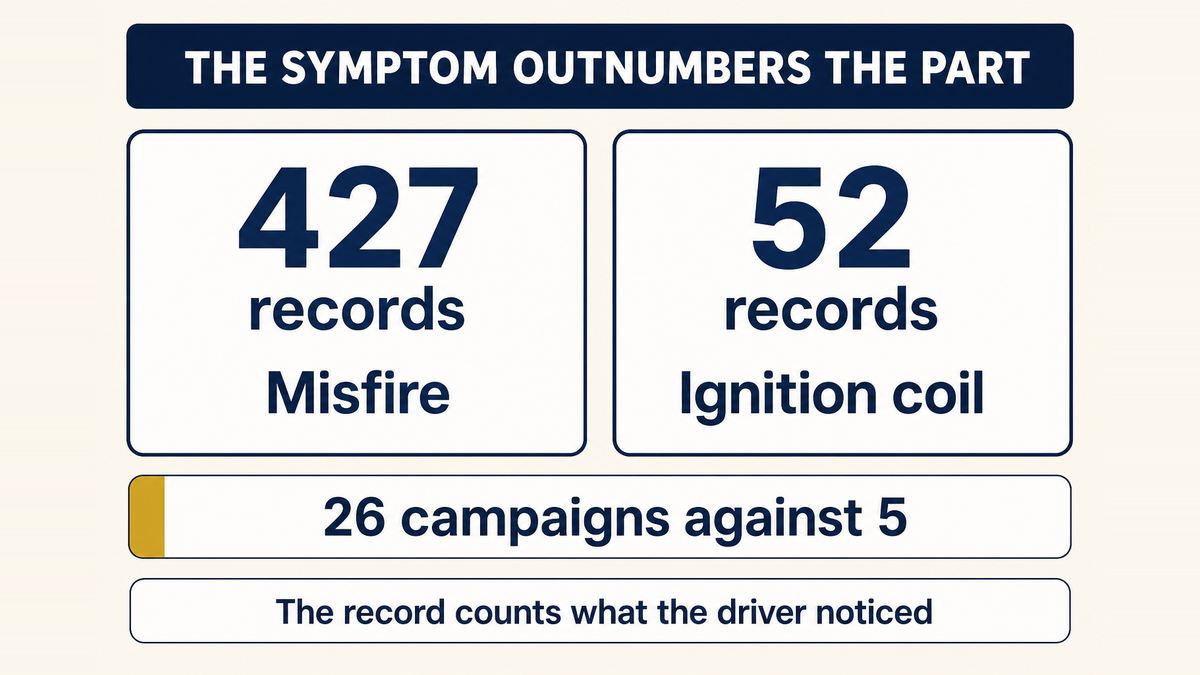
- Ignition coil appears in 52 records, belonging to 5 campaigns.
- Misfire appears in 427 records, belonging to 26 campaigns.
The symptom outnumbers the part by roughly eight to one. That ratio is the record telling you what kind of document it is: it is a record of what drivers noticed and what shops found, and what they found was a misfire. The coil is further down the chain, and often not named at all.
There is a second clue in the way these campaigns were filed. Of the five, two carry the component string ELECTRICAL SYSTEM:SOFTWARE and two carry ELECTRICAL SYSTEM:IGNITION:COIL. Even in the filing system, the coil sits on the boundary between an electrical component and the software that drives it — which is exactly where the next section finds the failures.
6. Five Campaigns, and None of Them Is a Coil
Five campaigns in eleven years name an ignition coil. Read them in order and a pattern appears that no specification sheet would predict.
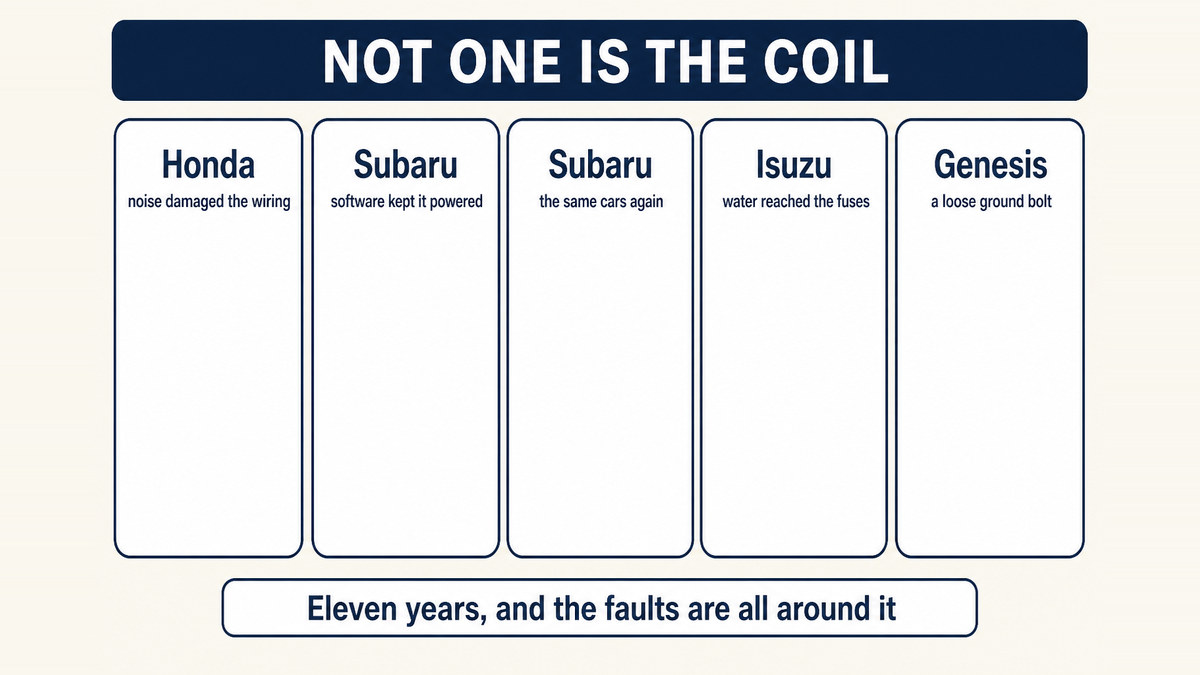
Honda, campaign 15V559000, filed 3 September 2015, 17,796 vehicles. The wires inside the plug-top ignition coils could be damaged because of improper protection against electrical noise. A coil with damaged wiring can overheat, and the engine can stall. The remedy was to replace the coils with a new design.
Subaru, campaign 19V743000, filed 18 October 2019, 466,205 vehicles. The engine control module may continue to power the ignition coil after the engine is shut off, which could cause a short circuit and a blown fuse. A short circuit while driving can stall the car.
Subaru, campaign 21V264000, filed 15 April 2021, the same 466,205 vehicles. The same defect, described again in the same words — and this campaign explicitly includes every vehicle previously repaired under the 2019 recall. The first fix did not hold, so the same cars were recalled a second time, and the second remedy added replacing the coils themselves.
Isuzu, campaign 23V564000, filed 10 August 2023, 19,479 vehicles. The chassis harness had an incorrectly sized wire seal for the two externally mounted ignition coil pack fuse holders, which let water in and corroded the fuses. Corroded fuses caused a misfire and loss of engine power. The remedy was to replace both fuse holder assemblies.
Genesis, campaign 26V493000, filed 30 July 2026, 42 vehicles. The ignition coil ground bolt may be loose, resulting in an engine misfire or a stall while driving. The remedy was to tighten the bolt. This is the most recent campaign in the whole file.
Line them up and the causes are: electrical noise, software, software again, water, and a loose bolt. Across five manufacturers and eleven years, exactly one of those campaigns concerns the inside of a coil — and even there the damage came from the electrical environment rather than from the winding itself, and the fix was a design change to the coil's protection.
Everything else is around the coil. The module that drives it, the seal in front of it, the bolt that grounds it, the harness that carries the signal. For a buyer that is a specification instruction, and it is the subject of the next section.
7. The Two Things a Photograph Cannot Show
A coil is bought on how it looks and on a part number, and the two things that decide whether it works are in neither.
The first is the electrical figures. Primary resistance with the range it may vary across, the secondary resistance, and the spark energy or dwell figures behind them. These are what a cheaper coil changes first, because they are the parts of the design that cost copper and core material to get right, and because a coil that is slightly out of range will still produce a spark at idle. It shows up as a misfire under load, at high engine speed, or on a plug that has worn — which is precisely when the monitor is watching.
The second is the connection. Three of the five campaigns above failed at a wire, a seal or a ground bolt, and none of those is visible on a finished part. The connector's terminal plating, the seal that keeps water out of it, and the path the current takes to ground are the difference between a coil that works for a hundred thousand kilometres and one that works in a workshop.
There is a third point that belongs with them. A coil is a wound component, and how well it is potted — how thoroughly the resin fills the housing around the windings — decides whether it survives vibration and thermal cycling in the place it is mounted. Potting quality is not visible either, and it is the first thing that goes in a cheap assembly.
8. What a Cheap Ignition Coil Quote Drops
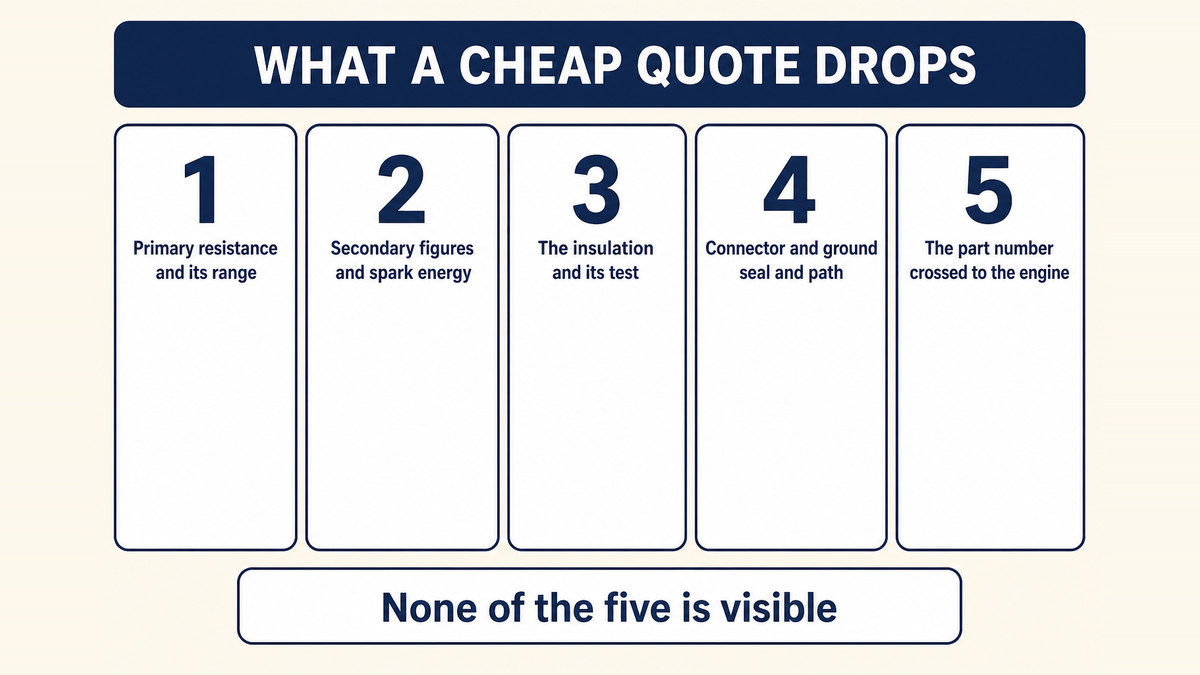
A coil's cost is in copper, core material, electronics, resin and testing — none of which shows up in a photograph. Five places a low quotation comes from:
Primary resistance, and its range. A single figure with no tolerance band is not a specification, because a coil's behaviour depends on where in the band it sits and how far it moves when hot.
The secondary figures and the spark energy. The numbers that decide whether the coil can still fire a worn plug on a cold morning. Copper and core material are what buy them.
The insulation and its test. A coil that arcs internally fails in a way that looks like something else — a rough idle, an intermittent misfire, a monitor light that comes and goes.
The connector seal and the ground path. The cheapest item on the drawing and the cause of three of the five campaigns in the federal record. Terminal plating and a seal that actually seals are what keep water out.
The part number, crossed to the engine. A coil that fits the connector but not the engine's calibration is the same class of error the spark plug article described. The part number is the only place that information lives.
9. Six Checks and Where the Price Comes From
Six checks cover an ignition coil before it is ordered.
- Primary resistance, with the range it may vary over.
- Secondary resistance and the spark energy or dwell figures behind it.
- The insulation, the test behind it, and whether the coil carries its own igniter or needs one elsewhere.
- The connector and the ground: terminal plating, the seal, and how the coil is grounded once it is bolted down.
- Heat and vibration: the temperature class, and how the housing is potted.
- The part number, crossed to the engine so the coil matches the calibration it drives.
On the factory side the questions are about who makes what: who winds the coil, where the core and the igniter come from, what resin is used and how it is cured, and whether every unit gets an end-of-line electrical test or whether the test is done on samples. Our sequence is in the factory audit checklist, and the metal side is covered in metal stamping and machined parts. Where a supplier also holds a social or ethical audit, the scheme behind the certificate is worth reading — see social audit schemes compared.
A coil's price is built from the copper winding, the core, the igniter electronics, the housing and its resin, the connector, and the testing. Copper and the electronics set the base. The resin and the end-of-line test are the two lines that are easiest to reduce without changing how the part looks, and they are the two that decide whether it survives in service.
A coil is light and it is fragile for its weight — the housing can crack and the connector is easy to knock — so it is packed in trays with the connector protected, not loose in a bag: see export packaging quality control and carton drop test standards. For consolidated shipments the chargeable weight method is set out in how volume decides what a shipment is charged. How the goods are described for entry is covered in how an HTS code is assigned, and the origin paperwork in the certificate of origin guide.
10. Frequently Asked Questions
Does an ignition coil fall under any federal inspection standard?
No. The in-use inspection standard is organised as one section per system and covers brakes, brake power unit, steering, suspension, tyres and wheel assemblies, with no engine or ignition section. A coil therefore has no federal figure to be measured against once the vehicle is in service.
Is an ignition coil an emissions part?
In effect, yes. The federal onboard diagnostics rule requires vehicles to detect malfunctions in the emission control system and alert the operator, and its deficiency provisions name engine misfire as one of the major diagnostic monitors a vehicle may not simply lack. The same section adopts California's 2013 OBD requirements by reference, so the requirement is essentially the California one. Any part whose failure produces a misfire is a part the car's own monitoring is required to notice.
What does a misfire cost beyond the coil?
Potentially a catalytic converter. In Subaru's 2019 campaign, vehicles with confirmed ignition coil damage and a certain stored diagnostic trouble code also had the front exhaust pipe — the pipe carrying the catalyst — replaced. A misfire sends unburned fuel into the catalyst, and a catalyst fed raw fuel overheats and loses the coating that does the work. That is why a coil fault can turn into an emissions repair costing multiples of the part.
What does the federal record show about ignition coils?
52 records in 5 campaigns, against 427 records in 26 campaigns for the word misfire — the symptom is named roughly eight times as often as the part. Of the five coil campaigns, one concerns wiring inside a coil damaged by the electrical environment, two concern engine control module software continuing to power the coil after shutdown, one a wrongly sized wire seal that let water into an ignition coil pack fuse holder, and one a loose ignition coil ground bolt. They were filed between 2015 and July 2026.
What should an ignition coil quotation state?
Primary resistance with the range it may vary over; the secondary resistance and the spark energy or dwell figures; the insulation and the test behind it; the terminal plating, the connector seal and the ground path; the temperature class and how the housing is potted; and the part number crossed to the engine. Those are the things a photograph cannot show, and three of the five federal campaigns above failed at exactly the connector-and-ground items.
The Faults Around the Coil, Mapped
We return the connector, ground and boot specification, the monitors that must catch a failure, and what a missed misfire costs.
Map My Surroundings
Questions & Comments
We read every one and reply within 24 hoursAn ignition coil is certified on a dwell curve rather than on a single spark voltage. Send the coil number and the engine, and we will ask for the sweep, the test voltage and the post-test output.