
Radiator Manufacturers: What the Recall Record Says Instead of a Standard
 ·
Updated October 15, 2026
·
11 min read
The parts in this series so far have each been governed by something: a marking, a certificate, a disposal rule, an exemption, a burn rate. The radiator has none of those. The federal inspection standard has a section for every system the wheel depends on — ten of them for brakes alone, plus steering, suspension, tyres and wheel assemblies — and no section for cooling at all. What exists instead is a different kind of record, and it is more useful than a specification would be. It is the recall file, and it describes what happens when this part fails. The answer is not that the engine gets hot. The answer is that fluid leaves the system and finds something hot enough to ignite.
1. What a Radiator Is, and How It Is Put Together
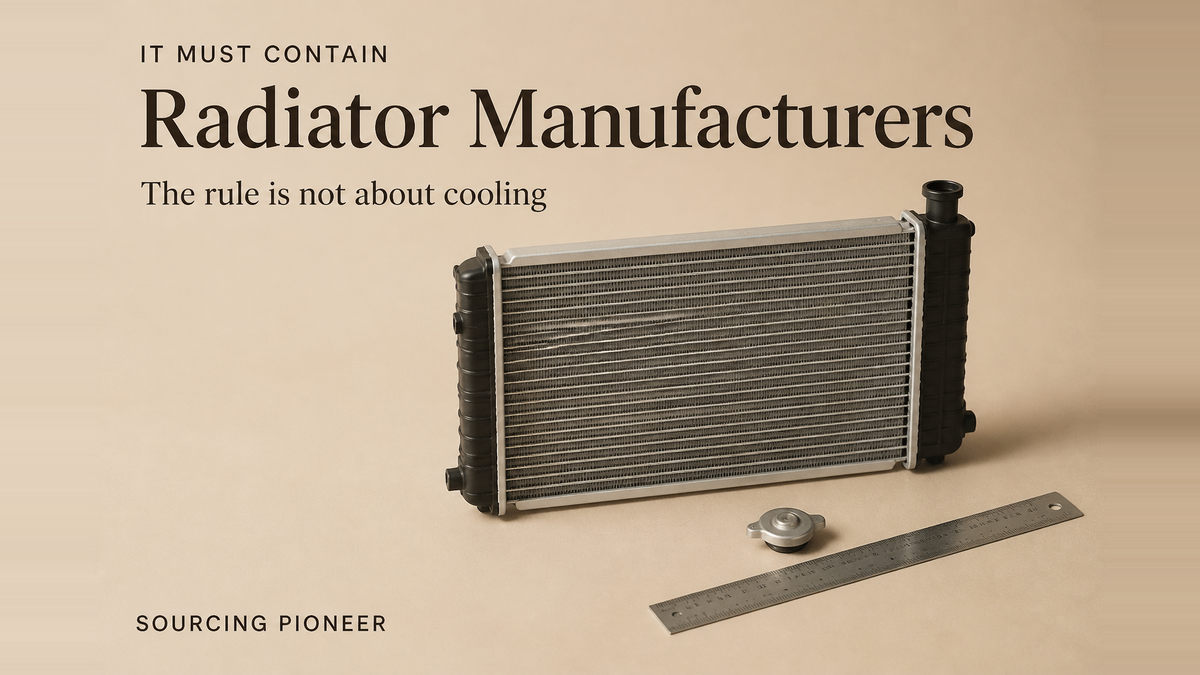
A radiator is a heat exchanger plumbed into a pressurised circuit. Hot coolant enters at the top, passes through tubes with fins bonded to them, and leaves cooler at the bottom. The system is held above atmospheric pressure by the filler cap, which raises the boiling point of the coolant — so the cap's rating is not an accessory but part of the operating envelope the whole system was designed around.
What matters commercially is how the assembly is built, because the construction explains where it fails. A modern radiator is an aluminium core — tubes and fins — joined to end tanks. On many radiators those tanks are a glass-fibre reinforced plastic, held to a header plate by a crimped joint sealed with a gasket. The core's own joints are made in a brazing furnace, where the whole assembly is heated so that a cladding layer flows and bonds the tubes to the fins and headers at once.
Two consequences follow. First, the brazing cycle is a thermal process with a window: too little heat and the joints are incomplete, too much and the fins erode. It is not a step a buyer can inspect on a finished part, which makes the furnace record the useful document. Second, the crimped tank-to-header joint is a mechanical seal held by clamping force against a gasket, sitting in a place that sees the full temperature swing of every drive cycle. That joint, and the gasket in it, is where a leaking radiator usually starts.
| The element | What it decides | What a vague quote hides |
|---|---|---|
| The core and its braze | Heat transfer and structural integrity | The brazing cycle and its record |
| The tank joint and gasket | Whether it stays sealed as it cycles | Gasket material and crimp force |
| The pressure rating | The system's boiling margin | The cap rating the part is built for |
| The filler neck and cap seat | Whether the system holds pressure at all | Neck dimensions and seat finish |
| Mounting and brackets | Whether vibration is absorbed or fed in | Rubber isolation and bracket gauge |
What this guide covers
- What a radiator is, and how it is put together
- The standard that inspects everything else skips cooling
- What the recall record shows instead
- The system now has electrics
- One remedy was partly software
- What a cheap radiator quote leaves out
- What to check on a sample
- Where the unit price comes from
- Frequently asked questions
2. The Standard That Inspects Everything Else Skips Cooling
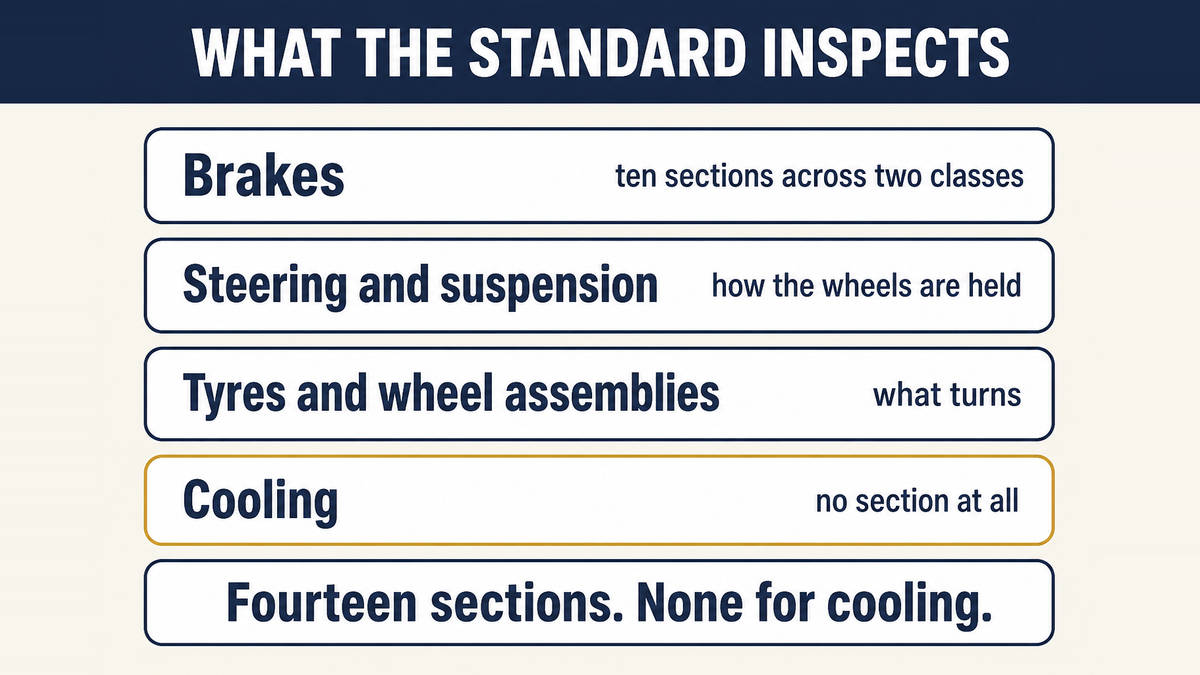
The federal in-use inspection standard is organised as one section per system, and reading the list is the quickest way to see what a vehicle is judged on. For light vehicles the sections are definitions, service brake system, brake power unit, steering systems, suspension systems, tires and wheel assemblies. For heavy vehicles the list is longer, because the brake system is broken out by type: hydraulic, vacuum assist, air, electric and service, followed by steering, suspension, tires and wheel assemblies.
Ten of those sections concern brakes. Four concern the things that hold a wheel on — steering, suspension, tyres and wheel assemblies. None concerns the cooling system. A vehicle can be presented for inspection with a radiator that is weeping, a cap that no longer holds pressure and a fan that has stopped, and the inspection standard has nothing to say about it, because cooling is not one of the systems that standard was written to check.
For a buyer this is a useful clarity rather than a gap to exploit. It means the specification for a radiator is not a federal document, and no inspection is going to catch a weak part for you. The customer's own experience is the test, and the only way to know what that experience will be is to read the record of what has gone wrong before.
3. What the Recall Record Shows Instead
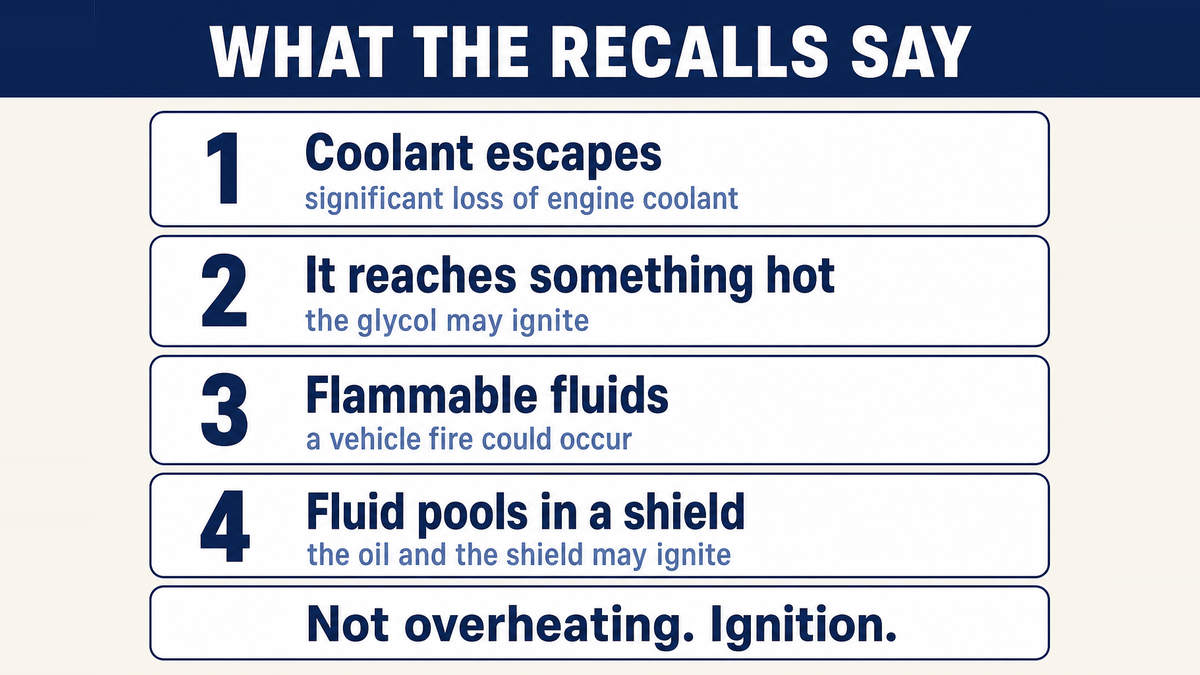
The federal recall records are where this part's failure modes are written down, and they are consistent enough to be worth reading together. Take three, all concerning coolant, all published in 2012.
The first concerns a cup plug in the cylinder head that could come loose:
The cylinder head cup plug (freeze plug) may become dislodged resulting in significant loss of engine coolant. As leaking engine coolant evaporates on the hot engine, the glycol may ignite causing an engine compartment fire.
National Highway Traffic Safety Administration, recall campaign 12V431000 (read 15 October 2026)
Read the consequence carefully, because it is not what a person who has just lost coolant expects. The coolant does not need a secondary fluid to start a fire. The glycol itself ignites. The substance whose job is to carry heat away is also a flammable liquid once it lands on a surface hot enough.
The second describes the same vehicle family a month later, and widens the mechanism from the fluid to the fluids:
Coolant system leaks may cause the engines to overheat and leak flammable engine fluids. If flammable engine fluids come in contact with the vehicle's hot exhaust system, a vehicle fire could occur.
National Highway Traffic Safety Administration, recall campaign 12V551000 (read 15 October 2026)
The third is about a different fluid in a different place, and it is included because it describes the same end state reached by a different route — fluid pooling where it should not be:
SPILLED OR DRIPPING OIL (SUCH AS AFTER AN OIL CHANGE) MAY COLLECT IN THE ENGINE SHIELD (BELLYPAN) NEAR HOT ENGINE OR EXHAUST SYSTEM SURFACES. AS A RESULT, THE OIL AND THE ENGINE SHIELD MAY IGNITE AND BURN… EITHER CONDITION COULD RESULT IN AN ENGINE COMPARTMENT FIRE, POSSIBLY CAUSING INJURY OR DEATH.
National Highway Traffic Safety Administration, recall campaign 12V288000 (read 15 October 2026)
Three recalls, one lesson for anyone selling into this system: the safety case for a radiator is not that it cools, it is that it contains. A joint that weeps only when the system is hot and pressurised is not a cosmetic defect and not merely a maintenance nuisance. It is the first step of a sequence that these records describe in the same order every time — a leak, a hot surface, and an ignition.
4. The System Now Has Electrics
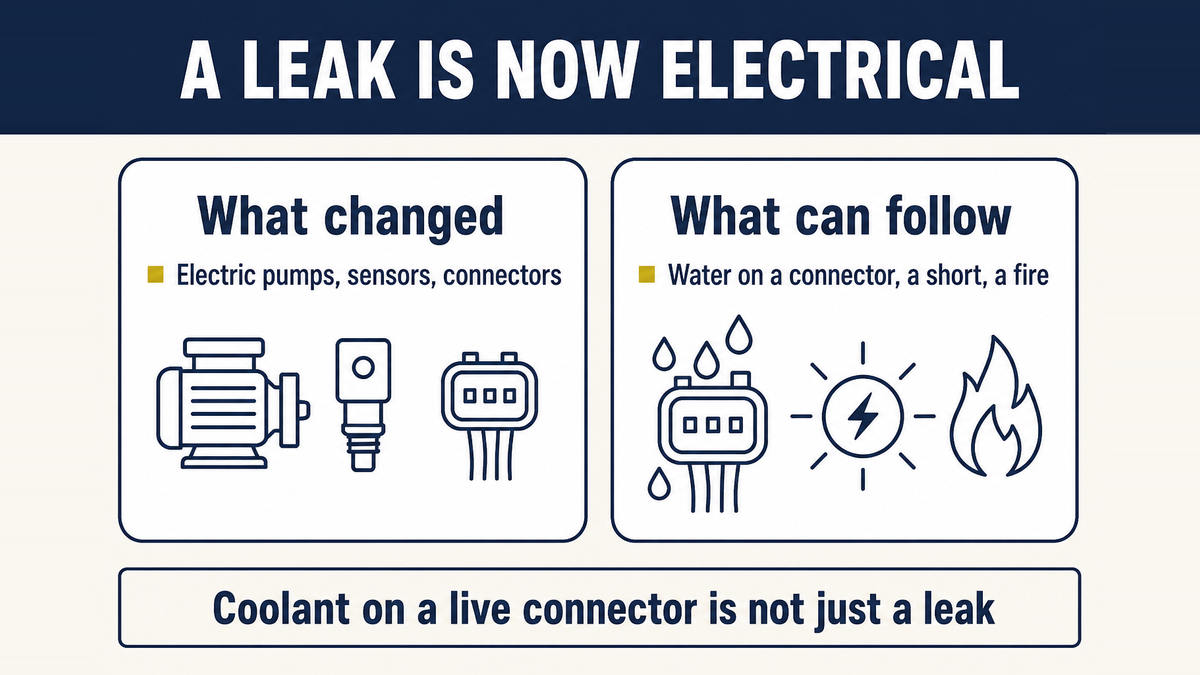
An older cooling system was entirely mechanical: a pump driven by a belt, a thermostat, a fan. A modern one carries electric pumps, sensors and connectors, which adds a failure mode that has nothing to do with pressure. A recent campaign describes it plainly:
An improperly sealed electrical connector on the water pump may be exposed to water and short circuit. An electrical short increases the risk of a fire.
National Highway Traffic Safety Administration, recall campaign 24V608000 (read 15 October 2026)
The remedy was to replace the pump and connector as needed and fit a protective shield. Two things follow for a supplier.
A leak is now an electrical event as well as a fluid event. Where coolant escapes onto a component that carries current, the outcome can be a short rather than a puddle, and the risk that follows is a fire rather than a slow loss of coolant. That raises the value of every sealing surface in the assembly, because the consequences of a small leak are no longer limited to the fluid circuit.
The protective shield is a product in its own right. The remedy included fitting one, which means a component that exists to keep fluid off electrics is part of how the system is made safe. A buyer selling into this area should expect the cover or shield to be specified rather than treated as trim.
5. One Remedy Was Partly Software
The most instructive detail in the whole set is not about a part at all. It is what one of the remedies actually consisted of, in the words of the record:
Ford will notify owners, and dealers will inspect the engine for coolant system leaks and reprogram the vehicle's powertrain control module and instrument cluster with an updated calibration and overheat strategy software.
National Highway Traffic Safety Administration, recall campaign 12V551000 (read 15 October 2026)
An overheat strategy is software. The remedy was not only to find the leak; it was to change how the vehicle behaves once it starts to overheat, and to change what it tells the driver. That has a direct consequence for anyone supplying cooling components: the part is judged together with the vehicle's response to it failing.
Two practical readings. First, a radiator cannot be assessed in isolation from the system it serves — its flow, its pressure rating and its thermal capacity interact with a control strategy that decides how much warning the driver gets. Second, when a customer reports that a vehicle ran hot without warning, the cause may sit in the strategy rather than in the part, and a supplier who has the specification in writing can show which of the two they are responsible for.
6. What a Cheap Radiator Quote Leaves Out
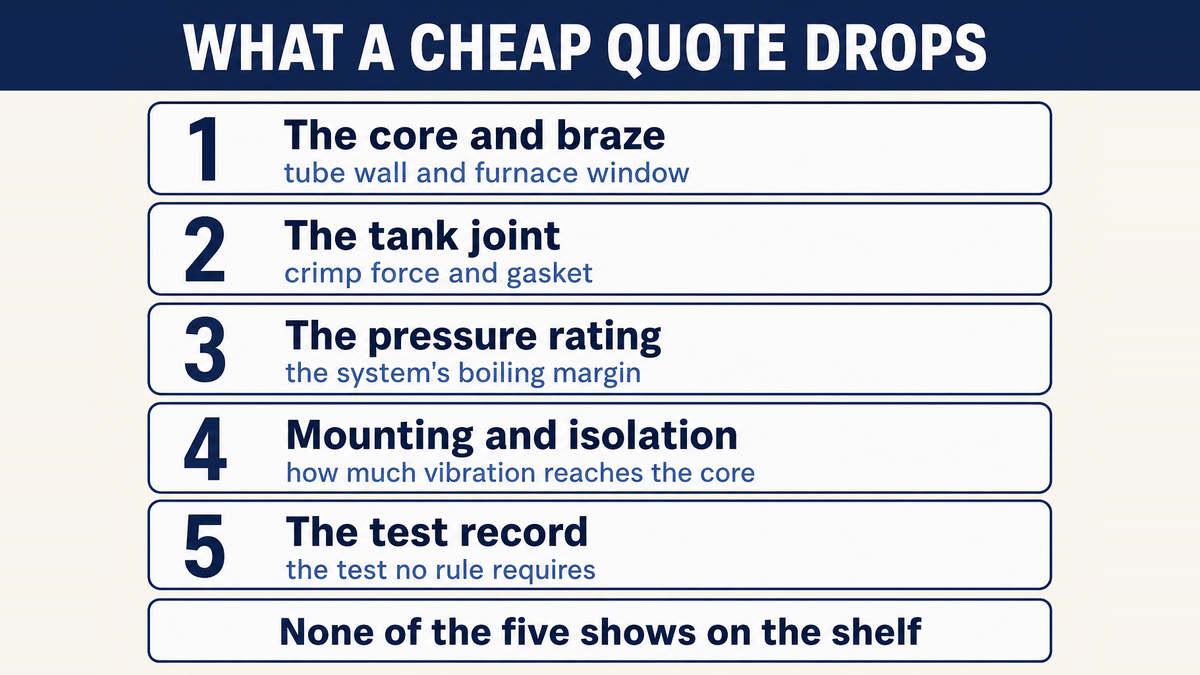
A radiator is a large, simple-looking assembly with most of its cost in processes rather than materials. Five places a low quote tends to come from:
The core and the brazing cycle. Tube and fin geometry set the heat rejection, and the furnace cycle sets whether the joints are sound. A core with thinner tubes saves aluminium and also removes thermal margin, and the brazing window is where an under-fired core hides.
The tank joint and gasket. The crimped joint is the assembly's pressure seal. Gasket material and crimp force decide whether it survives thousands of hot-cold cycles, and it is the first thing to look at when a radiator weeps only when hot.
The pressure rating. Because the cap rating sets the boiling point of the whole system, a radiator built for a lower pressure is not an equivalent part. This is a specification line, not a detail — and it is one a buyer can state in a sentence.
Mounting and isolation. Brackets and rubber isolators decide how much vibration reaches the core. A core that is dimensionally right but mounted rigidly will crack at the header, and the failure will be attributed to the part rather than to the fitment.
The thermal and pressure test record. Because no inspection standard covers cooling, the only evidence of a part's durability is the factory's own cycling and pressure test. Asking for it is the substitute for a regulation that does not exist.
7. What to Check on a Sample
A radiator can be measured and pressure-tested, which makes the sample stage unusually decisive. Six checks cover the ground.
- Core dimensions and tube count against the drawing, because a core with fewer or thinner tubes is a different thermal part with the same outside size.
- A pressure test at the rated figure, held long enough for a slow weep at the tank joint to show.
- The crimp: evenness all round, and whether the gasket is compressed consistently rather than pinched at the corners.
- The filler neck and cap seat, including the seat's finish, since a neck that does not let the cap seal defeats the pressure rating entirely.
- Bracket and isolator arrangement against the mounting points, and the rubber's hardness.
- The brazing and cycling records, and the furnace parameters for the batch the sample came from.
On the factory side the usual visit checks apply — whether the core is brazed in-house, where the tanks and gaskets come from, and who signs off the first article. Our sequence is in the factory audit checklist. Where a supplier also holds a social or ethical audit, the scheme behind the certificate is worth reading — see social audit schemes compared.
8. Where the Unit Price Comes From
A radiator's price is built from the core — tubes, fins and the brazing cladding — the end tanks and gaskets, the brazing and crimping processes, and the packaging. The core is the largest material line and the one where a millimetre of tube wall thickness is a real cost. The processes are where quality lives, and both of them, brazing and crimping, are invisible once the part is assembled. Packaging is the smallest line and the one that decides whether the fins arrive straight.
Weight is moderate and the part is bulky, so a radiator sits between the two freight calculations: heavier than a filter, less dense than a hub. The method is set out in how volume decides what a shipment is charged. Core dimensions also matter here in a way they do not for smaller parts, because a large core is easily damaged in transit, which is why the packaging specification belongs with the part specification.
A quotation worth comparing therefore names the core dimensions and tube specification, the brazing process, the tank material and gasket, the pressure rating the part is built for, the mounting arrangement, and the factory's pressure and cycling test record. How the goods are described for entry is the subject of how an HTS code is assigned, and the origin paperwork behind it is set out in the certificate of origin guide. Where a batch is split or assembled from parts made in more than one country, the way the goods are presented for entry matters, and that subject is covered in how assembly method changes duty treatment.
9. Frequently Asked Questions
Is there a federal standard for radiators?
Not a performance standard. The federal in-use inspection standard is organised as one section per system, with ten sections covering brakes across the two vehicle classes and further sections for steering, suspension, tyres and wheel assemblies, and none for the cooling system. What the federal record does contain for cooling parts is a body of recall documentation describing how they fail.
What actually happens when a cooling system leaks?
The recall record is consistent, and the outcome is not usually that the engine simply gets hot. One campaign states that leaking engine coolant evaporating on a hot engine may ignite the glycol, causing an engine compartment fire. Another describes coolant leaks leading the engine to overheat and leak flammable fluids which, on contact with the hot exhaust system, could cause a vehicle fire.
Why does the pressure rating matter so much?
Because the filler cap holds the whole system above atmospheric pressure, which is what raises the coolant's boiling point and gives the system its margin. A radiator built for a lower pressure is not a like-for-like replacement even if it fits, and the filler neck's seat must let the cap seal properly for the rating to mean anything.
Why is a leak an electrical problem now?
Because the system carries electric pumps, sensors and connectors. One campaign describes an improperly sealed electrical connector on a water pump that may be exposed to water and short circuit, with the consequence that an electrical short increases the risk of a fire. The same remedy included fitting a protective shield, which makes the shield part of how the system is made safe rather than an accessory.
What should a radiator quotation contain?
The core dimensions and tube specification, the brazing process and its furnace parameters, the tank material and the gasket for the crimped joint, the pressure rating the part is built for, the mounting and isolation arrangement, and the factory's own pressure and thermal cycling test record — since no inspection standard will test the part for you.
Where Each Construction Fails
We return the joint type, the pressure it was tested at, the failure location the record shows, and the electrics now bolted to it.
Map My Failures
Questions & Comments
We read every one and reply within 24 hoursTrying to get a factory to state the pressure rating rather than just supplying a part that fits, checking whether a crimped tank joint survives thermal cycling, or working out what replaces the test a regulator never wrote? Send us the application, the pressure rating and the market, and our team will put the radiator specification in writing.