
Wholesale Boutique Items: Three Routes, and the Duty Rule That Changed
 ·
Updated October 15, 2026
·
15 min read
Boutique owners buy wholesale stock through three routes, and the middle one gets most of the advice. You can buy from a big online wholesale market, from a local wholesaler, or straight from a factory. The route you pick sets your unit cost, your minimum order, and how long you wait. One change makes the cheapest route less cheap. Most guides have not caught up. This guide gives you the three routes, the numbers behind them, and the two rules that decide which one works.
The Short Answer: Three Routes, and a Cost That Changed
Start with the question behind the search. A boutique owner searching for wholesale items wants one thing. They want stock that can be sold at roughly twice what it cost, in small enough amounts to test.
Three routes can do that, and each trades one benefit for another.
Route one is a wholesale market. Think of the large online platforms that let small boutiques order a few units from many brands. The order minimum is low and the stock is already in the country. You pay for that convenience in unit price, and your margin is set by you else.
Route two is a local wholesaler. You buy from a wholesaler, often through a market centre or a trade show. Prices sit between the routes on either side. You need a resale certificate, and the good lines often carry a minimum.
Route three is the factory. You buy direct and pay the lowest unit cost. The catch is that you now own everything the other two routes did for you. That means the minimum order, the freight, the duty, and the label.
That last item is where this guide earns its keep. The label is not a detail. In the United States it is a legal duty. It lands on the party that sells to the public.
| What you are weighing | Online market | Domestic wholesaler | Factory direct |
|---|---|---|---|
| Smallest order | A few units per style | Often a case or a pack | Usually 50 to 300 units per style |
| Unit cost | Highest | Middle | Lowest |
| Cash outlay | On order, or on terms | On order | Deposit, then balance |
| Wait for stock | Days | Days | Weeks, plus freight |
| Who pays the duty | The platform already did | The wholesaler already did | You |
| Who is responsible for the label | Still you, in law | Still you, in law | You, and you must brief the factory |
The Route Most Guides Leave Out, and Why It Got Harder
The third route has always been the cheapest way to buy. Until lately it also had a shortcut. A small boutique could skip most of the customs forms. That shortcut is gone.
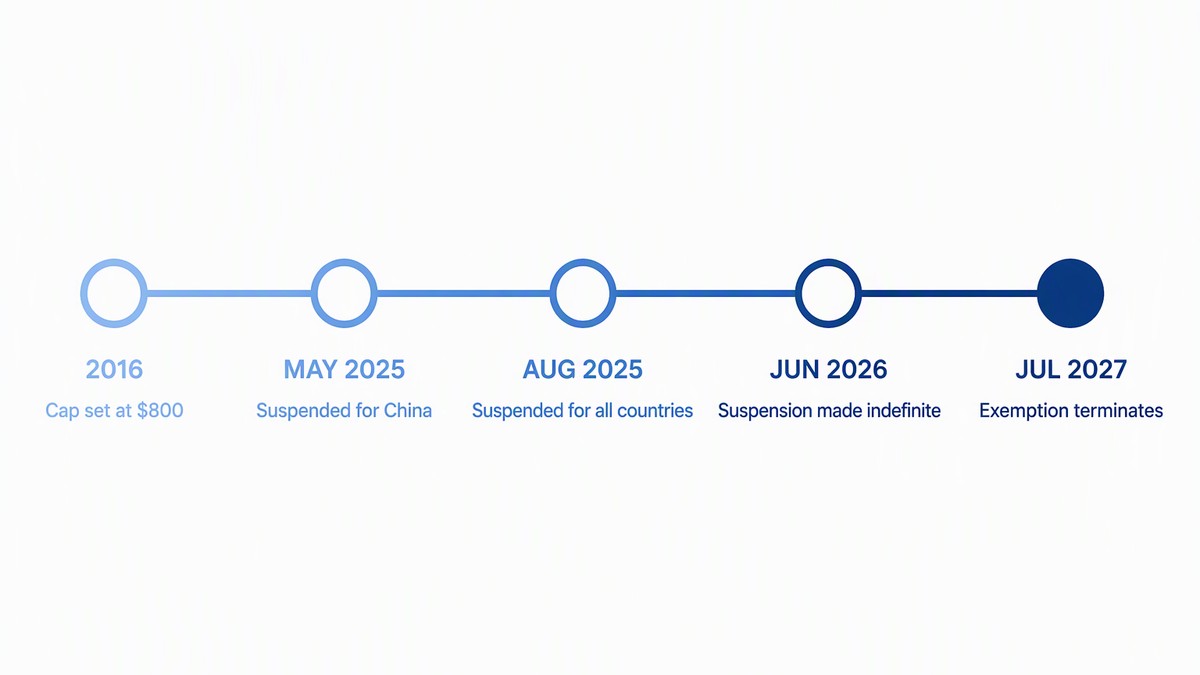
For years, a parcel worth under a set amount could enter the United States free of duty. The rule was called de minimis, from the Latin for "about the smallest thing". It let a boutique test a style by buying a small parcel direct. Nothing was paid at the border.
That is over. CBP states in a rule published on 8 October 2026 that the exemption "has been suspended since at least August 29, 2025". Two interim final rules published on 24 June 2026 made the suspension indefinite. A law passed in July 2025 terminates the exemption outright on 1 July 2027.
So the arithmetic changed. A small parcel from a factory now attracts the same duty as a large one. The saving you expected from going direct has to be measured after the duty, not before it.
The forms changed with it. Goods worth 2,500 dollars or less enter under an informal entry. That is lighter than a full formal entry. CBP is now proposing that informal entries be filed electronically, before or on the day of import. It also proposes that some carry a bond. Who may file is restricted: the owner or purchaser, or a licensed customs broker named by them.
In plain terms, the border no longer has a free lane for small sellers. It has a cheaper lane with a form to file.
The Label Rule That Follows the Goods
That is the part a boutique owner discovers late, usually after a customer complaint or a letter. In the United States, a textile item sold to the public needs a label. The boutique selling it is on the hook.
The scope is wider than most people assume. The FTC's own guidance says that if you "manufacture, import, sell, offer to sell, distribute or advertise" a covered product, you must comply. A boutique does not manufacture what and still falls inside that sentence.
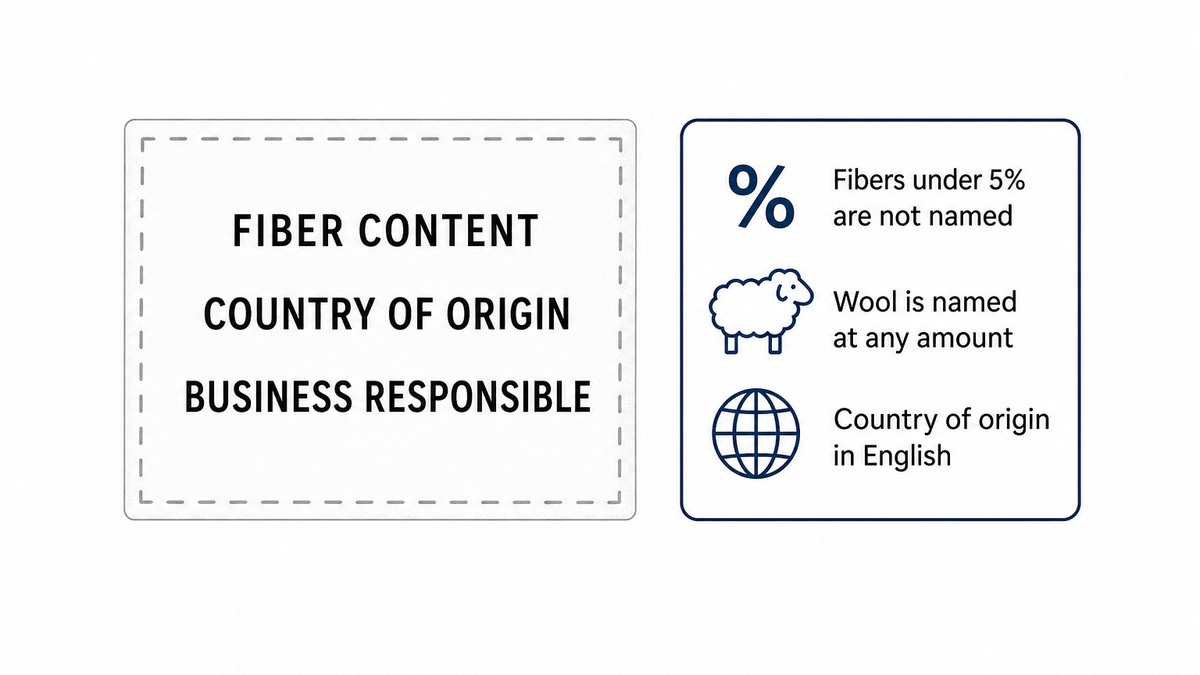
Three things must appear. They are the fiber content, the country of origin, and the name of the firm responsible for marketing or handling the item. Care instructions come from a another rule.
Fiber content has a format. The generic names and their numbers by weight are listed in descending order. The biggest fiber comes first. A blend reads "65% rayon, 35% polyester". A single-fiber item may say "All wool" instead of "100% wool".
Then there is the rule that catches people. the fiber rules in 16 CFR Part 303 allow you to name only the fibers that make up 5 per cent or more of the weight. Anything less must be grouped as "other fiber" or "other fibers", not named.
Two exceptions matter commercially. Wool and recycled wool must be named with their share even when they fall under 5 per cent. And a fiber under 5 per cent may be named if it does real work, such as a small amount of spandex that gives stretch. You do not have to explain the function, as long as there is one.
Country of origin is written in English. 19 CFR 134.11 requires imported goods to be marked "legibly, indelibly, and permanently". The final buyer must be able to read the English name of the country of origin. 16 CFR 303.4 adds that all required details must be in English.
That one word, "indelibly", rules out a sticker peel. A printed woven label survives. A glued tag does not.
Here is the point that decides who pays. When a factory prints the label, the factory is acting on your order. The FTC's plain-language reading is that a boutique can be protected in narrow cases. That cover fails if the boutique knew or should have known the sale would break the rules. Ordering a label you never read is hard to describe as not knowing.
One allowance helps at the sample stage. Goods still in an intermediate stage of production do not need a finished label. They may travel with an invoice instead. That invoice must state the fiber content, the country of origin, the factory's identity, and the issuer's name and address.
Put that with with how apparel labels and packaging are specified for Chinese factories. The label then stops being a surprise at the port. It becomes a line in the order.
What Does Not Need a Label, and What Only Needs One If You Speak Up
Boutiques sell more than clothes, so the boundary matters. The FTC splits goods into three groups, and the third group is the trap.
Covered: clothes, scarves, bedding, curtains, table linen, rugs, towels, cushions, throws and umbrellas. Bedding here includes blankets, comforters, pillows and quilts.
Not covered at all: shoes and footwear, headwear, handbags and totes, luggage, jewelry parts such as beads and buttons. Leather goods and novelty items are out too. Jewelry and bags surprise boutiques most. They feel like textiles and are not treated as such.
Covered only if you say something about fiber: belts, permanently knotted neckties, and a small list of similar goods. Selling a plain leather belt needs no fiber label. Describing it as "cotton webbing" makes the fiber rules apply to the whole item.
Decoration has its own threshold, and it is worth knowing before you approve a trim. Decorative trim under 15 per cent of the surface area is excluded, and the label simply notes that the stated content is exclusive of decoration. Above 15 per cent, the decoration must be disclosed on its own line. Collars and cuffs are exempt whatever you do to them.
| The goods | Label needed? | What to watch |
|---|---|---|
| Clothing, scarves, bedding, towels, rugs | Yes | Fiber numbers must be right, and must descend |
| Anything under 5% of the weight | Not by name | Group it as "other fibers", unless it is wool |
| Wool, in any amount | Yes, named | Name it with a share even below 5% |
| Trim and decoration under 15% of the area | Excluded | Add "exclusive of decoration" |
| Shoes, hats, bags, jewelry, leather goods | No | Do not describe them by fiber, or the rule starts to apply |
| Belts and knotted neckties | Only if you mention fiber | Saying nothing keeps them out of scope |
How to Run One Small Test Order
The sensible first order from a factory is small, boring, and fully documented. The goal is not to make money. The goal is to learn what the route costs you before you commit cash.
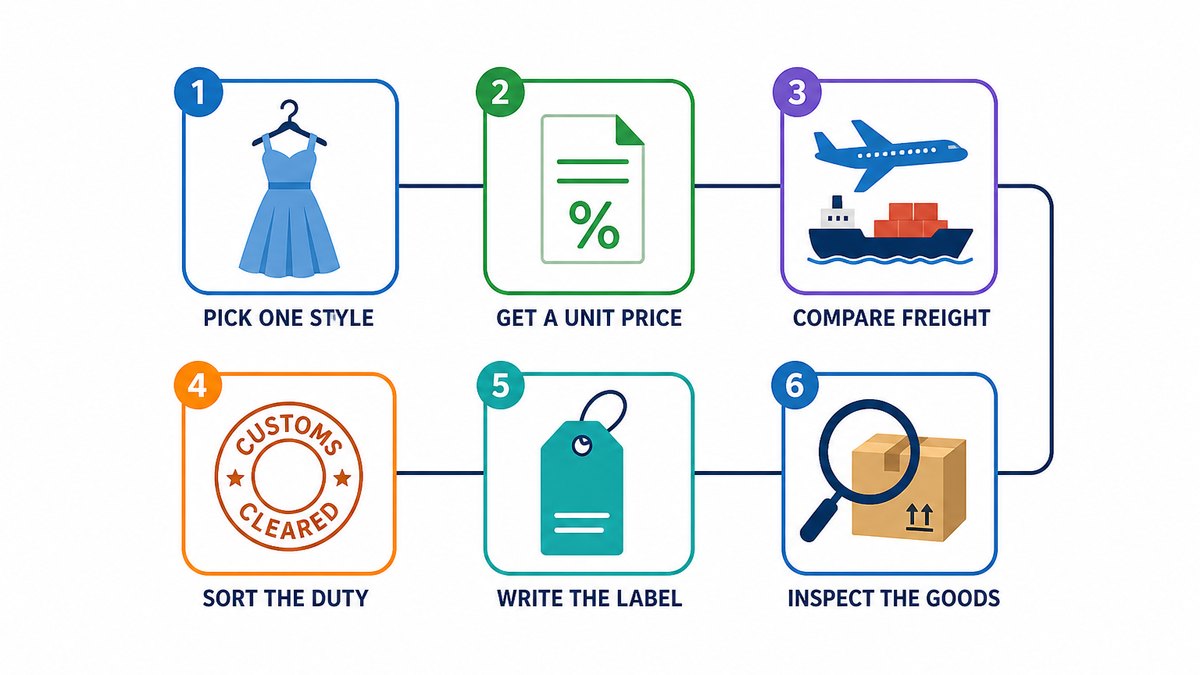
Pick one style in two or three colours. Ask for a quote on a quantity you can sell. Ask for the unit price at that quantity, not a price list. Ask what the freight adds by air and by sea. That gap decides whether a test is worth running.
Then sort out the border before the goods ship, not after. Confirm who will pay the duty and who will file the entry. If you buy on terms where the seller handles delivery and duty, that must be in writing. Otherwise the charge lands on you when the parcel arrives.
Write the label into the order. Give the factory the exact fiber numbers, the exact wording, and the exact position on the garment. A factory will print what you send, so an unread label is a self-inflicted problem.
Check the goods before they leave. An inspection during production catches a wrong label while it is still cheap to fix. The AQL sampling tables tell you how many units to open for your order size.
Finally, price the whole thing, not the unit cost. The gap between a quoted unit price and the landed cost is usually where the margin disappears. And the tariff code you declare sets the rate that duty is charged at.
What No Wholesaler Fixes
Whichever route you take, some work stays with you. No wholesaler, market or factory will do it, and no discount pays for getting it wrong.
Nobody will tell you what your customers will buy. Nobody will set a price that keeps your margin intact after duty and freight. Nobody will read your label for you. Nobody will check that the fiber numbers you sent were the ones printed.
The border is the same. Someone has to file the entry and pay the duty. The lower the route's unit price, the more of that work sits on your side. What a licensed customs broker does and what it costs is worth reading before your first direct order. And how delivered-duty terms move that job to the seller explains the one setting that changes who pays.
The route decides your cost. The forms decides whether you keep it.
Questions Boutique Owners Ask About Wholesale Items
Where do boutique owners buy wholesale items?
There are three routes. Large online wholesale markets let you order a few units from many brands with the stock already in the country. Domestic wholesalers supply through market centres and trade shows, usually with a resale certificate and sometimes a case minimum. Factories sell at the lowest unit cost but require a real minimum order and leave the freight, duty and labelling to you.
Is it cheaper to buy wholesale items directly from a factory?
The unit price is the lowest of the three routes, but it is not the whole cost. Add freight, duty, an entry filing and your time, then compare. Since the de minimis exemption was suspended, even a small parcel attracts duty, so the saving has to be measured after the border rather than before it.
What was the de minimis rule, and does it still apply?
It let parcels under a set value enter the United States free of duty. CBP states that the exemption has been suspended since at least 29 August 2025, that interim rules published on 24 June 2026 made the suspension indefinite, and that a law passed in July 2025 terminates it on 1 July 2027. Treat it as gone.
Do I need a label on the clothes I sell in my boutique?
Yes, if the item is covered. The FTC's guidance says anyone who sells, offers to sell, distributes or advertises a covered textile product must comply, which includes a boutique that makes nothing. The label must carry the fiber content, the country of origin and the name of the firm behind it.
What is the 5 per cent rule for fiber content?
You may name only the fibers that make up 5 per cent or more of the weight. Smaller amounts are grouped as "other fibers" rather than named. Wool and recycled wool are the exception and must be named with a share even below 5 per cent, and a fiber below 5 per cent may be named if it has a real function, such as spandex for stretch.
Can the factory print the label for me?
It can, and it will print exactly what you send. The duty stays yours, since the factory is acting on your order. A boutique has narrow cover in FTC policy, and it fails where the boutique knew or should have known the sale would break the rules. Send the exact numbers, the exact wording and the exact position, then check the sample.
Work out which route fits your boutique
Tell us what you sell and how much stock you can hold. We will say whether a market, a wholesaler or a factory suits your volume. We will also set out what the duty adds to each unit, and what the order must specify before what ships.
Plan My First Order
Questions & Comments
We read every one and reply within 24 hoursAsk us before you place a test order. Send the product, how much you can hold, and where you sell. We will say which route fits, what the duty adds to the unit cost, and what the label has to say before the first box ships.