
Dropshipping Office Supplies: Two Rulebooks, and a Volume Problem
 ·
Updated October 14, 2026
·
13 min read
Office and school supplies have a reputation as the safest category in this business. The items are cheap, they are not fashionable, and nobody sends a stapler back because it went out of season. That reputation is earned by the cheapest half of the catalogue. The other half carries two problems that appear on no supplier price list, and both of them decide the margin before a single order is placed: the category is really two categories separated by wording rather than by material, and its bulky end is charged for the space it takes rather than the weight it adds. This guide takes both.
1. Why This Category Splits in Two
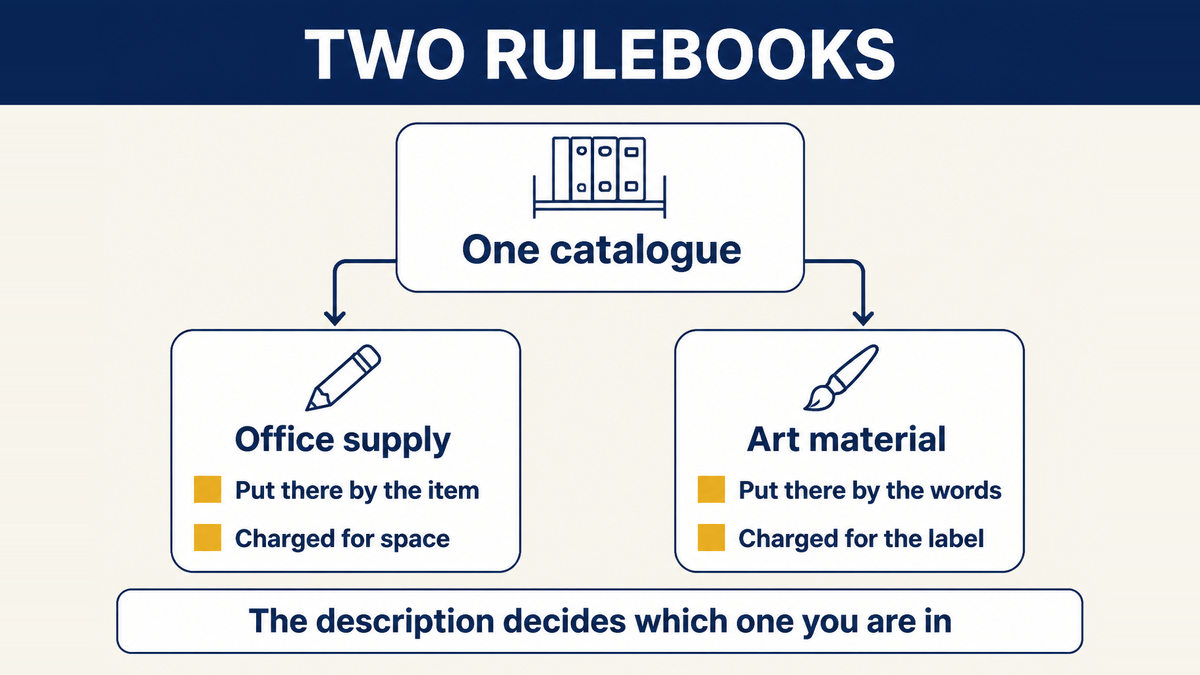
The first problem is that office supplies are not one category. They are two, and the line between them has nothing to do with what an item is made of. It is drawn by how the item is presented. A marker sold as stationery and the same marker sold as an art material sit under different labelling rules, and what separates them is the description on the listing rather than anything in the chemistry.
The second problem is physical, and it is the opposite kind of problem. Office and school goods are bulky and cheap, which is the worst combination for a parcel network that charges for space as soon as an item grows past a published size. A ream of paper, a desk tray and a document box all pass that size while weighing very little, so the parcel is priced as though the seller were shipping air.
Together those two facts produce the strange situation this guide is about. The cheap, flat end of the catalogue behaves well and carries the reputation. The bulky end and the art-supply end fail for reasons that have nothing to do with demand, and a plan built on the average of the whole category will be wrong about both of them at once.
| The question | Ordinary office supply | Art material |
|---|---|---|
| What puts it there | The item itself | The description of it |
| What governs the label | General labelling duties | A named standard, brought in by statute |
| Does age matter | Only for children’s goods | No — it covers users of any age |
| Where the cost bites | Volume, once a parcel grows | The label and the evidence behind it |
What this guide covers
2. The First Split: The Description Decides the Class
The rule behind art materials is unusual because it defines the product by the claim rather than by the contents. The statute does not say an art material is a paint, a pigment or a solvent. It says an art material is anything presented as suitable for the creation of visual or graphic art.
The term “art material or art material product” shall mean any substance marketed or represented by the producer or repackager as suitable for use in any phase of the creation of any work of visual or graphic art of any medium.
Labeling of Hazardous Art Materials Act, 15 U.S.C. 1277, Labeling of art materials (read 14 October 2026)
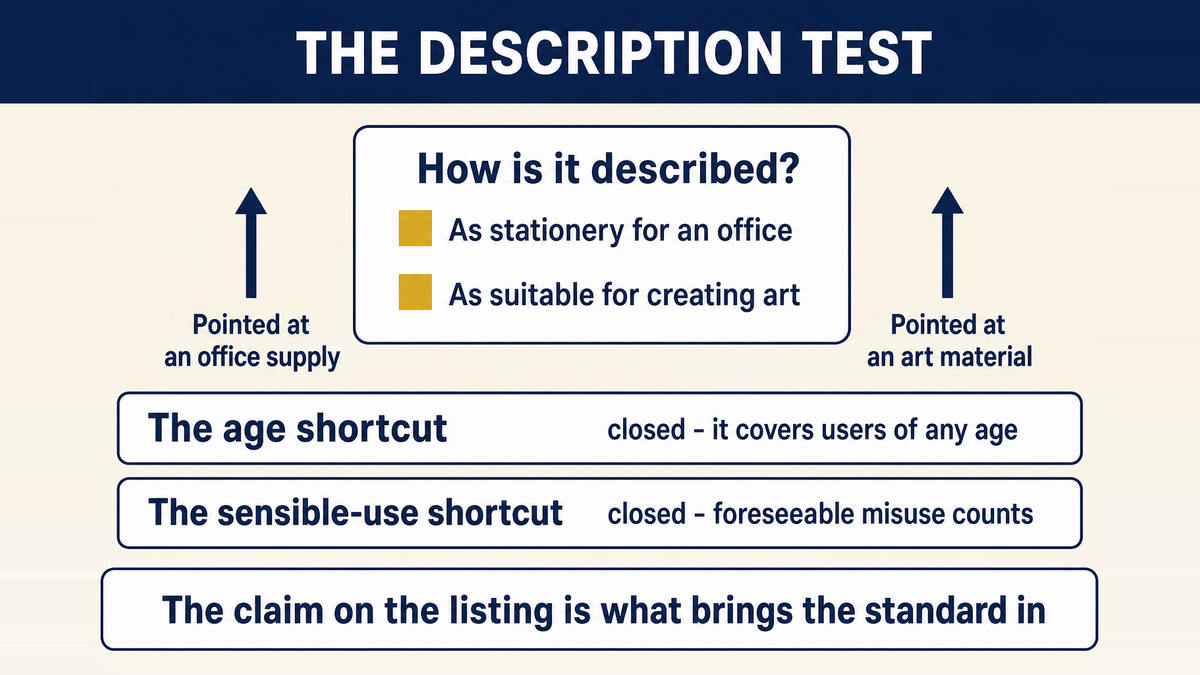
Read that closely and the consequence for a seller arrives immediately. The definition turns on what the producer or repackager says the item is for. A box of fine-liner pens described as stationery for an office is presented as an office supply. The same box described as suitable for sketching and illustration is presented as an art material, and the second description pulls it into a labelling standard that the first one never touches.
That is not a loophole in either direction, and the direction that costs money is the one sellers walk into on purpose. Listing copy that promises artistic use makes a product sound more appealing, and the same sentence is what brings the standard in. The claim is the trigger, so the copy is not marketing decoration sitting on top of the legal work; writing it carefully is the legal work.
Two further features of the standard rule out the shortcuts a seller might hope for, and both are worth reading before a listing is written rather than after.
This section applies exclusively to art materials packaged in sizes intended for individual users of any age or those participating in a small group. Labeling determinations shall consider reasonably foreseeable use or misuse.
Federal Trade Commission, 16 CFR 1500.14(b)(8), Art materials (read 14 October 2026)
The first sentence removes the age shortcut. Unlike the rules that apply to goods meant for children, this one is not limited by who the user is: it covers art materials meant for users of any age. A set of adult sketching pencils is not outside the standard because adults are the ones holding them. The wording of the statute says the same thing directly, in a sentence stating that the standard as modified applies to art materials intended for users of any age.
The second sentence removes the shortcut of assuming sensible behaviour. The assessment has to take account of use or misuse that can reasonably be foreseen, which is the reason the precautionary label is produced by a set procedure rather than written by whoever is running the store. The procedure is the substance of the obligation, and the rule spells it out in full: hazard and precautionary statements based on what is known in the scientific and medical communities, developed around hazards that show up over long exposure rather than at once, and covering products whose components are present in a form, volume or concentration that a toxicologist considers capable of causing a long-term health effect.
For a seller buying from a supplier, the useful question is therefore not whether the item is safe. It is whether the label on it was produced under that procedure, and who can show the paperwork. The regulation notes that a producer or repackager may have the determination certified by a certifying organisation, and that sentence is the one to act on, because a supplier’s own assurance and a certified determination are not the same document. When a supplier says the item is fine, ask which organisation certified that, and ask to see it.
3. The Second Problem: Space Is Charged, Not Weight
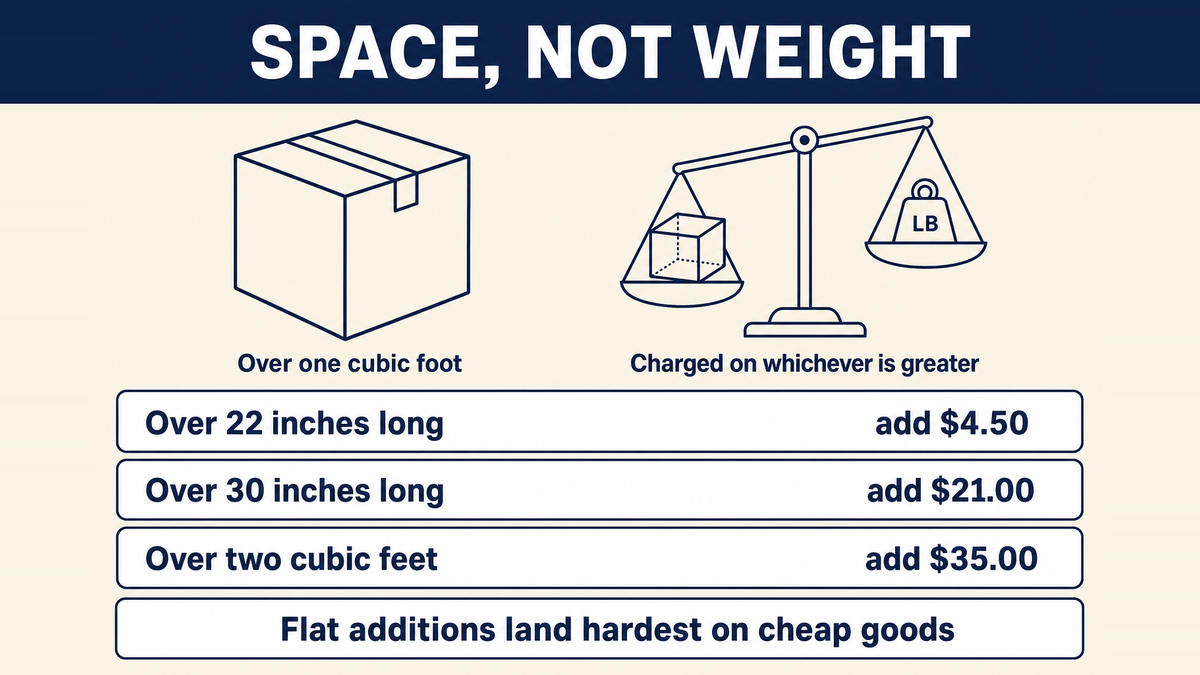
The other half of the category fails on arithmetic rather than on wording, and the arithmetic is published rather than negotiated. Bulky goods take up room without weighing much, and once a parcel passes a published size the carrier charges for whichever measure is larger.
Parcels that exceed one cubic foot (1,728 cubic inches) are charged based on the actual weight or the dimensional weight, whichever is greater… Parcels that exceed 22 inches but not greater than 30 inches in length, add $4.50. Parcels that exceed 30 inches in length, add $21.00. Parcels that exceed 2 cubic feet (3456 cubic inches), add $35.00.
United States Postal Service, Notice 123, Price List (read 14 October 2026)
Three features of that passage change how a catalogue in this category should be built.
The first is how small the trigger is. A cubic foot is roughly a box twelve inches on every side, which a pack of paper, a letter tray or a document box passes without effort while staying light enough to carry in one hand. Above that line the parcel is priced by the greater of weight or space, so a light bulky item is effectively charged for the room it occupies rather than the load it puts on the vehicle.
The second is that the additions are flat amounts rather than percentages, and they stack. A parcel past twenty-two inches adds one sum, past thirty inches adds a larger one, and past two cubic feet adds a third. Because they do not scale with value, the same flat sum is a rounding error on an expensive order and a serious share of a cheap one. A forty-dollar desk organiser and a four-hundred-dollar chair can carry identical additions, and only one of them can absorb that.
The third is that dimensions are worth getting right for their own sake. Some services list a fee charged per piece when the declared dimensions are wrong, which means an under-declared box is not corrected once but charged for repeatedly until the listing is fixed. That is why the measurement belongs in the listing data rather than in the warehouse, and why the number the plan needs is the packed dimension of the parcel rather than the product dimension on the supplier sheet. How packing turns into a charge is worked through in how volume decides what a parcel is charged.
There is one further thing about this charge, and it is the only part of it a seller can influence. The measurement that decides the price is taken from the packed parcel, so the packing decision is a pricing decision. Getting a document tray to sit inside a box that stays under the length step, or choosing a supplier who ships it flat rather than assembled, can move an order from one price band into the next without touching what the item cost to buy or what it sells for. That is worth more than a small discount on the unit cost, because it applies to every order rather than once, and because the alternative is explaining a freight line to a customer who was quoted something cheaper at checkout.
4. Why a Fixed Fee Punishes Cheap Items
The third force is small on any single order and large across a month. A card fee is normally a percentage plus a fixed amount, and the fixed part scales with nothing at all. It is the same on an order for a pen pot as on an order for a filing cabinet, so on the cheap item it takes a far larger share of the price to reach the same total.
Put that beside the flat additions from the previous section and the shape of this category becomes visible. An office supplies store tends to sell many inexpensive items, and each order carries a full set of level charges: a fixed component on the payment, a possible dimensional addition on the parcel, and any fixed handling or packing charge the supplier applies. Every one of those sits on a small price rather than scaling with it, which is the exact opposite of how a category of expensive items behaves.
The consequence for planning is that the number of orders needed to cover the store’s own fixed costs is much higher here than the average order value suggests, because contribution per order is thin. What contribution is and how it is assembled is set out in how a margin is actually built. This category is that arithmetic run at a low average order value, and it is the reason a store can be busy, well-reviewed and still not covering its subscriptions.
There is one useful consequence, though, and it points the other way. Because the fixed charges do not scale, raising the average order value is worth more here than cutting unit cost. A bundle that moves an order from one cheap item to three cheap items adds contribution without adding a second payment fee, and the same parcel that was already being charged for space carries the extra items at almost no freight cost. In a category where the parcel is priced by volume, the cheapest thing a seller can add to an order is another item that fits in the same box.
5. Who the Buyer Is, and How It Changes the Return
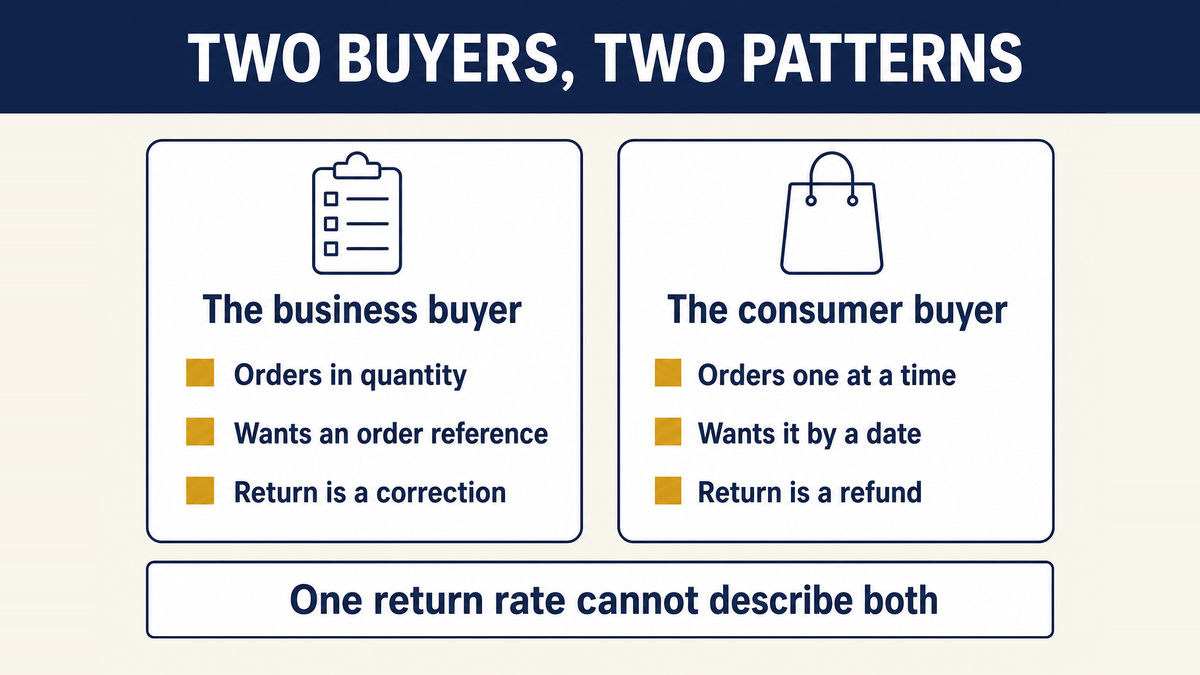
The last thing separating this category from a consumer category is that a large part of it is bought by businesses, for use rather than for a person. That single fact changes three things at once, and a plan that ignores it will set one set of expectations across two different populations.
Returns come first. A business buyer who receives the wrong size or the wrong colour is not a disappointed gift recipient; they are a purchasing decision that has to be corrected, and the correction usually means a replacement or a return rather than a refund the customer wanted anyway. What a return costs per delivered order, and the rate to plan for, is set out in what a return actually costs. The relevant difference here is that a business return is more likely to be a repeat order waiting on a fix, which makes the handling worth more than the refund suggests.
Order size comes second, and it is the one force in this category working in the seller’s favour. A business order tends to be larger and to repeat, which lifts contribution per order without changing any of the fixed charges. The items that make an order larger are usually the flat ones, so the lift arrives without a matching freight penalty.
The paperwork comes third, and it is the part most sellers skip. A buyer ordering for a company needs an invoice with the details their accounts system expects, and a supplier who can put the buyer’s own order reference onto the packing slip is worth more to that buyer than a slightly lower price. That is a service advantage rather than a product advantage, which matters in a category where the products are near-identical and the margin is thin.
The trap is assuming the whole catalogue sells that way. School buyers, home-office buyers and parents restocking for September are also in the category, and they behave like consumers, with the returns pattern to match. Setting one return rate and one service standard across both populations averages them into a number that describes neither. It is also worth separating school goods aimed at children from the rest, because goods intended mainly for children fall under their own product rules, which sit alongside the art-material standard rather than replacing it.
One supplier-side fact decides how well any of this holds together, and it is the one buyers meet first. Bulky low-value goods are usually sold by the carton rather than by the piece, because a supplier’s packing line is built to move volume and a single letter tray does not repay the handling. That suits a store selling to businesses, which orders in quantities, and it complicates a store built on single-unit consumer orders. The practical route through it is to buy in cartons for the items that repeat and to keep the single-unit catalogue to the flat goods a courier carries cheaply. Mixing the two without noticing is how a store ends up storing a stack of desk trays it never meant to own.
Timing is the last thing separating the two halves, and it is easy to plan around once it is named. The consumer half has a season and it is narrow: school goods sell in the window before the academic year starts, and a listing that misses that window waits twelve months. The business half has no season in that sense, because a company that runs out of paper does not wait for September. A store carrying both should expect its order mix to change shape through the year rather than its total to rise and fall evenly, and should set its service standards for the business buyers who order during the quiet months.
6. What to Check Before Listing
Five checks, ordered by how much they cost when they are missed rather than by how long they take.
- Read your own description. Unless the supplier can support the art-material label, describe the item as stationery and leave artistic use out of the copy. The claim is what brings the standard in, and it is written at the desk rather than in the factory.
- Ask who certified the label. For anything sold as an art material, ask the supplier for the precautionary label and for the organisation that certified the determination. A supplier’s assurance is not that document.
- Measure the packed parcel. The dimension that decides the charge is the box as it is sent, not the product on the spec sheet. Get it into the listing data, because a dimension fee that repeats per piece is a slow leak rather than a one-off.
- Compute contribution with the fixed charges in. Include the flat part of the payment fee and any dimensional addition. A contribution figure built without them will make a cheap catalogue look better than it is.
- Separate the two buyer types. Set return expectations and service standards for business buyers apart from consumers, and keep school goods aimed at children in their own group.
In this category the two decisions that carry the most money are made before anything physical happens: which words go on the listing, and which items are allowed into a box together. The first decides which labelling rules apply, and the second decides what the parcel costs to move.
7. Frequently Asked Questions
Is dropshipping office supplies profitable?
It can be, and the arithmetic is unforgiving at the cheap end. Office supplies sell at low prices with a full set of level charges on every order, so contribution per order is thin and the order count needed to cover the store’s fixed costs is higher than the average order value suggests. The items that do well are small in volume, light, and easy to add to an order that is already going out.
Do art supplies need special labels?
It depends on how they are presented rather than what they are made of. Anything marketed or represented as suitable for creating visual or graphic art falls under a labelling standard brought in by statute, and that standard applies to art materials intended for users of any age. The practical job is to confirm the precautionary label exists and to ask which organisation certified the determination behind it.
Why is shipping so expensive for office supplies?
Because bulky light goods are charged for the space they occupy. Once a parcel passes one cubic foot, the carrier charges on the greater of actual weight or dimensional weight, and flat additions apply past twenty-two inches, past thirty inches and past two cubic feet. None of those additions scale with the value of the order, so they land hardest on cheap items.
Can I sell school supplies for children?
Yes, with the extra step that goods intended mainly for children fall under their own product rules, which apply on top of the general labelling duties rather than instead of them. That is a separate regime from the art-material standard, which is not limited by the age of the user. Keep the two groups apart when you set your checks, because they ask for different paperwork.
What sells best in office supplies?
The items that stay under the size at which the parcel starts being charged for space, and that a buyer has a reason to order more than one of. Flat, light, repeat-order goods carry the category. Anything that is mostly air, or that only ever sells as a single unit at a low price, has to clear a higher bar before it contributes anything.
What a Fixed Fee Does to a Cheap Item
We return the per-order fee against your average item price, the point where it eats the margin, and the repeat-order effect.
Model My Fee Drag
Questions & Comments
We read every one and reply within 24 hoursPlanning an office or school supplies catalogue, unsure whether your listing copy pushes an item into the art-material labelling standard, or trying to work out what a bulky light parcel really costs to move once it passes a cubic foot? Send us the products you are looking at, and our team will price the packed parcel on its real dimensions and tell you which labelling obligations the items attract as they are described.