
Dropshipping Taxes: The Two Taxes, and Why They Fall in Different Places
 ·
Updated October 13, 2026
·
15 min read
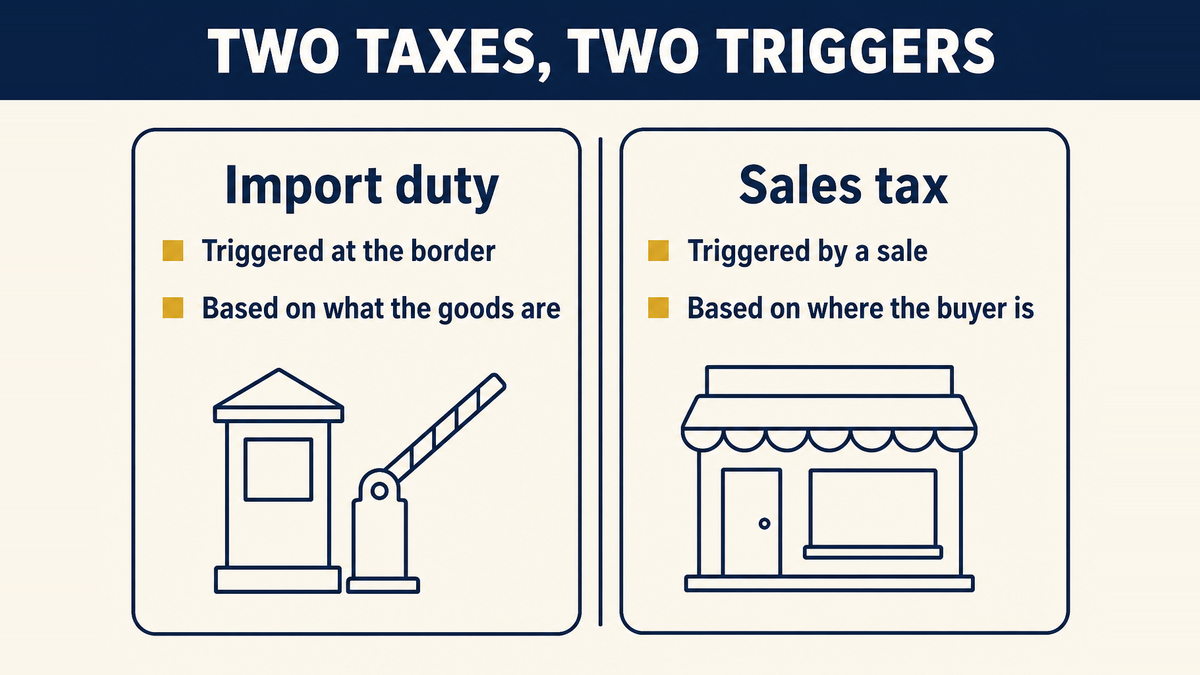
Most advice about tax in dropshipping lumps two completely different charges together, and that is why it is so hard to act on. Import duty is charged on goods crossing a border and it is based on what the goods are. Sales tax is charged on a sale and it is based on where the buyer is. They are triggered by different events, they are worked out on different amounts, and they frequently fall on different people. Once you separate them, most of the confusion goes away.

The Two Taxes Side by Side
| Import duty | Sales tax | |
|---|---|---|
| Charged when | The goods cross a border. | A sale is made. |
| Worked out on | The customs value and the classification of the goods. | The selling price, at the buyer's address. |
| Decided by | The terms of the sale between you and the supplier. | The state or country the customer lives in. |
What this guide covers
This article explains how the two charges differ in structure, because that is the part that decides your pricing and your terms. It is not tax advice, the rules differ between states and countries, and the levels change. Use it to know which questions to ask, then check the current position for the specific places you buy from and sell into.
1. Why Are These Two Different Subjects?
Because one is a charge on an object and the other is a charge on a transaction. Duty is attached to the goods, so it exists whether the goods are sold, stored or given away. Sales tax is attached to the sale, so it exists only when there is a buyer, and it is calculated from the price rather than from the product.
That difference explains why the two are administered by completely different bodies and why they are reported in different ways. Duty is settled with a customs authority at the moment the goods arrive. Sales tax is settled with the tax authority of the place where the customer is, on a schedule, long after the parcel has been delivered.
It also explains why the same business can be completely untroubled by one and heavily exposed to the other. A store that buys domestically and sells abroad has no import duty of its own to think about, and a store that imports and sells only where it is already registered may have no new sales tax question to answer. The two only become tangled when you both import and sell across borders, which is exactly what a modern dropshipping store does.
2. Tax One: Duty at the Border
Duty is worked out when the goods enter the country, from two things: what the goods are and what they are worth. What they are is decided by the classification code, and the rate for that code comes from the published schedule. The value is the customs value of the goods, which is not always the number on the supplier's invoice once freight and other adjustments are taken into account.
The code matters more than most sellers expect, because similar products can sit in different codes at very different rates. Looking the code up before you commit to a product is far cheaper than discovering it at the border, and the published schedule is the place to look it up rather than a summary from a supplier.
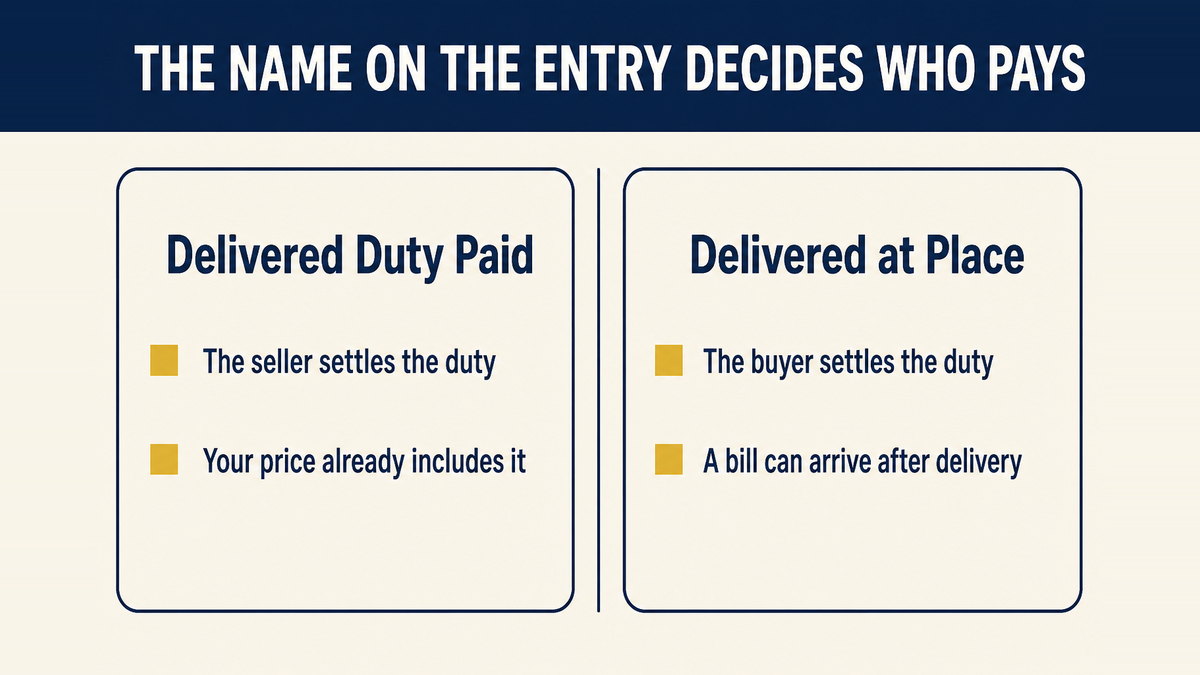
The question that decides who pays is not who placed the order. It is whose name is on the customs entry. Under one set of terms the seller carries the duty all the way to the destination, and the term itself says so: it is called Delivered Duty Paid. Under the neighbouring term, Delivered at Place, the goods are delivered but the duty is left to the buyer to settle. That single distinction decides whether the price you agreed is the price you pay.
DAP - Delivered at Place (insert named place of destination) · DPU - Delivered at Place Unloaded (insert of place of destination) · DDP - Delivered Duty Paid (Insert place of destination).
International Trade Administration, Know Your Incoterms. Duty rates for a given product are published in the USITC Harmonized Tariff Schedule
Read the terms on every quotation rather than assuming them. A supplier quoting a price per unit and a supplier quoting a delivered price are quoting two different products, and the gap between them is usually the duty plus the clearance fee. Our guide to what a delivered-duty-paid arrangement really covers and our notes on using a licensed customs broker cover the mechanics on the import side.
3. Tax Two: Sales Tax Follows the Buyer
Sales tax is charged on the sale, and the amount depends on where the customer is. That is the sentence to hold on to, because it inverts the intuition most sellers start with. It is not your address that decides it. It is the buyer's.
The practical consequence is that a store can carry an obligation in a place it has never been. A seller in one state selling to customers in another has to consider the rules of the customer's state, and those rules generally begin to apply once the seller passes a certain level of activity there, whether measured in sales value or in number of transactions. Those levels differ between states, and several states use different measures from each other, which is why the answer has to be worked out per place rather than once for the business.
It also means the answer changes with your customer mix rather than with your own arrangements. Passing the level in a new state is not something that happens because you decided to expand; it happens because enough people there bought from you. That is worth watching as a number rather than discovering as a letter.
Do not assume that selling through a platform removes the question. Where a platform collects tax on your behalf, that is a rule about the platform's role in the sale, and it applies to sales made through that platform. Sales made through your own store are yours to account for, and the two can sit side by side in the same month.
4. What Is the Drop Shipment Structure?
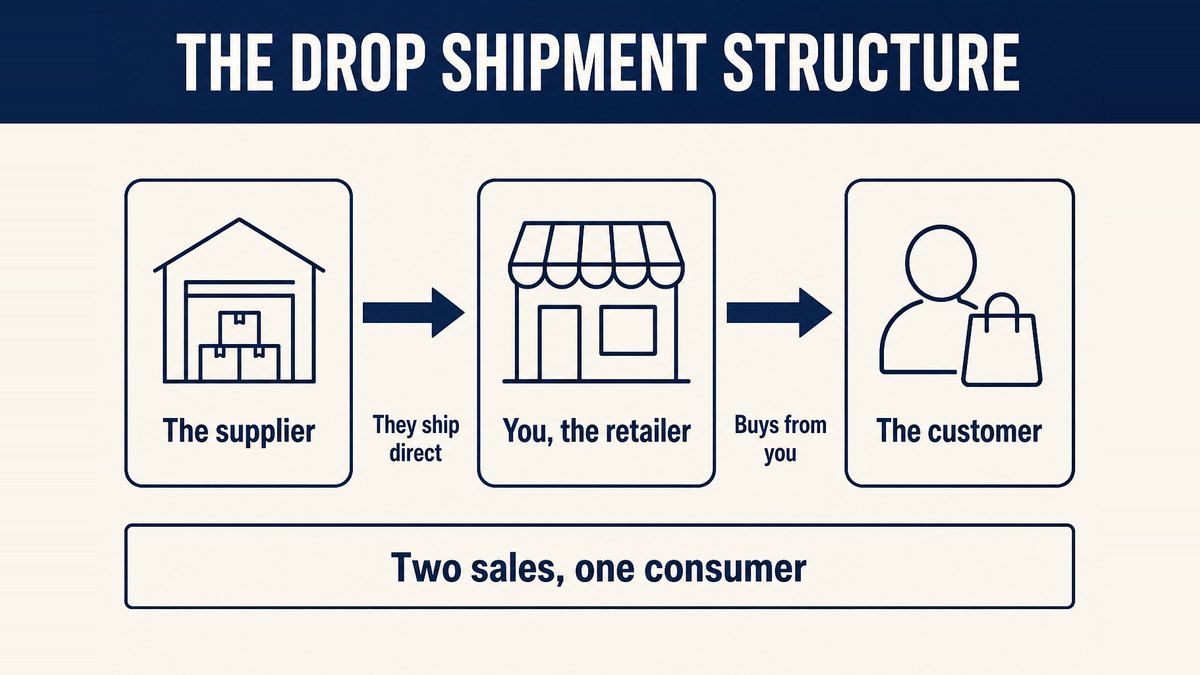
It is two sales with one consumer, and seeing it written out is what makes the sales tax question make sense. The customer buys from you. You buy from a supplier. The supplier ships to the customer, so the goods travel in one step while the money travels in two.
Tax authorities describe this pattern directly, and California's published guidance is unusually clear about who ends up carrying the charge. It sets out when the shipping party becomes responsible for the tax, and on what amount.
A drop shipment is the delivery of tangible personal property by a California retailer on behalf of an out-of-state retailer to a consumer in California. If you make a drop shipment to a California consumer, you are responsible for reporting and paying sales tax on the retail selling price if: the sale is on behalf of an out-of-state retailer, and the out-of-state retailer does not hold a California seller's permit. Typically, drop shipment transactions involve two businesses, two sales, and one consumer.
California Department of Tax and Fee Administration, Publication 121: Drop Shipments
The phrase to notice is the retail selling price. The tax is not worked out on the wholesale price the supplier charged you. It is worked out on the price the consumer paid, which is a number that belongs to your pricing and not to theirs. A supplier in that position is therefore accounting for tax on an amount it never received, which explains why suppliers in this situation are often careful about who is registered where.
Read from your side, the same sentence says something practical: if you are the retailer outside the state and you are not registered there, your supplier may be left holding a tax question about your retail price. That is one reason a supplier may ask for registration details before agreeing to ship, and it is a good reason to have the answer ready rather than to treat the question as an obstacle.
Having that answer ready is simpler than it sounds. A supplier in this position needs to know whether you hold a permit where the customer lives, because that is what decides which of the two of you is left holding the charge. A short written summary of the places you are registered in is usually enough. What causes the difficulty is not a missing registration but an unclear answer, because a supplier that cannot tell who carries the tax cannot quote a price it is willing to stand behind.
5. Where Does Each One Land in Your Price?
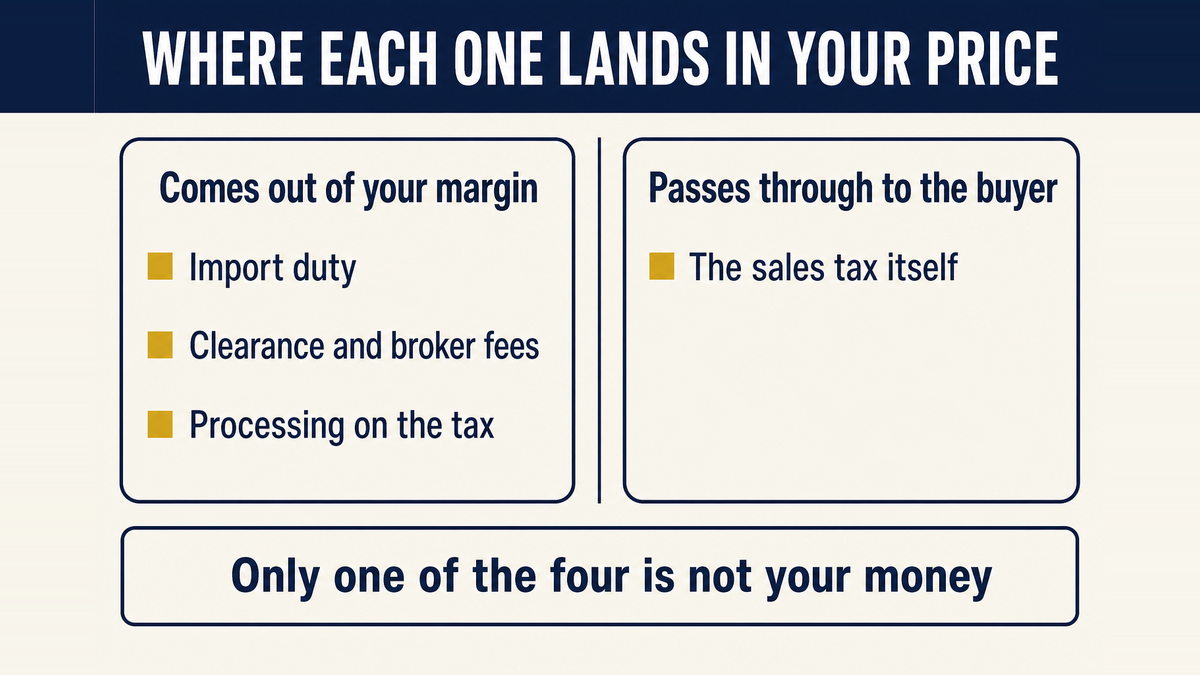
Once the two charges are separated, it becomes obvious that they land in completely different places in your accounts, and that only one of them is a cost to you.
| Charge | Where it sits | Who ends up bearing it |
|---|---|---|
| Import duty | Inside your cost of goods. | You, on every unit, whether it sells or not. |
| Clearance and broker fees | Inside your cost of goods, spread across the shipment. | You, and more per unit when the shipment is small. |
| Sales tax collected | Added to the customer's total and passed on. | The customer, in principle. |
| Processing on that tax | Inside your costs, because the fee is charged on the whole total. | You, on money that was never yours. |
The first two rows are a straightforward cost, and they behave like any other cost of goods: they reduce contribution per unit and they arrive whether or not the item sells. Duty of eight per cent on a six dollar unit is forty-eight cents, which does not sound like much until you notice it is four per cent of a twelve dollar contribution, on every single order.
The last two rows hold the detail that catches people out. Sales tax is not a cost to you, because you collected it from the customer and you pass it on. But the payment processor charges its percentage on the entire amount collected, and that amount includes the tax. On a 24.99 order with 7% tax added, the total collected is 26.74, and at 2.9% plus 30 cents the fee is 1.08 rather than the 1.02 it would have been without the tax. Six cents an order is not a crisis, but it is a genuine cost that exists only because you collected tax, and it applies to a figure that is not your money.
The cost that really deserves attention is the first row, because duty is the one charge in this article that cannot be passed on without making your price less competitive. The lever that changes it is the classification code and the customs value rather than the price you sell at. Our guide to finding the right HTS code and duty rate covers the lookup itself, and our notes on building a landed cost figure show where duty sits in the total. There are also legitimate structural routes that change the duty position, which our guide to knock-down and part-finished goods and our notes on certificates of origin set out.
There is a useful order to these decisions, and it runs from the fixed end to the flexible one. Work out the classification and the duty first, because both are fixed by what the product is and neither can be renegotiated after it has shipped. Then decide the terms of the sale, because those decide which of you settles the charge at the border. Then set the price with the duty already sitting inside it. Sellers who work the other way round, choosing a price and then looking for a supplier to fit it, tend to meet the duty as a reduction in margin rather than as an input to the price.
6. Frequently Asked Questions
Do I pay tax on dropshipping?
Two different taxes can apply, and they are not the same subject. Import duty is charged on the goods when they cross a border. Sales tax is charged on the retail sale and follows the buyer's location. A store can owe one, the other, both or neither, depending on where it buys and where it sells.
Who pays the customs duty on an imported order?
The party named on the customs entry rather than the party who placed the order. That is decided by the terms of the sale, and the names of the terms say which is which: one is Delivered Duty Paid and the other is Delivered at Place, which leaves the duty to the buyer.
Which state's sales tax applies to my online sales?
The state where the buyer is, not the state where you are. That is why a store can carry a tax duty in a state it has never visited, and why the answer changes with each customer rather than with each order you place.
What is a drop shipment for sales tax purposes?
It is two sales and one consumer. A retailer sells to the customer, and a supplier sells to that retailer while shipping straight to the consumer. California's published guidance describes exactly this, and it shows the supplier can become responsible for tax on the retail selling price when the retailer is not registered in the state.
Can a supplier be taxed on a price it never charged?
Under that structure, yes. The tax can be worked out on the retail selling price rather than on the wholesale price the supplier actually received, which means the tax base includes a margin that belongs to somebody else.
Both Taxes, Shown Inside the Price
We return the price built from landed cost, duty, and the sales tax cut-off in each state you ship to, with the registration trigger.
Build My Price
Questions & Comments
We read every one and reply within 24 hoursWorking out whether duty sits with you or the supplier, unsure which state's rules apply once orders start arriving from somewhere new, or been asked for registration details you did not expect? Post the product, the destination and the terms on your quotation, and our team will help you separate the border charge from the sale charge.