
Spray Dryer Manufacturer: Chambers, Atomizers and Air Paths From China
 ·
Updated October 13, 2026
·
27 min read
A spray dryer turns a liquid into a powder in one step by throwing it into a stream of hot air and drying the droplets before they land. It is bought on evaporation rate and outlet moisture, and it is accepted or rejected on three things the quotation almost never shows — whether the atomizer can make the droplet size the product needs, whether the air path can carry the powder out without blocking, and whether the chamber wall will still be clean four hours into a run. All three are decided on the drawing, and all three are cheap to fix there and expensive to fix afterwards.
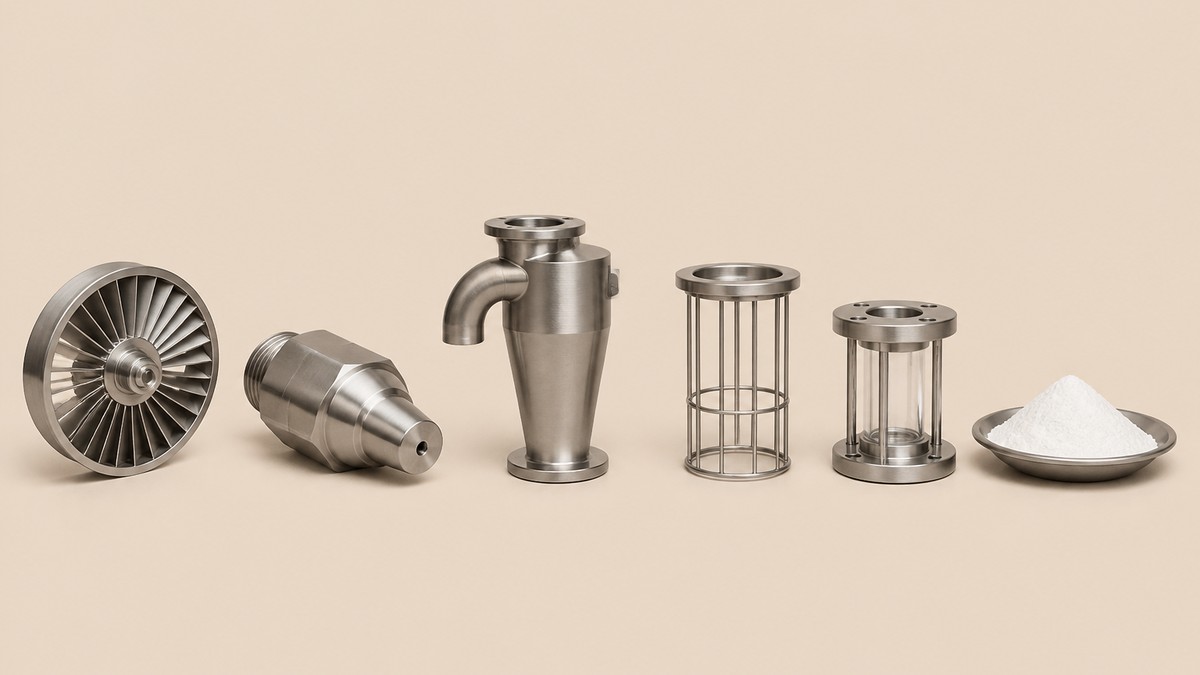
Six Lines That Decide Whether a Dryer Order Is Complete
| What the buyer has to settle | Why it is not obvious | The line on your order that closes it |
|---|---|---|
| The evaporation rate, not the feed rate | Two quotations for the same feed rate can be different sizes, because the duty is water removed | Kilograms of water evaporated per hour, with the inlet and outlet moisture stated |
| Which atomizer, and the droplet size it reaches | A wheel and a nozzle make very different powders from the same liquid | Atomizer type by name, with speed or pressure stated and the maker of the bought item |
| What the powder may touch, and what happens when it sticks | The chamber wall is where a run ends, and the answer is a wall detail rather than an operator instruction | The chamber finish and any air broom or wall scraper, written as a feature |
| How the powder leaves the air | Cyclone, bag filter or both, and in what order, decides recovery, emissions and fire risk | The separation train listed stage by stage with the outlet loading guaranteed |
| Where the moisture figure comes from | For a standardized product the moisture ceiling and the test method are not yours to choose | The moisture specification naming the method that will decide acceptance |
| What is inside the scope | Heater, fans, ductwork, insulation, instruments and controls move between quotations | A make-or-buy split with the maker named for each bought item |
What a Spray Dryer Manufacturer Actually Sells You
A spray dryer factory builds the chamber shell, the frame and the ducting. It buys the atomizer, the process fan and the air heater, the filter bags or cartridges, the rotary valves and the instruments. Which of those it makes and which it buys is the first thing to settle, because the bought items are on the critical path and the chamber is not.
What a buyer is really buying is a matched set, and the matching is the engineering. Four parts have to agree with each other: the atomizer, which decides how small the droplets are; the chamber, which decides how long they are in the air; the air system, which decides how much water the air can take; and the separation train, which decides whether the powder ends up in a bag or up the stack. Change any one of them and the other three move.
- The chamber
- The vessel the drying happens in, in one of four common shapes. Its diameter and height come from the droplet's drying time and the airflow, not from the batch size, and its wall is where powder either falls or sticks.
- The atomizer
- A rotary wheel spinning at high speed, or a nozzle using liquid pressure, or a nozzle using compressed air to break the liquid up. This is the single most important bought item on the machine, and it is the one with the shortest life.
- The air system
- A supply fan, a heater, and the ducting between them and the chamber. Its job is to deliver hot air at a controlled temperature and to carry the dried powder out again.
- The separation train
- A primary separation stage, usually a cyclone or the chamber base itself, followed by a final filter to catch what the primary stage misses. The powder that reaches the filter is either product or waste, and which one it is should be written down.
- The powder handling
- Rotary valves, screw conveyors and the discharge into whatever comes next. A dryer that produces good powder and cannot get it out of the building has not finished the job.
Two supporting devices belong in the same enquiry even when they come from a different factory, because the dryer cannot work without them. On the feed side, if the liquid arrives as a slurry that has to be thickened first, the dewatering step sits upstream and is a separate machine — a filter press that sets the cake consistency going into the feed tank decides how steady the dryer's inlet is. On the product side, powder that is dried is usually blended next, and a ribbon blender working on the same bulk density is where the blend uniformity is won or lost. Getting the density figure from the dryer to the blender is one number that both factories need.
It is also worth saying what a spray dryer is not, because buyers arrive with the wrong expectation more often here than anywhere else in this category. It cannot make a coarse, free-flowing granule. It makes a fine, dusty powder, and if the market wants granules then the machine that follows is an agglomerator or a fluid bed, not a different spray dryer. A quote that promises both a fine powder and a coarse one from the same chamber is promising something the process does not do.
The Chamber Arrangements, and What Each One Costs You
Four arrangements cover most industrial spray dryers, and the difference between them is where the powder goes when it dries and how the air leaves.
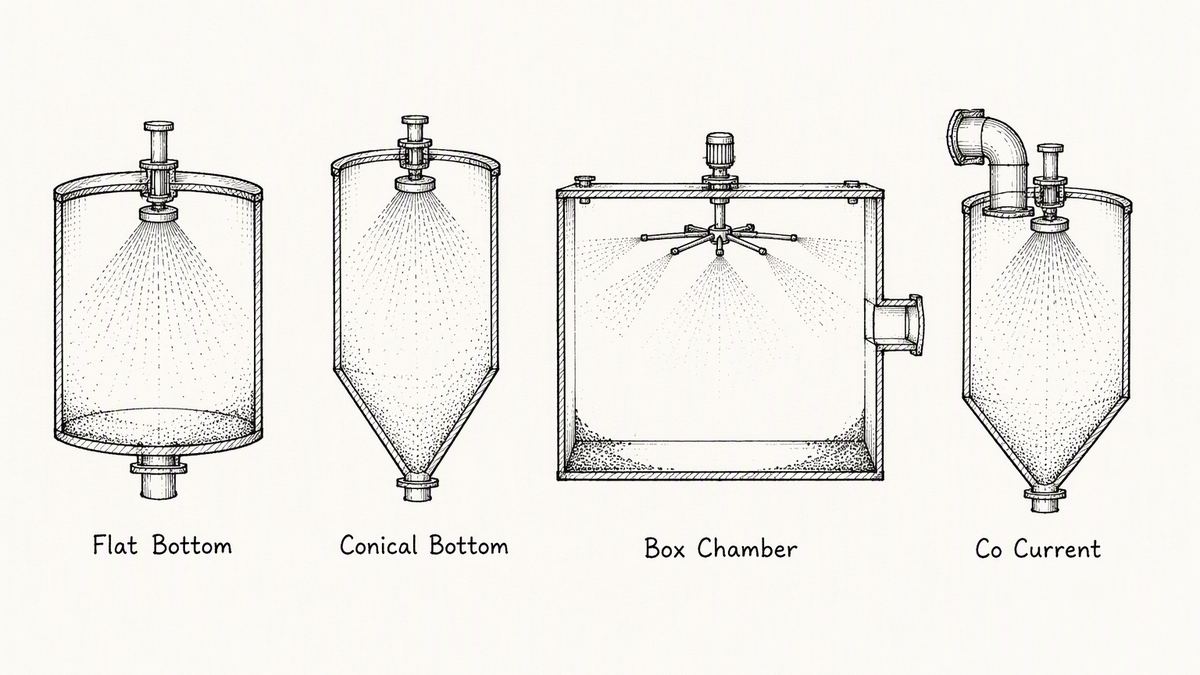
- A flat-bottomed cylinder
- The simplest shell to build and the easiest to inspect, because a person can stand inside it. Its weakness is that powder sweeps across a wide flat floor on its way to the outlet, and the floor is a place where it can sit and be scorched by the hot air above it. It suits products that dry into a free-flowing powder and can take some residence time at the base.
- A conical hopper bottom
- The floor tapers to a small outlet, so powder keeps moving and does not sit. It costs more to fabricate and it is harder to get inside, and the taper angle has to be steep enough for the product's own flow behaviour. This is the default choice for most food and chemical powders.
- A box chamber
- A large square-section room with the atomizer high in the middle and a flat or gently sloping floor. It gives the longest drying time for a given height and it is the arrangement usually chosen for very large evaporation rates and for products that need a long residence time. Its weakness is the corners, where air slows down and powder collects, and the size of the floor that has to be swept.
- Co-current flow
- Not a shape so much as an arrangement: the hot air enters at the top beside the atomizer and travels down with the droplets, so the hottest air meets the wettest droplet. That protects heat-sensitive products, because the droplet surface cools as it evaporates and the air is coolest where the powder is driest. It is the usual arrangement for dairy, coffee and anything with a flavour to preserve.
Two practical points follow from the choice, and both show up in the price. First, a box chamber is a welded structure with a much larger surface area, so it costs more to build, more to insulate and more to keep clean; a buyer who needs one should expect that and not treat it as a supplier's padding. Second, the chamber's dimensions are set by drying time and airflow, not by how much powder the plant wants per hour. The hourly output follows from the evaporation rate, so asking a factory for a chamber sized to a tonnage without giving it the inlet and outlet moisture is asking it to guess.
The Atomizer Decides the Powder
Everything about the powder — its particle size, how well it flows, how much dust it makes and how it dissolves — starts with how small the droplets were when they left the atomizer. Drying does not make particles bigger or smaller; it removes water from what was already there. That single fact is what makes the atomizer the most important bought item on the machine.
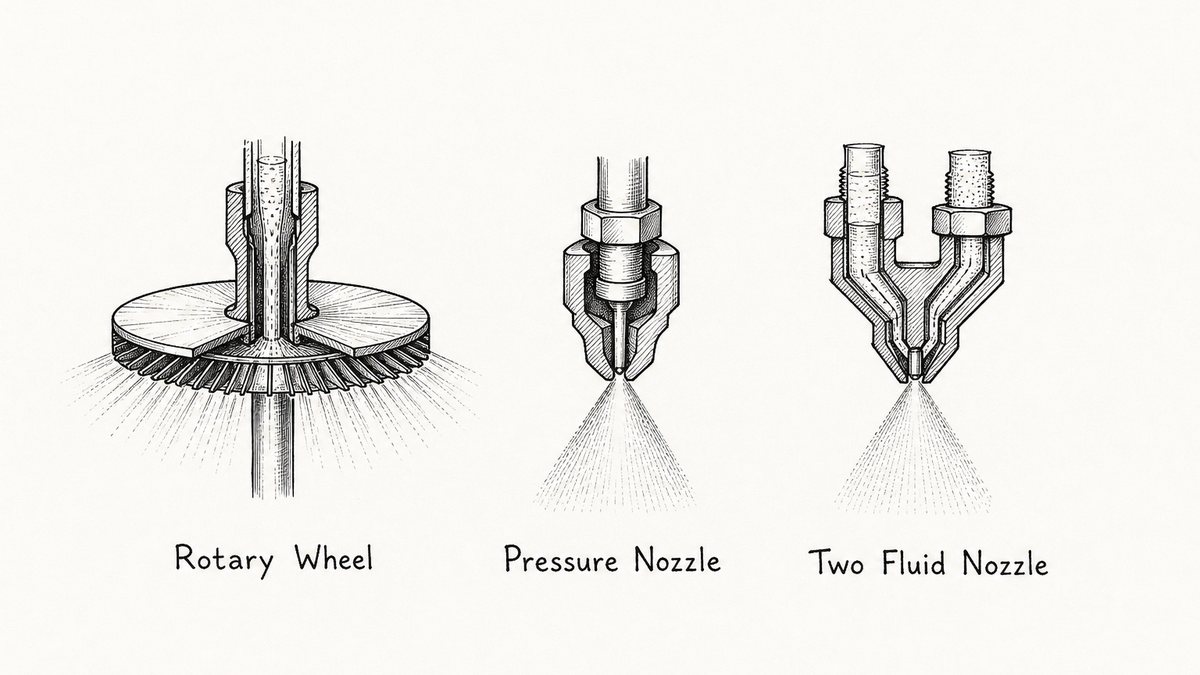
- Rotary wheel
- Liquid is fed down the hollow shaft and flung off a spinning disc with fine vanes on its rim. Droplet size follows the wheel speed and diameter, and a wheel copes well with viscous and abrasive feeds that would plug a small orifice. It needs a high-speed shaft with its own lubrication and cooling, and the wheel rim wears.
- Pressure nozzle
- The feed is pumped at high pressure through a small orifice and breaks up on its own. Simple, no rotating parts, and it makes the finest powder of the three when the feed is thin enough to pass a small hole. Its weakness is exactly that hole: it erodes, and as it erodes the droplets grow and the powder changes. It also plugs if anything fibrous or gritty arrives.
- Two-fluid nozzle
- Compressed air meets the liquid at a small tip and shatters it. It gives the finest control over droplet size and works with feeds too thick for a pressure nozzle, at the cost of a compressed air supply and the running cost that comes with it. It is the usual choice for small and medium machines and for products where the particle size has to be held tightly.
Three consequences matter to a buyer, and each one should be settled before the order rather than after the first production run.
The feed has to suit the atomizer, not the other way round. A pressure nozzle needs a clean, thin, non-abrasive liquid; a rotary wheel tolerates thick and slightly abrasive feeds; a two-fluid nozzle handles thick feeds but needs air. If the plant's product carries fibre or grit, or if it arrives at a viscosity the factory has not been told about, the wrong atomizer is chosen and no amount of adjustment fixes it. Send the viscosity and the solids content, and say whether the feed is filtered.
The atomizer is a wear part with a life, and the life is a purchasing decision. A pressure nozzle tip erodes — that is what the figure of the eroded orifice shows — and a rotary wheel rim wears down until it no longer makes the droplet size it was set for. Both are replaceable, and both should come with a spare in the original order, because a spare ordered later from a Chinese factory that has changed its drawing is a spare that does not fit. Ask for the wear-part list with part numbers, and buy the first set of spares with the machine.
The atomizer needs a serviceable mounting. A wheel spinning at high speed on a shaft that passes through the chamber roof needs a bearing arrangement, a lubricant, and a way to get at both. If the mounting cannot be lifted out as an assembly, every seal and bearing change becomes a chamber entry. That is the difference between a scheduled half day and an unplanned week, and it is a drawing decision.
The Air Path: Heater, Fan, Chamber, Cyclone, Filter
The air does two jobs at once: it supplies the heat that evaporates the water, and it carries the dried powder out of the chamber. Those two jobs compete, which is why the air path is designed as one system rather than bought as separate items.
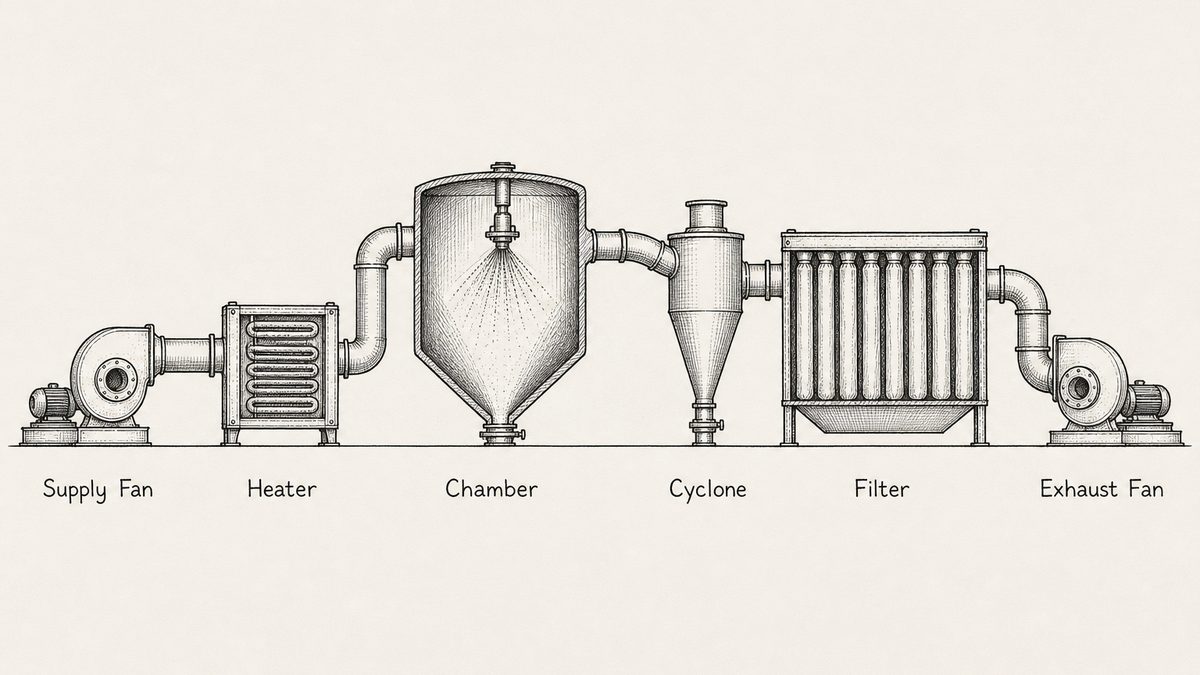
Reading the figure from left to right is the simplest way to understand the machine. Ambient air is pulled in by the supply fan and pushed through the heater. The heater raises it to the inlet temperature the product allows. It enters the chamber, meets the spray, and leaves carrying evaporated water and suspended powder. The cyclone takes out the bulk of the powder; the filter takes out what remains; the exhaust fan pulls the whole stream through and discharges it.
The exhaust fan is the part buyers think about least and it does the most quiet work. Because it sits at the end, it holds the chamber at a slight negative pressure relative to the room. That negative pressure is what stops dust escaping at every flange, sight glass and door. A machine whose exhaust fan is undersized, or whose ductwork has more resistance than the fan was chosen for, will not hold that pressure, and the first symptom is powder on the floor around the chamber rather than in the product stream.
- The heater
- Direct fired, where the combustion gas joins the drying air, or indirect, where a heat exchanger keeps the two apart. Direct is cheaper and more efficient; indirect is the only choice when the product must not meet combustion gas, and it is what a buyer needs when the product is a food with a flavour to protect or when the exhaust is regulated as a source of nitrogen oxides.
- The supply fan
- Sized against the total resistance of heater, chamber, cyclone, filter and ductwork. A fan chosen on the chamber alone will not deliver the flow once the filter loads up, and a loaded filter is not an exceptional condition — it is the normal end of a shift.
- The ductwork
- The part that moves between quotations. Powder-laden duct has to run without low spots where material settles, and it has to be sized to keep the gas speed high enough to carry the powder. A duct sized on clean-air velocity will settle out at the first bend.
- The separation train
- The cyclone takes coarse powder and returns it to product; the filter takes the fines. Whether those fines are product or waste is a commercial decision, and if they are to be captured rather than emitted, the filter becomes the product collection point and its design changes.
Two of those items connect to equipment further down the line, and both should be considered at the enquiry stage rather than after commissioning. The exhaust leaving the filter still carries heat, and if the plant has an odour or solvent problem as well as a drying problem, the stream that leaves the dryer is the feed to a control device — a thermal oxidizer sized on the dry gas volume rather than the wet one is what usually goes there, and it needs the figure measured after the filter, not before. And if the plant would rather collect the fines in water than in bags, the alternative is a wet route, where a wet scrubber chosen for the particle size that got through the cyclone replaces the filter. Both are legitimate, and neither can be sized from the dryer's nameplate.
The Water Balance Is the Design
Almost everything about a spray dryer follows from one calculation: how much water has to leave the product per hour. It is worth doing that arithmetic before reading any quotation, because it turns a page of prose into three numbers you can check.
The first number is the water load. Take the feed rate and multiply it by the difference between the inlet moisture and the outlet moisture, both as fractions of the total mass. A feed entering at seventy per cent water and leaving at four per cent, at a thousand kilograms an hour, is removing roughly six hundred and ninety kilograms of water every hour. That is the duty, and it is the number the dryer is sized on — not the feed rate.
The second number is the air flow, and it is bigger than most buyers expect. Air can only carry so much water vapour, and the limit rises with temperature. The hot air entering a dryer at 200 degrees Celsius can absorb a great deal more moisture than the same air leaving at 90 degrees, so the air flow is set by the difference between what the air can hold at the inlet and what it is allowed to hold at the outlet. That difference is why a dryer is large: it is not heating the water, it is carrying it away.
The third number is the heat. Raising the air to the inlet temperature and evaporating the water both cost energy, and the exhaust leaving at the outlet temperature walks away with a share of it. This is why heat recovery matters on a dryer and why the outlet temperature is a compromise: run the outlet too hot and the fuel bill climbs, run it too cool and the powder leaves wet and the filter bags start to blind.
Three practical consequences follow, and they are the ones that separate a workable quotation from a plausible one.
- Ask for the inlet and outlet moisture with the basis stated. Wet basis and dry basis look similar as numbers and mean very different masses. A factory that quotes on a wet basis while the plant supplied a dry basis will size the machine on the wrong duty, and the gap is large enough to be the difference between the machine working and not working.
- Ask for the design inlet and outlet air temperatures. These are the two figures that set the air flow, the heater size and the filter material. A quotation without them has not shown its working.
- Ask what the design assumes about ambient air. A dryer sized for cold, dry winter air and run in hot, humid summer air has less capacity in summer, because the incoming air is already part-way to its moisture limit. On a plant in a humid climate this is a seasonal production loss that nobody predicted.
One note on the alternative, since buyers often ask. Where the product tolerates longer contact with hot gas and a coarser output is acceptable, a rotary dryer working on a moisture basis and a residence time is a simpler and cheaper machine, and it is often the right answer for a mineral or a coarse, free-flowing product. Spray drying earns its cost when the feed is a liquid that has to become a powder in one step, or when the powder's particle size and solubility matter more than the capital cost.
Moisture Is a Legal Number for a Standardized Product
On most machines in this category, the buyer chooses the specification. On a dryer making a standardized food, one of the specifications is already written into law, and it comes with the test method that decides whether you met it. That changes what a buyer should put on the order.
The clearest example is nonfat dry milk, and the standard of identity for it is a short, readable section. The rule is 21 CFR 131.125, and it opens by defining the product and setting the ceiling in the same sentence:
“Nonfat dry milk is the product obtained by removal of water only from pasteurized skim milk. It contains not more than 5 percent by weight of moisture, and not more than 1½ percent by weight of milkfat unless otherwise indicated.”
Three things are happening in that sentence, and each one lands on the dryer.
The moisture figure is not a preference. It is a ceiling that comes with the name of the product. A dryer whose outlet moisture wanders above it does not make nonfat dry milk, whatever the label says, and the fix is not to write a looser specification — it is to change the machine or the run.
The product is defined as removal of water only, from pasteurized skim milk. Water is the only thing the process is allowed to take out, and the source material is fixed. Nothing may be added. For a buyer that means anything the machine puts into the powder is a defect rather than an additive: a lubricant that reaches the product, a metal fragment from a worn atomizer wheel, a scorched particle knocked off the chamber wall. The dryer is not only a dryer; at this point it is part of the product's definition.
The method of analysis is named. The same section lists how moisture is to be determined, referencing the official method for moisture in dried milk. That matters commercially because moisture at a four-to-five per cent ceiling is a figure two different methods can disagree on. A buyer who writes a moisture specification without naming the method has left an argument in the contract, and it will be had at the end of a commissioning run when neither side wants to repeat it.
Most products are not standardized, and for those the buyer is free to set the figure. The reason to know this rule anyway is that it shows how the two halves fit together: a moisture figure and a test method are one specification, not two. On anything the plant sells against a named product — dried milk, dried cream, dried whey, dried egg, a standardized juice powder — the first question is whether a rule already sets the number, and the second is which method the rule names.
Wall Build-Up, and the Deposit That Ends a Run
A spray dryer does not fail by breaking. It fails by accumulating. Powder that touches the chamber wall while it is still tacky sticks to it, and once there it either dries into a hard ring or stays soft and grows until it falls off in a lump. Both outcomes end a production run, and both are decided by the wall and the airflow rather than by the operator.
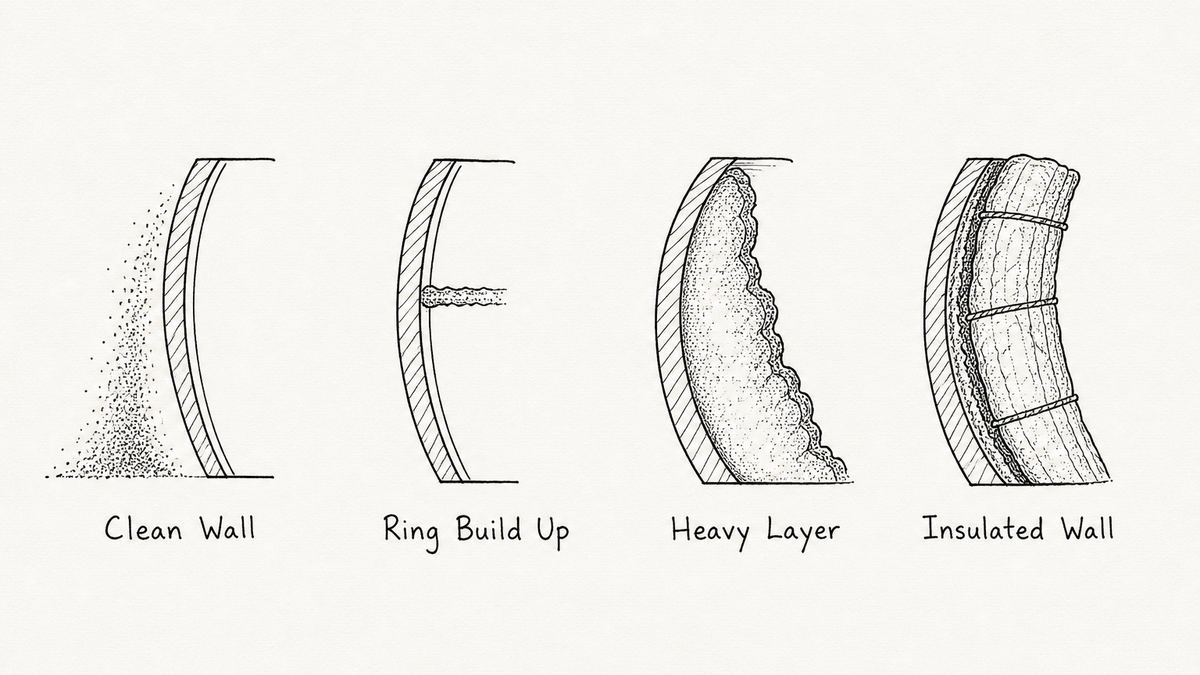
The four conditions in the figure are worth reading as a diagnostic sequence, because each one points somewhere different.
- A clean wall
- Powder falls freely. This is what the machine is designed to do, and it depends on the droplets being dry before they reach the wall, which in turn depends on the chamber being large enough for the drying time and on the air pattern keeping the spray away from the surface.
- A single ring at a fixed height
- The most informative of the four. A ring forms where the air pattern has a stagnation band or where the spray's outer edge just touches the wall. It tells you the atomizer is throwing wider than the chamber can accept, or that the air inlet is creating a swirl the chamber cannot straighten. It is a design signature, not a cleaning problem, and it will come back at the same height every run.
- A heavy layer over a large area
- The product is arriving at the wall still wet across a broad band. Usually one of three causes: the chamber is too small for the evaporation rate being asked of it, the feed is wetter than the machine was sized for, or the outlet temperature has been run too low and the droplets no longer dry before they land.
- A crust on an insulated wall
- The wall is hot, and the powder that lands on it is being held at a temperature for long enough to cook. A crust is a quality problem before it is a cleaning problem, because it changes colour and flavour, and it will come off in flakes into the product.
Two design features exist to deal with build-up, and a buyer should know which one is being offered.
The first is an air broom: a ring of ducts near the chamber wall that blows a curtain of air down the wall surface, keeping the spray away from it and sweeping any contact powder off before it can set. It costs air and it costs ducting, and on a difficult product it is the difference between a four-hour run and a twelve-hour run. The second is a wall scraper or vibrator on the outside of the shell, a mechanical device that knocks or wipes the wall so material cannot build. The first prevents the contact; the second deals with it after the fact. They are not substitutes, and a quotation that says only "chamber cleaning system" has not said which one it is.
One more wall detail belongs in the enquiry because it is invisible on a quotation and expensive later. The inside of the chamber should be free of ledges, stiffeners, bolt heads and unfinished welds. Every one of them is a place where powder collects and is held hot. A chamber built with internal stiffening to save plate thickness is cheaper and worse, and that trade-off is made on the drawing with no reference to the buyer.
Cleanable, and Kept in Repair
Where a dryer makes a food, the cleaning duty is written as a requirement on the equipment and a duty on the plant, and both are worth reading before the machine is specified.
The first is about the surfaces the product touches. The rule is 9 CFR 416.4:
“All food-contact surfaces, including food-contact surfaces of utensils and equipment, must be cleaned and sanitized as frequently as necessary to prevent the creation of insanitary conditions and the adulteration of product.”
Read as a buyer, the phrase that decides the design is as frequently as necessary. It sets no interval — it puts the interval wherever the product requires, which for a dryer means after every run that leaves residue, and possibly more often. A chamber that takes a day to open and half a shift to clean has therefore not been given a schedule, it has been given a problem. Everything that makes cleaning slow is a design decision: how the chamber is entered, whether the ducting can be opened, whether the cyclone can be reached, and whether the filter housing can be got into for a change without a scaffold.
The second rule is about keeping the machine fit to make food at all. The rule is 21 CFR 117.35:
“Buildings, fixtures, and other physical facilities of the plant must be maintained in a clean and sanitary condition and must be kept in repair adequate to prevent food from becoming adulterated.”
Kept in repair adequate to prevent food from becoming adulterated is the sentence that turns the failure modes in this article into obligations. A torn filter bag is not only a housekeeping matter: it puts filter material and unfiltered dust into the product. A cracked weld on a cyclone is not only a structural concern: it is an opening where unfiltered air can be drawn in. A worn atomizer wheel is not only an efficiency loss: it is a source of metal in the powder. Each of those is a repair the rule requires to be done, and the reason to design for it is that the repair has to be possible.
Three design consequences follow, and all three cost money at the drawing stage and save far more later.
- An access route into every part of the product path. Chamber door sized for a person and their equipment, not a hand; ducting with inspection sections rather than welded elbows; a filter housing with a platform at working height; a cyclone with a removable cone or an inspection port at the throat.
- Surfaces with nowhere for powder to hide. Ground-flush welds inside the chamber and the ducting, no internal stiffeners, no exposed threads, and no step at the transition into the cyclone. A crevice does not matter only because it is hard to clean; it matters because it holds material that then spoils and re-enters the next batch.
- Components that come off as assemblies. The atomizer on a mounting that lifts out, the filter bags on a cage that releases without tools, and the rotary valve with its rotor withdrawable without disturbing the ductwork.
None of that is exotic. Each of the three is a line on a general arrangement drawing, and each one is either there or absent depending on whether anybody asked. The practical way to get all of them is to write them into the enquiry as requirements with a measurement behind them, which is what a signed specification sheet with the figures already written down is for.
The Powder You Cannot See
A spray dryer makes the finest powder in the plant, which makes it the dustiest machine in the plant. That is not a housekeeping observation; it is the reason a dryer's separation train, its ductwork and its building are designed the way they are.
Three facts about the powder drive the design. The particles are small, so they settle slowly and stay airborne a long time. The powder is dry, so it flows almost like a liquid when it is disturbed. And the powder is combustible if the product is organic — milk, coffee, starch, sugar, spice, egg, chemical intermediates — which means a cloud of it in air can ignite and, if the cloud is confined, do considerably more than burn.
None of that needs to be handled by the buyer alone, because the standards that cover it are the ones the factory and the plant both work to, and they are named on the drawings. What a buyer should insist on is that they are named, and that the machine's features follow from them. Five features are the ones that matter most on a dryer.
- A chamber and ductwork with no ledges
- Dust settles on every horizontal surface and every internal stiffener. A smooth internal profile means less accumulation, and a duct that runs downhill or drains means less material left behind. Accumulated dust is the fuel load for the event nobody wants.
- Explosion relief sized and positioned
- Relief panels or vents, on the chamber and on the filter housing, sized for the volume they protect and directed somewhere a discharge cannot hurt anyone. Their positions are a drawing decision, and putting them where they discharge into a walkway is a common and serious error.
- Grounding and bonding of every conductive part
- Dust clouds ignite from static. The chamber, ducting, cyclone, filter housing and all the flanges have to be bonded to each other and to earth, and the flexible connections between duct sections have to carry a bonding strap across them. A rubber or fabric sleeve with no strap breaks the path.
- A filter that fails safe
- The filter is where the fines end up, so it is where the dust concentration is highest and where a torn bag releases material both into the product and into the room. Bag condition monitoring, a differential pressure gauge across the housing, and a clean way to change bags are the three things that keep it safe.
- Ignition sources removed
- No hot surfaces above the powder's ignition temperature inside the dust path, no sparks from metal-to-metal contact inside the chamber, and no tramp metal arriving with the feed. The machine cannot control what the plant feeds it, which is why the feed side belongs in the same conversation.
The commercial point behind all of it is this: a buyer who does not ask about dust protection will still get a machine, because the cheapest compliant-looking option exists and will be quoted. What they will not get is a machine whose relief is sized for its own volume, whose ducting is bonded across every flexible joint, and whose filter can be changed without opening the housing to the room. Those are the three items that move the price and never appear on a summary line.
How These Machines Actually Fail
Four failures cover most of what goes wrong on a spray dryer, and each one has a cause that can be seen before the machine leaves the factory.
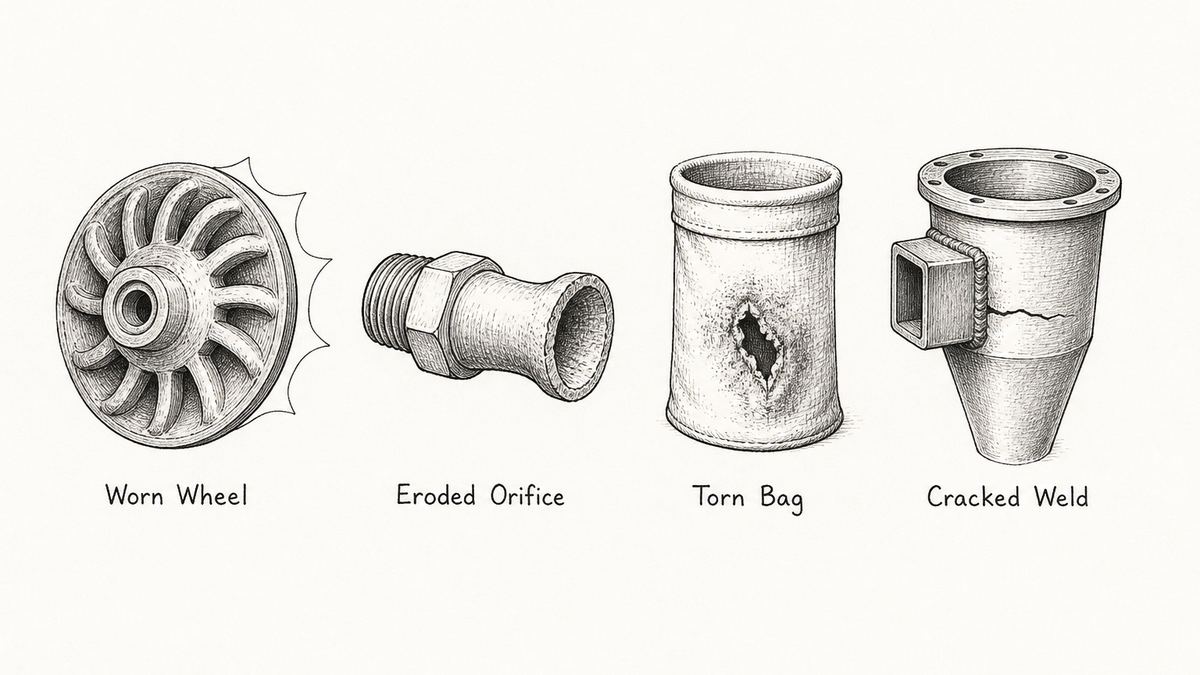
- Worn atomizer wheel
- The rim vanes round off and the wheel stops making the droplet size it was set for. The visible cause is abrasive feed and ordinary running hours; the hidden cause is a wheel made from a material chosen for price rather than for abrasion, and a mounting that lets the wheel run out of balance long before it should.
- Eroded nozzle orifice
- A pressure nozzle's orifice enlarges and washes into a bell shape, and as it does, the droplets grow and the powder coarsens. This is normal wear, and the machine should be specified with a spare tip set and a way to check the orifice, because a plant that cannot measure the hole cannot explain a change in its powder.
- Torn filter bag
- Bags tear at the cage, at the collar, or where they rub against a neighbouring bag. The consequence is not only a maintenance bill: unfiltered powder goes up the stack and, on a product where the fines are part of the yield, straight out of the accounts. Bag condition, cage condition and the way the bags are held apart all have to be checked.
- Cracked cyclone weld
- A weld along the joint of a cyclone opens up, usually from vibration, from thermal cycling as the machine starts and stops, or from plate that is too thin at the joint. Once open it draws air in and lets powder out at the same time, and the two effects are hard to separate from a distance. This is a build defect and it belongs on the pre-shipment list.
Two of those four are wear with a predictable life, and two are defects that should never have shipped. The distinction matters because it decides what to check and when. Wear parts are bought, not inspected: they need a spare set on the shelf and a measurement a plant can repeat. Defects are inspected: they need to be looked at in the works, before the machine is packed, when there is still time to correct them.
The measurements worth taking on this machine are few. Chamber internal profile and the absence of ledges, checked by eye and by a straight edge. Weld quality on the chamber and the cyclone, checked inside as well as outside. Wheel balance and vane condition on a rotary atomizer. Orifice size on a nozzle, taken with a gauge rather than judged by eye. Bag condition, cage straightness and bag spacing. Atomizer mounting alignment, because a wheel that is not square to its shaft will not last. And the bonding straps across every flexible duct connection, because a missing strap is invisible in a photograph and is exactly the kind of item that gets left off a shipment. That is the case for a pre-shipment inspection that puts measured dimensions on the record, and for the same reason it is worth doing it on the first machine rather than the tenth — a first article inspection on the chamber and the atomizer mounting before the run continues catches the tooling error while it is still one machine's problem.
What to Send, and What to Check in the Quotation
An enquiry that goes out as a feed rate comes back as a price for a box. One that goes out in four blocks comes back as something that can be compared with the next quotation. These are the four blocks.
Ten Lines a Spray Dryer Enquiry Has to Carry
| What to send | Why the factory cannot answer without it |
|---|---|
| The feed rate, and its moisture or solids content with the basis stated | The duty is water removed, not liquid fed, and a wet basis and a dry basis give different machines |
| The outlet moisture required, and the method that will decide acceptance | For a standardized product the ceiling and the test method may be fixed by rule rather than chosen |
| Viscosity, solids content and whether the feed is filtered | These decide whether a pressure nozzle can be used at all, or whether a wheel or a two-fluid nozzle is needed |
| What the feed contains: sugars, fats, salts, acids, fibres, abrasives | Each one changes the wall behaviour, the material choice and the cleaning method |
| Heat sensitivity, and the maximum product temperature allowed | This sets the inlet air temperature and whether the flow has to be co-current |
| The particle size the market wants, and the bulk density target | The atomizer type and speed follow from the particle size, and the density figure is also what the next machine needs |
| The atomizer type by name, with speed or pressure, and the maker | This is the most important bought item and the item with the shortest life; it must not be left as the word standard |
| The separation train stage by stage, with the outlet loading guaranteed | Cyclone, filter or both decides recovery, emissions and the dust protection features that follow |
| Inlet and outlet air temperatures, and the design ambient condition | These set the air flow, the heater and the filter material, and a humid climate reduces summer capacity |
| What is inside the scope: heater, fans, ducting, insulation, instruments, controls, spares | These are the lines that move between quotations and the reason two prices for the same duty differ by half |
Reading the answers back is quicker than it looks. Check that the moisture figures arrive with their basis stated, and that the factory used the basis you did. Check that the atomizer has a maker's name and a stated speed or pressure. Check that the air temperatures are given as design figures rather than a range. Check that the separation train is listed stage by stage with the outlet loading written down. Check the list of items excluded from the scope, because that list is where the money is. And check that the outlet moisture specification names the test method, because a moisture figure without a method is half a specification.
How much does a spray dryer cost?
There is no useful average, because the price follows the evaporation rate, the chamber size and shape, the atomizer and how much of the equipment is bought rather than made. Two dryers for the same duty can differ by a multiple if one is a small conical unit with a two-fluid nozzle and the other is a large box chamber with a rotary atomizer, a full air broom, explosion relief and a complete instrument package. What a buyer can do is ask for the price broken down by block: the chamber and its insulation, the atomizer and its mounting, the air system including the heater and fans, the separation train, and the instruments and controls. The items that move the number most are the chamber material and internal finish, the atomizer type and make, the air temperature duty that sets the heater, the filter material, and whether the ductwork, insulation, spares and controls are inside the scope at all.
What is the difference between a spray dryer and a fluid bed dryer?
A spray dryer starts with a liquid and makes a powder in one step, because it dries each droplet on its own before the droplet lands. A fluid bed dryer starts with a solid — usually a damp powder or a granule — and dries it while a stream of air keeps the particles suspended and moving. The two are often used together: a spray dryer makes a fine powder and a fluid bed then agglomerates it into the coarse, free-flowing granule that a market or a filling line wants. That is why the choice is not either-or. If the plant's raw material is a liquid and the product has to be a powder, the spray dryer is the first machine. If the feed is already a solid, a fluid bed is usually simpler and gentler.
How do I work out what evaporation rate I need?
Multiply the feed rate by the difference between the inlet and outlet moisture, both as fractions of the same total mass. A feed entering at seventy per cent water and leaving at four per cent, at a thousand kilograms an hour, is removing roughly six hundred and ninety kilograms of water an hour. That figure — kilograms of water per hour — is what the dryer is sized on, and it is the number to put in the enquiry. The trap is the basis. If the plant calculates on a wet basis and the factory sizes on a dry basis, the two numbers are far apart and the machine will be the wrong size, so state the basis beside every moisture figure you send.
Can a spray dryer handle a sticky product?
It can, but the stickiness has to be designed for rather than discovered. Sticky products — those high in sugar, fat or certain salts — stay tacky over a range of temperatures, and a droplet that lands on the wall while still tacky will stick instead of falling. Three design answers exist: an air broom that blows a curtain of air down the wall so the spray never touches it, a larger chamber so the droplets finish drying well before they reach the wall, and in the harder cases a cooled wall or a different process altogether. The one thing that does not work is running the dryer slower and hoping. If a product is known to be sticky, say so in the enquiry and expect the quotation to include the feature that deals with it.
Should I choose a rotary atomizer or a nozzle?
It depends on the feed and on the particle size the market wants. A rotary wheel handles viscous, slightly abrasive feeds and feeds with some solids in them, and it is the usual choice for large machines and for dairy products. A pressure nozzle makes the finest powder and has no rotating parts, but it needs a clean, thin feed that will pass a small hole without plugging, and its orifice erodes so the powder drifts coarser over time. A two-fluid nozzle takes a thick feed and gives the tightest control over droplet size, at the cost of a compressed air supply and the running cost of that air. Send the viscosity, the solids content and whether the feed is filtered, and the choice narrows to one.
What should I check before the machine ships?
Seven things, and most of them need only an eye and a gauge. Look inside the chamber for ledges, internal stiffeners, exposed bolt heads and unfinished welds, because each one is a place powder collects and is held hot. Check the welds on the chamber and the cyclone from inside as well as outside. Check the atomizer wheel for balance and vane condition, or gauge the nozzle orifice rather than judging it by eye. Check the atomizer mounting alignment, because a wheel that is not square to its shaft will not last. Check the filter bags, the cages and the spacing between them. Check that every flexible duct connection carries a bonding strap, because a missing strap is invisible in a photograph and is the kind of item that quietly stays out of a shipment. And check the explosion relief volume and discharge direction against the drawing, because relief that discharges into a walkway is the one error on this list that can hurt somebody.
Send the feed and the powder target — the feed rate alone is not enough
Tell us what has to be dried and what the powder has to be. The feed rate with its moisture or solids stated, the viscosity, and the outlet moisture the product has to meet. Then the evaporation rate, the air temperatures, the atomizer type, the separation train and what the powder may touch.
Request a Spray Dryer Sourcing Quote
Questions & Comments
We read every one and reply within 24 hoursMost dryer arguments come down to two figures that were never written down: the evaporation rate rather than the feed rate, and the basis the moisture was stated on. Send us both, and we will pin them down before the order.