
Trending Products for Dropshipping in 2026: How to Read a Trend Before the List Does
 ·
Updated October 12, 2026
·
16 min read
A trending product list is always published after the peak. That is not a flaw in the list, it is the nature of the format: a product has to be widely trending before it is worth writing about, and by then most of the easy margin is gone. The skill worth learning is reading demand at the stages before the list, and checking whether your supplier can land the product inside the window that is left.
Read the Stage, Not the List
| Stage | Where you see it | What it means for you |
|---|---|---|
| First appearance | Small communities, forum threads, early search movement | The whole window is still ahead. Test it, do not commit to stock. |
| Creators repeat it | Short video platforms and niche creators showing the same item | The window is open and visible. Order stock only if your lead time fits. |
| Lists publish it | Aggregators and suppliers publish trending roundups | At or near the peak, and the margin has already gone. |
| Mainstream retail | Large retailers and marketplaces carry it as a normal line | Past the peak. Clear what you hold and do not reorder. |
What this guide covers
- Why a trending product list is always late
- How a trend actually forms
- How to tell a trend from a one-week spike
- Where to see demand before the lists do
- The race: window versus production lead time
- Why the top trending products are the hardest to ship
- How to test a trending product without being stuck
- What to do when the trend turns
- Frequently asked questions
1. Why Is a Trending Product List Always Late?
Because a list has to be worth publishing, and a product is only worth writing about once enough people are already searching for it. The publication becomes popular, the reader arrives at the peak, and the margin has already been competed away by everyone who read the previous list.
There is also a business reason for the timing. A list earns its clicks from being current and broad, and the sources it draws on are themselves public and lagging. So a list of trending products is best understood as a history of what recently worked, written by somebody whose incentive is your attention rather than your margin.
That does not make lists useless. They are efficient for learning the shape of a category and for spotting recurring patterns, and they are a bad trigger to buy. Treat one as evidence that demand existed, never as evidence that it still does.
2. How Does a Trend Actually Form?
Demand appears in a small community first, spreads through creators, gets aggregated into lists, and finally reaches mainstream retail as an ordinary product line. Every step adds a delay, and each delay is a chance to be earlier than the next reader.
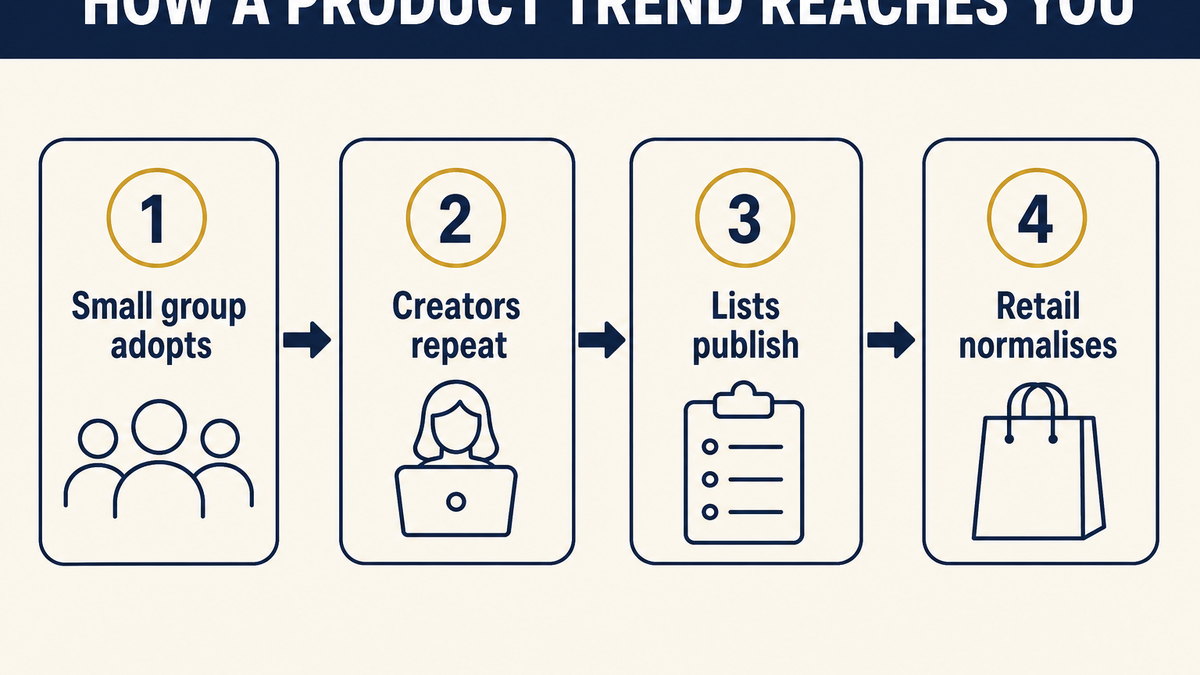
- A small group starts using it
- A hobby community, a niche forum or a specific profession adopts the product because it solves something for them. Volume is tiny, but the demand is real and it is not manufactured by marketing, which is exactly why it is the most valuable signal available.
- Creators discover and repeat it
- Video creators need new things to show, so they scan the same small communities. This is the stage where demand becomes visible and measurable, and it is usually the last moment when stock you ordered now can still arrive before the peak.
- Aggregators publish it
- Lists, roundups and supplier catalogues pick the product up. Reach is at its highest point here and margin is at its thinnest, because this is the stage that tells thousands of stores the same thing on the same day.
- Retail normalises it
- The product stops being interesting and becomes inventory. Demand continues, but it is served by competitors with better costs, and a small store has no advantage left to sell.
The practical consequence is that being early matters more than being right. A mediocre product read at the first stage is worth more than an excellent product read at the third, because the first one still has a window and the third one is already crowded.
3. How Do You Tell a Trend From a One-Week Spike?
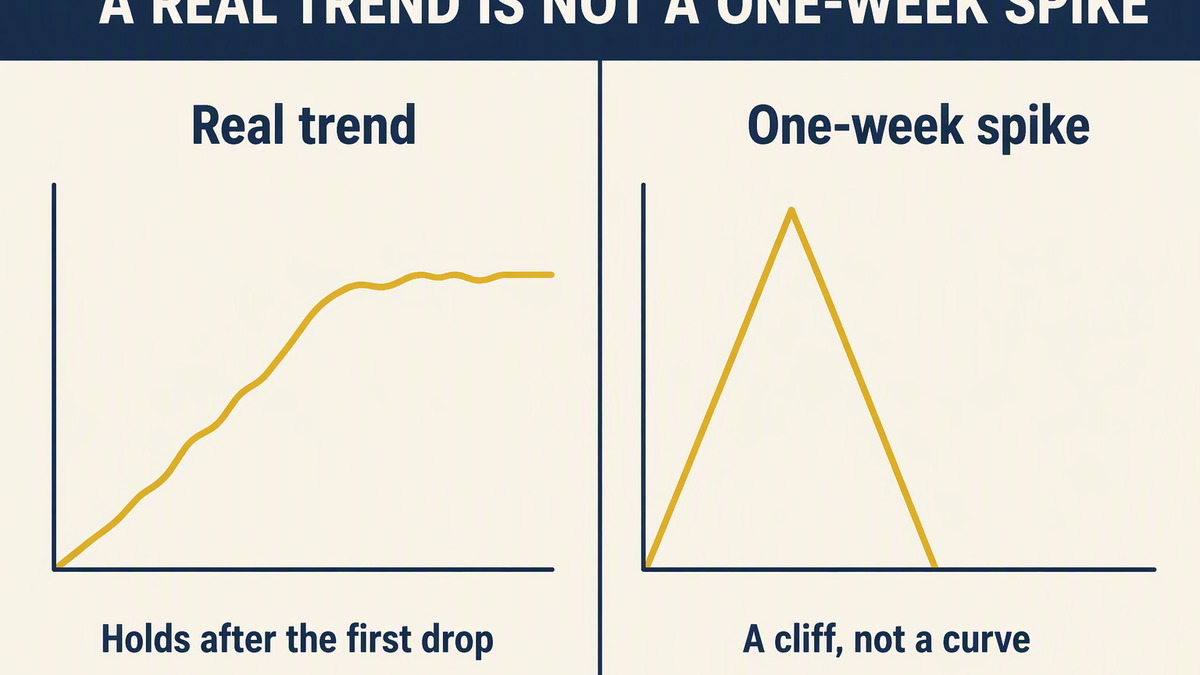
A trend repeats across ordinary weeks and appears in several unrelated places at the same time. A spike comes from one source, lives for a few days, and leaves no trace anywhere else. The difference matters because a spike cannot be served: by the time your stock lands, the demand has already left.
| What to look at | A real trend | A one-week spike |
|---|---|---|
| Where it appears | Several unrelated places, at the same time. | One video, one account, one post. |
| Shape over time | Holds after the first drop instead of falling to zero. | A steep rise followed by a cliff. |
| How people search | Repeated searches, and questions about how to choose. | A single phrase copied from the video. |
| What reviews do | Add up steadily over months. | A burst, then silence. |
| What suppliers do | Raise capacity and improve the item. | Add a listing and move on. |
The review signal is the one buyers skip and the one that is hardest to fake. Reviews add up only when customers keep arriving over time, so a product with a steady monthly build is showing you demand that existed before you looked at it. A product with a large number of reviews gathered in one short period is showing you a moment.
4. Where Can You See Demand Before the Lists Do?
In the places where the demand actually starts: small communities, early search movement, and the questions buyers ask before they know what to search for. None of those is a trend tool, and all of them are earlier than one.
- Niche communities, read for repetition. A single mention means nothing; the same problem described by different people over several weeks is a demand signal that no tool will show you yet.
- Search suggestions and comparison phrases. When people start typing the name of one product against another, they have moved from curiosity to choosing, which is the point where a product is about to be bought rather than watched.
- Marketplace questions and reviews. The questions under the closest existing product describe what buyers wish it did. That gap is a product brief, written by the market.
- Supplier-side movement. When factories start quoting an item that nobody has listed yet, the supply has moved ahead of the storefronts, and that gap is where a small seller can still be first.
The most reliable early signal available to a small store is a supplier who tells you what buyers are already asking them for. A sourcing partner who handles requests every day sees demand before it becomes a keyword, and that is worth more than any dashboard, because it reaches you while the window is still wide open.
5. The Race: Window Versus Production Lead Time
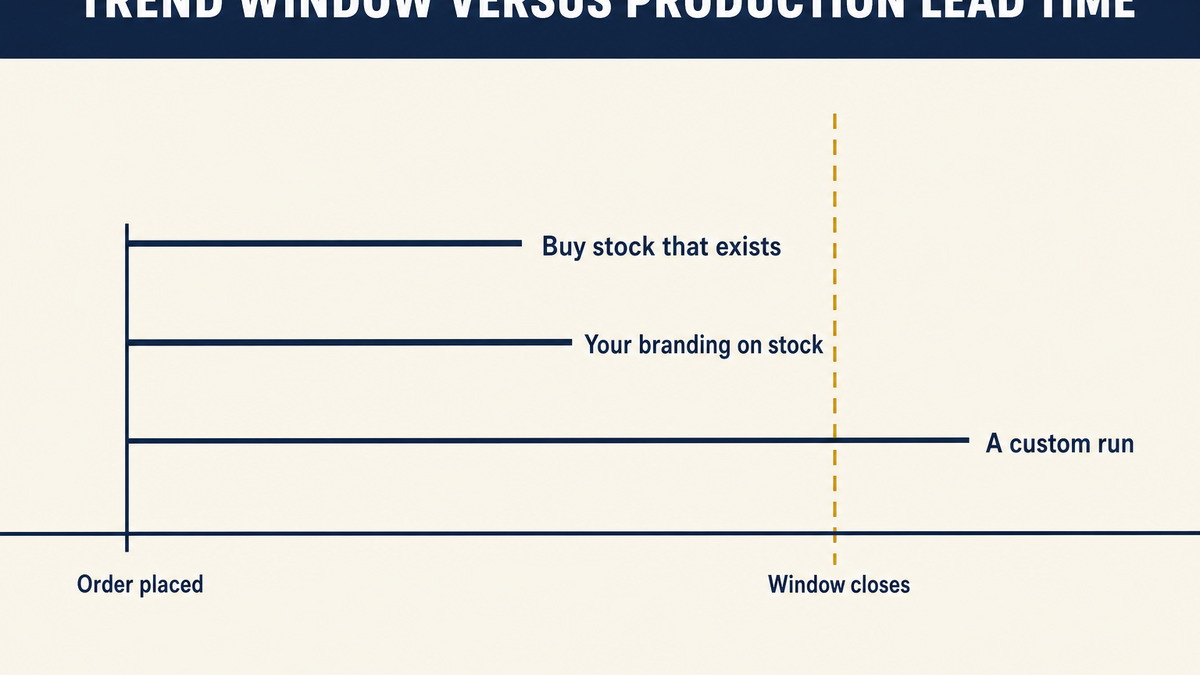
A trending product is only sellable if your supply lands before the window closes. Before you order, compare the window you expect against three separate supplier timelines, and remember that the longest one decides: stock you can buy today, your branding added to stock, and a custom run built to your specification.
| Supply route | What it requires | When it fits a trend |
|---|---|---|
| Buy stock that exists | An order and a shipping method, nothing else. | The shortest route. It is often the only one that fits a real trend. |
| Your branding on existing stock | Artwork, labels, and a packing step before shipping. | Only if the window is clearly longer than the packing and shipping time. |
| A custom run | Materials bought in, tooling or a specification, and a production slot. | Only for demand you expect to outlive the run, not for a trend. |
This is the part of trending products that a list cannot teach, because it is not about the product at all. A trend play is a speed play: the advantage comes from being able to source something that already exists, confirm it is the right specification, and move it before the window shuts. Cost matters far less, which is why shopping a trend on unit price alone is the wrong instinct. Working with a partner who can source per order and hold a small buffer is what makes that speed possible, and it is what a private sourcing agent in China is for. If you do move ahead, have the goods checked before they ship rather than after they sell, using an independent quality inspection.
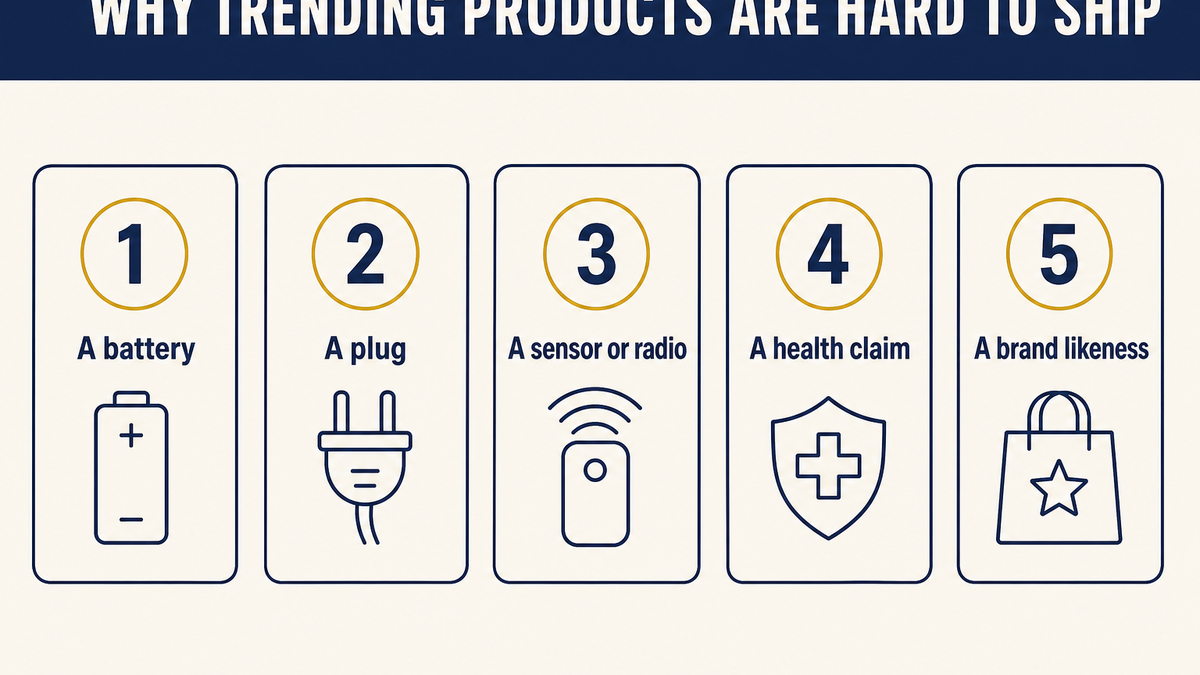
6. Why Are the Top Trending Products the Hardest to Ship?
Because novelty usually comes with a battery, a plug, a sensor or a claim, and each of those adds a step before the product can legally enter the destination country. The items that photograph best in a trend roundup are frequently the worst to source and move.
| What the product adds | The extra step it creates | What it costs when missed |
|---|---|---|
| A battery | Transport restrictions, and often a safety test for the market. | A shipment held at the carrier, or refused entirely. |
| A plug or mains power | The electrical rules of the destination country. | Stock that cannot legally be sold where you shipped it. |
| A sensor or a radio | Wireless approval before the device can be placed on the market. | A listing removed after you have paid for the run. |
| A health or medical claim | Advertising rules that decide what you may say. | Fines or forced takedowns on your own copy. |
| A resemblance to a brand | An intellectual property check before listing. | The listing, the stock, and in a bad case the account. |
Never list a powered or sensor product on the strength of a supplier's assurance that it is fine. Ask which test report exists, who issued it, and which countries it covers. A supplier who cannot name the document is telling you that nobody has cleared the product for your market, and that the clearing is now your job.
Classification works the same way: two products that look alike can carry very different duty, and the difference is larger than most margins. Check the code you would declare under on the USITC Harmonized Tariff Schedule before you commit, and treat the answer as part of the product decision rather than an afterthought. The border also costs more than it used to, because low-value parcels into the United States lost their duty-free treatment for goods of China and Hong Kong, as the Federal Register notice implementing Executive Order 14256 records.
7. How Do You Test a Trending Product Without Being Stuck?
Sell it per order in the smallest possible units and set a stop date before you start. A trend test is not about how much product you can buy, it is about how fast you can read the answer, and per-order fulfilment is the cheapest way to buy that answer.
- Write the window down first. Decide in advance how long you are willing to sell this product before you judge it, so the decision is made by a date rather than by hope.
- Buy nothing until the test pays for itself. Per-order sourcing means the customer funds the unit before you pay for it, which is the only structure that survives a short window.
- Watch the second week, not the first. A first week is contaminated by your own launch effort. The second week is when the product shows you the demand it can generate on its own.
- Fix the specification before you scale. If the test reveals a defect, correct it at the supplier while volumes are small, because a defect you scale is a return rate you inherit.
- Have a stop rule you already agreed with yourself. What result ends the test, and what result justifies stock. Deciding this in advance is what stops a slow product from quietly becoming inventory.
The one thing worth ordering early is the sample. A single piece costs almost nothing and settles the specification question before you are committed, and if the product is going to be customised for you, it also tells you which of the three lead times in the previous section applies to your supplier. If the trend proves out and the product deserves to become a normal line rather than a moment, the timing and the risks are set out in our guide to moving from dropshipping to wholesale.
8. What Do You Do When the Trend Turns?
Stop buying before you discount. A trend that has turned will not come back at your price, and holding the stock to protect your margin usually converts a small loss into a storage problem that occupies cash you need for the next product.
The tell is rarely dramatic. Orders do not stop, they slow, and the cost per sale quietly rises as you spend more to move each unit. By the time the decline is obvious, the discount you will need is larger than the discount that would have worked a month earlier.
Do not reorder a declining product to average down your cost. A lower unit price on stock you cannot sell is a bigger loss, not a smaller one, and it is the most common way a good month turns into a bad quarter.
The rest of the plan is short. Rank what you hold by how fast each item still sells and clear the slow end rather than the whole product. Move the customers you earned to a neighbouring product instead of letting them leave with the trend. Keep the specification and the supplier relationship, because the factory that got one trend right is a good candidate for the next one. And write down what the product actually did, because the next trend decision is easier with a record than with a memory.
9. Frequently Asked Questions
How do I find trending products for dropshipping before they peak?
Watch where a trend starts rather than where it is reported. Demand shows up first in small communities and in search data, then in creator videos, and only later in aggregator and supplier lists. By the time a product appears in a published list it is usually near or past its peak, so the useful skill is reading the first two stages.
How do I tell a real trend from a short spike?
Check whether the demand repeats across ordinary weeks and appears in several unrelated places at once. A trend shows up in search, in marketplaces and in small communities together. A spike comes from one video, lasts a few days, and leaves no trace in the other places.
How long do I have to sell a trending product?
Long enough to cover your production lead time plus shipping, or the product arrives after the window closes. Before you order, compare the window you expect against the time the supplier needs for stock, for your branding and for a custom run. Those are three different numbers, and the longest one decides.
Why are trending product lists full of electronics?
Because electronics look novel and photograph well, which makes them easy to list and easy to click on. They are also among the hardest products to source and ship, because anything with a battery or a plug usually needs certification for the destination country and carries transport restrictions that a low unit price cannot cover.
What should I do when a trending product stops selling?
Stop buying before you discount. A trend that has turned will not come back at your price, so holding the stock to protect the margin usually turns a small loss into a storage problem. Rank your running inventory by how fast each item still sells and clear the slow end rather than the whole product.
The Window, Against Your Production Days
We return the window estimate, the production days it has to cover, and the free signals that show demand before a list prints it.
Note My Window
Questions & Comments
We read every one and reply within 24 hoursSpotted something early and not sure whether it will hold, stuck between ordering stock and missing the window, or holding a product that has started to turn? Post the product, where you saw it first and what your supplier needs in time, and our team will help you read the stage it is really at.