
Best Dropshipping Suppliers in 2026: How to Choose One You Will Not Outgrow
 ·
Updated October 11, 2026
·
19 min read
There is no single best dropshipping supplier. The right one is decided by three things you cannot change later: where your customers live, how fast they expect the parcel, and whether you are testing products or scaling one. Almost every "best supplier" list mixes four completely different businesses into one table and then ranks them by price. That is why so many sellers sign up for a supplier that cannot do the one thing they actually need.
Which Supplier to Use, Based on the Constraint You Cannot Bend
| If you are | Use this | Because |
|---|---|---|
| Testing products on a small budget | A sourcing agent that ships per order | You can order one unit and change product next week, and no contract holds you to a catalogue. |
| Scaling one product you have validated | The factory, buying direct | The unit price falls and you control the specification, but you commit to a minimum order. |
| Selling to customers who expect the parcel in days | A warehouse in the destination country | Local stock removes the duty and clearance cost that is charged again on every single parcel. |
| Selling custom prints or merch | A print-on-demand platform | Nothing is made until an order lands, so you never hold unsold stock. |
| Wanting a ready catalogue in one dashboard | A directory or app | Product data is loaded for you, but you never own the supplier relationship. |
What this guide covers
- What "best dropshipping supplier" actually means
- Which type of supplier fits your stage
- How to vet a supplier before you pay
- How to tell a factory from a reseller
- What happens after you pick a supplier
- When shipping per order stops making sense
- The minimum order you should expect
- How to compare two suppliers side by side
- The supplier mistakes that cost the most
- Frequently asked questions
1. What Does "Best Dropshipping Supplier" Actually Mean?
It means four different businesses, and none of them is a substitute for the others. A directory sells access to a list. A platform sells software and often a warehouse. A sourcing agent buys on your behalf. A factory makes the goods.
Buyers get into trouble because one phrase covers all four. When a list ranks them by monthly price, it compares a small subscription with an app fee and with a factory that charges nothing up front. The number tells you nothing about which one can get your product to your customer.
| Type | What they actually own | What they control in your order | What you give up |
|---|---|---|---|
| Directory | A list of wholesalers and a membership site | Nothing. They introduce, then step out. | You open every account yourself and handle every parcel. |
| Platform or app | Software, and often a warehouse | Picking, packing and the tracking number | Supplier choice, plus a per-order charge on top of the fee. |
| Sourcing agent | Working relationships with markets and factories | Sourcing, quality checks and consolidation | You depend on their judgement, and you pay a service fee. |
| Factory | Machines, staff and tooling | Production to your specification | Flexibility, and usually a minimum order. |
So decide which of those four you are buying before you compare prices. A directory and a factory are not expensive and cheap versions of one thing. They are two different products, and the price on the page does not tell you which one you need.
2. Which Type of Supplier Fits Your Stage?
Match the type to your stage rather than to the cheapest plan. The mistake that costs the most is buying the supplier for the stage you want to be in rather than the one you are in.
The product is the variable, so keep the supplier cheap to leave. Sourcing per order through an agent means you pay only for what sells, and you can drop a product without a negotiation.
Cost per unit becomes the variable. Ask for pricing at two volumes and put the specification in writing, because a spec that lives only in a chat message changes the moment a cheaper material appears.
Lead time and cash become the variables. You commit to runs and hold stock, so the questions turn to payment terms, inspection, and where the goods sit while they wait for a buyer.
Why the stage decides the supplier, not the other way round
A supplier that is perfect for testing will hold you back when you scale, and a supplier built for volume will refuse your first small order. This is why "best" has no fixed answer. It only has an answer for your stage, your destination and your delivery promise. If you are moving between stages, the switch from per-order fulfilment to holding your own stock is the one that changes your cost base the most.
3. How Do You Vet a Supplier Before You Pay?
You check five things, and four of them cost nothing. Who legally owns the business, who physically makes the goods, how they will ship, who pays when something is wrong, and what happens to you when you stop ordering.
Vetting is not about trust. It is about finding out which of those five answers the supplier cannot give you, because that missing answer is the one that will cost you money later.
- The legal name on the licence
- Ask for the business licence and match the company name to the name on your invoice and your bank transfer. If the money goes to a person rather than a company, or to a third company that nobody has explained, stop and ask why.
- Who actually makes the goods
- A supplier can be a reseller and still be honest about it. What matters is that you know which one you are dealing with, because a reseller cannot change the production line to fix your problem, and cannot show you where a defect came from.
- The sample you can measure
- Order a sample and measure it against the numbers you wrote down, rather than judging it by feel. A supplier who cannot tell you the measurements of its own sample has no specification to produce against.
- Who pays for a defect
- Ask before the order, not after the complaint. The answer you want is written into the order confirmation: what counts as a defect, who pays the return, and who pays for the replacement parcel.
- The exit
- Ask what happens when you stop ordering. A supplier that holds your tooling, your artwork or your packaging plates can hold your product hostage. Find out who owns them, in writing, before you pay for them.
The cheapest test in this whole guide: place two orders. A first order tells you almost nothing, because most suppliers treat a first order as a job interview. The second order, placed after you have paid once and stopped being interesting, is the one that shows you the real response time, the real packing standard and the real quality. Run a second order before you commit to a production run, and if you plan to sell in volume, put an independent quality inspection between the two so you are judging the goods and not the seller's account of them.
4. How Do You Tell a Factory From a Reseller?
Ask for something only a factory can produce. A reseller can always send you a catalogue and a price list. A factory can send you a document that comes out of its own production process, and that is the difference you can test.
| Ask this | A factory can | A reseller can only |
|---|---|---|
| What is the production capacity per line, per day? | Answer in units and machines, because it schedules them. | Give a rough number, or defer to "the factory". |
| Show me the line on a live video call | Walk the floor and name the stations. | Offer a brochure, or a recorded clip. |
| Who owns the tooling, and where is it stored? | Name the mould, the storage and the owner. | Go quiet, then promise to check. |
| What is the reject rate on this product? | Give a figure and explain what causes it. | Say defects are rare. |
| Can you change one material on my order? | Tell you the cost and the lead-time impact. | Say yes to everything, then quote later. |
Being a reseller is not a crime, and many good suppliers are resellers who know their factories well. The problem is when you buy a factory's promise at a reseller's price and then discover that nobody in the conversation can change the production line. If you want to skip this whole test, work with a partner whose job is to stand between you and the factory, which is what a private sourcing agent in China is for.
Three answers mean walk away. A supplier who wants payment to a personal account. A supplier who will not say which company legally owns the business. And a supplier whose quoted price is far below everyone else, because in this market the low quote is either a different, cheaper material or a shorter production time with less checking.
5. What Happens After You Pick a Supplier?
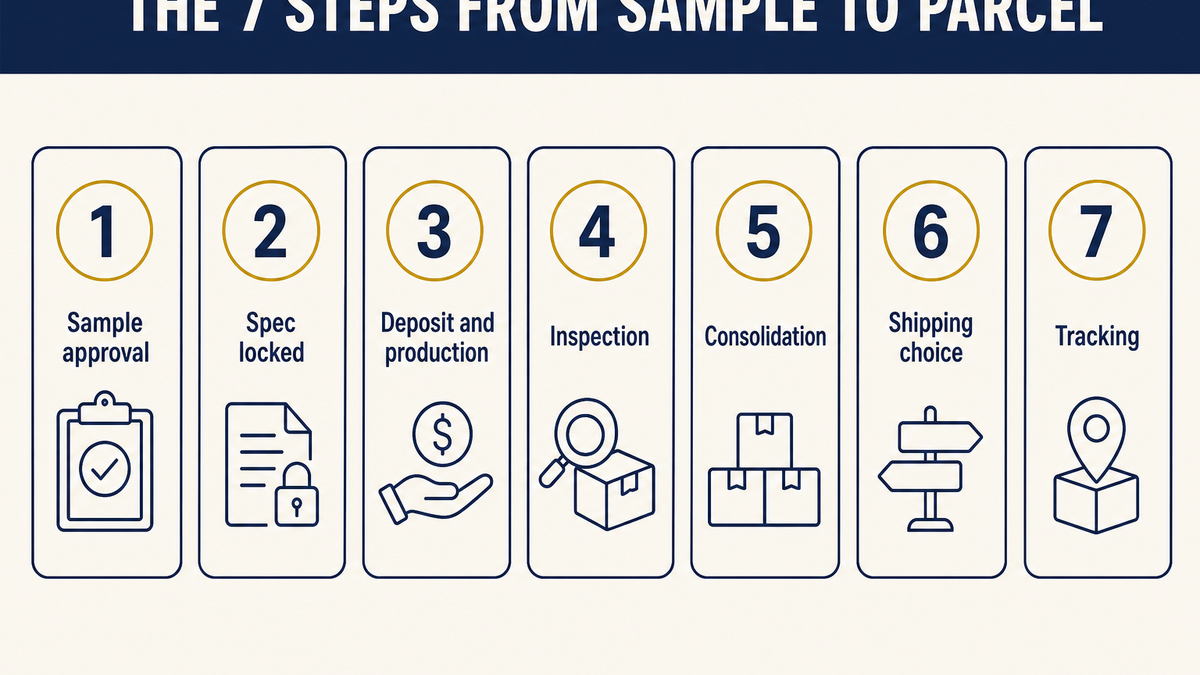
Seven steps run from the sample to the parcel, and each one is a place where a supplier can save money without telling you. Most "best supplier" lists stop at the sign-up page, which is why so many sellers are surprised by the second order.
- Sample and approval. You approve a physical piece, not a photo. Keep it, because it becomes the reference everything else is measured against.
- Specification locked. Materials, measurements, packing and artwork go into one document with the order, not into a chat thread.
- Deposit and production. Your deposit buys production time. Ask for the line start date and the finish date as two separate dates.
- Inspection. Checking happens before the goods leave the supplier, while your money is still in your hands and the goods are still theirs to fix.
- Consolidation. Goods from more than one supplier are collected, counted and combined, so you pay one shipment instead of five.
- The shipping decision. Air and express move small volume quickly; sea moves heavy volume cheaply. Choose by the date your customer expects, not by the price per kilo.
- Tracking, and the parcel itself. The last step is what your buyer sees: the box, the paperwork inside it, and the name on the label.
Two of those steps deserve their own guides. What your customer sees inside the box is controlled by how the parcel is packed, and removing a supplier's own invoice is a specific job that has to be agreed before production rather than at the shipping desk. We cover how that works in blind dropshipping from China. The step where goods are received, stored and picked one parcel at a time is a separate operation with its own costs, set out in our guide to China 3PL warehousing and order fulfilment, including how per-parcel courier rates are built.
If you sell on Shopify, the step that decides your margin is the handover between the store and the warehouse. Order data has to arrive with the right address, the right line items and the right tracking number, or you will spend your week fixing orders by hand. That handover is what we break down in the Shopify order fulfilment guide.
6. When Does Shipping Per Order Stop Making Sense?
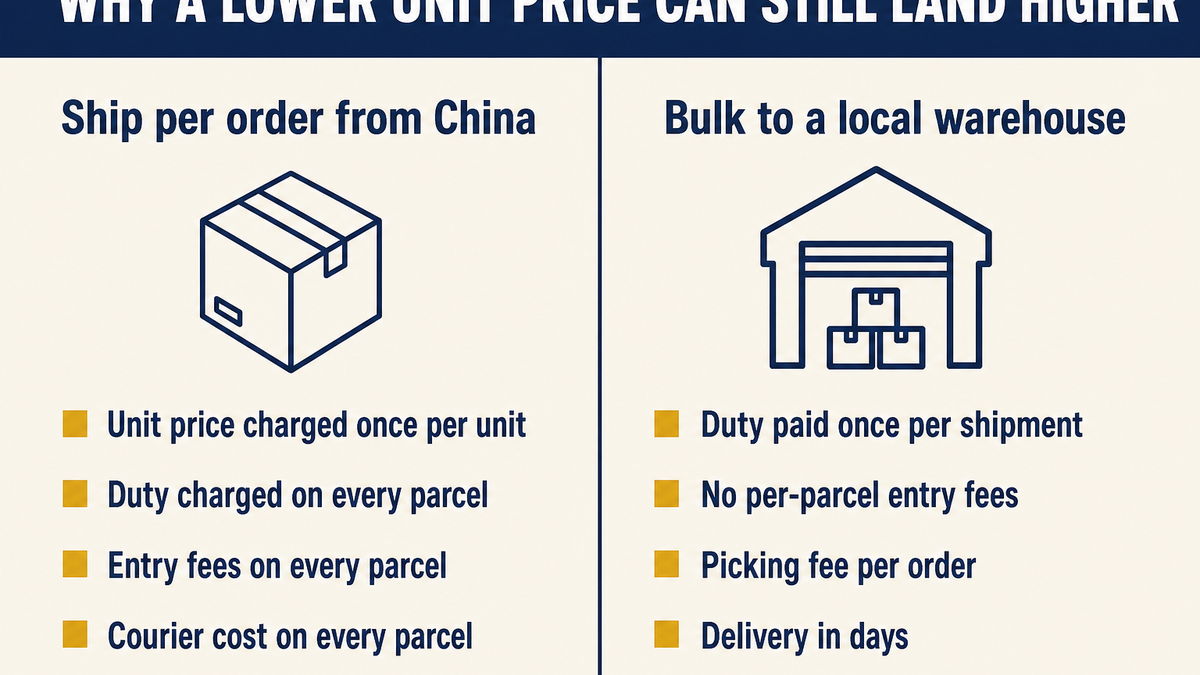
It stops making sense when the fixed cost of moving one parcel becomes larger than the saving you earned on the unit price. That crossover is somewhere around the point where your buyer expects the parcel in days rather than weeks, and it arrives earlier than most sellers expect.
The reason is that the two costs behave differently. A lower unit price is charged once per unit, so it scales with volume. Duty, entry fees, clearance and courier charges are charged again on every single parcel, so they do not scale down as you grow. A cheaper product source cannot fix an expensive delivery.
This got sharper in 2025. Low-value parcels that used to enter the United States without duty were steadily pushed into formal entry, first for goods of China and Hong Kong and then for all countries. The Federal Register notice implementing Executive Order 14256 records the end of that treatment for China and Hong Kong, and a later order suspended it for all countries. A parcel that once cleared with no paperwork can now need a broker, a declared value and a duty payment before it reaches your buyer.
| Your situation | Per-order from China | Bulk to a local warehouse |
|---|---|---|
| Testing products, unknown demand | Lower risk. You only buy what sells. | Money tied up in stock that may not sell. |
| One product selling every day | Fixed parcel cost charged on every order. | One shipment, then a picking fee per order. |
| Customers who expect delivery in days | Cannot usually promise it. | Can promise it, because stock is already there. |
| Heavy or bulky products | Air cost makes the margin disappear. | Sea freight brings the unit cost down. |
| Returns and exchanges | Overseas returns are slow and rarely worth it. | Returns come back to a domestic address. |
Check the current rate for your own product rather than trusting a rate someone quoted you last year. The USITC Harmonized Tariff Schedule is the official lookup, and the code you classify under decides the duty you pay. Getting the classification right is worth more than shaving a cent off the unit price, which is why we treat it as part of the sourcing decision in our dropshipping from China walkthrough.
7. What Minimum Order Should You Expect?
The minimum is set by setup time, not by material cost. A product the supplier already holds has almost no minimum, because nothing has to be set up. A product made to your specification carries a minimum that exists to cover the time the line spends preparing for you.
That is why the same supplier will happily send you one unit from stock and refuse a small order of something it has to make. It is the same company making two different deals.
| Stock held by the supplier | Made to your specification | |
|---|---|---|
| What the minimum covers | Nothing. The goods already exist. | Setup time, plus materials bought in for you. |
| Who chooses the design | The supplier, from what it already carries. | You, within what the line can make. |
| What you can change later | Nothing beyond the colour or size available. | Anything, and you pay for the change. |
| When it suits you | Testing, and products you have not proved yet. | Products that have already sold reliably. |
Do not treat a made-to-order minimum as a negotiation to win. It is usually not a markup, it is the point at which the supplier's setup time is covered, and pushing below it gets you either a rushed run or a different material. The lever you actually have is whether your product can be built from stock components with your own branding added at the end. That middle path is how most sellers move from per-order fulfilment to holding their own stock, and we set out the timing and the risks in our guide to moving from dropshipping to wholesale.
8. How Do You Compare Two Suppliers Side by Side?
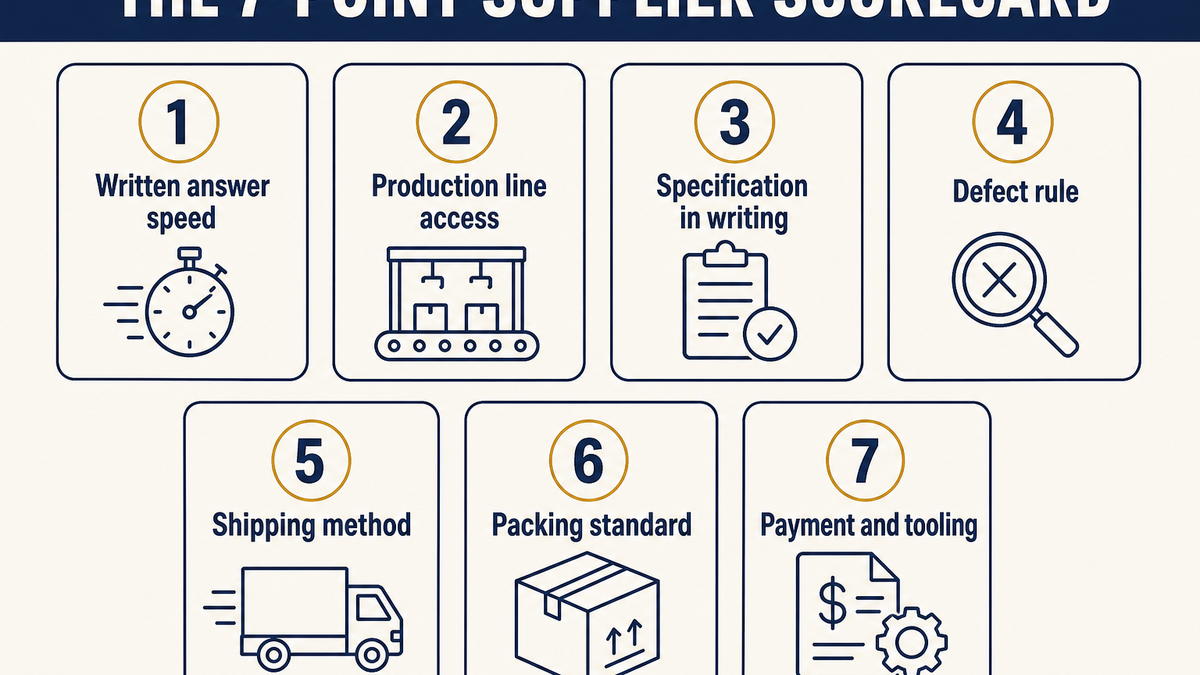
Score them on the same seven questions, written down, before either of them quotes again. A supplier comparison is really a decision about which risk you can live with, so the questions have to be identical on both sides or you end up comparing two different things.
| What to score | What a good answer looks like | Why it decides your margin |
|---|---|---|
| Response to a written question | An answer with numbers, within a day or two. | Every delay in production is your cash sitting in someone else's warehouse. |
| Can they show the production line | Yes, live, and they name the stations. | You can only fix a defect at the point it is made. |
| Specification in writing | Materials, measurements and packing on one document. | A spec in a chat message changes the first time a cheaper material appears. |
| The defect rule | Stated before the order, including who pays the return. | The cost of a bad batch is the batch plus the shipping plus the refund. |
| Shipping method, and who books it | Named carrier, named service, named transit time. | Two suppliers with the same product land it at different costs. |
| Packing standard | They can pack blind, and they say so plainly. | Whatever is inside the box is what your customer judges you on. |
| Payment terms and tooling | Company account, and it is clear who owns the tool. | Owning your tooling is what stops a supplier from holding your product. |
Put the scores in a file and keep them. Six months later, when the winning supplier starts to drift, that file is what tells you whether you are seeing a one-off problem or a change in how the account is being handled.
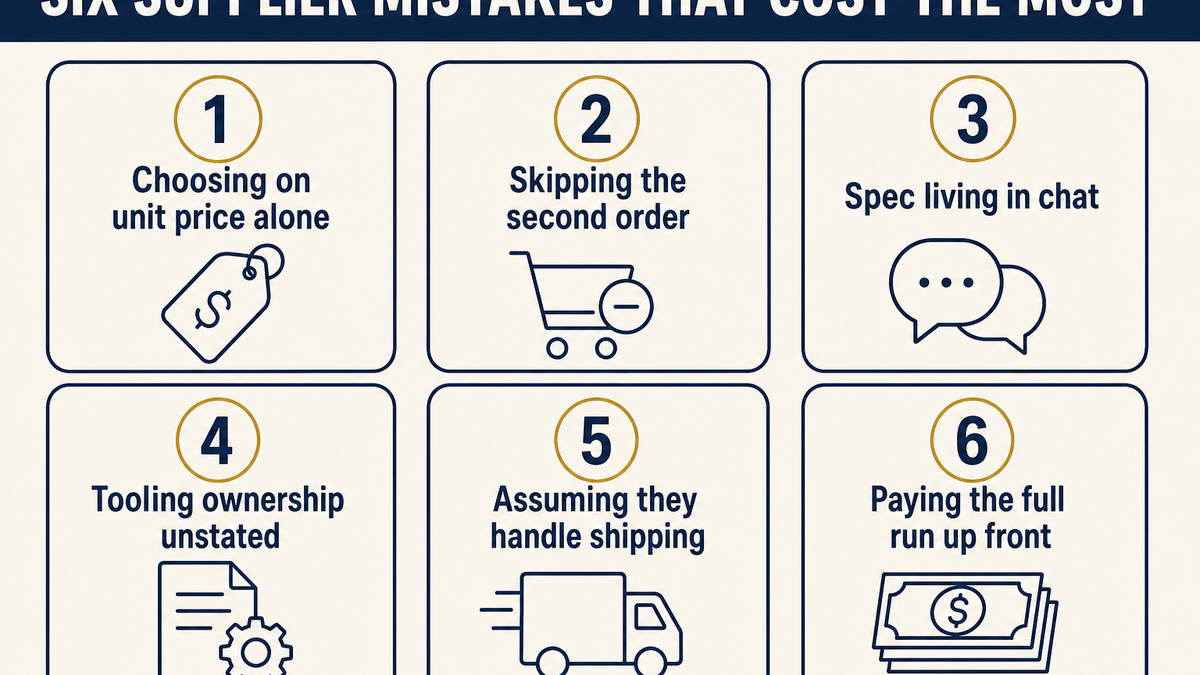
9. Which Supplier Mistakes Cost the Most?
The expensive mistakes are all made before production starts, which is also the only time they are cheap to fix. Choosing on unit price alone is the most common one, because it is the only number most buyers are shown.
Never send a deposit to a personal account, and never let a supplier arrange your customs entry without telling you the declared value. A parcel declared at the wrong value is your problem at the border, not the supplier's, and the supplier will not be the one paying the penalty.
The rest of the list is short. Skipping the second order, so you never see how the supplier behaves once you are routine. Letting the specification live in a chat thread instead of an order document. Leaving tooling and artwork ownership unstated. Assuming the supplier will handle shipping and finding out at the port that it only agreed to hand the goods to a forwarder. And paying for a whole run up front, which moves all the risk onto you at the exact point where you have the least information.
None of these need a lawyer to prevent. Each one is a question you can ask before you pay, and a supplier who refuses to answer it has just told you something useful.
10. Frequently Asked Questions
What is the best dropshipping supplier overall?
There is no single best one. The right choice is set by three things you cannot change later: where your customers live, how fast they expect the parcel, and whether you are testing products or scaling one. A sourcing agent fits the testing stage, a factory fits a product you have already validated, and a warehouse in your customer's country fits a store that promises fast delivery.
Can I use Alibaba for dropshipping?
Yes, and it is often the right first step once you have a product that sells. What Alibaba does not do is pick, pack and ship one parcel at a time to your customer. You still need a fulfilment partner between the supplier and the buyer, and that partner decides your delivery time.
How do I tell a factory from a trading company?
Ask three questions. What is the legal name on your business licence? Can I see the production line on a live video call? Who owns the tooling? A trading company answers the first one easily and stalls on the other two, because it does not own the machines and often does not own the tool.
Do I need private label to dropship?
No. Private label matters when you want to defend a higher price and control the specification. It also brings tooling cost, a minimum order and a longer lead time. Most sellers should prove demand with unbranded stock first, then move the winning product to private label.
What is the biggest hidden cost in dropshipping from China?
The last mile, not the product. Duty, entry fees and courier charges are charged on every parcel, while a lower unit price is charged once per unit. That is why a cheap China-direct parcel often lands more expensive than a domestic supplier's higher unit price once it reaches the customer.
Have Us Check the Supplier Before You Send a Deposit
Send us the supplier you are considering. We check the licence, ask the factory questions a reseller cannot answer, confirm who owns the tooling, and quote the same product so you have a second price to compare against.
Submit Your Supplier for a Check
Questions & Comments
We read every one and reply within 24 hoursNot sure whether a quote is a real factory price, unsure which type of supplier fits the stage you are actually at, or already had a supplier slip on a second order? Post your product, the country you ship to and what the supplier told you, and our team will help you read the answer.