
Hydraulic Jack Manufacturer: The Number on the Steel
 ·
Updated October 22, 2026
·
12 min read
A hydraulic jack carries exactly one federal duty, and the duty is a stamp. The rule that names a jack tells the operator to check that the device can carry the load, and then tells somebody to put that rating on the body in a way that will not wear off — cast in, stamped in, or marked by another suitable means. Nothing in that section is addressed to a factory, and nothing in it sets a design. That shape decides what a buyer can ask for, and it is the opposite of everything in this series so far: the wiper blade had a vehicle standard it could never be named in, and the jack has a workplace rule that never leaves the shop floor. This article reads the only federal text that names a jack, sets it against the voluntary standard that fills the gap, and turns both into six lines an order document should carry.
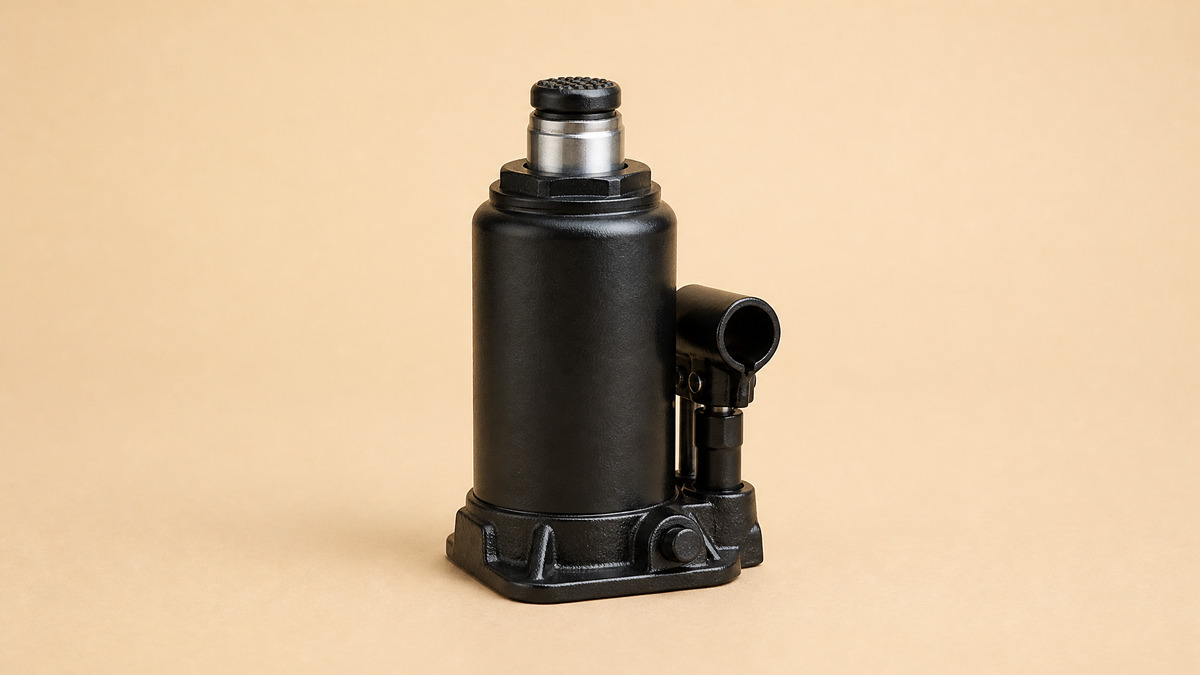
1. The Only Federal Text That Names a Jack
Search the federal register of vehicle standards and a jack does not appear. The text that does name one sits in a different title, in a different department, and in a subpart about hand tools. It is 29 CFR 1910.244, headed Other portable tools and equipment, and it belongs to the Occupational Safety and Health Administration, not to the safety agency that writes vehicle standards.
That address matters more than the wording. Part 1910 is a set of duties on employers and operators, written to keep a workplace safe. It is not a standard a factory certifies a product against. Read the two paragraphs that open the jack section and the difference is visible in the grammar:
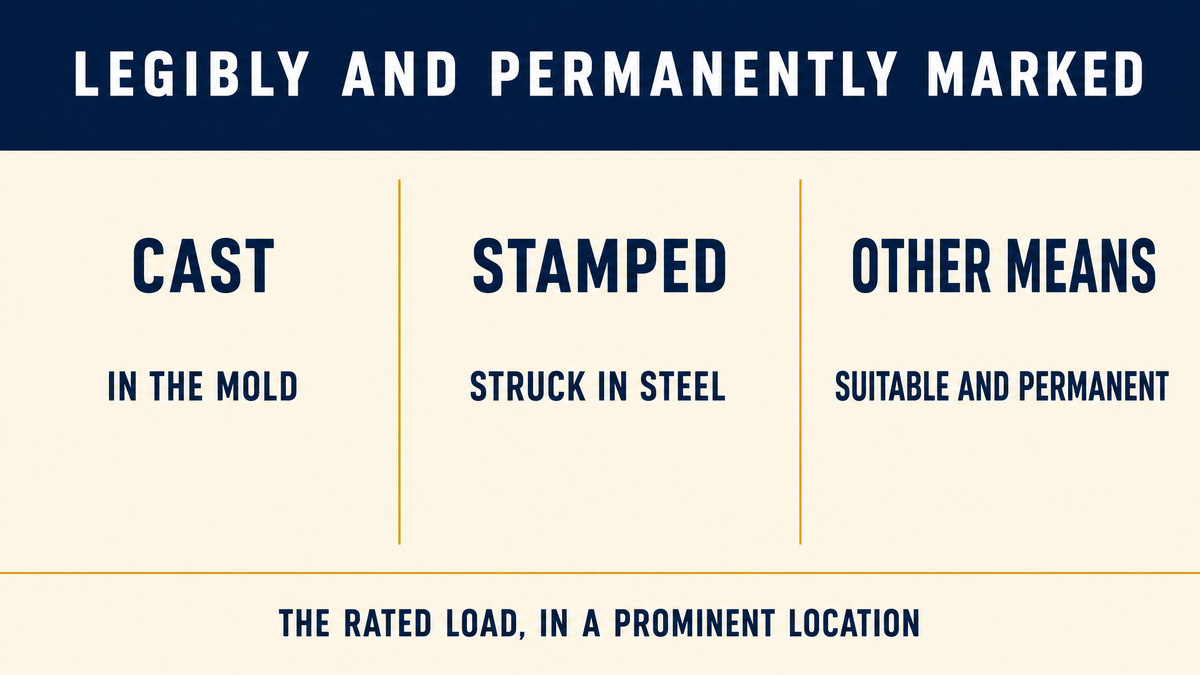
“(a) Jacks — (1) Loading and marking. (i) The operator shall make sure that the jack used has a rating sufficient to lift and sustain the load. (ii) The rated load shall be legibly and permanently marked in a prominent location on the jack by casting, stamping, or other suitable means.” — 29 CFR § 1910.244(a)(1)
The subject of the first sentence is the operator. The subject of the second is the mark. There is no sentence anywhere in the section that says who must design the jack, what test it must pass, or which body may certify it. The whole federal footprint of the product is a number, in a prominent place, put there permanently.
For a buyer, that has one hard consequence and one soft one. The hard consequence is that an unmarked jack cannot be used at work: the operator has a duty to check a rating, and a jack with no legible rating leaves that duty unperformed, whatever the device can actually lift. The soft consequence is that a supplier can be entirely truthful about the steel and still fail the only federal test that exists, because the failure is a missing or worn-off number rather than a broken part.
It is worth saying what the section does not cover, because the gap is where the rest of this article lives. It does not set a design, a material, a weld, a seal or a test load. It does not mention a factory. It does not create a mark that a buyer can check against a register, the way a tyre carries a code or a rim carries a symbol. What it creates is a claim that has to be legible at the point of use, and the operator is the person who reads it.
2. What the Rule Asks of the Operator
The rest of the jack section is a list of things the person using the device has to do, and every item on it is a design cue in disguise. Read it once for the duty, then a second time for what it implies about a jack worth buying.
The base and the cap. In the absence of a firm foundation the base shall be blocked; if the cap might slip, a block goes between the cap and the load. A supplier cannot control the floor of a customer's workshop, but it can control how much of the base touches that floor and how the saddle grips. A narrow base and a smooth cap push the operator towards blocking, which is the state the rule expects.
The stop indicator. The operator shall watch the stop indicator, keep it clean, and not overrun the limit of travel. That sentence presupposes a mark that can be seen and cleaned. A jack whose travel limit is a painted line under the pump arm, or a groove that fills with grit, is a jack that makes the rule hard to follow.
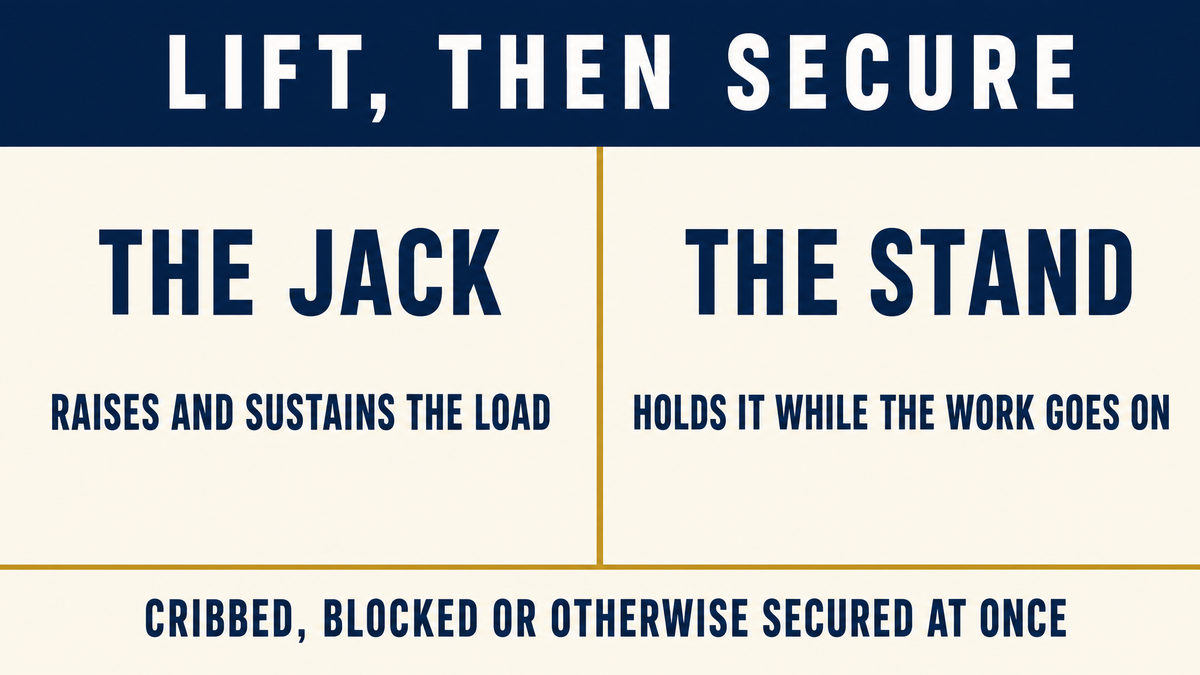
The load after the lift. After the load has been raised it shall be cribbed, blocked or otherwise secured at once. This is the sentence that separates the two devices sold together, and it gets its own section below, because the federal text never uses the phrase jack stand.
The cold line. Hydraulic jacks exposed to freezing temperatures shall be supplied with an adequate antifreeze liquid. This is the most concrete product line in the whole section, and it is easy to miss. A jack sold into a market with a real winter is being sold into a paragraph that names the fluid, and a supplier who ships one fluid to every market is quietly assuming a temperature range the rule does not.
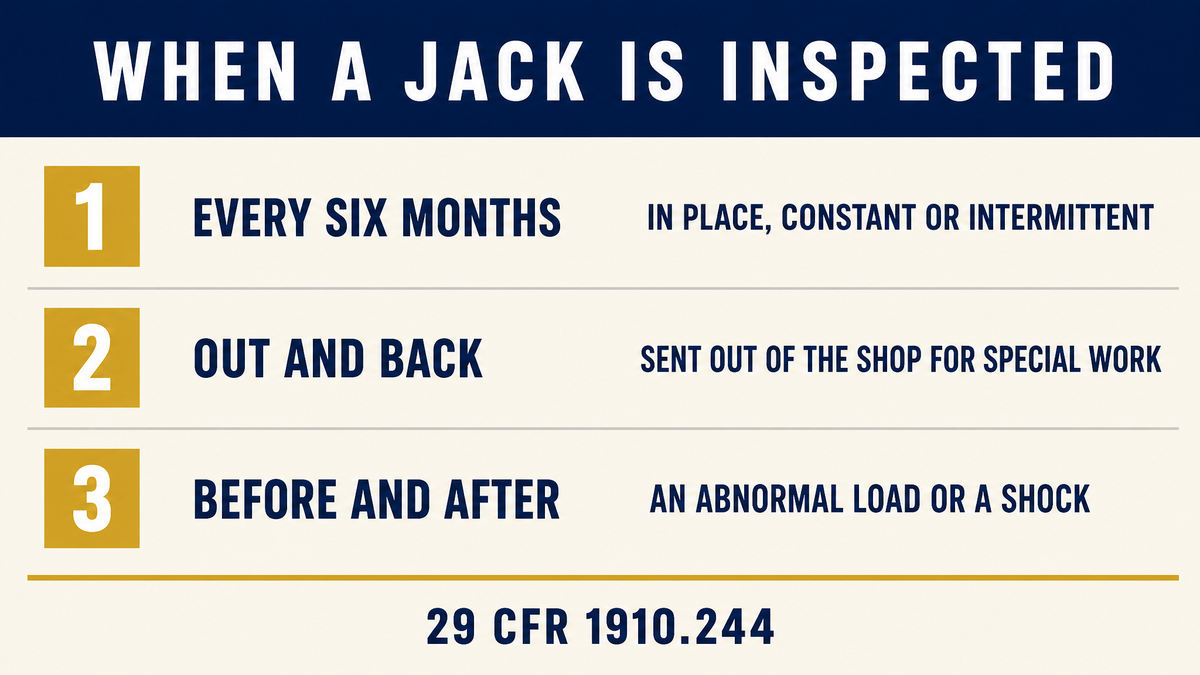
The service life. All jacks shall be properly lubricated at regular intervals, and each jack shall be thoroughly inspected at intervals set by the service conditions, and never less often than the three cases below. Repair or replacement parts shall be examined for possible defects, and a jack that is out of order shall be tagged and not used until it is repaired.
Look at what that service paragraph implies about a product. The rule assumes a jack can be inspected, lubricated and repaired, and it assumes a supply of parts. A sealed unit with no service points is not unlawful, but it turns every six-month inspection into a replacement decision, and it turns the tagging clause into a sentence about scrap. For a wholesale buyer the practical reading is simple: the three service lines — inspection access, lubrication points and parts availability — are commercial commitments, and they belong in the order document rather than in a brochure.
3. The Voluntary Document Behind the Mark
If the federal text stops at a stamp, something else has to say what the stamp should sit on, and in this category that something is a voluntary standard published by ASME. Its title is PASE — Safety Standard for Portable Automotive Service Equipment, and the current edition is PASE-2024: 86 pages, published by ASME, with earlier editions in 2019 and 2014. It is a document a buyer pays for, not a register a factory signs.
The scope sentence is the part worth reading closely, because it decides which of your products it covers:
“This Standard applies to the design, construction, marking, operation, maintenance, and owner or operation inspection of the following portable automotive service equipment: attachments, adaptors, and accessories, automotive hand jacks, automotive mechanical jacks, automotive stands, automotive ramps, mobile vehicle lifts and jacks, vehicle transport lifts, vehicle moving dollies, component dollies and jacks, shop cranes, engine stands, shop presses, oil filter crushers, strut spring compressors, oil and antifreeze handlers, portable hydraulic power kits, and engine support tools.” — ASME PASE-2024, scope
Three things follow from that sentence. The standard covers marking, which is the federal duty, and it also covers the design and the construction, which the federal text never touches. It names jacks and stands in the same list, so the pair sold together is governed by one document. And it is written for two readers at once, the maker and the owner, which is why the same book holds the design clauses and the inspection clauses.
The commercial consequence is blunt: a supplier who says “ASME” without an edition is saying nothing a buyer can check. The standard has three editions in the field, the cover varies, and an order document that names neither the edition nor the clause leaves the factory free to work to whichever text it prefers. What the ASME page sells is a PDF of the standard; nothing on it describes a certificate, a listing or a mark that a third party issues for a jack. So the check is the document, not a badge.
Three duties, three owners
| Duty | Who it binds | What the order carries |
|---|---|---|
| The mark | The employer and the operator | The rating, the method and the place |
| The design | The maker, by contract | The edition and the clause |
| The inspection | The owner | The interval, the points, the parts |
Read the middle row twice. Design is the one duty in the table that binds nobody by law, and it is the only one that decides whether the first row can be honestly met. A jack can carry a legible rating and still fail, quietly, at the weld, the seal or the base. That is why the voluntary document exists, and why the edition belongs in the paperwork rather than in a marketing sentence.
4. Lift, Then Secure: Two Devices, One Sentence
The section that names a jack never uses the phrase jack stand. What it does instead is require a second act, in one sentence: after the load has been raised, it shall be cribbed, blocked or otherwise secured at once. That is the handoff between the two devices a workshop buys together, and it is worth noticing how the duty is split.
The jack is the device that raises and sustains a load while it is being raised, and the federal text asks the operator to check its rating. The stand, cribbing or block is whatever holds the load while the work goes on, and the federal text does not name a marking duty for it at all. The stand's rating therefore comes from somewhere else: from the voluntary standard's design and marking clauses, and from the seller's own claim. For a buyer that is a real asymmetry, and it explains a habit of the trade: the jack's rating is quoted because a rule asks for it, and the stand's rating is quoted because the customer has learned to ask.
Two practical consequences follow, and both belong in a quotation. First, the two ratings are separate numbers and should be quoted separately, with the unit and the marking method for each; a set sold as “3 ton” without saying which device carries which figure is a set whose numbers a workshop will assume. Second, the stand is usually the device left under load overnight, which is the condition the federal sentence was written for. That is why the inspection clause and the tagging clause sit in the same section as the lifting clause: a device that holds a load for hours gets inspected, and a device that is out of order gets tagged.
5. Where the Rating Is Sold
Nothing in the text so far tells a buyer what number to put on a jack. The rating is a commercial decision, made by a maker against a market, and it arrives in a catalogue as a round figure with a unit attached. The legal surface is only this: the figure must be legible, permanent and prominent, and the operator must be able to check it against the load.
That gap is where most of the avoidable risk in this category sits, and it is a paperwork gap rather than an engineering one. Four questions close it, and none of them needs a laboratory:
- Where does the mark sit, and can it be read after the paint? The rule says prominent, legible and permanent. A rating cast into the base is permanent and hard to read; a rating stamped into the body is readable and can be filled by paint. Ask for the position on the drawing, not a photograph of a sample.
- Which method is used, and does the drawing say so? Casting, stamping or another suitable means are the three the rule allows. A sticker is not among them, and a label is the first thing a workshop loses.
- What travels with the rating? The unit, the model, and the mark that identifies the maker. A figure with no maker attached is a claim nobody can follow up, and the federal text's whole point is that somebody can.
- Does the same number appear on the document and on the steel? The commonest finding in a first shipment is a carton, a catalogue and a body that disagree. Ask for the number on the drawing, the number on the sample and the number in the carton to be checked against each other before the container is closed.
One more point belongs here, because it is the question a buyer asks last and should ask first. A bigger number is not a bigger margin. The rating describes a load the device is claimed to sustain; the load arrives through the saddle and leaves through the base, and the floor under the base is the part the rule tells the operator to block. So the useful comparison between two suppliers is not the figure alone. It is the figure, the place it is marked, and the geometry that carries it.
6. What the Record Says
Method first. The federal recall file holds 245,845 records, has no header row, and every field is scanned rather than trusting a column map. Controls: brake appears in 28,639 records and air bag in 16,162. Twenty-five terms are counted, each with its own pattern, and this time not one of them came back empty.
| Term | Records | Campaigns |
|---|---|---|
jack | 291 | 55 |
jacks | 65 | 15 |
stand | 333 | 47 |
bottle | 63 | 19 |
trolley | 358 | 25 |
saddle | 348 | 34 |
creep | 13 | 1 |
hydraulic | 9,711 | 963 |
pump | 11,978 | 502 |
pressure | 15,665 | 979 |
cylinder | 2,593 | 252 |
seal | 1,457 | 213 |
seals | 251 | 44 |
leak | 13,524 | 1,456 |
fluid | 4,472 | 437 |
hose | 3,221 | 430 |
weld | 2,498 | 286 |
pin | 2,318 | 253 |
handle | 5,138 | 210 |
capacity | 2,630 | 287 |
rating | 1,929 | 274 |
lift | 5,343 | 400 |
ram | 3,181 | 297 |
collapse | 275 | 40 |
overload | 795 | 97 |
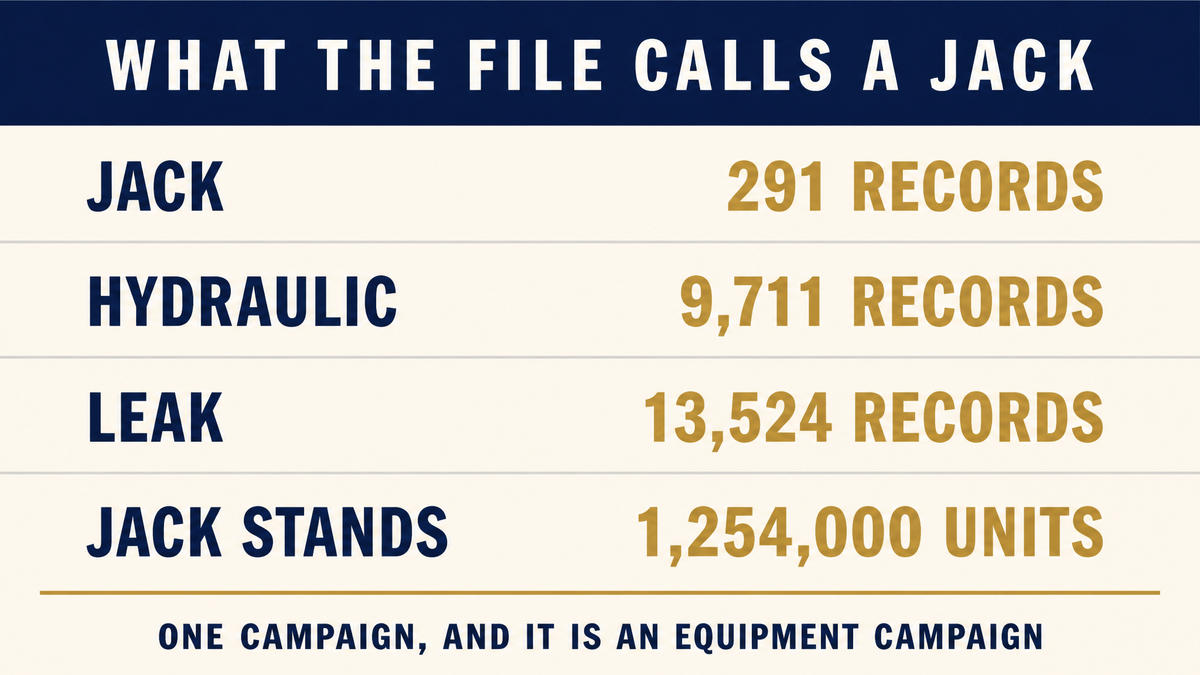
The jack's own words are the thinnest in the table. jack reaches 291 records across 55 campaigns, jacks 65 across 15, bottle 63, saddle 348 and creep 13 in a single campaign. Next to them, the vocabulary a jack shares with the rest of a car is enormous: leak at 13,524 records, pressure at 15,665, pump at 11,978 and hydraulic at 9,711. The contexts show where those numbers come from, and it is not lifting equipment. The largest hydraulic campaigns are brake campaigns, the largest pump rows are fuel and brake pumps, and the largest seal rows are brake master cylinders. A jack borrows its whole technical vocabulary from the systems it is used to work on.
The top of the jack list is a jack stand. Four of the five largest rows that mention a jack are stands, and all four carry campaign identifiers with an E in the third position — 20E027000, 20E016000, 20E046000 and 20E053000 — while the vehicle campaigns in the same list carry a V (16V043000, 21V440000). The largest is a Pittsburgh Automotive 3 ton steel jack stand at 1,254,000 units, followed by the same brand's 6 ton stand at 454,000 and another 3 ton at 118,000, then a Hyper Tough 2 ton jackstand at 13,956. Read that against section 4: the device the federal text implies but never names is the device with the million-unit campaign.
The headings say equipment, not vehicle. Campaigns filed under the mechanical equipment family number 157, 15 and 9 across three variants of the integrated jack and leveler heading, and 7 under the accessory scissor, screw and bottle jack heading. Two more rows in the same scan are not jacks at all: an audio jack under an electrical heading and a wiring connector. That is the same trap this series has recorded five times now, and here it lands on a word that also names a plug.
The word capacity lives on labels. capacity reaches 287 campaigns, and the four largest are label campaigns: a Scion xD at 271,417 units, a Peterbilt 387 at 213,230, a Toyota Sienna at 210,000 and a Toyota Highlander at 153,418, every one of them filed under the equipment heading for labels. In this file the word for the number a jack is bought on appears most often on a sticker that nobody reads.
The finding. The record counts equipment campaigns, and inside them it counts jack stands far more heavily than jacks. It carries the vocabulary of the systems a jack works on, and almost none of the vocabulary of the jack itself: creep at 13 records and overload at 795 across a quarter of a million rows. That is the same shape the clause pointed at from the other side. The federal text asks for a mark and a set of operator habits, the voluntary standard carries the design, and the recall record carries the stands. A buyer who wants the device to be right has to close the gap between those three, and the only place to close it is the order document.
7. Five Questions a Jack Quote Should Answer
A jack quotation usually arrives as a model, a capacity, a quantity and a price. Three of those four are commercial, and the fourth is the one the customer's safety officer will read. Five questions settle the rest.
- Where is the rated load marked, by which of the three methods, and can it be read after the paint? The federal duty is legible, permanent and prominent, so the answer is a position on a drawing and a method, not a promise.
- Which PASE edition and which clause does the factory build to? There are three editions in the field. A quote that names the edition is a quote that can be checked; one that says “ASME” cannot.
- Which fluid is filled, and what is the lowest temperature it claims? The federal text names antifreeze for jacks exposed to freezing temperatures, which makes the fluid a market-specific line rather than a detail.
- Where are the inspection points, the lubrication points and the parts list? The six-month inspection assumes a device somebody can open, lubricate and repair, and the parts clause assumes a supply.
- Is the stand's rating quoted as its own number, with its own unit and mark? The federal marking duty is written about jacks; the stand's figure is a claim by the maker, and the pair is what the workshop actually uses.
8. Six Lines to Put in the Order
Everything above reduces to six lines that belong in the order document. Each one is checkable when the container is opened, which is the only test a specification line should have to pass.
| Line | What to write | Why it is on the list |
|---|---|---|
| 1 | The rated load, the marking method, and the place on the drawing | It is the only federal sentence written about the product |
| 2 | The PASE edition and the clause the factory works to | Design binds nobody by law, and it decides everything else |
| 3 | The fluid, and the lowest temperature it is rated for | The federal text names antifreeze for freezing conditions |
| 4 | The stop indicator's position, and how it stays legible | The operator has to watch it and keep it clean |
| 5 | The inspection points, the lubrication points, the parts list | The six-month clause assumes a serviceable device |
| 6 | The stand's rating, as its own number and unit | The federal text never names a stand, so the claim is the maker's |
Three of those six lines are about a number, and three are about keeping a device serviceable. That is a different balance from the two previous articles, and it follows from the category. The wheel and the wiper were both decided by somebody else's document; a jack is decided by the maker's own claim, and the only thing the law adds is that the claim has to be legible on the steel.com/factory-audit-checklist-guide/" target="_blank" rel="noopener">the audit checklist behind a claimed rating is where a factory's own numbers get tested, and the pre-shipment check on a heavy carton is where a marking survives the trip — with when the charge switches from weight to volume worth settling at the same time, because a jack is dense enough to bill on mass.
Frequently Asked Questions
Does a hydraulic jack need a certificate?
There is no certificate and no register for a jack in the United States. The federal text that names one is a workplace rule, and what it asks of the product is a mark: the rated load, legibly and permanently placed in a prominent location. The design side is covered by a voluntary ASME standard that a buyer has to name in the order to make it binding.
What does 29 CFR 1910.244 actually require?
The operator must check that the jack's rating is enough for the load, and the rated load must be legibly and permanently marked in a prominent location by casting, stamping or another suitable means. The same section then sets out blocking the base, watching the stop indicator, securing the load once it is raised, antifreeze in freezing temperatures, lubrication, inspection intervals, parts and tagging.
Do jack stands need a rating mark?
The marking sentence in the federal section is written about jacks. The stand appears in the same section only through the sentence that says a raised load shall be cribbed, blocked or otherwise secured at once. A stand's rated figure therefore comes from the voluntary standard's design and marking clauses and from the maker's own claim, which is why it should be quoted as its own number.
How often must a jack be inspected?
Never less often than three cases: once every six months for constant or intermittent use at one place; when a jack is sent out of the shop for special work and again when it returns; and immediately before and immediately after any abnormal load or shock. A jack that is out of order is tagged and cannot be used until it is repaired.
Is ASME PASE compulsory?
No. It is a published standard that a buyer pays for, and its 2024 edition runs to 86 pages. What makes it binding is a contract that names the edition and the clause. Its scope covers design, construction, marking, operation, maintenance and inspection of portable automotive service equipment, including hand jacks, mechanical jacks and stands.
Why does the fluid matter in an order?
Because the federal rule says hydraulic jacks exposed to freezing temperatures shall be supplied with an adequate antifreeze liquid. That sentence makes the fluid a market-specific specification rather than an afterthought: one fill shipped to every destination is an assumption about temperature that the rule does not share.
A jack has one federal duty and it is a stamp. OSHA 1910.244 asks for the rated load to be marked legibly and permanently in a prominent place, by casting, stamping or another suitable means, and the sentence ends there.
Everything a buyer worries about sits outside it: the weld, the seal, the base, the release. Those live in a voluntary standard with three editions in circulation, so which edition the factory works to is a line in the order rather than a fact you can read off the jack.
Lift, Then Secure: Two Devices, One Sentence
We return the marking your unit needs, the jack stand requirement that follows it, and the voluntary standard behind the label.
Write My Stand Note
Questions & Comments
We read every one and reply within 24 hoursWhether a hydraulic jack's rating has to be cast or can be a plate turns on one sentence in 1910.244. Send the model and the market, and we will answer it with a drawing note.