
Wire Brush Manufacturer: Sourcing Wire Wheels and Cup Brushes From China
 ·
Updated October 12, 2026
·
17 min read
A wire brush looks like the simplest thing on the shelf, and the rules treat it as a machine part. 29 CFR 1910.94 gives it a name — a scratch brush wheel, defined as any power-driven rotatable wheel made from wire or bristles and used for scratch cleaning and brushing — and then hands it a table of its own. That table gives a minimum exhaust volume for the brush, and the figure changes with the brush's diameter and its width. So the size of the brush you order is not only a question about the work. It is a question about how much air the machine has to pull.

Five Lines That Decide Whether the Brush Suits the Machine
| What the buyer has to settle | Why it is not obvious | The line on your order that closes it |
|---|---|---|
| Whether the wire is crimped or knotted | Crimped wire is a cleaning tool and knotted wire is a cutting tool, and the two look similar in a photograph | The wire form, named rather than shown |
| The diameter and the width | On this product those two numbers set the minimum exhaust volume the machine must pull, not just the reach of the brush | Both dimensions, plus the machine the brush will run on |
| The direction the brush will turn | The dust and the loose wire have to be thrown into the hood; the rules forbid running the wheel so that they go into the operator's breathing zone | Which side of the spindle the brush mounts on |
| The wire material | Carbon steel leaves rust residue and throws sparks; stainless and brass-coated exist for exactly those two problems | The wire grade, stated as a material rather than a colour |
| Whether the brush arrives balanced and trimmed | Shedding wire, bare patches and uneven trim all survive a visual check of the carton in different ways | The balance and trim figure, plus how the brush is packed |
| Whether the price is a price or a warning | A cheaper brush is usually thinner wire, a lighter core or a shorter trim, and only one of those shows on arrival | The cost lines shown separately, with the wire diameter named |
What a Wire Brush Is, and the Five Shapes You Will Be Quoted
A wire brush is a rotating tool made of wire ends. Nothing about it is complicated in principle: wire is gathered, held in a core, and trimmed so that a known length of wire stands proud of the face and does the work. What makes it a product family rather than a product is the shape, because the shape decides where the wire points and therefore what the brush can reach.
The wheel brush. A circular brush that turns on a spindle, used on a bench machine for flat work and edges. It is the shape most people picture, and the one where the width of the wire band matters most, for reasons covered further down.
The cup brush. A short cylindrical brush with the wire standing out of a hub, used on an angle grinder for flat surfaces and for getting into corners. It presents a much wider working face than a wheel brush and takes far more side pressure, which is why cheap cup brushes are the ones that shed their wire first.
The end brush. A small brush with a single tuft standing out of a threaded stem, used for tight spots, holes and welds. It is the shape where the tuft's density decides the result, and the shape that is easiest to make badly, because a sparse tuft is hard to spot in a product photograph.
The twisted-in-wire or stem brush. Wire bristles are twisted between two lengths of stem, giving a long thin brush for tubes, bores and internal cleaning. Here the important dimension is the length and the head diameter, and the important question is whether the stem will fit the hole without being forced.
The strip brush. A straight band of wire set into a metal channel, used on machines and doors rather than by hand. This is a different manufacturing job again, and it is the shape most often miscosted, because the channel is a separate formed part rather than a pressed core.
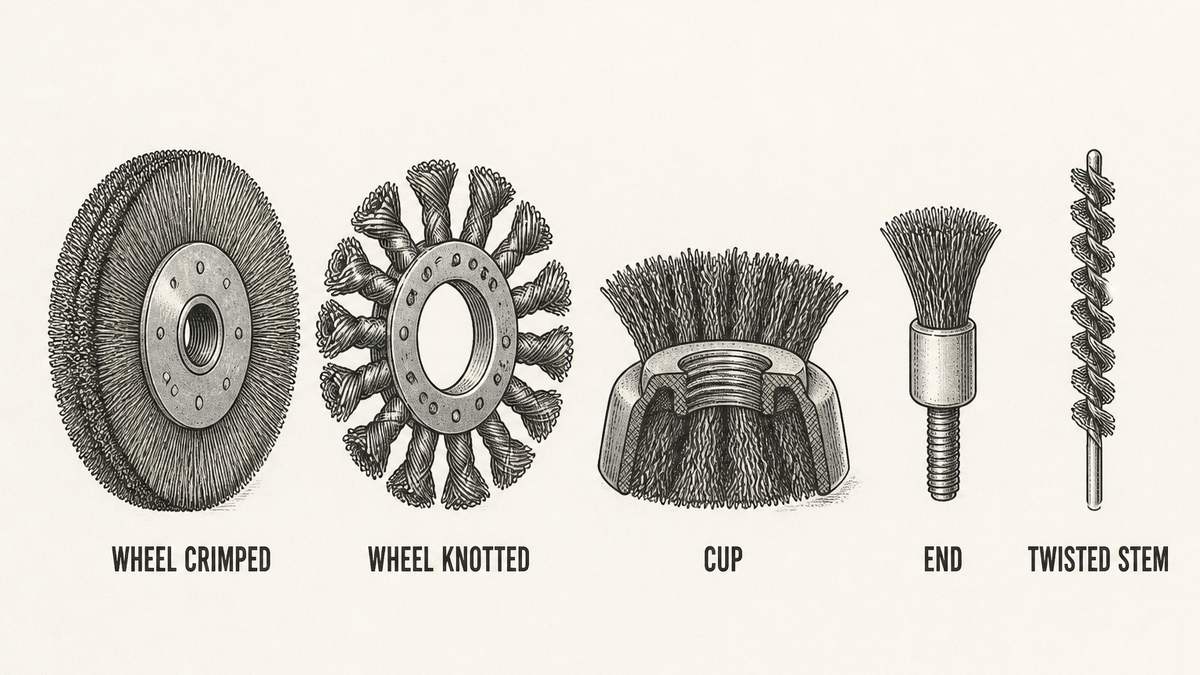
Two things follow from seeing the family as a whole. First, a quotation that says “wire brush” and a diameter has not told you which of these five you are buying, and they are not interchangeable. Second, the shape is the buyer's decision and not the factory's, because only you know whether the work is a flat plate, a corner, a bore or a doorway. That is the first line to settle, and everything after it is arithmetic.
Crimped or Knotted: The Choice That Decides Everything After It
The single most important line on a wire brush order is the wire form, and it is the one most often left to the factory because the buyer does not know the words. There are two answers and they do different jobs.
Crimped wire is wire that has been bent into a wave along its length before it is gathered into the brush. The crimp gives each wire end a springiness, so the brush face is soft against the work. That is what you want for cleaning, light deburring, rust and paint removal, and surface preparation before painting. It is gentle on the part and it presents thousands of fine contact points.
Knotted wire is wire that has been twisted into tight knots and those knots set into the core. The cut ends of the knot do the cutting, and the brush is stiff. That is what you want for heavy scale, weld slag, deep rust and rough castings, where a crimped brush would simply be worn away without moving the material. A knotted brush is a cutting tool that happens to be made of wire, and it will mark a soft surface.
The reason this has to be decided before anything else is that it changes almost every other line on the order. Knotted brushes need thicker wire and a heavier core to hold the knot, so the wire diameter and the core change. They are usually run at different machine speeds from crimped brushes of the same diameter. And they cost more, because knotting is a separate step from crimping. A buyer who specifies a diameter and a price and leaves the wire form open will get whichever the factory had on the shelf, and the price will look like a good deal compared to the knotted brush they needed.
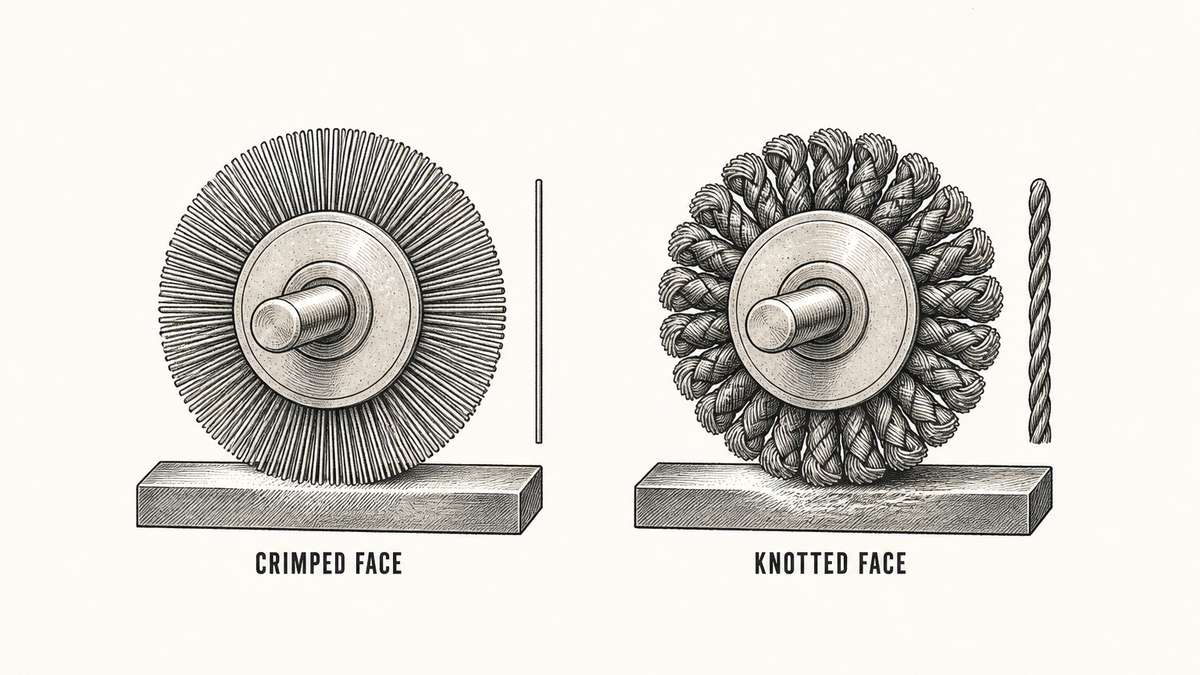
There is a practical way to check what you were sent, and it takes seconds. Look at a single wire end. A crimped brush gives you a wire with a visible wave in it, and the wire pulls out of the face easily and springs back. A knotted brush gives you a dense braided bundle that resists being separated and does not spring. If the sample you asked for as a knotted brush comes apart in your fingers like a crimped one, the order was substituted, and it is better to find that out from a sample than from a full carton.
The Size of the Brush Sets the Airflow the Machine Has to Pull
This is the part of the product that buyers almost never discuss with a factory, and it comes directly out of the rules. The section on ventilation says that wherever dry grinding, dry polishing or buffing is done, and employee exposure goes past the permissible exposure limits — and the rule adds, deliberately, without regard to the use of respirators — a local exhaust system has to be provided and used.
Then it gets specific about scratch-brush wheels. A scratch-brush wheel mounted on a floor stand, a pedestal, a bench machine or a special-purpose machine must have at least the minimum exhaust volume set out in a table for buffing and polishing wheels, and that volume is read off two numbers: the diameter of the brush and the width of the brush.
The figures run like this. For a brush up to 9 inches in diameter and 2 inches wide, the minimum is 300 cubic feet per minute. Over 9 up to 16 inches and 3 inches wide, 500. Over 16 up to 19 inches and 4 inches wide, 610. Over 19 up to 24 inches and 5 inches wide, 740. Over 24 up to 30 inches and 6 inches wide, 1,040. And over 30 up to 36 inches and 6 inches wide, 1,200.
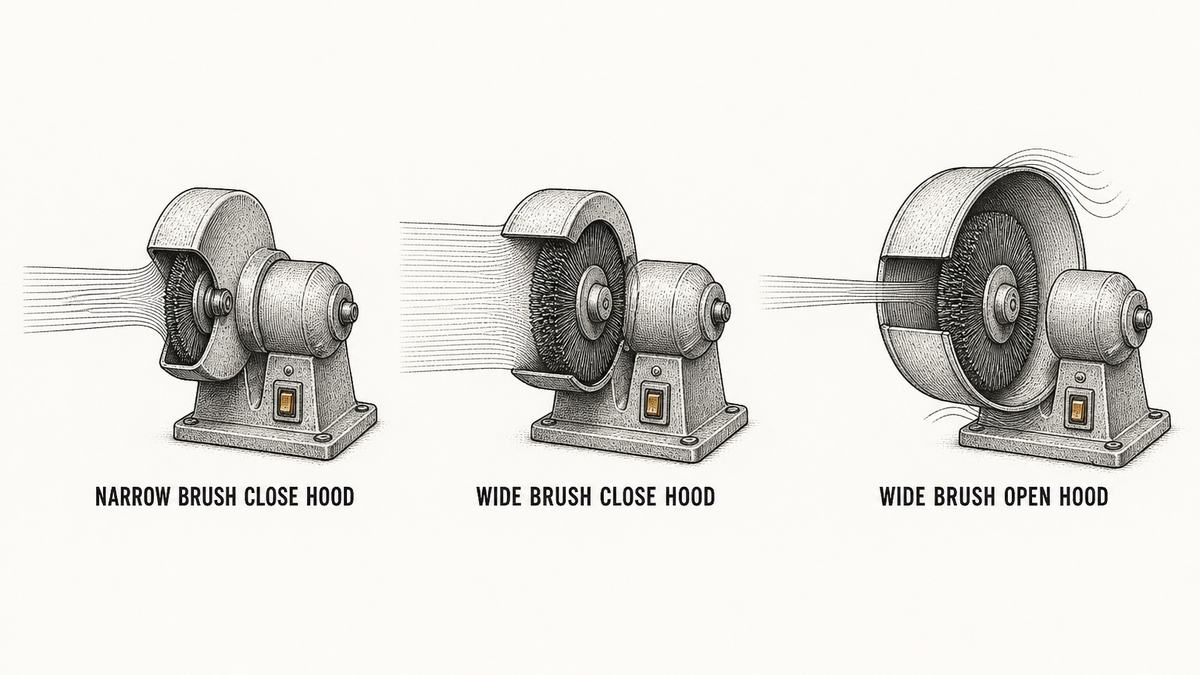
Why this matters to a buyer rather than only to an engineer is that it turns two dimensions into a specification with consequences. If you quote a wide brush where the machine was sized for a narrow one, the airflow is short. If the work has to be done outside the hood — and the rules acknowledge that it sometimes must — the volume has to be increased further, and a portable operation that cannot be brought inside an enclosure has its own requirement: a partial enclosure with an opening no larger than the work actually needs, holding an average face air velocity of not less than 200 feet per minute.
So the useful question to put to a supplier is not only “what is the brush rated to” but “what diameter and width do you make, and what does that size assume about the machine it runs on”. A factory that makes brushes all day will know its own size ranges without thinking. Ask them for the range, put the diameter and the width on the order as separate fields, and tell them what machine the brush is going on. That single sentence is what stops a cheap substitution from quietly creating a ventilation problem on somebody else's shop floor.
Which Way It Turns: Why Rotation Direction Is a Specification Line
Most buyers never think about which way a brush turns, because a brush turns the way the machine turns it. The rules think about it, and they do so in a sentence that is unusually direct: the hood has to be designed, placed and located so that the dust and dirt fall or are projected into the hood in the direction of the air flow, and then the sentence adds that no wheel, disc, strap or belt is to be operated in such a manner or such a direction as to throw the dust and dirt particles into the operator's breathing zone.
Read that against a bench machine and it becomes a mounting question. A wheel brush can be set to turn so that the work is brushed downward, with the dust and the shed wire thrown down into the hood and then taken away by the airflow. Turn the same brush the other way, or mount the hood on the wrong side, and the dust comes off the top of the brush and goes up and out, past the hood, into the air at the operator's face. Nothing about the product has changed. Only the geometry has.
Two things follow for a buyer. The first is that a brush order should say which face of the brush the wire leans towards, or at least that the brushes will be mounted in a stated direction, because a brush is not always symmetric in the way it is trimmed and set. A factory that trims its brushes for one direction of rotation will produce a different tool from one that trims for the other, and the difference is invisible in a photograph.
The second is that the same problem exists on the supply side, in the packing and the labelling. If the goods arrive with no indication of which way they were intended to turn, then whoever mounts them has a fifty per cent chance of getting it wrong, and the failure is silent — the brush still works, the dust just goes the wrong way. A simple arrow or a written line on the label, or a note in the carton, costs nothing and removes the coin toss. If you are supplying brushes to other people's workshops, that note is worth more than the brush's price advantage over the next supplier.

There is a second half to the same requirement that is easier to forget, and it is about the hood rather than the brush. The rules say that hoods for polishing, buffing and scratch-brush work should be built to conform as closely as the nature of the work allows to a specified shape, and that where the operation cannot be brought inside the hood the airflow has to be increased. In plain terms: the hood has to fit the brush. A hood that is much larger than the brush lets the airborne dust escape around the edges instead of being captured, which is exactly the third drawing in the figure above.
Wire Material, and What Each One Rules Out
Four wire materials cover almost everything that will be quoted to a buyer, and each one rules something out.
Carbon steel wire is the default. It is the strongest per unit of cost, it cuts well, and it is the right answer for general cleaning on steel where a little rust staining afterwards does not matter. It rules out two things. It leaves rust residue on whatever it touches, so it is the wrong choice on stainless steel, aluminium and anything that will be visible or will be welded. And it throws sparks, which matters in a plant where flammable vapour or dust is present.
Stainless steel wire is chosen where contamination is the problem rather than the work. It leaves no rust residue, which is why it is the standard answer on stainless steel fabrications and on anything going into food or clean work. It costs more than carbon steel, and it is a little softer, so it wears faster for the same job. If a customer asks for a brush that will not leave marks and will not rust, stainless is the answer and the price difference is the answer to a different question.
Brass-coated steel wire is carbon steel wire with a brass coating. It gives the low-spark, low-scratch behaviour of a softer wire while keeping the strength of a steel core, and it is used on softer metals and where a bright finish is wanted. It is not the same thing as solid brass wire, and a supplier who quotes one when you asked for the other has changed the product without changing the word “brass”. Ask for the coating weight if the difference matters to you.
Abrasive nylon is not wire at all. It is nylon filament loaded with abrasive grain, and it is used where a metal brush would scratch too deeply, where the part is soft, or where the customer wants a controlled finish rather than a cut. It is the only one of the four that cannot shed a metal fragment, which makes it the answer in places where a loose piece of steel wire in the product would be a defect rather than a nuisance.
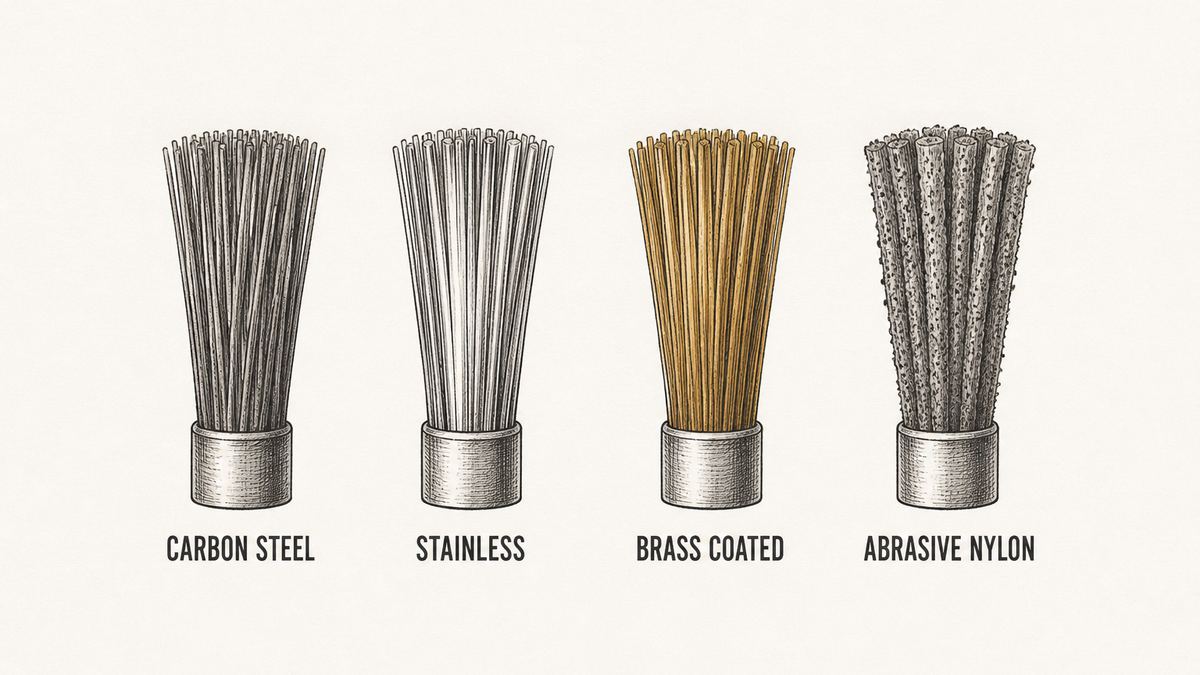
The practical instruction is to name the material rather than describe it. “Stainless” is better than “does not rust”; “brass-coated steel” is better than “brass”; “abrasive nylon” is better than “non-metallic”. Every one of those vague descriptions can be satisfied by two different products at two different prices, and the factory will choose the cheaper one unless the word on the order stops them.
Arbors, Trim Length and Getting the Brush Onto the Machine
A wire brush that does not mount properly is scrap, and the mounting details are the ones buyers leave unsaid.
The arbor hole and the machine's spindle. A wheel brush fits a machine through a bore in its centre plate, and that bore has to match the spindle. There is a second detail that catches people on bench machines: a keyway. If the spindle is keyed and the brush is not, the brush can slip under load, and a slipping brush at speed damages the bore and then the machine. Specify whether the bore is plain or keyed, and give the bore size, because “fits a bench grinder” is not a dimension.
Trim length. Trim length is how far the wire stands out from the core, and it changes the feel of the brush completely. Long trim makes a springy brush that is gentle and conforms to a shape; short trim makes a stiff brush that cuts harder and holds its diameter longer. It is a separate number from the diameter and it has to be on the order, because a factory that trims long when you needed short has delivered a soft brush that will not move the material.
Wire diameter. Thicker wire means a coarser, more aggressive brush that leaves a deeper scratch pattern. Thinner wire means a finer finish and faster wear. These three numbers — face diameter, trim length, wire diameter — sit together on the same specification and are usually quoted one at a time.
The hub or the stem. Cup brushes and end brushes mount through a threaded hub or a threaded stem, and the thread has to match the tool. A cup brush that is made for a metric spindle thread will not go onto an imperial one, and the difference is invisible in a catalogue until the brush will not seat. Ask for the thread, and ask whether an adaptor is included, because on angle-grinder brushes the adaptor is the part that goes missing in the carton.
None of this is difficult, and all of it is cheap to specify. The reason it matters is that the brush is the consumable and the machine is the fixed asset. When a brush does not fit, the brush is not the thing that gets replaced.
Reading a Wire Brush Supplier's Data Sheet
Most wire brush listings give a shape, a diameter and a price. Seven lines turn that into something you can order against without a sample loop.
- The shape and the wire form
- Wheel, cup, end, twisted stem or strip, and crimped or knotted. These two answers together decide the job the brush is capable of, and neither can be inferred from a photograph.
- The three dimensions
- Face diameter, trim length and wire diameter. Each one changes how the brush behaves, and a quotation with only the first has left the other two to the factory.
- The width, separately
- On a wheel brush the width of the wire band is a number in its own right, because together with the diameter it sets the minimum exhaust volume the machine has to pull. Ask for it as its own field, not folded into the diameter.
- The wire material and grade
- Carbon steel, stainless of a named grade, brass-coated steel with a coating weight, or abrasive nylon. Name the material rather than the appearance, so a cheaper substitution is visible on paper.
- The mounting details
- Bore size, keyed or plain, and for cup and end brushes the thread form. Plus whether a reducing bushing or adaptor is supplied and whether it is in the carton.
- The maximum running speed
- The speed the brush is made for, stated by the maker. A brush run too fast sheds wire, and a brush size that is available in several diameters will not have one figure for all of them. Ask for the figure per size.
- The packing
- How many to a carton, how they are separated, and whether the faces are protected. Wire brushing is a fragile product in transit in a specific way: the wire that arrives bent or matted is the wire that sheds.
Send those seven lines to two or three factories as a written request rather than asking for a price on a description, and the replies will sort the suppliers for you. A factory that makes its own brushes will answer the trim length and the wire diameter without hesitating, because those are the numbers it sets on its own machines. A trader will answer the shape and the price and go quiet on the rest.That is the same test that separates a maker from a reseller on any industrial consumable: ask for the wire grade and the tuft density, because a brush assembler will not have both numbers.
What to Test, and What the Record Should Show
Testing on a wire brush splits into two kinds, and confusing them is how buyers end up with paperwork that proves nothing.
The first kind is a process check at the factory: that the wire is the material and the diameter specified, that the core is the plate or ring thickness specified, that the trim length is what was ordered, and that the finished brush is balanced. These are the checks that prove how the brush was made. They cannot be done by looking at the finished product.
The second kind is a check of the brush as it stands, and part of that belongs to whoever mounts it. A brush that arrives with bent or matted wire, or with wire already working loose, is a defect on arrival, and it is worth checking before the carton is closed rather than after the brush has run.
The most reliable process check on this product is destructive and takes one brush out of the batch: pull a sample of wire ends and measure the wire diameter and count the ends per unit area of face. A brush made from thinner wire than specified, or from a sparser tuft, will pass every visual check and wear out in a fraction of the time, and this is the only cheap way to catch it.
- The material record
- One document per batch naming the wire material and grade, the wire diameter, the core material and thickness, the trim length, and the batch number that also appears on the packing. A general product sheet with no batch number cannot be tied to anything in your warehouse.
- A wire count and diameter check on a sample
- Destructive, cheap and decisive. It catches the two substitutions that matter most: thinner wire and a sparser face, both of which look fine and wear badly.
- A balance and run-out check
- How far the finished brush is allowed to run out of true, and how it was measured. An out-of-balance brush shakes the machine and sheds wire, and the fault is created at trimming rather than at use.
- The speed the brush was tested at
- Ask what the factory tests and at what speed, and ask for it in writing. Do not assume a spin test happened because the word appears on a certificate.
Then the habit that makes all of it usable: on a first order, have the goods checked before they ship, with the inspection tied to the same document set you wrote on the request.Have the first order checked against a written list, and take the number of brushes to open from the sampling table.A first order is also the moment to check against a drawing rather than by eye, because a thinner wire and a shorter trim are both invisible without a measurement.
Balance, Trim and the Four Defects That Show Up on Arrival
Four failures account for most of the wire brushes that come back, and three of them are visible the moment the carton is opened.
Shedding wire. Individual wires have come loose from the face, or are visibly detached and hanging. Some shedding is normal in the first minutes of running as the factory's own loose ends are thrown off, but a brush that arrives with wires already out of the face, or that continues shedding well past the first run, has a core problem. The core is not gripping the wire, and that is a manufacturing fault rather than a wear condition.
Bare patches. Sections of the face where the wire is missing and the core plate shows through. This is a filling fault: the tufts were not distributed evenly when the brush was assembled, and the result is a brush that cuts unevenly and wears far faster on the loaded side.
Uneven trim. The outer edge of the brush is not round, and tufts around the circumference are visibly different lengths. This is the trimming fault, and it is the one that shakes the machine, because an out-of-round brush cannot run true. It also causes the brush to hammer the work instead of brushing it.
A loose knot. On a knotted brush, the knots have opened out or come away from the core, and the wire is unravelling. This is the failure that matters most on heavy work, because the knot is what does the cutting, and a knot that opens loses its shape and then its grip.
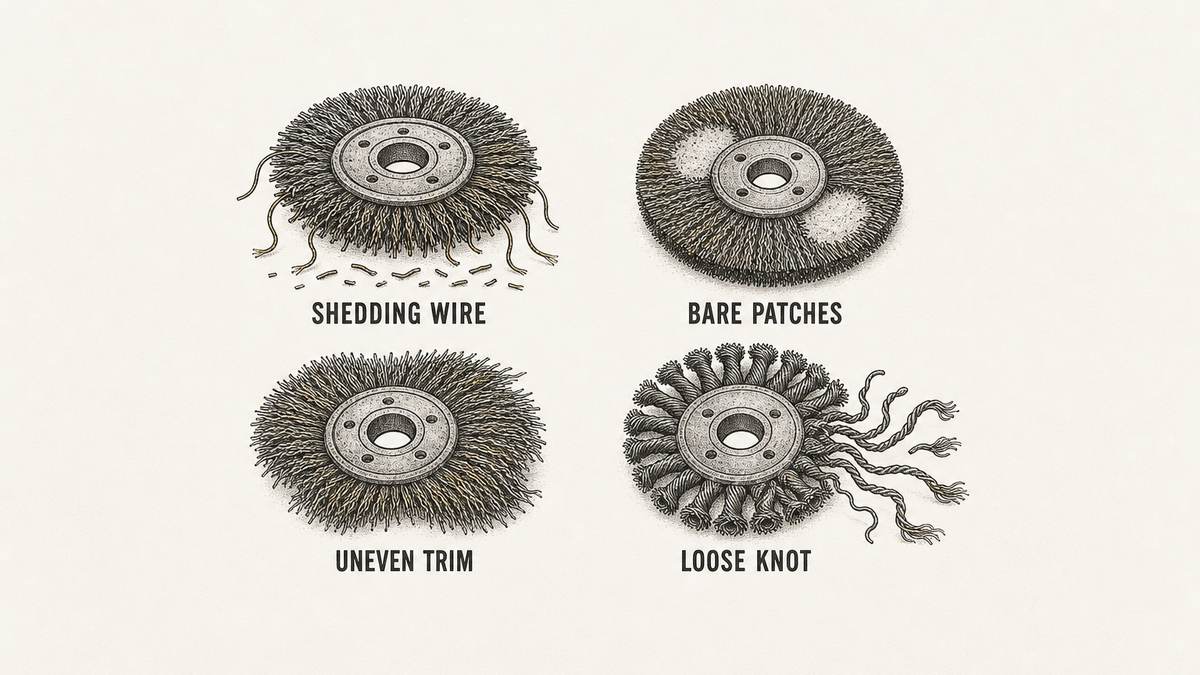
The fourth failure on the list, and the one that does not wait, is the brush that comes apart at speed. A wire that leaves a brush turning at working speed is a small hard projectile, and it is the reason a brush should not be run above the speed its maker states and should not be run without the guard and the hood in place. On this product the guard does double duty: it catches a broken wire, and it is the thing that makes the hood and the airflow work at all. The general machine guarding requirements sit alongside the ventilation rules here, and a brush is a machine part on both counts.
What a visual check cannot catch is the other half of the problem: a brush made from thinner wire or with a sparser face looks exactly like a good one. Those are caught by counting the wire ends and measuring the wire diameter on a sample, which is why that check sits at the top of the test list rather than at the bottom.
How the Price Is Built, and How to Check the Supplier Behind It
A wire brush has eight cost lines and only one of them is visible on a quotation. Knowing which eight they are is what makes two prices comparable, because the gap between them is almost never in the line you are looking at.
- The wire
- The largest material cost, and the easiest line to change without changing the appearance of the brush. Thinner wire of the same material costs less and wears faster, and the difference is invisible until the brush has run.
- Drawing the wire
- Wire is drawn down to the specified diameter, and the drawing affects how the wire behaves when it is crimped or knotted. A wire drawn from a cheaper rod can crimp unevenly.
- Crimping or knotting
- Two different processes at two different costs. Knotting is slower and needs thicker wire, which is part of why a knotted brush costs more than a crimped one of the same diameter.
- The core or the channel
- A pressed plate, a ring, or a formed metal channel. This is the part that holds the wire, so it is the part where a thinner core turns into a shedding brush.
- Filling and setting
- Getting the wire into the core at an even density. A fast fill leaves bare patches, and bare patches are the defect that shows up immediately and cannot be argued about.
- Trimming
- Cutting the face to length and to round. Trimming is the step that decides balance, and it is the step most often hurried.
- Balancing and the test run
- Checking the brush runs true, and spinning it. These are the lines that disappear quietly, and the cost of losing them appears at the customer's machine rather than on your invoice.
- Marking and packing
- The label that says which way the brush is intended to turn and what its speed figure is, plus the packing that stops the wire arriving matted. On this product the marking is not decoration; it is the instruction that stops the brush being mounted backwards.
So four of the eight lines are the same wire put through different machines, and the ones that disappear without trace are the balancing and the test run. A quotation that names the wire material and diameter, the trim length, the core, the wire form and the speed figure is one you can compare. A diameter and a price is not. The same discipline works on any consumable you buy repeatedly, and it is the same question that makes two wheels compared on the same job when you are buying the bonded products that sit next to brushes in the same catalogue.
Minimum order quantity on this product is set by the wire and the core rather than by the factory's goodwill. A standard diameter with a standard bore in a standard wire is usually a stock item. A non-standard diameter, a keyed bore, a special trim length or a different wire grade means a setup, so the first order carries it and the quantity follows. If you are quote-shopping a small order, quote the standard size first and then ask what changes when you move away from it.
Then check the party you are talking to, which on this product is easy to test. Ask who fills and trims the brushes. A real maker has the filling and trimming equipment and can describe the trim tolerance it holds; a trader buys finished brushes and cannot change the wire diameter or the trim at all, which matters the moment you want a different face. Ask to see the filling and trimming stations. Ask for samples from two different production runs rather than five from one afternoon, because two batches made months apart tell you far more about consistency than five made side by side. And on the first order, get the goods checked against the seven lines you wrote on the request before they ship.
Frequently Asked Questions
Should I buy a crimped or a knotted wire brush?
It depends on how much material you are trying to move. Crimped wire is bent into a wave so the face is springy and gentle, which suits cleaning, light deburring, rust and paint removal and surface preparation before painting. Knotted wire is twisted into tight knots so the cut ends do the work, which suits heavy scale, weld slag, deep rust and rough castings. A knotted brush is effectively a cutting tool and will mark a soft surface. The choice changes the wire diameter, the core and the price, so settle it before anything else on the order.
Does the size of a wire brush affect anything other than the work?
Yes, and this is the part buyers miss. Under the ventilation rules a wire brush is a scratch brush wheel, and one mounted on a floor stand, pedestal, bench machine or special-purpose machine must have at least a stated minimum exhaust volume. That volume is read from the brush's diameter and its width. A brush up to 9 inches in diameter and 2 inches wide needs 300 cubic feet per minute; the figures rise through the size range from there. So a wider or larger brush on the same machine needs more airflow, and the machine may not be sized for it.
Which way should a wire brush turn?
The way that throws the dust and any loose wire into the hood rather than into the operator's face. The ventilation rules require hoods to be placed so that dust is projected into them in the direction of the airflow, and they forbid running any wheel in a direction that throws dust into the operator's breathing zone. On a bench machine that makes it a mounting question rather than a brush question. It is worth telling your supplier which direction the brushes will run, and worth asking them to label the brush, because a brush mounted backwards still works and the fault is silent.
Is stainless steel wire worth the extra cost?
It is worth it when contamination is the problem rather than the work. Stainless leaves no rust residue, which is why it is standard on stainless fabrications and on equipment going into food or clean work. Carbon steel is stronger per unit of cost and cuts better, but it leaves rust staining and throws sparks. Stainless is also slightly softer, so it wears faster for the same task. If a customer asks for a brush that will not mark and will not rust, that is a stainless request and the price difference is the answer to a different question.
What is the difference between brass wire and brass-coated wire?
Brass-coated wire is carbon steel wire with a brass coating, so it keeps the strength of a steel core while behaving more gently and throwing fewer sparks than plain carbon steel. Solid brass wire is a softer material throughout and behaves differently again. A supplier who quotes one when you asked for the other has changed the product without changing the word, so name the material precisely on the order and ask for the coating weight if the difference matters to your application.
How do I check a wire brush supplier who says they are a manufacturer?
Ask who fills and trims the brushes. A maker has the filling machinery and the trimming equipment, and can tell you the trim tolerance it holds and the wire diameters it draws or buys. A trader buys finished brushes and cannot change the wire diameter or the trim length at all, which matters the moment you want a different face. Then ask to see the trimming station and the balancing check, and ask for samples from two different production runs rather than several from the same afternoon.
Send the machine and the material — not just “a wire wheel”
Tell us what the brush has to clean or cut and what will drive it, then the lines that decide whether it can be used at all: the shape, crimped or knotted wire, the face diameter, the trim length, the wire diameter and material, the width of the wire band, the bore or thread, the maximum running speed, and the marking you need on the brush and the label. If brushes have already arrived shedding wire, with bare patches, out of round, with knots opening out, or with wire matted from packing, send a photograph and a short description — the symptom usually says whether it was the wire, the core, the filling, the trimming or the packing.
Request a Wire Brush Sourcing Quote
Questions & Comments
We read every one and reply within 24 hoursSourcing wire brushes and getting quotations that all say “wire wheel”? Send the shape and whether the wire is crimped or knotted, then the lines that decide whether the brush can be used at all: the face diameter, the trim length, the wire diameter and material, the width of the wire band, the bore or thread and whether it is keyed, the maximum running speed, and the marking you need on the brush and the label. If brushes have already arrived shedding wire, with bare patches, out of round, with knots opening out, or with the wire matted from packing, describe what you saw and roughly when it appeared, because the symptom usually says whether it was the wire, the core, the filling, the trimming or the packing.