
Necklace Manufacturer: Sourcing Necklaces From China
 ·
Updated October 11, 2026
·
19 min read
A necklace is the most metal you will ever buy in a single piece of jewellery, and the one part of it your customer will use blind. Everything about the category follows from those two facts. It is the heaviest piece in a set, so weight and plating cost scale with length rather than with design detail. It hangs from the one point where the pendant meets the chain, which is the joint that takes the whole load if anything is ever caught. And the clasp sits behind the customer's head where they cannot see it, so a clasp that is technically fine but awkward to operate is a product they quietly stop wearing. This guide covers the three necklace constructions and what each asks of the wearer, why the clasp is the most under-specified component in the category, where the load actually goes, what a necklace specification has to state, how the price is built, what goes wrong, and how to check a supplier before the order ships.
What You Are Buying, and the Line That Decides It
| If you want | What it means in practice | The line on your order that decides whether it works |
|---|---|---|
| A clasp the customer can actually close | It is fitted behind the head, without looking | The clasp type, its size, and what it must survive after repeated use |
| A pendant that does not fall off | The whole hanging weight acts on one small joint | The bail or jump ring specification, and its thickness |
| A chain strong enough for the pendant | A heavy pendant on a fine chain fails at the chain, not the pendant | The chain type and width, matched to the pendant weight |
| A length that suits the customer's neckline | Length decides where the piece sits, and it is not adjustable by accident | The length and the extension range, each with a tolerance |
| A finish that survives more metal | Plating cost scales with surface area, and this piece has the most of it | The plating thickness per layer, measured rather than promised |
What Are the Three Necklace Constructions, and Which Should You Sell?
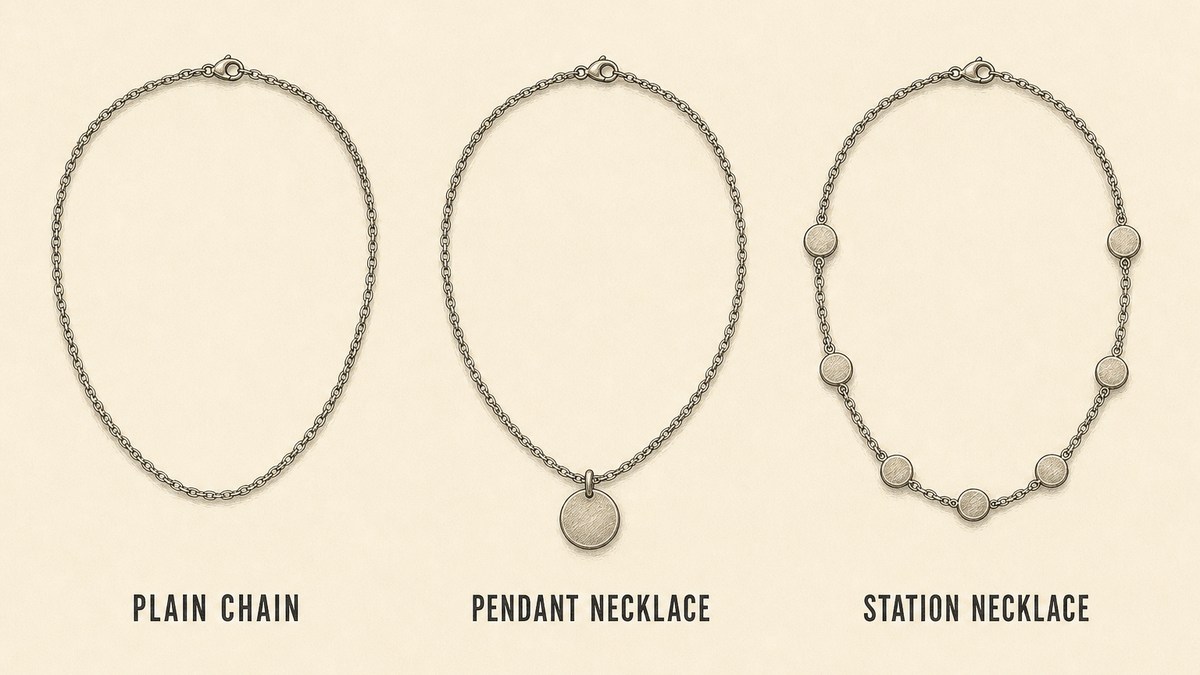
Three constructions cover almost everything you will source. The distinction matters because each one puts the load in a different place and each one fails for a different reason.
Plain chain. Nothing but chain and a clasp, and often the most profitable piece in a jewellery range because it carries almost no assembly labour. Its risk is concentrated in two components: the chain itself and the clasp. There is no design element to hide behind, so the chain quality is the product — a chain that stretches, kinks or breaks has nowhere to hide.
Pendant necklace. A chain with a single element hanging from it, joined by a bail or a jump ring. This adds the load point that defines the construction: the entire hanging weight is carried by one small part, and every movement of the wearer works that joint. It is the construction where a light chain and a heavy pendant combine into a failure that neither component would have had on its own.
Station necklace. A chain with several small identical elements spaced along its length. It distributes the load across many joints instead of one, which makes it mechanically the most forgiving — and it is the construction where matching becomes the problem, because several elements have to be identical in weight, size and finish, and a customer can see all of them at once.
Two commercial points follow. First, the constructions do not share components or tooling, so a supplier that runs plain chains may not run pendants — ask which constructions are actually on their line. Second, a necklace is the piece in a set that carries the most metal, so on a matching set it is the piece where a change of chain width or length moves the cost most. That is also why it is usually the piece a supplier trims first when a set price needs to come down.
Why Is the Clasp the Most Under-Specified Component in This Category?
Because it is the only component the customer has to operate without being able to see it. Everything else about a necklace is judged by looking; the clasp is judged by whether a person standing in front of a mirror can fasten it in three seconds. That makes it a usability question as much as a mechanical one, and it is almost never written into an order.
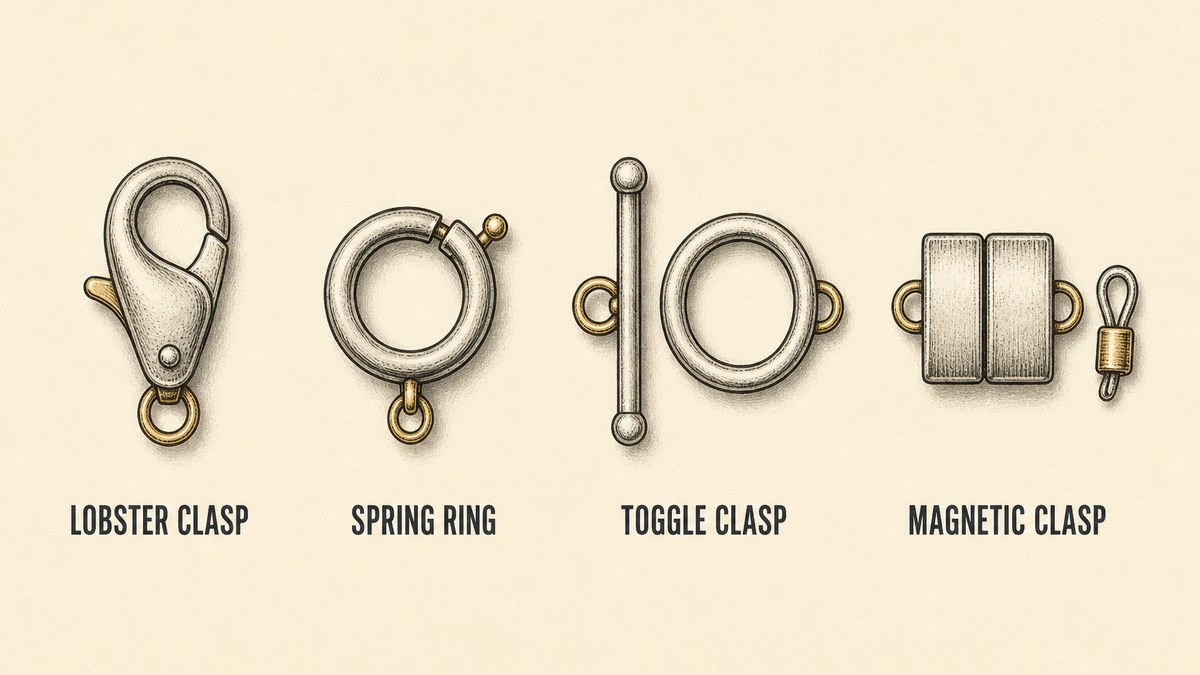
Four clasp types cover most of the category, and they differ as much in use as in cost.
Lobster clasp. A spring-loaded claw that hooks onto a ring or a chain end. It is the most common, the easiest to source and the easiest to operate by feel, because a small lever gives the fingers something to press. Its weakness is that it is a spring and a pivot, both of which wear — and it is the component most often swapped for a cheaper grade without anything about the finished piece changing.
Spring ring. A round ring with a spring-loaded gate. It is cheap and compact, and it is the hardest of the four to operate blind, because the gate is small and the ring gives the fingers nothing to grip. A necklace that a customer cannot fasten alone is a necklace they stop wearing, however good the chain is.
Toggle clasp. A bar that passes through a ring. It is the easiest to fasten without looking and it is genuinely decorative, which is why it is popular on heavier pieces. The cost is security: nothing locks, so a toggle relies on the bar staying at right angles to the ring, and a toggle that is too small for the piece can work loose during the day.
Magnetic clasp. Two parts that meet and hold. It is the easiest of all to fasten, and the one that most needs a secondary catch, because a magnet holds until it does not — and a necklace lost in a street is the worst possible outcome in this category.
The point that makes this actionable is that the clasp is a bought-in component in most factories. It is therefore exactly the part where a quotation can change without the design changing, and where a buyer who has not specified anything gets whatever the supplier buys in bulk. Specify the type, the size, and what the clasp must still do after repeated use — a cycle count or a minimum holding force — and then test it by fastening a sample behind your own head in front of a mirror. That last test costs nothing and catches the failure no drawing will show.
Two of the components behind this are common to the whole category: the joint that carries a hanging load, and the plating that covers the most surface area of any piece. The guides to bracelet manufacturing and to earring manufacturing work through those in the two shapes where they behave differently, and the category hub covering the metal in a necklace explains how the production stages are divided between suppliers.
Where Does the Load Actually Go?
Into one small part, and then into the chain. On a pendant necklace the entire hanging weight is carried by the bail or the jump ring that joins the pendant to the chain, and every step, turn and hug works that joint. Nothing else on the piece is loaded that way, which is why the joint is where a necklace starts to fail while still looking perfect.
Three components share the load, and each has its own failure mode:
The bail. The loop on the pendant that the chain passes through. It is the part that wears, because the chain runs on it constantly and the contact is tiny. A bail made of thin metal or soft material cuts through over months of normal wear — and it wears from the inside, where nobody looks until the pendant is on the floor.
The jump ring. Where a pendant is attached with a ring rather than a fixed bail, the ring is a second joint carrying the same load. A jump ring that can be pulled open by hand is a pendant waiting to be lost, and on a heavy pendant it is often the first thing to give.
The chain itself. A fine chain carrying a heavy pendant fails in the links, not at the pendant, because the chain is the weakest thing in the assembly. Matching chain width to pendant weight is the single most important pairing decision on a necklace, and it is the one most often made on appearance — a fine chain looks better in a photograph, which is exactly why it ends up under-specified.
The practical consequence is a rule for the order: specify the bail or ring thickness and the chain type and width together with the pendant weight, rather than each on its own. A supplier given a pendant drawing and a chain type but no weight has been given no way to check whether the pairing is safe, and will assume the buyer has already done the sum.
What Has to Go Into the Specification?
Seven lines carry the risk on this product, and four of them are dimensions that a necklace has more of than any other piece in the category.
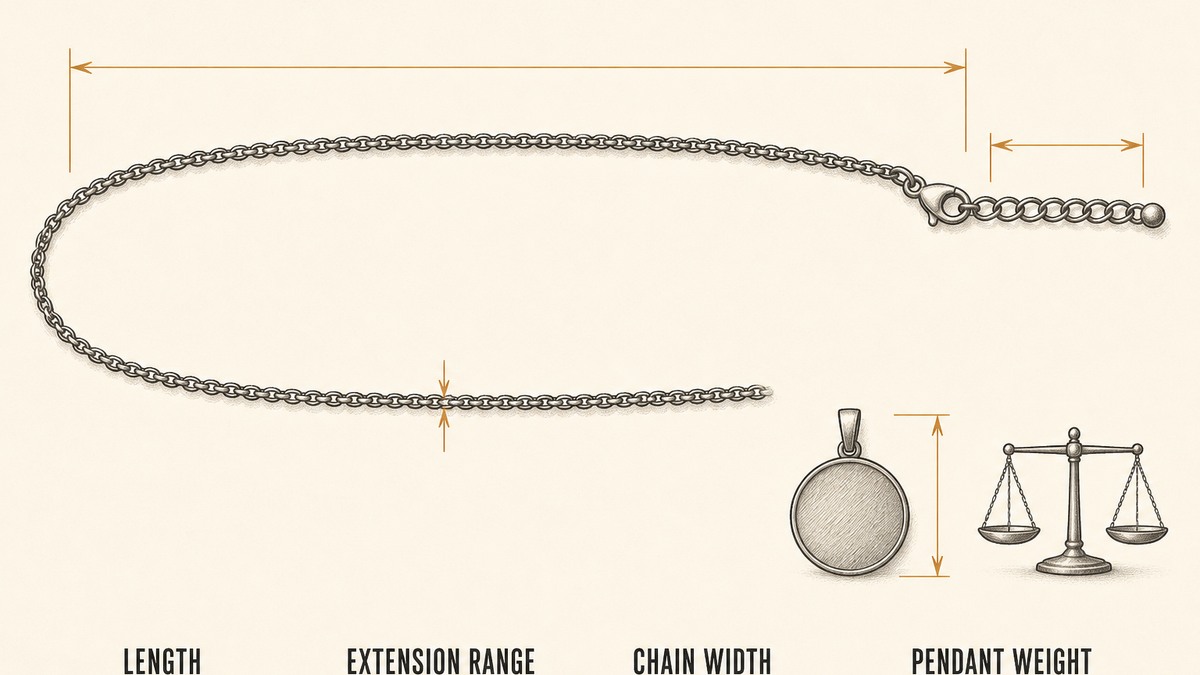
- Length, and the extension range, each with a tolerance. Length decides where the piece sits on the customer, and it is the number they will compare against. State the finished length and the extension separately, because an extension is a design decision and not a substitute for getting the main length right. A necklace a centimetre off is a necklace that sits wrong on every wearer.
- Chain construction, width and link dimensions. Name the chain type and give the width. A chain of the same appearance can be lighter or heavier in the metal, and on the piece with the most metal in the category this line moves the cost and the strength together.
- Pendant weight, with a tolerance. Give a target weight for the hanging element. It is the figure that decides whether the chain and the bail are adequate, and it is also the cheapest way to detect later that the metal in the pendant changed.
- Bail or jump ring, by thickness and attachment. Say which is used, how thick it is, and whether the ring is closed and soldered. This is the joint that carries the whole load, and it should never be left as a detail of the drawing.
- The clasp, with what it must survive. Type, size, and a requirement expressed as cycles or holding force rather than as the word secure. Add the usability point in the same line: state the minimum size of the operating lever or gate, because a clasp the customer cannot fasten is a product they stop wearing.
- Base metal, plating thickness per layer, and the measuring method. The plating cost on a necklace scales with surface area rather than with weight, and a necklace has more surface than any other piece. Name the base metal, give the thickness per layer, and require a method. Where a coating or enamel is involved, the lead limits for coatings on consumer products are set out in 16 CFR Part 1303. Where the piece will sit against skin, settling the harmful-substance question with evidence rather than assurance is worth the effort, and the OEKO-TEX system at oeko-tex.com is the reference most suppliers in this chain already understand.
- Marking, packing and element matching. The origin marking the shipment needs under 19 CFR Part 134, plus how the piece is packed so the chain does not kink or tangle, and — on a station necklace — the tolerance between the several repeated elements, because the customer sees all of them at once.
How Is the Wholesale Price Actually Built?
A necklace is the heaviest piece in the category, so its price is driven by length and chain weight more than by anything a customer can see. Four things move it.
- Chain weight per unit length, multiplied by the length. This is the largest line and the one that scales: a slightly lighter chain at the same appearance saves money across the whole length, and it also removes the strength the pendant needs. This is the substitution to watch for, because the finished piece looks identical.
- Clasp and findings, at necklace quantities. The clasp is a bought-in component, and on a plain chain it may be the single most expensive part of the product. A change of clasp grade therefore moves the price of a simple piece more than buyers expect.
- Plating and polishing time, which follow surface area. More length means more surface to polish and to plate, so a longer version of the same design is not proportionally cheaper per gram. Both are hand work and both are invisible on a photograph.
- Assembly and matching. A pendant necklace needs its joint made and checked; a station necklace needs several elements matched in weight and finish. Packing that keeps a chain from kinking is real labour, and on necklaces it is the difference between arriving ready to sell and arriving as a tangled return.
Because the piece is long and thin, freight is a modest share of the landed cost and the metal is a large one — the same shape of arithmetic as the other pieces in the category, and the opposite of a bulky product. The method for working it through is set out in the landed total on a necklace order.
What Goes Wrong?
Four failures account for most of what comes back, and the first two are the ones a customer discovers by losing something.
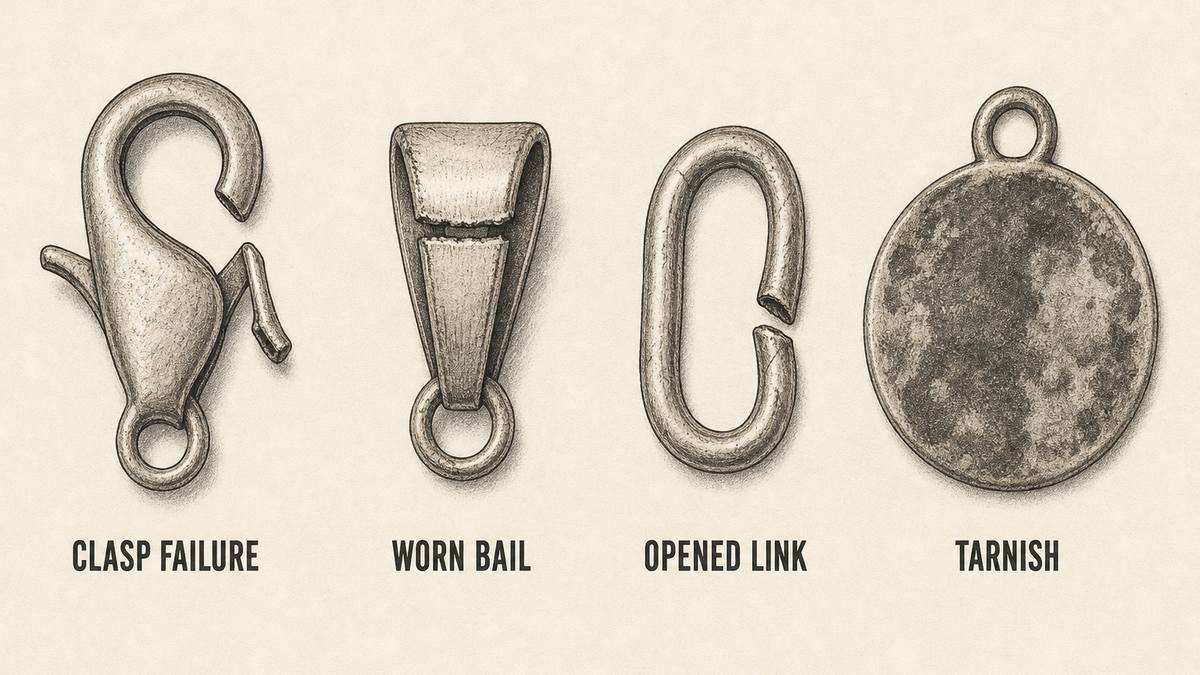
- The clasp failed
- A spring weakened or a lever bent, and the necklace came off while it was being worn. In this category that is the worst outcome available, because the piece is lost rather than returned, and it is entirely decided by a component the buyer usually did not specify.
- The bail wore through
- The chain cut a groove in the bail until it broke, and the pendant dropped. It wears from the inside over months, so the customer sees nothing wrong until the moment it fails — which is why the bail thickness belongs on the order rather than in the drawing.
- A link opened
- A chain link pulled open under the weight of the pendant, leaving a visible gap. It is the failure that proves the chain was matched to the design rather than to the weight, and on a fine chain it is the most likely outcome of pairing by appearance.
- It tarnished
- The surface discoloured, usually unevenly, and the piece stopped looking like what was photographed. It is partly a metal question and partly a storage question, which is why packing that stops the chain rubbing on itself belongs in the specification rather than in a supplier's habits.
All four are settled by a number on the order, and three of them sit in components the customer never thinks about until they fail. A necklace hides its risk better than any other piece in this category, because its weakest parts are small, cheap and completely invisible in the product photograph.
How Do You Check a Necklace Supplier Before You Commit?
Seven checks in this order, and the first one decides the rest. A necklace is the only piece in this category where the part that carries the load is usually bought in rather than made in the same room.
Ask who makes the chain, and where. Chain is often not made by the factory that assembles the necklace. Ask whether the chain is drawn and linked in their own workshop or bought in from a chain maker, and get the maker named. This matters more here than on any other piece, because the chain is what carries the pendant and it is the hardest thing to judge by eye. The general method for working out who is really making your product is set out in how to spot a trader.
Ask the plating question twice. Once as “how thick is the plating per layer?” and once as “who measures it, and with what?” The first answer is usually a range; the second is the one that tells you whether the figure is controlled or only repeated. A necklace has the most surface area of any piece in a set, so this is the line where a thin layer becomes visible soonest — at the clasp, at the bail and along the high points of the chain.
Weigh the chain on its own. Put the chain on a kitchen scale, write the figure down, and work out the weight per centimetre. A chain of the same look can be lighter in the metal, and it is the lighter one that gets quoted when a price has to come down. Weight per length is the number that catches the swap, and a photograph never will.
Fasten it behind your own head, in front of a mirror. Then take it off and put it on again using one hand only. This test costs nothing, takes ten seconds, and it is the only way to find the clasp the customer will not be able to work. A clasp that is fine on a bench is not automatically fine behind a head.
Hang the pendant and pull. Hold the chain, let the pendant hang, and pull gently on the pendant while watching the bail or the jump ring. You are looking for a ring that opens, a bail that bends, or a link that spreads. Then look at the same joint under a light: the bail wears from the inside, where nobody checks until the pendant is on the floor.
Check the certificates against the issuers, not the scans. Where a supplier offers a certificate, look it up in the issuer’s own record rather than trusting the file, using the approach described in checking a factory certificate in the issuer’s database.
Inspect before it ships, and measure rather than look. On a necklace the inspection is length, weight, function and packing: every piece measured flat under a light load and inside its tolerance, every clasp cycled and closed, every bail checked for thickness where the chain runs on it, the repeated elements on a station piece matched to each other, and the packing holding chains apart so they arrive straight rather than tangled. The method is the same as for any order, described in how a necklace shipment is inspected before it leaves, and how many pieces to pull comes from the the table the sample size for a necklace order comes from. Function first, photographs second.
Where Does a Cheap Necklace Quotation Get Its Money Back?
A cheap necklace quotation is usually a real price for less metal, less time or a cheaper clasp. This is the category where that is easiest to hide, because the largest cost line — the chain — is also the hardest thing to judge from a photograph and the easiest thing to change without changing the design. Six lines go missing.
- Chain weight per length. A lighter chain at the same look. It shows up on a scale and nowhere else, and on a pendant necklace it also takes away the strength the pendant needs. This is the first line to put a number against, because the whole price is built on it.
- Chain construction. The same appearance built from thinner wire, so the chain holds its shape on the display card and not on the customer. It is the difference between a chain that lasts and a chain that stretches, and it stays invisible until the piece is worn.
- The clasp. The right type from a cheaper maker, or a lighter spring inside it. The finished piece is the right shape and the wrong product, and the failure mode is the worst one in this category: the necklace comes off and is lost rather than sent back.
- The bail or jump ring. Thinner metal at the joint that carries the whole hanging weight, or a ring closed by hand instead of soldered. It saves a moment per piece, and it decides whether the pendant stays on at all.
- Plating thickness. Thinner layers at the same colour, so the piece looks right on arrival and wears through at the clasp and the high points after a few weeks of wear. On the piece with the most surface area in the set, this is the line that shows itself first.
- Polish and packing. A light polish costs nothing to promise and a great deal of time to deliver, and packing that lets chains lie against each other turns a necklace into a knot. Both are hand work, both are invisible in a photograph, and both explain how two prices can differ without a single component being different.
The way to close those six lines is to put them on the enquiry rather than raise them afterwards, and to make the quotation show them: chain type and weight per length, clasp type with its maker, bail or ring specification by thickness, weight per piece with a tolerance, plating thickness per layer with the measuring method, and packing that keeps chains apart. A supplier who can answer all six is quoting on your product, and the wider method for an order that carries your own brand is set out in the private label route for a necklace.
One closing point about this product in particular. The two parts that fail are the two parts a photograph cannot show — the clasp and the joint that carries the pendant. That makes the specification the only place a buyer can compete, and the sample the only proof. Write the lines, weigh the delivery, and keep the sample on file; on a piece that hangs, that is the whole difference between a product and a complaint.
Frequently Asked Questions
How do I compare two necklace quotations for the same design?
You cannot, until you know which parts each supplier makes and which it buys in. Ask both where the chain comes from and where the plating is done, then require the same six lines from both: chain type with its weight per length, clasp type with its maker, bail or ring specification by thickness, weight per piece with a tolerance, plating thickness per layer with the measuring method, and the packing that keeps chains apart. Two quotations become comparable when they describe the same product rather than the same pendant drawing.
What chain width should I use for a given pendant weight?
That is a pairing decision, and the safe way to settle it is to have the supplier state both numbers in writing: the chain width they are quoting, and the pendant weight they have rated it for. A supplier given a pendant drawing and a chain type but no weight has been given no way to check the pair, and will assume you have already done the sum. If the answer comes back as a range, ask for the top of it, and then test the pair on a sample by letting the pendant hang and pulling gently.
Why did my necklace come off while it was being worn?
Almost always the clasp, and almost always a spring that weakened or a lever that bent. The clasp is a bought-in part in most factories, which makes it the piece where a quotation can quietly change without the design changing. Put a requirement on the order that describes what the clasp must still do after repeated use rather than the word secure, then cycle a sample clasp on the bench and fasten one behind your own head. Nothing else on the piece can lose the necklace outright.
How much does it cost to manufacture a necklace in China?
It breaks into five separate costs, and a single unit price hides all of them: chain metal by weight per length, clasp and findings, plating and polishing time, assembly and matching, and packing that keeps the chain straight. Ask for those five as separate lines rather than one figure. It makes two suppliers comparable, and it usually tells you which line each one is competing on, which is more useful than the total.
Can one supplier make a matching necklace, bracelet and earring set?
Often yes, and it is usually the cheapest way to buy a set, because all three share the same metal, the same finish and often the same findings. The lines to add are the ones that keep a set looking like a set: that all pieces come from the same plating batch so the colours match, that the chain and the clasps come from the same lot, and that the weight tolerance applies across the whole set rather than only inside each piece. The necklace is the piece where a change of chain width or length moves the cost most, so it is also the piece to check first when a set price has to come down.
Is a pendant or a station construction easier to source?
A station necklace is the more forgiving of the two mechanically, because several small elements share the load instead of one joint carrying all of it. The trade-off is matching: several elements have to be identical in weight, size and finish, and the customer sees all of them at once. A pendant necklace puts the whole hanging weight on a single bail or ring, so it is simpler to build and far less forgiving if the chain was chosen for how it looks rather than for what it has to carry.
Send the length, the chain and the clasp — not just the pendant
Tell us the construction you want and which parts you expect to be made rather than bought in, and then the lines that decide the piece: the finished length and the extension range each with a tolerance, the chain construction and its width with a weight per centimetre, the clasp type and size with a requirement for what it must still do after repeated use, the bail or ring by thickness and attachment, the target weight per piece with a tolerance, the base metal and the plating thickness per layer with the measuring method, and the packing that keeps the chain from kinking. Add your target volume and finish. Those answers settle the chain and the clasp before a price means anything. We will come back with the suppliers whose chain source and plating line actually match your piece, the specification written as limits with methods rather than as labels, the five cost lines shown separately so quotations become comparable, a sampling plan built around measuring and flexing rather than photographing, and a clear statement of which component owns which risk on what you are buying.
Request a Necklace Sourcing Quote
Questions & Comments
We read every one and reply within 24 hoursHolding a quotation for a necklace and trying to work out what it is actually for? Post the chain type and its weight per centimetre, the clasp type, and the pendant weight, and we can usually say which lines are missing from it. If a clasp has already come off while the piece was being worn, say whether it was a lobster clasp or a spring ring and roughly how long it lasted, because the timing separates a weak spring from a clasp that was the wrong size for the piece.