
Jewelry Manufacturer: How to Source Metal Jewellery From China
 ·
Updated October 11, 2026
·
20 min read
Jewellery is the one category in this catalogue where the product photographs perfectly and fails invisibly. There is no seam to pull, no leak to find and no dimension to measure from a picture — the whole of the risk sits in the metal underneath a finish, in the joints between components, and in what the piece releases while it is against skin. That is also why this is a category where a well-specified order is genuinely hard to copy: anyone can photograph a bracelet, and almost nobody can tell you the plating thickness or where the chain came from. This guide is the hub for the category. It covers what a “jewelry manufacturer” actually is and is not, the five production stages and who does each, why a finished piece is often four different supply chains stapled together, how the base metal decision is made, the seven lines every piece needs regardless of what it is, how the price is built, what goes wrong, and how to check a supplier before the order ships.
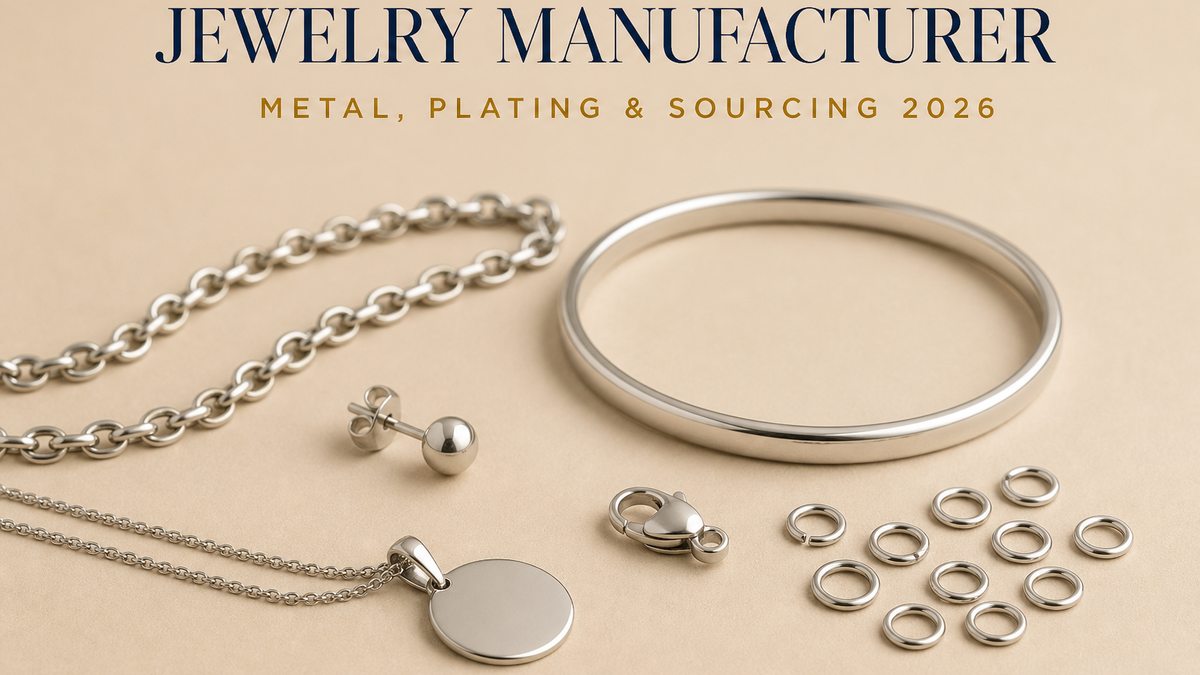
What You Are Buying, and the Line That Decides It
| If you want | What it means in practice | The line on your order that decides whether it works |
|---|---|---|
| A quote you can compare with another | “Jewelry manufacturer” describes dozens of different businesses | Which stages the supplier actually performs, named one by one |
| A finish that lasts a season | Finishing is the cheapest stage to under-buy | Plating thickness per layer, with the measuring method |
| Something the customer's skin tolerates | Reaction comes from release, not from colour | The release requirement for your market, tested not promised |
| A piece that survives being worn | Every joint and fastener is a separate weak point | The joint and clasp specification, stated per component |
| To own the design rather than rent it | Tooling and moulds are real assets with owners | Who holds the tooling, and what happens to it if you leave |
What Is a “Jewelry Manufacturer” Actually?
It is a label that covers at least four different kinds of business, and the reason it matters is that a quotation from each of them means something different. Until you know which one you are talking to, a price is not comparable with anything.
A finished-piece factory. It runs several stages itself — usually stamping or casting, polishing, and assembly — and sells you a complete piece. This is the arrangement most buyers think they are buying, and it is the one where a single supplier can be held responsible for the result.
A component maker. It makes one thing very well: chain, settings, clasps, or stamped blanks, and sells to other factories. Buying from a component maker is often how you get the best price on that component and the worst coordination across the order, because you become the assembler.
A plating and finishing shop. It does not make jewellery at all. It finishes other people's metal, and in this category it is frequently the stage that decides whether your product is acceptable — which is why “who does the plating?” is one of the most useful questions you can ask a supplier that presents itself as a factory.
A trader or sourcing office. It assembles a piece from several workshops and manages the order. That is a legitimate business and can be a good one to work with, provided it is honest about it, because coordination across four suppliers is real work. The problem is only when a trader answers a technical question it cannot actually control.
The practical consequence is a rule that applies to every article in this category: ask which stages the supplier performs itself, and in which building. A supplier that casts, polishes and plates in-house answers a question about plating thickness differently from one that sends the work out, and the difference is not good or bad — it is simply what you need to know before you can compare two prices.
What Are the Five Production Stages, and Who Does Each?
Almost every metal piece you will source passes through the same five stages. Knowing them is how you localise a problem: when something goes wrong, the question is always which stage, not which supplier.
Design and tooling. A drawing becomes a mould or a stamping die. This is where the one-off cost lives and where ownership matters, because tooling is a durable asset that somebody retains when the order ends.
Casting or stamping. Metal becomes a rough shape. Casting suits complex three-dimensional forms; stamping suits flat or simple forms and is generally cheaper at volume. The choice constrains the design, which is why it belongs in the conversation before the drawings are final.
Polishing. The rough piece is cut back and smoothed, by hand for the good grades. This is labour, it is all but invisible in a photograph, and it is the stage where a high polish grade and a low one diverge — in cost first, and in appearance months later.
Plating. The polished piece receives its layers. It is the stage most often subcontracted and the stage whose numbers buyers most often fail to specify, which makes it the single largest source of difference between two quotations for a piece that looks identical.
Assembly. Clasps, jump rings, settings and stones go on. This is where the smallest components live — and, as the two category guides below show, where the failures that end a product's life usually start.
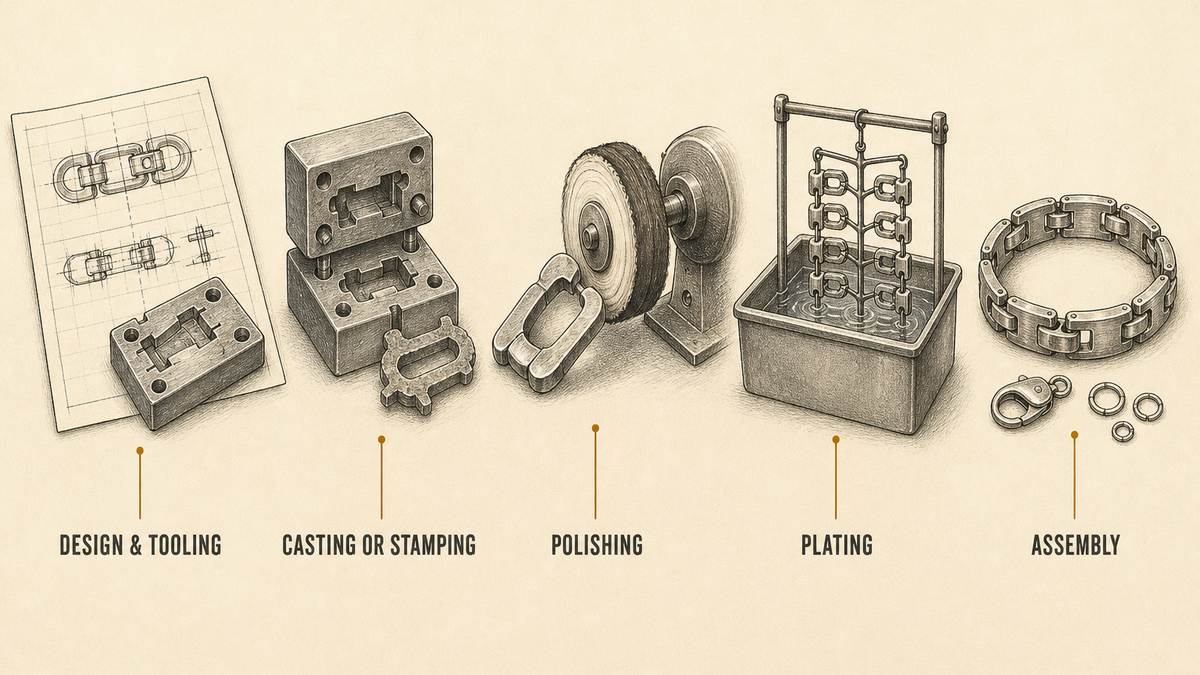
Two of the five are bought rather than made in a great many workshops: plating, and the components that go on at assembly. That is the structural reason quality varies so much inside this category, and it is the subject of the next section.
Why Is a Finished Piece Often Four Supply Chains Stapled Together?
Because a piece of jewellery is an assembly, and its parts are made by specialists. This is the single most useful mental model for the category: you are not buying a bracelet, you are buying a chain, a set of findings, a clasp and a finish, joined by somebody who may own none of them.
The component list is short and consistent. The chain or the form itself comes from a chain maker or a stamping shop. The findings — jump rings, wire loops, pins, the small hardware that holds everything together — come from a findings maker, and they are the cheapest parts in the piece. The clasp is usually bought in as a finished component from a specialist, which is why a clasp is the part you can specify most precisely and control least. The setting, where there is a stone, has its own maker and its own tolerances. And the finish is applied by a plating shop that may never see the drawing.
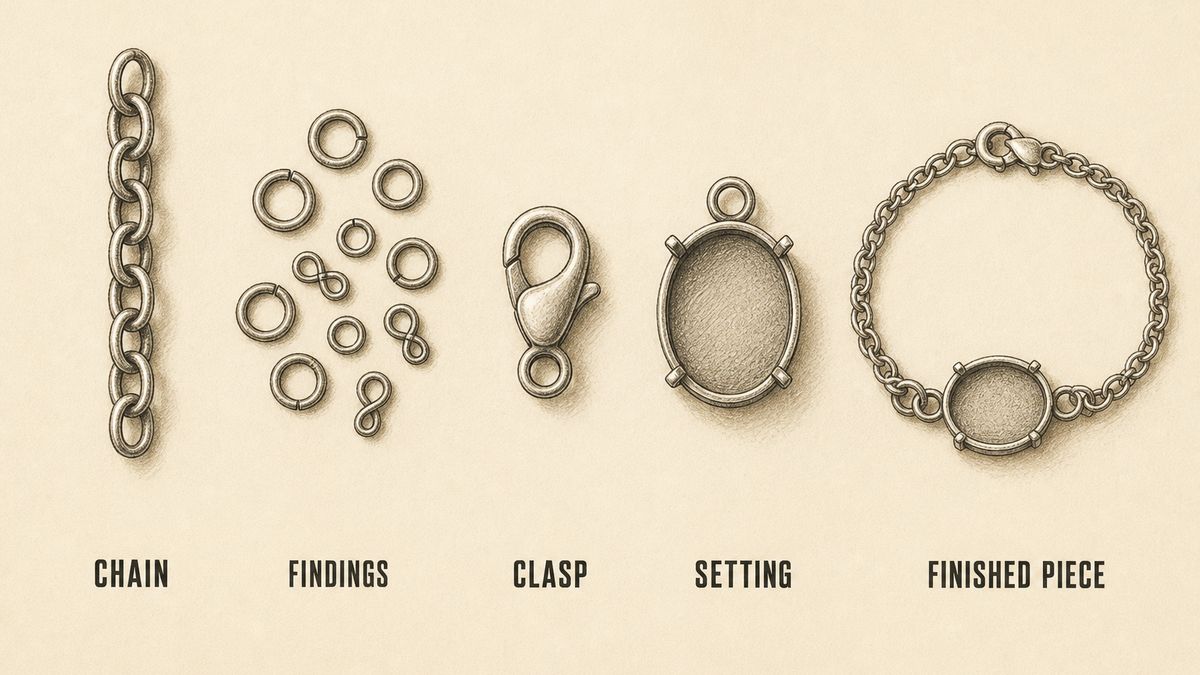
The consequences are practical and they compound:
A failure usually belongs to a component, not to the piece. A clasp that stops closing, a jump ring that pulls open and a plating that wears through are three different suppliers' problems, and a factory that owns only the assembly stage cannot fix any of them by trying harder. It can only buy differently on your behalf — which is exactly why the component specification has to be written down rather than discussed.
A sample is not a specification. Because the components are sourced per batch, the sample you approve and the shipment you receive can contain a different clasp of the same stated type. This is the mechanism behind the most common surprise in the category, and it is prevented by naming components rather than by approving a photograph.
Your leverage is the order, not the relationship. A supplier that buys its clasps in will buy the grade you specify if you specify it, and will buy the cheapest acceptable one if you do not. That is not a criticism; it is how a quotation stays competitive. It does mean the specification is doing the work that a factory's own quality culture would otherwise do.
The three pieces most buyers start with are the ones this category treats as separate problems, because they are. A bracelet concentrates the risk at a joint, an earring concentrates it at a post that goes through skin, and a necklace concentrates it at the clasp and at the single joint that carries the hanging weight — the differences are set out in the guides to the steps in making a bracelet, to earring manufacturing and to necklace manufacturing.
How Do You Decide the Base Metal?
Backwards. The base metal is not chosen for how it looks, because the customer never sees it — the finish covers it. It is chosen for three other things: what it weighs, how it behaves when the finish wears, and what it releases while it is in contact with skin. Those three questions point at different metals, and the honest answer is that this is the decision where a buyer most often lets the factory decide by default.
Brass is the traditional costume-jewellery base. It takes a fine cast or stamp, it polishes to a high shine, and its warm tone means a thin plating still looks convincing. Its weakness is that it is reactive: once the finish wears, the metal underneath is not inert, and that is the point at which a piece stops being jewellery and becomes a skin question. Brass is the right choice for a piece that will be plated generously and worn as fashion jewellery, and the wrong choice for a piece where the plating is the first thing to be reduced.
Stainless steel is the opposite compromise. It is harder, heavier, and far more forgiving when a finish wears, because the metal underneath is not trying to react with the wearer. It is harder to cast finely, it costs more to machine, and it is more difficult to plate — which is why a great deal of “stainless steel jewellery” is sold in its own colour rather than plated. Choose it when the product's promise is durability, or when the piece will be worn against skin for long periods.
Zinc alloy is the base most often found behind a very low quotation. It casts crisply and cheaply, which makes it popular for detailed shapes, and it is softer and less durable than either of the others. It is a legitimate material for a lightweight, low-cost piece and a poor one for anything sold on quality — and because the finish covers it completely, the customer has no way to tell until the plating has worn.
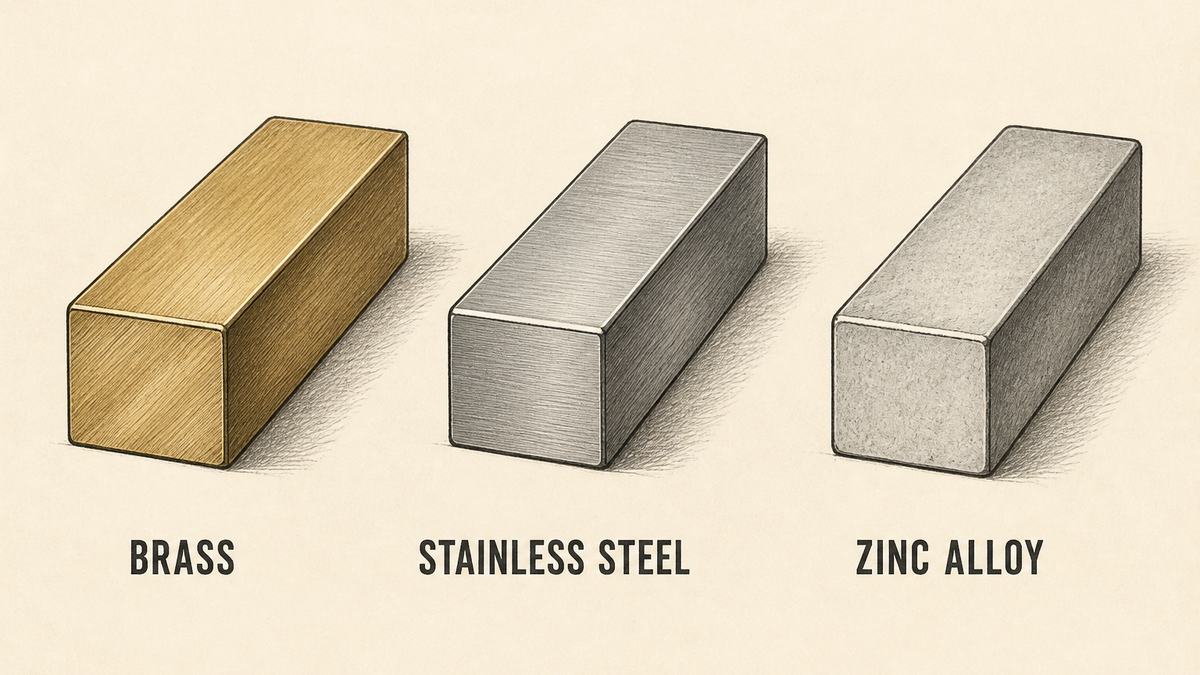
The decision has one more dimension that buyers usually miss: the base metal also determines what the plating has to achieve. A reactive base needs more plating to be safe, and a harder base is harder to plate well. So choosing a cheaper base metal does not simply save money on metal — it raises the plating cost required to reach the same standard, which means the saving only appears if the plating is quietly reduced as well. That combination is what a suspiciously low quotation for a familiar-looking design actually is.
What Are the Seven Lines Every Piece Needs?
Whatever the piece is — a bracelet, an earring, a pendant, a chain — the same seven lines decide it. Write them once and the category becomes manageable, because the differences between products are then only geometry.
- Base metal, named by grade or composition. Not “alloy” and not “stainless”, because both are families rather than materials. This is the line that decides what the wearer is in contact with once the finish wears.
- Plating thickness per layer, with the measuring method. Give a figure for each layer and name how it is measured. A thickness without a method is a number a supplier can agree to and then dispute.
- The release requirement for your market. Skin reaction is driven by what the metal releases while it is worn, so the requirement is a release test against the limit that applies where you sell — not a materials list and not a promise of absence. Confirm the current limit and test method for your destination, because they differ by market.
- Every joint and fastener, specified per component. Which joints are soldered and which are mechanical, and what each clasp must still do after repeated use. On jewellery this is a list, not a sentence, because a chain has many joints and a bracelet has at least one that takes the whole load.
- Target weight and tolerances, per piece and per set. Weight is the cheapest warning you have that the metal changed between the sample and the shipment, and on anything sold as a pair or a set the tolerance between the two pieces matters as much as the figure itself.
- Finish, and any coating or enamel. The finish type and the polish grade. Where a coating, enamel or painted detail is involved, the lead limits that apply to coatings on consumer products are set out in 16 CFR Part 1303, and that line is worth naming even when a supplier assures you it does not apply. Where the piece will sit against skin, the harmful-substance question is worth settling with evidence rather than assurance, and the OEKO-TEX system at oeko-tex.com is the reference most suppliers in this supply chain already understand.
- Tooling ownership, marking and packing. Who holds the mould or die, what happens to it if you leave, the origin marking the shipment needs under 19 CFR Part 134, and how each piece is packed so that two pieces cannot rub against each other in transit. Tooling is an asset; if your brand depends on the shape, find out who owns it before you need to know.
Two of those lines are the ones that separate a supplier from a source. Plating thickness per layer and tooling ownership are both questions a trader can answer without controlling the answer, which is exactly why they are the two worth asking twice.
How Is the Wholesale Price Actually Built?
Jewellery is priced by metal weight and finishing time, and those two move in opposite directions as you push a target price down. Five things move it.
- Metal weight and the alloy named. The largest single line. It is also the one where a quotation is easiest to make comparable, because weight is measurable with a kitchen scale — ask for the weight per piece, not a price per gram.
- Plating thickness and polish grade. Thicker plating costs metal and time; a higher polish costs only time, and a great deal of it, because it is hand work. Both are invisible in a photograph.
- Joints, fastenings and components. Soldering is skilled work, a specified clasp costs more than an unspecified one, and a findings-heavy design costs more than a plain one. This is the line most often reduced to hit a price and the line that decides whether the piece survives a year.
- Tooling, and minimums by finish and by component. Tooling is a one-off and an asset. Plating baths and finishing runs carry minimums, and a range of finishes or of components multiplies them, which is why a broad first range costs more than the work suggests.
- Assembly and packing labour. Every component added at assembly is a person doing it, and every piece has to be packed so it arrives unmarked. On small pieces this is a larger share of cost than buyers expect.
As with any small, dense product, freight is a small part of the landed cost and the metal is a large one — the reverse of a bulky category. The general method for working that through is set out in the landed total on a jewelry order.
What Goes Wrong, and Which Stage Owns It?
Four failures account for most of what comes back in this category. The useful thing about them is that each one belongs to a stage, which means each one has a specific fix rather than a general instruction to the supplier to try harder.
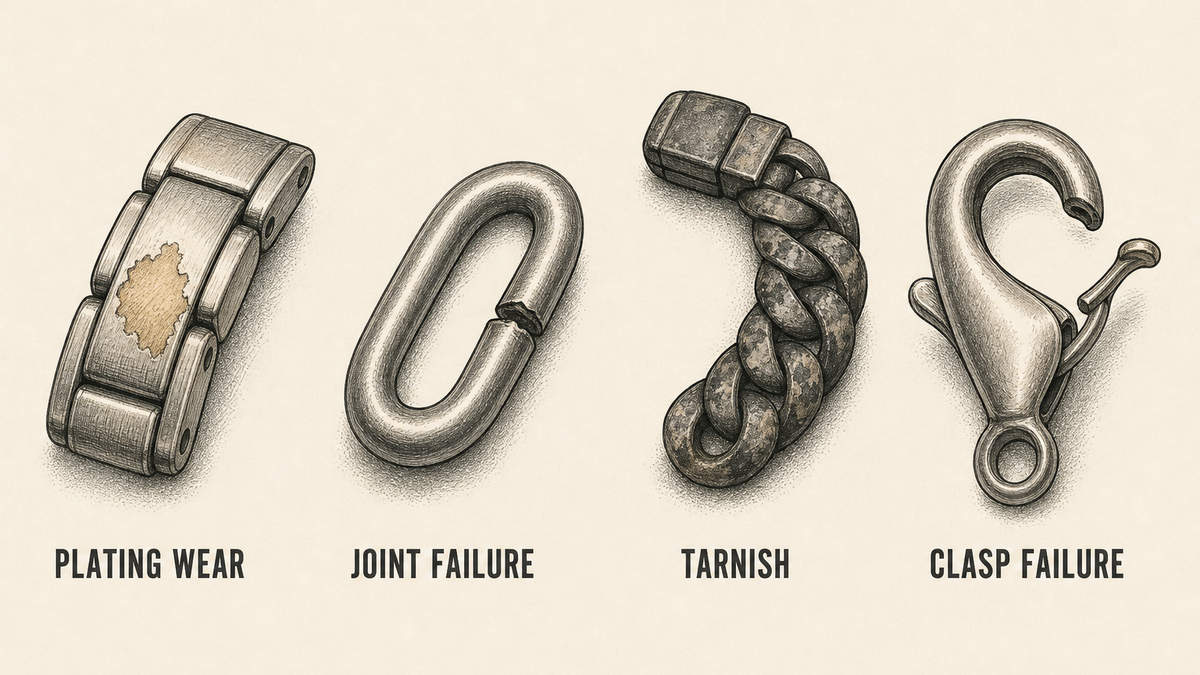
- Worn plating
- Owned by the plating stage. It failed at the high points first, and it fails sooner where the layer is thinner. The fix is a thickness figure with a method, plus a base metal that is acceptable when it is eventually exposed.
- Broken joint
- Owned by the assembly stage. A soldered joint cracked or a mechanical loop was never fully closed. The fix is naming which joints are soldered and requiring functional loops to be closed and soldered where the design allows.
- Tarnish
- Owned partly by the finish and partly by storage. The surface discoloured unevenly, and the packing decides whether pieces rubbed or sat against moisture in transit. The fix spans two stages, which is why packing belongs in the specification rather than in a supplier's habits.
- Skin reaction
- Owned by the material decision. It appears after a period of wear rather than on arrival, and it is driven by what the piece releases rather than by its colour. The fix is a release requirement tested against the limit for your market, settled before the order rather than after the complaint.
The reason this list is worth memorising is that it turns a vague quality conversation into a specific one. A supplier that only assembles cannot fix a plating failure, a plating shop cannot fix a clasp, and neither can fix a base-metal decision that should never have been made on price. Each failure has an owner, and naming the owner is what makes the next order better rather than merely stricter.
How Do You Check a Supplier Before You Commit?
Five checks, in this order, and the first one is the only one that is specific to jewellery.
Map the stages onto buildings. Ask the supplier to walk you through the five stages and say, for each, whether it happens in their own workshop, in a sister company, or at a third party. This is the single most informative question in the category, because it tells you which technical promises they can actually keep. The general method for establishing who is really making your product is the same as in any category, set out in whether you are talking to a factory or a trader.
Ask the plating question twice. Once as “how thick is the plating?” and once as “who measures it, and with what?” The first answer is usually a range; the second is the one that tells you whether the figure is controlled or merely quoted. If the plating is subcontracted, a supplier that cannot name the plating shop cannot check the number either.
Weigh and flex a sample. Put the sample on a kitchen scale and record the weight, then flex the load-bearing parts until something gives and note whether it failed in the metal or at a joint. Two cheap measurements that between them tell you whether the metal and the assembly match what was quoted.
Check the certificates against the issuers, not the scans. Where a supplier offers a certificate, look it up in the issuer's own record rather than trusting the file, using the approach described in looking the jewelry certificate up at the certifier.
Inspect before it ships. On jewellery the inspection is weight, function, finish and matching rather than appearance: the average weight inside tolerance, every fastener working, no bare patches at the high points, sets matched to each other, and the packing holding pieces apart. The method is the same as for any order, described in what a pre-shipment check covers on a jewelry order, and how many pieces to pull comes from the the count table behind a jewelry sampling plan. Function first, photographs second.
Where Does a Cheap Quotation Get Its Money Back?
A cheap jewellery quotation is usually a real price for less metal, less time or different components. Six lines go missing, and they go missing from the inside outward — which is why they surface as complaints about the surface rather than as visible defects.
- Metal weight. A lighter gauge or a softer alloy at the same silhouette. It shows up on a scale and not in a photograph, and on anything that flexes it decides whether the piece keeps its shape.
- Plating thickness. Thinner layers at the same colour, so the piece looks right on arrival and wears through at the high points after a few weeks of wear.
- The base metal under the plating. A cheaper base that needs more plating to be safe — which is exactly why it is usually paired with thinner plating. This is the substitution that turns a worn finish into a skin complaint.
- Joints and fastenings. Mechanical links where the order said soldered, jump rings left open, a cheaper spring inside a specified clasp. It saves minutes per piece and it is the difference between a product and a return.
- Components bought down a grade. A clasp of the right type from a cheaper maker, or findings of a lower gauge. The finished piece is the right shape and the wrong product.
- Polish grade and packing. A lighter polish costs nothing to promise and a great deal of time to deliver, and packing that lets pieces rub in transit turns two of them into seconds. Storage and surface damage are the same conversation.
The way to close those six lines is to put them on the enquiry rather than raise them afterwards, and to make the quotation show them: base metal by name, plating thickness per layer with the method, every joint and fastener specification, the weight per piece with a tolerance, the polish grade, and the component makers where they matter. A supplier who can answer all six is quoting on your product. If the piece carries your own brand, the wider question of how a private label order is put together is covered in the private label route for a jewelry.
One closing point about this category as a whole. Metal jewellery is unusual in that its visible qualities are cheap to copy and its invisible qualities are expensive to copy. That is bad news for a buyer who competes on photographs, and good news for one who writes the seven lines, weighs the delivery and keeps the sample. In a category where every competitor can show the same bracelet, the specification is the only real product advantage available.
Frequently Asked Questions
How do I compare two jewellery quotations for the same design?
You cannot, until you know which stages each supplier performs. Ask both to list the stages and say where each happens, then require the same six lines from both: base metal by name, plating thickness per layer with the measuring method, joint and fastener specification, weight per piece with a tolerance, polish grade, and the component makers where it matters. Two quotations become comparable when they describe the same product rather than the same drawing.
Which base metal should I choose for metal jewellery?
Choose it for what happens when the finish wears, because the finish always eventually wears. Brass takes a fine cast and polishes well but is reactive underneath, so it needs generous plating. Stainless steel is heavier and far more forgiving when exposed, which suits pieces sold on durability or worn against skin for long periods. Zinc alloy is the cheapest and the softest and is usually what sits behind a very low quotation. A cheaper base raises the plating cost needed to reach the same standard, so the saving only exists if the plating is reduced too.
Why is my jewellery tarnishing or turning skin green?
Those are two different problems with different owners. Tarnish is a finish and storage question — the surface discoloured and the packing may have let pieces rub or sit against moisture in transit. Skin reaction is a material question, and it is driven by what the piece releases while it is worn rather than by its colour, so the answer is a release requirement tested against the limit that applies in your market. Confirm the current limit and test method for your destination, because they differ by market.
Do I need to own the tooling for my jewellery design?
If the shape is the thing your brand depends on, yes — or at minimum you need to know in writing who holds it. Casting moulds and stamping dies are durable assets, and a supplier that owns the tooling can make the piece for somebody else. Ask who holds it, where it is stored, and what happens to it if the relationship ends. That question costs nothing to ask before the order and is very expensive to raise afterwards.
How much does it cost to manufacture jewellery in China?
The honest answer is that it breaks into five separate costs, and a single unit price hides all of them: metal by weight, plating and polishing time, joints and components, tooling amortised over the order, and assembly and packing labour. Ask for those five as separate lines rather than one figure, and the comparison between two suppliers becomes possible. It also tells you which line each supplier is competing on, which is usually more useful than the total.
Can one supplier make a matching bracelet, necklace and earrings set?
Often yes, and it is usually the cheapest way to buy a set, because all three share the same metal, the same finish and frequently the same components. The lines to add are the ones that keep a set looking like a set: that all pieces come from the same plating batch so the colours match, that the chain and findings are from the same lot, and that the weight tolerance applies across the whole set rather than only within each piece.
Send the seven lines, not just the drawings
Tell us what you want made and whether the design is yours or theirs, and then the seven lines that decide it: the base metal by grade, the plating thickness per layer with the measuring method, the release requirement for the market you sell into, every joint and fastener stated per component with what each clasp must survive, the target weight per piece and per set with tolerances, the finish and polish grade including any coating or enamel, and who holds the tooling plus the marking and packing. Add your target volume and the finishes you want. Those answers settle the metal and the assembly before a price means anything. We will come back with the suppliers whose in-house stages actually match your product, the specification written as limits with methods rather than as labels, the six cost lines shown separately so quotations become comparable, a sampling plan built around weighing and flexing rather than photographing, and a clear statement of which stage owns which risk on your piece.
Request a Jewellery Sourcing Quote
Questions & Comments
We read every one and reply within 24 hoursComparing quotations across different pieces of jewellery? Post the base metal by name, the plating thickness per layer, and the joint and clasp specification, and we can usually say which of the seven lines is missing. If you are not sure which stage a problem came from, describe the failure and we will help you work out which supplier in the chain owns it.