
Earring Manufacturer: Sourcing Earrings From China
 ·
Updated October 11, 2026
·
18 min read
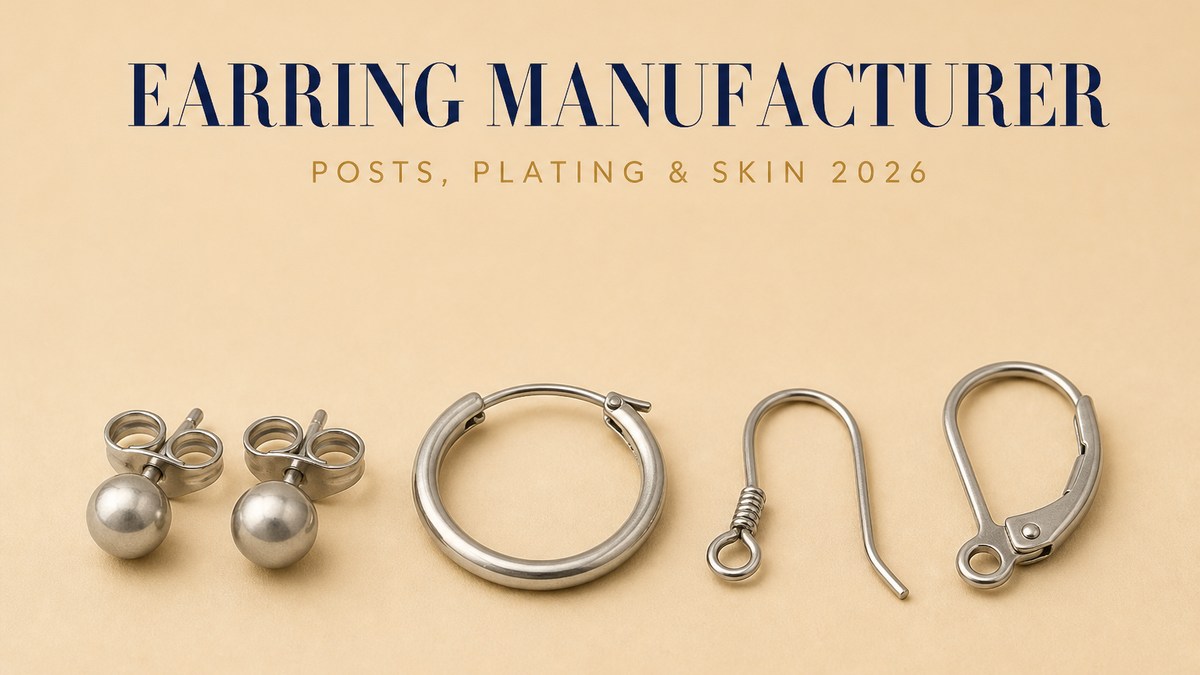
An earring is the only piece of jewellery that goes through the customer's skin and stays there. That single fact changes what you have to specify. A bracelet is judged on how it looks and whether the clasp holds; an earring is judged on whether the post breaks, whether the back stays on, and whether the customer's own body reacts to what the metal releases while it is in contact with a piercing. None of those three is visible in a photograph, and the third is the one that turns a product into a refund and a complaint. This guide covers the three earring constructions and what each asks of the wearer, why the post is the most important component in the product, how the fastenings differ in use rather than in cost, what an earring specification has to state, how the price is built, what goes wrong, and how to check a supplier before the order ships.
What You Are Buying, and the Line That Decides It
| If you want | What it means in practice | The line on your order that decides whether it works |
|---|---|---|
| A post that does not snap in the hand | The post is a thin bar taking a bending load every time it is handled | The post thickness and the material, plus how the post is joined to the front |
| A back that stays on | Friction backs loosen with use; the others have their own failure | The fastening type and the grip it must hold after repeated fitting |
| A piece the skin tolerates | Reaction comes from what the metal releases into a piercing | The release requirement for the market you sell into, tested rather than promised |
| A matched pair, not two earrings | An earring is sold in twos and judged side by side | The pair tolerance on weight, front size and finish colour |
| A stud a customer can wear all day | Front weight pulls the post and the lobe down | The maximum front weight for the post specified, and the back it pairs with |
What Are the Three Earring Constructions, and Which Should You Sell?
Three constructions cover almost everything you will source, and each one loads the metal differently. That is the commercial point: the construction decides which component fails first.
Stud. A front with a straight post through the piercing, held by a back on the far side. It is the construction that puts the most demand on a single thin piece of metal, because the post carries the front's weight and takes a bending load every time the earring is fitted. Studs are also the construction where a small saving in post thickness is most tempting and most damaging.
Hoop. A ring or oval that passes through the piercing and closes on itself, so the load is spread around the loop rather than concentrated at a post. It is the strongest construction by geometry — and the one where the closure decides whether it stays in, because a hoop that opens on its own is an earring that is lost.
Drop. A hook or stud at the top with something hanging below, connected by a link or a joint. It adds a new failure point that the other two do not have: the connection between the part that goes through the ear and the part that dangles. It is also the construction that pulls hardest on the lobe, because weight hangs below the piercing rather than sitting against it.
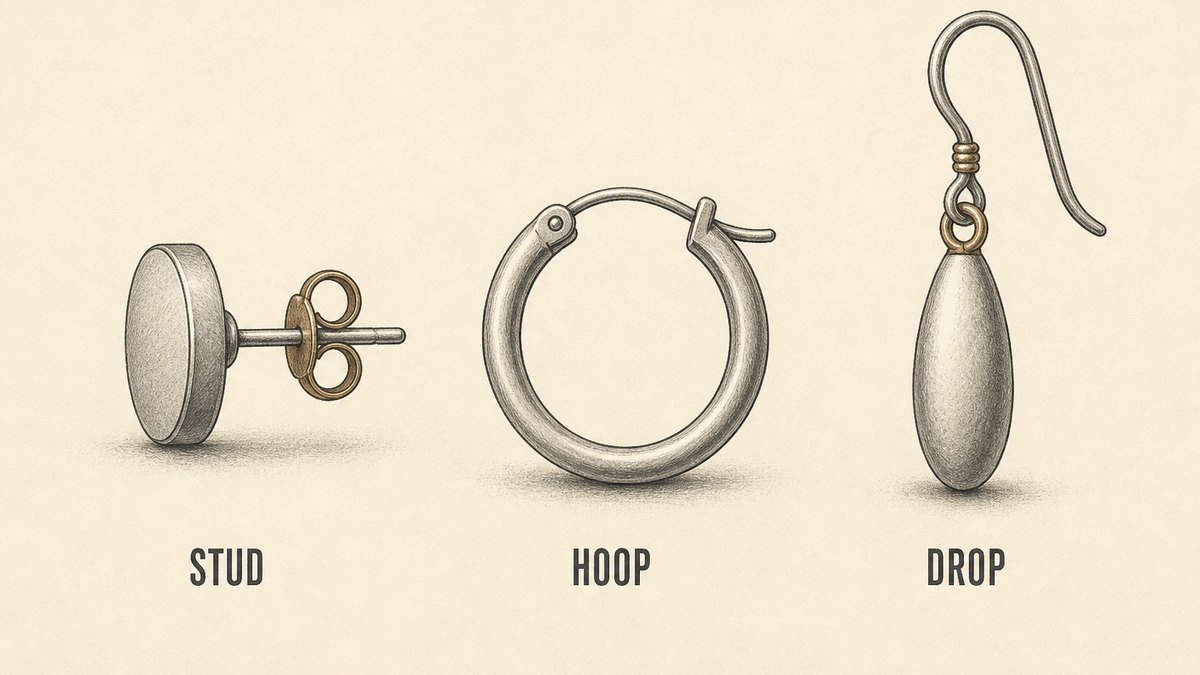
Two practical consequences. First, the three do not share parts or tooling, so a supplier strong on studs is not automatically set up for drops — ask which constructions are actually on their line. Second, the construction interacts with the fastening rather than standing alone: a heavier front on a friction back is a different product from the same front on a screw back, and the pair has to be specified together.
Why Is the Post the Most Important Component in the Product?
Because it is the thinnest piece of metal in the whole piece, it is the piece the customer handles most, and it is the piece that is inside the body while it is being stressed. Three properties decide it.
Thickness. The post is a thin bar in bending, and its stiffness falls off sharply as it gets thinner — so a post that looks adequate on a drawing becomes one that bends in a customer's fingers. This is the single most tempting place for a factory to take cost out, because post thickness is invisible in a product photograph and invisible in a finished pair held in the hand.
The material and the join. A post is usually joined to the front rather than made in one piece with it, which means there is a joint taking the same bending load. A weak join fails at exactly the moment the customer is pushing the back on, and it fails at the join rather than in the middle. Specify both the post material and how it is attached, because a good post on a poor join is a broken earring.
What is inside it. This is where earrings differ from every other piece in this category. A post sits in a piercing, in contact with tissue, for hours at a time. That makes the metal that is in contact with the customer — not the front, which everyone photographs — the part that decides whether the product is wearable for the person who reacts to it.
The practical consequence for a buyer is that the post deserves its own line on the order rather than being folded into a general metal description. Specify the material, the thickness with a tolerance, and the method by which the post is joined to the front. Then check all three on a sample by flexing a post until it gives and noting where it gave.
How Do the Fastenings Differ, and Why Does It Matter?
Four fastenings carry almost every earring you will source, and they are not a price ladder — they are four different compromises. Choosing one is a decision about how the earring will be used, not about how much it costs.
Butterfly back. A friction disc that grips the post. It is the cheapest and the fastest to fit, and it is the one that fails first, because friction grip is lost gradually as the back is taken on and off. A loose back slides along the post, the earring drops forward, and the customer's first impression is that the product is cheap rather than that the grip has worn.
Screw back. A threaded post with a back that screws on. It holds far more reliably and suits a heavier front, and its cost is time: a screw back is slower to take on and off, which matters to somebody putting in earrings every morning. It is the honest answer when the design is heavy and the alternative is a butterfly back that will not hold.
Lever back. A hinged lever that closes against the post. It is quick to fit, it hides its mechanism, and it holds well — the compromise is that it is a mechanism with a hinge, so the lever can work loose and the spring can weaken. It is the fastening that most rewards a stated cycle requirement.
French hook. A curved wire that simply hangs in the piercing with no back at all. It is the most comfortable for a heavy drop because nothing presses on the back of the lobe, and it is the least secure, because there is no closure — which is why it is usually paired with a small ball or a coil at the front end to stop the earring sliding out.
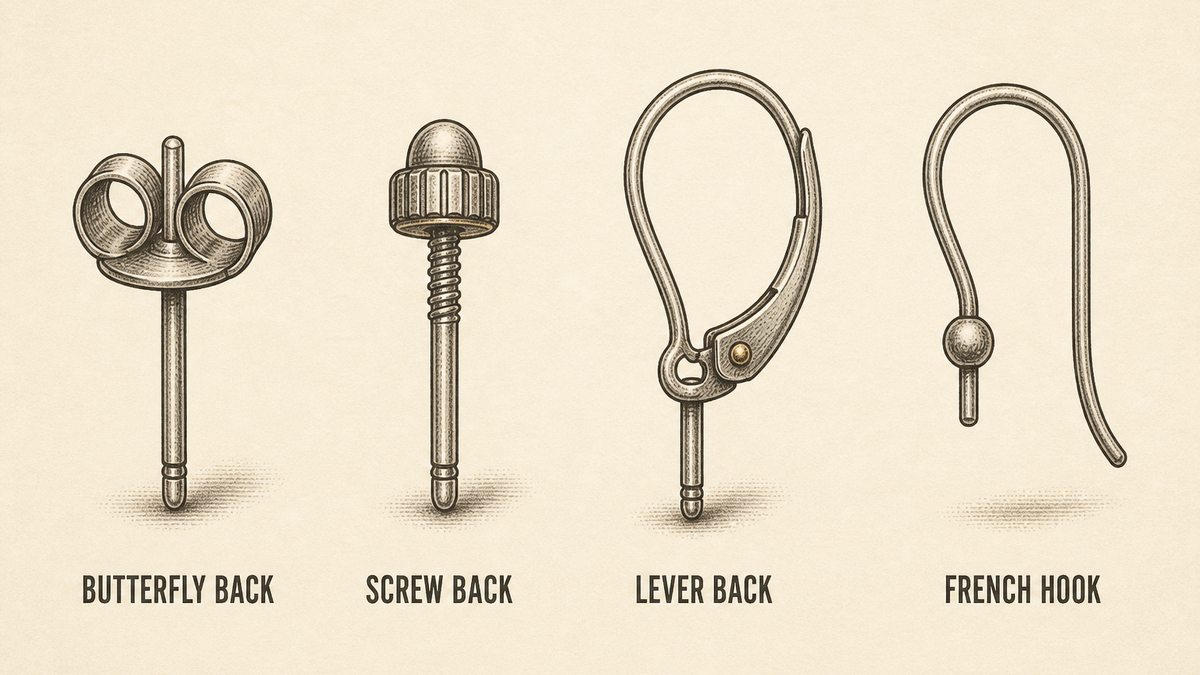
The pairing is the point. A butterfly back is a perfectly good fastening on a light stud and a poor one on a heavy front, and the same is true in reverse: a screw back on a featherweight stud adds fiddling time for no benefit. Specify the fastening together with the front weight rather than on its own, and state what the fastening must still do after repeated fitting — a grip figure or a cycle count, not the word “secure”. The metal-and-plating logic behind that pairing is the same set of numbers that decides a metal bracelet, where the load sits at a joint instead of at a post.
What Has to Go Into the Specification?
Eight lines carry the risk. Four are about the metal, three about the mechanism, and one about selling in pairs.
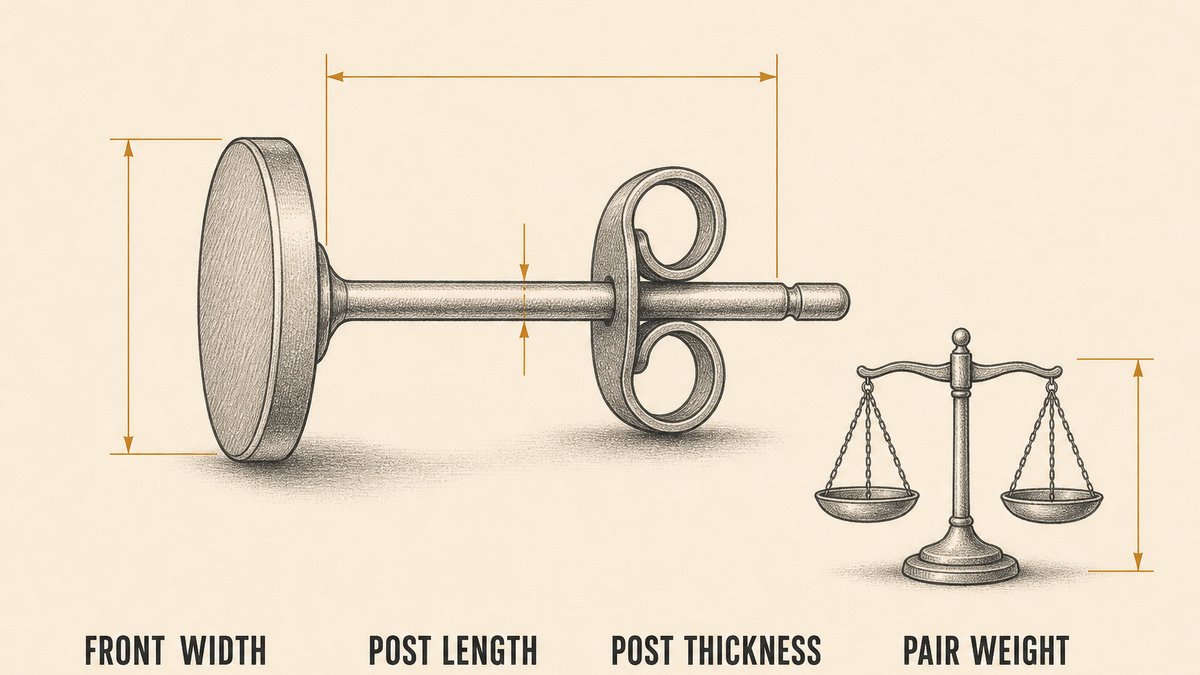
- Post material, thickness and length, each with a tolerance. Give the material by grade, the thickness as a figure with a tolerance rather than a range, and the length, because post length decides whether the fastening can grip at all. This is the line that prevents the failure the customer notices first.
- How the post is joined to the front. Say whether the post is welded, soldered or mechanically fixed, and require the join to be tested by flexing a sample until it gives, noting whether it failed at the join or in the post itself.
- Base metal, plating thickness and layer structure. The logic is identical to any other plated piece: name the base metal, give a thickness per layer, and state the method. On an earring it matters more than on a bracelet, because the post is inside a piercing rather than resting on skin.
- The release requirement for the market you sell into. Reaction is driven by what the metal releases while it is in contact, not simply by what the alloy contains, so ask for a release test result against the limit that applies where you sell. That limit and its test method differ by market, so confirm the current requirement for your destination rather than reusing a figure from another country.
- Fastening type, and what it must still do after use. Name the fastening and give it a requirement — a minimum grip force, or a number of fit-and-remove cycles it must survive. Without that, the back is whatever the factory had in stock.
- Front width, front weight and the pair tolerance. An earring is sold as a pair, so give the target weight and the tolerance for the pair and for the difference between the two earrings, and the same for the front width. A pair that arrives at noticeably different weights is a pair the customer can feel in the hand.
- Finish, and any coating or enamel. State the finish and the polish grade. Where a coating, an enamel or a painted detail is involved, the lead limits that apply to coatings on consumer products are set out in 16 CFR Part 1303, and that is worth naming on the order even when a supplier assures you it does not apply.
- Marking and packing. The origin marking the shipment needs under 19 CFR Part 134, plus the card, pouch or box, and how the pair is held so the two earrings cannot rub against each other in transit. If the piece carries your own brand, the wider question of how a private label order is assembled is covered in the private label route for an earring.
How Is the Wholesale Price Actually Built?
Four things move the price of an earring, and the first one is the reason two factories can quote the same design very differently.
- Post thickness, and the cost of getting the join right. A thinner post saves metal and, more importantly, saves the time a proper join takes. It is the smallest saving on the quotation and the largest risk in the product, which is why it is the first thing to be reduced and the last thing to be noticed.
- The fastening. A screw back costs more than a butterfly back, and a lever back costs more than both because it is several parts and a hinge. This is the line where a quotation quietly changes the design rather than the price.
- Plating and polishing time. Thicker plating costs metal and time, and a higher polish grade costs a great deal of time on small fronts. Both are invisible in a photograph and both are where a quotation gives you less.
- Pairing and packing. An earring is sold in twos, so the pair has to be matched for weight and finish, and the two pieces have to be held apart in the packing. This is real labour on a small product, and it is a line that buyers forget exists until they see the quotation.
As with any small, dense product, the freight is a small share of the landed cost and the metal is a large one — the opposite of a bulky category. The general method for working through that arithmetic is set out in the landed total on an earring order.
What Goes Wrong?
Four failures account for most of what comes back, and the first two are the ones a customer notices within a week.
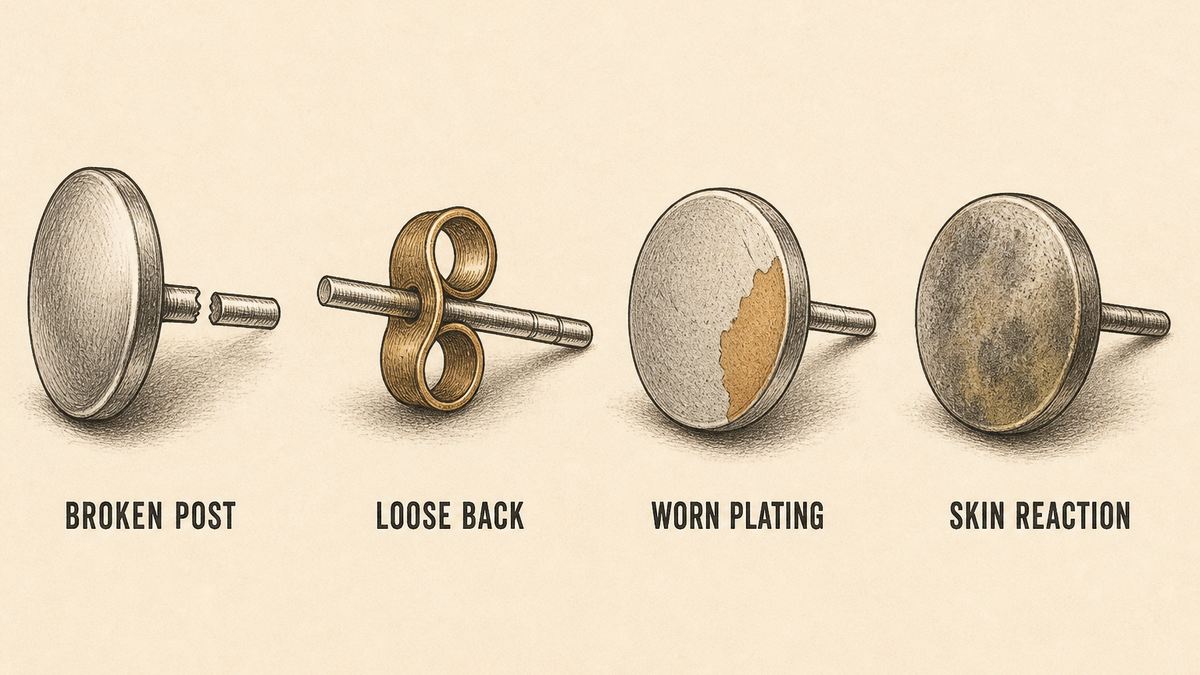
- The post broke
- Either the post was too thin for the weight it carries, or the join to the front gave way. It happens while the customer is fitting the earring, so it is the failure they associate most strongly with poor quality, and it is decided entirely by two lines on the order.
- The back stopped holding
- A friction back lost its grip, and the earring began sliding forward and dropping out. The earring is not defective in any way a customer can see — which is exactly why the grip requirement has to be specified rather than assumed.
- The plating wore through
- It wore at the points that touch the most: the post, where the back slides, and the front face where fingers go. Thinner plating reaches that point sooner, and on an earring the exposed base metal is sitting against a piercing rather than against skin.
- The customer reacted to it
- This is the failure that ends the relationship rather than the product. It is driven by what the piece releases while it is worn, it appears after a period of wear rather than on arrival, and it is the one outcome in this category that a specification can genuinely prevent and a price cannot.
All four are settled by a number on the order, and three of them sit in components the customer never thinks about until they fail. An earring is a small product with an unusually high proportion of its risk hidden inside the two most ordinary-looking parts: the post and the back.
How Do You Check a Supplier Before You Commit?
Four checks, in this order. On earrings they are unusually decisive, because the two parts that decide the product are the two smallest ones.
Ask which constructions and which fastenings are actually on their line. Studs, hoops and drops do not share tooling, and a factory that runs butterfly backs may not run lever backs at all. The method for establishing who is really making your product is the same as in any category, set out in factory or trading company, and on a product this small it is worth asking who makes the posts.
Flex a post until it breaks, and note where. This is the check with no substitute. Bend the post of a sample the way a customer's fingers would, and watch whether it fails in the middle of the post or at the join to the front. That single observation tells you which of your two specification lines is wrong, and it costs one earring.
Weigh and match the pair. Put both earrings of several samples on a kitchen scale and compare the two weights in each pair, then compare front widths with calipers. A pair that differs noticeably in weight is a pair the customer will feel, and it is the cheapest manufacturing defect you can detect before shipping.
Inspect before it ships. On earrings the inspection is function and match rather than appearance: that every back grips, that every post is straight and inside thickness tolerance, that pairs are matched, that the plating shows no bare patches on the post, and that the cards hold the two earrings apart. The method is the same as for any order, described in how an earring shipment is inspected before it leaves, and how many pieces to pull comes from the the table the sample size for an earring order comes from. Fit and remove every back you inspect.
Where Does a Cheap Quotation Get Its Money Back?
A cheap earring quotation is usually a real price for less metal and a different mechanism. Five lines go missing, and they go missing from the inside of the product outward.
- Post thickness. A thinner post at the same silhouette, saving metal and, more importantly, the time a proper join takes. It is invisible in the hand and it decides whether the earring survives being put on.
- The join between post and front. A weaker fixing that passes a visual check. This is the line that turns a bend into a break, and it is the cheapest thing on the quotation to get wrong.
- The fastening. A friction back where the design specified a screw or lever back, or a cheaper spring inside a lever back. Nothing announces it until the earring will not stay on.
- Plating thickness. Thinner layers at the same colour. The piece looks correct on arrival and wears through on the post and the front face after a few weeks of wear.
- Pairing and packing. Pairs matched loosely, or held in packing that lets the two earrings rub together. The saving is small and the complaint is about the surface, which is the hardest kind to answer.
The way to close those five lines is to put them on the enquiry: ask for post material, thickness and join method, the fastening type with a grip or cycle requirement, the plating thickness per layer, the pair weight tolerance, and the packing method, all as part of the quotation. A supplier who can answer all five is quoting on your product. It is also worth being clear from the start about which market the pieces are for, because the release requirement that matters most in this category is the one that differs by destination. The wider picture — which of the five production stages a supplier actually runs, and how that changes what a quotation means — is set out in the category hub on jewelry manufacturing.
Frequently Asked Questions
What is the minimum order for earrings wholesale?
Three minimums interact and the largest binds. A cast or stamped front needs tooling; plating baths carry a minimum per finish; and because earrings are sold in matched pairs, pairing adds labour per pair rather than per piece. That makes a first order in one construction, one fastening and one or two finishes far more economical than the same total quantity spread across a range, which is often the opposite of what a retail assortment wants.
Which earring fastening should I choose?
Choose it together with the front weight rather than on its own. A butterfly friction back is a good fastening on a light stud and a poor one on a heavy front, where it will slowly lose grip. A screw back holds far better and costs the customer time every morning. A lever back is quick and secure but is a mechanism with a spring. A french hook is the most comfortable for a heavy drop and the least secure, so it normally pairs with a small ball at the front end.
How do I keep earrings from irritating a customer's skin?
Reaction is driven by what the metal releases while it is in contact with a piercing, not simply by what the alloy contains, so the useful requirement is a release test result against the limit that applies in the market you sell into. Confirm the current limit and its test method for your destination, because they differ by market, and settle it alongside the base metal and the plating. On an earring the part that matters most is the post, not the visible front.
Why do earring posts break so easily?
Because a post is a thin bar in bending, and its stiffness falls away sharply as it gets thinner. It also usually joins the front rather than being made in one piece with it, so there is a joint taking the same load. Posts then fail in one of two places: in the middle if the post is too thin, or at the join if the fixing is weak. Flexing one sample until it breaks tells you which of the two you have.
Do I need to specify the weight of an earring?
Yes, and in two ways. The front weight decides whether the fastening can hold it and whether the earring is comfortable to wear all day, since a heavy front pulls on the lobe. The pair difference decides whether the two earrings feel like a matched pair, which a customer can detect in the hand even when they cannot see a difference. Give a target weight with a tolerance and a separate tolerance for the difference between the two earrings in a pair.
Can I sell studs and drops made by the same supplier?
Only if the supplier actually runs both constructions, which is worth asking directly rather than assuming. Studs, hoops and drops use different tooling and different labour, and a drop adds a joint that the other two do not have. A supplier strong on studs may buy its drops in from somewhere else, and in that case the specification you agreed is not the one being manufactured.
Send the post and the back, not just the front
Tell us which construction you want — stud, hoop or drop — and whether the design is yours or theirs, the post material, thickness and length with tolerances and how the post is joined to the front, the base metal with a plating thickness per layer and the measuring method, the release requirement for the market you sell into, which fastening you want and what it must still do after repeated fitting, the front width and the target pair weight with tolerances for both the pair and the difference between the two earrings, the finish and any coating or enamel, the card or pouch that holds the pair apart, and your target volume. Those answers settle the post, the mechanism and the metal before a price means anything. We will come back with the construction and fastening pairing we recommend and why, the specification written as limits with methods rather than as labels, the tooling cost and the plating and pairing minimums separated, a sampling plan built around flexing a post and weighing pairs rather than photographing them, and the metal, plating and pairing costs shown as separate lines.
Request an Earring Sourcing Quote
Questions & Comments
We read every one and reply within 24 hoursComparing earring quotations, or working through a skin reaction question? Post the base metal, the post material, and the plating the supplier named, and we can usually say which lines are missing. If you are trying to establish what a pair releases while it is worn, tell us the market you sell into and we will tell you which requirement to confirm before you order.