
Bracelet Manufacturer: Sourcing Metal Jewellery From China
 ·
Updated October 11, 2026
·
18 min read
A metal bracelet is the one product in this whole catalogue that fails on your customer's skin rather than in the box. Nothing about it breaks on arrival, no test flags it, and the sample looks perfect — and then a percentage of customers find that the plating has worn through, that the clasp has stopped closing, or that the same bracelet turned their wrist green and left a mark. That is why this category is decided by numbers that never appear in a product photograph: the thickness of the plating, the metal underneath it, the solder at every joint, and what the finished piece releases when it sits against skin for eight hours. This guide covers what a metal bracelet manufacturer actually does, why base metal and plating are meaningless without figures attached, how the joints and the clasp decide the product's lifespan, what a jewellery specification has to state, how the price is built, what goes wrong, and how to check a supplier before the order ships.
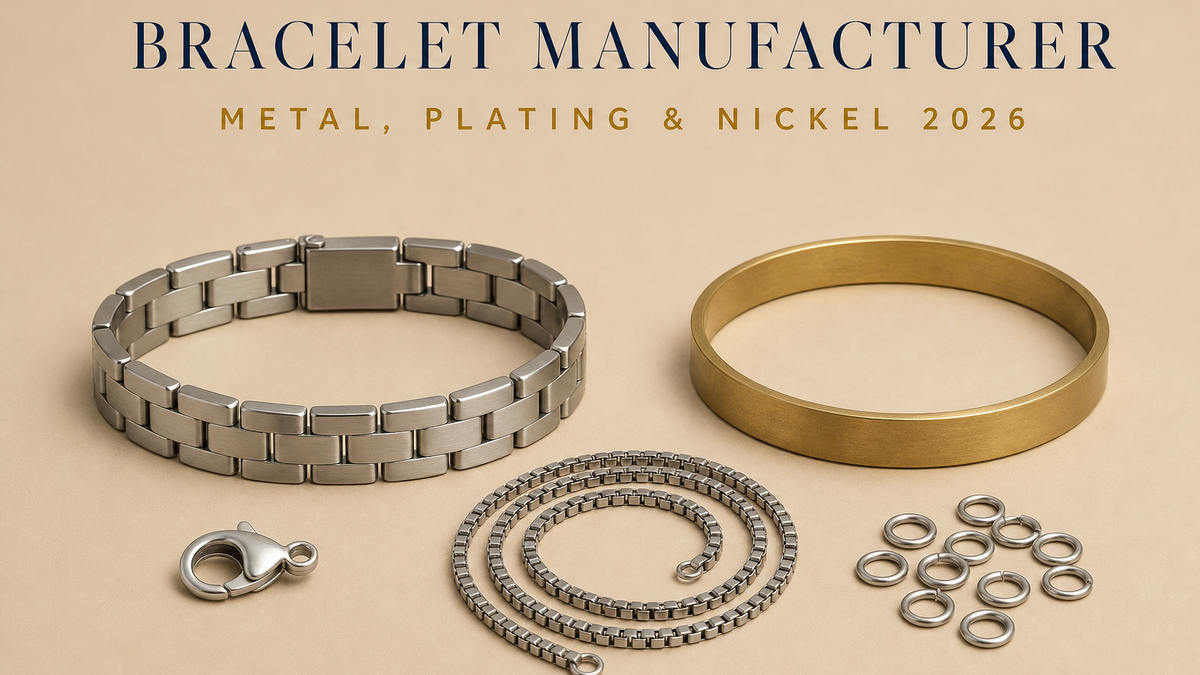
What You Are Buying, and the Line That Decides It
| If you want | What it means in practice | The line on your order that decides whether it works |
|---|---|---|
| A finish that survives being worn | Plating is a thickness, and thickness is a cost | The plating thickness in microns, per layer, with the test method |
| A piece that does not mark the skin | Skin reaction comes from what the metal releases, not from its colour | The nickel release limit and the base metal beneath the plating |
| A bracelet that stays on the wrist | A bracelet is only as good as its weakest joint | The joint type at every link, and whether the solder was specified |
| A clasp that still closes next year | The clasp is a mechanism, not a decoration | The clasp type, its spring or magnet, and the closing force you will accept |
| A length that fits rather than a length that is average | Wrist size varies more than a single figure admits | The length range and the extender chain, plus a tolerance on both |
What Does a Bracelet Manufacturer Actually Make?
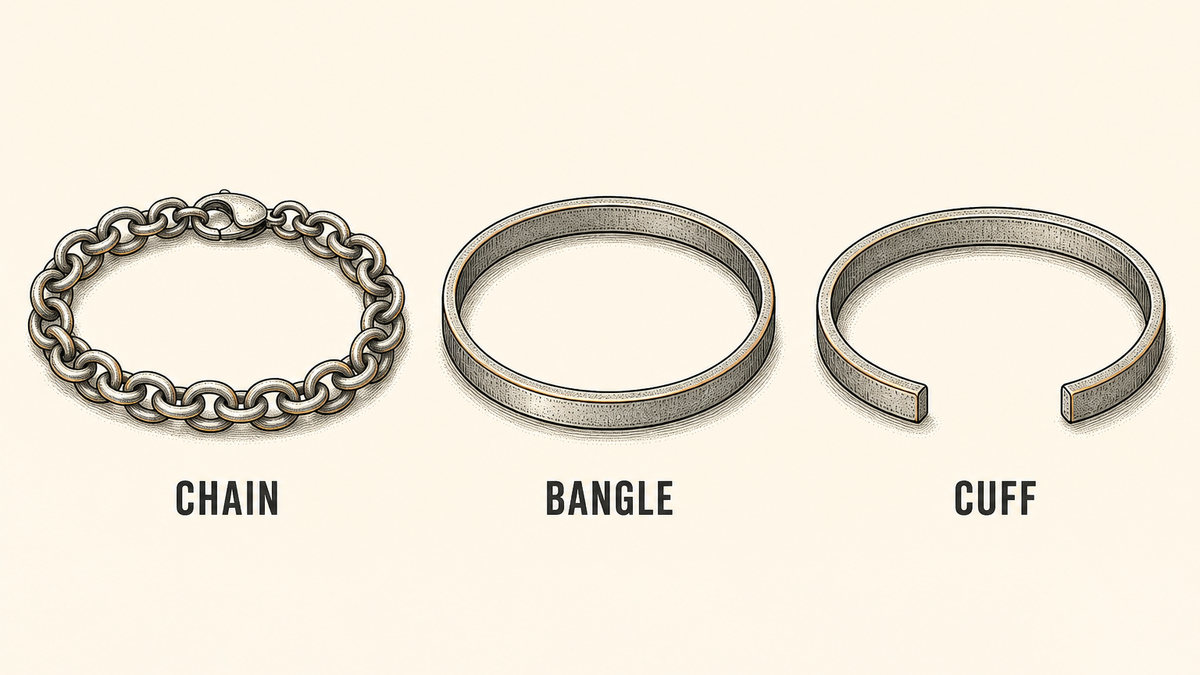
Three constructions account for almost everything you will source, and each one fails differently. Choosing between them is the first commercial decision, because they do not share tooling, they do not share labour, and they do not share the same failure.
Chain. Made from links that are formed and joined, then finished and assembled with a clasp and usually a few jump rings. It is the construction with the most joints per unit, which makes it the most sensitive to how the joints are made. It is also the most forgiving on fit, because a chain follows the wrist rather than fighting it.
Bangle. A rigid closed loop, usually stamped or cast, then polished or plated. It has no clasp and therefore almost no mechanism to fail — the risk moves entirely into the finish and the sizing, and a bangle that is a few millimetres out simply does not go over the hand.
Cuff. An open rigid band that the wearer flexes to put on. It is the construction that looks simplest and behaves worst, because it is designed to be bent by the customer. Every flex works the metal, so the material and the thickness decide whether it holds its shape or slowly opens up and stops staying on.
A fourth decision sits behind all three. A factory can put your logo on a chain it already makes, or work from your own drawings and tooling, or develop the piece with you from a sketch. The difference is what you own when the order finishes, and the trade-offs are the same ones that apply to putting your brand on any imported product, laid out in the private label route for a bracelet. In jewellery the ownership question extends to the mould: if the piece is cast, the tooling is a real asset and you should know whether it is yours or theirs.
Why Are “Stainless Steel” and “Gold Plated” Meaningless on Their Own?
Because both describe a label rather than a limit. Stainless steel covers a wide family of alloys with different behaviour, and gold plated describes a colour without saying how much gold is there. The two numbers that actually decide how the product performs on a wrist are the base metal and the plating thickness, and neither is visible.
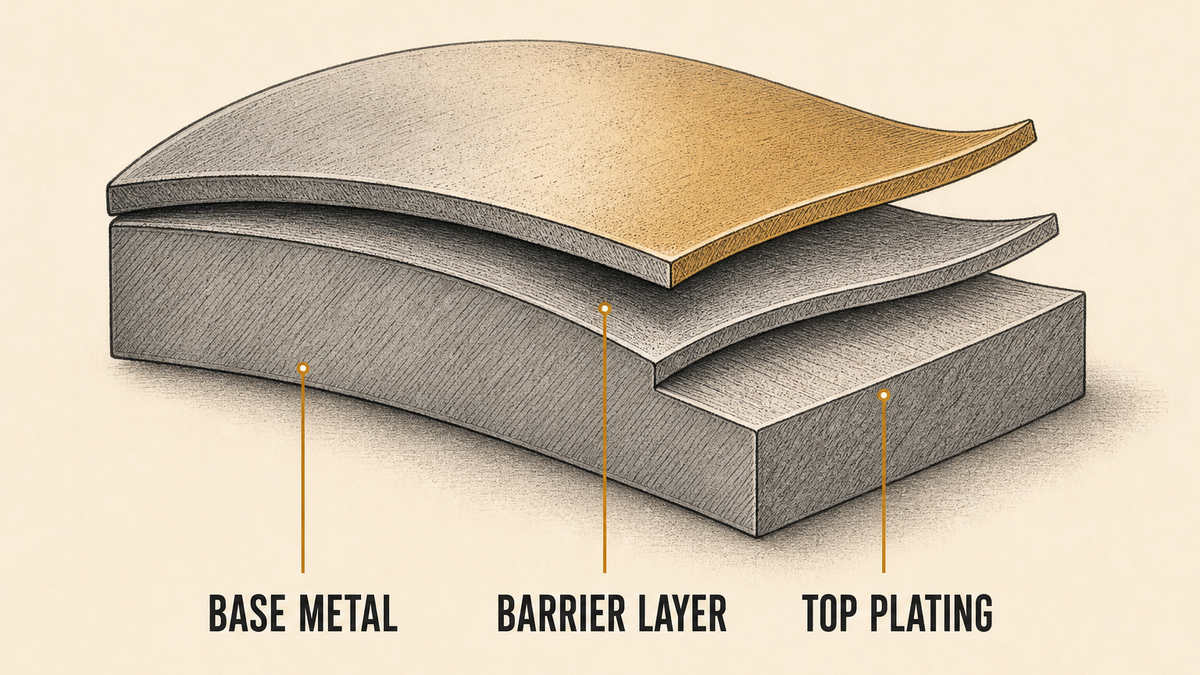
Here is why the pair matters more than either half. Plating on jewellery is normally built in layers rather than in one coat, and each layer is doing a job. The base metal is the structure — it decides the weight, the stiffness and, if the plating ever wears through, what the customer's skin is then in contact with. On top of it, a barrier layer is often used to stop the layers above from interacting with the base and to manage what migrates outward. The top plating is the one the customer sees, and it is the one whose thickness decides how long the piece stays the colour it was sold as.
Three practical consequences follow, and all three cost money:
Thickness, not colour, is the spec. Two bracelets that look identical in a photograph can differ by an order of magnitude in plating thickness, and the thinner one wears through at the high points — the edges of the links, the top of the clasp — which is exactly where a customer notices. If you do not state a thickness per layer, the factory has no reason to give you more than the minimum that passes a visual check.
The base metal is what the customer feels if you are wrong. Plating wears; that is a normal expectation for costume jewellery. What is not acceptable is what shows when it does. The base metal also determines the metal that can migrate through a worn finish, which is why the base metal and the nickel question are the same conversation.
The nickel question is about release, not presence. Skin reaction is driven by how much nickel the piece releases when it is worn, not simply by whether nickel appears in the alloy, so a supplier who answers with a materials list has answered a different question than the one that matters. Ask for the release test and the limit, not a certificate of absence.
How Do the Joints and the Clasp Decide the Lifespan?
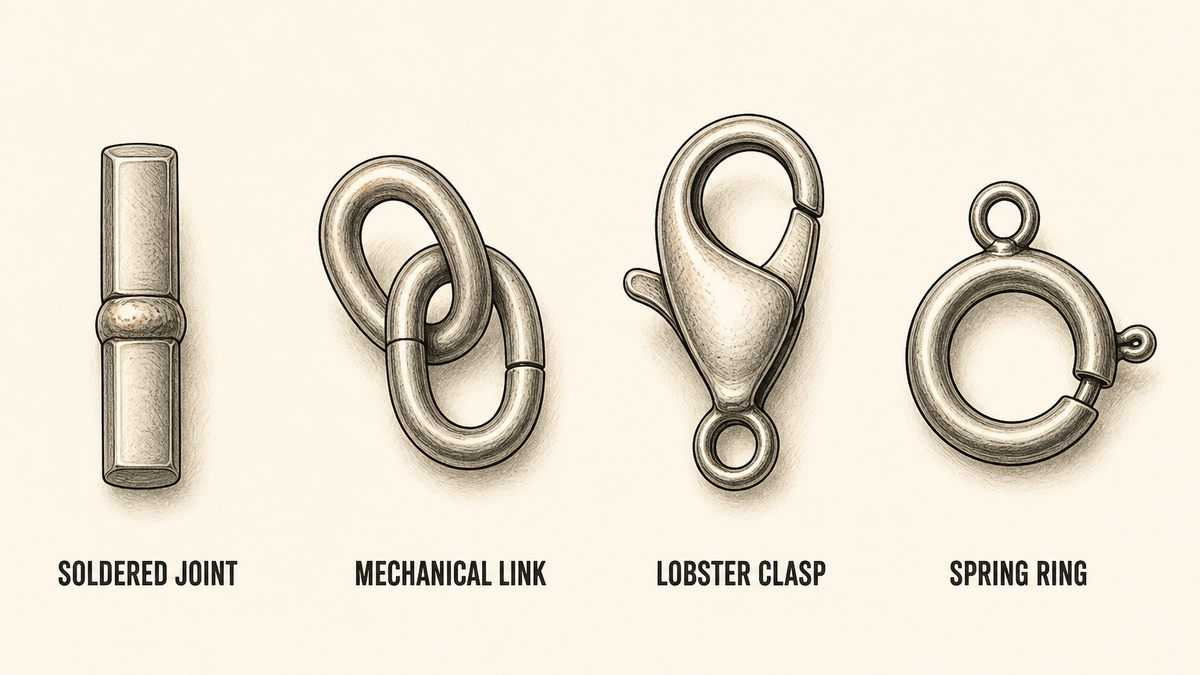
A chain bracelet is a hundred small bets, and the weakest one sets the outcome. Four constructions do the work, and they are not equally strong, equally cheap, or equally honest about what they are.
A soldered joint joins two metal ends with filler metal, and it is the strongest and the most expensive option. It is also the one that quality is hardest to see, because a good joint and a bad joint look the same until the bad one cracks. What matters is that the solder was specified at all, since a factory chasing a price can simply let the links hold each other mechanically and describe it as soldered.
A mechanical link relies on the shape of the metal — two loops interlocked and closed — with no solder. It is cheaper, it survives flexing better than a cracked joint, and it is the honest choice for a lightweight piece. Where it fails is at the closure: a loop that was not fully closed opens up and the chain comes apart at exactly the wrong moment.
The clasp is a mechanism, and mechanisms wear. A lobster clasp depends on a spring and a gate that has to return to position thousands of times; a spring ring depends on a spring and a friction fit. Both are specified by what they are made of and by what they must do after repeated use, and neither is specified by the word “clasp”.
The jump rings are what connect the clasp to the chain, and they are the cheapest component in the whole piece and the one most often left unsoldered. A jump ring that can be pulled open by hand is a bracelet that will be lost by a customer.
Two sizing points belong here because they are part of the mechanism rather than the styling. A bracelet needs an extender chain or an adjustable closure if it is to fit more than one wrist, and the extender is only useful if its end is finished so it does not catch. And the length range has to be stated with a tolerance, because the number your customer checks against is the one they will trust you or blame you for. In the earring category the same principle moves onto the post and the back, which is what the guide to the steps in making an earring works through.
What Has to Go Into the Specification?
Seven lines carry the risk. Four are about metal, two about mechanism, and one about the market you are selling into.
- Base metal, named. Not “stainless” or “alloy”, but the grade or the composition. This is what the customer is in contact with the moment the plating wears, so it is the line that decides whether a worn bracelet is a disappointment or a skin complaint.
- Plating thickness per layer, with the test method. Give a figure in microns for each layer and say how it is measured. A thickness figure without a method is a number a supplier can agree to and then argue about.
- Nickel release, as a limit to be tested rather than an absence to be promised. Reaction comes from what the piece releases while worn. Ask for the release test result and the limit that applies in your market — and be aware that the applicable limit and the test method differ by market, so this is one line where you should confirm the current requirement for where you sell rather than reuse a figure from another country.
- Joint type at every point of the piece. Say which joints are soldered, which are mechanical, and that functional jump rings are to be closed and, where the design allows, soldered. This is the line that prevents a chain coming apart in a customer's hand.
- Clasp type and closing behaviour. Name the clasp and state what it must survive: a stated number of open and close cycles, or a minimum closing force. Without that, the clasp is whatever the factory happened to have in stock that week.
- Length, width, weight and tolerances. Give the finished length with an extender range if there is one, the link or band width, and the target weight with a tolerance. Weight is the cheapest proxy you have for whether the metal that was quoted is the metal that arrived.
- Finishing, marking and packing. The finish and the polish grade, the logo application method, the origin marking the shipment needs under 19 CFR Part 134, and the card, pouch or box. If the piece is coated or painted anywhere — including a coloured enamel or a painted charm — the lead limits that apply to coatings on consumer products are set out in 16 CFR Part 1303, and that is a line worth naming even when the supplier assures you it does not apply.
How Is the Wholesale Price Actually Built?
Jewellery is priced by weight and by finishing time, and the two move in opposite directions as you chase a target price. Four things move it.
- Metal weight, and the alloy you name. This is the largest single line. A lighter gauge at the same look costs less and lasts less, and on a cuff it also changes whether the piece keeps its shape. Ask for the weight per piece rather than for a price per gram, because the two are not the same once scrap and finishing are involved.
- Plating thickness and polishing time. Thicker plating costs metal and time; a higher polish grade costs only time but a great deal of it, because it is hand work. Both are invisible on a photograph and both are where a quotation quietly gives you less.
- The joint and the clasp. Soldering is skilled work, and a specified clasp costs more than an unspecified one. This is the line most often reduced to hit a price, and it is also the one that decides whether the piece survives a year.
- Tooling, and minimums by length and finish. A cast or stamped piece needs tooling, which is a real cost and an asset. On top of that, plating baths and finishing runs have minimums, and a range of lengths or finishes multiplies them, which is why a broad first range costs more than the work suggests.
A note on weight that saves arguments later: ask the factory to weigh ten pieces and give you the average, then weigh the production delivery yourself. A difference in average weight is the simplest early warning that the metal changed between the sample and the shipment, and it takes a kitchen scale rather than a laboratory.
What Goes Wrong?
Four failures account for most of what comes back, and none of them is visible on a new sample.
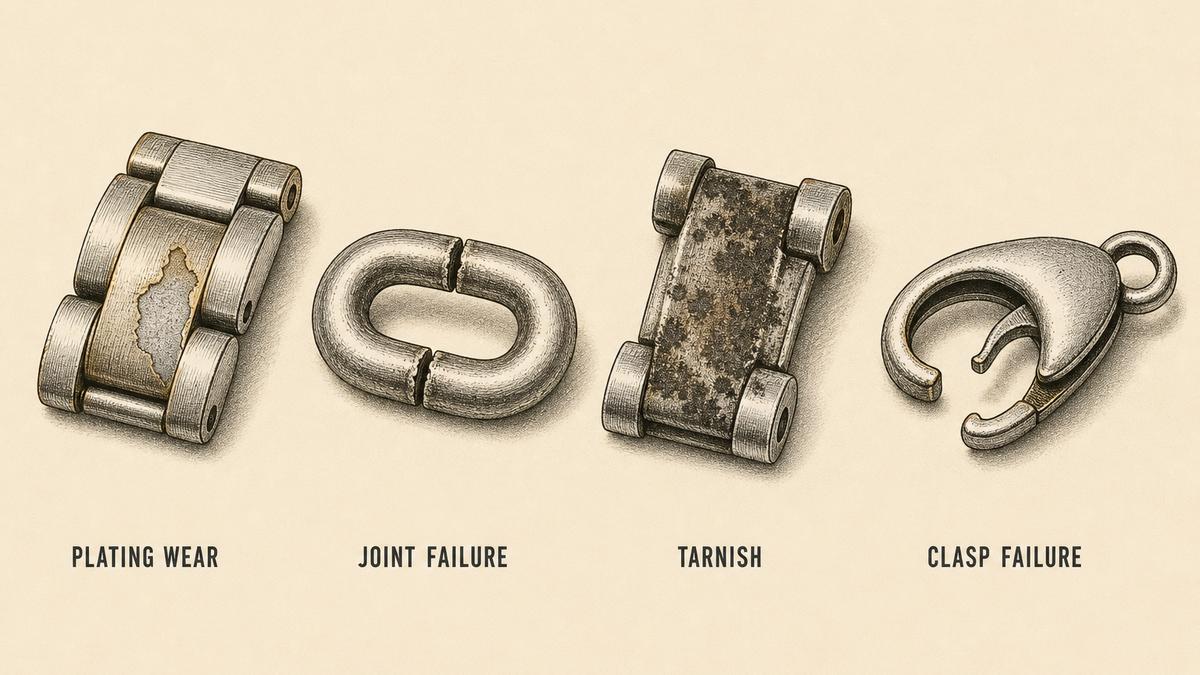
- The plating wore through
- It failed at the high points first — the link edges, the top of the clasp — and revealed whatever the base metal is. Thinner plating wears through sooner, and the customer reads it as poor quality rather than as a number.
- A joint opened
- A soldered joint cracked, or a mechanical loop was never fully closed, and the chain came apart. It is the failure that costs the customer the piece entirely, and it is decided at the bench rather than in the design.
- It tarnished
- The surface discoloured, usually unevenly, and the piece stopped looking like what was photographed. It is partly a metal question and partly a storage question, which is why packing and the finish are the same conversation.
- The clasp stopped closing
- A spring weakened or a gate bent, and a bracelet that will not close cannot be worn at all. Nothing else about the piece matters at that point, which is why the clasp deserves a cycle figure rather than a description.
All four are settled by a number on the order, and three of them are decided by components the customer never thinks about until they fail. That is the shape of this category: the visible part is the design, and the whole of the risk is in the metal underneath it.
How Do You Check a Supplier Before You Commit?
Four checks, in this order. On jewellery they are cheap and unusually decisive, because the things that matter are all measurable with small tools.
Find out who pours the metal and who finishes it. Casting, polishing and plating are often three different workshops, and plating is the one that decides the finish. A trader can assemble a bracelet from all three without owning any of them, which means a question about plating thickness is being answered by somebody who did not do the plating. The method for establishing who is really making your product is the same as in any category, set out in spotting a middleman.
Weigh the sample and count the joints. Put the sample on a kitchen scale and record the weight; then trace the piece and write down every joint and every closure, and check that each one matches what you specified. This is a five-minute task that catches the two substitutions that matter most, and it gives you a baseline to compare the production delivery against.
Wear one. This is the check with no substitute in this category. Wear the sample yourself for a week — shower in it if that is how your customer will live — and then look at the high points of the links and the clasp. Plating wear shows up at the contact points first, and a week of wear tells you more about the finish than any certificate will. If you cannot wear it, rub it against a cloth with a little hand soap and look again.
Inspect before it ships. On jewellery the inspection is weight, closure function and finish rather than appearance: that the average weight is inside tolerance, that every clasp opens and closes, that every jump ring is closed, that the plating shows no bare patches at the high points, and that the cards and pouches are right. The method is the same as for any order, described in how a bracelet shipment is inspected before it leaves, and how many pieces to pull comes from the the table the sample size for a bracelet order comes from. Function first, photographs second.
Where Does a Cheap Quotation Get Its Money Back?
A cheap jewellery quotation is usually a real price for less metal and less time. Five lines go missing, and they go missing from the inside outward — which is why they arrive as skin complaints and lost bracelets rather than as visible defects.
- Metal weight. A lighter gauge at the same silhouette. It shows up on a scale, not in a photograph, and on a cuff it also decides whether the piece keeps its shape.
- Plating thickness. Thinner layers at the same colour. The piece looks correct on arrival and wears through at the high points after a few weeks of wear.
- The solder. Mechanical closures where the order specified soldered joints, or jump rings left open. It costs minutes per piece and it is the difference between a bracelet and a bracelet that comes back.
- The clasp. A cheaper mechanism with a weaker spring, or a smaller size than the design assumed. Nothing about the finished piece announces it until the clasp stops closing.
- Packing and finishing. A lighter polish grade, and a pouch or card that lets the piece rub against itself in transit. Storage and tarnish are the same conversation, and this is where a saving becomes a complaint about the surface.
The way to close those five lines is to put them on the enquiry: ask for the base metal by name, the plating thickness per layer, the joint and clasp specification, the target weight per piece with a tolerance, and the finish grade, all as part of the quotation. A supplier who can answer all five is quoting on your product. It is also worth pricing the order where it lands rather than where it is quoted, because jewellery is small and dense and the freight behaves unlike the bulky categories — the method for that is set out in the landed total on a bracelet order. If you are choosing between suppliers rather than components, the category hub explains how to compare them stage by stage — see the metal in a bracelet.
Frequently Asked Questions
What base metal should I choose for a jewellery bracelet?
It depends on what shows if the plating wears, because plating always eventually wears. The base metal decides the weight, the stiffness and what the customer's skin is in contact with when that happens, so it should be named by grade or composition rather than described as stainless or alloy. For a cuff it also decides whether the piece holds its shape, since the customer is meant to bend it every time they put it on.
How thick should the gold plating be?
There is no universal figure, because the requirement depends on how the piece is worn and what the market expects. What matters is that you state a thickness per layer in microns together with the method used to measure it, and that you test it yourself by wearing a sample for a week and checking the high points of the links and the clasp. A supplier given no thickness will supply the minimum that passes a visual check.
How do I stop a bracelet turning a customer's skin green?
Skin reaction is about what the piece releases while it is worn rather than simply what it contains, so the answer is a release test and a limit rather than a promise of absence. Confirm the limit and the test method that apply in the market you sell into, because they are not the same everywhere, and settle it alongside the base metal specification. A worn plating that exposes a reactive base metal is how this becomes a complaint rather than a comment.
Do soldered or mechanical links last longer?
A properly soldered joint is stronger, and it is also the one where a poor job is hardest to see, because a good joint and a bad joint look the same until the bad one cracks. A mechanical link survives flexing better than a cracked joint and is the honest choice for a lighter piece, provided the loops are fully closed. Specify which joints are soldered, and require functional jump rings to be closed and soldered where the design allows.
What is the minimum order for a bracelet manufacturer?
Two minimums interact. A cast or stamped piece needs tooling, which is a one-off and becomes a real asset if it is yours; and plating baths and finishing runs carry minimum quantities per finish. A range of lengths or finishes multiplies the finishing minimum, which is why a first order in one length and one finish is far more economical than the same total quantity spread across a range. Ask for the tooling cost and the finishing minimum separately.
How do I check the metal weight actually delivered?
Ask the factory to weigh ten pieces from the sample batch and report the average, then weigh ten from the production delivery yourself. Jewellery is small enough that this is a kitchen-scale task. A drop in average weight is the earliest and simplest signal that the metal changed between the sample and the shipment, and it is a measurement your supplier cannot argue with.
Send the metal, not just the mood board
Tell us which construction you want — chain, bangle or cuff — and whether the piece is your design or theirs, the base metal by grade, the plating thickness per layer with the measuring method, the nickel release requirement for the market you sell into, which joints are soldered and which are mechanical, the functional jump ring rule, the clasp type and the closing behaviour it must survive, the finished length with the extender range, the width and the target weight per piece with a tolerance, the finish grade, whether any coating or enamel is involved, and your target volume. Those answers settle the metal and the mechanism before a price means anything. We will come back with the construction and the finish we recommend and why, the specification written as limits with methods rather than as labels, the tooling cost and the finishing minimum separated, a sampling plan built around wearing a piece and weighing it rather than photographing it, and the metal, plating and making-up costs shown as separate lines.
Request a Jewellery Sourcing Quote
Questions & Comments
We read every one and reply within 24 hoursComparing two bracelet quotations for the same design? Post the base metal, the plating thickness, and the joint type the supplier named, and we can usually say which lines are missing. If a bracelet has already come back with plating worn through at the high points or a clasp that stopped closing, tell us where it failed and we will help you work out which number to blame.