
Private Label Pet Food: How to Source It From China
 ·
Updated October 11, 2026
·
18 min read
Private label pet food is the one pet product where the paperwork decides whether your order can land at all. A toy with a bad seam comes back as a claim. A bag of food that does not meet the import rules does not come back at all — it sits at the port, or it goes back on your account. So the order of work is different from every other pet product you will source: you settle the label, the facility and the import path first, and only then argue about price per bag. This guide explains what private label actually means in this category, what the United States rules require before a shipment of pet food or treats can enter, what a dog or cat food specification has to state, how the product is really made, what goes wrong, and where a cheap quotation gets its money back.
What You Are Actually Buying, and the Line That Decides It
| If you want | What it means in practice | The line on your order that decides whether it works |
|---|---|---|
| Your brand on a food that already exists | The supplier has a formula in production and prints your bag | The recipe is not yours, so the supplier can sell the same food to your competitor. Ask what they will not sell twice |
| Your own formula | You own the recipe and they make it for you | Who holds the formula, and what happens to the batch records if you move |
| A label you can legally use | The bag has to match what is inside and what the rules allow | The guaranteed analysis, the ingredient list and the claim you make about the food |
| A shipment that clears | The plant has to be registered and the shipment announced before it arrives | The facility registration number and who files the prior notice |
| A product that survives the trip | Fat goes off and moisture moves through film | Water activity, the barrier film and the shelf life you are willing to print |
What Does “Private Label Pet Food” Actually Mean?
Private label means the product is made by somebody else and sold under your brand. That is the whole of it. The word says nothing about who invented the food, and that is the part buyers get wrong.
In this category the term covers two very different arrangements, and they cost very different amounts of money:
- Stock formula, your bag. The factory already makes a chicken and rice kibble for other customers. You pick one close to what you want, pay for your artwork and your bag printing, and take delivery. It is fast and cheap to start, and the obvious risk is that your competitor can buy the same food from the same line.
- Your formula, their line. You pay for recipe development, a trial batch and the testing that goes with it, and the recipe belongs to you. This is the arrangement that is worth the money if the food is your product rather than a commodity, and it is the arrangement where you have to settle in writing who holds the formula, who keeps the batch records, and what you get if you leave.
Two more words get mixed in and are worth separating. White label is usually used for the first arrangement: a stock product you re-brand. Contract manufacturing usually means the second: you own the specification and they make to it. Suppliers use all three words loosely, so the only thing that matters is the answer to one question: if I walk away, can you sell this exact food to somebody else?
Can You Import Pet Food From China Into the United States?
Yes, and the path is not secret, but it is a chain of requirements where the weak link is usually the buyer rather than the factory. Four things sit in that chain, and only one of them is a product test.
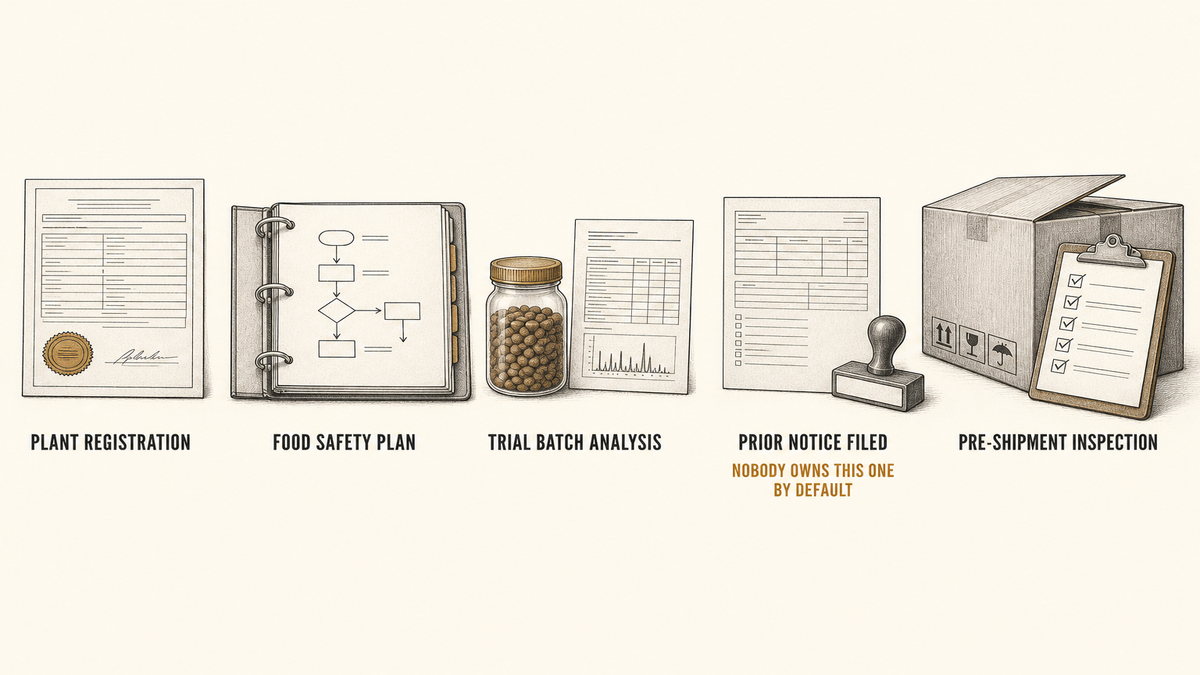
The plant has to be registered. A facility that makes, processes, packs or holds food for people or animals in the United States generally has to be registered with the food authority, and that registration is renewed every other even year. Foreign plants are in scope, not just American ones. The rule sits in 21 CFR Part 1 Subpart H, registration of food facilities. In practice you ask the factory for its registration number and you match the number to the plant name and address on the paperwork, because a number quoted from a sister company is not your plant's number.
The shipment has to be announced before it arrives. Food for animals is not exempt. Somebody has to file prior notice with the authorities before the shipment reaches the border, and the rule sits in 21 CFR Part 1 Subpart I, prior notice of imported food. Who files it is a commercial decision, not a legal one: your freight forwarder normally does, and if nobody has been told they own it, you find out at the port. This is the single most common avoidable delay on a first pet food shipment.
The maker has to run preventive controls. Current good manufacturing practice and hazard analysis for animal food sit in 21 CFR Part 507. What this means to you as a buyer is that a serious plant can show you a food safety plan, name the hazards it controls, and describe how it checks them. If the answer to “can I see your food safety plan?” is a blank look, the plant is not a plant you want your brand on.
The product itself has to avoid prohibited material and stay inside contaminant limits. Two parts of the rules matter most here. 21 CFR Part 589 lists substances that may not be used in animal food or feed, which is where the rules on certain ruminant material sit. 21 CFR Part 509 sets the levels of unavoidable contaminants. Those two are the reason a chew or a treat that is fine in one market is not automatically fine in another.
One more layer sits at state level rather than federal. Feed is commonly registered state by state, and the ingredient and label wording is guided by the model rules that the Association of American Feed Control Officials publishes and updates — aafco.org is where that vocabulary is defined. If you are selling through retail rather than direct, ask who is handling state registration, because it is usually not the factory and it is usually not your freight forwarder.
None of that is a reason to avoid the category. It is the reason to settle the chain in the first two weeks instead of discovering it in the fourth month.
What Has to Be on the Bag?
The bag is where a private label pet food order is most often lost, because artwork is approved late and the label is the one part of the product nobody thinks of as a specification. The rules for animal food labelling sit in 21 CFR Part 501, and the industry vocabulary that sits on top of them comes from AAFCO. Five blocks do most of the work.
- Product name
- The name is not free text. In this category the words in the name are tied to the share of the named ingredient in the food, which is why “chicken”, “chicken dinner” and “with chicken” are three different promises. Decide the name early, because it decides the recipe, not the other way round.
- Guaranteed analysis
- The minimum protein and fat and the maximum fibre and moisture, expressed as percentages. This is the block a buyer can actually check against a lab report, and the block that quietly breaks when a factory swaps a protein source to protect its margin.
- Ingredient list
- Ingredients in descending order by weight. This is where a formulation change becomes visible, which is why you want the approved list attached to the order rather than buried in a design file.
- Feeding or use wording
- What the food claims to be and who it is for. A claim that the food is complete and balanced for a life stage is a claim about formulation and testing, not about marketing, so it has to be settled before the recipe is frozen.
- Net quantity, lot and origin
- The net weight, a lot or date code, and the country of origin. The lot code is the cheap line and the one most often left off a first order, and without it every complaint becomes an argument about which container the bag came from.
Two practical warnings. First, artwork is a long lead item: bag printing usually runs behind the food, so a late label approval delays the shipment even when the food is ready. Second, the label and the recipe have to be frozen together. If the supplier reformulates after your artwork is printed, you are either reprinting bags or shipping a bag that no longer describes the food inside it, and the second one is a much more expensive mistake.
What Has to Go Into Your Specification?
If you have sourced a manufactured product before, the shape of this will be familiar: the specification is the product, and the supplier is whoever can meet it. The difference here is that two of the lines are not visible on the finished item, so a factory can meet every line you can see and still fail the two that matter.
The pet toy sourcing guide makes the same argument for the neighbouring category, and it holds here: start from how the product fails, then write the lines that keep the failure small.
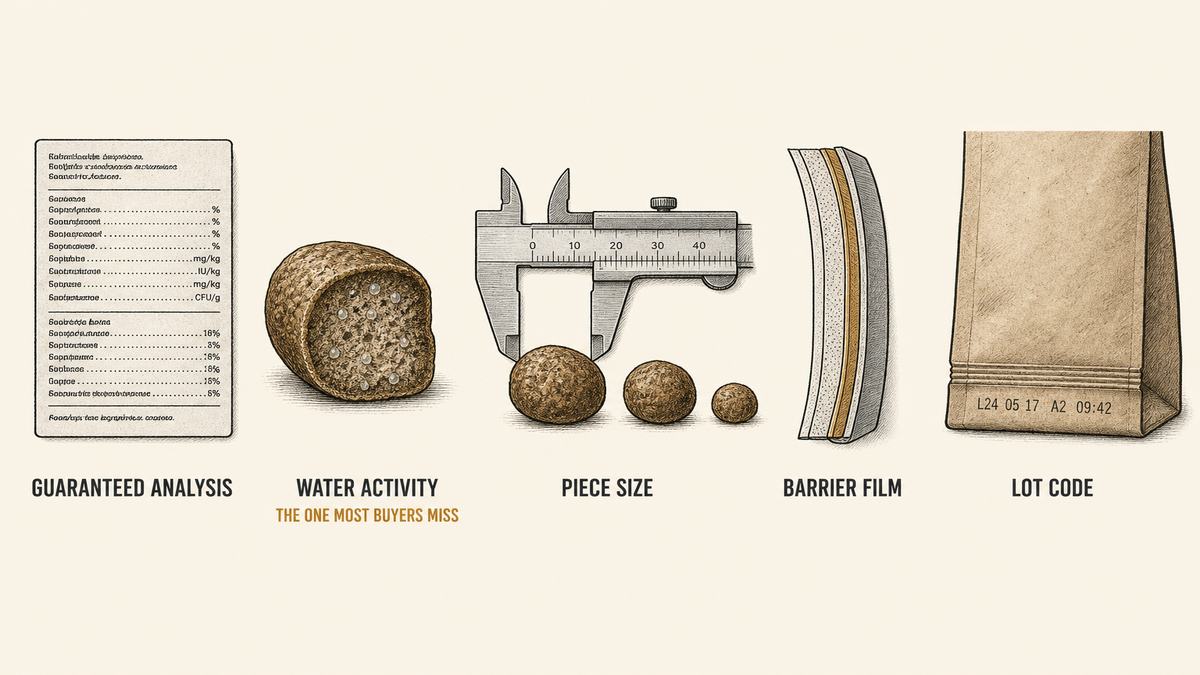
Write these lines into the order, with a number, a method and a rule for what happens when the number is missed:
- Guaranteed analysis, as a range rather than a target. A target invites drift. Give a minimum protein and fat and a maximum fibre, moisture and ash, and say which method you are testing against. Then say what happens if a batch lands outside the range, because otherwise the only remedy available to you is a conversation.
- Water activity, not just moisture. Moisture tells you how much water is in the food. Water activity tells you how much of it is free to support mould and bacteria. A soft treat can sit inside a perfectly normal moisture figure and still spoil on a warehouse shelf, and this is the line most buyers have never heard of and the one most likely to save them a container.
- Piece size for treats and chews. The size and hardness of a chew is not cosmetics. Specify the dimensions and, where the product is hard, specify what happens when it is bitten, because a piece that breaks into a small hard fragment is a different product from one that softens or shears.
- Fat quality and the antioxidant that protects it. Kibble and baked treats carry fat, fat goes off, and the reason a bag smells wrong six months later is a fat and antioxidant decision made on the day it was made. Ask what antioxidant is used, at what level, and specify the shelf life you are entitled to print.
- Bag structure, barrier and seal. The film is part of the product. Specify the structure, the barrier that keeps oxygen and moisture out, the seal width, and how the bag is tested. A thinner film shows on the pallet, not on the sample, which is exactly the substitution a cheap quote relies on.
- Lot coding and batch records. Specify how each batch is coded and that the code is recorded against the batch record. This is the line that turns a quality complaint into a five-minute check instead of a negotiation.
Anything you want added to the food is its own approval question. Ingredients and additives used in animal food are covered by the same additive framework as other feed, in 21 CFR Part 570 and the list of additives permitted in feed and drinking water in 21 CFR Part 573. A supplier who can tell you which route an ingredient comes in under is a supplier who has done this before.
How Is the Food Actually Made, and Who Formulates It?
Almost every pet food or treat you will private label comes off one of four processes, and the process decides your minimum order and your development cost far more than the recipe does.
Extrusion is the dry kibble process: ingredients are mixed, cooked under pressure and pushed through a die, then dried and coated. It needs real equipment and a real run length, so it is a bad fit for a small first order and a good fit once you have volume. Baking uses a lower temperature and produces a softer, denser biscuit; it suits treats and smaller runs, and it is kinder to ingredients that extrusion would damage. Freeze drying removes water from raw or cooked material and leaves the structure intact, which is why single-ingredient treats are usually made this way; it is a premium process with a premium cost and it is unusually sensitive to how the raw material was handled. Jerky and dried strips rely on drying and on the water activity of the finished piece, which is why that line belongs on your order rather than in the supplier's notes.
The question buyers forget to ask is who writes the formula. Three answers exist. The factory's own formulator does it, usually by adapting a recipe it already runs. A third-party formulator does it and hands the recipe to the factory. Or you arrive with a recipe. The first is cheapest and leaves you owning the least, the third is the most work and leaves you owning the most, and the second is where most first brands end up. Whichever it is, settle the ownership question before the trial batch, because the trial batch is when the recipe becomes worth something.
A trial batch is also the only honest way to test the two things you cannot see on a sample. Ask for the analysis of the trial against your own ranges, ask where the water activity landed, and ask how the bag performed after a week in a warm room. A supplier who can answer those three questions has run a real trial. A supplier who can only send photographs has sent you photographs.
What Goes Wrong?
Five failures account for most of what comes back from a private label pet food order, and every one of them points at a line rather than at bad luck.
- The food moulded or smelled wrong before its date
- Water activity was never specified, so a batch that looked fine in the factory carried enough free moisture to spoil on a warehouse shelf. It is the most common shelf-life failure in the category and the one a moisture figure alone will not catch.
- The food went rancid
- Fat quality, or too little antioxidant, or a bag that lets oxygen through faster than assumed. The complaint arrives months after the container, which is why the remedy is a line on the order rather than a claim against the shipment.
- The bag did not match the food
- The supplier reformulated after the artwork was printed, or the recipe drifted to protect a margin, and the guaranteed analysis on the bag stopped describing what was in it. This is a reprint and a possible recall, not a discount.
- Something that is not allowed is in it
- An ingredient from a source that is prohibited in animal food, or a contaminant above the unavoidable level. This is the failure that stops being a commercial problem, and it is why the two rules on prohibited substances and contaminant levels belong in your supplier questionnaire rather than in a folder.
- The shipment stalled at the port
- Nobody filed the prior notice, or the plant's registration did not match the paperwork, or the label was still being fixed when the container shipped. The product was fine. The chain was not, and the cost is storage and delay rather than a replacement.
Four of those five are settled by a line on the order and one by a date on a calendar. Neither is expensive. What is expensive is discovering them in the fourth month, which is what happens when a first private label order starts with a price request instead of a specification.
How Do You Check a Supplier Before You Pay for Anything?
Four checks cost almost nothing and between them they remove most of the risk in this category. Do them in this order, because each one makes the next one cheaper.
Match the plant to the paperwork. Ask for the facility registration number and the plant name and address, and check that the three agree. Confirm who you are actually dealing with, because a trading company and a factory answer a question about water activity completely differently — the method for that is set out in whether a private label plant is a plant or a reseller. Then take any certificate they wave at you and look it up in the issuer's own record rather than trusting the scan, using the approach described for the private label certificate, checked in the certifier's own register.
Read the food safety plan, not the brochure. Ask which hazards the plant controls and how it checks them. You are not auditing the document. You are finding out whether anybody at that plant can talk about their own process without reading from a slide.
Test the trial batch against your own limits. Send the trial to a lab you chose, against the ranges you wrote, not against a generic list the supplier supplied. The analysis that matters is the one where you picked the laboratory and the limits. This is also where you find out whether the guaranteed analysis on the draft artwork matches the food in the bag.
Inspect before it ships. A pre-shipment inspection on a food order is mostly a check of identity, packaging and records rather than of taste: that the bags are the approved artwork, that the lot codes are present and legible, that the cartons match the order.Have the first production run checked against your own written list, and take the number of bags to open from the sampling table. On a food order this inspection is cheap next to the cost of a container that has to be held.
Where Does a Cheap Quotation Get Its Money Back?
A cheap pet food quotation is not usually a lie. It is a quotation for less than you assumed, and the same six lines go missing every time. Read the quotation against this list and the difference between two prices stops being mysterious.
- The antioxidant and the fat. A cheaper fat and less antioxidant produce a bag that is fine at the trial and wrong at the warehouse. It is the classic invisible substitution in this category because nothing you can see or smell on delivery tells you.
- The bag film. A thinner structure, or one with less of the barrier layer, keeps the food for a shorter time. It is also the substitution that shows up as a freight saving, which is why it is popular.
- Recipe development. A low price often assumes a stock recipe rather than your own, which is fine if you wanted a stock recipe and a problem if you believed you were buying your own formula.
- The testing. A quotation that excludes analysis has excluded the only evidence you will ever have about what is in the bag.
- Lot coding and records. Skipping the code costs nothing to leave out and removes your ability to trace anything. A claim you cannot trace is a claim you pay for in full.
- The registration and the filing work. Somebody has to hold the registration relationship and file the prior notice. If the quotation quietly assumes you are doing it, the cost has not gone away. It has moved to you, and it arrives at the port.
Finally, price the order where it lands rather than where it is quoted. Pet food is dense and heavy, so it pays for mass rather than for volume, which is the opposite of the toy category next door, and it means the freight share of a cheap bag can be larger than the freight share of an expensive one. The what a private label order costs once it has landed in exactly the same way here, and on a pallet of kibble the gap is usually larger than the buyer expected.
None of this argues against the category. Pet food is one of the few pet products with a real regulatory floor under it, which means a buyer who settles the rules early is competing on execution rather than on luck. That is a much better position to be in than the one the toy category puts you in.
Frequently Asked Questions
Can I put my own brand on pet food made in China?
Yes. Private label pet food and treats are made for foreign brands routinely, either from a stock recipe that the factory already runs or from a formula developed for you. The difference that matters is ownership: on a stock recipe the factory can sell the same food to somebody else, and on your own formula it cannot, provided you settled the ownership in writing before the trial batch.
Does pet food from China have to be registered to enter the United States?
The plant does. A facility that manufactures, processes, packs or holds food for animals in the United States generally has to be registered, and foreign plants are in scope, under 21 CFR Part 1 Subpart H. On top of that, each shipment has to be announced in advance through prior notice under 21 CFR Part 1 Subpart I. The practical check is simple: ask for the registration number and match it to the plant name and address, and confirm in writing who is filing the prior notice.
What is water activity and why does it matter more than moisture?
Moisture is how much water is in the food. Water activity is how much of that water is free enough to let mould and bacteria grow. A soft treat or a semi-moist food can sit inside a normal moisture figure and still spoil on a shelf, because the water in it is available. If you specify only moisture, you have specified the wrong number, and the failure turns up months after the container.
How much does it cost to develop a private label pet food?
It depends on the process and on whether the recipe is yours. A baked treat or a single-ingredient freeze-dried treat usually needs little development beyond a trial and a bag. A dry kibble needs a real run length because extrusion is heavy equipment, so development cost is tied to volume rather than to the recipe. Recipe development, bag printing and analysis are separate costs and should appear separately on the quotation, so the honest answer is to ask for those three lines to be shown rather than folded into a unit price.
Do I have to test every batch of pet food?
No, but you need a rule that decides which tests run on which batches. The cheap and frequent ones are the physical and labelling checks: bag structure, seal, lot code, net weight. The analytical ones can follow a lower frequency as long as nothing changed, and the moment the recipe, an ingredient source or the bag film changes, the earlier report stops describing your product and testing has to be repeated.
What is the minimum order for private label pet food?
It is set by the process and the packaging, not by the supplier's mood. Treats and baked products can usually start far smaller than extruded kibble, because kibble needs a real production run to be economic. The other half of the answer is the bag: printed bags have their own minimum, and on a first order the bag minimum is often the number that actually decides what you can order. Ask for the two minimums separately, because suppliers tend to quote the larger of the two.
Send the market and the product, not just the picture
Tell us the market you are selling into, whether the recipe is yours or you want a stock formula, the guaranteed analysis you need, the process you have in mind, the treat or kibble size, the bag format and shelf life you want to print, and your target volume. Those answers settle the process, the plant and the bag before a price means anything. We will come back with the process we recommend and why, the specification written as ranges with methods rather than targets, the label blocks that have to be agreed before artwork, the registration and prior notice steps named with who owns each one, a testing and inspection plan against your own limits, and the development, bag and analysis costs shown separately rather than folded into the unit price.
Request a Pet Food Sourcing Quote
Questions & Comments
We read every one and reply within 24 hoursSetting up a private label pet food order and not sure what a quotation covers? Post the product format, the packaging type, and whether the recipe is yours or theirs, and we can usually say which lines are missing. If you are stuck on labelling, or on what the shipment needs before it clears customs, tell us the market you sell into and we will point at the usual requirements.