
Phone Case Manufacturer Sourcing Guide: Materials, Moulds, Printing and Magnets
 ·
Updated October 9, 2026
·
25 min read
A phone case is a moulded part with a printed surface, and almost every problem buyers run into comes from treating it as a printing job instead of a moulding job. The mould costs more than the first production run, the material decides whether the case turns yellow on a windowsill, the printing decides whether the design survives a pocket, and if you are selling a magnetic case you should know exactly which safety rule you are and are not inside. This guide covers the six decisions that set the price and the quality of a phone case order, what a factory can and cannot change after the mould is cut, and how to test a sample before you commit to a production run.
What to Specify, by What You Are Selling
| If you are making | Specify this | Because |
|---|---|---|
| A clear case | The material grade by name, with an anti-yellowing requirement and a test method | Clear is the hardest case to sell and the easiest to get wrong. Yellowing is a property of the material, not a defect in it, so the grade you choose decides whether the case still looks new in three months. |
| A printed case | The print method, and an adhesion test written into the order | Four common methods fail in four different ways. Naming the method lets you compare quotes, and the adhesion test is the only thing that proves the design is attached rather than resting on the surface. |
| A magnetic case | The magnet grade, the pull force, and confirmation that the magnet cannot be removed | Pull force decides whether the case works with the accessories customers already own. Encapsulation is the safety question, and it is also the design question, because a magnet that can come free is a part a child can swallow. |
| A rugged or protective case | The drop height, the surface, and where the case is expected to fail | "Military grade" is a marketing phrase, not a measurement. A drop figure means nothing without the height, the surface and the corner tested, so agree those three and write them down. |
| A case for a brand new phone model | A 3D file, a dummy unit, and a fit-tolerance range in millimetres | A case that is a fraction of a millimetre out will not fit or will not stay on. No screenshot of a phone model is a substitute for a physical unit the factory can mould and fit against. |
| A case sold as a children's product | A different testing plan, agreed before the mould is cut | Children's products carry rules that adult accessories do not. Deciding this after the tooling exists means paying for testing you did not plan for, or reworking a product you cannot change. |
1. What a Phone Case Quotation Actually Covers
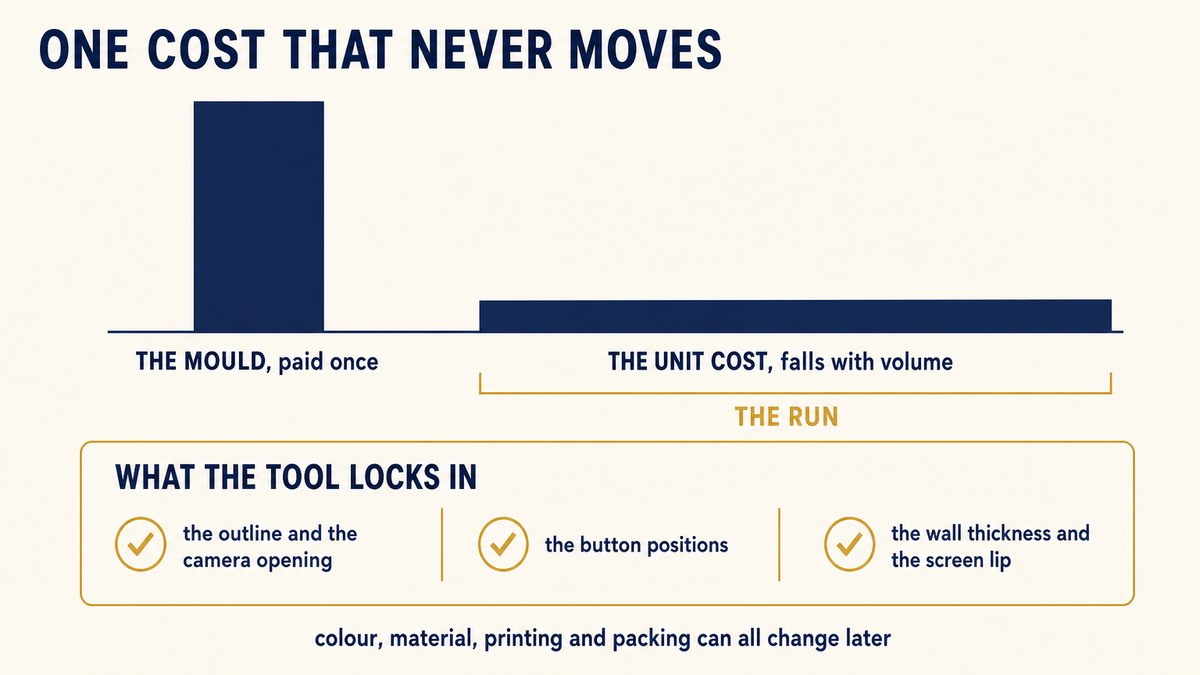
A phone case has two cost structures stacked on top of each other, and they behave completely differently. The first is a one-time tooling cost that does not change with order size. The second is a per-unit cost that falls as the order grows. Most buyers compare quotes on the second and forget the first, which is why a cheaper unit price can end up costing more for a first order.
- The mould
- A steel or aluminium tool cut to the shape of your case. Paid once, owned by whoever paid for it, and reused for every later order of that model. This is usually the single largest line on a first order.
- The material
- Priced by weight, and the weight depends on how much plastic the design uses. A thick rugged shell uses several times the material of a slim snap case, which is a large part of why they cost different amounts.
- The printing
- Priced per unit and set up per design. Four colours cost more than one, and each new design is its own set-up, so a range of twelve designs is not one order split twelve ways.
- The magnets
- Bought in as a separate component, usually from a different supplier than the plastic. Small money per unit and the first thing to delay a delivery, because the case cannot be finished without them.
- Packing
- The sleeve, the box, the hang tag. Cheap per unit and the fastest part of the order to change, which is why it is worth keeping as its own line.
2. Materials: TPU, Polycarbonate, Silicone and the Hybrids
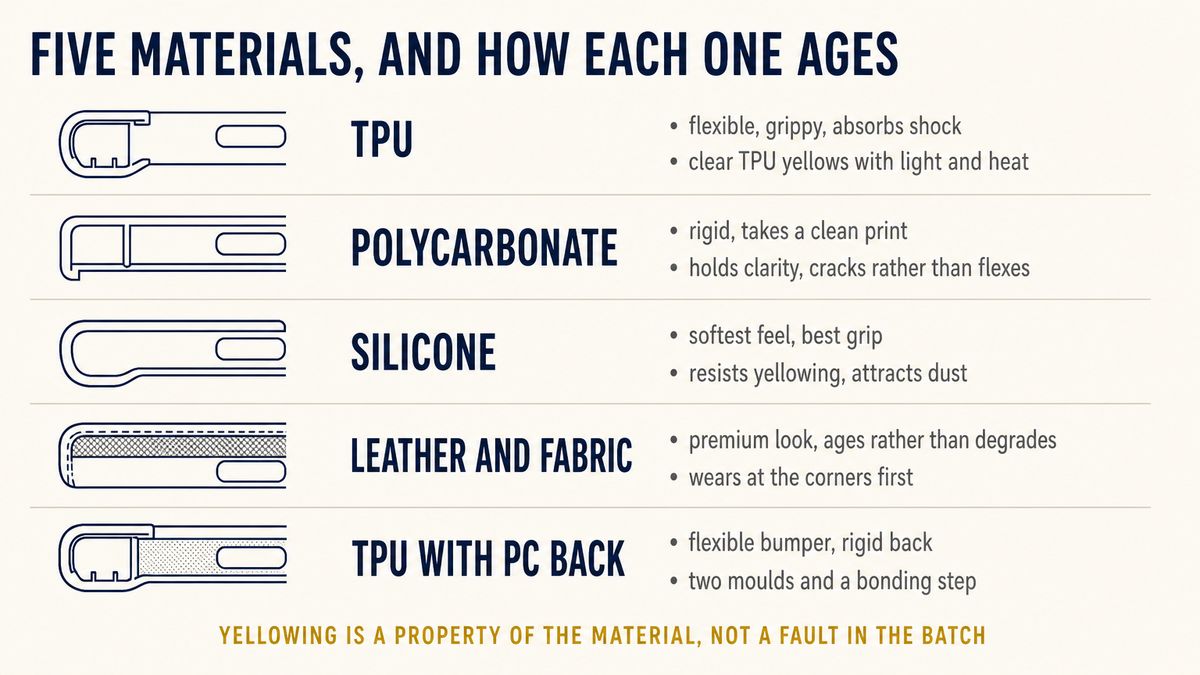
The material decides how the case feels, how it protects, and how it looks in six months. It is also the specification most often written as a brand name rather than a grade, which is why two cases that are both described as TPU can behave differently.
| Material | What it is good at | How it ages |
|---|---|---|
| TPU | Flexible, grippy, cheap to mould, absorbs shock well. The default for slim cases and for the bumper section of a two-part case. | Clear TPU yellows. This is the single most common quality complaint in the category and it is a property of the material rather than a fault in the batch. |
| Polycarbonate | Rigid, hard, holds its shape, takes a clean print. Used for hard shells and for the back panel of a hybrid case. | Keeps its clarity far better than TPU, and resists scratching better on the back. It cracks rather than flexes, so it does not absorb impact on its own. |
| Silicone | Softest feel, excellent grip, very good at resisting yellowing. | Attracts dust and lint, which is a real complaint from customers even when the material is performing correctly. Harder to print on than the other two. |
| Leather and fabric | Premium look, and it ages rather than degrades, which some buyers treat as a feature. | Wears at the corners first. Adhesion to a plastic shell is the manufacturing risk, and it is worth asking how the leather is bonded. |
| Hybrid, TPU with a PC back | The compromise most brands settle on: a flexible bumper that absorbs impact and a rigid back that prints crisply and stays clear. | Two materials means two suppliers, two moulds and a bonding step. More reliable in appearance and more complex to make. |
Yellowing, and why you cannot order your way out of it
Case suppliers describe the mechanism consistently: standard TPU yellows through photo-oxidation, which is a change in the material caused by light and heat rather than soiling on the surface. That distinction matters because it tells you what will not work. You cannot clean it off, and no amount of careful packing will prevent it, because the change happens after the customer opens the box.
What the trade does instead is delay it. Anti-yellowing grades rely on UV inhibitors and additives that slow the change rather than stop it. That gives you three honest options, and no fourth.
- Specify an anti-yellowing grade and test it. Ask for the grade name, and ask what UV exposure test was run and for how long. A supplier who cannot name the grade is quoting a category, not a material.
- Move the clear part to polycarbonate. If clarity is the selling point, put the transparent part in a material that holds clarity, and keep TPU for the parts that need to flex.
- Give the customer something to compare against. Cases that ship with a clear TPU component and a photograph of it after six months in daylight will get fewer complaints than cases that promise permanent clarity.
3. Moulds and Tooling: Why the Case Is Priced by the Tool
Injection moulding works by filling a machined cavity with melted plastic. The cavity is the product. Everything about the shape you are selling was decided when that cavity was cut, which is why the tool deserves more of your attention than the invoice suggests.
What the tool decides, permanently
Once the mould exists, you can change the colour, the material grade, the printing and the packaging. You cannot change the outline, the camera opening, the button positions, the thickness of the wall or the depth of the lip around the screen without cutting a new tool or modifying the old one. Small changes are sometimes possible by welding and re-machining the cavity, but that is a repair with a cost and a risk, not a design change.
This is the practical reason to spend money on a physical sample before tooling rather than after. A 3D-printed or CNC-machined prototype is not the production part and does not feel like it, but it is dimensionally close enough to hold against the phone and answer the questions that matter: does the camera clear, do the buttons line up, does the case stay on.
Why the cavity count matters to your minimum
A mould can have one cavity or several. A multi-cavity tool makes several cases per cycle, so each unit costs less to mould, but the tool costs more and it needs a bigger machine. On a phone case, where the part is small and the volumes are high, multi-cavity tools are normal.
Ask two questions about any mould quote. How many cavities, and what is the smallest run the tool can start economically? The second question is where minimum order quantities come from on this product. A moulding machine has a setup cycle and a minimum sensible run, and no supplier will start a machine to make two hundred cases. If your minimum looks higher than you expected, the mould is usually why.
Get the tool ownership written, and get the tooling drawing. A drawing tells you what shape you are paying for and gives you something to check the first samples against. Ask for it before the tool is cut, not after, because a drawing that arrives with the finished mould is a description rather than a decision. Our factory audit guide covers how to confirm whether the supplier cuts the tool in-house or sends it out, which on phone cases is a common arrangement and a common source of delay.
4. Printing and Decoration: Which Method Survives a Pocket
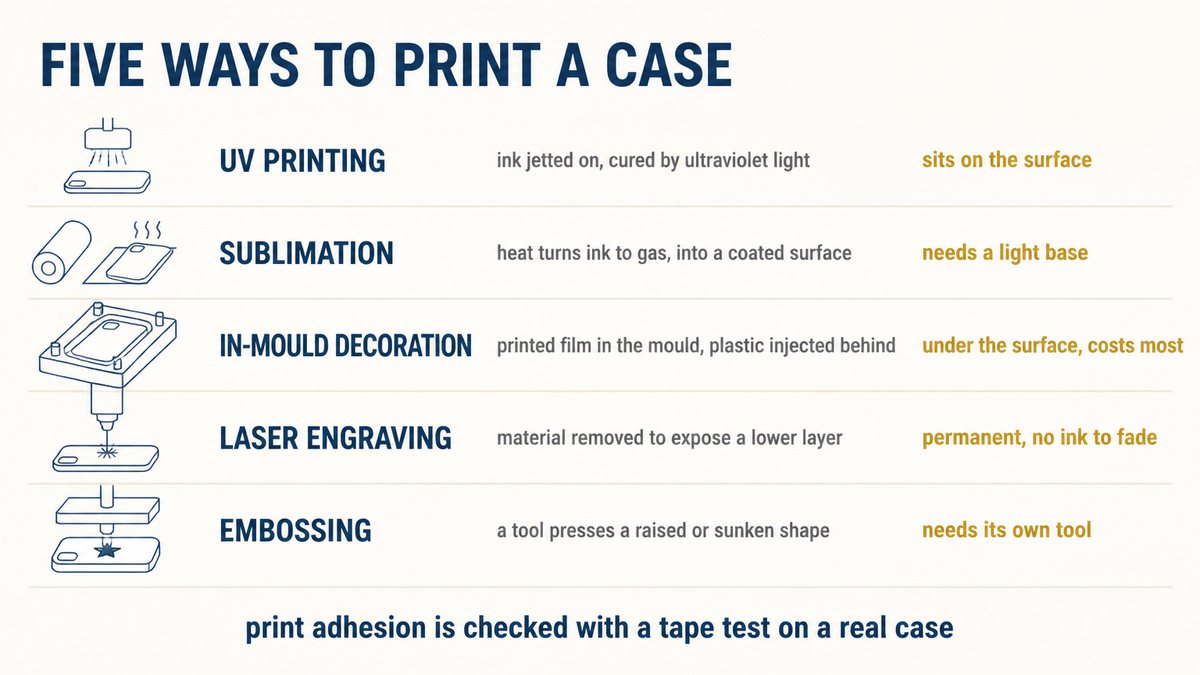
The printing is where a case earns repeat orders or generates returns, because it is the part the customer sees and the part that wears. Five methods cover most production, and the choice is a trade between cost, colour range and how hard the print has to hold on.
| Method | How it works | Where it fails |
|---|---|---|
| UV printing | Ink is jetted onto the surface and cured with ultraviolet light. Handles full colour, photographs and small runs without a set-up plate. | It sits on the surface, so it is the method most likely to wear at the corners and edges. Adhesion depends on surface treatment before printing. |
| Sublimation | Heat turns the ink into gas, which sinks into a coated surface and becomes part of it. | Needs a light or white base, so it struggles on dark cases. The print is durable because it is inside the material rather than on it. |
| In-mould decoration | A printed film is placed in the mould and the plastic is injected behind it, so the design ends up under the surface. | The most durable option and the most expensive, because it needs the film made and positioned. Design changes mean new films. |
| Laser engraving | A laser removes material to expose a different colour underneath, or to cut a pattern into the surface. | Permanent, and it cannot fade, because there is no ink. It needs a two-layer material and it works in one colour per layer. |
| Embossing and debossing | A tool presses a raised or sunken shape into the case and, usually, a printed colour into it. | Adds texture and a premium feel. Needs its own tool, so it is a cost that only makes sense on a simple, repeatable design. |
The test that settles most print arguments
Print adhesion is checked with a tape test, the same method used across the coatings industry. A grid of cuts is made through the printed layer down to the plastic, tape is pressed over the grid and pulled away, and the amount of print that lifts with the tape is rated against a scale. The published method is ASTM D3359, and asking for it by name is the difference between a supplier saying the print is good and a supplier showing you a number.
Run it on a production case, not a flat test plaque. A plaque proves what the print can do on an ideal surface; the interesting failures happen at the curved edge, in the corner radius, and around the camera opening where the print head or the film did not sit flat.
Two habits make the difference between a design that lasts and one that generates complaints.
- Keep the design out of the wear zones. Corners and the edges of the back panel take the abrasion. A design that runs an element across a corner will lose it first, and no print method changes that.
- Treat the surface treatment as part of the specification. Most print failures on plastic are a surface preparation problem rather than an ink problem. Ask what is done to the case before printing, and ask it as a question with a technical answer rather than a yes or no.
If your logo or wordmark goes on the case, the same design file has to work across the sleeve, the tag and the case itself. Our custom logo printing and finishing guide covers how the options differ across those three surfaces.
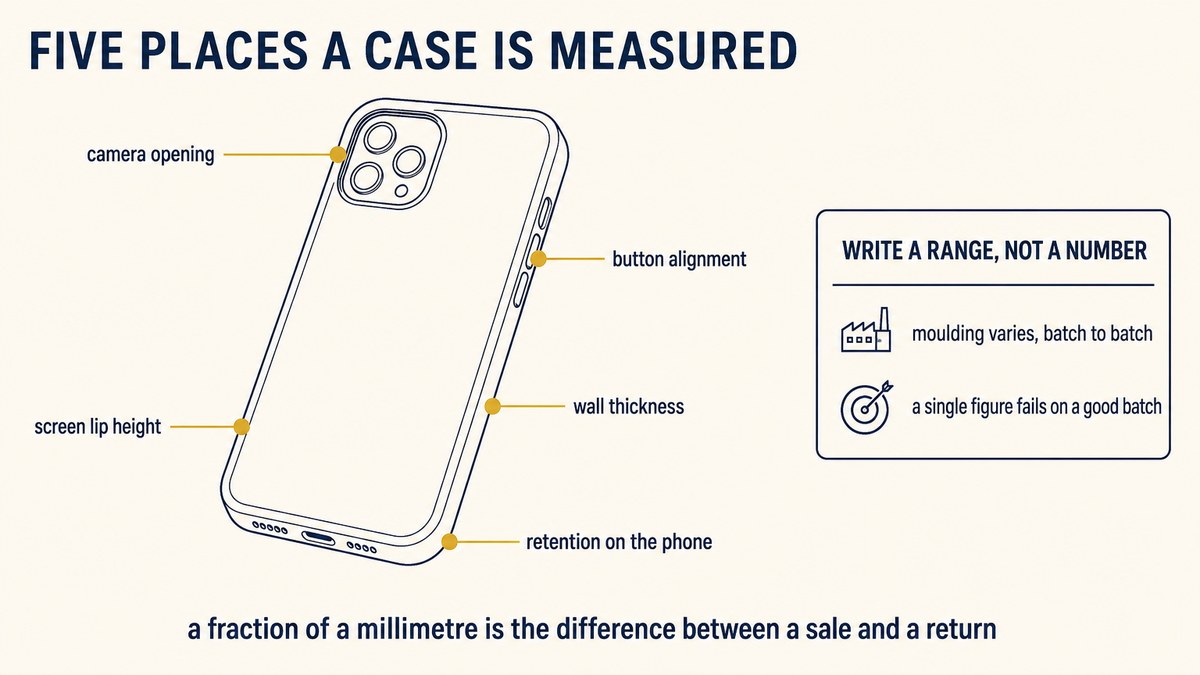
5. Fit and Tolerance: The Fraction of a Millimetre That Decides a Return
A phone case is a close-fitting part, and the difference between a case that delights a customer and one that comes back is often less than a millimetre in one opening. The measurement points are few, which is good news, because it means a buyer can specify them all without a metrology lab.
| What is measured | Why it goes wrong |
|---|---|
| The camera opening | The highest-value complaint in the category. If the opening is a fraction too small, the case blocks part of the lens or the flash, and the customer finds out by taking a photograph. If it is too large, the camera surround is left unprotected and the design looks cheap. |
| Button alignment | Moulded-in button covers have to sit over the real buttons with enough clearance to press and enough contact to feel deliberate. A cover that needs a firm push, or that presses the volume button when the case is fitted, is a return. |
| The lip around the screen | The raised edge that lets a phone be laid face down without the glass touching. Too shallow and it does not protect, too deep and the edge of the screen becomes hard to reach with a thumb. |
| Overall thickness and weight | Straight from the mould design rather than from a measurement. Thicker walls protect more and weigh more, and the customer who wants protection and the customer who wants a slim case are two different buyers. |
| Retention on the phone | Whether the case stays on. A flexible TPU frame grips differently from a rigid polycarbonate shell, and a case that can be shaken loose is a case that will be dropped. |
Two practical points turn this from a list into a specification.
First, give the factory a physical unit. Not a screenshot, not a drawing, not the model name — an actual phone of the exact model you are making the case for. Camera modules differ between models that look identical from the front, and between regional variants of the same model. A dummy unit is what the factory fits against, and it is the reference the first samples are checked on.
Second, write a tolerance range rather than a single number. Moulding is a repeatable process with normal variation, so a specification that says the camera opening is 34.2 millimetres will fail on a good batch. A specification that says 34.2 millimetres with a stated plus-or-minus range gives the factory something to aim at and gives you something to inspect against. Our first article inspection guide sets out how to agree those numbers before the tool is cut rather than after the first batch arrives.
6. Magnets: The One Part With a Safety Rule Attached
Magnetic cases exist because customers already own magnetic wallets, chargers and car mounts, and a case that does not work with them is a case that gets returned. The magnets are also the only component in a phone case that has a mandatory consumer safety rule written about it, so this is the section worth reading twice.
What the rule actually covers
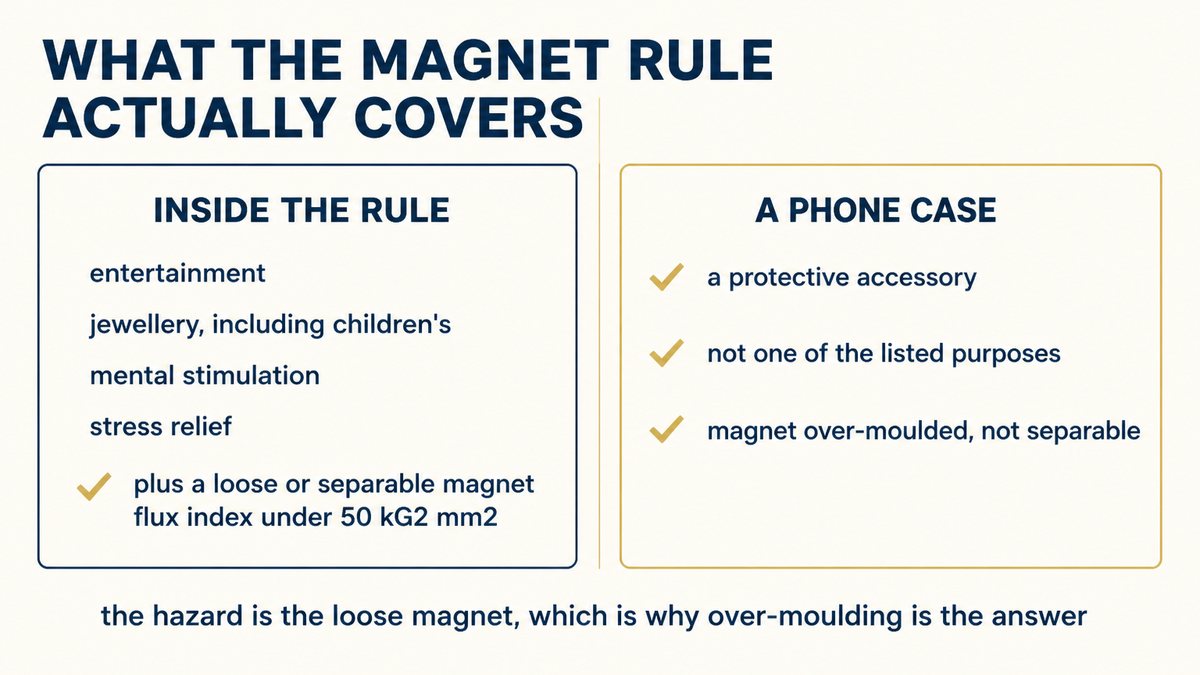
The rule is 16 CFR Part 1262, Safety Standard for Magnets. Read the scope carefully, because the precise wording decides whether it applies to you. Under the rule, a "subject magnet product" is a consumer product designed, marketed, or intended to be used for entertainment, jewellery (including children's jewellery), mental stimulation, stress relief, or a combination of these purposes, and that contains one or more loose or separable magnets.
That definition is a list of purposes. A phone case is a protective accessory, and protecting a phone is not on the list. So a magnetic phone case sold as a phone case is not, on the face of it, a subject magnet product — and it is worth saying that plainly, because a lot of marketing copy implies otherwise.
Three parts of the rule are still worth carrying into your design, though.
- The requirement, for when it does apply. Each loose or separable magnet that fits entirely within the small-parts cylinder must have a flux index below 50 kG² mm², measured using the procedure in ASTM F963-17. If you also sell a magnetic fidget, a stress-relief item or a piece of magnetic jewellery, you are inside the rule and that number is your limit.
- The scope excludes some buyers but not some products. Products sold and distributed solely to educators, researchers, professionals and commercial or industrial users are not subject magnet products, and toys covered by 16 CFR part 1250 are exempt. Neither of those helps a consumer accessory.
- The date. The rule applies to subject magnet products manufactured after 21 October 2022, so it is the current standard rather than a recent proposal.
Why the rule exists, in numbers
The rule's own published findings state the case for it. An estimated 26,600 magnet ingestions were treated in United States hospital emergency departments between 1 January 2010 and 31 December 2021, with about 5,000 involving identified subject magnet products and a further 20,000 involving unidentified magnet products that are likely to have been in scope. The same findings record five fatal magnet ingestion incidents in the United States between November 2005 and January 2021, four of which involved children two years old or younger.
The mechanism those findings describe is the reason a single magnet is far less dangerous than two. One magnet may pass through. Two, or a magnet and a piece of metal, can attract each other through body tissue and pinch it, with the injuries listed in the findings including bowel obstruction, perforation and sepsis.
What this means for a case design
Here is the sentence to take away: the hazard is the loose or separable magnet. Every design answer follows from it.
A magnet array that is over-moulded into the case, so the plastic encloses it completely, cannot be separated by a customer and cannot be swallowed. A magnet array that is glued into a recess, or held behind a sticker or a printed film, can come free — and a case that fails in that way has produced exactly the object the rule was written about, in a product aimed at adults, carried by adults, and left on a table within reach of a child.
The cylinder the rule uses comes from 16 CFR Part 1501, the small-parts method, and that part is worth knowing for a second reason: it defines how a detached component is judged. Under § 1501.4 a part that has come free during use-and-abuse testing is tested in the cylinder one piece at a time, and if it fits entirely without being compressed, the article fails. Part 1501 itself applies to toys and articles intended for children under three years old, so it does not cover a phone case. But it gives you the right question to ask your own design, and the same cylinder is the one the magnet rule points at. The exempt list in that part also shows where the line is drawn — children's clothing and accessories such as buttons, and grooming products such as toothbrushes and barrettes, are exempt from it, which tells you that the rules track the age the product is intended for.
Specifying the magnetic function
Separately from the safety question, the magnets are a product feature, and an under-specified array is why reviews say the wallet falls off. Four lines belong in the specification.
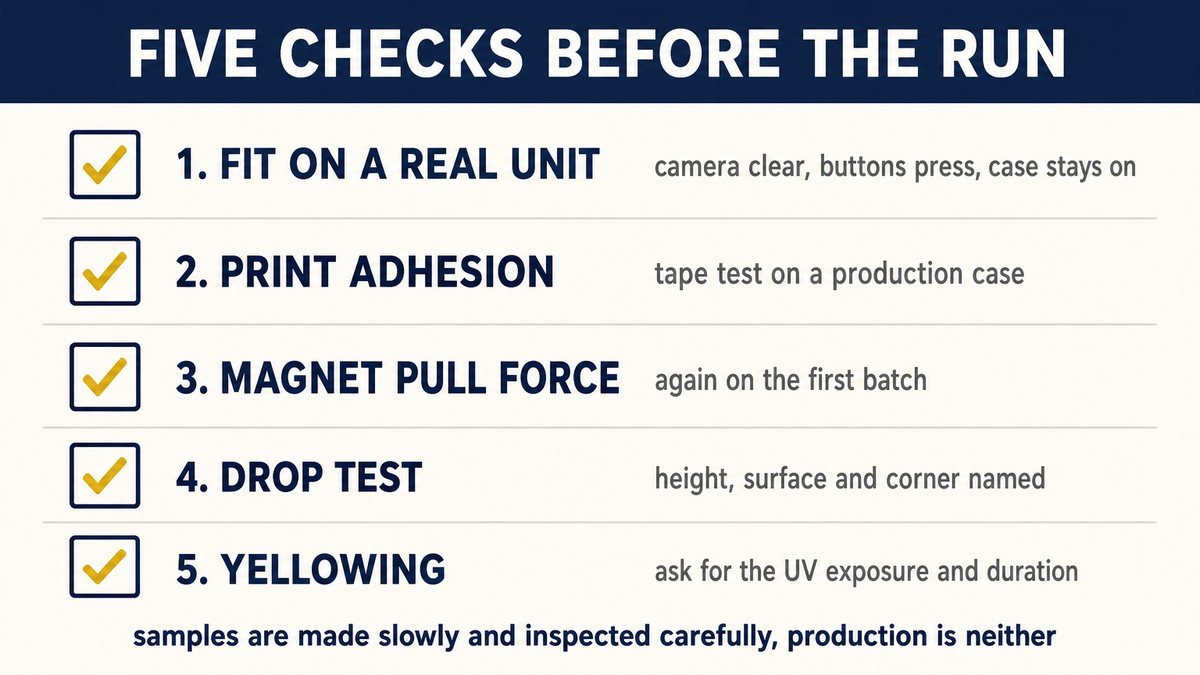
7. How to Test a Case Before You Order the Run
Sample approval on a phone case is about proving five things, and only one of them needs equipment you do not have. Run them on a sample from the production tool, not on a prototype, because the prototype was made by a different process and will not tell you what the mould will do.
- Fit, on a real unit. Camera opening clear, flash unobstructed, buttons press correctly, screen lip present, and the case retained when shaken. Do this on the exact model and variant you are selling, and photograph the corners and the camera area so there is a record.
- Print adhesion. Ask for the tape test result, and run your own on one sample. Print a copy of the design in an unusual place if that is what you sell, because print behaviour at a corner radius is different from print behaviour on a flat back.
- Magnet pull force. Measured on the sample and again on the first production units. If the number drops between the sample and the batch, the array is shifting or the grade has changed.
- Drop test, with the three variables named. Height, surface and the point of the case that takes the fall. A number without those three means nothing, and it is why "military grade" should not appear on your packaging without a test report behind it.
- Yellowing, if the case is clear. Ask what UV exposure test the supplier ran and for how long, and treat the answer as evidence rather than a claim. On a clear case this is the test most likely to save a refund programme.
Then repeat the checks on the first delivery rather than trusting the sample. Samples are made slowly and inspected carefully; production is neither. Our pre-shipment inspection guide covers how to write the brief so it comes back with measurements and photographs rather than an opinion about quality.
8. Minimum Order, Private Label and the Wholesale Route
Two numbers drive the minimum on a phone case order, and neither is the printing. The first is the mould: a machine run has to be long enough to be worth starting, and on a new tool the supplier wants the run to cover the mould's own cost. The second is the magnet or hardware component, which is bought in minimum quantities from a separate supplier and cannot be bought in ones and twos.
That produces the pattern most buyers meet. A stock design in a stock colour has a low minimum, because the tool already exists and the machine is already set up. Your own design has a high minimum, because you are paying for the tool. Your own design in several colours raises it further, because each colour is a separate run with its own setup. And a stock design with your own printing sits in between, which is why it is the usual first order for a new brand.
| Route | What you pay for | What it means |
|---|---|---|
| Stock design, stock colour, your printing | Print setup and your own artwork | The lowest entry point and the fastest to market. You do not own the shape, so you cannot stop another brand selling the same shell with a different print. |
| Stock design, your own colour and finish | A colour run plus printing | A middle step. The shape is still shared, but the product looks like yours, and you find out how the supplier performs before buying a tool. |
| Your own design and your own tool | The mould, the design work, and the first run | The only route that gives you a product nobody else has. Budget for the tool as a separate decision from the production order, and fix the ownership in writing. |
Wholesale works differently from private label, and buyers often mix the two up. Buying wholesale means buying cases that already exist, in the colours they already exist in, at a price that falls with quantity. It is the right route if you are testing whether a category sells at all, and the wrong one if the whole proposition is your own design. Ask any supplier which of their products are stock and which are tooled to a specific customer, because the answer tells you how much of what you are being shown is actually available to you.
9. A Five-Step Sourcing Roadmap
- Decide the route before the design. Stock and printed, or your own tool. Everything else — minimum, timeline, cost and how much control you have — follows from that one choice, and changing your mind later costs the tool.
- Write the material and the print method by name. A grade for the plastic, a named method for the print, and an adhesion test specified on the order rather than mentioned afterwards.
- Send a physical phone, not a picture of one. Then agree the measurement points and a tolerance range before the tool is cut.
- Specify the magnet array properly, and require over-moulding. Grade, layout, pull force and encapsulation, with the retention method confirmed in writing.
- Test the sample, then test the first delivery. Fit, print adhesion, pull force, drop and yellowing on the sample, and at least fit, weight and pull force again on the first batch.
Everything in this guide sits inside our Electronic Products sourcing hub, which collects the consumer electronics and accessory guides in one place.
10. Frequently Asked Questions
Is a magnetic phone case covered by the magnet safety rule?
On the face of the rule, no. Under 16 CFR Part 1262 a subject magnet product is a consumer product designed, marketed or intended for entertainment, jewellery including children's jewellery, mental stimulation or stress relief, and containing one or more loose or separable magnets. A protective phone case is not intended for any of those purposes, so it does not meet that definition. What the rule does give you is the reason to care about the design. Its own published findings describe an estimated 26,600 magnet ingestions treated in United States hospital emergency departments between 2010 and 2021 and five fatal magnet ingestion incidents, four involving children two years old or younger, and the hazard it identifies is a loose or separable magnet. So even though a case is outside the rule, the design principle it rests on applies directly: the magnet must not be able to come free.
Why does my clear case turn yellow?
Because of the material, not the batch. Case suppliers explain it the same way: standard TPU yellows through photo-oxidation, a change caused by light and heat, rather than through soiling on the surface. That distinction is what matters commercially, because it means you cannot clean it off and careful packing will not prevent it — the change happens after the customer opens the box. Anti-yellowing grades rely on UV inhibitors and additives that slow the process rather than stop it. If clarity is central to the product, the durable answer is to move the transparent part to polycarbonate, which holds its clarity much better, and keep TPU for the parts that need to flex. And it is worth avoiding any claim of permanent clarity on the packaging, because no supplier can support it.
What is the minimum order for a custom phone case?
It depends on which route you take, and the tool is usually the reason. If you are printing your artwork onto a stock design in a stock colour, the minimum is low because the mould already exists and the machine is already set up — you are buying a printing run. If you want your own shape, you are buying a mould, and the supplier needs the first production run to be long enough to justify cutting it, which pushes the minimum up sharply. Adding colours pushes it up again, because each colour is a separate run. The usual first order for a new brand is a stock design, one colour, with your own printing, and it is a sensible way to find out how a supplier performs before you pay for a tool.
Which printing method lasts longest?
In-mould decoration generally lasts longest, because a printed film is placed in the mould and the plastic is injected behind it, so the design ends up beneath the surface where nothing can rub it off. It is also the most expensive, and every design change means new films. Laser engraving is permanent in a different way — it removes material rather than adding ink, so there is nothing to fade, but it works within the colours of the layers underneath. Sublimation sinks the ink into a coated surface, so it is durable but needs a light base. UV printing is the most flexible for full-colour and short runs, and the most exposed, because the ink sits on the surface. Whichever you choose, the practical test is a tape test for adhesion on a production case rather than a flat sample.
Is "military grade" a real specification for a phone case?
It is a marketing phrase until you attach a test to it. What matters is which standard was used, at what drop height, onto what surface, and with the case landing on which part. A drop result without those four details cannot be compared with anything, including another supplier's result. So ask for the test report and read those variables off it, then decide whether the test resembles the way customers actually drop phones. A case tested by dropping it flat onto a hard floor tells you little about a corner impact onto a pavement, which is the failure customers report most often.
Do I own the mould if the factory pays for it?
Only if the agreement says so, and the default arrangement usually goes the other way. Whoever pays for the tool normally owns it, so a factory that funds the mould to win your order keeps the shape. That matters commercially more than it first appears: the shape is the product, so if the supplier owns it they can run the same case for someone else, and moving to a new supplier later means paying for a new tool and matching a shape you never controlled. Handle it before the tool is cut. Put the ownership in the agreement in writing, along with the right to have the tool moved to another supplier, and ask for the tooling drawing so you know what shape you are paying for.
Get the Tool, the Material and the Print Specified Before You Order
Our team writes the specification for the mould, the material grade and the print method, agrees the measurement points and the tolerances before the tool is cut, confirms the magnet array is over-moulded, and runs the fit, adhesion and pull-force checks on the first batch.
Request a Phone Case Sourcing Quote
Questions & Comments
We read every one and reply within 24 hoursCOMMENTS INTRO FOR THIS ARTICLE — write a topic-specific question prompt here.