
Hair Extension Supplier Guide: Remy Grades, Weft Types, Weight and Customs
 ·
Updated October 9, 2026
·
24 min read
A hair extension price is built on three things: the grade of the hair, the weight of the bundle, and the construction of the weft. Change any one of them and the price moves more than the difference between suppliers ever will. This guide covers how hair is actually graded and traded, why the cuticle direction matters more than the label on the bag, how weight and length trade against each other, what the processing does that shows up three weeks later, and how the material you claim decides the customs code the shipment travels under.
What to Order, and What to Ask For, by the Kind of Buyer You Are
| If you are | Order this | Because |
|---|---|---|
| Selling bundles to salons | Cuticle-aligned human hair, machine weft, stated weight dry | Stylists notice shedding and matting before anyone else. A machine weft with aligned cuticles survives repeated washing, and a stated dry weight is the only weight you can check. |
| Starting a brand on a small budget | A stock colour, a stock length, and your own label | The colour and length ranges are what multiply the minimum order, not the hair itself. Two lengths in one natural colour is a real product line; ten lengths in eight tones is a warehouse. |
| Building a wig line | A named lace type, with the closure or frontal specified separately | The lace decides the hairline and the price more than the hair inside it. Say which lace, because the same wig specification against three different laces is three different products. |
| Selling tape-in or clip-in | Lighter hair per piece, with the adhesive or clip specified as a line item | The attachment is a separate component with its own supplier. If it is not broken out on the quotation you cannot compare two offers, and the tape is the part that fails first. |
| Importing for the first time | One material, one subheading, and the invoice wording checked before shipping | The customs classification is decided by what the hair is made of. A loose claim on the invoice does not just misdescribe the goods, it puts the shipment in the wrong duty line. |
| Buying for a market that tests | The same order plus a testing plan agreed before deposit | Testing is charged per sample per test and it is almost never in the unit price. Adding it after the quantity is fixed means paying for it with no volume to spread it across. |
1. What a Hair Extension Quotation Covers
A quotation for hair is a quotation for a raw material, not for a manufactured product. That single difference explains most of the confusion first-time buyers run into, because the price moves with whatever the hair cost that month rather than with a fixed bill of materials.
Hair is a traded commodity. It is bought by weight from collectors and agents, sorted, washed, processed and then bundled. When you ask a supplier for a price on 20-inch bundles, you are asking for a price on an amount of a material whose cost changed when the last lot was bought, which is why a quote can be valid for a week and not a quarter.
- The hair itself
- The largest line by far, and the one that moves. Priced by weight and by length, and the two are not independent — a longer bundle of the same weight is thinner, because the same mass is spread further.
- The processing
- Washing, sorting, treating and dyeing. Cheap processing is where a bundle that feels perfect in the bag turns into one that tangles after three washes, and it is invisible at the moment you buy.
- The weft
- Machine sewing, hand-tying, or bonding to a strip. This is skilled work and it is priced per piece rather than per gram, so a hand-tied weft can cost several times a machine weft on the same hair.
- Attachment parts
- Tape, clips, keratin bonds, micro-rings. Separate components with their own suppliers, and usually quoted as separate lines if they are quoted at all.
- Labels and packaging
- Your brand tag, the bundle band, the bag. Small money per unit and the fastest part of the order to change, so it is worth keeping separate so you can reorder quickly.
2. Remy, Non-Remy and Cuticle Direction
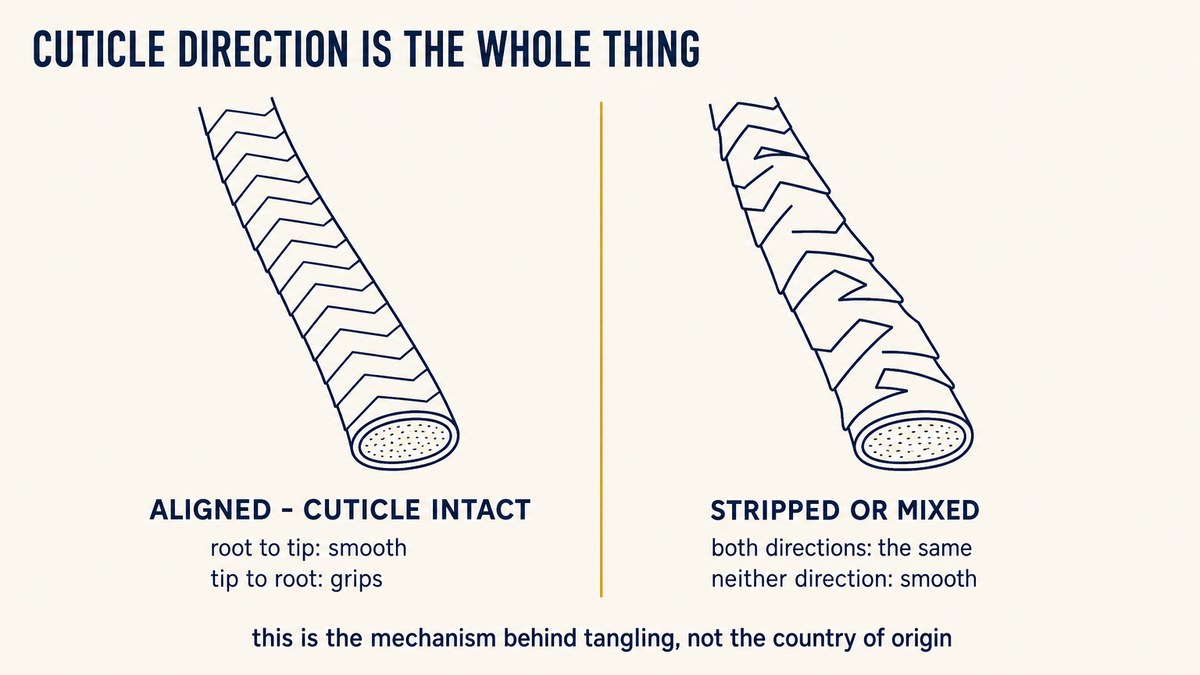
If you take one thing from this guide, take this: hair behaves well or badly depending on which way the cuticles point. Human hair strands have overlapping scales that lie in one direction, from root to tip. If every strand in a bundle points the same way, the surface is smooth, and the bundle stays smooth as it is washed and brushed. If the strands are mixed, or the cuticles have been stripped off, the scales interlock with each other like teeth, and the hair tangles into itself.
That is the whole mechanism behind every quality complaint you will ever receive about tangling, matting or shedding. It has almost nothing to do with the country the hair came from and almost everything to do with how it was handled.
What Remy actually means, and what it does not
Remy describes hair that has been kept in one direction with the cuticle intact. Non-Remy, sometimes sold as cuticle-stripped, has had the outer layer chemically removed so that the natural direction stops mattering, because there is no cuticle left to interlock.
Here is the part buyers rarely hear. Remy is not a regulated standard. No law defines how much of a bundle must be aligned for it to be called Remy, and there is no certificate that settles it. It is a trade word, and trade words are worth exactly what the person selling them means by them.
So do not treat Remy as a checkbox. Treat it as a claim that has to be tested, and test it the way the trade tests it. Take a few strands, hold them between finger and thumb, and run from root to tip, then tip to root. On aligned hair, one direction is smooth and the other grips slightly. On stripped or mixed hair, both directions feel the same, and neither is smooth. That difference is the whole thing, and no photograph can show it.
3. Where the Hair Comes From: Xuchang and the Origin Question
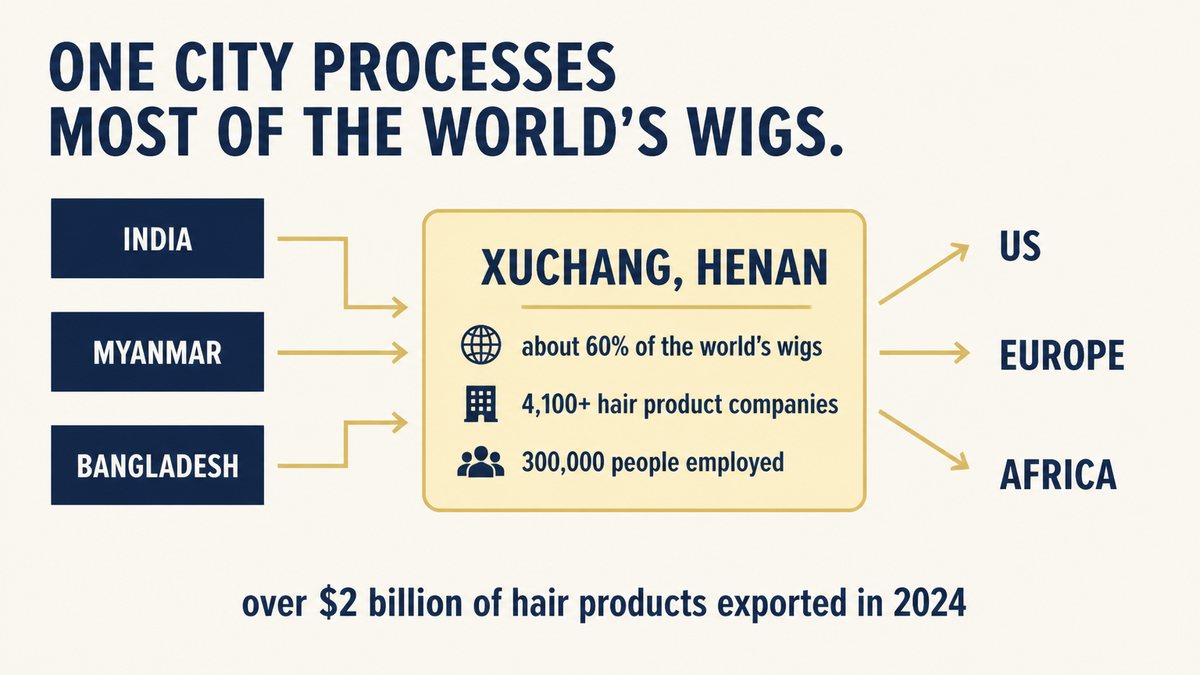
Almost every wig and extension sold anywhere starts its manufacturing life in Xuchang, a city in Henan province in central China. The city produces around 60% of the world's wigs, is home to more than 4,100 hair product companies, and employs roughly 300,000 people in the industry, according to reporting on the city's export trade, which also puts its 2024 hair product exports above $2 billion.
The useful thing to understand is that Xuchang is a processing hub, not a source of hair. The hair itself is collected elsewhere and brought there. Reporting from the city notes that the origin of the raw hair has shifted over time from the Chinese mainland toward India, Myanmar and Bangladesh on cost, and that even the largest wig manufacturer based there draws more than 60% of its human hair from India, as described in this report on the Xuchang hair industry.
Why the origin label on a bundle is a story, not a fact
This is where a lot of brand-building runs into trouble. Hair sold as Brazilian, Peruvian or Malaysian is a description of a texture and a set of handling properties, not necessarily of a farm. The trade uses those names to describe how the hair behaves, and the actual collection point can be somewhere else entirely.
Two consequences follow, and both are practical.
First, do not build a premium claim on a country name you cannot support. If you market Brazilian hair, you are making a claim about origin. Ask your supplier, in writing, where the hair in this specific lot was collected, and keep the answer. If they cannot tell you, the name is a marketing word and you should price and describe it as one.
Second, the origin question is also a customs question. Where goods are processed decides what the country of origin statement should say, and the wording is narrower than most suppliers assume — our origin marking guide walks through the accepted forms. When a supplier offers to print whichever country you prefer on the label, the correct answer is no.
What the raw hair costs
Premium human hair is not a cheap input, and it is worth knowing the scale before you judge a quotation as high. Reporting from Xuchang puts the top grade of human hair at up to 30,000 yuan per kilogram, as described in this report on the city's wig industry.
That number does not tell you what your bundle should cost, because the price depends on length, weight, grade and processing together, and the top grade is not what most commercial orders use. What it does tell you is why a quotation that looks suspiciously low is worth questioning rather than celebrating. When a price comes in well below everyone else, the saving is almost always in the grade, the weight, or the processing — and two of those three are invisible at the moment you accept it.
4. Weft Construction: Machine, Hand-Tied, Clip-In, Tape-In, Keratin
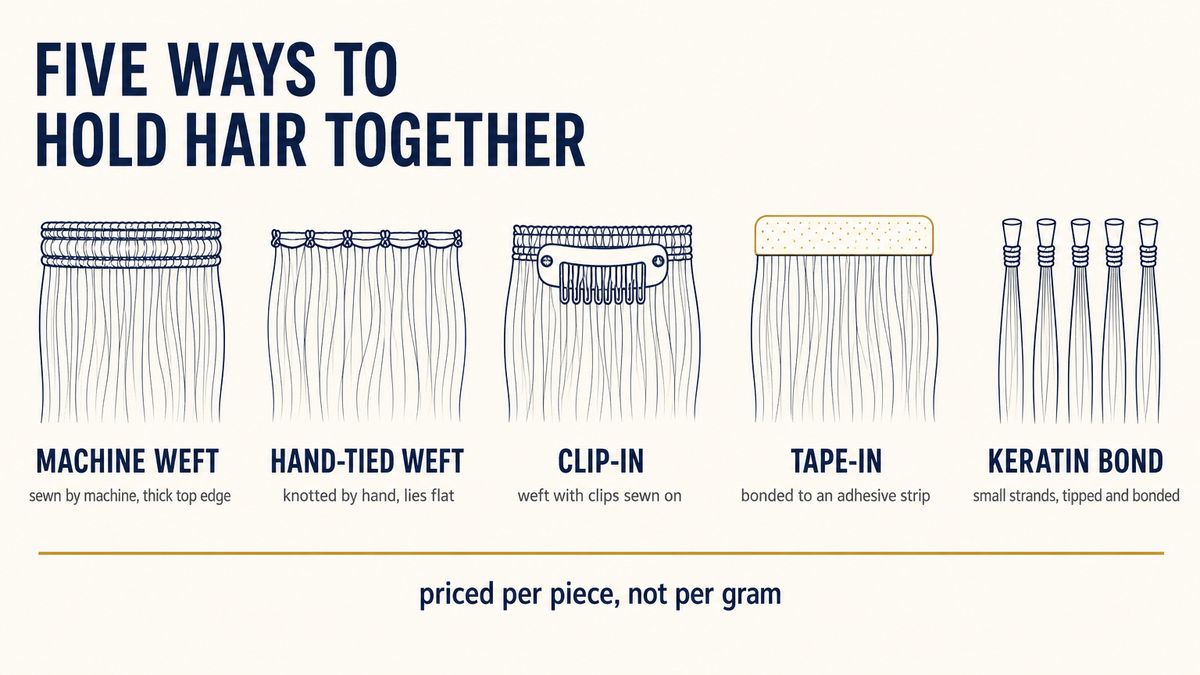
The weft is the strip that holds the bundle together. Ask which construction you are buying, because the same hair in two different wefts is two different products at two different prices, and the difference shows up in how the weft lies against the head and how long it lasts.
| Construction | How it is made | What it means for you |
|---|---|---|
| Machine weft | Hair is sewn across a strip by machine | The cheapest per piece and the most common. It is thicker at the top edge, which can show through fine hair. |
| Hand-tied weft | Hair is knotted into a thin strip by hand | Lies flat and moves like natural hair. Skilled piece work, so it costs several times a machine weft and takes longer to produce. |
| Clip-in | A machine weft with clips sewn on | The easiest product to sell and the easiest to get wrong, because the clip is the part that fails. Specify the clip, not just the hair. |
| Tape-in | Hair is bonded to a double-sided adhesive strip | The adhesive has its own shelf life and its own storage rules. Heat and time both degrade it, so a batch left in a warm warehouse arrives compromised. |
| Keratin bond | Small strands tipped with a keratin adhesive for individual fitting | Priced per strand, and the bond quality decides whether the tip holds. This is the construction where per-unit work dominates the cost. |
One practical point across all five: the attachment is a separate supply chain. The clips, tape and keratin tips usually come from a different supplier than the hair does, which means changing one does not change the other, and a delivery delay on a small component can hold up an order of finished pieces. Ask which parts are bought in-house and which are bought in, and build the schedule around the slowest one.
When you compare two quotations for the same hair, ask both for the weight per bundle, the number of bundles per kilogram, and the weft construction. Those three numbers, side by side, explain almost every price difference you will see. A quotation that is cheaper on the same weight and the same weft usually has a different grade, and a quotation that is cheaper because the weft is machine rather than hand-tied is not cheaper at all — it is a different product being sold to you as the same one.
5. Length Against Weight: Why the Gram Is the Real Unit
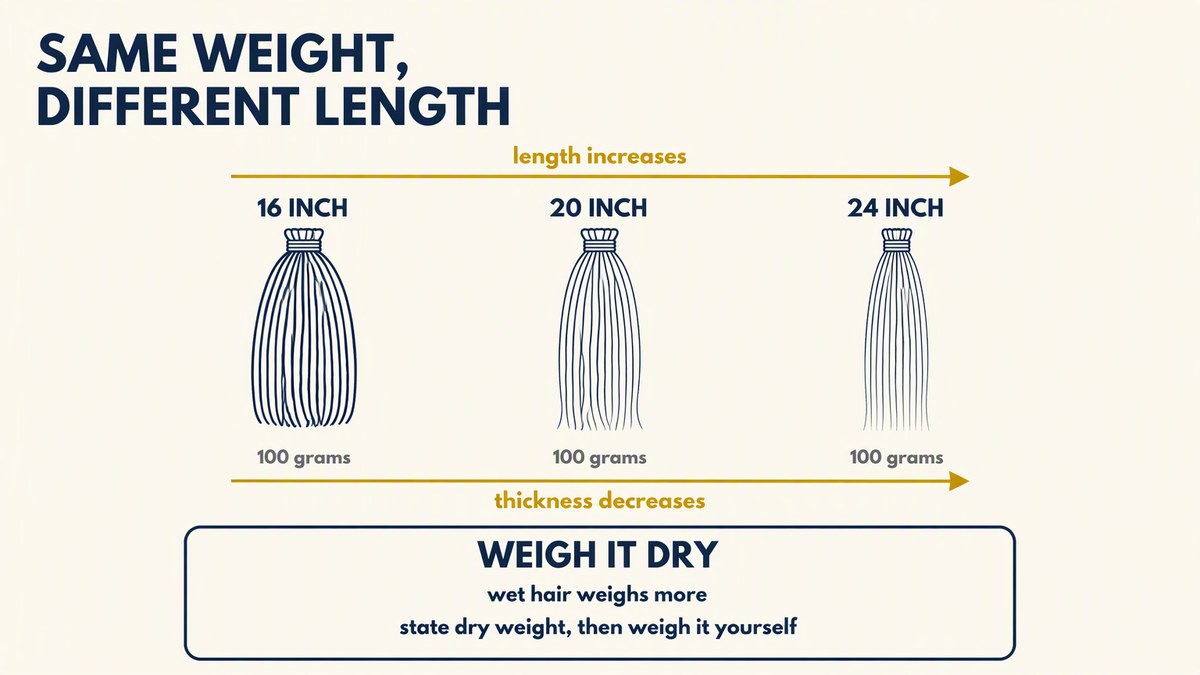
Here is the relationship that trips up almost every first-time buyer. A bundle is sold by weight, and the hair inside it is sold by length. Those two are not independent, because the mass of a bundle is spread across however many strands it contains. Ask for longer hair at the same weight and you get fewer strands, which means a thinner bundle.
So "20 inch, 100 grams" and "24 inch, 100 grams" are not the same amount of hair. The second one is a measurably thinner bundle, and it will not cover the same area of a head. This is why a customer who orders the same weight in a longer length sometimes complains the bundle looks smaller, and why the complaint is correct rather than imagined.
Wet weight and dry weight
There is a second trap underneath the first. Hair is weighed either wet or dry, and wet hair is heavier. A supplier quoting wet weight can offer what looks like a heavier bundle for the same money, and the customer receives less hair than the number implies.
Fix this in one sentence in the specification: state the weight as dry weight, measured after drying, on a calibrated scale. Then check it yourself on arrival with a kitchen scale accurate to a gram. Weighing an incoming bundle takes a minute, and it is the fastest way to find out whether the specification is real.
How to write a bundle specification
- Length in inches, and state whether that is the length of the hair or the length including the weft. The difference is an inch or so, which is enough to matter on a short length.
- Weight in grams, dry, per bundle.
- Grade claim in plain words — cuticle intact and aligned, or cuticle removed — rather than a bare brand word.
- Weft type, named from the five above.
- Colour reference against a physical ring or a sealed sample, not a name.
Five lines. An order without them cannot be inspected, because there is nothing to inspect it against, and a dispute without them is one person's memory against another's. The measurement discipline is the same one that applies to any order — our first article inspection guide sets out the pattern of agreeing the numbers before production rather than after delivery.
6. Colour, Texture and the Processing That Fails Three Weeks Later
Almost all the difference between a bundle that lasts a year and one that tangles in a month is set before you ever see it, in the processing. It happens in the wash, the sorting room and the dye bath, and it is not visible in the bag.
Cuticle stripping, and why it is sometimes fine
Stripping the cuticle is a real technique, not automatically a cheat. Removing the outer layer makes the hair take dye evenly and removes the direction problem, which is why stripped hair is used in some cheap, heavily coloured products. The trouble is that removing the cuticle also removes the protection, so stripped hair needs to be coated to feel acceptable, and the coating is what washes out.
That is the mechanism behind the most common complaint in this trade. A bundle feels silky in the shop because it has been coated. Thirty days later, after several washes, the coating is gone, the unprotected hair is exposed, and it starts to mat. Nothing changed except that the thing making it feel good was temporary.
Colour: specify against a physical reference
Hair colour is described against shade systems and names that vary between suppliers, and natural hair is not a uniform colour to begin with. A shade called natural black by one factory can sit next to a visibly different natural black from another, and both are describing the truth.
The fix is simple and it is the same one that works for denim, leather and any other material with natural variation: approve a physical sample, seal it, date it, and keep a duplicate. Then check production against that sample under a consistent light. A colour name in a quotation is not a specification; a sealed bundle is.
Texture is a word, not a number
Straight, body wave, deep wave, curly — these are the trade's names for pattern families, and they are not standardised. Two suppliers can both send you a deep wave that looks nothing alike. If the pattern matters to your product, define it with something you can compare: send them a reference bundle, or ask for the pattern to be specified by the number of curves over a set length. It sounds fussy and it prevents a whole category of dispute.
7. Lace, Closures and Frontals for Wig Orders
If you are ordering wigs rather than bundles, the lace is where the product is won or lost. It decides how the hairline looks, how the cap breathes, and a large part of the price. Ask for it by name and by base material, because lace comes in several kinds and the names are used loosely.
Two checks matter on any wig order. First, check the lace against the skin tone it is meant for, on a real person or a head form, not held up to a window. Second, check the knots. Hand-tied knots that have not been bleached read as dark dots along the hairline, and that is the single defect most likely to come back as a complaint. Ask how the knots are handled before you approve the sample, and look at the hairline in daylight rather than in a lit room.
The caps, closures and lace usually come from specialist suppliers rather than the wig workshop, which means a wig order has more separate supply lines in it than a bundle order. Our factory audit guide covers how to map which stages a supplier runs itself and which it buys in, and that map is the thing that tells you where a delay will come from.
8. How to Test a Sample Before You Commit
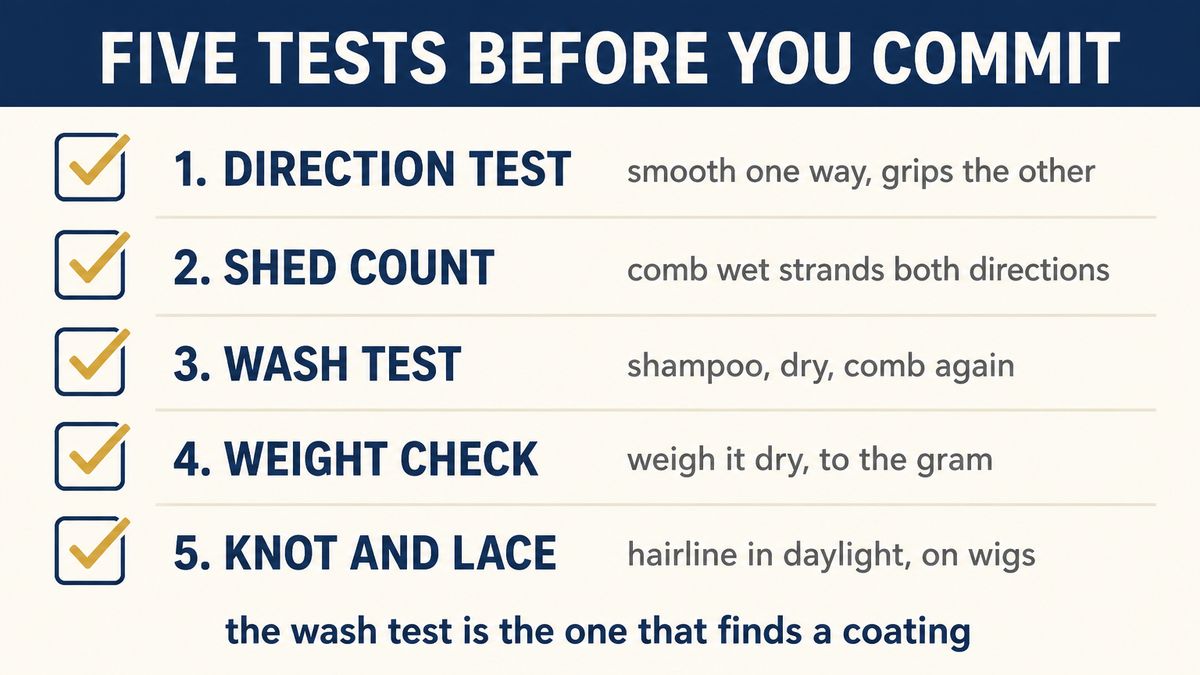
Order a sample of the actual production hair, not a display bundle. Suppliers keep their best hair for samples, which is a sensible commercial habit and a real problem for you, so ask for the sample to be drawn from the lot you would be buying from. Then run five tests.
- The direction test. Run a few strands between finger and thumb, root to tip, then tip to root. One direction should be smooth and the other should grip. Both the same means stripped or mixed.
- The shed count. Comb ten wet strands from root to tip and count what comes away in the comb. Then do it in the opposite direction. A bundle that sheds going both ways is not aligned.
- The wash test. Wash a small section with mild shampoo, dry it, and comb it again. This is the test that finds a coating, and it is the one most buyers skip because the sample felt perfect.
- The weight check. Weigh the bundle dry on a scale accurate to a gram and compare it with the quotation. Do this on arrival of every batch, not just the sample.
- The knot and lace check on wig orders — hairline in daylight, and the knots against the lace.
Run the same five on a production bundle when it arrives. Sampling tells you what the supplier can do; checking the delivery tells you what they actually did, and those are different questions. Our pre-shipment inspection guide covers how to write the inspection brief so it comes back with counts and weights rather than an opinion.
9. MOQ, Private Label and the Code the Shipment Travels Under
Minimum order quantities in this trade are set by the raw material lot and the sorting work, not by the packing line. Sorting hair into matched lengths and tones is hand work, and a supplier cannot justify opening a lot for a small run. The practical consequence is that your minimum multiplies per colour and per length, exactly as the wash multiplies the minimum on a denim order. Two lengths in one tone is a realistic first order; ten lengths in eight tones is a warehouse you have to pay for before you have a single customer.
On private labelling, most of the visible brand value is in three cheap components: the bundle band, the tag, and the bag. Our custom logo printing and finishing guide covers the options for each. They are the fastest part of the order to change and the part most likely to be reused across products, so it is worth getting them right once.
The classification decided by what the hair is made of
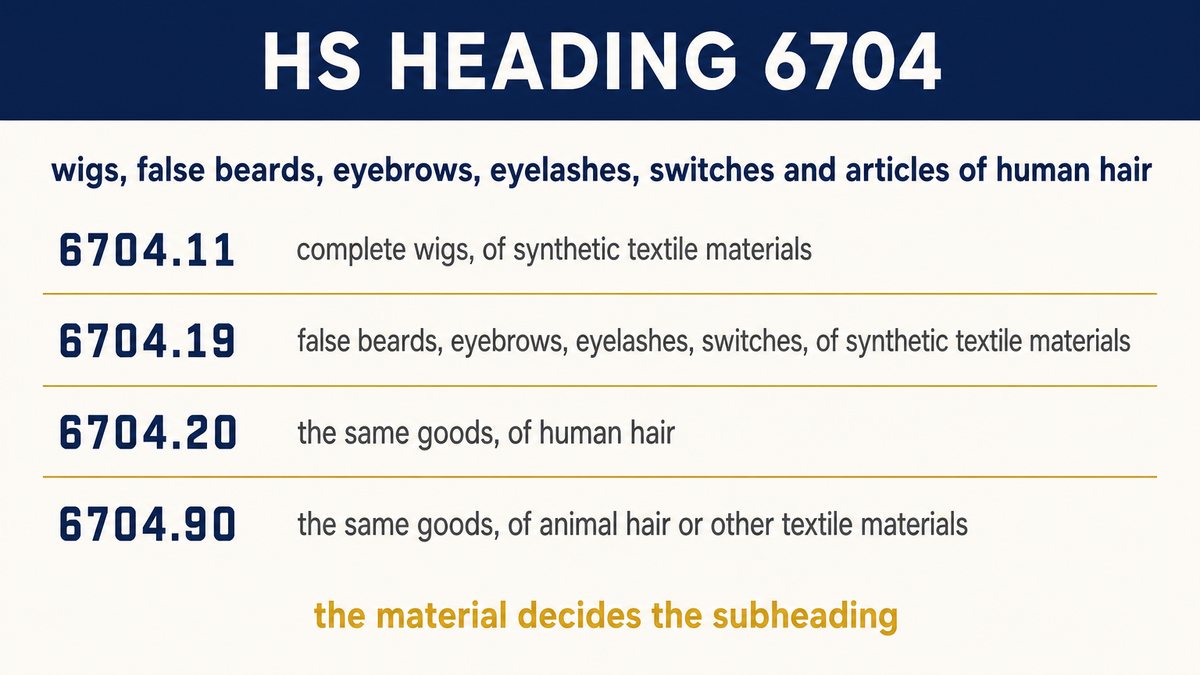
Wigs, false beards, eyebrows, eyelashes and switches, along with articles of human hair not elsewhere specified, sit under heading 6704 of the Harmonized System. The structure of that heading is the important part for a buyer, because the subheadings split by material rather than by finished product. As listed in this reference to heading 6704:
| Subheading | Covers |
|---|---|
| 6704.11 | Wigs, complete, of synthetic textile materials |
| 6704.19 | False beards, eyebrows, eyelashes, switches and the like, of synthetic textile materials |
| 6704.20 | Wigs, false beards, eyebrows, eyelashes, switches and the like and other articles, of human hair |
| 6704.90 | The same goods, of animal hair or of textile materials other than synthetic |
Read that table again with the grade discussion in mind, because the two connect. If the subheading is decided by whether the goods are synthetic, human hair or another material, then whatever the invoice says about the material is what determines the duty line the shipment travels in. A loose description is not a small error on a document. It files the goods as something they are not.
Two habits follow. First, make the invoice describe the goods exactly as they are — if a product is a synthetic blend with a human hair content, say so rather than calling the whole thing human hair. Second, check the duty rate for your own origin and destination combination rather than relying on a number someone quoted you, because rates are set by the pair of countries involved and change. Your freight forwarder or customs broker will confirm the ten-digit code and the rate for your specific case, and that confirmation belongs in the order file.
10. A Five-Step Sourcing Roadmap
- Write the five-line specification. Length in inches, dry weight in grams, the grade claim in plain words, the weft type, and colour against a physical reference.
- Sample from the production lot, and run all five tests. Direction, shed count, wash, weight, and the knots if it is a wig. Approve on the wash test, not on how it feels in the bag.
- Narrow the range before you negotiate the price. One or two lengths in one or two tones. Every added colour and length multiplies the minimum, and the minimum is the real cost of starting.
- Get the material statement in writing, per lot. It supports the grade claim you are charging for, and on the customs side it is the basis of the invoice description.
- Weigh and test the first delivery. The first production batch is where a supplier's real grade shows up, and the scale is the fastest way to find out.
Everything in this guide sits inside our Beauty & Care Products sourcing hub, which collects the beauty, personal care and hair-product guides in one place.
11. Frequently Asked Questions
Is Remy hair a grade or a standard?
It is a trade word, not a regulated standard. No rule defines how much of a bundle must be cuticle-aligned before it can be called Remy, and there is no certificate that settles the question. It describes hair that has been kept in one direction with the cuticle intact, as opposed to hair whose outer layer has been chemically stripped. Because it is a description rather than a standard, it has to be tested rather than trusted. The direction test — running strands between finger and thumb in both directions — tells you more in a minute than any label does, and no photograph can show the difference.
Why is my 24-inch bundle thinner than my 20-inch bundle at the same weight?
Because length and mass work against each other. A bundle is sold by weight, and that weight is spread across however many strands it contains. Take the same 100 grams and cut it longer, and you have fewer strands, which means a visibly thinner bundle that covers less of a head. This is not a supplier short-changing you, it is how the material works, and it is why a customer who reorders a longer length at the same weight sometimes complains the bundle looks smaller. When you write a specification, give the weight and the length together, and expect the thickness to change with the length.
Should I specify wet weight or dry weight?
Dry weight, always, and write the words "dry weight" into the specification. Wet hair weighs more, so a supplier quoting wet weight is describing what the bundle weighed before it dried. On a quotation that looks like a heavier bundle for the same money; on delivery it is simply less hair than the number suggests. State the weight as measured dry, on a calibrated scale, and then check it yourself on arrival with a scale accurate to a gram. Weighing an incoming bundle takes about a minute, and it is the cheapest test in the whole order.
Why does hair that felt silky in the shop tangle after a few washes?
Almost always a coating. Cuticle-stripped hair has no outer protection, so it is coated with a silicone-type finish to make it feel smooth. That finish is temporary, and it washes out over the first several washes. What is left underneath is unprotected hair that grips itself and mats. This is why the wash test matters more than any other check: wash a small section with mild shampoo, dry it, and comb it. If the bundle still feels the same it was quality hair, and if it has turned dry and grippy the smoothness you felt was a coating. Judging a bundle before washing tells you how it was finished, not what it is made of.
Can I choose which country is printed on the label?
No. The country of origin statement has to reflect where the goods were processed or manufactured, and it is a legal statement rather than a marketing choice. This comes up constantly in the hair trade because bundles are sold under country names — Brazilian, Peruvian, Malaysian — that describe a texture and handling properties rather than a collection point. Reporting from Xuchang notes that the raw hair has shifted toward India, Myanmar and Bangladesh on cost, and that even the largest manufacturer based there draws most of its human hair from India. So a country name on a bundle is often a description of behaviour, and if you build a premium claim on it you are making an origin claim you may not be able to support. Ask where the hair in a specific lot was collected, keep the answer in writing, and do not print a country the paperwork does not support.
How do I know which customs code a hair order falls under?
The heading is 6704, covering wigs, false beards, eyebrows, eyelashes, switches and the like, plus articles of human hair not elsewhere specified. What matters is that the subheadings split by material: complete wigs of synthetic textile materials sit in one, the same goods of human hair in another, and goods of animal hair or non-synthetic textile materials in a third. Because the material decides the subheading, the description on the invoice decides the duty line, which is why a loose material claim is a real problem rather than a paperwork detail. Describe the goods exactly as they are, and have your forwarder or customs broker confirm the ten-digit code and the rate for your own origin and destination pair, since rates depend on that combination and change over time.
Get the Grade Tested and the Specification Written Before You Order
Our team writes the five-line bundle specification, samples from the production lot rather than the display stock, runs the direction and wash tests, checks dry weight on arrival, and lines the material statement up with the invoice description so the shipment is classified as what it actually is. You get a comparable quotation and a reorder that matches the sample.
Request a Hair Extension Sourcing Quote
Questions & Comments
We read every one and reply within 24 hoursCOMMENTS INTRO FOR THIS ARTICLE — write a topic-specific question prompt here.