
Sunglasses Manufacturing Sourcing Guide: Frame Materials, Lens Types, Private Label & the Rules That Apply
 ·
Updated October 9, 2026
·
24 min read
Sunglasses look like a fashion product and are regulated like a medical device. That single sentence explains most of the trouble brands get into: a supplier quotes a beautiful acetate frame and a polarised lens, the container ships, and nobody has the certificate that US customs asks for on arrival. This guide covers the frame materials, the lens constructions, the hinges that fail, the private-label routes, and the paperwork that decides whether your order clears or sits at the port.
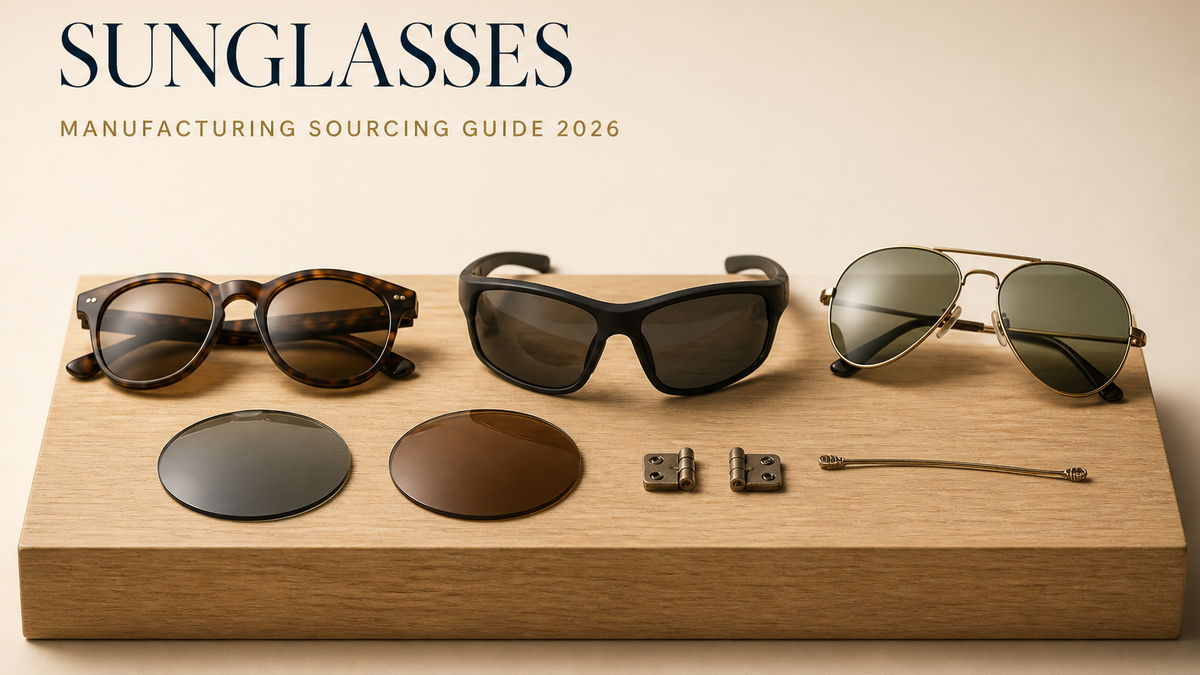
Which Frame and Lens to Order, Matched to What You Are Selling
| If you are selling | Order this | Because |
|---|---|---|
| A premium fashion frame at a high price | Cellulose acetate, cut and tumbled | Depth of colour that cannot be moulded in, warm to the touch, and it takes a hand polish. The most expensive route, and the only one that reads as designer on a shelf. |
| A light sports or everyday frame | TR90 | About a third lighter than acetate and it flexes instead of snapping. Injection moulded, so a new shape means a tool, but the tooling is far cheaper than an acetate line. |
| A metal aviator or wire frame | Stainless steel or beta-titanium | Thin profiles and a premium feel. Beta-titanium costs more and resists fatigue, which matters on a spring hinge that opens and closes daily. |
| A giveaway or promotional pair | Moulded polycarbonate frame, TAC lens | Cheapest combination that still looks correct in a photo. Keep the tint and the shape simple, because decoration cost dominates at this price. |
| Anything with a polarised claim | TAC laminated lens | The polarising film sits between two layers, which is what makes the claim true. Test it yourself by rotating the lens against a screen. |
| Anything entering the United States | Any of the above, plus the lens certificate | A certificate showing the lenses passed an impact-resistance test has to accompany each lot. This is the item most first-time brands do not know they need. |
What this guide covers
- Frame materials: acetate, TR90, metal and titanium
- Lens materials: TAC, CR-39, polycarbonate and nylon
- Coatings, polarisation and lens categories
- Hinges, temples and the parts that fail
- Private label routes: stock, semi-custom and full custom
- The United States rules: registration, the agent and the lens certificate
- Europe: CE marking and the PPE rules
- How to test and inspect a sunglasses order
- A five-step sourcing roadmap
- Frequently asked questions
1. Frame Materials: Acetate, TR90, Metal and Titanium
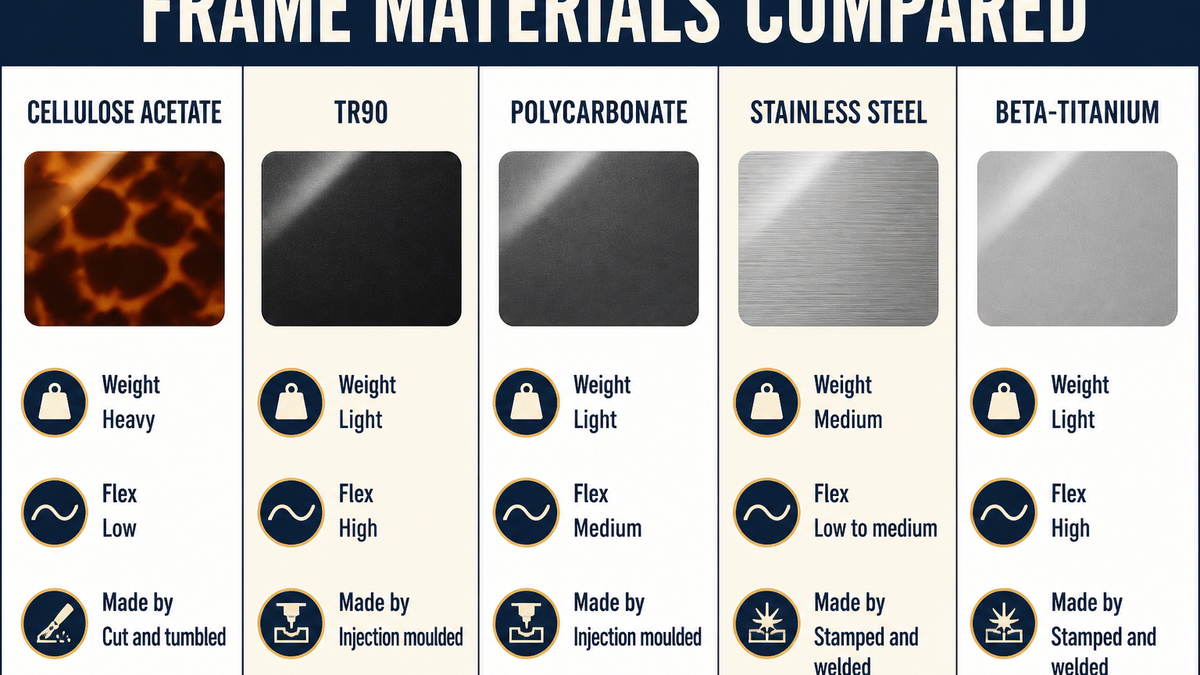
The frame material is the main driver of both cost and perceived value, and buyers usually choose it from a photograph rather than from the manufacturing route. That is the wrong order. Each material is made by a different process, which sets the tooling cost, the minimum order and the range of shapes and colours you can offer.
| Material | How It Is Made | Weight | Flex | Colour Options | Tooling |
|---|---|---|---|---|---|
| Cellulose acetate | Sheet cut and tumbled, or block cut | Heavy | Low | Laminated patterns, tortoiseshell, clear | Cutting and tumbling line |
| TR90 | Injection moulded | Light | High, springs back | Solid colours, limited patterns | Steel mould |
| Polycarbonate | Injection moulded | Light | Medium | Solid colours | Steel mould, cheaper than TR90 |
| Stainless steel | Stamped, formed and welded | Medium | Low to medium | Plating, coating, coloured wire | Press tooling |
| Beta-titanium | Stamped, formed and welded | Light | High, resists fatigue | Limited, usually natural or coated | Press tooling plus welding skill |
Why acetate is the expensive one, and why it still wins
Acetate frames are not moulded. They are cut from a sheet or a block, shaped, and then polished in rotating drums with progressively finer media. That multi-stage polish is why an acetate frame has a depth of gloss that a moulded frame cannot match, and it is also why the process is slower and the tooling is a production line rather than a single tool.
The advantage that matters commercially is colour. Acetate sheet can be laminated so that two or three colours sit in layers through the thickness of the material. When the frame is cut and polished, the layers appear as a pattern that runs through the material rather than sitting on the surface. That is what tortoiseshell actually is, and it is the reason a printed copy never looks the same: a printed pattern sits on top and wears through, while a laminated one is the material itself.
What TR90 actually is
TR90 is a trade name for a family of nylon-based thermoplastic materials used for lightweight frames. The practical properties a buyer cares about are that it is noticeably lighter than acetate, that it bends and returns rather than cracking, and that it can be moulded into shapes with thin sections that would be fragile in acetate.
The trade-off is colour and feel. TR90 takes solid colours well and patterns poorly, and it never feels like a hand-finished material, because it is not one. That is not a defect; it is the correct choice for a sports frame where weight and flexibility matter more than material richness.
Metal frames and the fatigue question
Metal frames are stamped and formed from sheet or wire, then welded and plated. The material decision that matters most is whether the frame is stainless steel or beta-titanium, and the reason is fatigue rather than weight. A spring hinge loads the temple every time it opens, and a temple that fatigues will eventually crack at the weld. Beta-titanium resists that cycle far better, which is why it appears on frames that carry a warranty.
2. Lens Materials: TAC, CR-39, Polycarbonate and Nylon
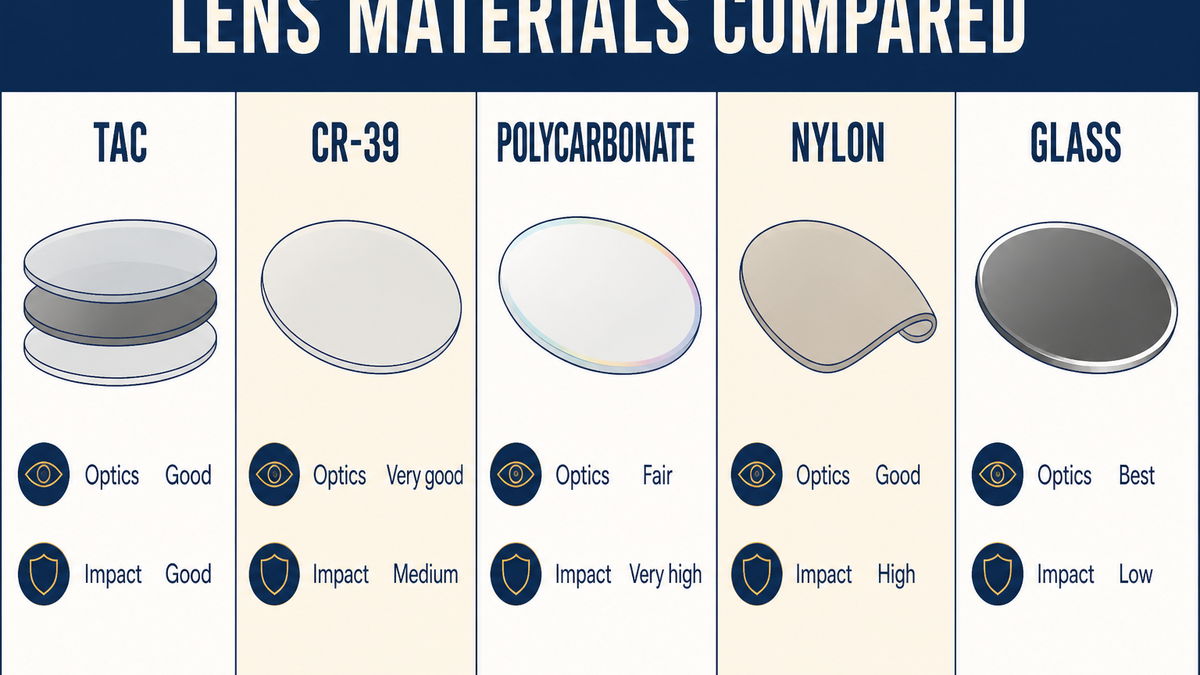
Lens choice is usually treated as a tint decision. It is really a construction decision, because the material determines what protection claims you can make and whether those claims survive a test report.
| Lens | What It Is | Optical Quality | Impact | Typical Use |
|---|---|---|---|---|
| TAC | Laminated layers with the polarising film bonded inside | Good | Good | Everyday polarised sunglasses |
| CR-39 | Cast thermoset plastic | Very good | Medium | Fashion frames where clarity sells |
| Polycarbonate | Injection moulded | Fair, can distort at the edge | Very high | Sports and safety-influenced frames |
| Nylon | Injection moulded | Good | High | Wrap frames and thin profiles |
| Glass | Ground and tempered | Best | Low unless treated | Heritage and high-end optical |
How a polarised lens is actually built, and how to prove it
A TAC polarised lens is a sandwich. A polarising film is stretched so that its molecules line up in one direction, then bonded between layers, with a tint layer and hard coats on the outside. The result is a lens that blocks light vibrating in one plane, which is what removes glare bouncing off water or a road.
You do not need a laboratory to check that the claim is true. Take the lens and hold it in front of a screen such as a laptop or a phone, then rotate it. A genuinely polarised lens will go dark at roughly ninety degrees and clear again as you keep turning. A tinted lens with no polarising film just stays the same shade. Run this on a sample before you print “polarised” on a box, because it is the single most common false claim in the category and it is trivially easy for a customer to disprove.
Ask for the laminated construction in writing, not just the word polarised. A supplier who says “polarised, TAC, 7-layer” has told you the construction. A supplier who says “polarised coating” has described a film applied to the surface, which is a different product and behaves differently once it is scratched.
3. Coatings, Polarisation and Lens Categories
A lens is sold on its coatings as much as its material, and coatings are where a specification quietly gets vague. Each one is a separate line in the bill of materials, so each one is a place where a supplier can save cost without changing the look of the sample.
| Coating | What It Does | How to Check It |
|---|---|---|
| Anti-reflective | Cuts reflection off the back surface, so you see less of your own face | Hold it against a light and look for a coloured sheen; rub a corner with a cloth and check it does not smear off |
| Mirror | A reflective layer on the outside, mostly a fashion finish | Inspect at a low angle for cloudy patches and uneven edges near the rim |
| Hydrophobic | Makes water bead and sheds fingerprints | Breathe on the lens; a treated one clears noticeably faster |
| Hard coat | Scratch resistance on the outer face | Rub with a coin or a key on a sample, never on production stock |
| Gradient tint | Darker at the top, lighter at the bottom | Check the fade line is horizontal across the pair, not sloped from one lens to the other |
| Photochromic | Darkens in sunlight and clears indoors | Take a pair outside into direct sun for a few minutes and time how long the change takes |
Lens categories: the number on the label is a protection grade
Under the European standard for sunglasses, lenses are grouped into categories that describe how much visible light they let through. The category is not a fashion grade. It tells the wearer what the lens is safe for, and category 4 in particular is not suitable for driving because it is too dark to read a dashboard.
Category 3 is the one that covers most sunglasses sold for general outdoor use, and it is the category to specify if you are unsure, because it is dark enough for bright sun and still usable behind a windscreen. The exact transmission figures for each category are set out in the standard rather than by the factory, so the correct question to a supplier is which category the lens is tested to, not how dark it looks.
Do not accept a tint description as a substitute for a category. A dark-looking lens can still pass too much ultraviolet light, and a lens that blocks visible light without blocking UV is worse than no sunglasses at all, because the pupil opens behind it. Ask for the UV transmission test report, not for the colour.
4. Hinges, Temples and the Parts That Fail
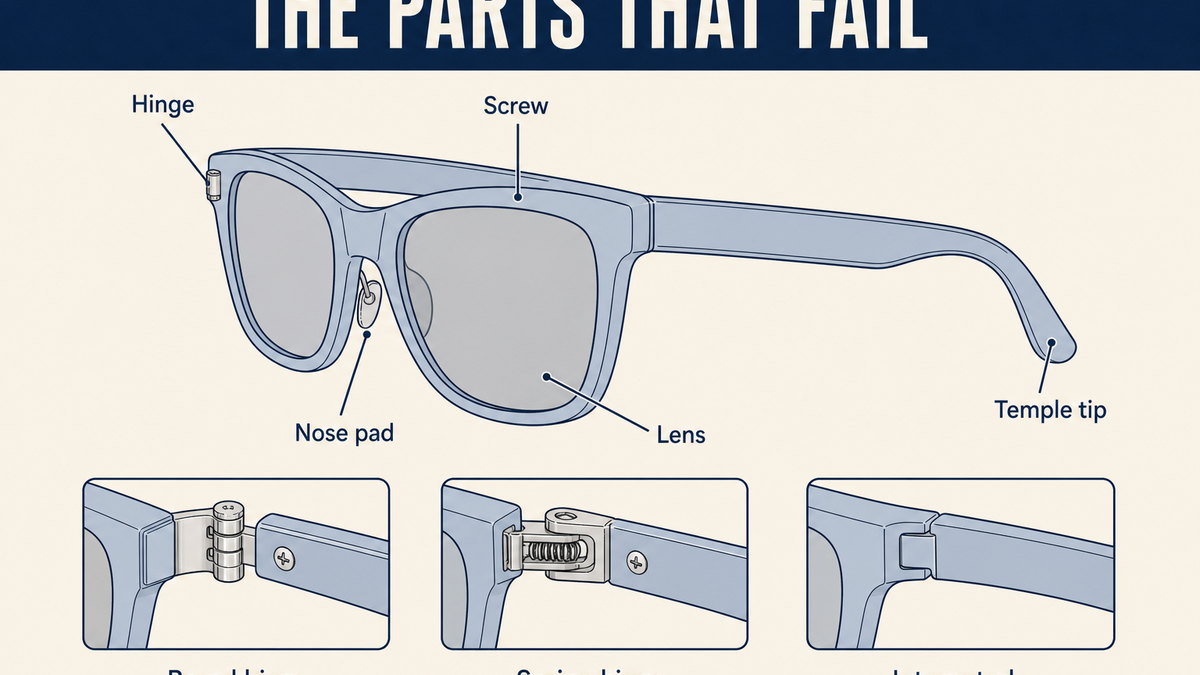
Every sunglasses complaint that is not about the lens is about a hinge, a nose pad or a screw. These are the smallest parts in the product and the ones most likely to be sourced from the cheapest available supplier, because they are invisible in a photograph.
| Part | Types | How It Fails |
|---|---|---|
| Hinge | Barrel hinge, spring hinge, integrated hinge on metal frames | The barrel works loose so the temple flops, or the spring fatigues and stops holding tension |
| Screw | Standard, or a screwless pin on some designs | Backs out and is lost, which is the single most common repair |
| Nose pads | Moulded into the frame, or separate adjustable pads | Hardens, yellows, or tears off the arm on a push-fit design |
| Temple tips | Slip-on covers or moulded ends | Slide off, or split where they grip the temple wire |
| Metal plating | Electroplated or coated finishes | Wears through at the contact points and exposes the base metal |
The two specs that decide whether a hinge survives
The first is the metal the hinge is made from. A hinge stamped from thin sheet will deform the first time someone drops the frames in a bag. The second is the opening force, measured in newtons, and it is worth writing into the order because it is what a customer feels.
Ask for a cycle test rather than a single measurement: open and close the temple a set number of times and record both the opening force and whether the screws have moved. A hinge that starts at a comfortable force and ends at half of it has fatigued, and the customer will notice within a few months of daily use. This is also the point where the metal composition matters for another reason entirely, because a plated frame in prolonged skin contact has to meet restrictions on the release of nickel, the same requirement that applies to any metal worn against the skin.
5. Private Label Routes: Stock, Semi-Custom and Full Custom
Sunglasses are a tooling-heavy product, so the route you choose sets your minimum order more than the material does. There are three, and the middle one is the one most first brands never hear about.
Choose an existing shape and change the lens tint, the colour and the logo. The only route that supports a genuinely small first order, which is why it is the right choice for testing whether the brand sells at all.
An existing mould with your own acetate pattern, a different lens category, your own hinge or your own temple tip. Usually the best value in eyewear, because the frame reads as yours while the expensive tooling stays with the factory.
Your own shape drawn from nothing, with its own mould or its own acetate cutting programme. Worth it when the silhouette is the brand, and only when a second and third season are already planned.
What to ask before you accept a quotation
Ask who owns the mould. A factory that owns it can move the shape to another brand; if you paid for it, the ownership should say so on the order. Ask how many cavities the tool has, because the cavity count sets the unit price and the factory’s ability to run your order alongside other work. And ask which lens supplier the lenses come from, because a quotation that names a lens maker is one you can compare against another quotation, while a quotation that just says “polarised” is not.
Then get the branding specified properly rather than as an afterthought. Lens printing, temple printing and a metal logo on the temple are three different processes with three different minimums, and the artwork approval loop is the same one that applies to any decorated product. Our guide to custom logo printing and finishing walks through getting the artwork signed off before a full run is printed.
6. The United States Rules: Registration, the Agent and the Lens Certificate
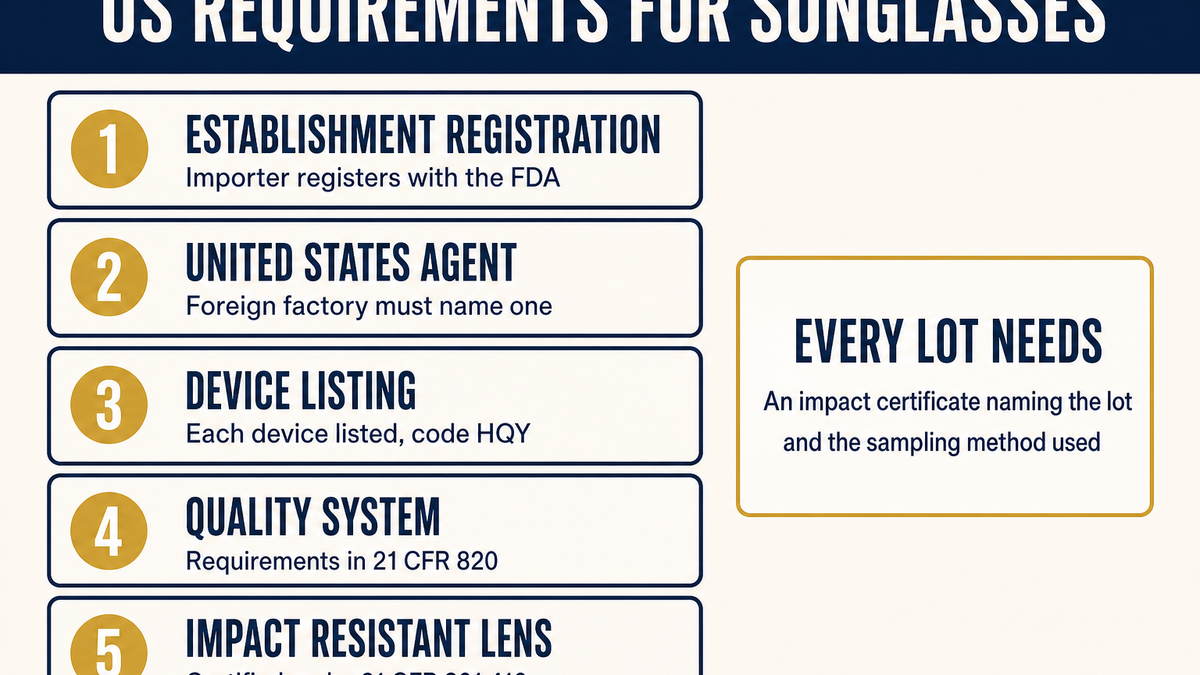
This is the section that separates a brand that ships from a brand that has its first container held. Sunglasses sold in the United States are classified as medical devices, and while they are exempt from the premarket notification that most medical devices need, they are not exempt from anything else.
The FDA sets out the position plainly on its page covering sunglasses, spectacle frames and spectacle lenses, and there are five duties worth reading twice.
- Establishment registration
- US manufacturers and the initial US distributor, meaning the importer, must register the establishment with the FDA.
- United States agent
- A foreign manufacturer must register with the FDA and name an agent based in the United States. If your factory has no US agent, that is a problem you want to find before the ship sails.
- Device listing
- Manufacturers must list each device they make with the FDA. Sunglasses carry the classification product code HQY, under 21 CFR 886.5850.
- Quality system
- Manufacturers must meet the quality system requirements in 21 CFR 820. Ask your factory what its quality system documentation looks like before you assume this is in place.
- Impact-resistant lens certification
- The lens must be certified as impact resistant under 21 CFR 801.410.
The certificate that has to travel with every lot
Here is the sentence most first-time brands have never seen, and it is worth quoting exactly. The FDA states that a certificate showing the lens complies with 21 CFR 801.410 should accompany each lot of spectacle lenses or sunglasses seeking entry into the United States, and that the certificate should show the eyewear has been sampled and found impact resistant using a statistically significant method.
Read that again with a sourcing hat on. It is not a certificate for the product generally. It is a certificate per lot, and it depends on a sampling method, which means the factory has to keep records of the sample it tested. A supplier who sends you a generic test report with no lot number has not given you this document, and the FDA is explicit that failing these requirements can result in detention of the goods at the port of entry.
What counts as a statistically significant sample
The FDA names three sampling procedures it accepts, and one of them will already be familiar if you have ever written an inspection order for China. They are ANSI/ASQC Z1.4 from 1993, ISO 2859-1 from 1999, and MIL-STD 105 at an acceptable quality level of 6.5 with general inspection level II.
That last one is a standard AQL sampling plan, which means the impact-resistance requirement is not an exotic laboratory process bolted onto your order. It is a sampling and testing step that fits inside the inspection regime you are already running. If you already ask for pre-shipment inspection, the lens sampling can be added to the same visit, provided the inspector has the drop ball equipment and the batch is still open.
The test itself is the drop ball test described in 21 CFR 801.410(d)(2), or an equivalent method the manufacturer can show is no weaker. The regulation itself is published in full on the electronic Code of Federal Regulations, and it is short enough to read in ten minutes.
Put the certificate in the purchase order, not in an email thread. Write that each lot must be accompanied by an impact-resistance certificate naming the lot number and the sampling method used, and that goods without it will not be accepted. A requirement in the order is enforceable; a request in a chat message is not.
7. Europe: CE Marking and the PPE Rules
The European route runs on a different logic. Sunglasses that protect the wearer from sun glare are treated as personal protective equipment, which means they fall under the PPE Regulation and require CE marking. Where the FDA asks for a per-lot certificate, the European system asks for conformity with a product standard and a technical file that sits behind the CE mark.
Sunglasses sit under PPE Regulation (EU) 2016/425, which is the text that makes CE marking a requirement rather than a marketing choice. The product standard for sunglasses and related eyewear is EN ISO 12312-1. In practice this means the lens has to be tested for the ultraviolet and visible light transmission figures that place it in a category, and the frame and lens have to meet the mechanical requirements in the standard. When a supplier tells you a lens is “UV400”, the useful follow-up question is which standard the test report is written against, because UV400 is a claim and EN ISO 12312-1 is a test.
If you sell into both markets, specify the lens once and buy the paperwork twice. A lens that passes the European transmission requirements will almost always need a separate impact-resistance test and certificate for the United States, and the two documents are produced by different test houses. Build both into the sampling budget at the start rather than discovering the US requirement when the container is already loading.
8. How to Test and Inspect a Sunglasses Order
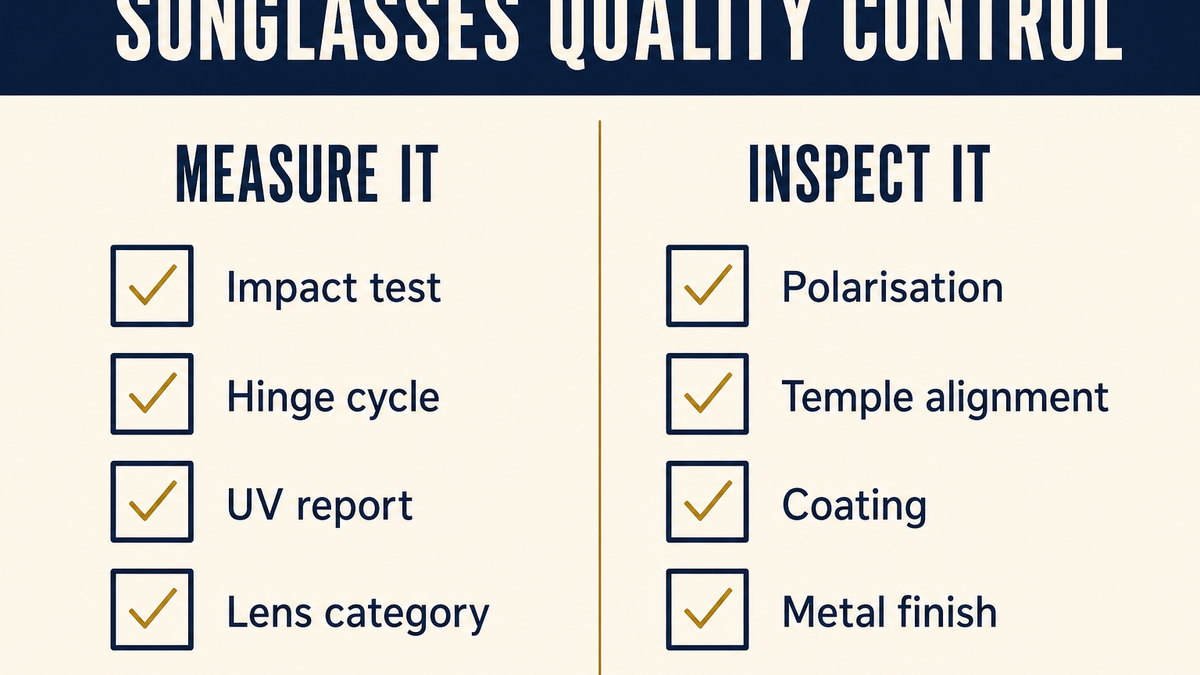
These eight checks cover the parts most likely to generate a return or a customs question, and they fit into a single inspection visit.
- Impact resistance
- Confirm the drop ball test was run on a sample drawn by one of the accepted methods, and that the certificate carries the lot number. Without this the order does not clear the United States.
- Polarisation
- Rotate a lens against a backlit screen. A true polarised lens goes dark at about ninety degrees. Run it on at least one lens from each lot.
- UV transmission
- Read the test report rather than the tint. Check the report names the standard and gives a transmission figure, not just a category letter.
- Lens category
- Confirm the category on the report matches the category you ordered and the one printed on the packaging.
- Hinge cycle
- Open and close a temple repeatedly and record the opening force before and after. Look for screws that have backed out and a barrel that has worked loose.
- Temple alignment
- Stand the frames on a flat surface and check both temples touch at the same point. A twisted temple is a fit complaint even when every dimension is within tolerance.
- Coating and scratch
- Inspect the coating at a low angle for cloudy patches, then rub a sample lens with a cloth and check the coating does not smear off at the edge.
- Metal finish and skin contact
- Look for plating that has worn thin at the nose pads and temple tips, since those are the points in prolonged contact with skin, and check the supplier’s declaration for the metal parts.
Two of these belong in a written record rather than a visual pass: the impact test result and the hinge cycle figures. Both produce numbers, and numbers are what let you compare the bulk run against the sample you approved. That measured approach is what a first article inspection formalises on the first production run.
9. A Five-Step Sourcing Roadmap
Worked in this order, these five stages keep both the tooling mistake and the customs mistake out of your first eyewear order.
- Choose the frame material from the selling price, not from a photo. Acetate carries the premium because the process is slower and the colour runs through the material. TR90 and polycarbonate carry weight and flex. Pick the material and the shape together, because each one implies a different tooling route.
- Fix the lens by construction, not by tint. Name the material, the category and the coatings as separate lines, and require the polarised claim to be supported by a laminated construction rather than a surface film.
- Choose the route before you ask for a quotation. Stock, modified stock or full custom. Ask who owns the mould, how many cavities it has, and which lens maker the lenses come from, so that two quotations can actually be compared. A short factory audit will also tell you whether the factory cuts its own acetate or buys finished frames.
- Build the certification into the order. For the United States, that means the impact-resistance certificate per lot with the sampling method named, plus the factory’s registration and its US agent. For Europe, the transmission test against EN ISO 12312-1. Put all of it in the written order rather than in an email, which is what a bilingual sales contract is for.
- Inspect against numbers, then mark the goods correctly. Measure the hinge cycle and confirm the lens test results rather than looking at the frames. Then check the country of origin marking on the temple, because eyewear is one of the categories where the accepted short forms are narrower than suppliers assume. Our breakdown of made in PRC versus made in China labelling covers which abbreviations a customs authority will accept.
Everything in this guide sits inside our Apparel, Fashion & Bags sourcing hub, which collects the material and factory guides for this category in one place.
10. Frequently Asked Questions
Are sunglasses really treated as a medical device in the United States?
Yes. Sunglasses are classified as medical devices, and they carry the classification product code HQY under 21 CFR 886.5850. They are exempt from the premarket notification, which is the submission most medical devices need, but the other obligations still apply. US manufacturers and the initial US distributor must register the establishment with the FDA, foreign manufacturers must register and name a United States agent, each device must be listed, the manufacturer must meet the quality system requirements in 21 CFR 820, and the lens must be certified as impact resistant.
What is the drop ball test, and do I need a certificate for every shipment?
The drop ball test is the impact-resistance test described in 21 CFR 801.410(d)(2), or an equivalent method that is no weaker. The FDA states that a certificate showing the lens complies with 21 CFR 801.410 should accompany each lot of sunglasses seeking entry into the United States, and that the certificate should reflect that the eyewear has been sampled and found impact resistant using a statistically significant method. In practice that means a certificate per lot, which means the factory has to keep records of the sample it tested, so a generic report with no lot number is not the document being asked for.
What sampling method counts as statistically significant?
The FDA names three procedures it accepts: ANSI/ASQC Z1.4 from 1993, ISO 2859-1 from 1999, and MIL-STD 105 meeting an acceptable quality level of 6.5 at general inspection level II. The third is an ordinary AQL sampling plan, so this requirement can be handled inside the same inspection regime you already use for other products rather than as a separate laboratory exercise.
Is UV400 the same thing as polarised?
No, and the two are often confused in marketing. UV400 describes how much ultraviolet light the lens blocks, and it is a protection claim. Polarisation describes a filter inside the lens that blocks light vibrating in one plane, which is what removes glare from water or a road. A lens can be polarised without being UV400 and the other way round. You can check polarisation yourself by rotating the lens against a backlit screen, because a genuinely polarised lens goes dark at about ninety degrees, but UV protection needs a transmission test report.
Should I choose acetate or TR90 for my first frame?
Choose based on where the product sits. Acetate is the premium route, because it is cut and polished rather than moulded, and because the laminated sheet lets colour run through the material instead of sitting on the surface. It costs more and the tooling is a production line rather than a single tool. TR90 is injection moulded, noticeably lighter, and flexes instead of cracking, which suits sports and everyday frames. It takes solid colours well and patterns poorly. For a first order where you are testing whether the brand sells, a stock or modified stock TR90 frame keeps the tooling exposure low.
Can my factory ship sunglasses to the United States without a US agent?
No. The FDA requires a foreign manufacturer to register its establishment and to name an agent who either resides in the United States or maintains a place of business there. If your factory cannot name one, the goods risk being held, because the FDA states that failing these requirements may result in detention at the US port of entry. Ask for the agent’s details as part of supplier screening, alongside the establishment registration number, before you place a production order.
Get the Frame, the Lens and the Certificate Checked Before You Order
Our team confirms the frame material against your selling price, specifies the lens by construction rather than by tint, quotes the stock, modified and full custom routes side by side, and makes sure the per-lot impact-resistance certificate, the factory registration and the origin marking are all in the written order before production starts.
Request a Sunglasses Sourcing Quote
Questions & Comments
We read every one and reply within 24 hoursNot sure whether to cut an acetate frame or mould a TR90 one, trying to tell a real polarised lens from a tinted one, or stuck on what the impact-resistance certificate for a US shipment has to say? Post your frame, lens spec or test report below and our team will help you read it.