
Plastic Bottles & Cosmetic Packaging Sourcing Guide: PET, HDPE, PP, Closures & Decoration
 ·
Updated October 9, 2026
·
22 min read
A bottle is three decisions, and only one of them is the resin. The resin decides whether your product can sit on a shelf under lights. The neck finish decides whether any cap in the world will fit it. The decoration decides whether anyone picks it up. Buyers who quote a bottle on price alone usually discover the neck finish problem after the mould is cut, which is the most expensive place to discover anything. This guide covers all three, plus the closures, the tooling maths, the food-contact rules on both sides of the Atlantic, and the tests to run before you commit to a production run.
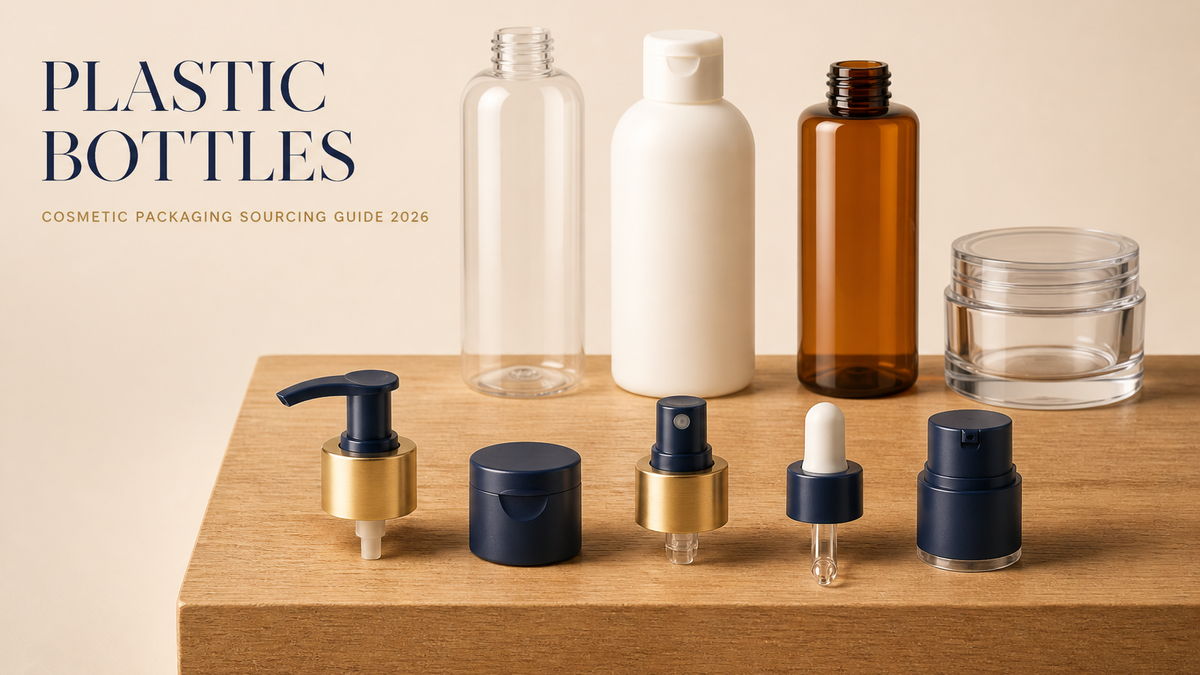
Which Resin to Order, Matched to What Is Going Inside the Bottle
| If you are filling | Order this | Because |
|---|---|---|
| Water, clear juice, toner, micellar water | PET, standard | Clear, strong, the cheapest clear resin, and it recycles in the mainstream stream. Keep the fill below roughly 60 °C unless you pay for heat-set grades. |
| A premium serum in a bottle a customer keeps | Thick-wall PETG or acrylic | Weight and glass-like clarity signal value. Note that PETG is not recyclable with PET and will contaminate that stream, so say so on the pack. |
| Shampoo, body wash, detergent | HDPE | Squeezable, chemically tough, and opaque so it hides what is inside. Poor oxygen barrier, which does not matter for a soap. |
| A cream, balm or thick gel in a jar | PP or SAN, wide mouth | Handles heat and fills well in a wide-neck jar, and the wide mouth lets the customer reach the last of the product. |
| Vitamin C, retinol or anything that oxidises | Airless pump, PP body | The product never meets air, so it does not oxidise on the shelf. Also stops the customer contaminating the formula with a finger. |
| A product going into the EU | rPET with a stated recycled share | Recycled content is being written into law for beverage bottles, and retail buyers ask for it across the board. Ask for the percentage in writing. |
What this guide covers
- The six resins, and which one your product needs
- Neck finishes: the spec that decides whether your cap fits
- Closures and dispensers
- Wall thickness, weight and hand feel
- Decoration methods and what each one costs you
- Food contact and cosmetic rules
- Tooling, MOQ and stock versus custom
- How to test a bottle before you commit
- A five-step sourcing roadmap
- Frequently asked questions
1. The Six Resins, and Which One Your Product Actually Needs
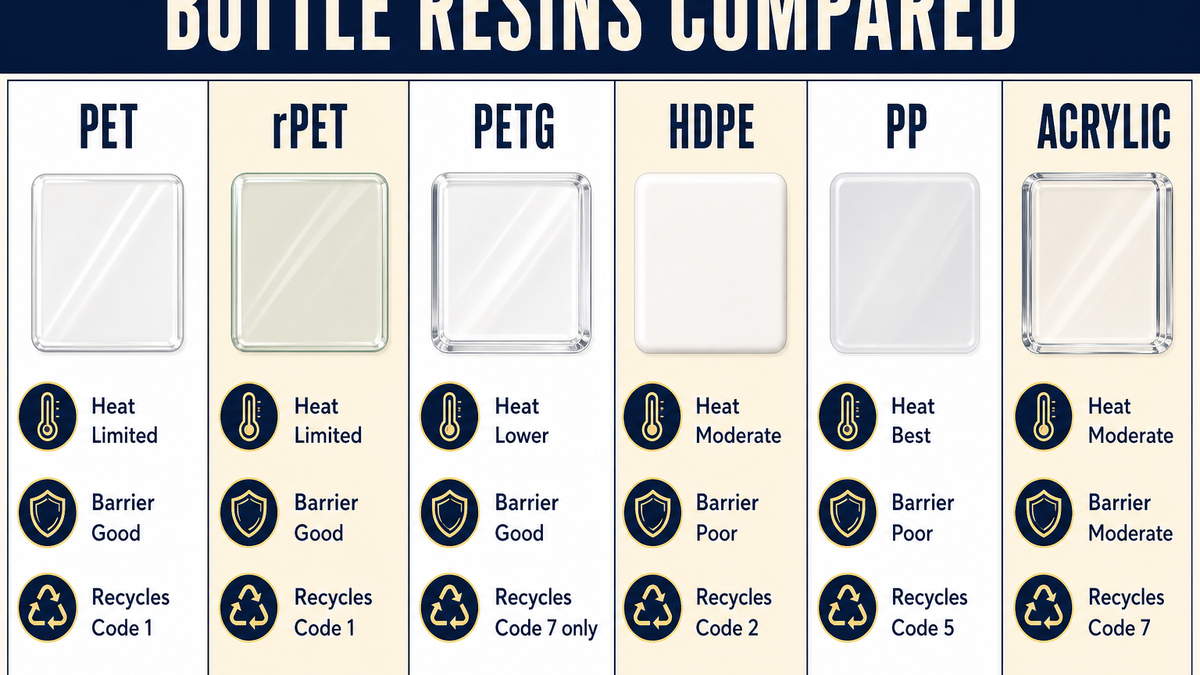
Almost every cosmetic and household bottle is made from one of six materials. They are not interchangeable, and the differences that matter are the ones you cannot see: what the contents do to the plastic over eighteen months, and what the plastic does to the contents.
| Resin | Looks Like | Handles Heat | Oxygen Barrier | Recycles As | Typical Use |
|---|---|---|---|---|---|
| PET | Clear and light | Limited — standard grades soften around 60 °C | Good | Code 1, mainstream | Water, juice, toner, clear liquids |
| rPET | Clear, slightly hazier | Similar to PET | Good | Code 1, mainstream | Anything with a recycled-content claim |
| PETG | Very clear, thick-looking | Lower than PET | Good | Code 7 — not with PET | Thick-wall premium bottles |
| HDPE | Opaque, waxy | Moderate | Poor | Code 2, mainstream | Shampoo, detergent, body wash |
| PP | Translucent to opaque | Best of the group | Poor | Code 5, growing | Jars, closures, pumps, hot fill |
| PMMA or SAN | Glass-like and heavy | Moderate | Moderate | Code 7 | Premium cream and gloss jars |
The PETG trap
PETG is the resin that makes a cheap bottle look expensive. It is clearer than PET, it moulds into thick walls without the haziness that PET develops at heavy weights, and it takes a polish that reads as glass on a shelf. That is why it turns up in every premium serum launch.
It also cannot be recycled with PET. Chemically the two are close enough to look identical in a photo and different enough that PETG acts as a contaminant in the PET recycling stream. Some recycling programmes treat it as code 7, meaning it goes to general waste. If you are buying PETG, the honest position is to say so on the pack rather than to imply the bottle is recycled or recyclable. A false environmental claim is the fastest way to lose a retail listing, and in some markets it is a fine.
Recycled content is becoming a requirement, not a preference
The European Union has written recycled content into law for beverage bottles under its single-use plastics rules, with a share required by 2025 and a higher share by 2030. Those figures apply to beverage containers rather than to a shampoo bottle, but the direction of travel is not in doubt, and retail buyers are already asking suppliers for a recycled percentage on cosmetic packaging too.
So ask for the recycled share as a number, and ask for the test report that proves it. A supplier who says “eco-friendly material” has told you nothing. A supplier who says “30 per cent post-consumer recycled content, with the certificate” has given you something you can put in a tender document. The regulation itself is published on EUR-Lex under Directive (EU) 2019/904, and it is worth reading before you accept an environmental claim from anyone.
2. Neck Finishes: The Spec That Decides Whether Your Cap Fits
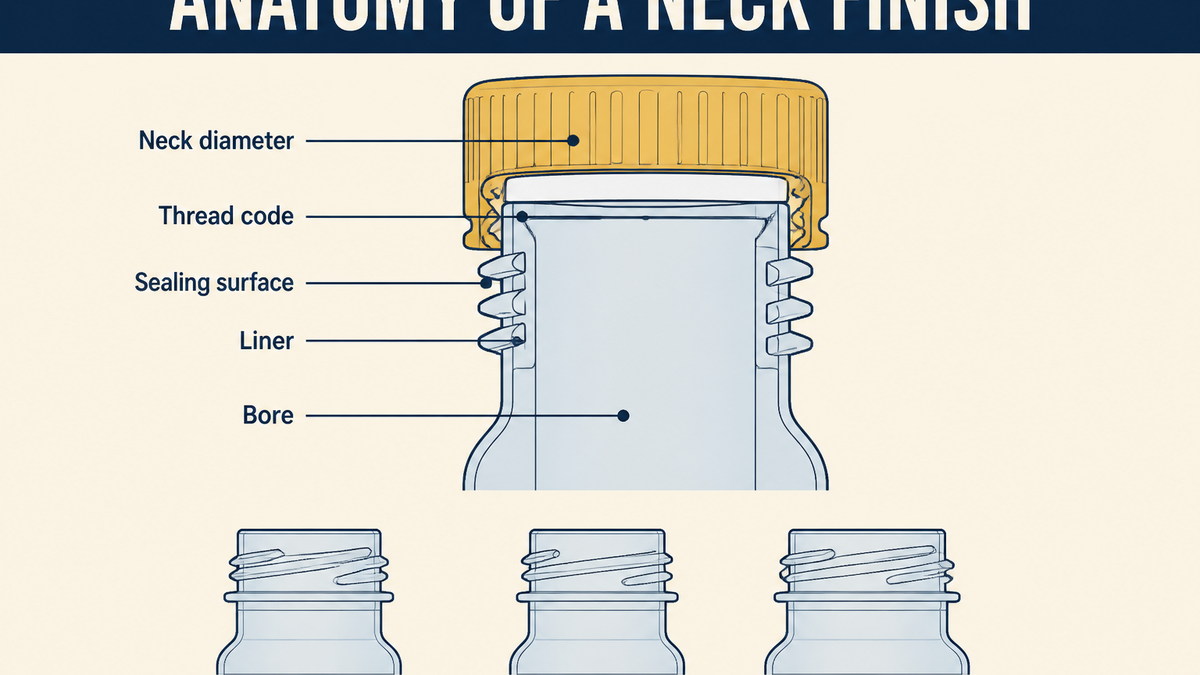
This is the part buyers skip, and it is the part that ruins launches. A neck finish is written as two numbers separated by a slash, such as 24/410. The first number is the diameter in millimetres. The second is a code for the thread form and height. Get it wrong and no stock cap on the market will seal your bottle.
Why the second number exists
Two bottles can both be 24 mm across the neck and still not accept the same cap, because the thread pitch and the height of the neck differ. The second number in the code pins that down, so a cap made for 24/410 will fit any bottle made to 24/410 and will not seat properly on 24/415. This is why the finish has to be agreed before the mould is cut rather than after.
The practical consequence: if you plan to use a stock closure from a supplier’s catalogue, choose the neck finish first and design the bottle around it. Buyers who design the bottle first and then look for a cap usually end up paying for a custom closure as well as a custom bottle.
The three questions to settle before tooling
- Neck finish
- The diameter and thread code, agreed in writing with the closure supplier, not assumed from a sample bottle the designer liked.
- Sealing method
- Whether the cap seals on the top of the neck, on the inside bore, or with an induction liner. This changes the neck drawing, so it cannot be left to the cap supplier alone.
- Liner material
- Foam, pulp, PE or induction foil. A leaking bottle is usually a liner that is incompatible with the contents, not a cap that is too loose.
Never approve a bottle mould from a 3D render alone. Ask for a physical pre-production sample with the intended closure screwed on, filled with the real product, and left upside down for 48 hours. Neck finish errors are invisible on screen and obvious on a bench.
3. Closures and Dispensers
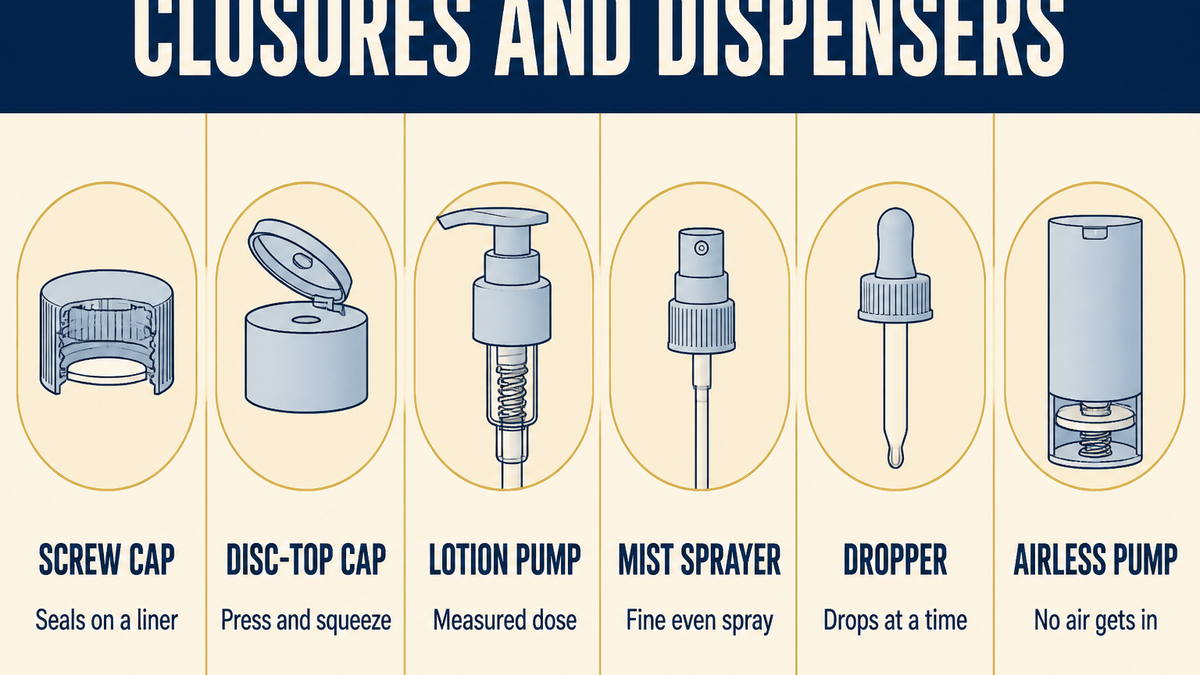
The closure is often a bigger spending decision than the bottle, because it is the part the customer touches twice a day for a year. It is also the part most likely to be chosen last, from whatever the supplier had on the shelf.
| Closure | How It Dispenses | Best For | What Goes Wrong |
|---|---|---|---|
| Screw cap with liner | You pour | Toners, refills, wide-mouth jars | Wrong liner for the contents, so it weeps in transit |
| Disc-top cap | Press and squeeze | Lotions, gels, cleansers | The hinge snaps at the living hinge after heavy use |
| Lotion pump | Depress the head | Body lotion, hand cream, shampoo | Dose per stroke drifts between batches |
| Treatment pump | Smaller measured dose | Serums, facial oils | Too large a dose for an expensive formula |
| Fine mist sprayer | Aerosol-free spray | Setting spray, facial mist, fragrance | Spray pattern turns uneven or spits as the bottle empties |
| Dropper | Glass or plastic pipette | Serums, essential oils | The bulb hardens, or the pipette does not reach the last of the product |
| Airless pump | Piston pushes up, no air enters | Retinol, vitamin C, anything that oxidises | Air gets in at the base if the piston seal is poor, and the formula oxidises anyway |
When airless is worth the extra cost
An airless pack costs more than a bottle with a dropper, and for most products it is a waste. It earns its price in one specific case: the formula degrades when it meets air. Vitamin C, retinol and most antioxidant actives qualify. A basic hyaluronic serum does not.
The test is a shelf-life test, not an opinion. Fill three units, keep them at room temperature, and check the formula at one, three and six months. If the colour or the smell has moved in the dropper bottle and not in the airless one, you have your answer and a number to justify the cost. If both are unchanged, you have saved money by not buying airless.
Ask for the pump dose in millilitres and test it yourself. Draw ten strokes and weigh them. A treatment pump that delivers 0.4 ml instead of 0.25 ml has just increased the cost of goods on your most expensive product, and nobody will notice until the customer complains that the bottle only lasted three weeks.
4. Wall Thickness, Gram Weight and Hand Feel
Two bottles can be identical in shape and differ by half in price, because price follows the weight of plastic, not the size of the bottle. Buyers who quote on shape alone get quotes that cannot be compared.
The spec to agree is the gram weight of the empty bottle, with a tolerance. A 30 g bottle and a 20 g bottle of the same shape are different products: the heavier one feels more solid in the hand, resists denting when squeezed, and survives a taller drop. That is the entire reason premium packaging feels premium.
| Build | Hand Feel | Squeeze | Suits |
|---|---|---|---|
| Light wall | Flexible, can feel flimsy | Squeezes easily | High-volume value lines, refills |
| Standard wall | Firm, neutral | Squeezes with effort | The everyday bottle most brands ship |
| Heavy wall | Rigid, dense, glass-like | Barely moves | Premium serums and gifting |
Surface finish is half of what the hand reads as quality
The customer’s judgement of whether packaging is expensive is made in the first second, and it uses three inputs: weight, temperature and surface. Weight you control with gram weight. Temperature is why thick-wall acrylic and PETG feel like glass — they conduct heat away from the hand slowly. Surface is the finish on the mould itself.
So write the finish into the specification rather than leaving it to the factory. A high-polish mould produces a glossy bottle; a mould with a light texture produces a soft matte surface that hides fingerprints, which matters on a hand cream that gets used with wet hands. Finish is set by the mould, so it cannot be changed after tooling without cutting a new one.
5. Decoration Methods and What Each One Costs You
Decoration is where the artwork decisions get expensive, because each method constrains the artwork differently. Choose the method before the designer finishes the label, not after.
| Method | Coverage | Colours | Durability | Best For |
|---|---|---|---|---|
| Silk screen printing | Direct on the bottle, partial | One to four, in solid areas | High — it is ink fused to the surface | Clean, minimal branding on a clear bottle |
| Heat transfer printing | Direct, can cover a curve | Multi-colour, fine detail | High | Detailed graphics without a label |
| Pressure-sensitive label | A label applied to the bottle | Unlimited | Medium — edges can lift in a wet bathroom | Short runs, frequent artwork changes |
| Shrink sleeve | 360°, covers the whole body | Unlimited, photographic | Medium — it tears when opened | Maximum shelf impact on a plain bottle |
| Spray coating | The whole bottle | Any solid colour or soft-touch | Medium — chips at the base | Coloured or rubberised finishes |
| Metallising | The whole bottle | Metal-look finishes | Medium — scratches show | Gifting and limited editions |
The artwork rules that trip people up
Silk screen cannot print a gradient or a photograph. It lays down flat ink in solid areas, so a design that works beautifully in a design tool can be impossible on the bottle. If your artwork has a soft fade, you need heat transfer, a label or a sleeve instead.
Shrink sleeves are the cheapest way to put a photographic image on a plain bottle, and the most common surprise is that the print distorts where the bottle narrows. Artwork has to be pre-distorted for the shape, which is a step in the process rather than a design choice, and the supplier should be the one to produce that distorted file rather than the brand trying to guess it.
And remember that decoration is where your brand mark lands, so the same rules on labelling and finishing apply here as on any other product. Our guide to custom logo printing and finishing covers the artwork approval loop that stops a wrong-colour logo being printed across a full production run.
Get a printed sample before the run, on the actual bottle with the actual ink, and approve it in daylight rather than under office lighting. Colour on a clear plastic surface shifts more than colour on paper, and the difference between a warm red and an orange is usually invisible on a monitor.
6. Food Contact and Cosmetic Rules
Anything that touches what a person eats, drinks or puts on their skin sits under a set of rules that your supplier either knows or does not. The reason this matters commercially is simple: a retail buyer will ask for the paperwork, and a supplier who has never produced it cannot produce it in a week.
United States: the polymer has to be cleared
In the United States, food-contact plastics sit under the FDA’s indirect food additive rules, and the polymers used in bottles and closures are listed in Title 21 of the Code of Federal Regulations. Part 177 covers polymers specifically, and it is published in full on the electronic Code of Federal Regulations.
The practical takeaway for a buyer is not to read the regulation yourself but to ask the right question. Do not ask “is this food grade”. Ask which regulation the resin is cleared under, and ask for the written declaration that names it. A resin supplier who makes food-contact PET will have that document on file, because their own customers demand it. A trader reselling unbranded resin will not.
Europe: Regulation 10/2011 and the migration limit
In the European Union the governing text is Commission Regulation (EU) No 10/2011 on plastic materials and articles intended to come into contact with food, published on EUR-Lex. It sets out which substances may be used, what may migrate out of the plastic into the contents, and how the testing is done.
The number to know is the overall migration limit: 10 milligrams of material per square decimetre of surface area, or 60 milligrams per kilogram of food for small articles. That covers everything that comes out of the plastic, not just one substance. A bottle can pass every individual substance limit and still fail the overall test, which is why the test result is reported as a single figure.
The document you will be asked for is the one the regulation calls a “declaration of compliance”, and two things about it catch buyers out. It is specific to the material and the conditions of use, so a declaration written for cold fill does not cover a hot-filled product. And it has to be traceable to the batch, so a photocopy of a generic certificate with no company name on it is not worth asking for.
Everywhere: the rules that follow the finished pack
- Country of origin
- The bottle has to disclose where it was made, and the accepted short forms are narrower than most suppliers assume. Our breakdown of made in PRC versus made in China labelling sets out which abbreviations a customs authority will actually accept.
- Cosmetics pack marking
- A cosmetic pack carries a batch code, the responsible person’s details and an opened-jar symbol showing how many months the product keeps after opening. Mould the space for these into the design rather than trying to fit them onto a label later.
- Coating and ink rules
- Decorated bottles, metallised finishes and heavy pigments are the usual places where a restricted substance turns up. Ask for the ink and coating declarations separately from the resin declaration, because they are separate lines in your bill of materials.
- State-level warnings
- Some markets require a warning where a listed chemical is present. The list of chemicals is maintained by California’s Office of Environmental Health Hazard Assessment, and it is revised over time, so a declaration written three years ago is not a substitute for a current one.
7. Tooling, MOQ and Stock Versus Custom
The tooling decision is the one that sets your minimum order and your risk, and there are three routes rather than two. Most first-time buyers only consider the two extremes.
Choose from shapes that already exist and change only the colour, the decoration and the closure. The lowest-risk way to launch, and the only route that lets you place a genuinely small first order.
An existing body with a new neck finish, a modified shoulder or a custom closure. Often the best value in packaging, because you get a distinctive pack without paying for a full mould.
Your own shape, drawn from nothing. Worth it only when the shape is the product, and only when you expect to repeat the run across several seasons.
The questions that decide which route you are on
Ask the factory these four before you ask for a price, because each one changes the answer by a multiple rather than a percentage. Do you own the mould, or does a client own it? If a mould exists and is owned by another brand, can it be used with a different decoration and a different neck, or not at all? If a new mould is needed, how many cavities will it have, and how does the cavity count change the unit price? And what is the smallest run the factory will hold an existing mould for?
That last question is the one buyers forget. A factory’s minimum order is often driven by the setup time on the line rather than by the plastic, so a factory with a busy line will quote a high minimum on a stock mould simply because it would rather run something else. If your order is small, the honest question is not “what is your MOQ” but “when is the next slot when a small run is convenient for you”.
Pay for a physical sample made from the production mould before you approve the mould design. A bottle is a three-dimensional object that has to work in the hand, fit a filling line, survive a carton and seal against a cap. None of those can be judged from a render, and a change after the mould is cut is a new mould, not an adjustment.
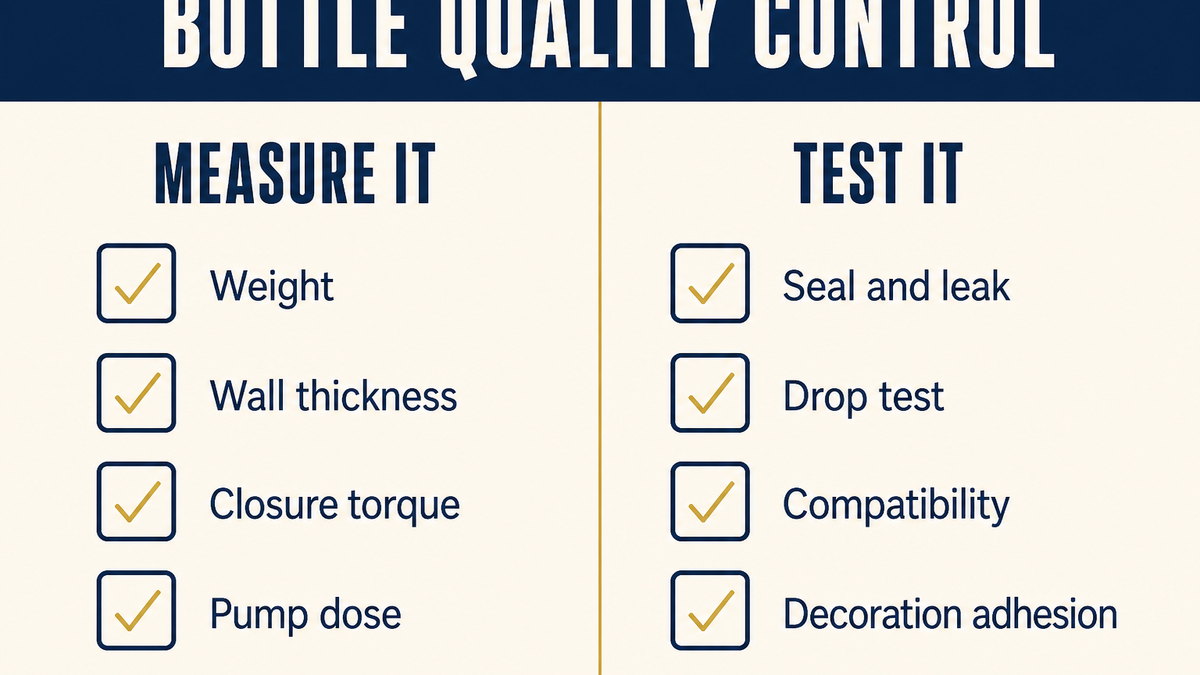
8. How to Test a Bottle Before You Commit
These eight checks take an afternoon on a bench and will catch nearly every problem that would otherwise surface as a customer complaint or a rejected container. Run them on a pre-production sample filled with the real product.
- Weight
- Weigh ten empty bottles and compare against the agreed gram weight with its tolerance. This is the check that proves you got the wall thickness you paid for, and it is the first thing a light-wall substitution changes.
- Wall thickness
- Measure at the shoulder, the body and the base. The base is where thin walls cause failures, because that is where the load is when the bottle is dropped.
- Seal and leak
- Fill to the stated level, close to the agreed torque, and stand inverted for 48 hours. Then repeat after a warm storage period, because a seal that holds cold can weep at 40 °C.
- Drop
- Drop a filled bottle from the height it will see in a carton, onto a hard floor, on the base, the shoulder and the side. The side drop is the one that splits a shoulder seam.
- Closure torque
- Measure the force needed to open and to re-close. A cap that needs a tool is a complaint; a cap that opens in a bag is a leak.
- Pump dose
- Ten strokes, weighed. Check the first stroke as well as the fifth, because a pump that only primes after three strokes loses the customer’s first impression.
- Compatibility
- Store filled units at 40 °C for four weeks as an accelerated test. Look for panel deformation, colour change, loss of gloss and any change in the product itself.
- Decoration adhesion
- Rub the print with a wet thumb, then run a fingernail across it. If the ink lifts, the cure was wrong and the whole run is wrong.
Two of these deserve a written result rather than a look. The weight check and the drop test both produce a number, and a number is what lets you compare one batch to the next. A visual check tells you a bottle exists; a measured check tells you whether the factory drifted between the sample and the bulk run. That measured approach is what a first article inspection formalises on the first production run, and what a pre-shipment inspection repeats before the container is booked.
9. A Five-Step Sourcing Roadmap
Worked in this order, these five stages keep the expensive mistakes out of your first packaging order.
- Decide the resin from what is going inside, not from the look. Heat, oxygen sensitivity and chemical attack set the resin. Clarity is a consequence, not a starting point.
- Fix the neck finish before anyone draws the bottle. Agree the finish and the closure together, with the closure supplier, in writing. This is the single decision that is most expensive to get wrong, because it is the one that requires new tooling to fix.
- Choose the route: stock, modified stock or full custom. Two thirds of first launches belong in the middle column, and one third of buyers never find out that column exists. A short factory audit will also tell you whether the factory owns the mould or is passing the work on.
- Approve a physical sample filled with the real product. Weight, seal, drop, torque and pump dose, measured and written down. Then put the numbers into the order so the bulk run is checked against them rather than against memory.
- Confirm the declarations before the container ships. Resin declaration, ink and coating declaration, recycled-content figure if you are claiming one, and the country of origin marking. All of it belongs in the written order rather than in an email chain, which is what a bilingual sales contract is for.
Everything in this guide sits inside our Packaging & Plastic Products sourcing hub, which collects the resin, component and factory guides for this category in one place.
10. Frequently Asked Questions
What is the difference between PET and PETG, and does it matter which I buy?
Both are clear plastics made from the same family, and they behave differently in two ways that matter. PETG moulds into thicker walls without turning hazy, which is why it looks like glass and appears on premium serum bottles. But PETG cannot be recycled alongside PET, because it acts as a contaminant in that recycling stream, and it is classed under recycling code 7 rather than code 1. If you buy PETG for the look, say so honestly on the pack rather than implying the bottle is recyclable.
What does a neck finish such as 24/410 actually mean?
The first number is the neck diameter in millimetres and the second is a code for the thread form and neck height. The second number is the one that catches people out, because two bottles can both measure 24 millimetres across the neck and still refuse the same cap: a cap made for 24/410 will not seat properly on a 24/415 bottle. That is why the finish has to be agreed with the closure supplier before the bottle mould is cut.
Is a plastic bottle food safe by default?
No. Food contact depends on the specific resin grade and the specific conditions of use, not on the plastic type in general. In the United States the polymers are cleared under the FDA’s indirect food additive rules in Title 21 of the Code of Federal Regulations, and in the European Union the governing text is Regulation (EU) No 10/2011, which also sets an overall migration limit of 10 milligrams per square decimetre. Ask your supplier for a written declaration that names the regulation and the batch, not for a promise that the material is food grade.
What is a realistic minimum order for a custom bottle?
It depends on whether a mould already exists. An existing stock shape with your own colour and decoration can often start at a modest quantity, because there is no tooling to pay for. A brand new shape means paying for a mould, which only makes sense if you expect to repeat the order. There is a middle route most buyers miss: take an existing body and change only the neck finish, the shoulder or the closure, which gives you a distinctive pack for a fraction of a full custom tool.
How do I choose between a pump, a dropper and an airless pack?
Match the closure to how the customer uses the product, then test whether the formula actually needs protection from air. A dropper suits a serum used a few drops at a time. A pump suits a lotion applied to a large area, and a treatment pump gives a smaller measured dose for an expensive formula. An airless pack is worth its higher cost only when the formula degrades on contact with air, which is true of vitamin C and retinol and not true of most basic hydrating serums. Test it: fill three units of each and compare the formula at one, three and six months.
What should I check on a bottle sample before placing the order?
Eight things, and they take an afternoon. Weigh ten empty bottles against the agreed gram weight, measure wall thickness at the shoulder, body and base, stand a filled bottle inverted for 48 hours to check the seal, drop a filled bottle on its base, shoulder and side, measure the opening and closing torque, weigh ten pump strokes, store a filled unit warm for four weeks as an accelerated compatibility test, and rub the decoration with a wet thumb. Record the weight and drop results as numbers so you can compare the bulk run against the sample.
Get Your Resin, Neck Finish and Closure Checked Before You Cut a Mould
Our team reviews the resin against what you are filling, confirms the neck finish with the closure supplier before tooling, quotes stock, modified and custom routes side by side, and measures weight, seal, drop and pump dose on the pre-production sample against written tolerances.
Request a Bottle & Packaging Quote
Questions & Comments
We read every one and reply within 24 hoursWorking out which resin your formula actually needs, unsure what a 24/410 neck finish means, or trying to compare a stock bottle against a custom mould on price? Post your bottle, closure or sample measurements below and our team will help you read them.