
Toothbrush Bristles Materials Guide: Nylon, PBT, DuPont Tynex & Bamboo Charcoal Sourcing
 ·
Updated October 9, 2026
·
13 min read
A toothbrush lives or dies by its bristles. If you pick the wrong filament, your brush goes soft in three weeks, the tufts fall out in the sink, and the tips scratch gums instead of cleaning them. This guide shows you exactly which bristle material to order, what each one costs, and how to check the quality before your container leaves China.
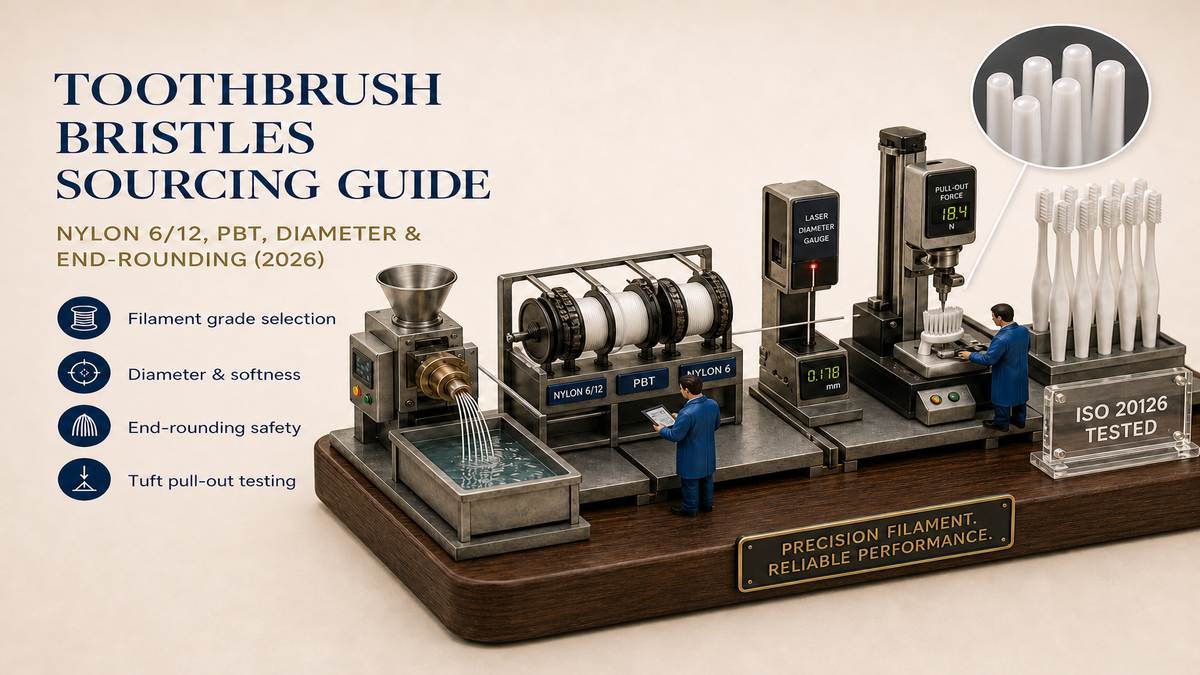
Direct Answer: Key Rules for Choosing Toothbrush Bristle Material
- Material: Use Nylon 6/12 (often sold under brand names such as DuPont Tynex) for roughly 90% of manual toothbrushes. It holds its shape in water, springs back after bending, and does not go limp when it meets whitening toothpaste.
- Filament diameter: Soft is about 0.15–0.18 mm, medium about 0.20–0.23 mm, hard about 0.25–0.30 mm. Most supermarkets and online stores in North America and Europe now ask for soft only.
- The hidden cost: Rounding the tip of each bristle into a smooth dome adds roughly $0.03–$0.08 per brush. Skip that step and the bristles cut gums, which fails product safety review and drives returns.
- Check first: Ask for a tuft pull-out force report and microscope photos of the bristle ends before you pay any deposit.
1. Why Bristle Material Decides Whether Your Toothbrush Sells
Most buyers spend weeks on handle shape, colour cards and packaging, then treat the bristles as a footnote on the order sheet. That is backwards. Bristles are the only part of a toothbrush that touches the customer, and they are the part that wears out first.
When bristles go wrong, customers do not write “bad filament.” They write “the brush went floppy after two weeks” or “the bristles hurt my gums.” Both complaints get blamed on your brand, not on the factory that extruded the filament.
Four things usually go wrong in low-cost toothbrush production:
- Bristles soften too fast. Cheap polypropylene filament bends and stays bent. After ten brushings the head looks worn out.
- Tufts pull out. If the anchor wire is thin or the tufting hole is oversized, whole clumps come out while brushing.
- Sharp bristle tips. Filament is cut, not rounded. The cut edge is a small blade that scratches the gum line.
- Bristles break off. Dry filament snapped during tufting leaves short bristles that fall out later.
Each of these has one root cause: the buyer ordered a material and a process they did not fully understand. The rest of this guide fixes that.
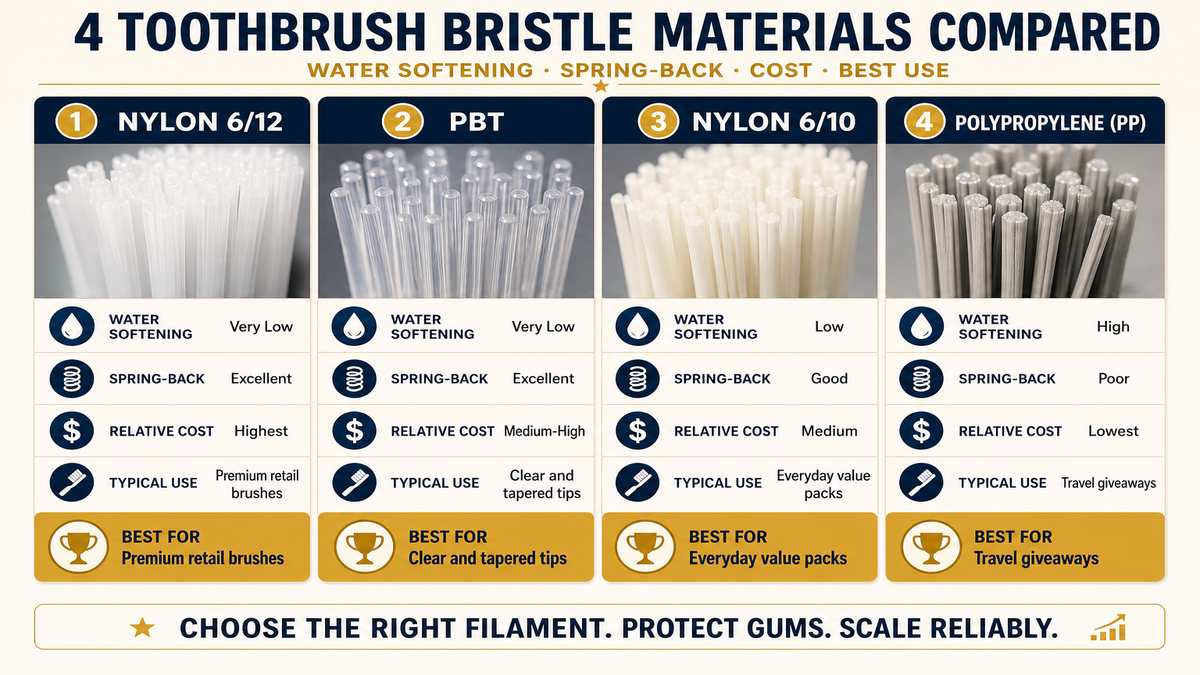
2. Bristle Material Comparison: Nylon 6/12, PBT, Nylon 6/10 and PP
Filament for toothbrushes is sold by grade, not by colour. The grade number tells you how the plastic chain is built, and that single number controls how the bristle behaves in a wet mouth.
| Filament Material | Water Softening | Spring-Back | Typical Filament Cost | Best For |
|---|---|---|---|---|
| Nylon 6/12 (Tynex class) | Very low | Excellent | Highest | Premium manual brushes, soft-bristle retail lines, hotel and dental brands |
| PBT (polybutylene terephthalate) | Very low | Excellent | Medium to high | Colour-shifting and transparent bristles, tapered micro-tip designs |
| Nylon 6/10 | Low | Good | Medium | Everyday brushes where cost matters more than feel |
| Polypropylene (PP) monofilament | High | Poor | Lowest | Disposable travel brushes, promotional giveaways, cleaning brushes |
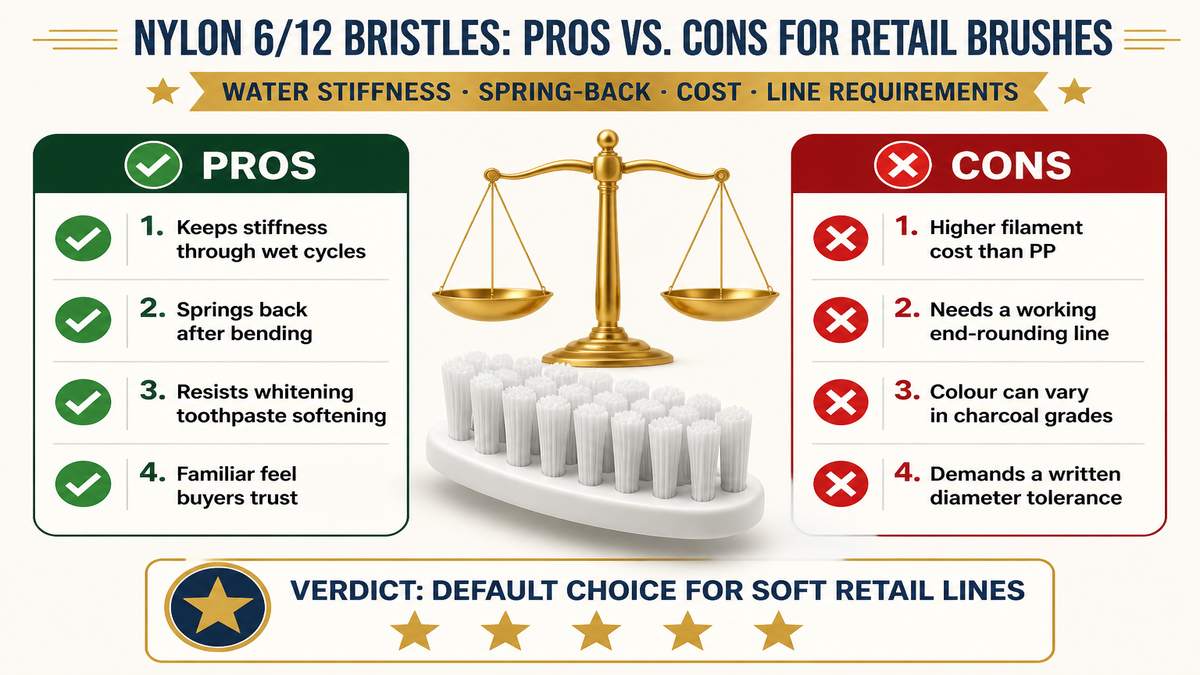
A. Nylon 6/12: the safe default
The two numbers describe how many carbon atoms sit on each side of the nylon chain. More carbon atoms mean the plastic pulls in less water, and water is the enemy of a bristle. Nylon 6/12 soaks up far less moisture than the cheaper Nylon 6 grades, so it keeps its stiffness through hundreds of wet cycles.
That is why almost every well-known toothbrush brand in Europe and North America builds its soft line on Nylon 6/12. If you are launching your first brush and you want to avoid customer complaints, this is the filament to order.
B. PBT: the choice when looks matter
PBT behaves much like Nylon 6/12 in water but takes colour and clarity far better. If your design calls for crystal-clear bristles, colour-gradient tufts, or very fine tapered tips, PBT is usually the right pick. The trade-off is price, and only a handful of filament extruders in China run it well.
C. Polypropylene: only for throwaway products
PP monofilament is cheap and easy to produce, and it shows. It softens quickly in warm water and stays bent after each brushing. It is fine for a hotel giveaway or a cleaning brush. It is the wrong choice for anything carrying your brand label on a retail shelf.
3. Filament Diameter and End-Rounding: The Two Numbers Buyers Miss
Two line items decide how a brush feels in the hand, and neither of them appears on most quotations.
A. Filament diameter sets the soft, medium or hard label
Bristle stiffness is mostly a matter of thickness, not material. A thin Nylon 6/12 bristle is softer than a thick one made from the same spool.
| Retail Label | Filament Diameter | Who Usually Buys It |
|---|---|---|
| Extra soft | 0.10 – 0.15 mm | Sensitive-gum lines, post-surgery and children’s brushes |
| Soft | 0.15 – 0.18 mm | The default for most supermarket and online listings |
| Medium | 0.20 – 0.23 mm | Value packs, some Asian and Latin American markets |
| Hard | 0.25 – 0.30 mm | Limited demand; some markets still ask for it |
Ask your supplier to state the diameter in millimetres on the order sheet, and to keep a tolerance of plus or minus 0.02 mm. If the quotation only says “soft bristle,” you have no way to check what arrives.
B. End-rounding is what makes a bristle safe
Newly extruded filament is cut to length, and a cut end is a sharp edge. Every retail toothbrush has to pass an end-rounding step where the tips are ground and polished into smooth domes. This is the single most skipped process in cheap production, because it needs extra machines, extra labour and extra time.
You cannot see the difference on a product photo. You can see it under a microscope, and you can feel it on your gums. Before approving bulk, ask for microscope photos of the bristle tips at roughly 30x magnification, taken from three different tufts across the head.
4. Tufting Methods: Anchor Wire vs. Hot-Melt
Tufting is the step where bundles of filament are pushed into holes in the brush head. There are two ways to hold them in place, and the method you choose affects how the brush performs at the end of its life.
A. Anchor wire tufting
A small metal staple folds around the middle of each tuft and pins it into the hole. It is fast, cheap and works on almost any handle material. Its weak point is that a badly set staple can let a tuft work loose, and the metal staple is visible if you look into the hole.
B. Hot-melt (anchorless) tufting
Tufts are pushed through and the backs are fused with heat, so no metal is used. This gives a cleaner look inside the head, better tuft retention and no risk of a staple rusting. The trade-off is a higher machine cost, which is why most factories only offer it above a certain order volume.
Whichever method you pick, put the tuft retention number on the order sheet. Most factories we work with quote a tuft pull-out target somewhere between 15 N and 25 N, and they test it with a force gauge on a sample of tufts from each batch. Ask your supplier which number they hold to and how many tufts they pull per batch, then lock that into the bilingual sales contract so it is not quietly dropped later.
5. Bamboo Charcoal, Castor Bean and “Eco” Bristle Claims
Plant-based and charcoal bristles sell well, and they are also the easiest claims to fake. Knowing how each one is actually made protects you from buying a story instead of a product.
- Bamboo charcoal bristles are normal plastic filament with charcoal powder mixed in. The charcoal gives the grey-black colour and the marketing angle. It does not make the bristle softer, and it does not make the brush compostable.
- Castor bean based nylon replaces part of the oil-based raw material with a plant-derived one. The bristle still behaves like nylon. Ask what share of the content is plant based, because “plant based” on a spec sheet can mean anything from 20% to 100%.
- Biodegradable filament is a real category but a narrow one. Most grades soften faster and lose stiffness sooner than standard nylon, so test them properly before promising them to a retailer.
For any claim you plan to print on the box, ask for the raw material certificate from the extruder and keep it on file. Retailers in Europe and North America increasingly ask for that paper during product safety review.
6. Quality Control: What to Test Before You Pay the Balance
Bristle problems are cheap to catch in the factory and expensive to catch in a warehouse. Four checks cover almost everything.
A. Tuft pull-out force
A force gauge pulls individual tufts straight out of the head. The factory records the value for each one. Ask for at least twenty tufts tested across a batch, drawn from the front, middle and back rows, and ask for the lowest value, not the average.
B. Bristle end-rounding photos
Microscope images at roughly 30x, taken from several positions on the head. Sharp, flat or torn tips mean the polishing step was rushed.
C. Bending recovery
Bend a sample of bristles over, hold for a few seconds, then release. Good Nylon 6/12 springs straight back. Filament that stays bent will disappoint customers within weeks.
D. Safety and rules paperwork
Manual toothbrushes are covered by an international standard that sets out physical property requirements and test methods: ISO 20126:2022, Dentistry — Manual toothbrushes.
Oral care goods sold in the United States also fall under Consumer Product Safety Commission rules. Ask your factory which standard they test to, and keep the reports with the shipment.
Run all four checks as part of a formal pre-shipment inspection before the container leaves.
Treat the first moulding run as a separate first article inspection. Bristle defects found in the factory cost you a rework day; the same defects found in a retailer’s warehouse cost you the account.
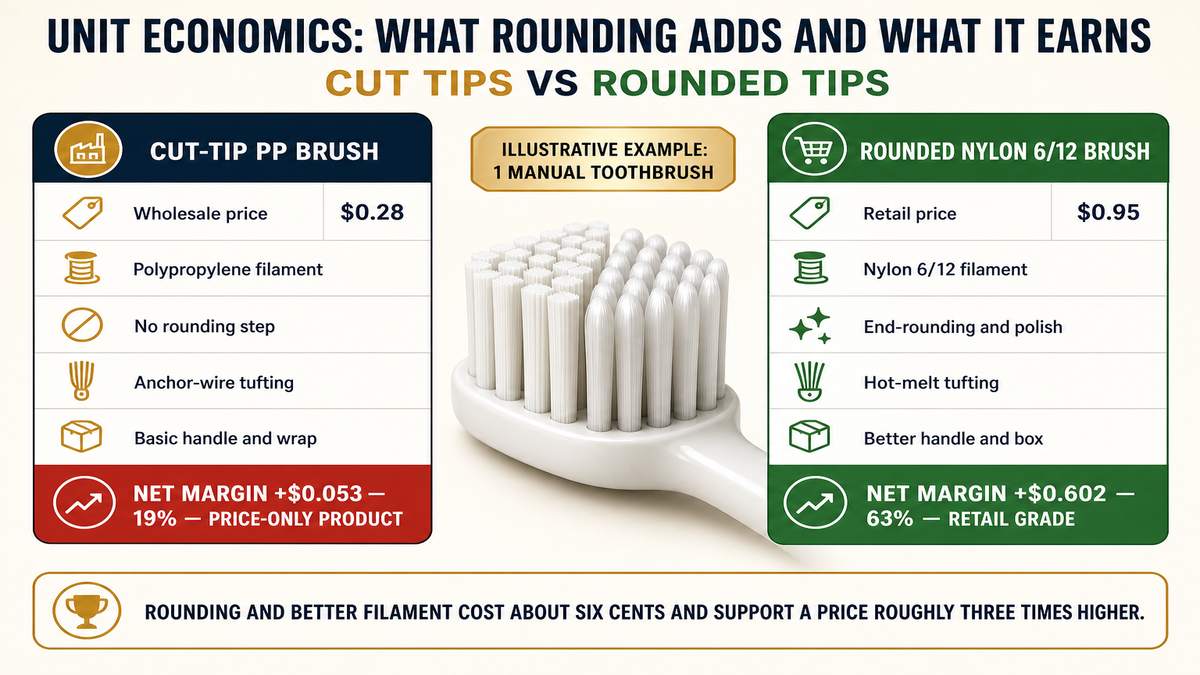
7. Cost Breakdown: What a Custom Toothbrush Really Costs
Bristle choice moves the unit price more than most buyers expect. Here is how the money splits on a standard manual toothbrush, based on factory quotations collected for this guide.
| Cost Item | Entry Version (PP filament) | Retail Version (Nylon 6/12, rounded) |
|---|---|---|
| Handle (injection moulded) | $0.070 – $0.110 | $0.090 – $0.140 |
| Bristle filament | $0.010 – $0.020 | $0.030 – $0.055 |
| Tufting and end-rounding labour | $0.015 – $0.030 | $0.035 – $0.060 |
| Packaging (blister or paper box) | $0.030 – $0.070 | $0.045 – $0.090 |
| Mould cost per unit at 50,000 pcs | $0.020 – $0.040 | $0.020 – $0.040 |
| Total factory cost per brush | $0.145 – $0.270 | $0.220 – $0.385 |
The gap looks small in dollars and large in margin. A rounded Nylon 6/12 brush can be sold at a premium price, while a PP brush can only compete on price against supermarket own-label packs. If you want your own logo on the handle, plan the artwork early with a supplier who handles custom logo printing and finishing.
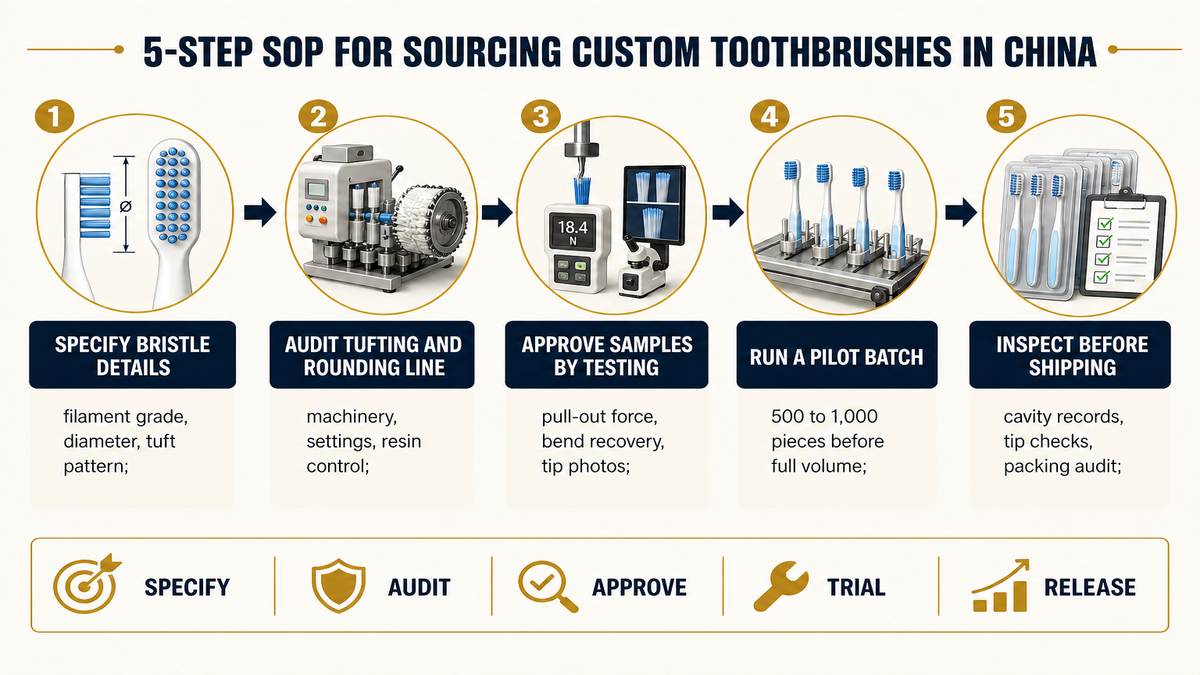
8. Five-Step Sourcing Roadmap for Custom Toothbrushes
Working through these five stages in order keeps bristle problems out of your container.
- Lock the bristle spec. Material grade, diameter in millimetres, tuft pattern, filament colour and the rounding requirement, all written on one page.
- Check the factory before the samples. Ask to see the filament extrusion or tufting equipment and the end-rounding line, not just the finished brushes. A short factory audit answers more than a month of emails.
- Approve samples properly. Test pull-out force, bending recovery and end-rounding on the samples, then keep one approved brush sealed as your golden sample.
- Run the first bulk batch as a trial. Inspect the first 500 to 1,000 pieces before the factory runs the full volume, so a tufting setting can still be corrected.
- Inspect before shipping. Pull tufts, photograph bristle ends and check the paperwork on the finished batch, then book the container.
9. Frequently Asked Questions
Are bamboo toothbrush bristles actually biodegradable?
Almost always no. Most bamboo-handle toothbrushes use ordinary nylon bristles, sometimes with charcoal powder added for colour. The bamboo refers to the handle, not the bristles. If a supplier claims compostable bristles, ask for the material certificate and test reports before you print that claim on a box.
Can I put my own logo on a ready-made toothbrush design?
Yes, and it is the cheapest way to launch. Most factories offer existing moulds for the handle and can add your logo by pad printing, hot stamping or an in-mould label. The only part you must still specify is the bristle material and rounding, because that is where quality lives.
What is a normal minimum order quantity for a custom toothbrush?
For an existing handle mould, factories we work with often start near 10,000 pieces, and prices improve sharply at 50,000 and above. For a brand new handle mould, expect a tooling cost that is only worth paying if you plan a long term range.
How do I tell good end-rounding from bad end-rounding without a lab?
Rub the bristle head across the back of your hand. A properly rounded head feels like a soft brush; a poorly finished one feels like a stiff nail brush and leaves light scratch marks. Then confirm with microscope photos from the factory at roughly 30x magnification.
Get Your Bristle Spec and Factory Checked Before You Order
Our team reviews your bristle specification, checks the tufting and end-rounding lines at the factory, tests pull-out force on samples, and holds one approved golden sample before bulk production starts.
Request a Bristle Sourcing Quote
Questions & Comments
We read every one and reply within 24 hoursStuck on a bristle specification, worried a supplier is cutting the end-rounding step, or not sure how to test tuft strength before bulk? Post your filament grade, diameter or sample results below and our team will help you read them.