
How to Handle Failed Quality Inspections: Rework, Scrap, or Compensation Negotiation (2026 Guide)
 ·
Updated September 30, 2026
·
15 min read
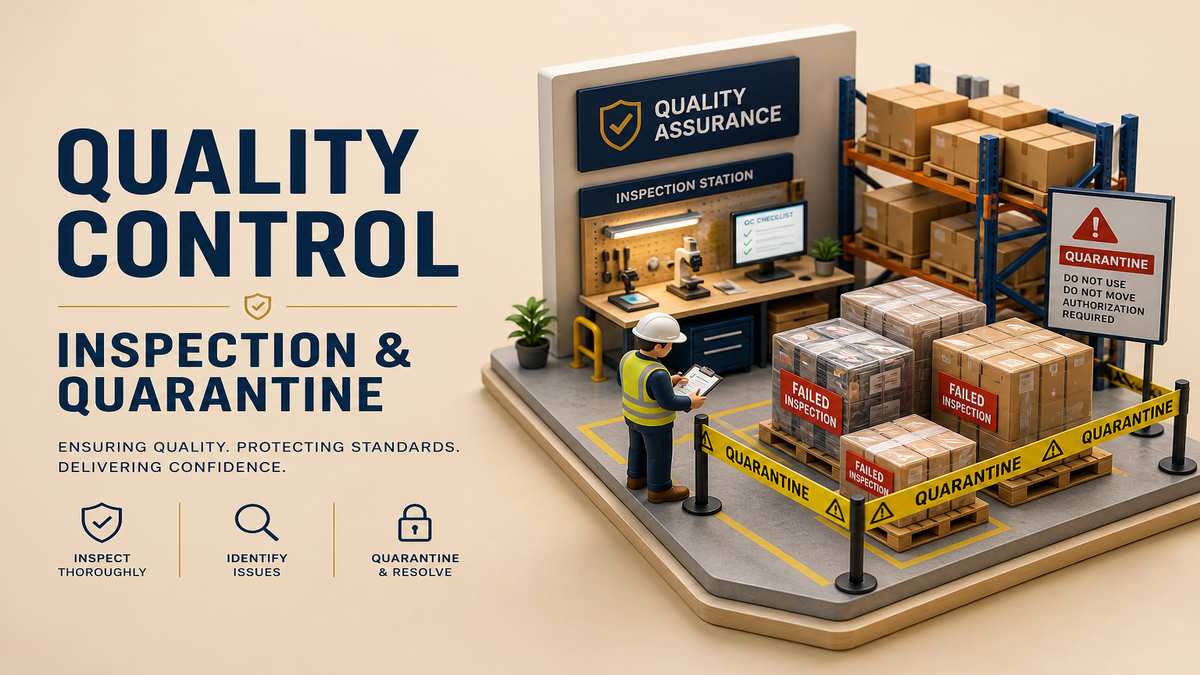
Direct Answer: When your pre-shipment inspection in China fails, take three immediate actions within 24 hours: First, freeze the final 70% balance payment and instruct your freight forwarder to hold the container loading dock arrival. Second, classify failed defects into critical safety hazards, major functional flaws, or minor cosmetic blemishes to choose between on-site factory rework, full scrap and remake, or accepting goods under a negotiated price concession. Third, enforce a formal written Corrective Action Plan (CAP) requiring the factory to complete 100% sorting, destroy scrap under inspector supervision, and pay all re-inspection fees before cargo release.
Receiving a red “FAIL” or “PENDING” report from your third-party quality inspector in China can feel like a sudden disaster. Your ocean container vessel cut-off is approaching, retail warehouse shelves are waiting, and the supplier is arguing that the minor surface marks are completely normal for mass production. Panic is your worst enemy. Knowing how to handle a failed quality inspection separates experienced importers from novices who lose thousands of dollars on unsellable inventory.
In this comprehensive guide, we break down the immediate 24-hour action protocol, compare Rework vs. Scrap vs. Concession decisions, expose factory shortcuts during sorting, analyze compensation and chargeback methods, and share an actionable 5-step SOP to supervise rework in China.
What Should You Do in the First 24 Hours After a Failed Inspection?
The first 24 hours after an inspection failure decide whether you protect your capital or lose your leverage. Many buyers make the mistake of calling the factory in anger or demanding an immediate refund over chat. Experienced sourcing specialists follow a structured emergency protocol to secure goods, stop cash outflows, and lock in evidence:
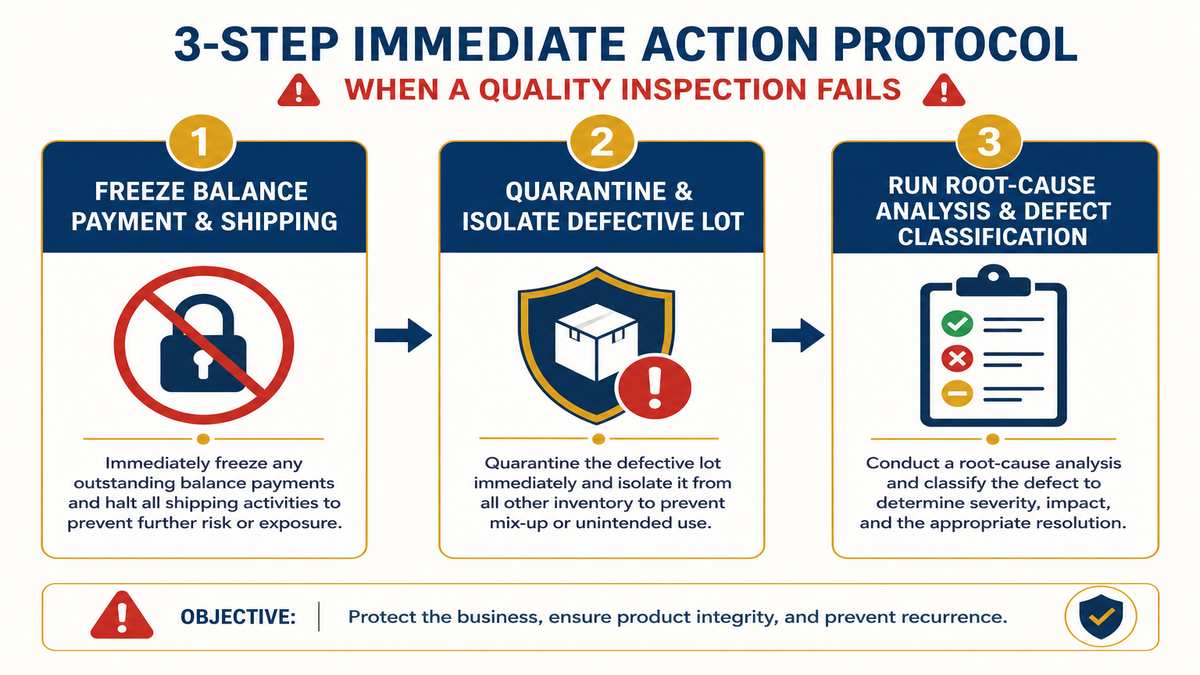
- Freeze the Final Balance Payment Immediately: In standard international manufacturing contracts, buyers pay a 30% deposit upfront and the remaining 70% balance after a passing pre-shipment inspection (PSI) sign-off. That final 70% payment is your single strongest piece of leverage. The moment your inspection company issues a failed report, notify your finance team to freeze all outgoing wire transfers. Never accept verbal promises to “settle discounts on the next order” once money has left your account.
- Put an Immediate Hold on Shipping Bookings: If your cargo is booked under standard FOB or CIF terms, contact your freight forwarder immediately to place a formal booking hold. Letting defective goods leave the factory gate and enter the port customs area makes physical rework impossible and multiplies port storage costs.
- Demand Defect Isolation and High-Definition Video Evidence: Instruct the factory quality manager to move the entire production lot into a clearly marked, taped-off quarantine warehouse zone. Request high-resolution photos and video showing the defective items alongside the approved golden sample signed during your first article inspection (FAI) tooling reviews.
Rework, Scrap, or Concession: How Do You Choose the Right Path?
Once your leverage is secured, you must decide how to handle the defective batch. You have three primary resolution pathways: Rework, Scrap and Remake, or Accept with a Concession Discount. Choosing the wrong option leads to customer returns or long delivery delays:
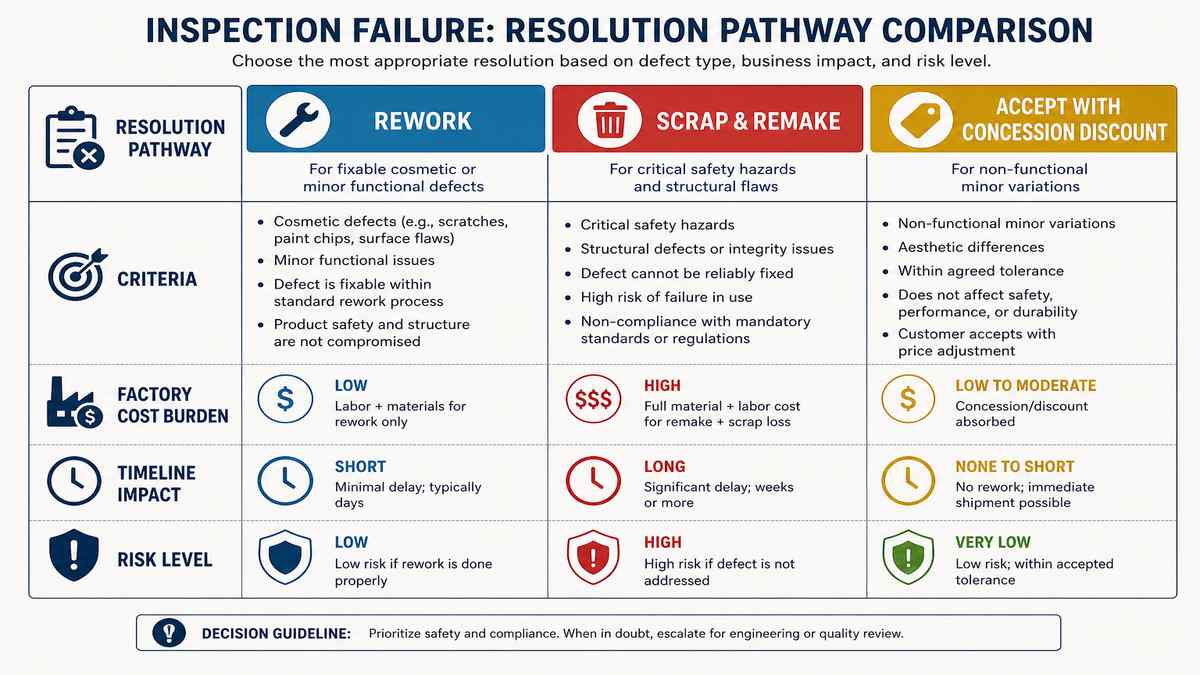
| Resolution Path | When to Choose (Technical Criteria) | Factory Cost Burden | Timeline Delay | Buyer Risk Level |
|---|---|---|---|---|
| Factory Rework | Surface-level defects, incorrect barcode stickers, loose screws, minor paint burrs, repacking needs. | Medium (Labor hours, new packaging, repacking line). | 3 to 7 working days. | Low to Medium (Risk of cosmetic damage during disassembly). |
| Scrap & Remake | Critical safety hazards, wrong raw materials, structural mold flaws, failed chemical safety rules. | High (100% raw material loss and production costs). | 15 to 30 working days. | Very Low (Fresh production under strict quality gates). |
| Concession Discount | Minor cosmetic shade variations, non-functional flaws within acceptable retail margins. | Low (Direct margin deduction on commercial invoice). | 0 to 1 day (Immediate cargo release). | Medium (Potential negative customer reviews or lower resale price). |
Option A: When to Mandate Factory Rework
Factory rework is the most common solution in consumer goods manufacturing. It works best when the product defect is non-destructive and can be corrected without damaging core components. Classic examples include replacing wrinkled gift box packaging, cleaning glue residue off plastic housings, replacing incorrect user manuals, or applying corrected export carton shipping mark regulations.
However, rework carries hidden dangers. When factory workers rush to disassemble finished goods under tight deadlines, they often scratch delicate polished surfaces, strip screw threads, or introduce dust into optical lenses. You must establish strict rework instructions before giving the factory permission to proceed.
Option B: When You Must Demand Full Scrap and Remake
Some production errors cannot be repaired. If the factory used the wrong plastic resin (such as brittle recycled ABS instead of virgin flame-retardant ABS), failed electrical insulation testing, or exceeded heavy metal limits under international consumer safety rules published by the U.S. Consumer Product Safety Commission (CPSC), rework is impossible.
In these critical safety scenarios, demanding a complete scrap and remake is non-negotiable. Releasing unsafe products into the market exposes your brand to customs seizures, mandatory consumer product recalls, and severe legal liability under U.S. Customs and Border Protection (CBP) trade regulations.
Option C: When to Accept Goods Under a Concession Discount
If your retail marketing launch or holiday selling season leaves zero buffer for a 15-day remake, accepting slightly flawed goods with a cash discount (known as a concession allowance) might be the most practical business choice. This path is suitable only for minor cosmetic defects (such as a 5% color tone shift on a back panel) that do not impact product durability, electrical safety, or core user experience.
Ensure that the agreed price deduction covers your commercial risks, including expected customer return rates, promotional markdown costs, or secondary liquidation discounts.
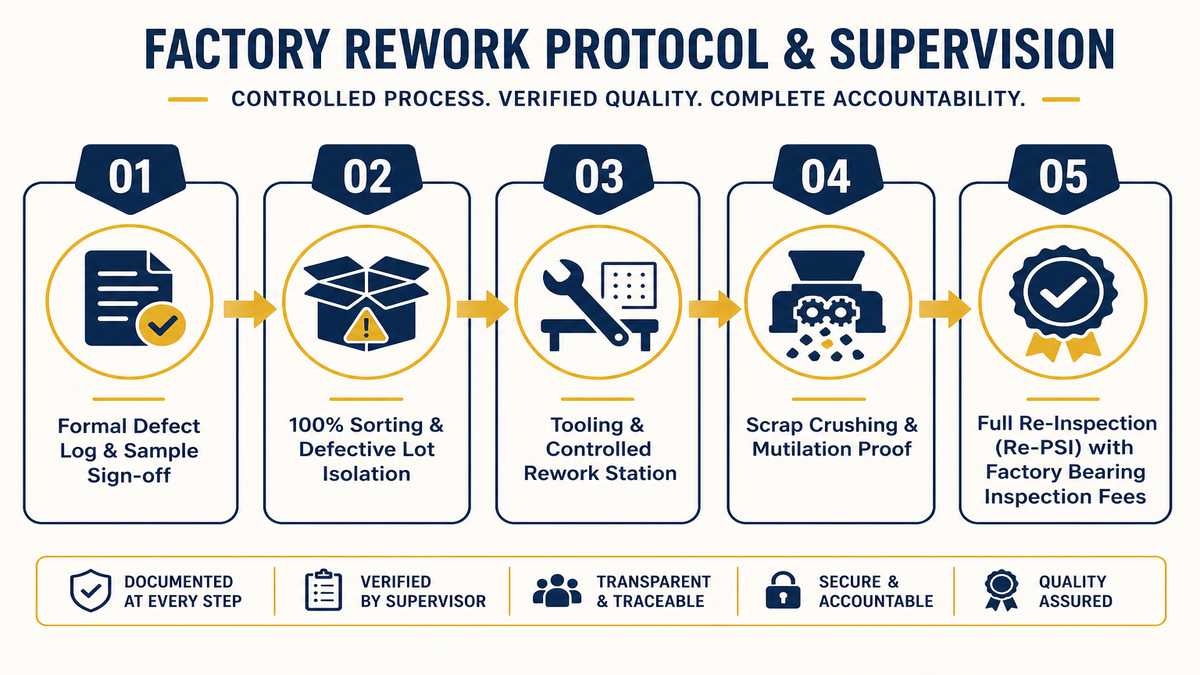
The 5-Step SOP for Supervising Factory Rework in China
Never tell a Chinese supplier to simply “fix the goods and ship them out.” Without on-site supervision, factory workers often pick out only the worst 10% of defects, mix flawed products back into finished cartons, and rush the shipment to the seaport. Follow this 5-step standard operating procedure to maintain complete control over the rework process:
Negotiating Financial Compensation and Supplier Chargebacks
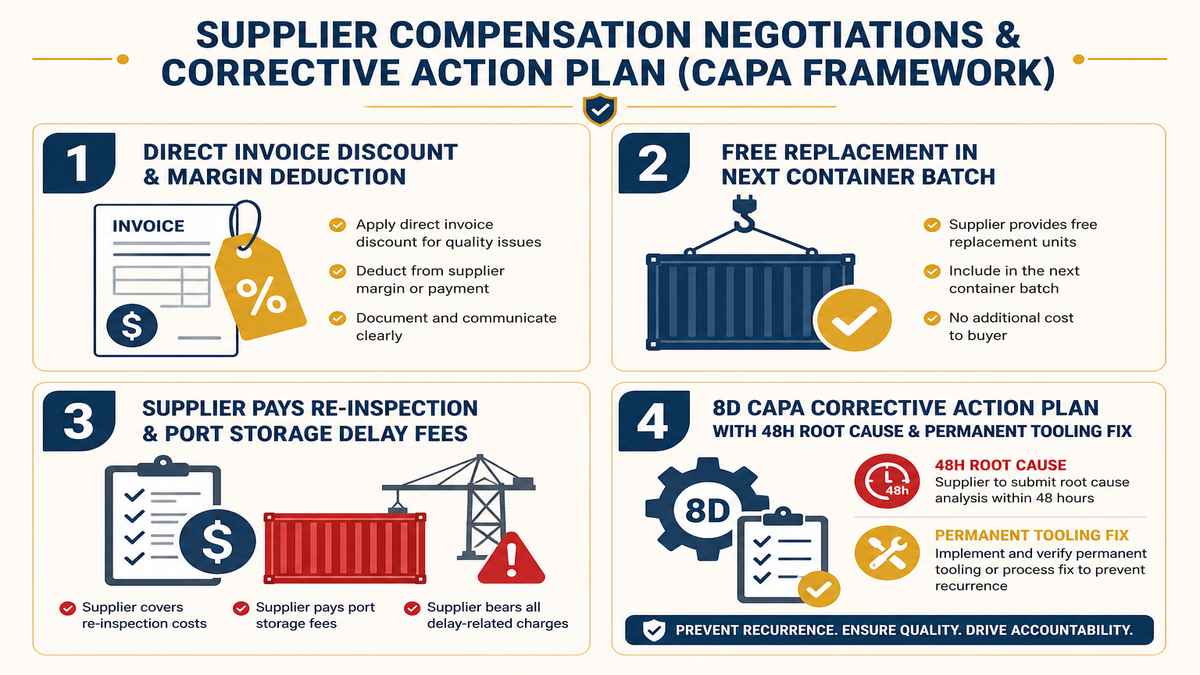
A failed inspection always generates extra costs, including re-inspection fees, freight delay penalties, port demurrage, and wasted raw materials. Negotiating who pays for these losses requires clear contract terms and firm commercial communication:
| Compensation Method | How It Works | Best Suited For | Buyer Advantage |
|---|---|---|---|
| Direct Invoice Deduction | Deduct the cash value of defective goods directly from the final 70% wire transfer. | Scrapped units or agreed concession discounts on the current shipment. | Immediate cash recovery with zero dependency on future orders. |
| Free Replacements in Next PO | Supplier manufactures extra free units to replace defective goods in your next scheduled batch. | Stable, ongoing supplier relationships with recurring quarterly production orders. | Maintains good supplier goodwill while recovering full product value. |
| Credit Note Against Future Bills | Supplier issues a formal signed credit memo valid for 12 months. | High-volume buyers who place multiple orders per month across different product lines. | Flexible accounting credit usable across various production runs. |
| Supplier-Funded Air Freight Top-Up | Factory pays the price difference between ocean freight and express air freight for urgent goods. | Critical stock-out emergencies where retail shelf deadlines cannot slip. | Protects retail store rankings and prevents out-of-stock platform penalties. |
How to Enforce a Corrective Action Plan (CAP) to Prevent Recurrence
Solving the immediate defect is only half the battle. If you do not force the supplier to fix the root cause in their production line, the exact same defects will reappear on your next order. Professional quality engineers use a standardized Corrective Action Plan based on international quality standards from the American Society for Quality (ASQ):
- Pillar 1: Root Cause Analysis (5 Whys / Ishikawa Fishbone): Demand that the factory explain why the failure occurred. Was it a worn stamping die, poor worker training on the night shift, or raw material humidity in the warehouse?
- Pillar 2: Immediate Containment: Document how the factory separated existing flawed inventory from good stock.
- Pillar 3: Permanent Engineering Fix: Require verifiable mechanical or process changes, such as installing automated optical sensors, upgrading injection mold cooling channels, or replacing manual packaging lines with validation scanners.
- Pillar 4: Milestone Checks: Require the supplier to submit weekly photo logs and schedule an early during production inspection (DUPRO) on the next batch to confirm that the fix remains in place.
Illustrative Sourcing Scenario: Silicone Baby Suction Bowls
To understand how to manage inspection failures and protect capital, consider this real-world quality dispute scenario:
A North American e-commerce brand ordered 20,000 sets of food-grade silicone baby suction bowls from a manufacturer in Ningbo, China. The order value was $48,000, with a 30% deposit ($14,400) paid and a 70% balance ($33,600) due after inspection. The agreed quality standard was AQL Level II Normal Sampling (Critical 0, Major 2.5, Minor 4.0).
The third-party inspector pulled 315 sample sets from the finished batch. The inspection revealed 0 Critical defects, 18 Major defects (excessive silicone flash and air bubbles on the rim that could trap food bacteria), and 24 Minor defects (minor color streak marks). Under AQL 2.5, the maximum allowable Major defects was 14. The batch failed inspection with a red REJECT result:
- Financial Leverage: The buyer immediately withheld the $33,600 balance payment and notified the freight forwarder to hold the container loading scheduled for the following Monday.
- On-Site 100% Sorting: The buyer required the factory to open all 20,000 sets. Factory workers spent 4 days trimming silicone flash under magnifying lamps and sorting units into passing and non-repairable piles.
- Scrap & Compensation: 850 units with deep structural air bubbles were deemed unfixable. The factory agreed to crush the defective bowls in the presence of the inspector and deducted $2,040 (850 units × $2.40 unit price) from the final invoice.
- Re-Inspection: A second AQL inspection was conducted on Friday. The batch passed with only 3 Major cosmetic defects. The factory paid the $300 re-inspection fee directly.
- Outcome: The buyer received 19,150 perfect units, saved $2,340 in direct deductions, and avoided negative 1-star reviews on Amazon.
Frequently Asked Questions (FAQ)
What is the very first step when a factory inspection fails?
Immediately freeze the remaining balance payment (typically the final 70%) and instruct your freight forwarder to hold the container booking. Never release final funds before reviewing the defect breakdown, checking physical limit samples, and agreeing on a written corrective action plan with the supplier.
Who pays for the second inspection after factory rework?
Under standard international trade terms and supply contracts, the supplier is fully responsible for all re-inspection fees (typically $280 to $320 per man-day) and any additional local travel costs caused by an initial failed inspection.
When should you choose rework over scrapping a defective production batch?
Choose factory rework when defects are surface-level or modular (such as loose threads, wrong barcode stickers, minor cosmetic burrs, or replaceable screws) and the process will not compromise product structural safety or delay critical holiday shipping deadlines.
How do you negotiate compensation if a factory refuses to remake defective goods?
Use your held 70% balance payment as leverage. Negotiate an immediate invoice discount (concession allowance), demand free replacement units in the next production run, or deduct the scrap value directly from the final settlement invoice.
What is a Corrective Action Plan (CAP) in China manufacturing?
A Corrective Action Plan (CAP) is a formal 8D-style engineering document where the supplier identifies the root cause of production defects, establishes permanent tooling or process fixes, and sets strict follow-up check milestones within 48 to 72 hours.
Need Expert On-Site Dispute Support in China?
Do not let a failed factory inspection turn into a total loss. Sourcing Pioneer deploys on-the-ground quality engineers across Zhejiang, Guangdong, Jiangsu, and Fujian to supervise 100% rework sorting, protect your capital, and negotiate fair supplier compensation.
Request On-Site Inspection Support
Questions & Comments
We read every one and reply within 24 hoursDid your factory fail an AQL inspection in China, push back on re-inspection fees, or threaten to delay shipping unless you accept flawed goods? Post your product category, defect rate, and supplier location below — Alan Xiao answers every comment with practical engineering and negotiation advice.