
Pros and Cons of Hiring a China Sourcing Agent: Full Cost, Risk, and ROI Guide (2026)
 ·
Updated September 23, 2026
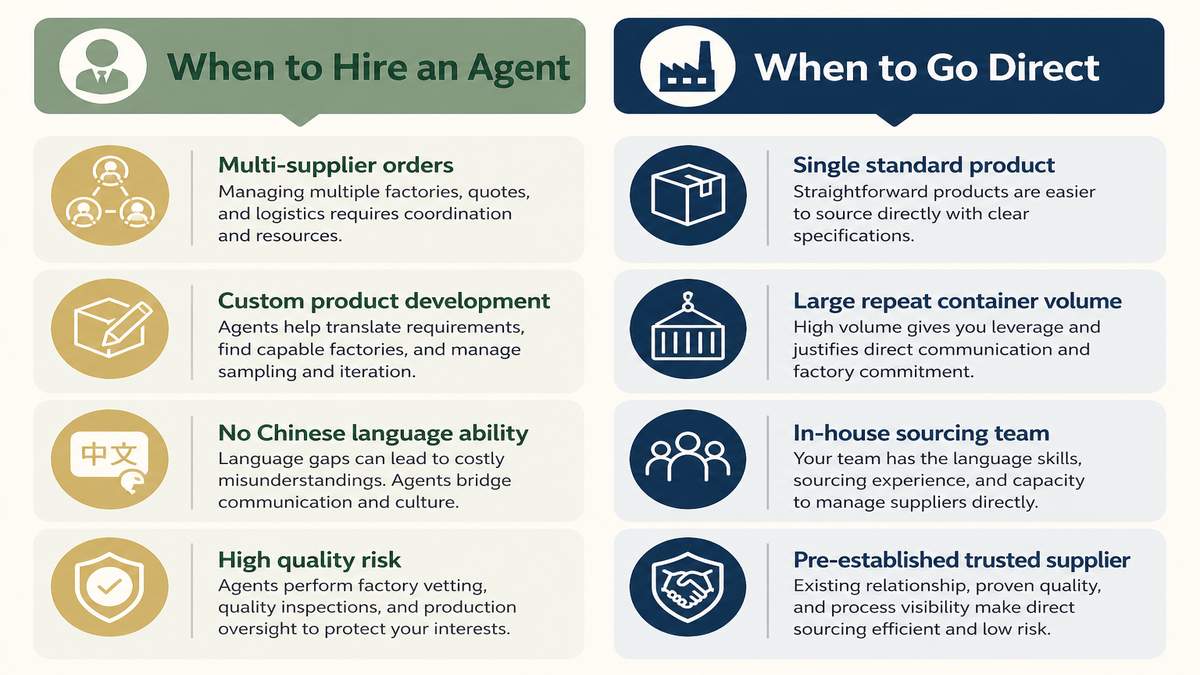
Hiring a China sourcing agent makes financial sense when you are launching custom products, buying from multiple workshops, or spending over $10,000 to $20,000 annually where local price negotiation and on-site quality control save more money than the agent’s 5% to 10% fee. Conversely, if you are buying single standard off-the-shelf items in small trial batches under $2,000, paying an agent commission adds unnecessary cost, and dealing directly with suppliers online is faster.
For overseas brands, Amazon sellers, and retail importers, sourcing directly from overseas manufacturing hubs presents both massive profit margins and substantial operational risks. While an experienced agent acts as your trusted eyes and ears on the factory floor, an unvetted middleman can add extra cost, create communication delays, or hide supplier rebates. This guide provides an honest, balanced breakdown of the real advantages, hidden risks, financial ROI calculations, real-world case studies, and safety rules for working with sourcing partners in China.
Quick decision framework: when to hire an agent vs when to go direct
Before examining every individual benefit and drawback, use this operational matrix to evaluate your current business stage:
The 5 major advantages of hiring a China sourcing agent
When working with a reputable, registered partner, an agent delivers value across five distinct operational areas:
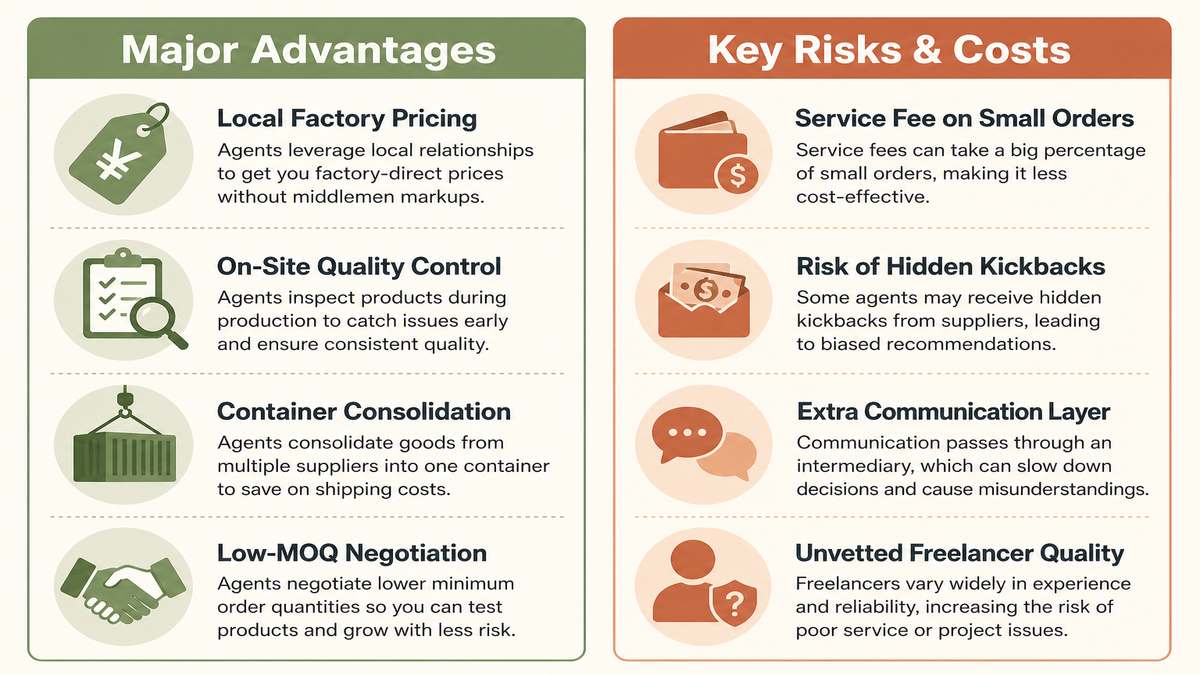
1. Local factory pricing and genuine cost breakdown
Foreign buyers contacting factories on English-language wholesale portals frequently receive “export quotes” that include built-in markups of 15% to 30%. Because local agents search domestic industrial networks (such as 1688 and specialized regional trade clusters) in Chinese, they access genuine local factory pricing.
Moreover, experienced agents understand raw material price indices for plastics, metals, textiles, and electronics. Instead of guessing, they calculate the real cost of production, machine runtime, and labor, allowing them to negotiate fair prices without prompting the factory to secretly cut corners on material quality. To see how these fees compare with trading markups, explore our sourcing agent versus trading company versus manufacturer cost comparison.
2. On-site quality inspection and dispute protection
The most common failure in international trade is “quality fade”—where the factory makes a perfect initial sample, but mass production suffers from rough stitching, color mismatch, weak packaging, or defective internal parts. Remote video calls and factory-provided photos cannot reliably catch these hidden flaws.
A sourcing agent sends inspectors directly to the production line for during-production (DUPRO) and pre-shipment inspections (PSI) using standard international AQL 2.5 quality tables. If defects exceed acceptable limits, the agent withholds final balance payments and manages on-site rework before goods leave the country. For a step-by-step look at sampling standards, read our detailed guide to third-party quality inspection services in China.
3. Multi-supplier warehousing and container consolidation
If you are developing a retail brand, you might source product units from one factory in Ningbo, printed gift boxes from a packaging printer in Dongguan, and custom fabric pouches from a workshop in Yiwu. Shipping three separate small LCL (Less than Container Load) ocean shipments means paying triple local port handling fees, separate customs declaration costs, and higher freight rates.
A sourcing agent receives all goods at their central warehouse, checks piece counts, repacks items into unified cartons, and consolidates everything into a single Full Container Load (FCL). This consolidation frequently cuts total international shipping bills by 20% to 35%.
4. Low-MOQ negotiation and custom sample support
Tier-1 manufacturing plants often set high Minimum Order Quantities (MOQs) of 3,000 to 5,000 units, which creates severe inventory cash-flow pressure for growing brands. Local sourcing agents leverage their ongoing trade volume with industrial clusters to negotiate trial MOQs of 500 to 1,000 units.
They also coordinate physical prototyping, tooling modifications, and packaging design revisions in person. If you are developing custom branded products, our step-by-step tutorial on how to launch private label products in China explains how to manage these sample runs efficiently.
5. Export paperwork, HS codes, and import rule checks
International customs regulations are strict. Using incorrect Harmonized System (HS) tariff codes, missing country-of-origin labels, or failing consumer safety rules can lead to customs seizures, heavy fines, or port storage penalties. Sourcing agents prepare accurate commercial invoices, packing lists, and export declarations, and help check that products meet safety rules established by agencies like the U.S. Consumer Product Safety Commission (CPSC).
The 5 real risks and drawbacks of using a sourcing agent
While the benefits are significant, working with a sourcing agent introduces five specific operational risks that every buyer must understand and manage:
| Potential Risk / Drawback | Why It Happens | How to Protect Your Business |
|---|---|---|
| 1. Extra Service Fees | Agents charge 5% to 10% commission or fixed project fees, which hurts small orders under $3,000. | Calculate total landed cost; use self-sourcing for simple micro-orders. |
| 2. Hidden Supplier Rebates (Kickbacks) | Dishonest agents recommend factories that pay them secret commissions instead of the best factory. | Require direct factory quotes, retain factory visit rights, and sign anti-kickback agreements. |
| 3. Slower Technical Communication | Adding an intermediary layer can slow down urgent design changes or complex engineering discussions. | Set up direct technical group chats involving the factory engineer and the agent. |
| 4. Unvetted Freelancer Quality | Unregistered freelance agents may lack business licenses, QC staff, or legal accountability. | Work only with registered companies that have physical offices and verified customer track records. |
| 5. IP & Product Design Leaks | Agents or suppliers might share custom mold designs or packaging artwork with competitor stores. | Sign enforceable bilingual Non-Disclosure Agreements (NDAs) before sharing technical CAD drawings. |
To understand exactly how transparent agents price their services and what items sit outside standard commissions, review our comprehensive analysis of China sourcing agent fees and quote comparison models.
The financial math: does a sourcing agent save or cost you money?
Let us look at a realistic financial comparison for an expanding e-commerce business ordering $30,000 worth of custom home decor products across two different factories:
| Expense Item | Scenario A: Self-Sourcing (Direct) | Scenario B: With a Professional Sourcing Agent |
|---|---|---|
| Factory Production Cost | $30,000 (standard export markup price) | $26,400 (local negotiation saves ~12%) |
| Agent Service Fee (7%) | $0 | $1,848 |
| Quality Inspection | $650 (two separate third-party inspector visits) | Included in agent service scope ($0 extra) |
| Warehousing & Consolidation | $550 (two separate LCL handling fees) | $180 (single consolidated container loading) |
| Defective Product Losses | $900 (estimated 3% unnoticed minor defect rate) | $0 (defects caught and remade on-site before shipping) |
| Total Landed Cost | $32,100 | $28,428 |
| Net Financial Result | Baseline | Net Savings: $3,672 (11.4% total savings) |
As the numbers show, when order size exceeds $15,000 to $20,000, the combination of local factory price negotiation, combined shipping, and defect prevention easily pays for the agent’s commission fee while delivering net savings.
For a complete breakdown of every task a professional partner performs across this cycle, read our overview of what a sourcing agent does and their core daily responsibilities.
Building an in-house procurement team vs hiring an agency
As brands grow past $500,000 in annual purchasing volume, business owners often ask whether they should hire full-time local staff in China instead of paying agency commissions. Here is how the annual expenses compare:
| Expense Factor | Setting Up an In-House China Office | Partnering with a Sourcing Agency |
|---|---|---|
| Staff Salaries & Benefits | $35,000 – $55,000/year per bilingual sourcing manager. | $0 fixed payroll; fees scale directly with order volume. |
| Office & Warehouse Rent | $12,000 – $24,000/year for workspace in Yiwu or Shenzhen. | Shared warehouse access included in project terms. |
| Travel & Factory Visits | $6,000 – $10,000/year in regional high-speed rail and hotels. | Local regional staff cover clusters with minimal travel overhead. |
| Management & Legal Entity | High complexity (setting up a WFOE or foreign enterprise registration). | Zero corporate registration or local tax filing needed. |
| Best Fit For | Brands spending over $1.5M – $2M annually with continuous daily orders. | Growing brands spending between $20,000 and $1M annually. |
Real-world case studies: when hiring an agent succeeded vs failed
To see these dynamics in action, examine three common scenarios from international e-commerce sellers:
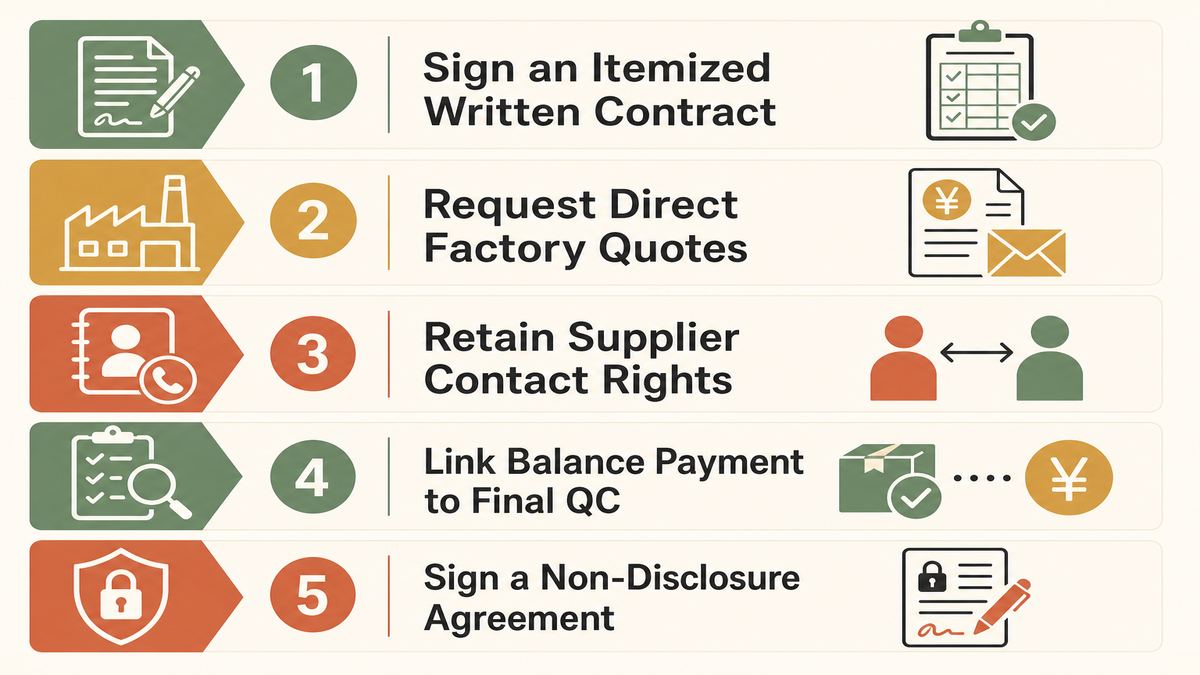
5 practical rules to hire a sourcing agent safely
If you decide that hiring an agent matches your business goals, apply these five safety rules to eliminate middleman risks:
When you are ready to evaluate candidate agencies, follow our step-by-step checklist on how to choose a reliable China buying agent.
Frequently asked questions about hiring a sourcing agent
Is it worth hiring a sourcing agent for Amazon FBA sellers?
Yes, especially for private label Amazon sellers. Sourcing agents inspect FBA barcode labels, ensure drop-test ready master carton packaging, bundle multiple accessories from different workshops, and prevent negative customer reviews caused by manufacturing defects.
Can a sourcing agent really get lower factory prices than I can?
In most cases, yes. Local agents search domestic wholesale channels in Chinese, understand current raw material costs, and negotiate based on industrial cluster standards rather than inflated “overseas buyer” price lists.
What is the typical commission fee for a China sourcing agent?
Standard commission rates range from 5% to 10% of the total product value, depending on order size, product complexity, and inspection scope. Larger volume orders often qualify for lower tiered rates of 3% to 5%.
How can I prevent a sourcing agent from taking secret factory kickbacks?
Choose registered sourcing firms that provide transparent, itemized quotes, reserve the right to visit the factory in person, and include a clear anti-kickback disclosure clause in your written agreement.
Should I use an agent if I only buy small trial orders under $2,000?
For simple standard products under $2,000, self-sourcing directly on verified B2B wholesale platforms is generally more cost-effective. Hire an agent once your order volume grows or when you start custom private-label manufacturing.
The bottom line
Hiring a China sourcing agent is not an expense—it is a strategic investment in supply chain risk management. When your business model involves custom products, private labeling, multiple suppliers, or strict quality requirements, the savings in lower factory pricing, reduced shipping costs, and defect prevention far outweigh the service fee.
By choosing a registered partner with transparent pricing, clear contracts, and strict quality inspection standards, you can scale your manufacturing operations in China with confidence, consistency, and peace of mind.
Questions & Comments
We read every one and reply within 24 hoursAre you deciding between working with a China sourcing agent or ordering directly from factories? Tell us about your product or what worries you most about manufacturing overseas.