
Shipping to Egypt from China: Costs, Routes, ACID Rules, and 7 Costly Mistakes (2026)
 ·
Updated September 23, 2026
·
Updated September 23, 2026
Shipping goods from China to Egypt successfully requires matching your cargo volume to the right freight channel—using DDP postal/special line couriers for samples under 2kg, air freight for urgent shipments over 45kg (taking 5 to 10 days into Cairo), and sea freight (LCL/FCL taking 25 to 35 days into Alexandria or Port Said) for bulk cargo. Crucially, all commercial sea and air shipments entering Egyptian ports must secure a valid 19-digit ACID (Advance Cargo Information Declaration) number on the official Nafeza platform before cargo leaves Chinese ports, or the goods will be rejected and returned at the shipper’s expense.
For cross-border e-commerce sellers, wholesalers, and retail brands importing from China into Egypt, North Africa represents a rapidly growing consumer market. However, many first-time importers choose low-margin heavy products without checking real freight rates, fail to understand Egyptian customs tariffs, or overlook mandatory electronic pre-registration. This comprehensive guide breaks down actual shipping routes, explains the official ACID customs clearance workflow, provides real landed cost calculations, and highlights the seven most common logistics mistakes to avoid.
China to Egypt shipping methods at a glance
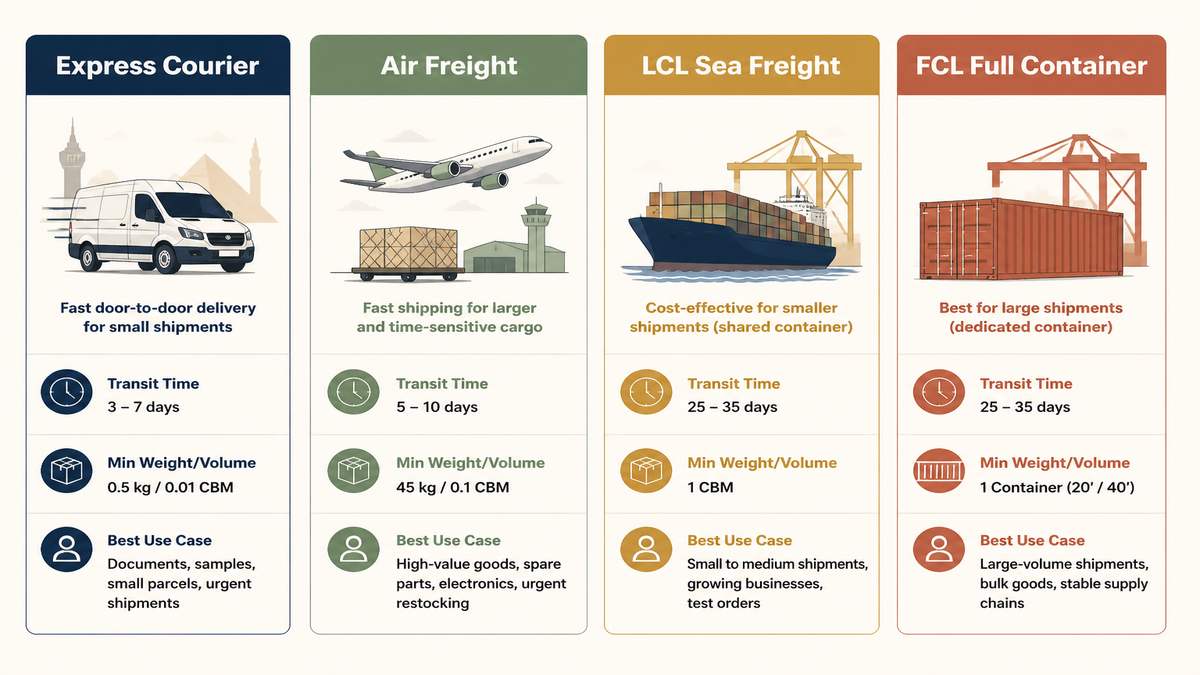
To choose the most cost-effective freight solution for your order size and delivery urgency, compare the four primary shipping channels:
Main shipping routes, transit times, and major Egyptian ports
Understanding the geographic journey of your cargo helps you plan inventory restocks and set customer delivery expectations:
| Shipping Method | Departure Ports (China) | Destination Ports (Egypt) | Standard Transit Time | Minimum Weight / Volume |
|---|---|---|---|---|
| Express Courier | Shenzhen, Hong Kong, Shanghai | Door-to-door (Cairo, Alexandria, Giza) | 3 – 7 Days | 0.5 kg |
| Air Freight Cargo | Guangzhou (CAN), Shanghai (PVG), Shenzhen (SZX) | Cairo International Airport (CAI) | 5 – 10 Days | 45 kg |
| LCL Sea Freight | Ningbo, Yiwu, Shenzhen, Qingdao | Alexandria Port, Port Said, Damietta | 25 – 35 Days | 1 CBM |
| FCL Sea Freight | Ningbo, Shanghai, Shenzhen, Guangzhou | Alexandria, Port Said, Sokhna Port | 22 – 30 Days | 1 Container (20′ / 40′) |
If you are coordinating production across several factories in Zhejiang or Guangdong, having a local partner consolidate goods at a central warehouse before container loading saves significant port handling fees. Explore how our sourcing agent responsibilities guide breaks down warehouse consolidation and container loading supervision.
Mandatory Egypt customs clearance: the ACID system and Nafeza portal
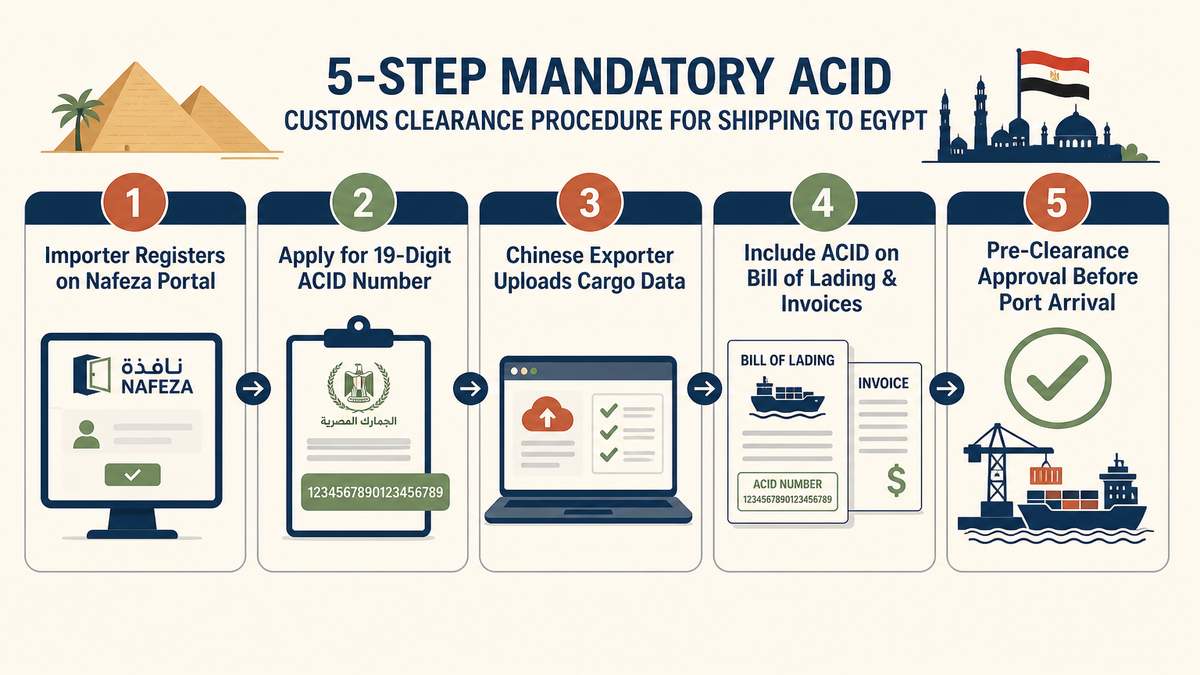
The most important legal requirement for shipping to Egypt is the Advance Cargo Information (ACI) system. Under Egyptian Customs Law, commercial cargo cannot be loaded onto a vessel or plane in China without a valid 19-digit ACID number.
The official clearance process follows five strict steps:
For international terms defining who pays for port clearance and insurance, consult the official International Chamber of Commerce Incoterms rules.
Egyptian import customs tariffs and regulatory rules by category
Egyptian customs applies both import tariffs (ranging from 5% to 40% depending on product classification) and a standard 14% Value Added Tax (VAT) calculated on the CIF value plus customs duty. Understanding these rates prevents budget miscalculations:
| Product Category | Typical Customs Duty | Import VAT | Mandatory Clearance Documents |
|---|---|---|---|
| Consumer Electronics & Accessories | 5% – 20% | 14% | NTRA Telecommunications Approval, CE Test Reports, ACID Number |
| Industrial Tools & Hardware | 5% – 15% | 14% | Commercial Invoice, Packing List, Certificate of Origin, ACID Number |
| Apparel, Blankets & Textiles | 30% – 40% | 14% | GOEIC Inspection Certificate, Textile Fiber Composition Label |
| Plastic Homeware & Drinkware | 20% – 30% | 14% | Food Grade Contact Testing Report, ACID Number, Packing List |
| Beauty & Personal Care Devices | 10% – 20% | 14% | EDA (Egyptian Drug Authority) or Safety Registration, ACID Number |
7 costly mistakes to avoid when shipping from China to Egypt
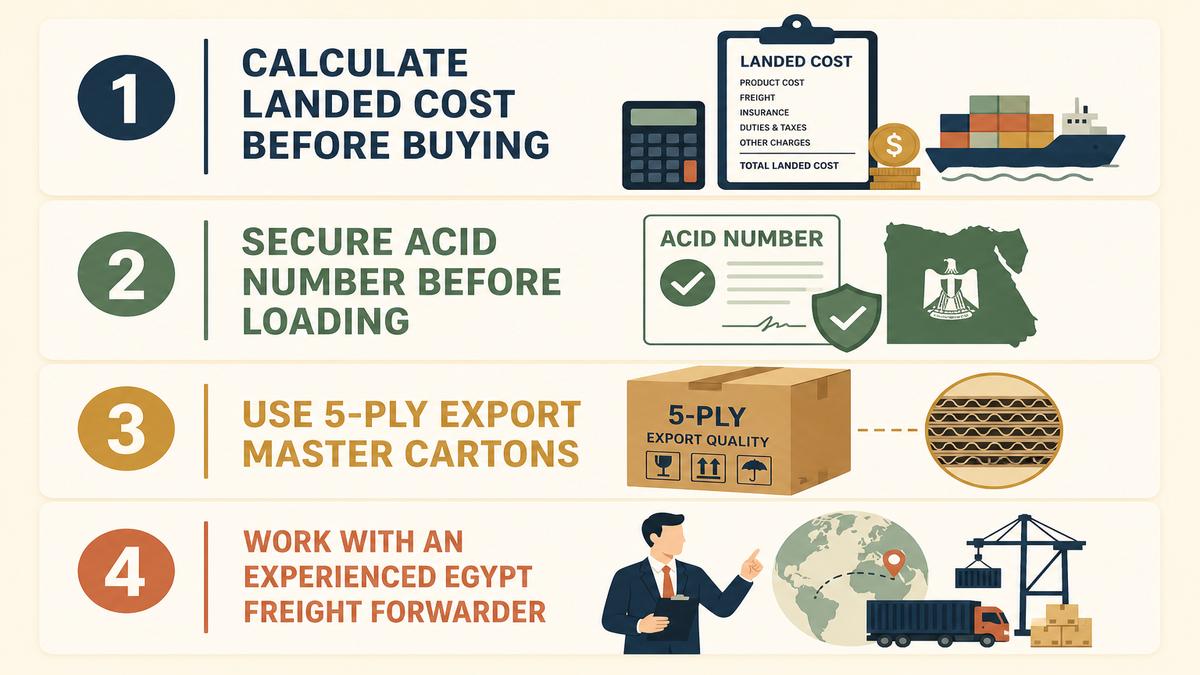
Over years of managing cross-border logistics to the Middle East and North Africa, we have seen importers lose thousands of dollars to avoidable errors:
Mistake 1: Choosing heavy, low-value products without checking freight rates
The most common mistake beginners make is selecting low-priced, bulky goods—such as cheap plastic homeware, ceramic mugs, or budget apparel—before asking for shipping quotes. When ocean freight or air rates are added to local import duties, the total shipping cost exceeds the local retail price in Cairo or Alexandria.
The Fix: Always calculate your complete landed cost first. Focus on high-value-to-weight products (such as precision tools, specialized electronics, or beauty accessories) where logistics represents less than 15% of your retail margin.
Mistake 2: Loading cargo before receiving the 19-digit ACID number
Some suppliers rush to load containers onto ships before the Egyptian importer finishes the ACID application on Nafeza. Under Egyptian law, any container arriving at an Egyptian seaport without an official ACID number cannot be unloaded, cleared, or auctioned—it must be returned to the port of origin at the shipper’s expense, incurring massive return freight and demurrage charges.
The Fix: Never release factory balance payments or permit container dispatch until the freight forwarder checks the 19-digit ACID number on the draft Bill of Lading.
Mistake 3: Choosing the wrong courier channel for product samples
Sending product samples via standard commercial couriers (DHL or FedEx) often results in surprise customs duty evaluations upon arrival in Egypt, even for items marked “sample with no commercial value.” Furthermore, standard couriers reject products containing built-in lithium batteries, liquids, or powders.
The Fix: For standard non-sensitive samples under 2kg, use specialized DDP postal lines (such as YunExpress) where taxes are pre-cleared, or work with forwarders who provide battery-compliant channels. For custom product development, read our guide on how to get a product manufactured in China and test golden samples.
Mistake 4: Underestimating export packaging and moisture protection
Cargo traveling by sea from China to Egypt spends 25 to 35 days in humid maritime environments, passing through tropical waters and the Red Sea. Inadequate single-wall cardboard boxes frequently crush under stacking pressure, leading to damaged inventory upon arrival.
The Fix: Require suppliers to use 5-ply double-wall corrugated master cartons, heavy-duty edge protectors, nylon strapping, plastic pallet shrink-wrapping, and silica gel desiccant bags inside every master box.
Mistake 5: Shipping without on-site factory quality inspection
Once cargo leaves China and arrives in Egypt, returning defective goods for repair or refund is practically impossible due to double customs tariffs and international freight costs. Discovering missing accessories or broken parts at your warehouse in Egypt means taking a direct financial loss.
The Fix: Always conduct a formal pre-shipment quality inspection (PSI) while goods are still in the factory. If you need local inspection support, review our complete guide to third-party quality inspection services in China.
Mistake 6: Mismatched HS codes and invoice documentation
Egyptian customs cross-checks the Chinese export declaration against the Egyptian import entry. If the Harmonized System (HS) code, product description, or declared quantity on the commercial invoice differs from the packing list or ACID data, customs will freeze the clearance and impose severe documentation audit penalties.
The Fix: Work with an experienced forwarder to check that HS codes match Egyptian customs tariff schedules exactly before submitting documents through CargoX.
Mistake 7: Hiring unverified logistics brokers without Egypt clearance experience
General freight forwarders who primarily handle US or European routes often lack working experience with Egyptian customs protocols, the Nafeza digital portal, or local port clearance agents in Alexandria. This lack of specialization leads to container clearance delays and high port storage fees.
Additionally, inexperienced forwarders often book shipping lines offering only standard 7-day free demurrage periods. If customs paperwork or inspection takes 12 days at Alexandria port, importers face daily container penalty fees. Always negotiate for 14 to 21 free demurrage days in writing before booking.
The Fix: Partner with registered freight specialists who handle regular container volume to Egypt and provide transparent, itemized quotes. To understand how supply chain partners structure their fees, explore our guide to China sourcing agent fees and quote comparison.
Real landed cost math: sample calculation for Egypt shipping
To see how logistics and customs duties shape retail profit margins, examine this realistic cost breakdown for importing 1,000 units of custom stainless steel tumblers (Total volume: 2.5 CBM, Total gross weight: 400 kg) from Ningbo to Alexandria Port via LCL Sea Freight:
| Cost Element | Calculation Basis | Total Amount (USD) | Cost Per Unit |
|---|---|---|---|
| Factory Production Cost | 1,000 units × $3.50 EXW | $3,500.00 | $3.50 |
| Warehouse Consolidation & Trucking | Local Ningbo delivery + carton labeling | $120.00 | $0.12 |
| LCL Ocean Freight (Ningbo to Alexandria) | 2.5 CBM × $160 / CBM | $400.00 | $0.40 |
| Nafeza ACID Registration & CargoX Fees | Platform electronic filing fee | $85.00 | $0.09 |
| Egyptian Customs Duty (est. 10%) | 10% of CIF value ($4,105) | $410.50 | $0.41 |
| Egyptian Import VAT (14%) | 14% on (CIF value + Customs Duty) | $632.17 | $0.63 |
| Port Handling & Local Clearance | Alexandria terminal & clearance agent | $250.00 | $0.25 |
| Total Landed Cost in Egypt | All production + logistics + customs | $5,397.67 | $5.40 / unit |
With an average retail price of 450 EGP to 600 EGP ($9.50 to $12.50 USD) in Egyptian retail stores and e-commerce platforms, a total landed cost of $5.40 leaves a healthy gross profit margin of 43% to 56%, proving that structured planning makes importing to Egypt highly profitable.
When weighing whether to manage overseas logistics independently or work with local sourcing professionals, read our balanced review of the pros and cons of hiring a China sourcing agent.
Frequently asked questions about shipping to Egypt
What is an ACID number in Egyptian shipping?
An ACID (Advance Cargo Information Declaration) number is a mandatory 19-digit customs identification number issued by the Egyptian Nafeza platform. It must be generated by the importer and printed on all shipping documents before cargo leaves the export port.
How long does sea freight take from China to Egypt?
Standard ocean shipping transit time ranges from 22 to 35 days depending on departure ports (Ningbo, Shanghai, or Shenzhen) and destination ports (Alexandria, Port Said, or Sokhna Port).
Can I ship samples with batteries or liquids to Egypt?
Standard commercial couriers (DHL/FedEx) typically restrict battery and liquid samples. Importers should use specialized DDP air channels or freight forwarders with dangerous goods licenses to transport battery-powered devices safely.
What is the cheapest way to ship goods from China to Egypt?
For large commercial shipments over 1 CBM or 300 kg, LCL or FCL sea freight offers the lowest unit cost per kilogram. For small parcels under 2 kg, dedicated DDP postal lines provide the best value.
What happens if my shipment arrives in Egypt without an ACID number?
Under Egyptian customs law, goods arriving without an official ACID number cannot be unloaded or cleared through customs and must be returned to the country of origin at the shipper’s expense.
The bottom line
Shipping to Egypt from China is a highly profitable endeavor when approached with proper regulatory preparation and realistic cost modeling. By securing your official ACID number on Nafeza before dispatch, selecting high-margin lightweight products, enforcing strict factory quality inspections, and using durable 5-ply export packaging, you can eliminate customs delays and protect your business margins.
Partner with experienced freight forwarders and local sourcing specialists who understand Egyptian customs protocols, ensuring your goods move smoothly from the factory floor directly to your warehouse in Egypt.
Questions & Comments
We read every one and reply within 24 hoursAre you planning a shipment from China to Egypt or facing challenges with Nafeza ACID registration? Share your cargo details or questions below.