
China Business Visa (M Visa) Guide for Sourcing Trips in 2026
 ·
Updated September 24, 2026
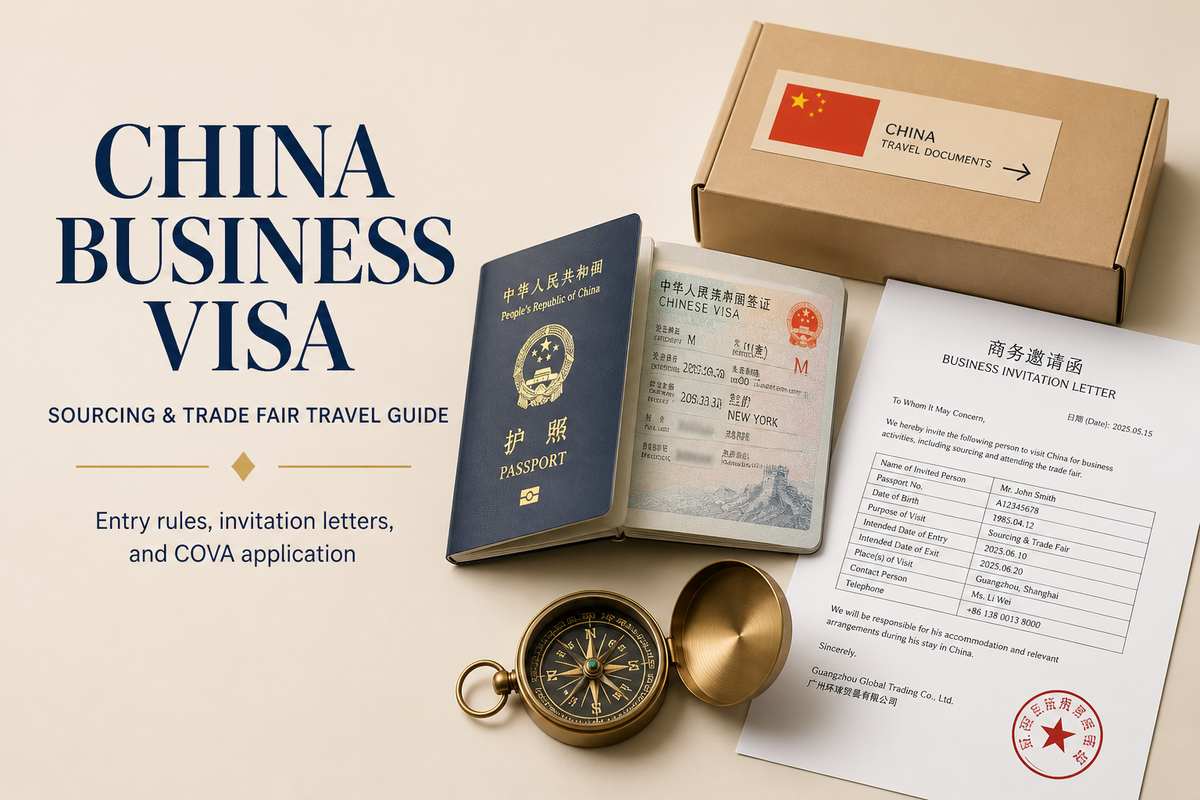
Direct Answer: To attend trade fairs, visit manufacturing facilities, or buy goods in China, most international importers need a Chinese Business Visa (M Visa). However, under updated 2026 entry policies, passport holders from over 35 countries in Europe, Asia, and Oceania can enter China visa-free for 15 to 30 days, while international transit travelers can explore manufacturing hubs using the 144-hour transit without visa policy. For longer business visits or buyers needing multiple entries, applying for an official M Visa with a certified invitation letter remains the safest and most flexible choice.
Planning your first sourcing trip to China can feel hard at first, but the entry process is much simpler once you understand your options. Whether your goal is attending the Canton Fair in Guangzhou, navigating the Yiwu International Trade Market, or evaluating custom manufacturing facilities across Guangdong and Zhejiang provinces, securing legal entry documentation is your foundation.
In this complete 2026 travel guide, you will learn how to choose between visa-free entry, transit exemptions, and the M Business Visa. We break down the required paperwork, explain how to obtain an official company invitation letter, walk through the China Online Visa Application steps, and share practical travel tips for on-the-ground communication and payments.
Do You Need a Visa for Your China Sourcing Trip? (2026 Rules)
Before filling out application forms or visiting a visa service center, check whether you actually need to apply for a visa. China has broadened its unilateral visa-free entry lists and transit exemption policies significantly over the past two years to welcome global business travelers.
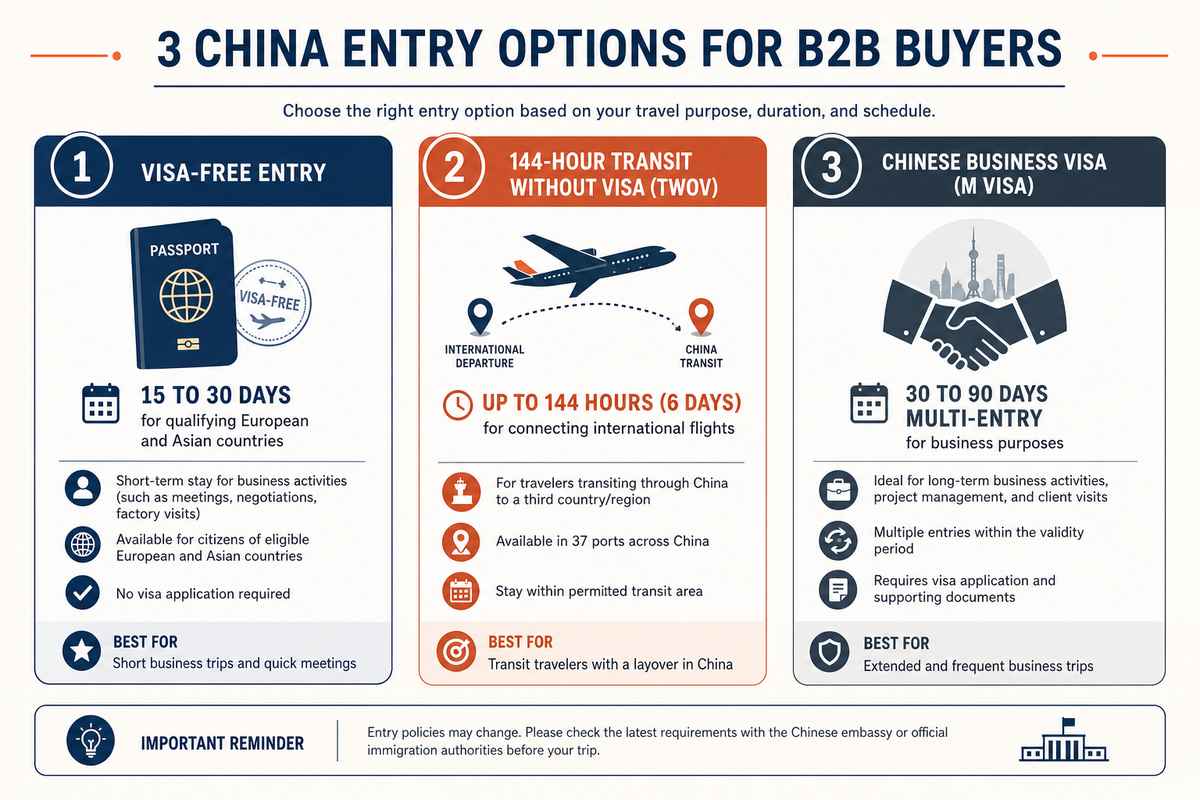
International buyers visiting China currently fall into three main entry categories:
Unilateral Visa-Free
Citizens of eligible countries (including Germany, France, Italy, Spain, the Netherlands, Switzerland, Australia, New Zealand, Malaysia, Singapore, and South Korea) can enter China for up to 15 or 30 days without a visa for business, trade, and market research.
144-Hour Transit (TWOV)
Pass through China to a third country or region (such as USA → Shanghai → Hong Kong) and stay up to 6 days (144 hours) in designated regional clusters like the Yangtze River Delta or Guangdong province without an advance visa sticker.
Standard M Visa
For buyers from countries not covered by visa-free lists (such as the United States, Canada, and the UK), or buyers planning stays longer than 30 days, or importers needing 6-month to 10-year multiple entries for frequent factory inspections.
Check National Immigration Rules Before Booking Flights
Entry policies and bilateral exemption lists can change. Always check the latest updates on the National Immigration Administration transit exemption rules before buying non-refundable airline tickets.
Here is a quick comparison table to help you decide which entry route matches your sourcing schedule:
| Entry Method | Maximum Stay | Permitted Travel Scope | Ideal Buyer Use Case |
|---|---|---|---|
| Unilateral Visa-Free | 15 to 30 Days | All provinces across mainland China | Fast trips to attend trade exhibitions or negotiate with existing suppliers. |
| 144-Hour Transit (TWOV) | 144 Hours (6 Days) | Designated provinces (e.g. Shanghai + Zhejiang + Jiangsu) | Quick 3-day visits to Yiwu or Canton Fair while traveling between Asia-Pacific destinations. |
| Business (M) Single Entry | 30 to 90 Days | All provinces across mainland China | First-time comprehensive sourcing trips visiting factories in multiple regions. |
| Business (M) Multiple Entry | 30 to 90 Days per visit | All provinces across mainland China (valid 6 months to 10 years) | Active importers, brand owners, and buyers who travel to China several times a year. |
What is the China M Visa and What Can You Do With It?
The M Visa is China’s official visa category issued to foreign travelers who plan to visit China for commercial and trade activities. It was created specifically for business people, purchasing agents, entrepreneurs, and company representatives.
With an M Visa, you are legally permitted to:
- Attend international trade fairs, industry exhibitions, and wholesale markets.
- Visit manufacturing plants, assembly workshops, and supplier sample showrooms.
- Conduct commercial talks, sign sales contracts, and place trial product orders.
- Perform during-production product checks, pre-shipment checks, and quality audits.
- Meet with working with professional sourcing agents and freight forwarders to coordinate shipping logistics.
Important Legal Difference: Business (M) vs. Work (Z) vs. Tourist (L)
An M Visa does not permit you to receive a local salary or take employment from a Chinese company. If you plan to work long-term as an employee in China, you must apply for a Work (Z) Visa and obtain an official work permit. Conversely, never use a Tourist (L) Visa for commercial negotiations if an M Visa is required by the local consulate, as giving the wrong travel reason can lead to entry refusal.
Required Documents for a China Business Visa Application
Consulates and visa service centers review your paperwork to check your identity, your business background, and your planned travel schedule. Submitting clean, organized documents prevents processing delays.
Here is the standard checklist of documents required for an M Visa application:
How to Get a Valid China Business Visa Invitation Letter
The invitation letter is the cornerstone of your business visa file. Chinese visa officers evaluate this letter to ensure that a real, registered Chinese commercial entity is expecting your visit and taking responsibility for your business activities while in China.
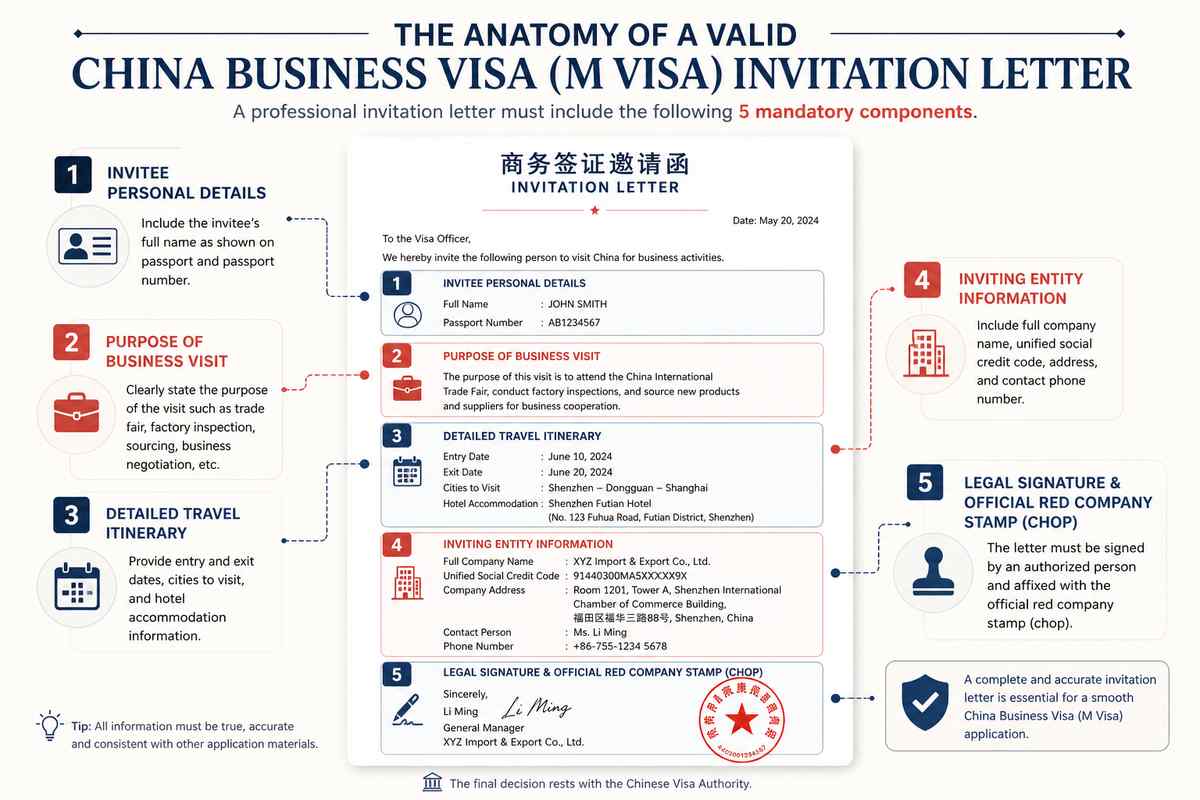
A legally acceptable business invitation letter must be printed on the official company letterhead of the inviting business and contain five essential components:
1. Invitee Personal Details
The letter must list your full legal name exactly as shown in your passport, your gender, date of birth, nationality, and your passport number. Any spelling difference between the invitation and your passport will result in an immediate rejection.
2. Purpose of the Visit
Clearly state the commercial purpose of your trip. Common acceptable descriptions include “Attending trade exhibitions”, “Inspecting manufacturing lines and tooling samples”, “Conducting supplier audits and commercial talks”, or “Selecting goods at wholesale commodity markets”.
3. Detailed Travel Schedule & Financial Undertaking
Provide your planned arrival date, departure date, cities to be visited, and hotel addresses. The letter must also clearly state who will cover your travel and accommodation costs (usually specified as “All travel, accommodation, and living expenses will be paid by the visitor’s foreign company”).
4. Inviting Entity Information
The letter must list the full registered legal name of the Chinese company, their 18-digit Unified Social Credit Code (营业执照统一社会信用代码), registered office address, contact telephone number, and official corporate email address.
5. Legal Signature & Official Red Stamp (Chop)
The document must be signed by the company’s legal representative or authorized manager and stamped with the company’s official round red seal (公章). Letters submitted without an authentic company seal are considered invalid by consulates.
How to Secure an Invitation Letter for Trade Shows vs. Factory Visits
Canton Fair: Once you complete buyer registration on the official Canton Fair Buyer E-Service Tool (BEST), you can download an electronic invitation letter directly from the event organizers.
Yiwu Market & Factory Tours: If you are visiting independent suppliers or wholesale markets, your manufacturing partner or registered buying office can issue a verified invitation letter. When working with our team at Sourcing Pioneer, we provide clients with formal invitation letters and itinerary support through our custom sourcing and market trip assistance.
Step-by-Step Guide: How to Apply for a China M Visa (COVA Process)
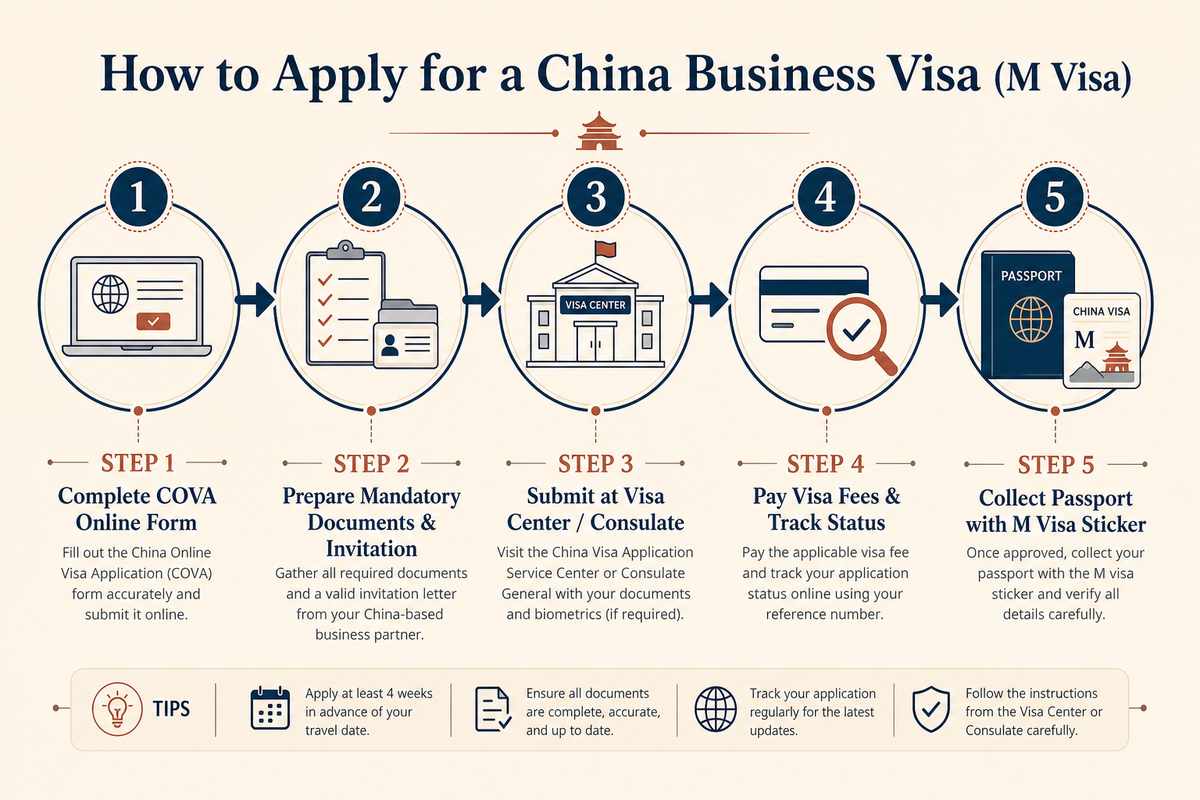
Applying for a Chinese business visa follows a standard workflow managed through the China Online Visa Application system. Follow these five steps to ensure a smooth application:
Step 1: Complete the Online Form on the COVA Portal
Visit the official COVA website, select the country and city of the Chinese embassy, consulate, or Chinese Visa Application Service Center (CVASC) responsible for your region, and start a new application. Fill out all sections carefully, including personal background, work history, family details, travel plans, and inviting party information. Save your Application ID so you can return to edit details before final submission.
Step 2: Upload Digital Photo & Print Confirmation Pages
Upload a standard digital passport photo during the online application. Once completed, review every page for accuracy, submit the form online, and print the full completed form along with the COVA Confirmation Page containing your unique barcode.
Step 3: Check Appointment Rules (AVAS vs. Walk-In Policy)
In most countries (including the United States, United Kingdom, Canada, Australia, and many European nations), Chinese consulates have removed the mandatory online appointment requirement (AVAS). Applicants can walk in directly during morning submission hours with their printed COVA form and supporting documents. Check your local visa center website to confirm whether your specific office requires an appointment or accepts walk-ins.
Step 4: Submit Paperwork & Complete Biometrics (Fingerprints)
Visit the visa office with your passport, physical photo, invitation letter, flight and hotel bookings, and printed COVA form. Unless you qualify for a fingerprint exemption (such as children under 14, adults over 70, or applicants who have provided fingerprints at the same consulate within the last 5 years), you will have your fingerprints scanned on-site.
Step 5: Pay Visa Fees & Collect Your Passport
After your application is accepted, you will receive a pick-up slip with a collection date. Return on the designated date (or use an authorized mail return service where available), pay the consular and service fees, and collect your passport with your new M Visa sticker.
Visa Processing Time, Costs, and Express Fees in 2026
Visa fees and turnaround times depend on your nationality, the number of entries requested, and whether you choose regular or expedited processing. Consular fees are set on a reciprocal basis between China and your home country.
| Country / Region | Standard Processing Time | Estimated Single / Multi-Entry Fee | Expedited / Rush Options |
|---|---|---|---|
| United States | 4 Business Days | $140 (Standard 10-Year Multi-Entry) | Express: 2-3 days (+$25); Rush: 1 day (+$38) |
| European Union | 4 to 5 Business Days | €60 to €125 (Consular + CVASC fee) | Express: 2-3 days (+€30 to €45) |
| United Kingdom | 4 Business Days | £130 to £151 (Regular 2-Year Multi-Entry) | Express: 2-3 days (+£30 to £60) |
| Canada & Australia | 4 to 7 Business Days | CAD $100 to $142 / AUD $109 to $180 | Express: 2-3 days (+CAD $35 / +AUD $66) |
Note: Visa Application Service Centers (CVASC) charge a separate administrative service fee (typically $20 to $45) on top of the government consular fee. Always check payment methods accepted at your local office, as many centers only accept debit cards, credit cards, or cashier checks.
Top 5 Mistakes That Cause China Visa Delays or Rejections
Even minor oversights can result in rejected applications or missed flight connections. Based on practical sourcing experience, here are the most frequent mistakes international buyers make when applying for an M Visa:
Listing factory visits or trade show attendance while applying for an L Visa causes immediate rejection. Always apply for an M Visa if your trip involves trade or sourcing.
A plain letter printed on blank paper with only an English signature will be rejected. The letter must feature the Chinese company letterhead and their official round red company chop.
If your flight ticket shows arrival in Guangzhou on October 15, but your invitation letter states meetings in Shanghai starting October 10, visa officers will question your file. Ensure all dates and cities align across documents.
Submitting your paperwork only one week before your flight leaves zero room for administrative delays. Always submit your application 3 to 4 weeks before your scheduled departure.
Submitting photos with colored backgrounds, dark clothing that blends into the background, or glares on glasses is the leading cause of COVA portal upload errors. Use professional white-background passport photos.
Essential Travel Prep: Payments, eSIM, and Internal Transport
Securing your visa sticker is only half the battle. Once your visa is approved, getting ready for the practical realities of travel inside China ensures a productive and stress-free trip.
1. Setting Up Mobile Payments (Alipay & WeChat Pay)
China is virtually a cashless society. While major international hotels and high-end restaurants accept Visa and Mastercard, local taxis, wholesale market stalls, and cafes rely exclusively on mobile QR payments. Download Alipay and WeChat before leaving home and link your international credit card (Visa, Mastercard, or AMEX). Alipay’s international version allows smooth card-linked scanning without needing a local Chinese bank account.
2. Internet Connectivity & International Roaming / eSIM
Popular Western websites and apps (including Google, Gmail, WhatsApp, Instagram, and LinkedIn) are inaccessible via local Chinese Wi-Fi networks without specialized connection tools. The simplest solution for business travelers is buying an international roaming data package from your home carrier or buying a travel eSIM (such as Airalo, Nomad, or Holafly). Data roaming automatically routes your internet traffic through overseas servers, keeping all your essential communication apps fully functional without extra software.
3. Booking High-Speed Trains and Domestic Flights
China’s high-speed rail network connects major industrial hubs with extreme speed and reliability. When traveling between wholesale markets and factory zones, taking high-speed trains from Shanghai or Hangzhou to Yiwu is significantly faster and more convenient than domestic flights. You can book train tickets in English using the official Trip.com app or 12306 app using your passport number.
Frequently Asked Questions About China Business Visas
How far in advance should I apply for my China Business Visa?
You should apply between 3 to 4 weeks before your intended departure date. Consulates will generally not accept applications submitted more than 90 days before your travel date, as single-entry visas typically must be used within 90 days of issuance.
Can I visit factories in Yiwu and Guangzhou on the 144-hour transit without visa?
Yes, provided your international itinerary qualifies as a transit (Country A → China → Country C) and your stay remains within the authorized provincial cluster. For example, you can land in Shanghai, spend 5 days in Zhejiang visiting Yiwu markets, and depart from Hangzhou or Shanghai to Hong Kong. However, you cannot travel between Shanghai and Guangzhou on a single 144-hour permit, as they belong to different transit regions.
Can a registered sourcing agent provide an invitation letter for my visa?
Yes. A legally registered Chinese sourcing company or trading office can issue an official business invitation letter stamped with their registered corporate chop, stating that you are visiting for supplier meetings and market research.
Can I convert a Tourist (L) Visa into a Business (M) Visa inside China?
Under normal circumstances, you cannot convert an L Visa to an M Visa while inside mainland China. You would need to leave mainland China (for example, by traveling to Hong Kong) and apply for a new M Visa at the local commissioner’s office or visa service center.
How many entries can I get on a China Business Visa?
Depending on your nationality and application history, you can be granted single-entry (valid 3 months), double-entry (valid 6 months), or multiple-entry visas (valid 6 months, 1 year, 2 years, or up to 10 years for US and Canadian passport holders).
Final Checklist: Preparing for Your China Sourcing Journey
Sourcing products directly from Chinese manufacturers offers unbeatable pricing advantages, deep customization potential, and direct supply chain visibility. By securing the proper business visa, organizing your invitation paperwork, and preparing your mobile payment tools in advance, you set yourself up for a smooth and rewarding procurement trip.
If you need on-the-ground support navigating wholesale markets, scheduling factory audits, or coordinating order follow-up across China, our team at Sourcing Pioneer is ready to assist you every step of the way.
Questions & Comments
We read every one and reply within 24 hoursHave questions about securing an official business invitation letter, completing the COVA form, or scheduling market visits in Yiwu and Guangzhou? Share your trip details below.