
Tie Rod Manufacturer: The Quarter Inch at the Tyre
 ·
Updated October 22, 2026
·
11 min read
The ball joint article in this series found a federal sentence that describes a part without measuring it. A tie rod is the next step along the same linkage, and it gets something the joint never did: numbers. A steering linkage may have a quarter inch of free play at the tyre and no more. Toe-in may not exceed one and a half times the figure the vehicle maker publishes. And the lash at the rim is capped by a table indexed to the diameter of the steering wheel.
What makes those numbers unusual is where they are measured. None of them is a property of the tie rod. They are properties of a steering system, measured at a tyre or at a rim, and the part's only job is to keep them inside the limits. That is a different kind of document from anything else in this series: not a standard for the product, but a tolerance on the vehicle, which the product has to preserve.
1. A Quarter Inch, Measured at the Tyre
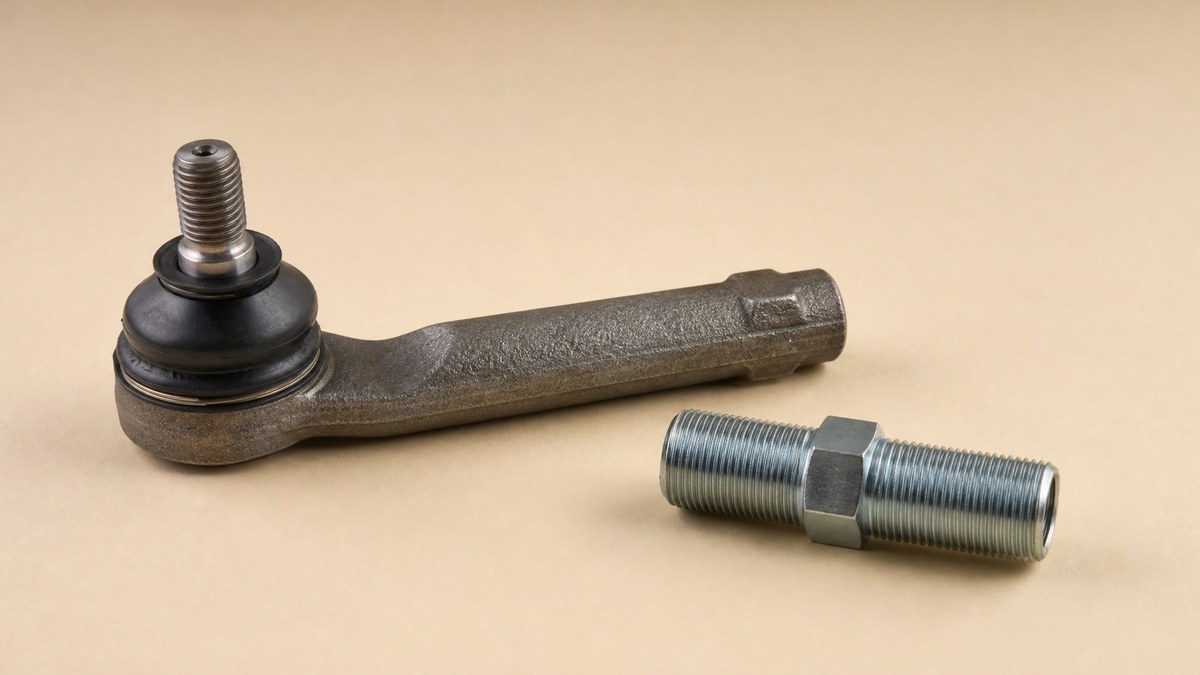
49 CFR 570.7(b) is one sentence long: free play in the steering linkage shall not exceed one-quarter of an inch. What follows it is the procedure, and the procedure is where a buyer learns what the sentence means.
Elevate the front end to load the ball joints. Make sure the wheel bearings are correctly adjusted. Grasp the tyre at the front and rear and attempt to turn the wheel assembly left and right. If the free movement at the front or rear tread of the tyre exceeds one-quarter inch, the linkage has excessive play.
Three details in that paragraph do the work. The measurement is at the tread, not at the tie rod end, so the tolerance includes every joint and every joint's clearance between the steering wheel and the road. It is taken with the suspension loaded, because an unloaded linkage moves through a different arc. And the wheel bearings have to be right first, because bearing play shows up at the tyre as linkage play — a diagnostic trap the rule closes before it starts.
For a manufacturer, the consequence is that a tie rod cannot be checked on its own. A joint with a few thousandths of clearance can pass or fail depending on what it is connected to, and the only number that matters is the one at the tyre. Which is why a sample is worth less here than a stack-up: a factory audit that measures the assembled linkage tells you more than any single joint on a bench.
2. Two Plays, Two Numbers
570.7(a) sets the other tolerance, and it is expressed as a table rather than a figure. System lash — the free play felt at the rim before the front wheels respond — is capped according to the diameter of the steering wheel.
| Steering wheel diameter | Maximum lash |
|---|---|
| 16 inches or less | 2 inches |
| 18 inches | 2¼ inches |
| 20 inches | 2½ inches |
| 22 inches | 2¾ inches |
The procedure is specified too: engine running, wheels straight ahead, turn the wheel in one direction until there is a perceptible movement of a front wheel, and read how far a point on the rim travelled. More than the table value means excessive lash.
Why a table and not a number? Because a bigger wheel gives more rim travel for the same angular play, and a rule written in inches has to account for the lever. It is a small piece of engineering in a place most people would not look for one, and it is the reason a complaint of “loose steering” means different measurements on a small car and a truck.
3. Toe Is Relative to Somebody Else
570.7(d) is the odd one out, because it does not give a figure at all. Toe-in and toe-out measurements must not be greater than one and a half times the value in the vehicle manufacturer's service specification for the alignment setting.
That is a rule written as a multiple of a document the regulator does not publish. It works because every vehicle already has a published alignment figure, and it fails for a supplier who wants to know “the” toe setting, because there is no such thing. The tolerance is half again as much as whatever the maker specified for that model.
For an order, that has a practical consequence. A tie rod assembly that is dimensionally correct will produce the maker's toe when it is adjusted to the maker's figure; one that is a few millimetres short will still adjust, but it will adjust to the end of its thread or beyond the range the alignment shop expects. Length matters, and it matters against a reference the part does not carry.
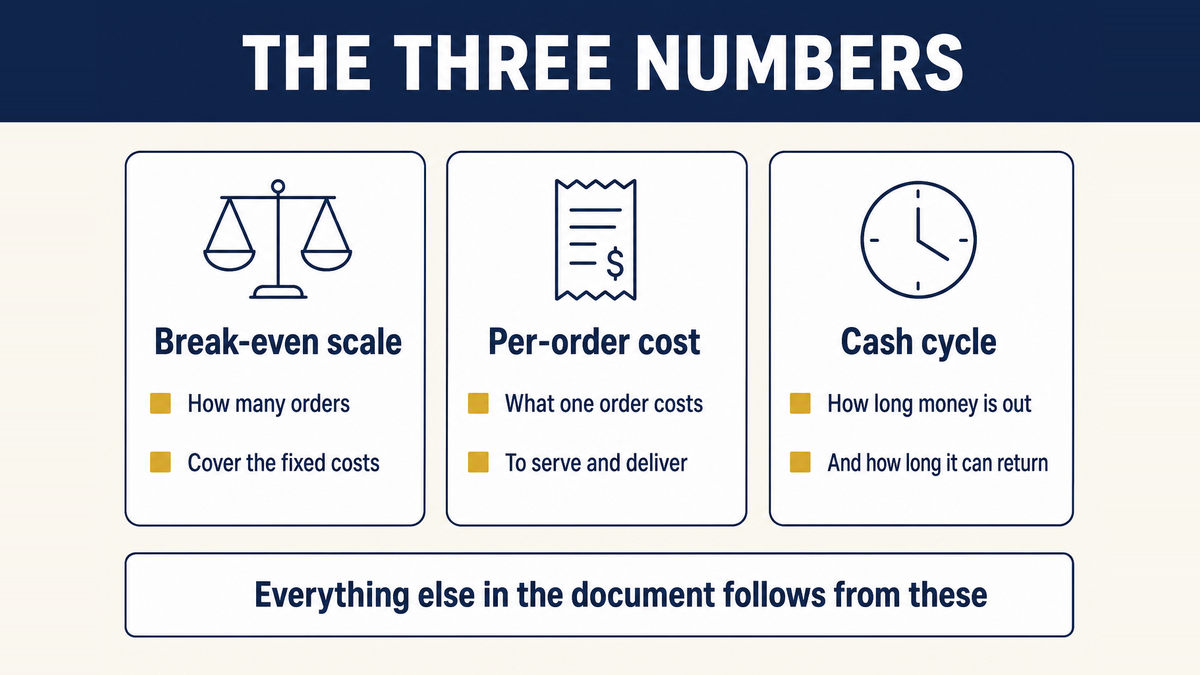
4. What the Steering Rule Never Mentions
Part 570 has a suspension section and a steering section, and the two are written in different registers. The suspension section describes condition: seals cut or cracked, joints bent or damaged, bushings cracked or missing. The steering section describes behaviour: play at the rim, play at the tyre, free turning, toe.
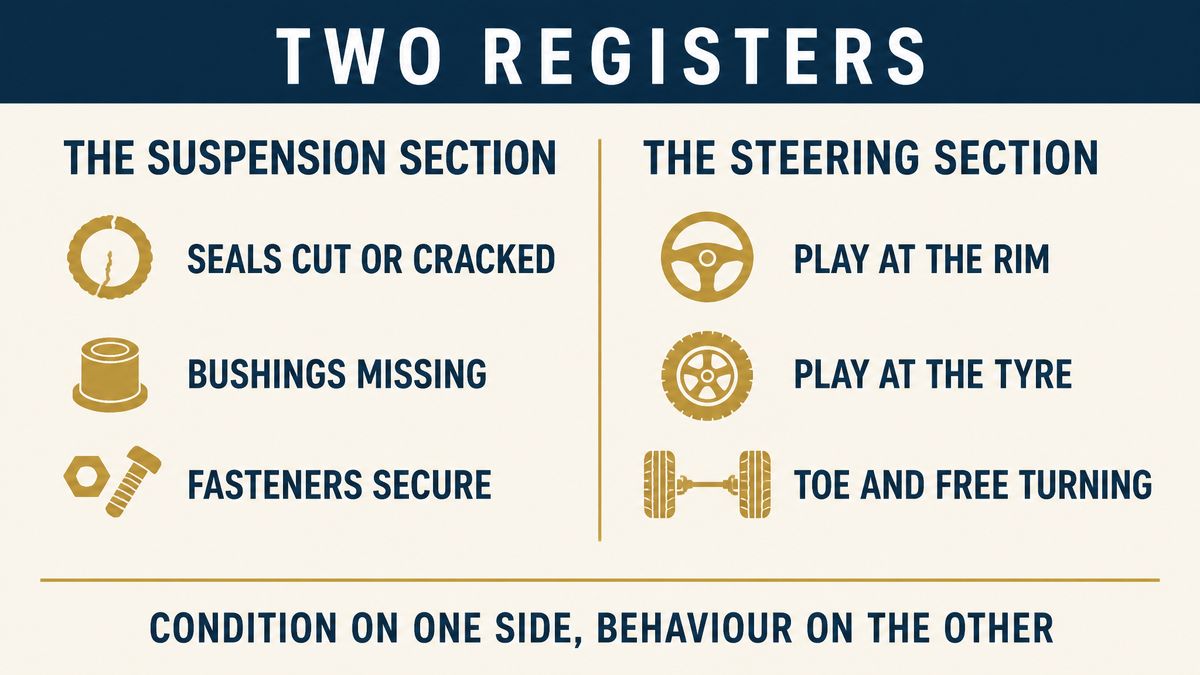
Read the steering section for what is absent and the difference is stark. There is no clause about the tie rod's boot. There is no clause about its thread, its taper, its socket or its grease. The part appears in the Part only as a contributor to three measurements and a turning check.
That is not an oversight; it is a design. An inspection standard is written to be applied in twenty minutes with a lift and a ruler, and the state of a rubber boot on an inner tie rod end is not visible without removing it. The regulator chose the measurement that can be taken over the one that would be more informative.
For a buyer, that gap is the specification. Everything the regulation does not say about the tie rod — boot compound, socket seat, stud hardness, sleeve thread class — is exactly what has to be written into an order, because nobody else is going to write it.
That difference has a commercial shape. A condition rule can be answered with a sample: show the inspector a boot, a bushing, a fastener. A behaviour rule can only be answered with a measurement of the whole assembly, which means a supplier can be perfectly correct about every component and still deliver a vehicle that fails the quarter inch, because the clearance that matters is the sum of clearances nobody specified. Buying against a behaviour rule therefore requires specifying the parts more tightly than the rule does, not less.
5. Where the Price Difference Comes From
Two tie rod ends with the same thread and taper differ in five places. The first is the one the regulation ignores and the workshop sees first.
The boot. The same rubber problem as the ball joint, with one addition: a tie rod end's boot sits at the end of a linkage that moves with every steering input, so it flexes more often and at a sharper angle. A boot that hardens at the fold opens early.
The socket seat. A moulded polymer seat, a spring-loaded seat and a staked steel socket are three different answers to the same question: how much clearance will this joint have after fifty thousand kilometres. The seat is what produces the quarter inch at the tyre, eventually.
The stud and its taper. The taper has to match the steering arm or the knuckle, and the thread has to take the nut's preload without stripping. A stud that is too hard cracks; one that is too soft yields.
The adjusting sleeve. On a rod with a sleeve, the thread class and the clamp decide whether the alignment stays where it was set. A sleeve that creeps is a vehicle that wanders, and wandering is the complaint that brings the car in.
The plating. A steering part lives under the car, in spray. Corrosion on the exposed thread is what makes the next alignment impossible, and it is the cheapest thing to specify. What the carton does about it is the other half: the packaging checklist covers protection in transit.
6. The Record Knows the Assembly and Not the Word
Method unchanged. The federal recall file holds 245,845 records across 15,305 campaigns, no header row, every field scanned, twenty-five terms each with its own pattern. Controls: brake 28,639, air bag 16,162.
Three terms returned nothing: lash, shimmy and clunk. The first is the word the regulation itself uses in 570.7(a) — lash or free play in the steering system shall not exceed — and it appears in none of the 245,845 records. The other two are how a driver describes the same condition.
The heading, by contrast, could hardly be more specific:
| Heading | Campaigns |
|---|---|
| STEERING:LINKAGES:TIE ROD ASSEMBLY | 857 |
| STEERING:CRITICAL FASTENERS | 570 |
| STEERING:COLUMN | 695 |
| STEERING:RACK AND PINION | 314 |
| STEERING:LINKAGES:DRAG LINK:CONNECTION | 200 |
857 campaigns under one heading is the largest single-part column in this series after seat belts, and it says the tie rod assembly is a well-understood failure in the field. The free-text terms tell a different story: tie appears in 1,871 records, but the three largest campaigns containing it are a Ford parking brake recall and two rear suspension campaigns. linkage appears in 845 records, and the largest is a Ford shift linkage covering 2,925,968 vehicles — a gearbox part, not a steering one.
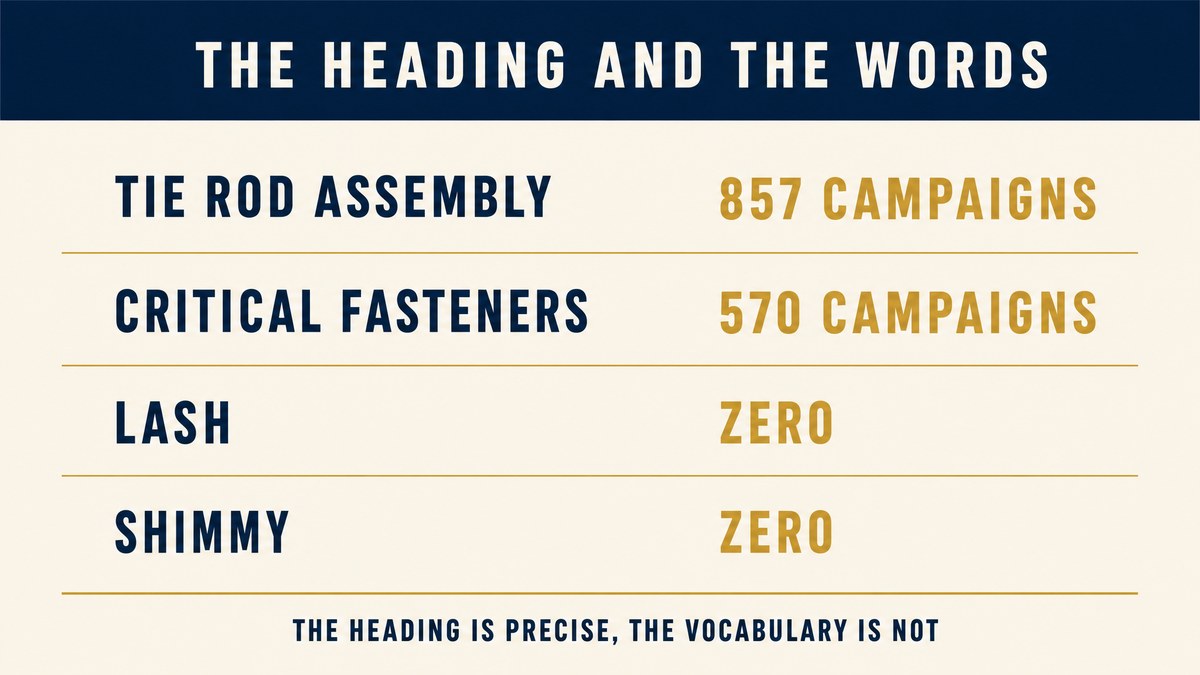
So the tie rod sits between the two poles this series has mapped. It is not invisible like the air cleaner, and it is not crowded out like the coil: it has the second-largest heading of any part measured here. What it lacks is its own words. The field files it by assembly name and describes the complaint in somebody else's vocabulary, which is why a search for the regulator's term returns nothing at all.
7. Seven Questions a Tie Rod Quote Should Answer
A quotation in this category is a photograph, a cross-reference and a price. The seven questions below belong to two groups: the first two make the part fit, and the rest decide how long it keeps the tolerance the regulation measures.
- Position, reference and length. Inner or outer, left or right, and the part number it replaces — with the overall length, because toe is set against the maker's figure and a short assembly runs out of thread.
- Which end of the linkage? Inner ends and outer ends see different loads and different boots; a catalogue that treats them as one item is telling you something.
- Boot compound and flex cycle. The steering boot flexes more often and at a sharper angle than a suspension boot, and the rule never mentions it.
- Socket seat type, and the clearance it holds after cycling. Polymer, spring-loaded or staked. This is what eventually shows up as a quarter inch at the tyre.
- Stud taper and thread class. The taper has to match the steering arm, and the thread has to take the preload.
- Sleeve thread class and clamp torque. A sleeve that creeps is a vehicle that wanders.
- Two prices. One as quoted, one with the five items below written into it.
8. Six Lines to Put in the Order
None of these lines is in the regulation. Each of them is a property the regulation assumes when it measures a quarter inch at the tread.
- Position, reference and overall length.
- Boot compound and flex cycle.
- Socket seat type and the clearance it holds.
- Stud taper and thread class.
- Sleeve thread class and clamp torque.
- Two prices: as quoted, and with the five items above written into it.
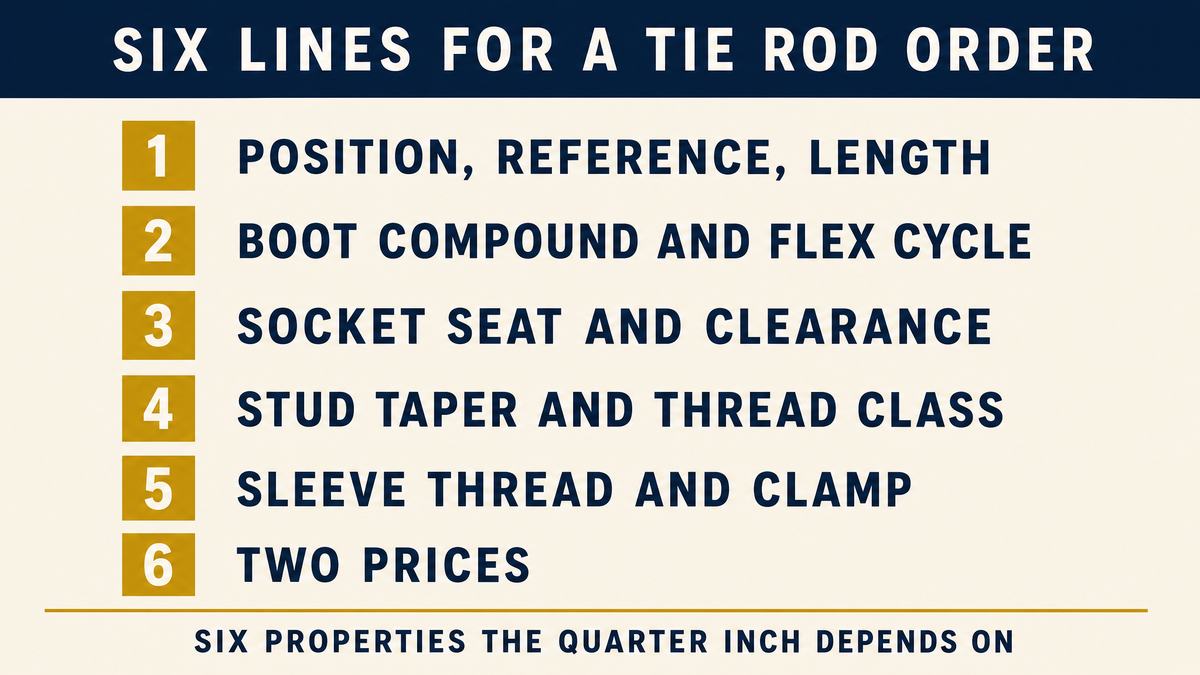
A tie rod is a link, and the numbers that judge it belong to the steering system rather than the rod. The inspection measures free play at the wheel, compares toe against a factory figure, and allows a quarter of an inch before it calls the linkage loose.
That quarter inch is the whole tolerance a driver gets. It is produced by a thread, a socket and a boot, so the order has to hold the three of them to a length and a preload rather than to a drawing that only shows the shape.
A Note That Travels With the Part
The fitter receives the toe setting, the jam nut torque, and a line naming the point on the tread where the gauge sat.
Draft My Alignment NoteFrequently Asked Questions
Is there a federal standard for tie rods?
Not for the part. 49 CFR 570.7 sets tolerances for the steering system of a vehicle in use — play at the rim, play at the tyre, free turning and toe — and the tie rod appears only as a contributor to those measurements.
Where does the quarter inch come from?
570.7(b): free play in the steering linkage shall not exceed one-quarter of an inch. It is measured at the front or rear tread of the tyre, with the front end elevated to load the ball joints and the wheel bearings correctly adjusted.
Why is the rim tolerance a table instead of a number?
Because the rim is a lever. A larger steering wheel produces more travel in inches for the same angular play, so the limit rises with diameter: 2 inches at 16 inches or less, up to 2¾ inches at 22 inches.
What does the rule say about toe?
That toe-in and toe-out must not be greater than one and a half times the value in the vehicle manufacturer's service specification. It is a multiple of a document the regulator does not publish, which is why there is no single correct toe figure.
Does the steering rule mention the boot?
No. The suspension section names seals, bushings and fasteners; the steering section names only play, free turning and alignment. A tie rod's boot fails before its socket does, and the rule has no clause for it.
What usually kills a tie rod end?
The boot first, then the socket seat. Once water reaches the seat, clearance grows, and the first symptom is the free play the inspection measures at the tread rather than anything felt at the wheel.
Questions & Comments
We read every one and reply within 24 hoursA tie rod's tolerance is measured at the steering wheel, a quarter inch away from the part itself. Send the application, and we will turn that allowance into a length and a preload.