
Thermostat Manufacturer: Defined in Law, Never Specified
 ·
Updated October 22, 2026
·
12 min read
This is the only part in the series that appears in federal text four different ways, and not one of them says what it must do. It is defined, it is named in a parameter list, it is described inside a brake-test cabinet, and it is the subject of a diagnostic requirement. None of those four is a product standard.
That makes the thermostat a harder buying problem than the intercooler, which had no rules at all. A part with no rules is obviously unregulated. A part whose name appears in a certification section is a part a buyer will assume is covered, and the assumption is wrong in a specific way worth knowing.
1. Twenty-Six Records, and One Is a Caravan
Method unchanged. The federal recall file holds 245,845 records across 15,305 campaigns, no header row, every field scanned. Controls: brake 28,639, air bag 16,162.
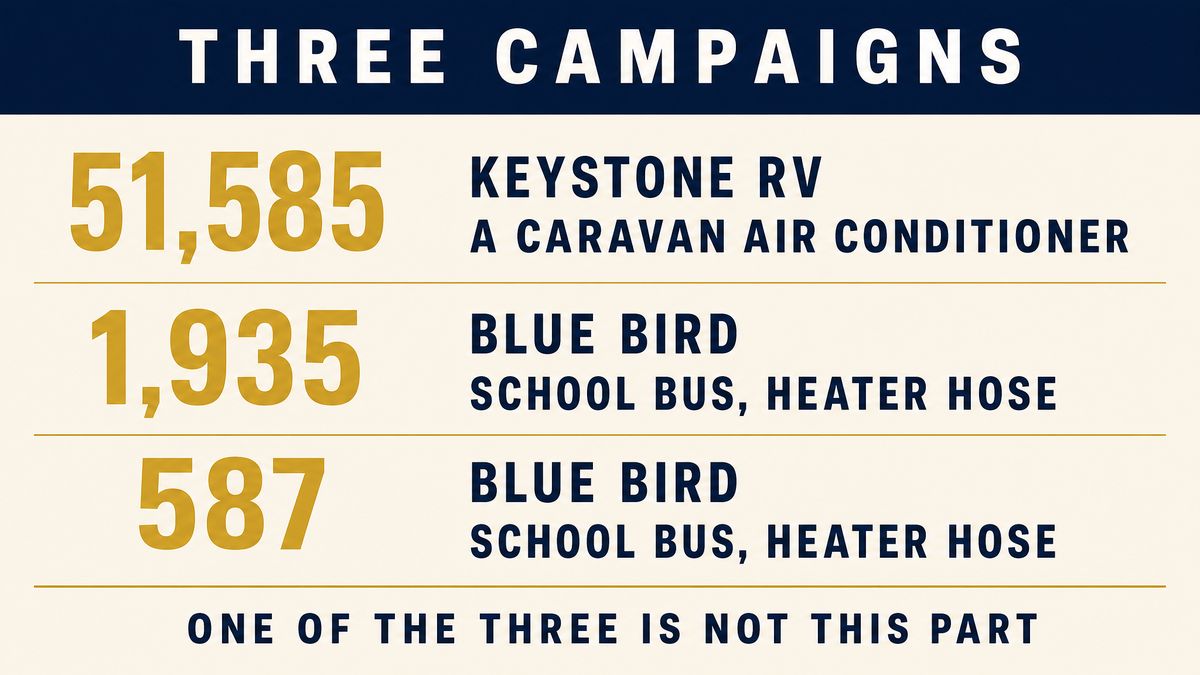
The word thermostat appears in 26 records across 3 campaigns. Three. That is the smallest count in the series, and the three are worth reading one by one because they do not describe the same device.
Keystone RV, 51,585 trailers. The affected vehicles carry an air conditioner with an LCD thermostat that may not be wired correctly, and the consequence is an electrical short. This is a room thermostat in a caravan. It shares a word with the part in this article and nothing else.
Blue Bird, 1,935 and then 587 school buses. These two are the real thing: due to the design of the thermostat, a heater hose may rupture, which could result in hot coolant entering the passenger compartment. Read the causal chain carefully. The thermostat is named as the origin, the failed component is a hose, and the consequence is a scald risk to passengers, not an engine that overheats.
And the heading check: of the component headings in the file, none contains the word. The driveshaft row before this one sat under a heading with 1,511 records. This part has no category at all, which is why looking for it in the file returns only what happened to be written in a summary sentence.
2. What the File Counts Instead
Set the part beside the thing it exists to control.
| Term | Records | Campaigns | What it is |
|---|---|---|---|
overheat | 9,229 | 607 | the outcome |
coolant | 886 | 116 | the medium |
stuck | 510 | 58 | the failure word |
stuck open | 57 | 6 | the common direction |
thermostat | 26 | 3 | the part |
stuck closed | 2 | 2 | the dangerous direction |
Nine thousand two hundred and twenty-nine records of overheating, and twenty-six of the part whose job is to prevent it. Fifty-seven records of something stuck open against two stuck closed — and the direction that overheats an engine is the one the file barely mentions.
Now the four words a thermostat engineer would use, counted across the whole file: pellet zero, jiggle zero, boil zero, regulat zero. wax returns 89 records across 7 campaigns, but a wax in this file is an underbody rustproofing compound, not the charge inside the actuator.
So the archive has no vocabulary for how the part is built and almost none for the part itself. What it has, in abundance, is the temperature.
3. The Word Is Defined. The Part Is Not.
Four federal documents, four near-misses.
Part 571. The vehicle standards, searched in full: thermostat appears once, as thermostatically controlled heating system, describing a cabinet used to heat brake assemblies to 70 or 120 degrees Celsius during a test. That is the only occurrence in the entire part, and it is about a oven.
Part 570. The light-vehicle inspection: zero occurrences.
Part 85, the aftermarket certification subpart. Here the word appears 19 times, and a buyer who finds this will reasonably conclude the part is covered. It is defined there: Thermostat means a temperature-actuated device. It also sits in a parameter list, and the parameters are specific: Thermal Deflection Rate, Mechanical Torque Rate, Index Mark Position, and for the electrically heated version, the time to rotate the coil tang when energised, the circuit resistance and the switching temperature.
Then read the list heading. Those parameters belong to the carburettor choke thermostat — a bimetal coil that opens a choke plate on a cold start. It shares the word, the definition and the parameter table with the coolant thermostat, and it is a different device on a different system. Across all nineteen occurrences in that subpart, the word coolant does not appear within four hundred characters of any of them.
Part 86, the OBD rule. This is the only text in federal law that requires anything at all of the coolant thermostat, and what it requires is not a property of the part.
4. The Only Rule Is a Test for Its Failure
Paragraph (i)(1) of the OBD section for spark-ignition engines opens with a sentence that is the whole federal law on this part: “the OBD system must monitor the thermostat on engines so equipped for proper operation”.
Read what follows. The malfunction criterion is not a pressure, a lift, a flow or a cracking temperature. It is a temperature that fails to arrive: “the coolant temperature does not reach a warmed-up temperature within 20 degrees Fahrenheit of the manufacturer’s nominal thermostat regulating temperature”.
Two more numbers sit around that one. The manufacturer “may disable thermostat monitoring at ambient engine start temperatures below 20 degrees Fahrenheit”, and the monitor will not be allowed to be suspended on starts where the coolant temperature is more than 35 degrees Fahrenheit lower than the fault cut-off.
So the law's contribution to this part is a definition of when its absence becomes visible, with a tolerance of twenty Fahrenheit degrees and two cold-start exemptions. Nothing about the wax, the spring, the pin, the bleed hole, the housing or the seal.
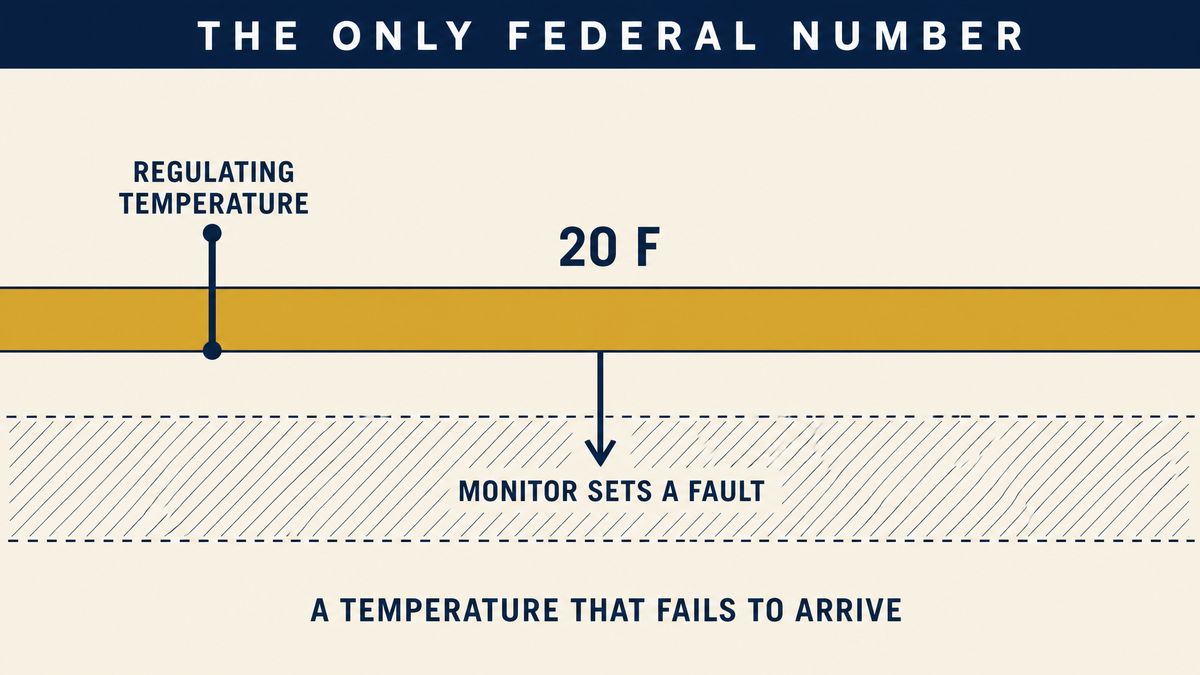
For a supplier this changes who the customer is. A thermostat that fails open does not strand anybody. The engine runs, the gauge reads low, the heater blows cold in winter, and after a drive cycle the monitor sets a fault because the coolant never came within twenty degrees of regulating temperature. The claim arrives at the counter as a software-detected failure on a part that still physically works, and the buyer who does not know that will read the return as a quality problem rather than a design direction.
5. What the Part Actually Is
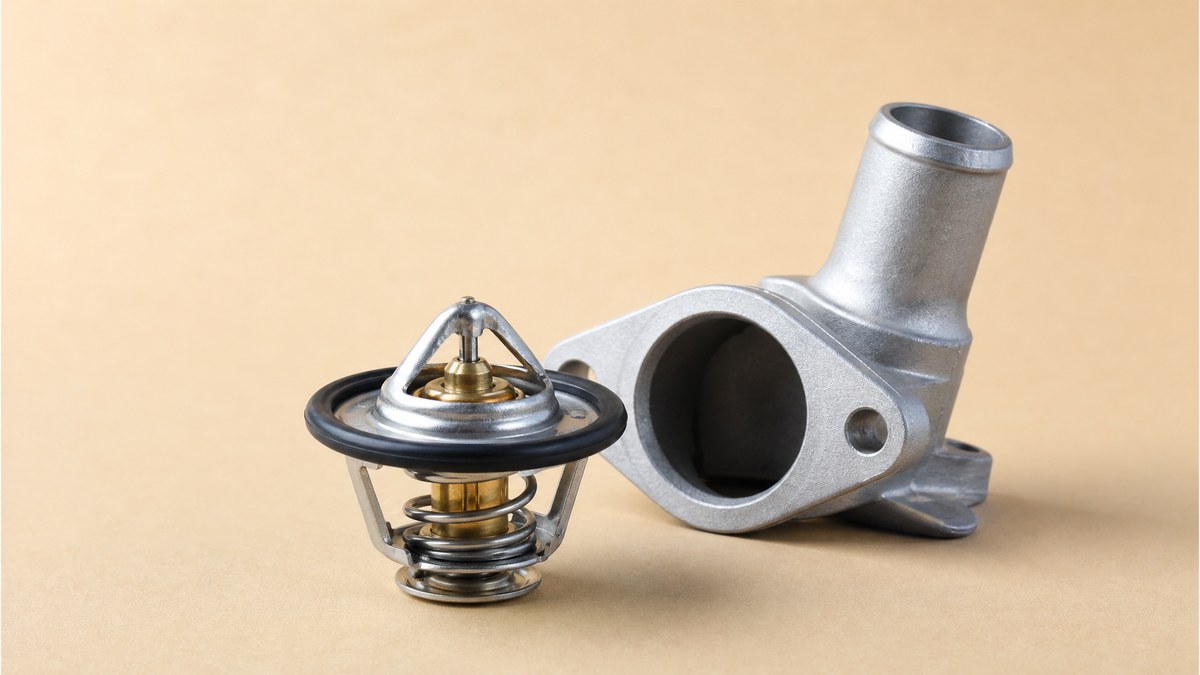
Almost every car thermostat is a wax motor. A metal cup holds a charge of wax blended so that it melts across a narrow band of temperature; melting expands it; the expansion pushes a pin out of the cup; the pin opens a valve against a return spring. Warm it and it opens, cool it and the spring closes it. There is no sensor, no wiring and no control.
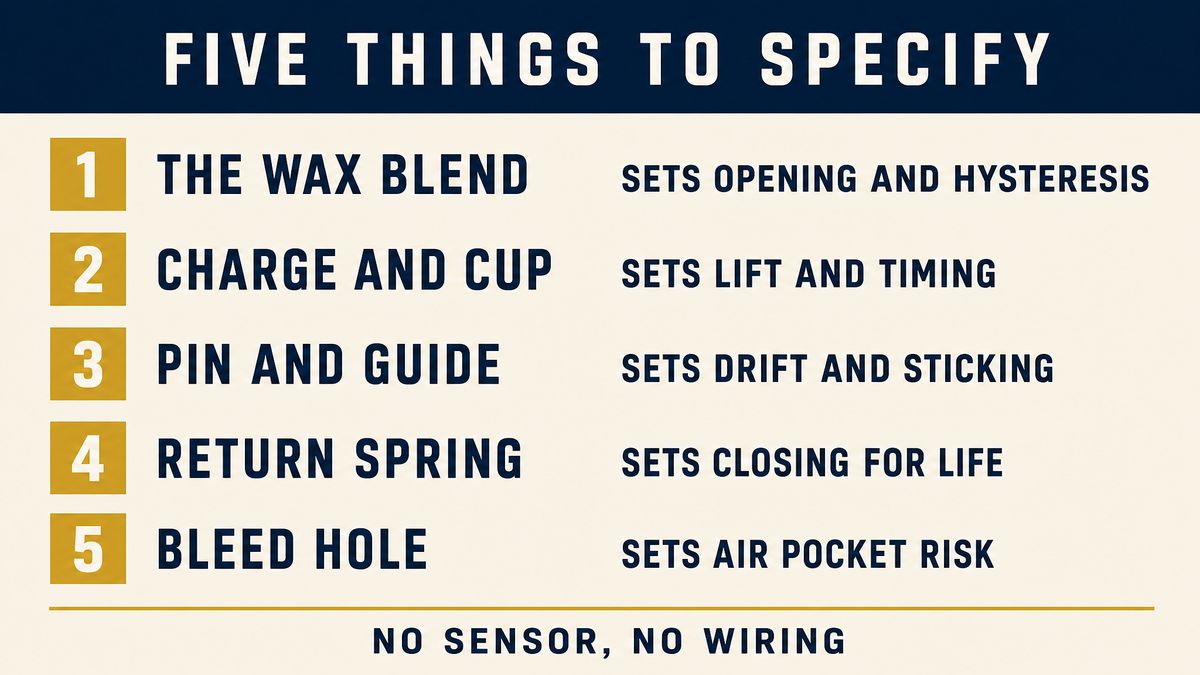
Five details decide whether that works for a hundred thousand cycles.
The wax blend. It sets the opening temperature, and it sets the hysteresis — the gap between the temperature at which the valve opens and the temperature at which it closes again. A wide hysteresis means the engine runs in a wider band, which is a fuel and emissions question as much as a comfort one.
The charge and the cup. How much wax, and how well the cup conducts heat to it. Under-charged, the valve opens late and never reaches full lift.
The pin and its guide. The only moving interface. Its finish and its clearance decide whether the part opens at the same temperature in year five as in week one, and whether it sticks.
The return spring. It has to close the valve against a cold, stiff seal for the life of the car. A spring that sags holds the valve partly open, which reads on the monitor as a thermostat that never quite gets there.
The bleed hole. A small vent, sometimes with a loose pin in it, that lets air past the closed valve while the system fills. Blocked, an air pocket sits behind the valve, the wax never sees hot liquid, and the engine overheats with a thermostat that is not broken.
6. Fail Open or Fail Closed
The two directions are not symmetrical and the file shows it: 57 records of something stuck open, 2 of something stuck closed.
Stuck closed is the one drivers fear and the one that produces a roadside event. No flow through the radiator, temperature climbs within minutes, and the failure is unambiguous.
Stuck open is the one that actually happens, and it is quiet. Flow bypasses regulation, the engine runs cold, the heater is weak, fuel consumption rises, and the monitor is the only thing that notices. Two records in a quarter of a million for the dramatic direction, and the common direction is barely reported at all because nobody breaks down.
Many thermostats are built to fail open on purpose, on the reasoning that a cold engine is better than a cooked one. That is a defensible design choice and it is also a specification: a buyer who does not ask which way the part fails has not specified the failure.
There is a third case that belongs here. The Blue Bird campaigns in section 1 are not a thermostat that stuck: the file says due to the design of the thermostat, a heater hose may rupture. A restriction or a pressure behaviour at the thermostat can raise the pressure the heater circuit sees, and the hose becomes the failed part. When the thermostat is the cause and the hose is the failure, the warranty claim lands on the hose.
7. Opening Temperature Is a System Number
The part carries a number stamped on it, and that number is not a property of the thermostat. It is a property of the engine: the temperature the designer wants the coolant held at, and therefore the temperature at which flow should begin.
Two consequences follow, and both cost money.
One engine, two ratings. The same block can be sold in two markets or two trim levels with different thermostats, because the calibration differs. A distributor who stocks one rating for both will have returns from one of them and will not know why, because the part fits and the box is right.
A colder thermostat is not a fix. Fitting a lower rating to cure a hot-running engine moves the whole system down, and the monitor is watching for a temperature that fails to arrive. A colder part can keep the gauge out of the red and still be a fault the software reports, and in winter it is a heater that does not work.
8. Where the Price Difference Sits
The wax. Blend and charge weight. This is the difference between a part that opens at 88 and one that opens at 92 and calls it 88.
The pin and guide. Finish, clearance and whether the guide is machined or formed. It is the only sliding interface in the part.
The spring. Rate and relaxation. A spring that loses load closes the valve slowly for the rest of its life.
The seal and the flange. The rubber ring and the crush washer are usually in the box and usually the reason a new thermostat leaks. A carton that arrives with them loose is a packing fault before it is a warranty claim, which is what the export packaging checklist is for.
The bleed. A hole, a pin, or nothing. A part with no bleed is cheaper and needs a longer fill procedure.
The test. Lift against temperature, measured on a sample from the run, not on a certificate. A thermostat that opens at the right temperature and only lifts halfway passes a “it opens” check and fails on a hot day. Lift is measured on a sample from the run, and a sample drawn from a run is what a factory audit looks at.
9. Seven Questions, Six Lines
The part is small, the questions are not.
- Opening temperature, and how it is checked? The stamp, the actual crack point, and the tolerance around it.
- Full-lift temperature and lift in millimetres. A valve that opens and does not lift is a restriction.
- Hysteresis. The gap between opening and closing.
- Which way does it fail, open or closed, and is that deliberate?
- Bleed: hole, pin or none? And what fill procedure does the part assume?
- Seal and crush ring, material, and whether they ship in the box.
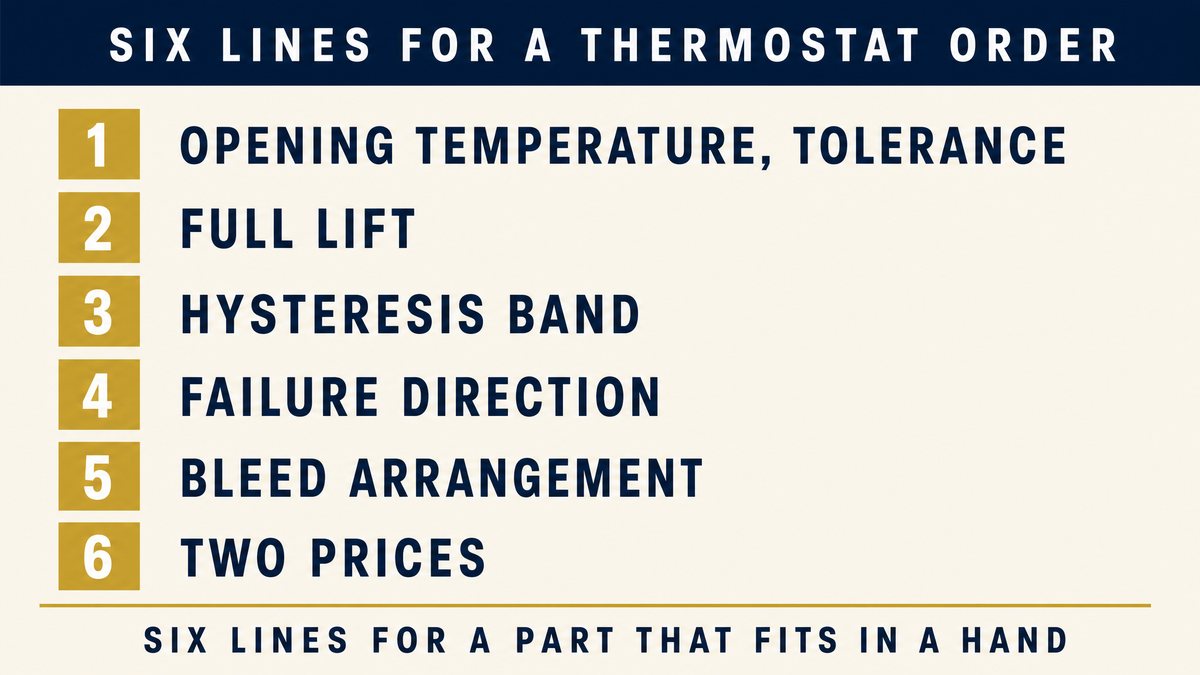
- Two prices: as quoted, and with the six lines below written into it.
- Opening temperature with tolerance.
- Full-lift temperature and lift.
- Hysteresis band.
- Failure direction, stated.
- Bleed arrangement.
- Two prices: as quoted, and with the five items above written into it.
Twenty-six records mention the thermostat. One of the three campaigns is a caravan air conditioner; the other two concern a heater hose that bursts rather than a valve that sticks. The part is almost absent from the file that records failures.
Meanwhile the only federal requirement is a test for its absence: the monitor compares coolant temperature against the regulating temperature and calls a fault when it falls twenty degrees short. The law asks the car to notice, not the factory to build.
A Position You Can Defend on a Claim
The failure criterion quoted, the two conditions that must not trigger it, and the sentence to use when a customer reports overheating.
Set My Warranty PositionFrequently Asked Questions
Is there a federal standard for coolant thermostats?
No product standard. Part 570 does not mention the part, Part 571 mentions only a thermostatically controlled oven in a brake test, and the nineteen mentions in Part 85 belong to the carburettor choke thermostat.
What does federal law actually require of it?
One diagnostic duty, in the OBD rule: the system must monitor the thermostat and must detect a malfunction when coolant does not warm to within 20 degrees Fahrenheit of the “nominal regulating temperature”.
Why does the recall file have so few records for it?
26 records across 3 campaigns, and one of those is a caravan air conditioner thermostat. The file records failures that injure or strand people; a thermostat stuck open does neither.
Which failure direction is more common?
Stuck open, by a wide margin: 57 records against 2 for stuck closed. It is also the direction that produces a cold heater and a fault code rather than a breakdown.
Can I fit a colder thermostat to cure overheating?
It moves the whole system down and can still leave the monitor reporting a thermostat that never reaches regulating temperature. It treats a symptom and creates a fault.
What does the bleed hole do?
It lets air past the closed valve while the system fills. Blocked, an air pocket sits behind the valve, the wax never sees hot liquid, and the engine overheats with a working thermostat.
Questions & Comments
We read every one and reply within 24 hoursA thermostat is checked by the car rather than by a standard, and the check is a temperature shortfall. Send the engine and the market, and we will set the opening point.