
PVD Coating Sourcing Guide: Colours, Substrate, Thickness and Testing
 ·
Updated October 9, 2026
·
26 min read
A gold-coloured PVD finish contains no gold. PVD is a way of putting a coating onto a surface in a vacuum, and the colour comes from the compound you deposit rather than from a dye or from the metal you named — which is why a "gold PVD" watch case is not gold plated and does not carry a gold content. This guide covers what PVD actually is, why the colour is set by chemistry rather than choice, why the layer underneath decides whether the coating survives, which materials the process rules out, how thin it really is, how to test adhesion rather than trust it, and how a PVD job gets quoted in China.
What to Specify, by What You Are Coating
| If you are coating | Specify this | Because |
|---|---|---|
| Watch cases and jewellery in brass or zinc alloy | A plated base layer, then the PVD colour, with both thicknesses stated separately | PVD deposits onto a clean conductive surface and is far too thin to provide corrosion protection on its own. The base layer does that job, and a quotation that names one thickness has hidden the other. |
| Stainless steel parts in a decorative gold or black | The coating compound by name, plus a target thickness in microns | Steel is a good substrate and often needs no base layer, so the whole result rests on the compound and the film. Naming the compound is the difference between a gold finish and a dark gold one. |
| Hardware, cutlery and sanitary fittings | A wear-resistance test as well as a thickness figure | These parts are handled and cleaned constantly. Thickness proves how much coating you got, not how well it is stuck, and those are separate questions. |
| Plastic housings and trim | A low-temperature process, confirmed in writing, with the adhesion test agreed up front | Standard deposition runs hot enough to damage many plastics. Running cooler is possible but it changes the process, and the change can cost you adhesion. |
| Tooling and moulds you are buying from a factory | The aerospace or coating-house specification the coating must meet | On tooling the coating is a performance part, not a finish. There is a published specification for at least one common coating, so there is no reason to accept a verbal standard. |
| Anything in a very small order | A batch price, and the number of parts the chamber holds | PVD is a vacuum batch process. Your cost is driven by how full the chamber is, not by how much coating material your parts consume. |
1. What PVD Coating Is, and What It Is Not
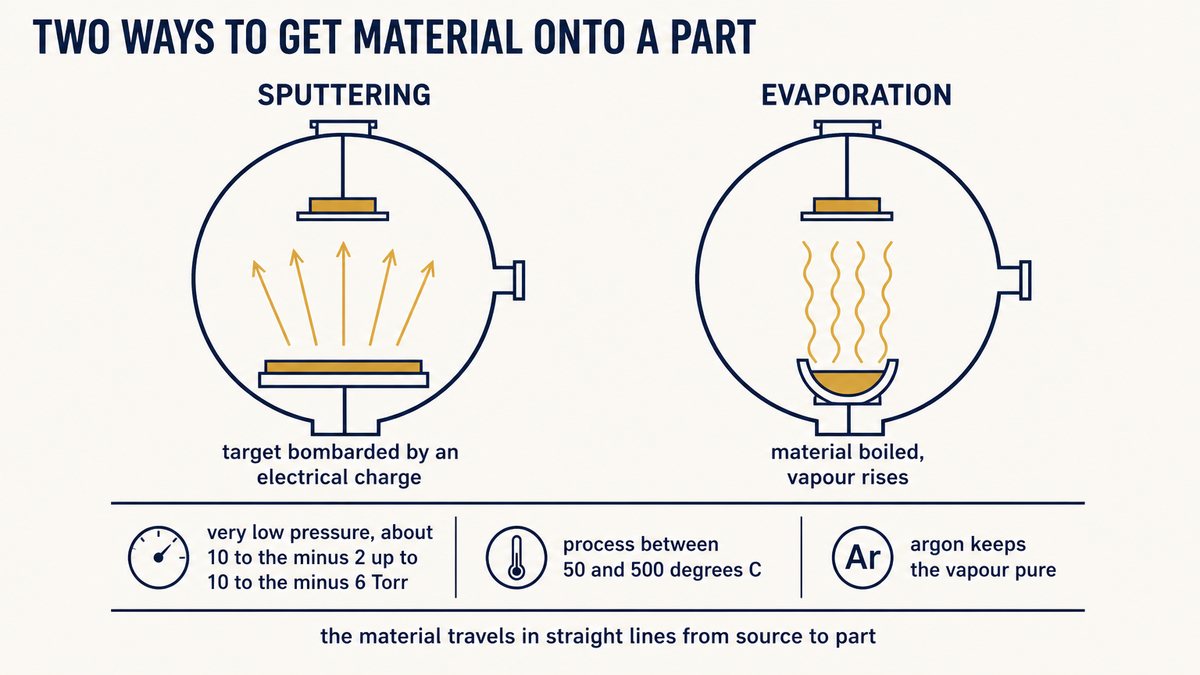
PVD stands for physical vapour deposition. A solid coating material is vaporised inside a high vacuum chamber, travels through the chamber as a vapour, and condenses onto the part as a thin film. That is the whole idea, and it is worth stating plainly because most of the practical consequences follow from it. Coating houses describe it the same way: a solid source is vaporised into atoms or molecules and carried as vapour through a vacuum and a low-pressure gas or plasma to the surface, where it condenses into the coating.
The phrase line of sight matters more than it sounds. Because the material travels in straight lines from the source to the part, the part has to be presented to the vapour, which is why parts are fixtured and rotated on multiple axes inside the chamber, or carried past the source on a conveyor. A surface that faces away from the source throughout the cycle gets less coating, or none.
Four things PVD is not
- It is not a colour. PVD is a family of processes. The colour comes from the compound you choose to deposit, and different compounds are different chemistries rather than shades of one product.
- It is not gold plating. A gold-coloured PVD finish can be produced without gold. It is a hard, thin, coloured film, which is a different product from a plated layer of actual precious metal.
- It is not a thick protective jacket. Films are measured in microns, and often in single digits of microns. Where a part needs real corrosion protection, that protection comes from another layer.
- It is not a wet process. No plating bath, no rinse tanks. Coating houses describe it as greatly reducing the toxic substances that have to be managed and disposed of compared with conventional coating methods that use fluid precursors and chemical reactions.
2. The Two Processes You Will Be Quoted
Two methods account for most PVD work, and a coating house will usually describe both without naming which one your job will run on. Ask, because the method affects what the coating can do and how the part has to be presented.
One more point about the process that has commercial consequences: because the coating is deposited atom by atom, the surface has to be clean and, for the standard processes, electrically conductive. Contamination that would be invisible — fingerprints, polishing compound, a stray oil film — sits between the substrate and the coating and becomes a weak point. This is why an experienced coating house spends real effort on cleaning and preheating the parts, and why the same coating can behave differently at two suppliers who run identical machines.
3. Colour Comes From the Compound, Not a Dye
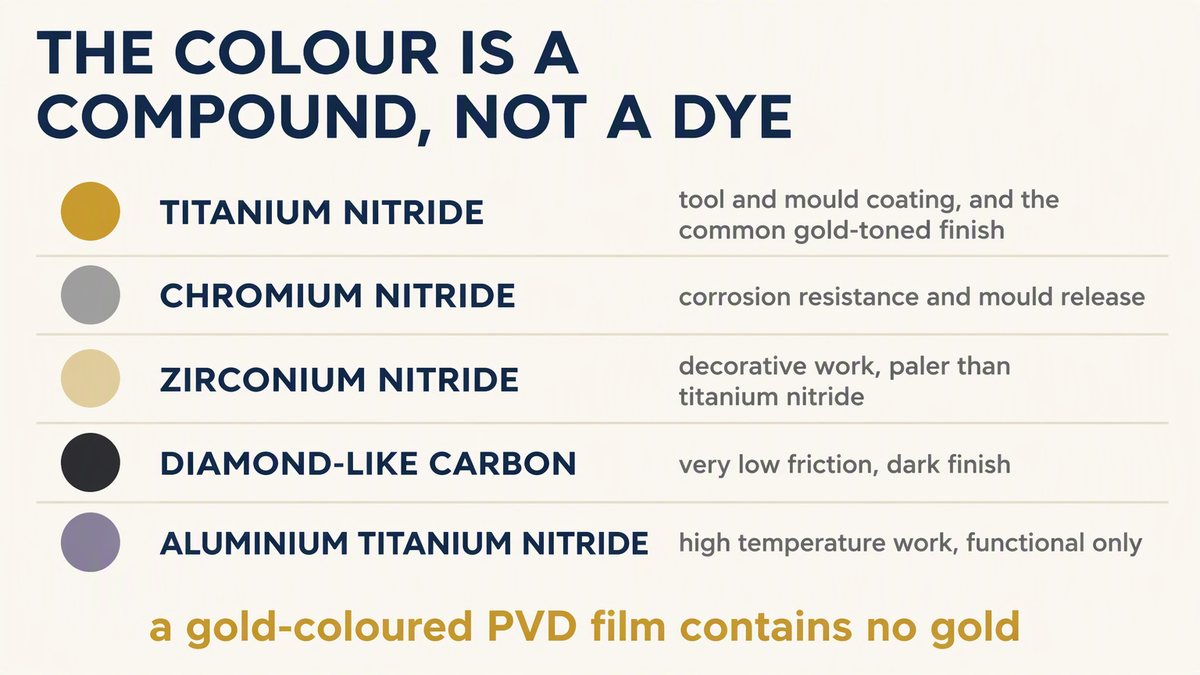
This is the part that most buyers get wrong first, and it is the answer to the most common question in this category. When a supplier quotes a gold PVD finish, they are not quoting a plating thickness of gold. They are quoting a compound film whose colour happens to be gold, and the colour is a property of that compound.
A coating house data sheet for titanium nitride states the appearance as dark gold, and notes that the coating is hard, inert and lowers friction. That single line explains a lot of confusion in the trade. Titanium nitride is a wear coating used on cutting tools, punches and moulds, and its colour is a side effect of its chemistry. When the same compound is used on a watch bezel or a piece of jewellery, you get the same colour and the same hardness, but it is not a precious-metal layer and it does not contain gold.
| Compound family | Typical appearance | Where it is used |
|---|---|---|
| Titanium nitride | Dark gold | The general-purpose hard coating for tools and moulds, and the common gold-toned finish on watches, jewellery and hardware. |
| Chromium nitride | Silver-grey | Corrosion resistance and mould release, with a plated-steel look. |
| Zirconium nitride | Pale gold to champagne | Decorative work where titanium nitride is too yellow, and where a pale warm tone is wanted. |
| Diamond-like carbon | Dark grey to near black | Very low friction and high hardness, with a dark finish. Used on watch cases and on parts that rub against other parts. |
| Aluminium titanium nitride | Dark grey to violet-grey | High-temperature work on cutting tools. Functional rather than decorative. |
The practical consequence for a product range
If you change the colour of a product, you may be changing the compound, and if you change the compound you may be changing the process settings, the number of targets loaded and the run time. A range that offers gold, silver and black is not one coating run in three colours; it can be three setups.
This is worth knowing before you promise a colour range to a retail buyer. Ask the coating house to quote each colour as its own line, with its own minimum quantity, rather than quoting a blended figure. You will get a more honest number and you will find out early which colours are expensive to add.
4. Why the Substrate Decides Whether It Works
Ask any coating house what matters most for adhesion and you will get the same answer: the surface the coating goes onto. One data sheet puts it directly, stating excellent adhesion as long as the substrates were properly cleaned and the process was properly executed. That is a conditional promise, and the condition is yours to manage.
The standard processes need a conductive surface
Conventional PVD deposits onto electrically conductive materials. That is a real limit, and it means the surface matters twice over: it has to be clean enough to bond to, and it has to be the right kind of material to receive the coating.
Which is why brass and zinc alloy usually get a base layer first
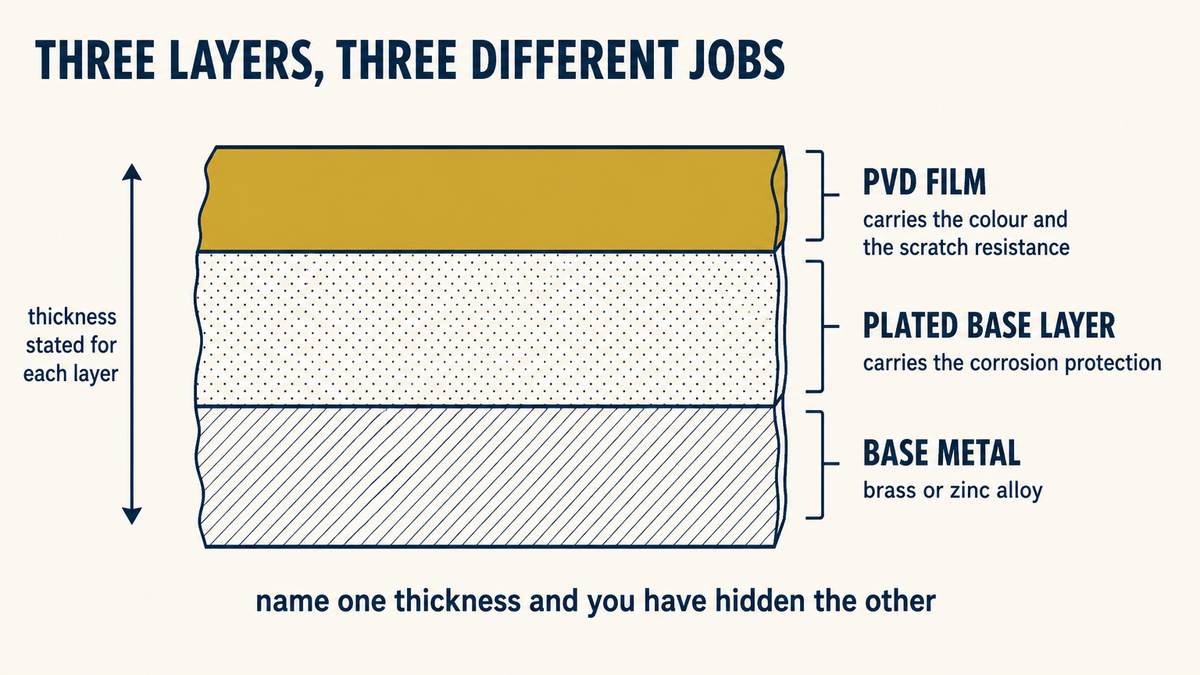
This is the detail that separates a coated part that lasts from one that fails, and it is the one most often left out of a quotation. PVD films are extremely thin. A film a few microns thick cannot carry the corrosion protection for a part that sees sweat, salt spray or regular washing, because there is simply not enough material there and a scratch goes straight through it.
So on a brass or zinc-alloy watch case, the normal build is a plated layer first and the PVD colour on top. The plated layer does the protective work and gives the coating something sound to sit on; the PVD layer supplies the colour and the scratch resistance. When a quotation mentions only one thickness, ask which layer it refers to. A part specified with a coating thickness but no base layer thickness has an unfinished specification, and the failure will show up as corrosion at the edges rather than as a visible coating defect.
Ask the coating house to state the full layer stack for your part, in order, with a thickness for each layer from the base metal upwards. It takes one line on a quotation and it answers the three questions that decide whether the part survives: what is providing the protection, what is providing the colour, and what is providing the adhesion. A supplier who can describe the stack without looking it up is a supplier who understands their own process.
5. Temperature: What PVD Rules Out
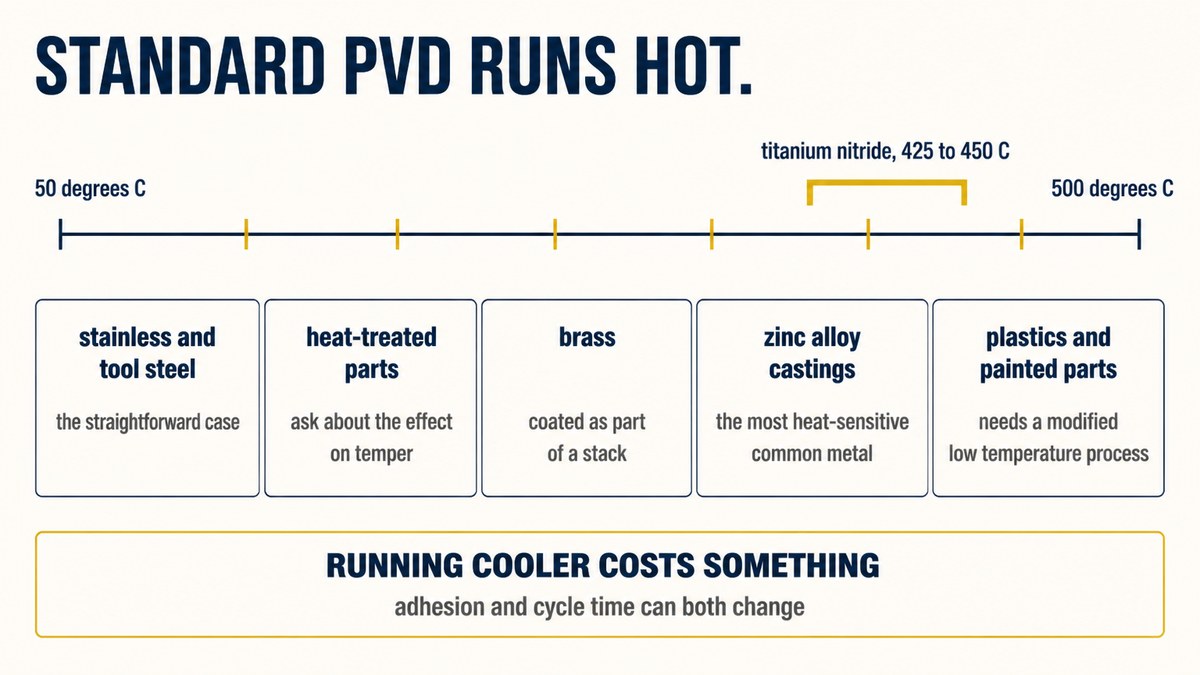
Standard PVD is a hot process, and this is the constraint most likely to catch a buyer out because it shows up in the material rather than in the finish. A tool coating house states that it applies titanium nitride at about 800 °F, which is roughly 425 °C, and says plainly that this temperature may adversely affect some materials. Another coating data sheet puts the same coating at 425 to 450 °C. Equipment makers give a broader working range, describing the process as usually running between 50 and 500 °C depending on the coating, the substrate and the process.
So the number is not one number. It depends on the coating you chose and on what the coating house is willing to run. What matters for a buyer is the next sentence, which is the most useful line in any coating data sheet: parts can be coated at lower temperatures, but this requires process modifications that can adversely affect coating properties such as adhesion and cycle time.
Read that carefully. A supplier who says "yes, we can coat plastic" is telling the truth. They are also telling you, if you ask the follow-up, that the process will be changed, and that two of the things the change affects are how well the coating sticks and how long the cycle takes. The second one lands on your price.
| Material | What to ask about temperature |
|---|---|
| Stainless steel, tool steel, hardened steel | The straightforward case. Steel is the substrate most coating data sheets are written for, and one supplier lists hardened steel, stainless steel and tool steels among the materials it coats as standard. |
| Heat-treated or tempered parts | Whether the coating temperature will affect the heat treatment. One coating house recommends talking to a heat treater before coating anything with material concerns, which tells you the question is a real one. |
| Brass | Usually coated as part of a stack with a plated layer, so ask for both temperatures and whether the plating survives the coating cycle unchanged. |
| Zinc alloy die castings | The most heat-sensitive metal common in consumer goods. Expect a plated base layer and a short, cool cycle, and ask directly what deposition temperature the coating house will run for this alloy. |
| Plastics and painted parts | Whether a low-temperature process will be used, what it does to adhesion, and how much longer the cycle becomes. Get all three answers in writing before approving the sample. |
6. Thickness: How Thin It Really Is
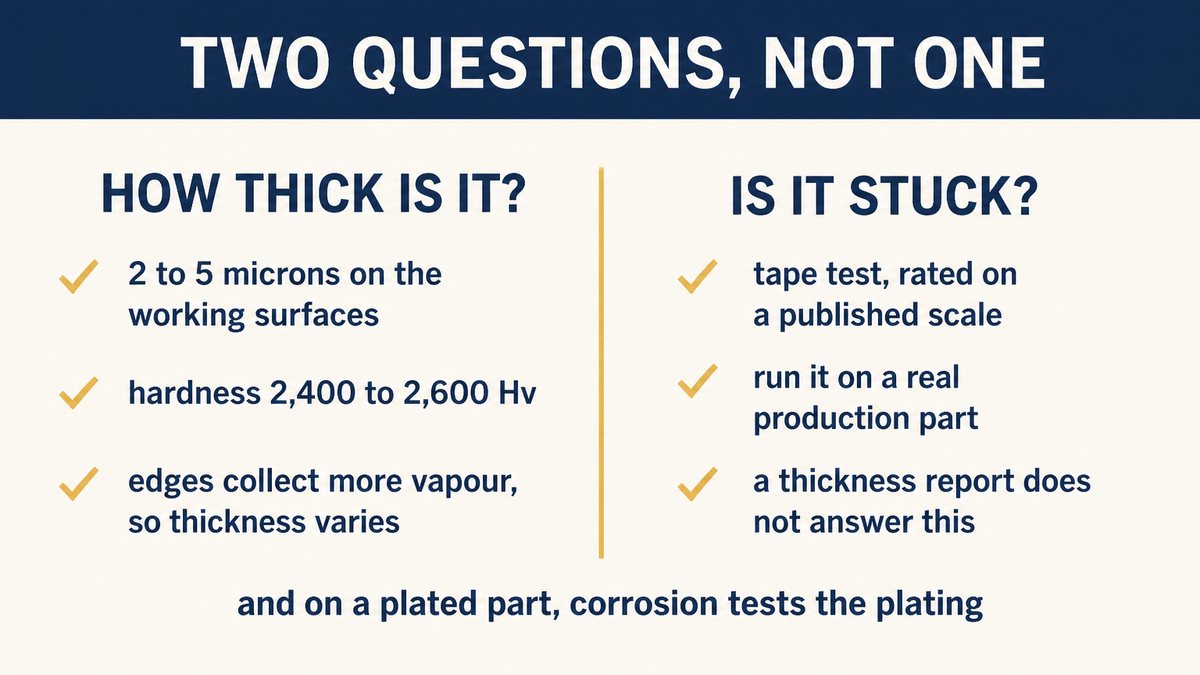
PVD coatings are thin in a way that surprises people who are used to plating. A published titanium nitride data sheet gives the thickness as 0.0001 to 0.0002 of an inch on the working surfaces, which is 2 to 5 microns. Equipment makers describe films generally as ranging from a few atoms to many microns. Your entire coating, in other words, is thinner than a sheet of household foil by a wide margin.
The reason that is acceptable is hardness. The same data sheet gives titanium nitride a hardness of 2,400 to 2,600 Hv, which it notes is harder than carbide. A film that thin survives normal handling because it is harder than the steel underneath it. The substrate can deform under an impact while the coating, in the ordinary course of wear, resists scratching.
Thickness is not even across the part
Here is the detail that explains most finish complaints, and it comes straight from a coating house's own technical notes. There is variation in coating thickness across a part: edges collect more vapour, so they get more coating, and factors such as process parameters, part geometry and where the part sits inside the vacuum chamber all influence how thick the coating ends up on a particular area.
Two practical results follow. First, a colour that looks slightly deeper or brighter along an edge is not a defect, it is the geometry of the process, and it is worth agreeing with the coating house how much variation you will accept before you reject a batch over it. Second, some faces of a part will always receive less coating than others. If a surface that gets less coating is the one the customer sees, the specification needs to be written that way from the start — which is a fixturing question as much as a coating question.
"Make it thicker" is not a free fix
The obvious thought on reading that the film is only microns thick is to ask for more. It is possible to build up thickness by coating a part more than once, and the same data sheet says so. It also says the limit: as the coating gets thicker, there is a greater chance of spalling, which means patches of coating lifting away from the surface.
So thickness is a range to be specified, not a number to be maximised. Ask for a target with a tolerance, test the result, and treat a supplier who offers unlimited extra thickness without mentioning spalling as someone who has not run the experiment.
7. How to Test Adhesion and Wear, Not Just Thickness
There are two separate things to prove about a PVD coating, and buyers routinely accept evidence for one and assume the other. Thickness tells you how much coating you received. Adhesion tells you whether it is attached. A part can pass a thickness check and fail an adhesion check, and only one of those failures is visible before the product reaches a customer.
Thickness
Film thickness is measured with instruments rather than by eye, and coating houses check it in several ways: a calotest, X-ray fluorescence, a stylus profilometer, or by cutting a cross-section and examining it under a microscope. You do not need to choose the method, but you do need the report to state which one was used and where on the part it was measured — because of the edge variation above, a single number with no location is close to meaningless.
Adhesion
The standard method for rating how well a coating sticks is a tape test, published as ASTM D3359, Standard Test Methods for Rating Adhesion by Tape Test. The idea is simple enough to describe without the document: a grid of cuts is made through the coating down to the substrate, tape is pressed over the grid and pulled away, and how much coating lifts off with the tape is rated against a scale. The method is the same one used across the coatings industry, which means a result is comparable between suppliers.
Ask for the test to be run on the actual production stack, on the actual substrate, at the actual thickness — not on a flat test coupon. A coupon proves what the coating can do on an ideal surface, and the interesting failures happen on a real part with a curved surface, a hole, or a thread that did not get the same fixturing attention.
Wear and corrosion test the layer underneath
This is the point most buyers miss. If the part is a brass or zinc-alloy item with a plated base layer and a PVD colour on top, then a corrosion test is largely a test of the plating, not of the PVD. A good salt spray result tells you the plated layer is sound and the stack is closed. It does not tell you the PVD film is thick enough or bonded, because a film a few microns thick is not what is holding the corrosion back.
Wear is the test that belongs to the PVD. Run it in the condition the product will actually meet — a rub test against the surface it will contact, repeated enough times to be meaningful — and compare a coated sample against an uncoated one. A wear result is far more useful when it is comparative, because there is no universal pass mark for a coating on a consumer product. Our first article inspection guide covers how to fold this kind of measurement into the approval stage rather than discovering it at delivery.
8. PVD Against Electroplating: Where Each One Wins
Buyers often frame this as a choice. On a decorative part in a base metal it usually is not one, because the normal build uses both. The useful exercise is to see what each layer is good at.
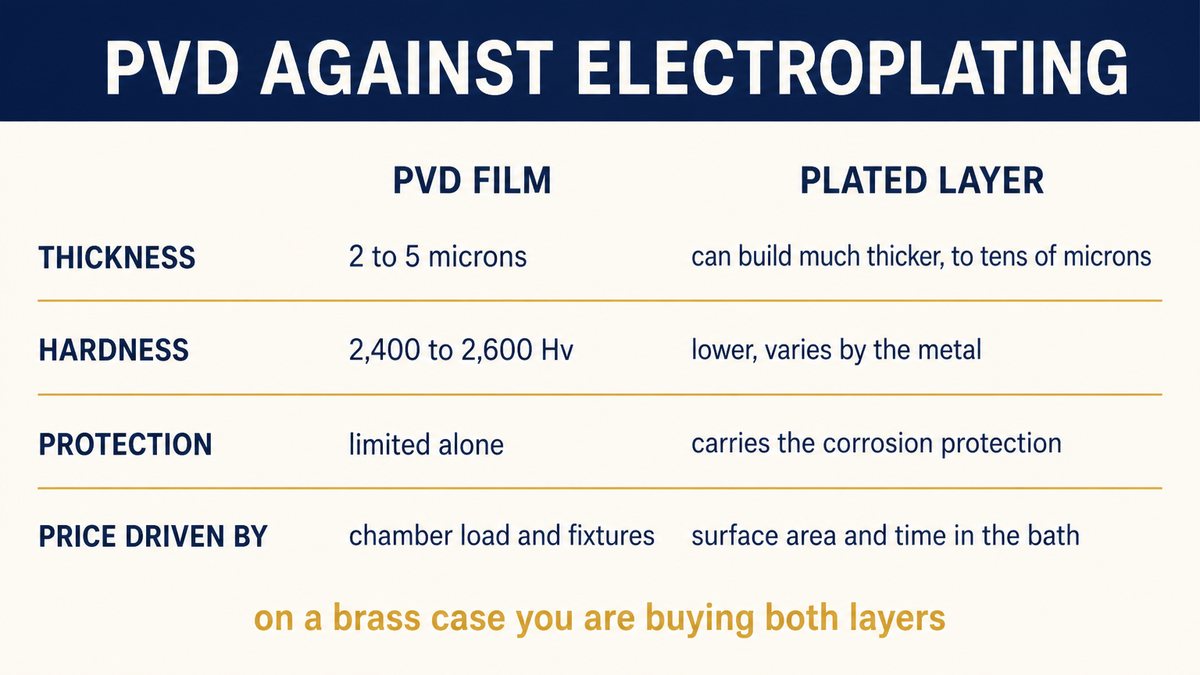
| PVD coating | Electroplating | |
|---|---|---|
| Typical thickness | Microns — 2 to 5 for a common hard coating | Can be built much thicker, from a fraction of a micron to tens of microns |
| Hardness | Very high. One titanium nitride data sheet gives 2,400 to 2,600 Hv, harder than carbide | Lower than a hard PVD compound, and it varies by the metal being deposited |
| Corrosion protection | Limited on its own, because there is so little material present | The layer that carries it, which is why it goes underneath on a base-metal part |
| Colour | Set by the compound. Coating houses state that the finishes resist tarnishing and that the colours do not fade | Set by the metal deposited, and it can wear through to the metal below |
| Process | Dry, in a vacuum chamber, on fixtured parts | Wet, in baths, with the part on a rack or in a barrel |
| What drives the price | The chamber load, the fixtures and the cycle time | The surface area, the thickness and the time in the bath |
Two boundaries are worth stating plainly, because leaving them out is how a specification ends up wrong.
First, PVD does not replace the plating on a base-metal part. It is too thin. If you remove the plated layer to save money and keep the PVD colour, you have removed the corrosion protection and kept the appearance, and the failure will show at the edges and in the threads first.
Second, a deeper scratch behaves differently on the two layers. A hard PVD film resists scratching better, but once something does cut through it, there is almost no material there to absorb the damage, and the exposed substrate is right underneath the cut. Plating gives you more material between the surface and the metal, at lower hardness. Neither is universally better; they fail in different ways, and the way a product is used decides which failure matters.
9. How a PVD Job Gets Quoted in China
A PVD quotation is a batch quotation, and understanding that is the difference between a price you can work with and a price that never falls. The cost of running a chamber is largely fixed: pump down, heat, deposit, cool, vent. Once that cycle is running you want as many parts in it as the fixtures will hold.
Four things follow.
- Small parts are cheap to coat and large ones are not, because the constraint is how much fits on a fixture, not how much coating material the parts consume. A price per piece without the chamber load behind it is not a number you can negotiate with.
- Fixtures can be a tooling cost. An unusual shape may need a fixture designed and made before the first run, and that is a one-time cost that belongs in the quotation as its own line.
- Each colour is its own run. Because the colour is a different compound, a three-colour range is three setups with three minimums, not one order split three ways.
- A wrong colour is expensive but often recoverable. Titanium nitride can be stripped chemically so the part can be recoated, though one coating house notes that stripping works on steel alloys but not on every material, because the chemistry attacks some substrates, and that stripping costs roughly 40% of the coating cost. Worth knowing before you approve a colour, and worth knowing that on the wrong substrate it is not an option at all.
Send the actual part, not a drawing. PVD depends on line of sight, so geometry decides what gets coated and where the thin spots land, and nobody can price a fixture from a two-dimensional drawing. Send a finished part with the surface condition you intend to coat, and ask for a coated sample back before you approve the bulk order. That sample is the only reference that settles what the colour should look like.
One more piece of paper is worth having if you are coating tooling rather than product. There is a published specification for at least one common coating: the aerospace standard AMS 2444 is named by a PVD coating house as the specification for its PVD coating, and by a tool coating supplier as the aerospace specification for titanium nitride. If you are buying coated tools or moulds, writing that number into the purchase documents gives you something to measure against instead of an adjective. Our factory audit guide covers how to check whether a supplier actually owns the process or sends your parts out to someone else, which on coatings is a common arrangement and a common source of delay.
10. A Five-Step Specification Roadmap
- Write the layer stack from the base metal up. What provides the corrosion protection, what provides the colour, what provides the adhesion, and a thickness for each.
- Name the compound, not the colour. Titanium nitride for gold, chromium nitride or diamond-like carbon for grey and black, with a target thickness and a tolerance in microns.
- Check the temperature against the material. Ask for the deposition temperature as a number, and if the part is heat-sensitive, ask what the low-temperature process does to adhesion and to the cycle time.
- Agree two tests, not one. Thickness with a location, and adhesion by tape test on a production part. Add a wear test in the condition the product will meet, and treat a corrosion result as evidence about the plated layer.
- Quote by batch and by colour, then keep the sample. Get the chamber load and each colour as its own line, and keep a coated sample sealed as the colour reference for the next order.
Everything in this guide sits inside the Jewelry & Watches sourcing hub, which collects the plating, finishing and marking guides for watches and jewellery in one place.
11. Frequently Asked Questions
Is gold PVD real gold?
No. Gold-coloured PVD is a compound film whose chemistry produces a gold appearance, and it does not contain gold as a plated layer. The most common compound behind a gold-toned finish is titanium nitride, which a coating house data sheet describes as having a dark gold appearance. That is the same compound used to coat cutting tools and moulds, where the colour is a side effect of the chemistry rather than the point of the coating. So a "gold PVD" watch case is a hard, thin, gold-coloured film over whatever is underneath it. It is not gold plated, it does not carry a gold content, and it should not be described to a customer in a way that implies either.
How long will a PVD coating last?
There is no honest single answer, because it depends on the layer stack, the substrate, the thickness and how the product is used. What you can do is break the question into three parts that do have answers. How hard is the film, which the coating house can give you as a hardness figure. How thick is it, in microns, which can be measured and reported. And what is carrying the corrosion protection, which on a base-metal part is the plated layer underneath rather than the PVD. A coating that wears through on a keyring in a pocket is not the same problem as coating that corrodes in a bathroom, and the two are fixed in different places.
Can PVD be applied to plastic?
Yes, using a lower-temperature process, but the important part is the trade-off. One coating house states plainly that parts can be coated at lower temperatures, but that this requires process modifications which can adversely affect coating properties such as adhesion and cycle time. So the answer to "can you coat it" is yes, and the answer to "will it be as good" is that the process was changed, which may have cost something. Ask two follow-up questions before you approve a plastic part: what the deposition temperature will be, and what the change does to adhesion. Get both in writing, and test adhesion on the real part.
Why does my coating look different along the edges?
Because thickness varies across a part, and edges collect more vapour than flat surfaces do. A coating house technical note says this directly: there is some variation in coating thickness across surfaces, edges collect more vapour so they get more coating, and factors such as process parameters, part geometry and the part's position inside the chamber all influence the result. Along an edge you are seeing a slightly heavier film, which reads as a slightly deeper or brighter colour. This is normal rather than a defect, and the practical response is to agree an acceptable range of variation with the coating house before production instead of rejecting batches over it later.
Should I ask for a thicker coating so it lasts longer?
Not as a first move, and not without a limit. It is possible to build up thickness by running a part through the coating process more than once, so the request is technically reasonable. But the same coating data sheet notes that as the coating gets thicker there is a greater chance of spalling, which means sections of the coating lifting away from the surface. So thickness is something to specify as a target with a tolerance and to check by measurement, not something to maximise. If a supplier offers unlimited extra thickness without mentioning the risk of spalling, they have not run the experiment on your part and the answer is theoretical.
Is PVD cheaper than plating?
The two are priced on different things, so the comparison depends on your part. PVD cost is driven by the vacuum cycle and how many parts fit in the chamber on fixtures, which means small parts in a dense load are cheap per piece and large or awkward parts are not. Plating cost is driven by surface area, the thickness you build and the time in the bath. On a decorative base-metal part you are usually buying both anyway, because the plated layer provides the corrosion protection that a micron-scale PVD film cannot. The useful question is not which is cheaper, it is what the full stack costs and which layer is doing which job.
Get the Layer Stack Written Down Before You Order
Our team writes the full layer stack for your part, names the coating compound rather than the colour, checks the deposition temperature against your material, and puts a thickness figure with an adhesion test on the order file so the sample you approve is the product you receive.
Request a PVD & Plating Quote
Questions & Comments
We read every one and reply within 24 hoursCOMMENTS INTRO FOR THIS ARTICLE — write a topic-specific question prompt here.