
Motorcycle Exhaust Wholesale: The Label Is a Sentence
 ·
Updated October 22, 2026
·
12 min read
Fifty articles into this series, the numbers have been a size, a fitment, a rated load, a laboratory scope, a fire rating, an aggregate and a divisor. This last one is different in a way that decides whether the product can be sold at all: the federal rule for a replacement motorcycle exhaust prescribes the sentence that goes on the label, word for word, including the list of motorcycles it is allowed to be fitted to and a closing line that says installation on anything else may violate Federal law. A muffler is not approved in the abstract. It is approved for a list, and the list is printed on the part. Add a noise standard that is judged on the motorcycle rather than on a bench, and a carton that has to contain a sheet of a specific size in a specific type, and the category turns out to be the most paperwork-heavy in the series.
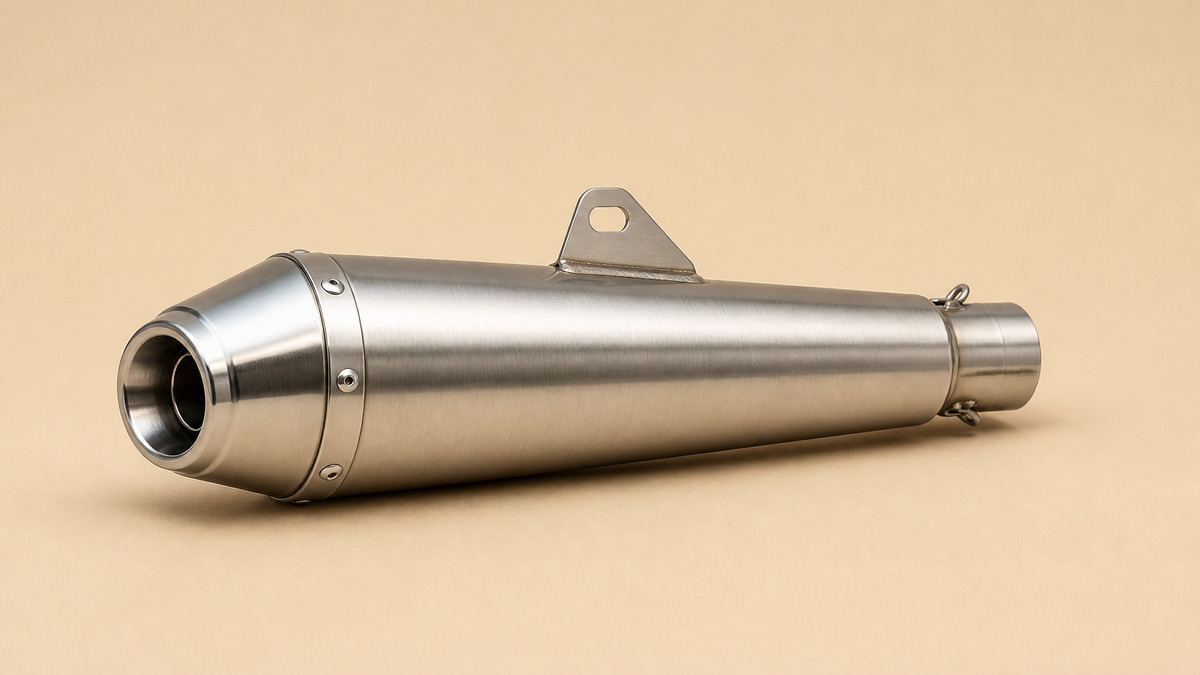
1. The Label Is a Sentence With a List
Start with the requirement that makes this category unlike every other one in the series. The manufacturer of a replacement exhaust system has to affix a permanent, legible label at the time of manufacture, and the label has to survive being installed:
“(b) The labels or marks shall be affixed in such a manner that they cannot be removed without destroying or defacing them, and must not be applied to any part which is easily detached from such product. (c) The label or mark shall be in a readily visible position when the exhaust system is installed on all motorcycles for which it is designed and marketed.” — 40 CFR § 205.169(b), (c)
That kills the easy option before the article gets to the wording. A sticker on the box is not a label, a tag on the mounting strap is not a label if the strap comes off, and a plate that disappears behind a heat shield is not in a readily visible position. What the rule asks for is a mark on the part itself, in a place a police officer or an inspector can read with the muffler bolted to a motorcycle.
Then comes the text, and it is prescribed rather than suggested. For a replacement system the label must carry this statement, with the bracketed parts filled in:
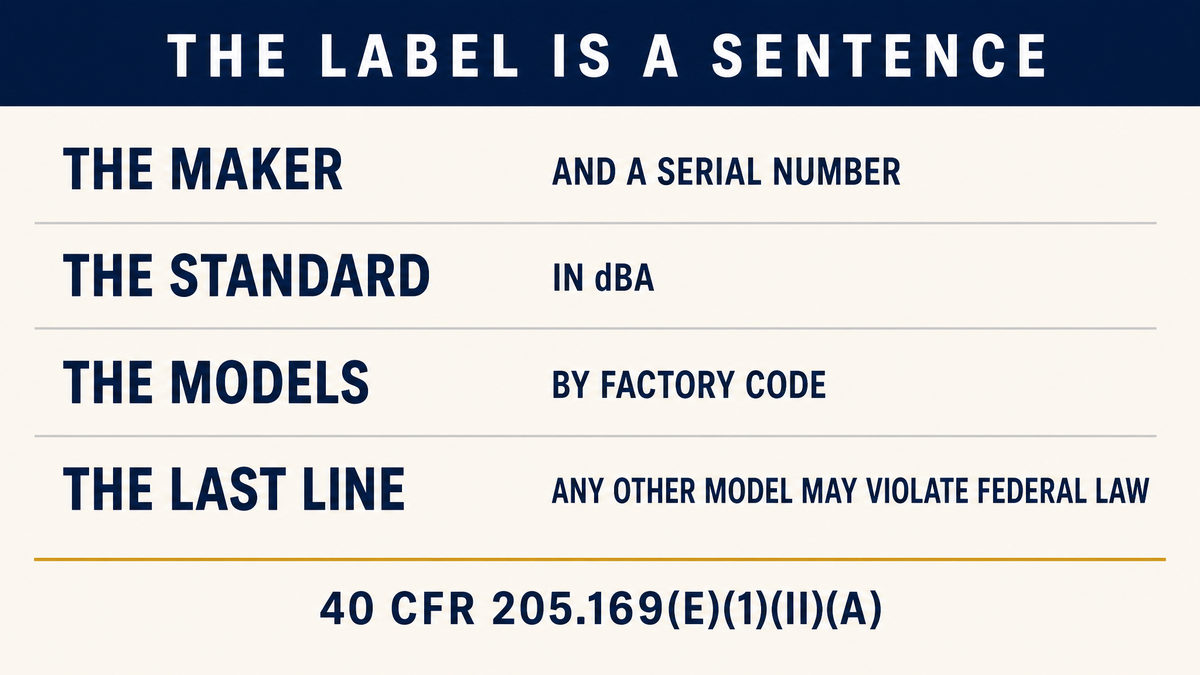
“This (manufacturer's name) exhaust system (serial number) meets EPA noise emission requirements of (noise emission standard) dBA for the following motorcycles: (list of model specific codes). Installation of this exhaust system on motorcycle models not specified may violate Federal law.” — 40 CFR § 205.169(e)(1)(ii)(A)
Read it as a buyer and three things appear that a catalogue almost never carries. The label names the maker and a serial number, so the part is traceable to a batch. It names the standard in dBA, so the number on the can is a statement about the rules rather than a performance boast. And it names the models, by the motorcycle manufacturer's own model codes, with a sentence that turns a wrong fitment into a possible violation of federal law.
That last clause is the reason this article exists. On a wiper blade and on a wheel, the fitment was a commercial matter: a part that did not fit was a return. Here the fitment is printed inside a legal sentence, and the rule adds that the model specific code must be the same one the motorcycle manufacturer uses, described in the exhaust labelling section of the motorcycle rules. A distributor who reprints a label with a shortened model list, or who sells one system across a range of models, is not stretching a description. It is editing a statement the regulation wrote.
2. The Number the Label Has to Carry
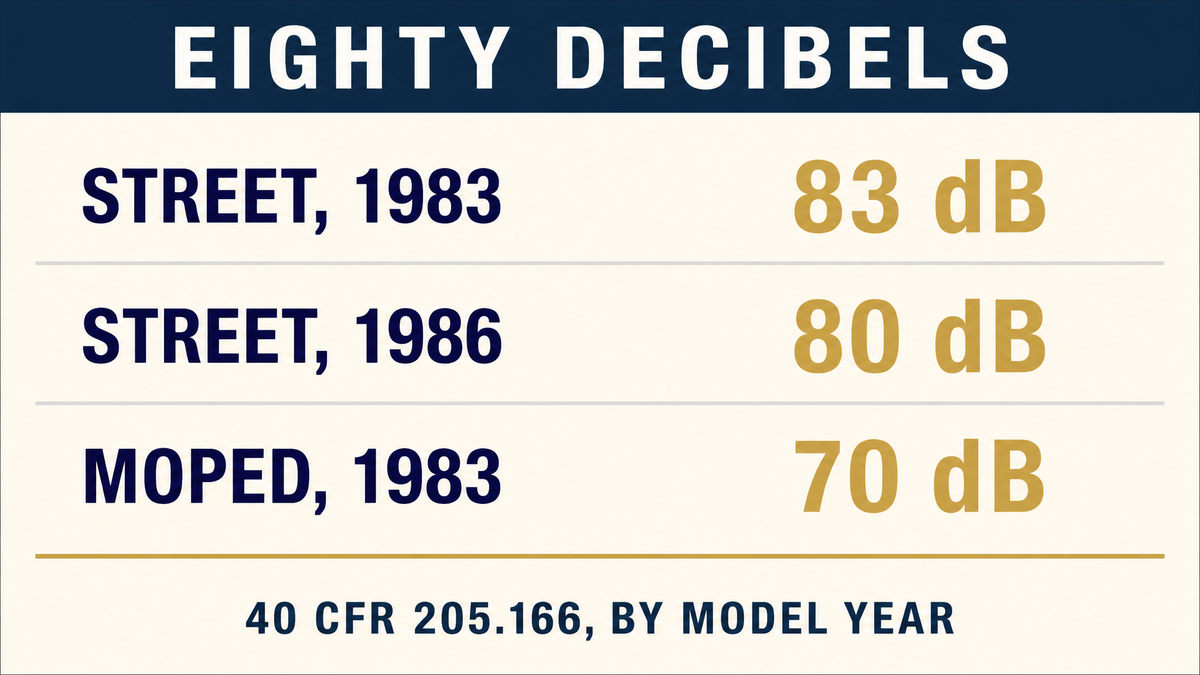
The number in that sentence is not a design target. It is a standard read off a table by model year, and the table has moved twice:
| Machine | 1983 model year | 1986 model year and later |
|---|---|---|
| Street motorcycle | 83 dB | 80 dB |
| Moped-type street motorcycle | 70 dB | — |
| Off-road, 170 cc and below | 83 dB | 80 dB |
| Off-road, above 170 cc | 86 dB | 82 dB |
Two features of that table matter more than the figures. The first is that the standard is written as an effect on the motorcycle, not a property of the part: a system complies if, when installed on a motorcycle that already meets the rules, it does not cause that motorcycle to exceed the level. There is no bench rating for a muffler in this subpart, which is why a supplier who quotes a sound level for the part on its own has quoted something the rule does not recognise.
The second is the Acoustical Assurance Period. A street system has to keep the motorcycle inside the standard for one year or 6,000 kilometres (3,729 miles) after sale to the ultimate purchaser, whichever comes first, and an off-road system for one year or 3,000 kilometres (1,865 miles). Read that as a sourcing requirement and it lands on the packing material: the fibre that silences a muffler settles with heat cycles, so a system that passes on the first day and fails at 3,000 miles is a system that fails this paragraph.
One more distinction completes the number. The rule separates street from off-road machines and separates off-road machines by engine displacement at 170 cc. That is a labelling decision as much as an engineering one: the same can, sold into two of those rows, carries two different statements and two different model lists. A supplier who offers one part number across a street bike and a dirt bike has offered a part that cannot honestly carry either label.
3. Out of Scope, and Why That Is a Marketing Question
The subpart has boundaries, and every one of them is drawn around how the part is sold rather than how it performs. Three of them matter to a wholesale order.
Header pipes sold separately are out. The applicability section excludes them, and the definitions section says what a header pipe is: any tube of constant diameter which conducts exhaust gas from an engine exhaust port to other exhaust system components which provide noise attenuation. Then it closes the door on the obvious workaround in one sentence: tubes with cross connections or internal baffling are not considered to be exhaust header pipes. Weld a balance pipe into a header, or stuff a baffle inside it, and the part has stopped being the thing the exclusion describes.
Competition-only systems are out, but not out of the labelling section. The subpart does not apply to systems designed and marketed solely for competition motorcycles, except for the labelling requirements, which apply in full. So a closed-course system still needs a permanent mark, and the statement it has to carry is not an exemption but an accusation waiting to happen:
“This product is designed for use on closed course competition motorcycles only and does not conform to U.S. EPA noise emission standards. Used on motorcycles subject to EPA noise regulations constitutes tampering and is a violation of Federal law unless it can be shown that such use does not cause the motorcycle to exceed applicable Federal standards.” — 40 CFR § 205.169(e)(2)
A pre-1982 statement exists, and so does an export one. Systems designed solely for motorcycles built before January 1, 1982 carry their own sentence, and systems built in the United States solely for use outside the country carry the words For Export Only. Four label variants, then, for one product family, and the choice between them is a statement about intent that the catalogue has already made.
That is the practical reading of this section, and it is uncomfortable for a trading business. An exemption here is tested by how the part is marketed, not by what it does. The rule says designed and marketed solely for competition motorcycles, so a can that is sold as race-only but appears in a street catalogue, or is photographed on a registered bike, has a marketing problem before it has an engineering one. The label is where the two meet: it is the only document that states which motorcycles the part is for, and the regulation wrote its text.
4. The Sheet in the Carton
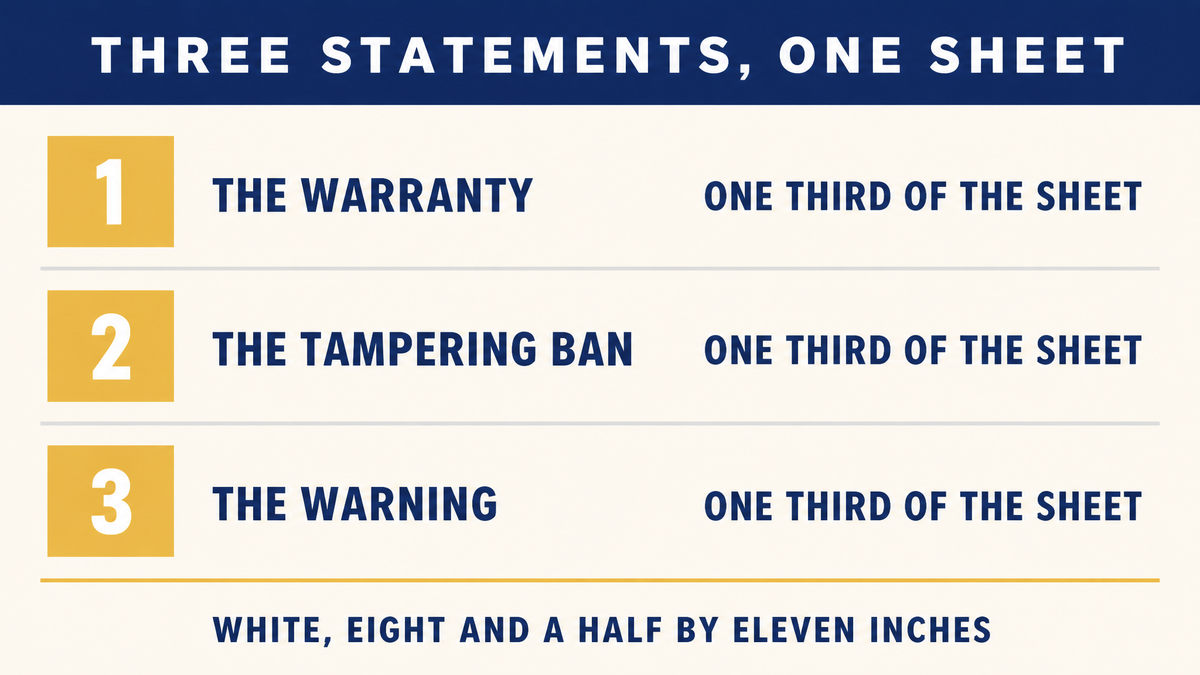
The last requirement in the subpart is the one that most often fails a factory inspection, because it is a printing job rather than a manufacturing one. Along with the product, the manufacturer has to include three statements, and the physical specification for them is exact:
“The manufacturer must include the Noise Emissions Warranty statement, Tampering Prohibition statement and the Warning statement with each product. All three statements must be printed on a white sheet or card at least 8½″ × 11″. Each statement must cover no more than ⅓ of the sheet. No other printing must be on the sheet. The statements must be printed in black ink; the statement headings must be in capital letters in a minimum size type of 12 point … and the text … a minimum size type of 10 point … The sheet or card must be placed with the exhaust system inside any packaging. If there is no packaging, the sheet must be affixed to the exhaust system so that it will not be accidentally detached in shipping.” — 40 CFR § 205.173-4
Three of the requirements in that paragraph are the sort of thing a buyer can check with a ruler and a photocopier. The sheet is a size, not a leaflet: 8½ by 11 inches, white, black ink. The type is a size: 12 point capitals for the headings, 10 point for the text. The placement is a rule: inside the packaging, or attached to the part so it cannot fall out in transit. And one of the three statements is prescribed word for word as a warning about what happens when the product wears:
“Warning: This product should be checked for repair or replacement if the motorcycle noise has increased significantly through use. Otherwise, the owner may become subject to penalties under state and local ordinances.” — 40 CFR § 205.173-3
Read that warning against the Acoustical Assurance Period in section 2 and the two fit together. The standard has to hold for a year or 3,729 miles; the sheet tells the owner what to do when it stops holding. A supplier who ships a can with a web address instead of the sheet has skipped the only part of this subpart that speaks to the person who will actually notice the noise rising.
5. The Word That Makes It Illegal
Everything above is administration until it meets one sentence in the statute. The Clean Air Act's prohibited acts include a provision written specifically for the aftermarket, and it is the reason the label carries a warning about other models rather than a note about performance:
“(3)(B) for any person to manufacture or sell, or offer to sell, or install, any part or component intended for use with, or as part of, any motor vehicle or motor vehicle engine, where a principal effect of the part or component is to bypass, defeat, or render inoperative any device or element of design installed on or in a motor vehicle or motor vehicle engine in compliance with regulations under this subchapter, and where the person knows or should know that such part or component is being offered for sale or installed for such use or put to such use.” — 42 U.S.C. § 7522(a)(3)(B)
Four words in that paragraph do the work, and each one is a sourcing question. Manufacture or sell. The prohibition reaches the factory and the distributor, not only the workshop that fits the part. A principal effect. Not a side effect, not a theoretical consequence: the test is what the part mostly does once installed. Bypass, defeat, or render inoperative. A muffler with a removable baffle is the textbook case, because the part's principal effect depends on whether the baffle is in it. And knows or should know. A seller who catalogues a race system for a street model, or prints a label listing models the system was never tested on, is on the wrong side of that phrase without ever touching a motorcycle.
The statute also says something a buyer should keep in view, because it cuts the other way: nothing in that paragraph requires the use of manufacturer parts. An aftermarket exhaust is not unlawful because it is aftermarket. It is unlawful when its principal effect is to defeat a device installed under the rules, and the label is the document that states which motorcycles it may be fitted to without doing so.
Four labels, four markets
| Label | Who it serves | What the order must fix |
|---|---|---|
| Replacement | Street and off-road riders | The dBA figure and the model codes |
| Competition only | Closed course use | That it is marketed only for that |
| Pre-1982 only | Vintage machines | The model year cut-off |
| For export only | Markets outside the US | The destination, in writing |
Look down the third column and the pattern of this whole series appears one last time. The specification is not a property of the metal; it is a statement about which machines the part may be used on, and every variant of the label is a different answer to that question. A factory that can print all four is not a factory that can sell all four: each one commits the seller to a list, and the list is the product.
6. What the Record Says
Method last. The federal recall file holds 245,845 records, has no header row, and every field is scanned. Controls: brake 28,639, air bag 16,162. Twenty-five terms were counted, and one came back at zero.
| Term | Records | Campaigns |
|---|---|---|
exhaust | 3,820 | 370 |
muffler | 306 | 34 |
silencer | 4 | 1 |
baffle | 8 | 4 |
pipe | 1,461 | 201 |
header | 287 | 39 |
slip | 2,693 | 176 |
catalytic | 142 | 15 |
converter | 699 | 81 |
canister | 116 | 19 |
noise | 3,041 | 166 |
sound | 606 | 32 |
dba | 216 | 60 |
decibel | 0 | 0 |
emission | 271 | 37 |
tamper | 47 | 2 |
heat | 3,495 | 430 |
shield | 596 | 91 |
titanium | 324 | 20 |
stainless | 386 | 48 |
chrome | 105 | 18 |
weld | 2,498 | 286 |
gasket | 252 | 36 |
bracket | 5,865 | 647 |
tip | 620 | 76 |
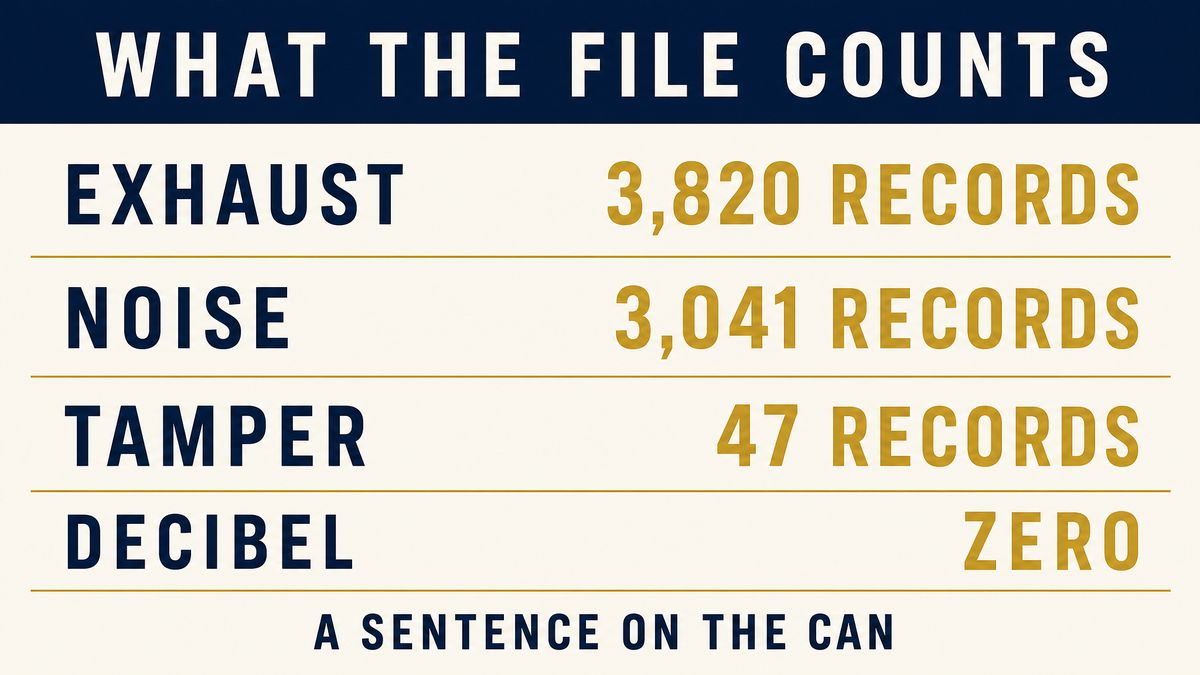
The exhaust is in the record, and properly filed. exhaust reaches 3,820 records across 370 campaigns, and the headings are the ones you would hope for: engine and engine cooling: exhaust system at 308 campaigns, the same heading carrying manifold at 210, and the emission control variant at 125 and 68. The largest rows are ordinary vehicle campaigns: a Chevrolet Impala at 1,003,556 units, a BMW Z4 at 917,106 and a BMW 328i at 740,561, all under the exhaust heading.
The regulatory vocabulary is nearly missing. decibel returns nothing; dba reaches 216 records in 60 campaigns; noise reaches 3,041 records but mostly as a description of a symptom; and tamper appears 47 times in 2 campaigns. baffle reaches 8 records in 4 campaigns, silencer 4 records in 1, and catalytic 142 in 15. The words that decide whether this product may be sold at all are, in the file, almost invisible.
The materials are louder than the rules. bracket 5,865, heat 3,495, weld 2,498, stainless 386, titanium 324, chrome 105. A machine that knows what a muffler is made of, and barely knows what it is required to say.
The finding, and the last one in this series. Fifty articles have now asked the same question of fifty products, and the record has answered it in every possible shape. A wiper blade and a jack were barely in the file at all; a cargo net's own name appeared once; a tire changer and its four synonyms were zero. Here the product is filed properly, with its own headings and a million-unit campaign, and the words that govern it — decibel, tamper, baffle — are the thinnest in the table. The pattern is not that the record is empty. It is that the record counts what breaks, and the specification is always about what must be said. Those are different documents, and the second one is the one a buyer has to write.
7. Five Questions an Exhaust Quote Should Answer
A wholesale quotation in this category usually arrives with a pipe diameter, a material, a finish, a fitment list and a price. Four of those five are about the metal. The fifth is the one that decides whether the product may be sold into the United States at all, and it is usually a single word: universal, or a model range that begins with a brand name and ends with a dash.
- Which of the four labels does this part carry, and does the catalogue agree with it? Replacement, competition-only, pre-1982-only or export-only. The label states an intent; the catalogue has to state the same one, because the exemption is tested by how the part is marketed.
- Which dBA figure, for which model years and which machine class? The standard moves with the model year and separates street from off-road, and off-road by displacement at 170 cc. One number across a range is a number that will be wrong somewhere.
- Which model codes, and are they the maker's own? The rule requires the model specific code used by the motorcycle manufacturer. A distributor's internal code is not a substitute, and a label listing a family name is not a list.
- How is the mark fixed, and is it visible once installed? It has to be impossible to remove without destroying it, must not sit on a detachable part, and must be readable with the system bolted to the motorcycle.
- Is the information sheet in the carton, at the right size and type? White, at least 8½ by 11 inches, black ink, three statements at no more than a third of the sheet each, headings in 12 point capitals and text in 10 point. This is the requirement a print shop fails.
8. Six Lines to Put in the Order
Everything above reduces to six lines, and they are the last six in a fifty-article series. Every one of them is a sentence rather than a measurement, which is what this category turned out to be about.
| Line | What to write | Why it is on the list |
|---|---|---|
| 1 | The label variant, and the statement text it requires | The wording is prescribed, not drafted |
| 2 | The dBA figure with the model years it applies to | 83 dB became 80 dB for street machines in 1986 |
| 3 | The model codes, copied from the maker's own list | The rule names the maker's codes, not yours |
| 4 | The mark's method and position, visible when installed | A tag on a removable strap is not a mark |
| 5 | The information sheet: size, ink, and two point sizes | Three statements, each a third of 8½ by 11 |
| 6 | The baffle and the packing fibre that hold the number | The assurance period runs to 3,729 miles |
The first three lines are legal text, the next two are printing, and the last is the only engineering line in the table. That distribution is the honest summary of this category: a well-made muffler that carries the wrong sentence is a product that cannot be sold, and a mediocre one that carries the right sentence and holds its fibre for a year is a product that can.com/factory-audit-checklist-guide/" target="_blank" rel="noopener">the audit that reads a label is where a printed sentence meets a production line, and the carton check that keeps a sheet inside is where the paperwork survives the trip — with how a muffler's packed volume decides the freight worth settling at the same time, because a can is mostly air.
Frequently Asked Questions
Is a replacement motorcycle exhaust legal in the United States?
It can be. The subpart applies to replacement systems and components for federally regulated motorcycles, and one that meets the rules is labelled with the prescribed statement, is designed so that it does not push a motorcycle that meets the rules above the noise standard, and lists the models it may be fitted to. An unlabelled system, or one whose label lists models it was never tested on, is a different proposition.
What exactly does the label have to say?
The maker's name, the serial number, the noise emission standard in dBA, and the list of model specific codes, followed by the sentence that installation on models not specified may violate Federal law. The model codes must be the ones the motorcycle manufacturer uses. The mark has to be permanent, must not sit on an easily detached part, and must be visible with the system installed.
What is the noise standard for a street motorcycle?
83 dB for the 1983 model year, falling to 80 dB from 1986. A moped-type street motorcycle is 70 dB for 1983. Off-road machines are split by displacement: 83 dB falling to 80 for engines of 170 cc and below, and 86 dB falling to 82 above 170 cc. The test is the effect on the motorcycle, not a bench rating for the muffler.
Are race exhausts exempt?
Partly. The subpart does not apply to systems designed and marketed solely for use on competition motorcycles, but the labelling section applies in full, so a closed-course system still carries a permanent statement saying it does not conform and that street use constitutes tampering. Because the exemption turns on how the part is marketed, a race system listed for road models has a problem.
Is a header pipe covered by the rules?
Header pipes sold as separate products are excluded. The definition is a tube of constant diameter carrying exhaust gas to other components that provide noise attenuation. A tube with cross connections or internal baffling is not a header pipe, so welding in a balance pipe or a baffle takes the part back inside the rules.
What has to be in the box besides the exhaust?
An information sheet: a white sheet or card at least 8½ by 11 inches carrying the noise emission warranty, the tampering prohibition and the warning, each covering no more than a third of the sheet, printed in black with headings in capital letters of at least 12 point and text of at least 10 point. It goes inside the packaging, or is fixed to the part so it cannot come loose in shipping.
A motorcycle muffler is one of the few parts whose rule is a sentence printed on it. 40 CFR 205 requires the can to carry a statement about replacement and about the models it fits, and the wording is prescribed rather than suggested.
That makes the label a manufacturing step, not a sticker applied at packing. A can that leaves the line without it is not a quiet can missing a mark; it is a part that cannot be sold into the market it was built for.
The Insert, Typeset and Ready to Print
One sheet with model coverage, the fitment note and the closed-course statement, sized to sit flat inside the box.
Typeset My Insert
Questions & Comments
We read every one and reply within 24 hoursThe sentence printed on a motorcycle exhaust is prescribed, and the model list inside it is part of the claim. Send the fitment sheet and the market, and we will draft the text.