
How to Handle Price Increases from Chinese Suppliers After Prototype Approval (2026 Guide)
 ·
Updated September 30, 2026
·
17 min read
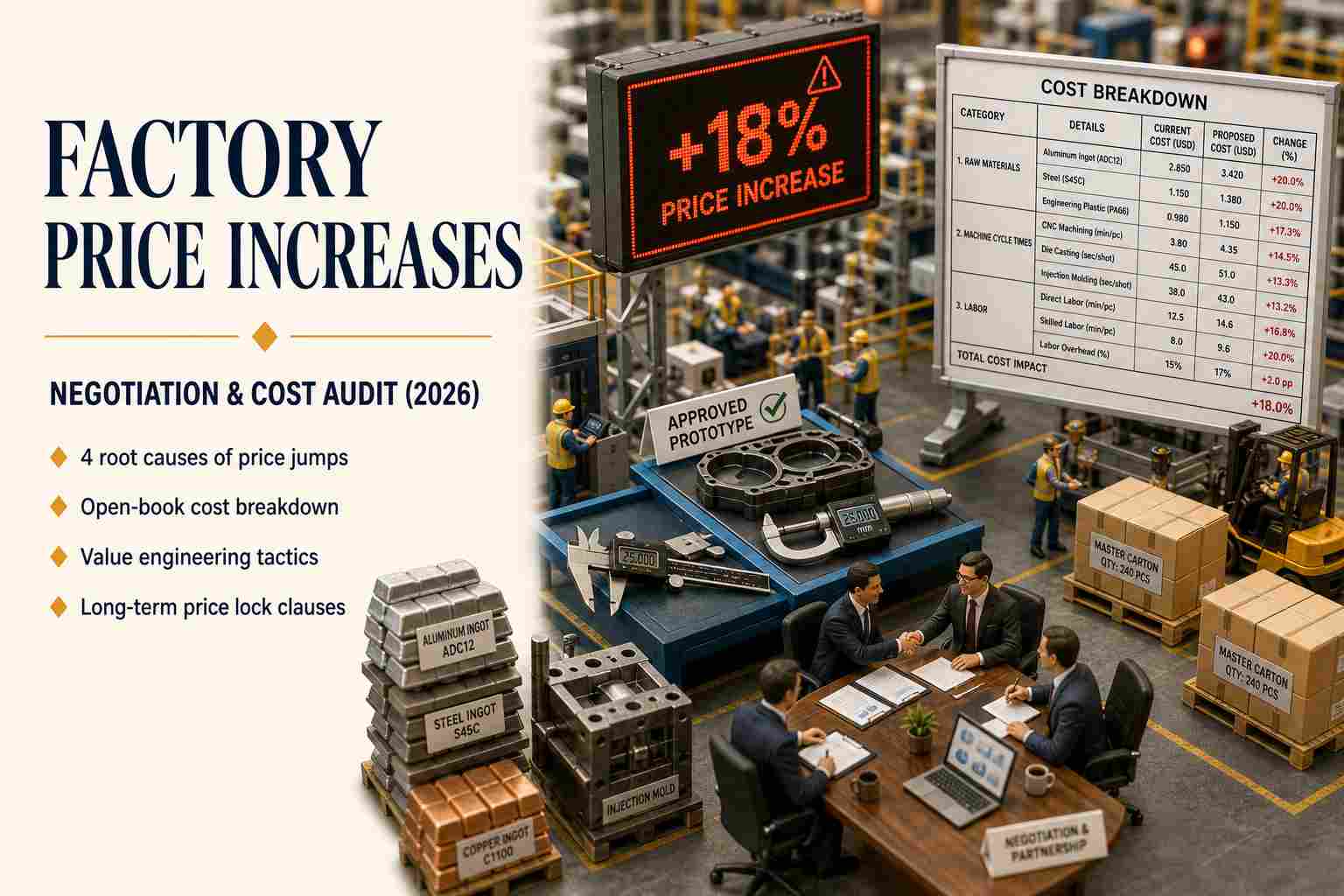
Direct Answer: When a Chinese supplier demands a sudden price increase after prototype sign-off, take four structured steps: First, do not accept or reject the quote immediately; request a standardized, itemized Cost Breakdown Sheet (CBC) separating raw material weight, cycle times, direct labor, scrap rates, and factory margin. Second, cross-check their material claims against official market indices on the Shanghai Futures Exchange to separate real cost inflation from lowball quote tricks. Third, conduct Value Engineering (DFM) to trim wall thickness, standardize hardware, and eliminate costly packaging steps. Fourth, leverage volume-tiered order commitments and mold ownership transfer clauses to lock in a fair agreed price.
Few moments in global procurement are more frustrating than this: You spend three months refining CAD drawings, paying tooling fees, and testing samples. Finally, the golden sample arrives in your office. It looks great, passes all drop tests, and meets your exact functional requirements. You email the factory to issue the initial 5,000-unit mass production order, only to receive a polite reply from the sales rep: “Dear friend, due to rising raw material costs and production difficulties during trial molding, our unit price must increase by 18%.”
Suddenly, your carefully modeled retail profit margins vanish. You feel trapped because the factory holds your custom injection molds and weeks of lead time have already elapsed. Giving in immediately sets a dangerous precedent for future price hikes, while walking away risks losing your market launch window. Knowing how to handle supplier price increases with data-driven negotiation strategies is what separates elite sourcing professionals from vulnerable buyers.
In this comprehensive guide, we dissect the 4 root causes behind post-prototype price jumps, share an open-book “Should-Cost” breakdown model, provide an actionable 5-step negotiation playbook, analyze real-world dispute case studies, and show you how to write contract clauses that guarantee long-term price stability.
Why Do Chinese Suppliers Raise Prices Right After Prototype Approval?
To negotiate effectively, you must first understand the true motive behind the price increase. Not all price adjustments are bad-faith attempts to squeeze extra margin; some stem from real engineering and economic challenges during mass production transition:
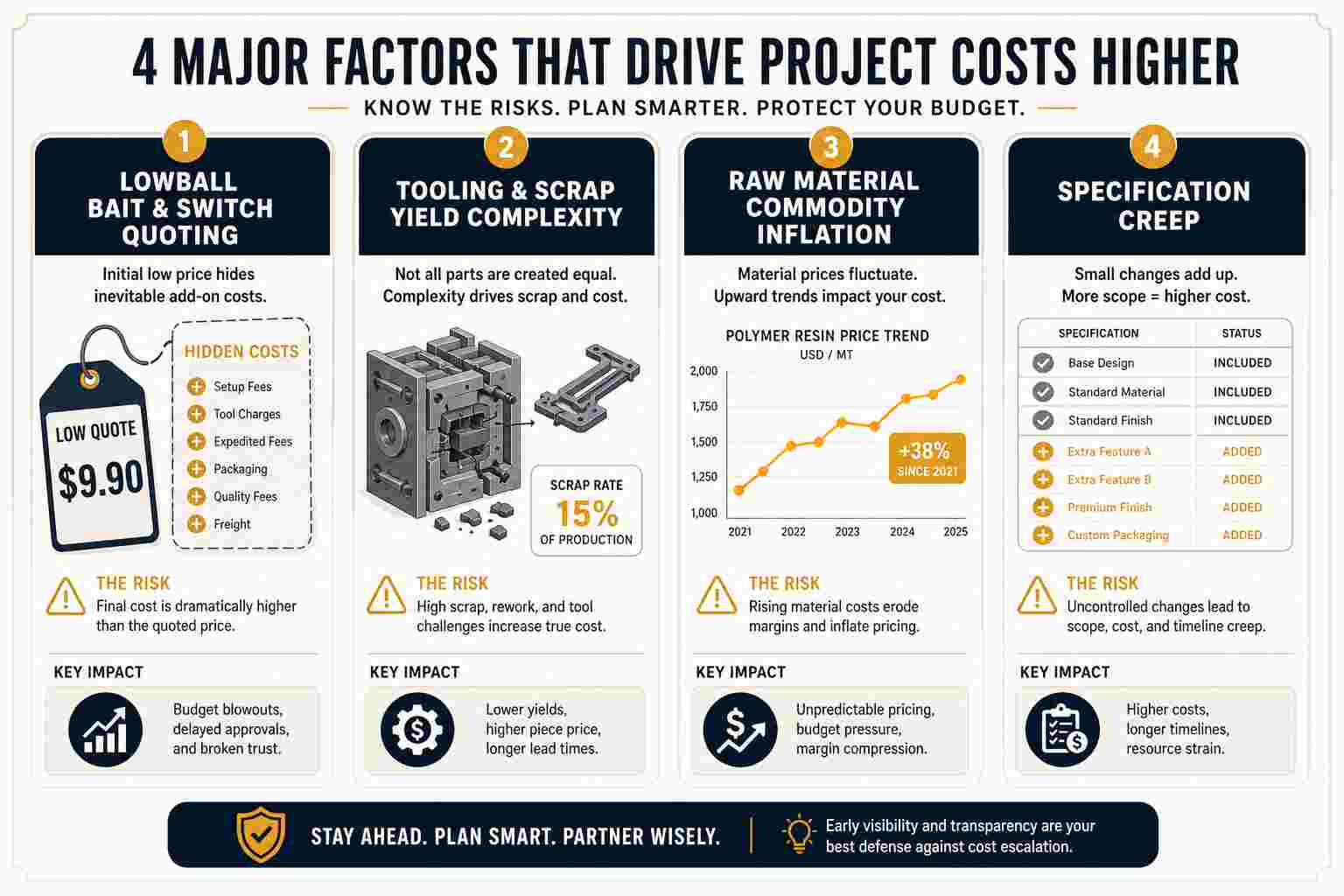
| Root Cause Category | Underlying Factory Mechanism | Legitimacy Level | Effective Buyer Countermeasure |
|---|---|---|---|
| 1. Lowball “Bait-and-Switch” Quoting | Sales team intentionally quoted below actual production costs to win your tooling deposit and freeze out competitors. | Unjustified (Bad Faith) | Benchmark against competitor quotes and enforce original signed quotation terms. |
| 2. Unforeseen Tooling & Scrap Complexity | Mass production trial runs revealed high scrap rates (e.g., 15% mold flash, warpage, or slow cycle times) not seen in handmade prototypes. | Partially Justified | Collaborate on Value Engineering (DFM) mold adjustments to increase production yield. |
| 3. Raw Material & Commodity Surges | Global commodity spot prices (aluminum, copper, silicone, polycarbonate) increased significantly between initial quote and mass production. | Justified (If Verified) | Check historical prices on official exchanges and apply index-linked cost formulas. |
| 4. Buyer-Side Specification Creep | Minor aesthetic changes, tighter color tolerances, luxury gift boxes, or extra barcode labels added during prototyping. | Justified | Audit added features and strip non-essential packaging or surface treatments. |
1. The “Bait-and-Switch” Sourcing Trap
In highly competitive Chinese industrial clusters (such as Shenzhen electronics, Yongkang hardware, or Ningbo plastics), trading companies and aggressive factories often submit aggressive, rock-bottom quotes during initial supplier outreach. Their deliberate strategy is to win your tooling deposit, build the custom molds, and wait until you have approved the sample. Once you are emotionally committed and facing tight retail deadlines, they announce an “unavoidable” price hike, calculating that you will pay rather than restart a 90-day sourcing cycle.
2. High Scrap Rates and Mold Cycle Bottlenecks
Making one single prototype in a factory sample room is very different from running 10,000 units on a high-speed assembly line. Sample makers use skilled craftsmen who spend hours hand-polishing and fine-tuning a single unit. When the design moves to mass production, unexpected thermal warpage, gate vestige blemishes, or tight mechanical clearances can cause a 15% scrap rate. The factory raises prices to cover these wasted materials and slower output rates.
3. Macro Commodity and Energy Price Shifts
Global commodity prices do not stand still. If three to four months pass between your initial RFQ quotation and the final tooling approval, major price swings in copper ingots, virgin ABS granules, or stainless steel coils can alter the factory’s raw material sourcing costs. Legitimate manufacturers often absorb minor 2% to 3% fluctuations, but larger shifts force them to request price adjustments to avoid running production at a net cash loss.
4. Uncontrolled Product Specification Creep
During the sample iteration cycle, buyers frequently request “small improvements”: adding a soft-touch matte coating, switching from a plain polybag to a rigid magnetic gift box, demanding tighter color matching tolerances under Pantone standards, or requiring custom laser-etched serial numbers. While each individual tweak seems minor, their cumulative effect adds significant labor, cycle time, and component costs to the final bill of materials.
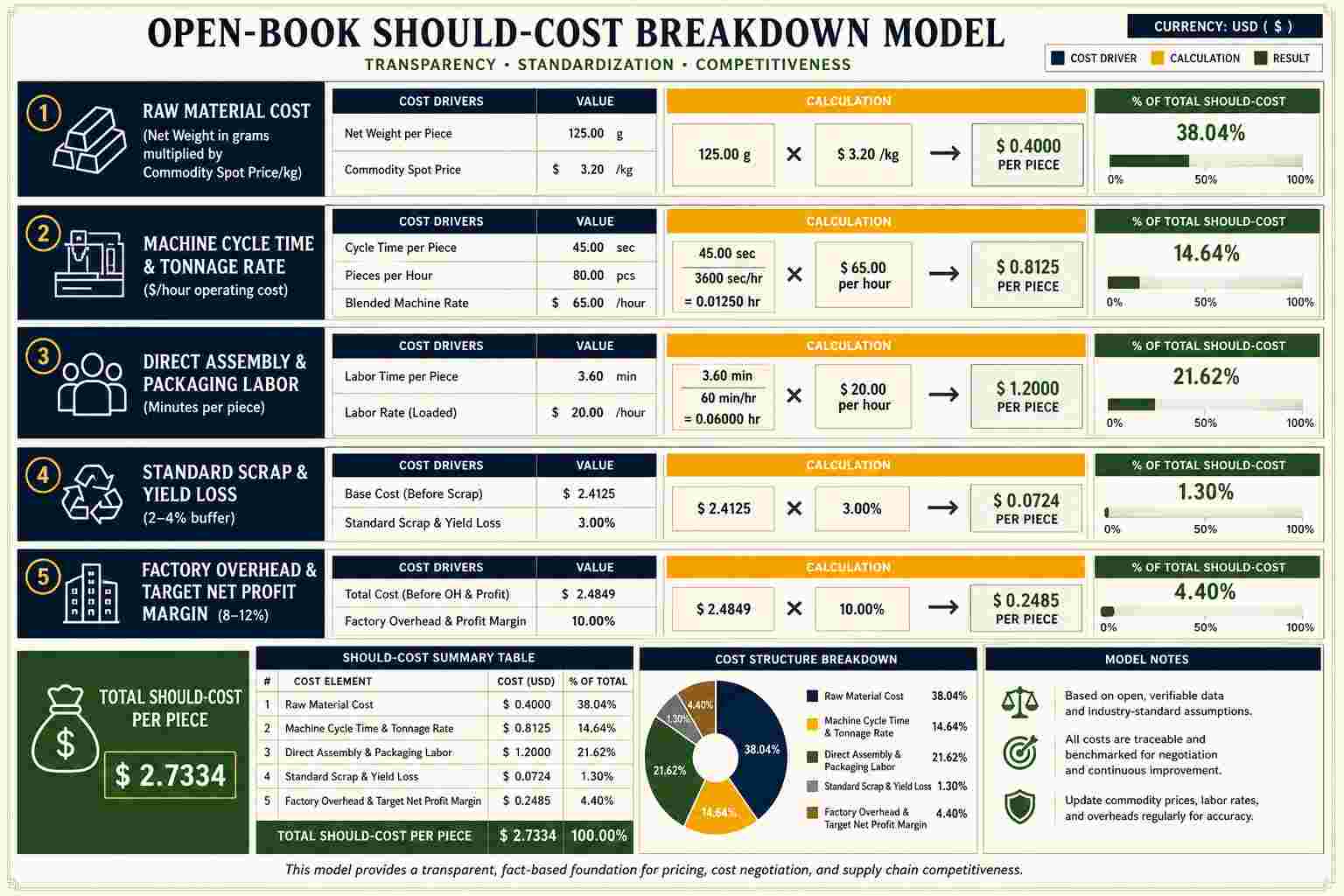
The 5-Layer “Should-Cost” Breakdown Model
Never enter a price negotiation with emotional arguments like “This is unfair” or “You promised a lower price.” Professional buyers win negotiations by using objective data. You must deconstruct the product into a structured 5-layer Should-Cost Model:
The 5-Step Strategic Negotiation Playbook
When the supplier sends a price increase notification, execute this systematic 5-step playbook to take control of the conversation:
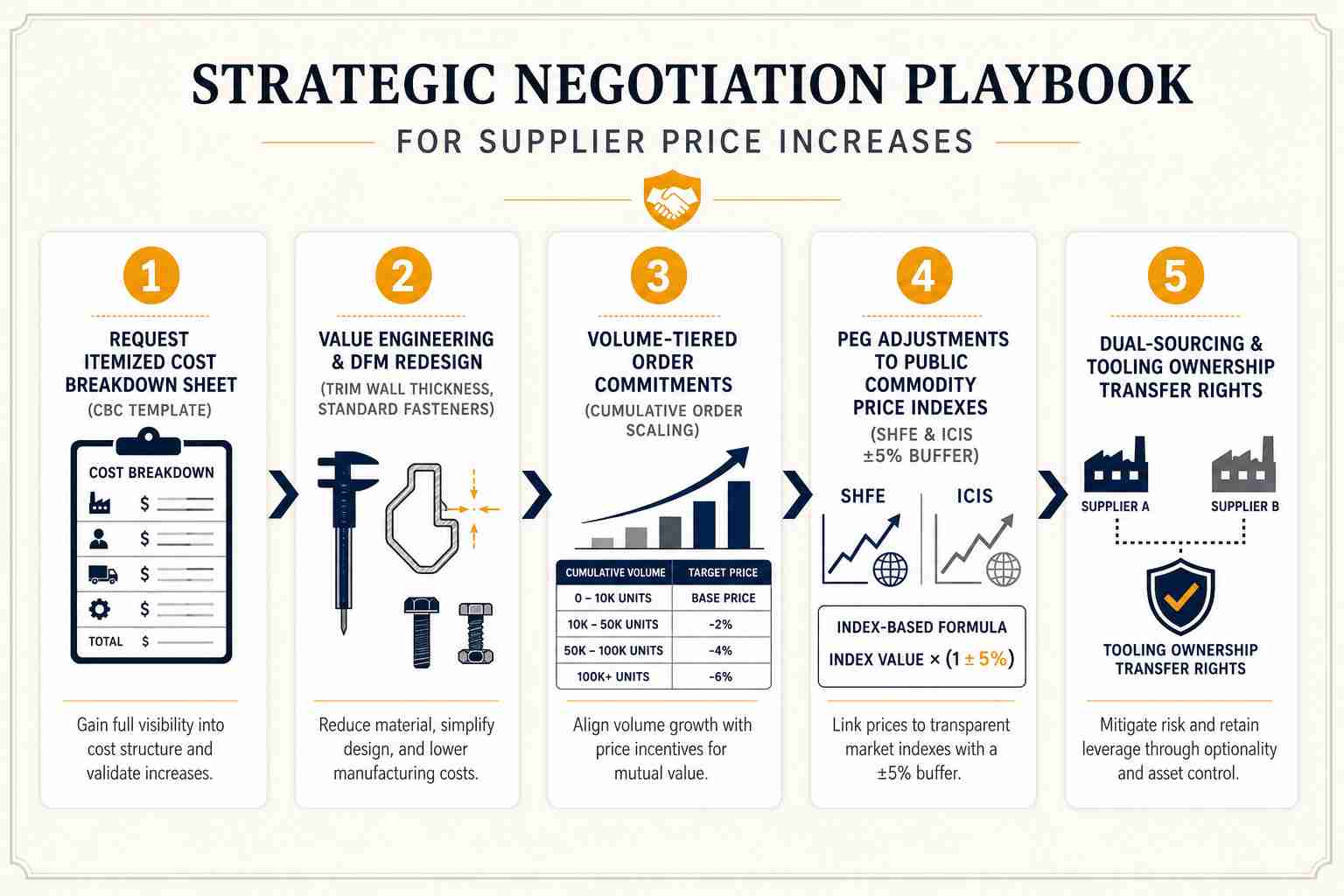
- Request a Standardized Cost Breakdown Sheet (CBC): Send the supplier a blank cost breakdown template. Require them to itemize raw material weights, unit costs, cycle times, packaging costs, and factory margins. Unjustified price hikes usually fall apart when the supplier realizes they must justify the numbers in writing.
- Execute Value Engineering (Design for Manufacturing): Work with the factory engineers to strip unnecessary costs. Can you reduce wall thickness from 3.0mm to 2.5mm to save 16% on raw plastic weight? Can you replace custom electroplated screws with standard zinc-plated fasteners? Can you simplify retail packaging boxes to reduce folding labor? Linking your review with an early first article inspection (FAI) tooling review ensures engineering tweaks do not hurt functional performance.
- Offer Volume-Tiered Order Commitments: If the factory claims setup costs are too high for your initial trial order of 2,000 units, offer a volume tier schedule: “We will pay \$5.20 for the first 2,000 trial units, but the price drops back to \$4.60 automatically once our cumulative orders cross 10,000 units.”
- Peg Adjustments to Public Commodity Price Indexes: If the supplier blames rising metal or resin costs, tie price adjustments directly to verified public markets, such as the Shanghai Futures Exchange (SHFE) for metals or published chemical price trackers from the ICIS Chemical Pricing Index. Agree that prices adjust only if raw material indices move by more than ±5%, and ensure that prices drop automatically when commodity prices fall.
- Leverage Dual-Sourcing and Mold Transfer Rights: If the supplier remains stubborn and refuses to cooperate, bring out your secondary sourcing options. Remind them calmly that your contract establishes clear mold ownership, and prepare to move the tooling to a backup factory audited under your supplier factory audit standards. If quality issues or defect disputes accompany the price increase, referencing standard protocols for handling failed quality inspections and rework compensation provides strong legal standing.
How to Write Manufacturing Contracts That Prevent Price Creep
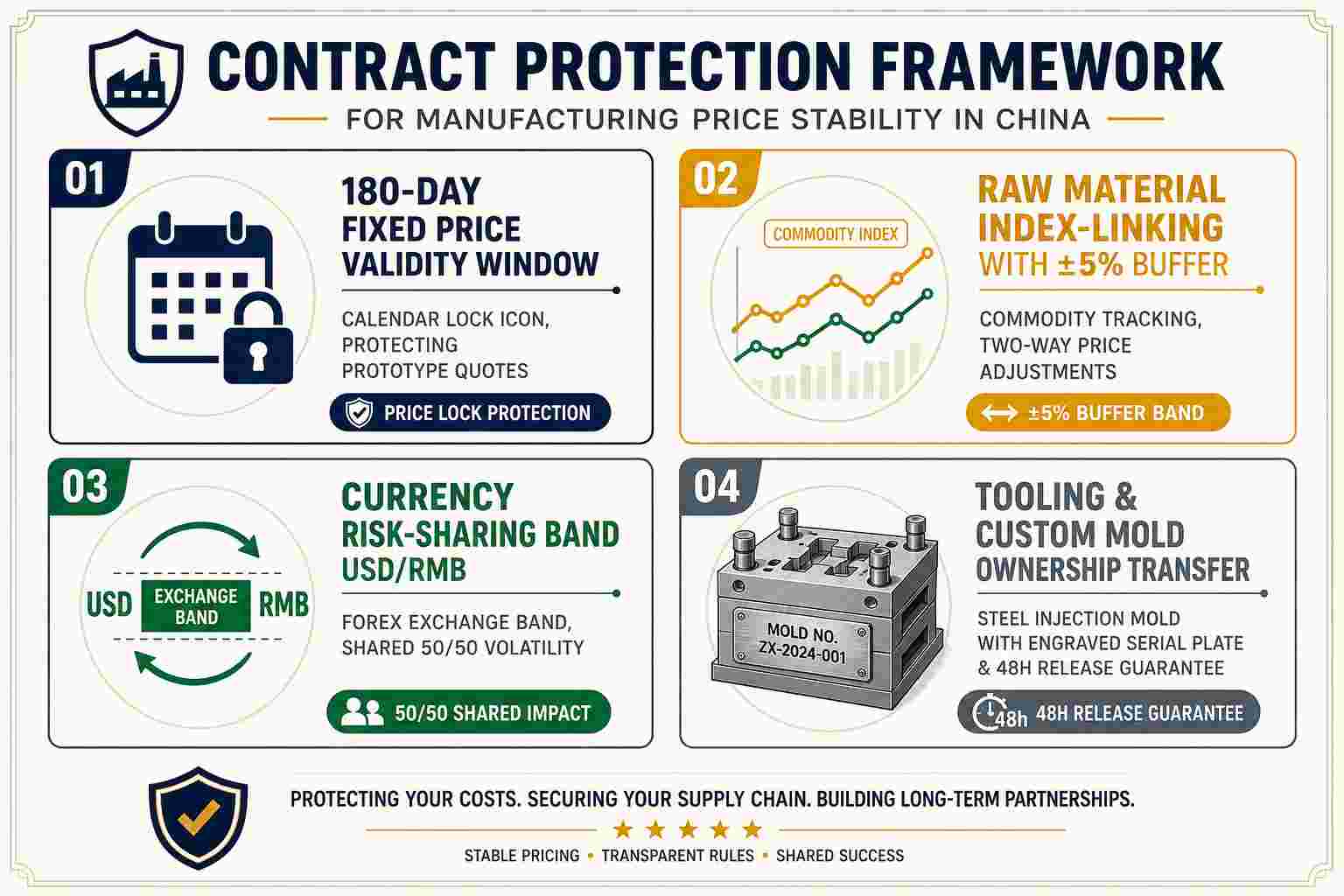
The best way to win a price negotiation is to prevent it before tooling begins. Include these four protective clauses in your initial Supply Agreement and Production Orders:
| Contractual Protection Clause | Key Legal & Commercial Terms | Protection Benefit for Buyer |
|---|---|---|
| 1. Fixed-Price Validity Window | Agreed unit price is legally locked for 180 to 365 days following golden sample sign-off. | Eliminates surprise price increases between prototype sign-off and first mass production runs. |
| 2. Raw Material Index-Linking (±5% Buffer) | Prices adjust only if published commodity indices move by more than 5%. Adjustments apply only to the raw material cost fraction. | Prevents the factory from marking up labor, overhead, or profit margins under the guise of material inflation. |
| 3. Currency Risk-Sharing Band (USD/RMB) | Exchange rate band of ±3% absorbed by supplier; movements beyond 3% shared 50/50. | Protects against foreign exchange volatility while avoiding arbitrary currency surcharges. |
| 4. Tooling & Mold Ownership Transfer | Buyer owns 100% of all custom molds, dies, and design files upon full payment of tooling invoices. | Gives you the legal authority to retrieve custom tooling and move production if disputes arise. |
Key Steps to Enforce Tooling Ownership and Prevent Hostage Scenarios
In China contract law, possession of physical tooling creates practical leverage. If a factory realizes that you cannot easily move custom injection molds to a competitor, they hold tremendous power during pricing talks. To protect your brand, always engrave your company name, patent number, and a unique serial code directly onto the mold base steel. Require the factory to provide high-resolution photos and video of the mold base showing the engraved ownership plate before paying the final 50% tooling balance.
Furthermore, state explicitly in your contract that the factory must release the molds to your designated logistics representative within 48 hours of written notice, without imposing arbitrary “storage fees,” “maintenance surcharges,” or “tooling release penalties.”
Illustrative Sourcing Scenario: Aluminum Camping Lanterns
To see how structured cost modeling and calm negotiation work in real life, consider this typical procurement case study:
An outdoor gear brand designed a custom anodized aluminum LED camping lantern with a factory in Yongkang, Zhejiang. The initial target quote was \$8.50 per unit for 5,000 units, and the buyer paid \$12,000 for custom extrusion and stamping dies. After the buyer approved the golden sample, the supplier announced a revised price of \$10.20 per unit (+20% increase), citing rising aluminum costs and anodizing surface reject rates.
Instead of panicking or canceling the project, the buyer executed the 5-step playbook:
- Step 1 (Open-Book Audit): The buyer sent an itemized cost breakdown template. The factory reported: Aluminum Raw Material: \$3.80 (400g), CNC & Stamping Labor: \$2.10, Anodizing & Scrap: \$1.80, Electronics: \$1.50, Margin: \$1.00.
- Step 2 (Data Cross-Checking): The buyer checked aluminum ingot spot prices on the Shanghai Futures Exchange. Aluminum had risen by 8% over the quarter, which accounted for only a \$0.30 increase in raw material cost, not the \$1.70 demanded by the factory.
- Step 3 (Value Engineering): Factory engineers explained that 12% of lantern bodies suffered color streaks during anodizing due to sharp 90-degree outer corners. The buyer modified the CAD drawings to add a 1.5mm edge chamfer, reducing the anodizing scrap rate from 12% to under 2%.
- Step 4 (Volume Commitment): The buyer signed a 12-month rolling forecast committing to 15,000 units over three production runs, with final quality validated under pre-shipment inspection (PSI) protocols. They also optimized packaging with clear shipping marks on export cartons to streamline warehouse intake.
- Outcome: The final unit price was settled at \$8.85 per unit (+4% adjusted for real metal inflation), saving the brand \$20,250 on their annual production run while maintaining a strong, cooperative factory partnership.
Frequently Asked Questions (FAQ)
Why do Chinese suppliers raise prices right after prototype approval?
Suppliers often raise prices due to four main factors: initial lowball quoting to win your attention, discovering unexpected tooling complexity and high scrap rates during trial molding, real surges in raw material commodity prices (like aluminum, copper, or polymer resins), or packaging and specification creep added during the prototyping phase.
How do you challenge an unexpected price increase from a factory?
Never argue with emotional claims. Immediately request an itemized Cost Breakdown Sheet (CBC) separating raw material weight, machine cycle times, direct labor, scrap rates, and factory overhead. Compare their numbers against public commodity price indices and third-party manufacturing benchmarks.
What is Value Engineering (Design for Manufacturing) in cost reduction?
Value Engineering (DFM) modifies product design to lower production costs without reducing quality or function. Examples include reducing plastic wall thickness by 0.5mm, standardizing screw sizes, changing custom color finishes to standard stock masterbatches, or simplifying packaging insert folds.
Can you move custom tooling to another factory if the supplier refuses to find common ground?
Yes, provided your initial tooling agreement clearly states that you own 100% of the injection molds and stamping dies. Your contract must give you the legal right to retrieve and transfer tools to a secondary backup manufacturer without paying extra release fees.
How do you lock in long-term price stability in a manufacturing contract?
Include raw material index-linking clauses with a ±5% deadband buffer, establish 180-day fixed-price validity windows, define volume-tiered rebate schedules, and state that any cost adjustments must be backed by official published commodity indexes.
Need Help Negotiating Manufacturing Costs in China?
Do not let unexpected factory price increases destroy your product margins. Sourcing Pioneer conducts open-book should-cost audits, performs Value Engineering (DFM) reviews, and negotiates fair, long-term contract pricing directly with Chinese factory management.
Get a Cost Breakdown Audit
Questions & Comments
We read every one and reply within 24 hoursDid your Chinese manufacturer announce a sudden price increase after prototype sign-off, blame rising raw material costs, or refuse to honor their initial quote? Share your product category, order volume, and quoted price hike below — Alan Xiao provides direct cost breakdown analysis and negotiation guidance.