
Catalytic Converter Manufacturer: The Target Is the Old Part
 ·
Updated October 22, 2026
·
14 min read
Every other part in this series is measured against a number the regulation supplies: a load, a pressure, a character height, a bulb type. A replacement catalytic converter is measured against another product. Its conversion efficiency has to equal or beat the converter it replaces, its light-off time has to equal or beat it, and both have to be shown on the same bench under the same gas. There is no federal figure to hit. The specification is the used part on the car, which is why a quotation that quotes a number is already answering a question nobody asked.
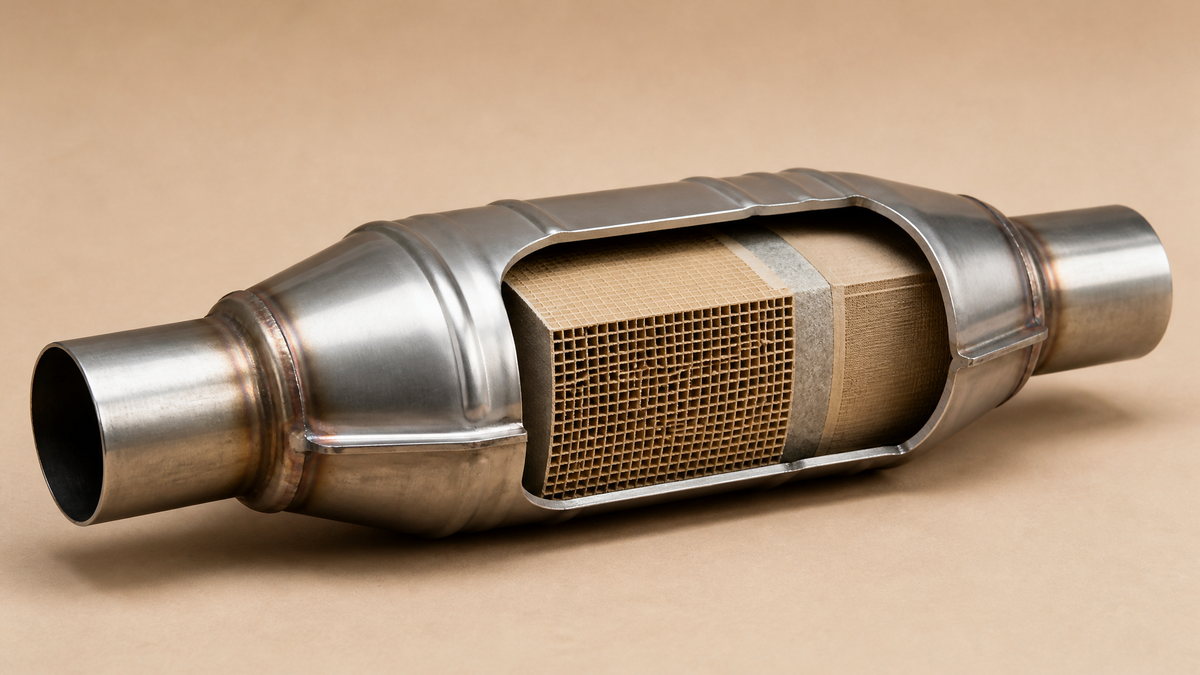
1. The Subpart Written for Aftermarket Parts
Most of this series has read standards written for vehicles and then worked out how they reach a part. This row is the reverse. 40 CFR Part 85, Subpart V — sections 85.2101 to 85.2123 — is an aftermarket parts certification programme, written for the part rather than the car, and its applicability section says so in one sentence: the provisions apply to emission related automotive aftermarket parts which are to be installed in or on 1968 and later model year light-duty vehicles and light-duty trucks.
The definition of an aftermarket part is deliberately wide: any part offered for sale for installation in or on a motor vehicle after such vehicle has left the vehicle manufacturer's production line. Not a part sold without a box, not a part sold only to independents — any part offered after the production line. A converter sold through a distributor, a rebranded unit, a rebuilt original: all of it sits inside that sentence.
The programme is a certification, and the word is used precisely. The manufacturer certifies, having notified the Agency of its intent under 85.2115, and the Agency can object under 85.2116 or decertify under 85.2121. Nobody issues a pass. The document that exists at the end is a notification and a set of records, not a certificate with a seal.
Two appendices hang off the subpart, and their titles are worth reading closely. Appendix I is the “Recommended Test Procedures and Test Criteria and Recommended Durability Procedures To Demonstrate Compliance With Emission Critical Parameters”. Recommended, twice. What is mandatory is the parameter; what is recommended is how you show it. That distinction decides which argument a buyer can win, and it comes back in section 3.
2. The Target Is the Old Part
85.2114 is the section that changes the shape of the question. Before certifying, the manufacturer has to establish three things: whether the part is emission-related at all, which vehicle or engine configurations it is being certified for, and whether it qualifies under one of the part categories in 85.2122. The third one carries the sentence this article is about.
A part may be certified in that category only if its emission-critical parameters are equivalent to those of the original equipment or previously certified part it is to replace. Read that twice. The yardstick is not a federal limit and not a competitor's product. It is the part that was on the vehicle — or, if that part was itself an aftermarket unit already certified, the certified part it is replacing. Equivalence runs down a chain, and every link is another product.
Two consequences follow, and both are practical. The first is that a generic converter has to be tested against its worst case. If one unit is sold to cover forty applications, the bench has to represent the hardest of the forty, and Appendix I names the variable: the greatest peak air flow of the configurations being certified. A converter that passes on a 1.6-litre engine and is sold for a 3.0-litre one has not been certified for the second, however good the substrate is.
The second is that the used part is evidence. A buyer asking "what efficiency does this converter achieve" is asking for a number that does not exist in the regulation. The question that has an answer is "efficient compared with what, measured how, at what flow". That is a harder question to answer and a much harder one to fake, which is why the suppliers who can answer it are a short list.
3. What "Equivalent" Is Measured As
85.2122 is a long list of part categories, each with its own critical parameters, and the converter sits at item 15. It names three: conversion efficiency, light-off time and mechanical and thermal integrity. The section then defines them, and the definitions are where a buyer learns what the test actually is.
Conversion efficiency is the measure of the converter's ability to oxidize hydrocarbon and carbon monoxide to carbon dioxide and water under fully warmed-up conditions, expressed as a percentage. The qualifier is the whole point: a converter is efficient cold for about ninety seconds and efficient hot for the rest of its life, and this parameter measures the second state.
Light-off time measures the first. It is the time required, at an ambient of 68 to 86 °F, for the converter to warm up enough to convert 50 per cent of the incoming hydrocarbon and carbon monoxide. A part can match the original on efficiency and lose the cold start entirely, which is why the regulation does not let one parameter stand in for the other.
Aged is defined too, and it is not a synonym for old. An aged converter is one that has been operated through a cycle designed to chemically age it, including exposure to representative lead concentrations, and to stress it mechanically in a way that resembles in-use conditions. The comparison is therefore run twice: fresh against fresh, aged against aged.
Appendix I then writes the comparison out as two inequalities, and they point in opposite directions. The fresh and aged conversion efficiencies of the replacement shall be equal to or exceed those of the original equipment converter for carbon monoxide and hydrocarbons. The fresh and aged light-off times shall be equal to or less than those of the original. More is better for one, faster is better for the other, and both have to hold on the same bench under the same conditions.
| What is compared | The replacement must be | Measured under |
|---|---|---|
| Conversion efficiency, fresh and aged | equal to or greater than the original | fully warmed-up conditions, inlet gas 650–850 °F |
| Light-off time, fresh and aged | equal to or less than the original | ambient 68–86 °F, 50 per cent conversion |
| Mechanical and thermal integrity | shown, not compared | the durability procedure in Appendix I |
| Air flow the bench must reach | the greatest of the covered applications | peak intake mass air flow |
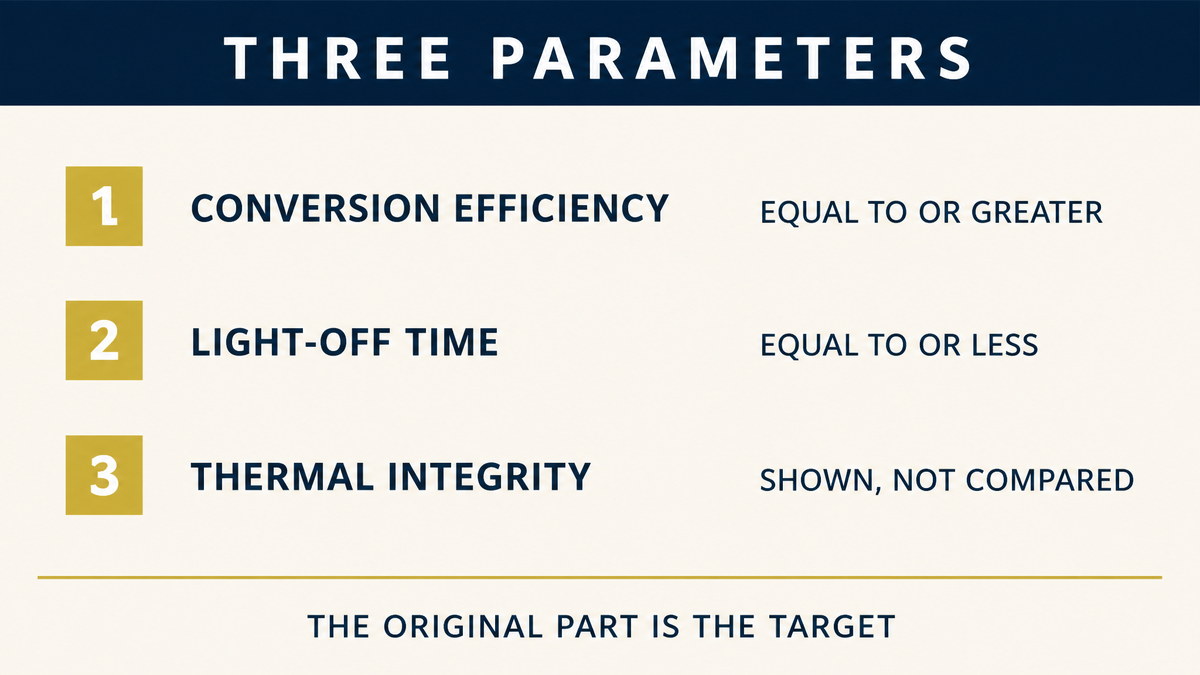
The gas conditions are fixed in a table rather than left to the laboratory: carbon monoxide between 1.0 and 2.5 per cent, oxygen at least 1.5 times the CO figure, hydrogen no more than 0.33 times it, total hydrocarbons between 500 and 2,000 parts per million by volume on a methane calibration, and an inlet gas temperature of 650 to 850 °F. Two converters tested under different feeds are not being compared at all, which is why a report has to carry the feed gas with the result.
One more number decides whether a bench run covers a catalogue. The LOT test flow has to sit between 0.10 and 0.40 times the peak air flow, and the peak air flow is defined as the maximum engine intake mass air flow during the 195 to 202 second interval of the Federal Test Procedure. A generic converter claiming forty applications is therefore tested at the greatest of forty peaks. That single sentence is the difference between a certified range and a wish.
4. The Label Is Five Words and a Name
85.2119 is short, and it is the section a buyer can check on the box before opening it. Each certified part must carry the words "Certified to EPA Standards" and the name of the aftermarket part manufacturer, or of the party designated to determine the validity of warranty claims. Both have to be durable and readable for at least the useful life mileage interval of the part — not until the carton opens, and not a sticker that lifts at the first heat cycle.
The regulation allows a way out of the long form, and it is narrower than it looks. Instead of the name and the statement, the part may carry unique identification markings — but the description of the marking, and a statement that it stands in place of the name, has to be given to the Agency in the notification of intent to certify. And one prohibition follows immediately: the unique symbol shall not be used on any uncertified or decertified part built or assembled after the date of decertification. A logo is not a substitute for certification unless it has been declared as one.
The packaging carries five items, and they are the ones a purchaser can read without a bench:
- The statement "Certified by (name of manufacturer or warranter) to EPA Emission Standards".
- A list of the vehicles or engines for which the part is certified.
- A maintenance or replacement interval, if it is shorter than the interval in the original equipment instructions.
- A description of any maintenance the part needs that the original did not.
- Installation instructions, if they differ from the vehicle manufacturer's.
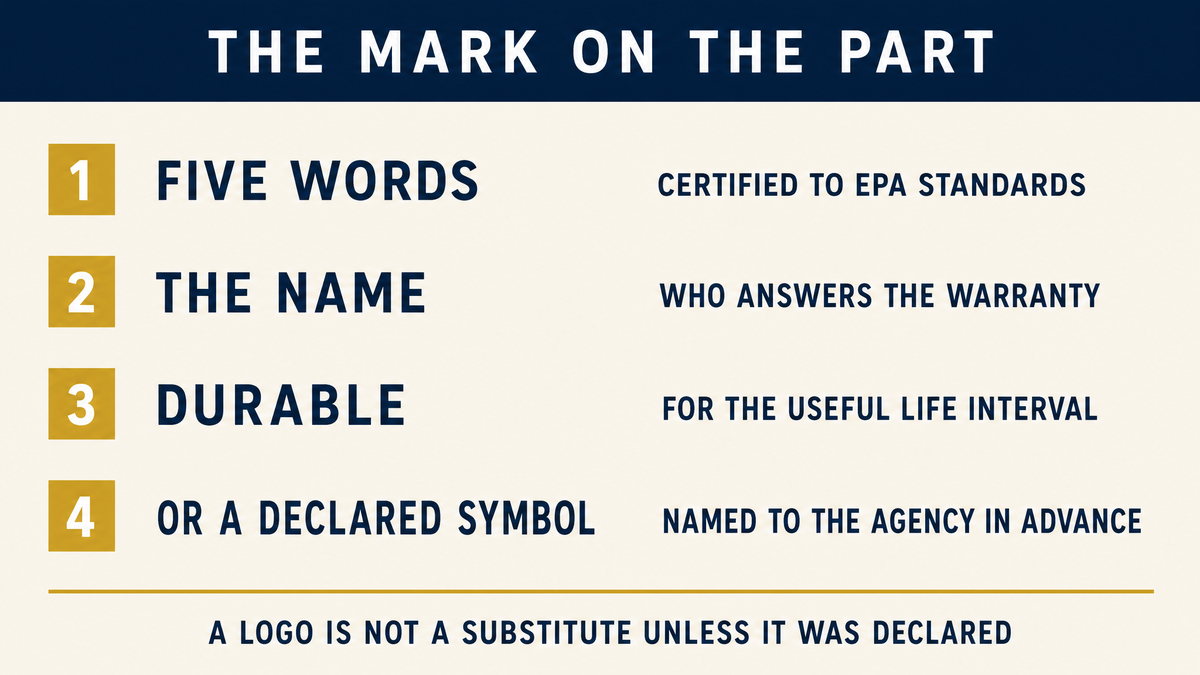
Two of those items may move. The maintenance and installation notes can sit on a written insert, provided the insert also carries the statement, the vehicle list and the interval; and the vehicle list alone may live in a catalogue, provided access to it is readily available to purchasers and installers. Everything else has to be on the package.
There is even a provision for stock already in the field. Under 85.2119(f) a manufacturer may certify existing in-service stock, provided the part does not differ in any operational or durability characteristic from the parts named in its notification, and a supplemental information sheet is made available to everyone selling it. That is the clause that makes a mid-season certification possible — and the clause that makes a sudden relabelling of old stock visible.
5. Who Counts as the Manufacturer
The duty follows the name, not the factory, and the definition is wider than most buyers assume. Under 85.2113 an aftermarket part manufacturer is any of four things: a manufacturer of an aftermarket part; a party that markets aftermarket parts under its own brand name; a rebuilder of original equipment or aftermarket parts; or a party that licenses others to sell its parts.
Read the second and fourth together and the practical consequence is plain. If you buy converters in a container and sell them under your own brand, the certification obligation does not belong to the factory that welded the can. It belongs to whoever put the name on the part — and the label on the box has to name the party designated to determine warranty claims, which may or may not be the same company.
This is the point at which a private-label buyer discovers what they have actually bought. A factory that will happily print your logo on a can, without a notification of intent behind it and without a bench comparison to the original part, is offering you a product that carries a name with nothing underneath it. The label is five words; the five words are a claim about a test, and the test is a comparison to a part that left the production line years ago.
6. What the Price Difference Buys
Two converters for the same car, one at half the price of the other, differ in five places. None of them is visible from outside the can, and all of them show up in the bench comparison the regulation asks for.
The substrate. A ceramic honeycomb and a metallic one are different products with different thermal behaviour. Inside either, the cell density and the wall thickness decide how much surface the gas meets and how quickly the part heats — and heat is light-off. The washcoat. The layer that carries the catalyst has a loading, and the loading is where most of the material cost sits, because it holds the platinum-group metals: platinum, palladium and rhodium. A quotation that names the substrate and not the loading has named the cheap half.
The precious-metal loading itself. This is the line item a buyer usually cannot see and a supplier usually will not itemise. It is also the first thing removed to hit a price, because removing it changes nothing in a photograph and nothing in a cold start, and everything in the aged comparison eighteen months later. The canning. The mat that holds the substrate, the insulation, the welds and the end cones decide whether the part survives thermal cycling or the substrate breaks up inside a can that still looks perfect.
The durability run. The aged half of the comparison is not free. Somebody has to run the ageing cycle and then repeat the efficiency and light-off tests, and that work does not appear in a unit price unless it was done. This is the same two-price technique as every other row in the series, and here it has a sharper edge than usual: ask for the unit price as quoted, and the price with the substrate, the washcoat loading and the aged comparison named in writing. The gap is the design cost, and on a converter it is smaller than the difference between a certified part and an uncertified one.
7. What the Record Cannot See
Method first, unchanged. The federal recall file holds 245,845 records across 15,305 campaigns, has no header row, and every field is scanned. Controls: brake 28,639, air bag 16,162. Twenty-five terms were counted, and one of them was a control rather than a subject.
Seven of the twenty-five came back at zero, and the seven are the words that describe this product.
| Term | Records | Campaigns | What it is |
|---|---|---|---|
converter | 699 | 81 | the word, shared with another part |
torque | 2,253 | 279 | the other part that owns the word |
catalyst | 297 | 48 | the material, not the part |
catalytic | 142 | 15 | the adjective that names it |
platinum | 694 | 22 | the metal inside the washcoat |
palladium | 2 | 1 | the second metal |
honeycomb | 36 | 1 | the shape of the substrate |
substrate | 0 | 0 | the part body |
washcoat | 0 | 0 | what carries the metal |
monolith | 0 | 0 | the industry word for it |
rhodium | 0 | 0 | the third metal |
light-off | 0 | 0 | one of the three certified parameters |
tampering | 0 | 0 | removing or defeating emission controls |
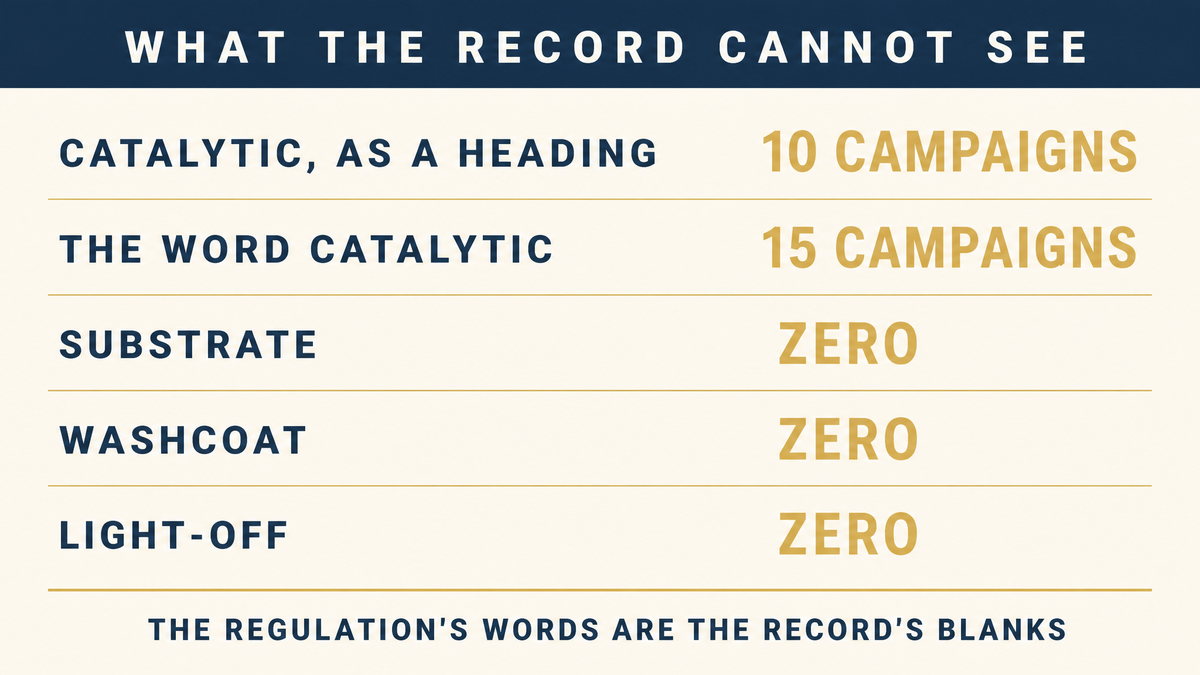
The heading barely exists. Component headings containing the word are almost nothing: EMISSION CONTROL:CATALYTIC accounts for 10 campaigns, against 1,684 for the headlamp heading and 125 for the crankcase emission heading. The converter is a part the federal government writes an entire subpart about and the recall file hardly names.
And the word itself is borrowed. torque appears in 2,253 records across 279 campaigns; converter in 699 across 81. In this file, "converter" is mostly a torque converter, so even a search for the part returns mostly the transmission. That is a different kind of silence from the water pump: not a missing heading, but a shared word that makes the heading less useful than it looks.
What the record does see is the aftermath. overheating 1,602 records, melted 261, plugged 256, poisoning 124. Those are the ways a converter dies, described in the vocabulary of a driver and a service writer. Meanwhile light-off, the parameter the certification turns on, appears in no record at all.
The finding. Across this series the pattern has been that the record counts what breaks and not what must be said. Here it goes one step further: the more precisely a product is defined in law, the less the record has to say about it. Four pages of definitions, three named parameters, two inequalities and a numbered test table produce a part that the field data describes only as "melted" or "plugged". Which is why, for this category, the comparison on the bench is not one piece of evidence among many. It is the only one there is.
8. Seven Questions a Converter Quote Should Answer
A quotation in this category usually arrives as a photo, a fitment list and a price per unit. The seven questions below decide whether that fitment list is a certification or a guess, and six of them can be answered from a notification and a bench report.
- Which configurations, and what is the greatest peak air flow among them? The certification covers a set of vehicle or engine configurations, and the bench has to reach the hardest one. Ask for the set and the highest flow in it.
- What was it compared against? An original equipment converter, or a previously certified aftermarket part. Equivalence runs down a chain, and the answer tells you which link this unit sits on.
- Both runs, fresh and aged? An efficiency figure without an ageing cycle describes a new part, and no vehicle spends its life with a new part.
- What is the light-off time against the original? Equal or less, at an ambient of 68 to 86 °F to 50 per cent conversion. An efficiency number without a light-off number describes half the part.
- What exactly is marked on the part, and in whose name? The words Certified to EPA Standards and the manufacturer or the party designated to decide warranty claims, durable for the useful life interval — or a declared unique marking.
- What is on the package? The five statements, in particular the vehicle list and whether the replacement interval is shorter than the original equipment instruction.
- What does the better-specified unit cost? Substrate, washcoat loading and the aged comparison named in writing, priced beside the quoted unit. The gap is the design cost.
9. Six Lines to Put in the Order
Six lines cover a part whose specification is another product. Each one is something a factory or a brand owner can answer in writing before a container is loaded.
- The configuration list and its greatest peak air flow. The set of vehicles or engines the unit is certified for, and the highest flow among them. Without it, the bench result covers nothing.
- The part it is compared against. Original equipment, or a previously certified aftermarket unit — named, not implied.
- Conversion efficiency, fresh and aged, with the feed gas. Carbon monoxide, oxygen, hydrogen, hydrocarbon level and inlet temperature, because a result without the feed is not a comparison.
- Light-off time, fresh and aged. Equal to or less than the original, at the stated ambient, to 50 per cent conversion.
- The marking and the package. The statement, the name, the durability claim, the vehicle list and the interval — on the part and on the box, in the places the subpart names.
- Two prices. As quoted, and with the substrate, the washcoat loading and the aged comparison named. The difference is the design cost, isolated from labour and freight.
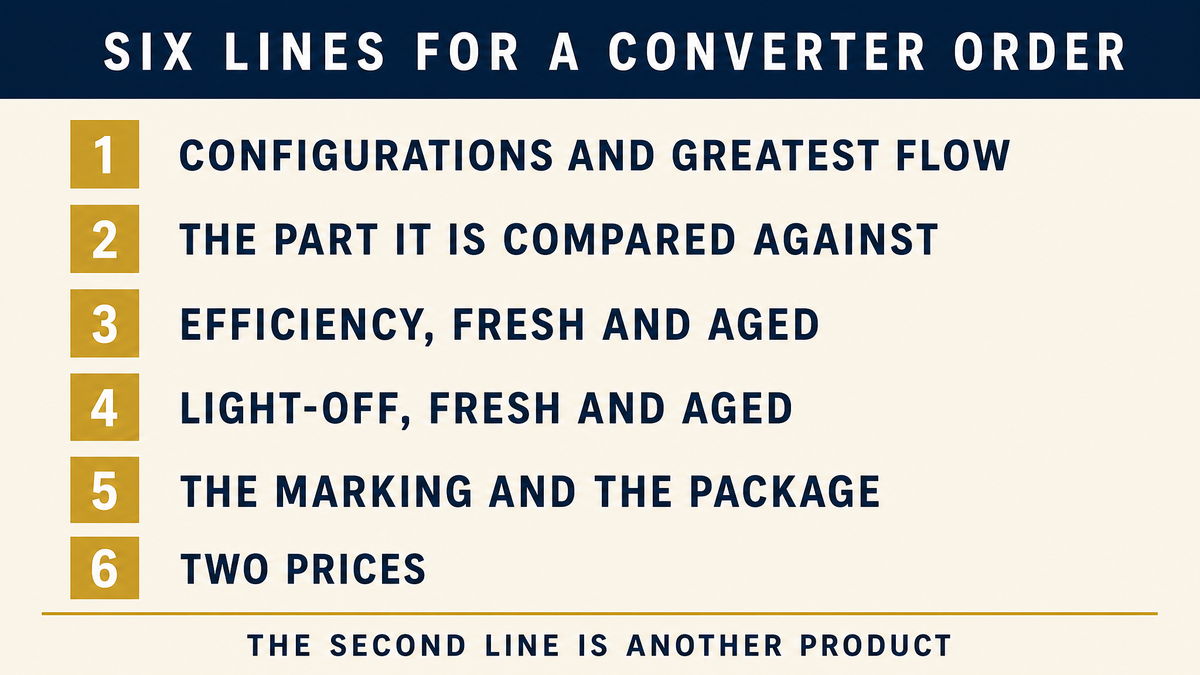
Line five is the only one a purchaser can check without asking for anything, and it is worth doing before the technical questions. A carton that names the certification, the vehicles and the interval, with the same name on the part inside, is a carton that came from a notification of intent. A carton that names none of them has a price advantage which is really the cost of a test nobody ran.
Two of the six lines sit outside the converter itself. A bench comparison is only evidence if the audit that reads it knows which page matters, and how an audit reads a laboratory report is where a claimed result becomes a fact. The other is the carton: a coated substrate that arrives with the mat crushed has lost the clearance that keeps it alive, and the pre-shipment checklist is where that is settled — with how the packed volume decides the freight worth pricing at the same time, because a converter is mostly air and a pallet of them is mostly not.
Frequently Asked Questions
Is there a federal efficiency figure a converter has to reach?
No. Under 85.2114 a replacement part can be certified on emission-critical parameters only if those parameters are equivalent to the original equipment part, or to the previously certified part, that it replaces. Appendix I turns equivalence into two inequalities: conversion efficiency equal to or greater than the original, light-off time equal to or less than it, both fresh and aged. The number you are aiming at belongs to the car the part is going on.
What does "Certified to EPA Standards" actually mean?
It is a statement the aftermarket part manufacturer makes under Subpart V, not a certificate issued by the Agency. The manufacturer notifies EPA of its intent to certify, EPA may object or later decertify, and the part must carry the statement and the name durably for the useful life interval. Anyone who markets the part under their own brand is a manufacturer for this purpose, so the name on the box is the party that made the claim.
Can one converter be sold for many different cars?
Yes, if the bench represents the hardest of them. Appendix I requires the test flow to be not less than the peak air flow of the configurations being certified, and where a generic converter covers several applications, the greatest peak air flow is the one that counts. A generic unit tested on the smallest engine in its fitment list has not been certified for the largest.
Does a converter taken from a scrap car need certification?
No — it is original equipment, not an aftermarket part, and the subpart applies to parts offered for sale for installation after the vehicle left the production line. What does need care is the difference between a used original and a rebuilt one: a rebuilder is expressly included in the definition of an aftermarket part manufacturer, so a rebuilt unit sold as a replacement sits inside the programme.
What is light-off time, and why does it matter more than efficiency?
It is the time a converter needs, starting from an ambient of 68 to 86 °F, to convert 50 per cent of the incoming hydrocarbon and carbon monoxide. Most of a trip's emissions happen in the first two minutes, before the part is hot, so a converter that matches the original when warm and lags it when cold is worse in use than its efficiency figure suggests. The regulation measures both because one without the other describes half a part.
Why do converters fail after a year or two?
The record names the ways: overheating 1,602 records, melted 261, plugged 256, poisoning 124. All four are downstream of something else — a misfire, a rich mixture, coolant or oil burning — and all four shorten the life of a part whose durability was supposed to be shown on an aged bench. That is why the aged half of the comparison matters: a unit that only passed fresh has been shown to work on the day it was made.
A replacement converter is not judged on its own merits. It is judged against the converter it replaces, on a set of inequalities a laboratory applies to both. Being efficient is not the test; being no worse than the original on the measured points is.
Which is why the question to a factory is not whether the part is approved but what it was compared against, on which cycle, and with what result. A sheet without those three answers describes a part rather than a performance.
How Equivalent Is Measured, Stated Plainly
We return the test basis behind the equivalence claim, the label text, and the party that signs as manufacturer in your market.
Draft My Equivalence Note
Questions & Comments
We read every one and reply within 24 hoursA catalytic converter certificate without a reference part beside it describes a part rather than a performance. Send the sheet, and we will tell you what it is missing.