
Car Parts Manufacturer: Which Document Governs the Part
 ·
Updated October 22, 2026
·
12 min read
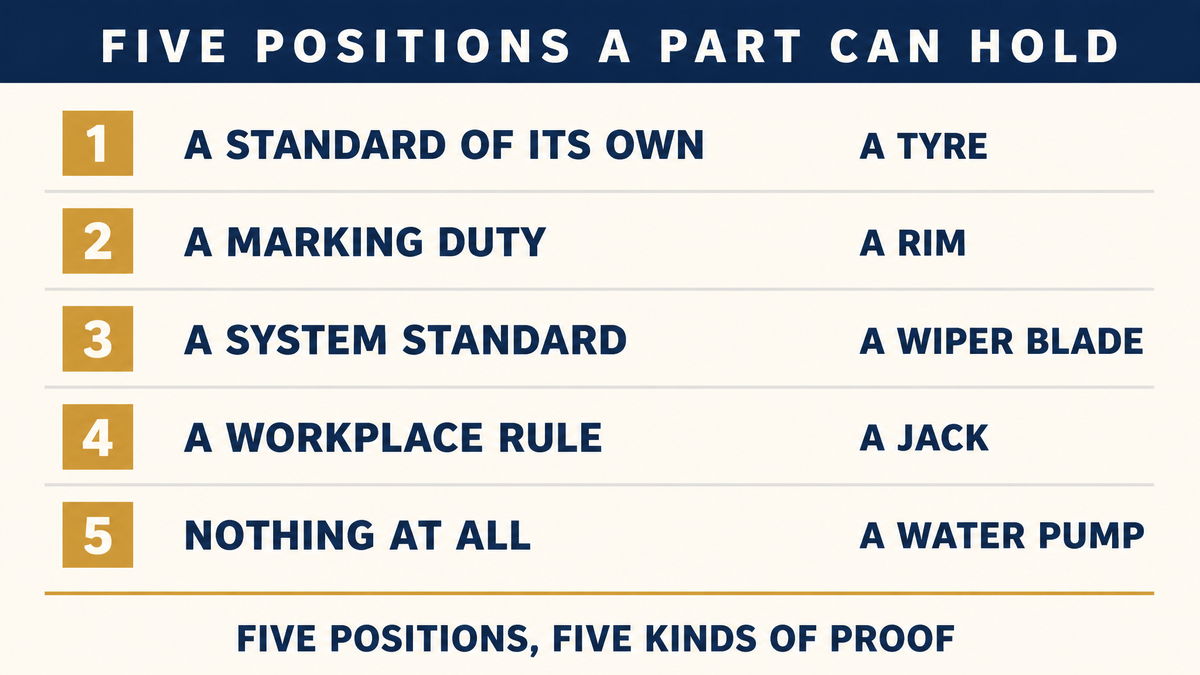
Fifty-two articles on this site have now read the federal text behind one product family at a time, and the exercise produced something more useful than any single one of them: a map. Every car part sits in one of five positions, and the position tells you what a supplier has to be able to show you before you order. A tyre carries a standard of its own. A rim carries a marking duty inside a vehicle standard. A wiper blade answers to a system standard that can never name it. A jack answers to a workplace rule with a stamp in it. A water pump answers to nothing at all. Ask which position a part occupies and the rest of the conversation changes — because a trader can talk about quality for an hour, and only a factory can name the document.
1. The Question Behind Every Quote
Most sourcing conversations start with a price and a specification sheet. The question that decides whether the sheet means anything comes earlier and is much shorter: what governs this part? Not in the sense of quality, and not in the sense of the customer's expectations, but in the plain sense of which document, if any, tells anybody what the product has to do.
The answer is not the same across a car. Read enough of the federal text and five positions emerge, and each of them implies a different kind of evidence.
That is why the map is worth carrying into any category you have not bought before. It tells you what to ask for in the first message, and it tells you when a supplier's answer has nowhere to go. A factory that has built the same part for a decade can name its document in one sentence. A trader who has sold it for a decade can describe its quality in ten.
2. Five Positions a Part Can Hold
1. A standard of its own. A tyre is the cleanest case in the whole catalogue: seven items moulded into both sidewalls, an identification number with a plant code and a date, and in the modern rule four markings on each wall and five on one. Nothing has to be obtained from a third party, because the specification is on the product. Evidence to ask for: a photograph of the sidewall, and a date code you can read.
2. A marking duty inside a vehicle standard. A rim has no standard of its own, but the vehicle standards that govern rims place a duty on the rim maker: the marking, the items, the letter height, the depth. The number that decides the fitment belongs to a tyre maker's published listing rather than to the wheel. Evidence to ask for: the marking as it appears on a production piece, and the published listing the dimension was checked against.
3. A system standard that never names the part. A wiper blade is governed by a standard written about the vehicle's wiping and washing system. The blade is what makes contact with the glass, and the clause never says the word. Evidence to ask for: a fitment list, a length in millimetres, and a wet check on a named vehicle.
4. A workplace rule addressed to the operator. A jack, a tire changer and a fire extinguisher are not governed by the vehicle code at all. The text that reaches them is written for the person using them: a rated load that has to be stamped, a danger zone a body must not enter, a rating earned in a fire test. Evidence to ask for: the marking and its method, the guard and the cycle it covers, the test result on the label.
5. Nothing at all. A water pump answers to none of it. No marking duty, no listing, no workplace rule, and no component heading in the recall file. Evidence to ask for: a bench report you commissioned yourself, because nobody else will require one.
Two families sit between the fourth and fifth positions and are worth naming, because they are the easiest to misread. A cargo net is governed by an arithmetic rule: a working load limit that counts for half or all of itself depending on how it is routed, and a quarter of its strength if nobody marked it. A motorcycle exhaust is governed by a printed sentence: a label whose wording is prescribed down to the models the system may be fitted to. In both, the document is not a standard the part must pass. It is a statement the seller has to make, and the buyer's job is to check that the statement is true.
3. The Tests That Travel
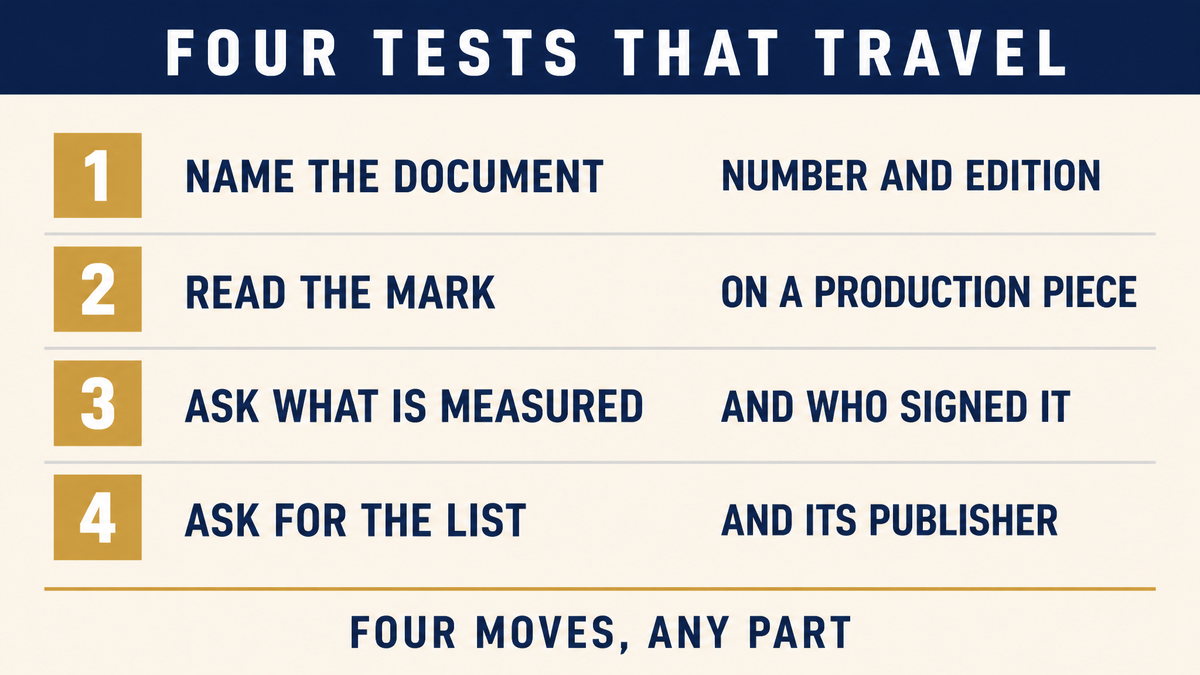
Because the five positions differ, the evidence differs, and that is the practical value of the map. Four moves work on any of them, and they cost a buyer one message each.
Name the document. Ask which standard governs the part, by number and edition. A tyre has a marking rule with a paragraph number; a rim has a marking duty inside a vehicle standard; a jack has a workplace clause; a fire extinguisher has a test. A supplier who answers with a document number has a factory behind the answer. A supplier who answers with the word certified has not answered, because certification is a consequence of a document rather than a substitute for one.
Read the mark on a production piece. Every position on the map except the fifth leaves something to read: a sidewall, a cast rating, a laboratory mark, a printed sentence. Ask for a photograph of the mark on a sample that came off the line, not a rendering of the product. The photograph tells you four things at once — whether the mark exists, whether it is legible, where it sits and whether the factory knows which one you mean.
Ask what is measured, and by whom. Where the document is a test, the question is not whether the part was tested but what the test measured and who signed it. A fire rating, a burst pressure, a hot run, a flow curve: each is a number with a method behind it, and a report without a signature is a claim with a table around it.
Ask for the fitment list, and where it is published. If a part fits some vehicles and not others, the list is part of the specification, and the publisher matters. A fitment list published by the vehicle maker, a tyre maker or the supplier himself carries different weight, and the difference is the whole argument in the wiper, wheel and exhaust articles this site has already published.
4. What a Trader Cannot Answer
The distinction between a factory and a trading company is not a moral one. Both are legitimate, and a good trader is worth more than a mediocre factory. What a trader cannot do is answer four specific questions, because the answers live on the production floor and in the paperwork behind it.
The plant code. On a tyre it is three symbols assigned by the agency. On other parts it is a factory name, a line number, a mould number or an address on a certificate. Wherever it lives, it names a place, and a trader sells from a place he does not own.
The edition and the clause. Not the standard — the edition of it, and the clause the part is built to. A standard with three editions in the field is three documents, and a quotation that names one is a quotation a factory can be held to.
The drawing. Dimensions that never appear on a product photograph: a pulley diameter and an offset, a marking position measured from a bead, a machining tolerance on a gasket face. A trader forwards a picture. A factory sends a drawing with those numbers on it.
The signed report. A bench test with a date, a method and a signature. This is the one that ends most conversations, because it cannot be improvised in a chat window and it cannot be borrowed from another model.
Put those four side by side and the pattern is simple. A trader answers with adjectives. A factory answers with nouns. The words professional, reliable and strict QC have no place to go. A plant code, an edition number, a drawing and a signature do.
5. What the Record Cannot Tell You
The obvious shortcut for a buyer is the recall file: a quarter of a million records of what went wrong with vehicles. This site has now scanned 245,845 records with 25 terms at a time across ten product families, and the results are consistent enough to state as a rule.
In the tyre family, the largest component heading in the entire series is TIRES:MARKINGS at 19,461 campaigns — the file counts the writing on the product more heavily than any other component. In the cooling family, the word pump appears 11,978 times and almost all of it is fuel pumps, while cavitation, weep and boil appear zero times. In the tire-changer family, changer, changers, balancer and demount are four zeros in a quarter of a million rows.
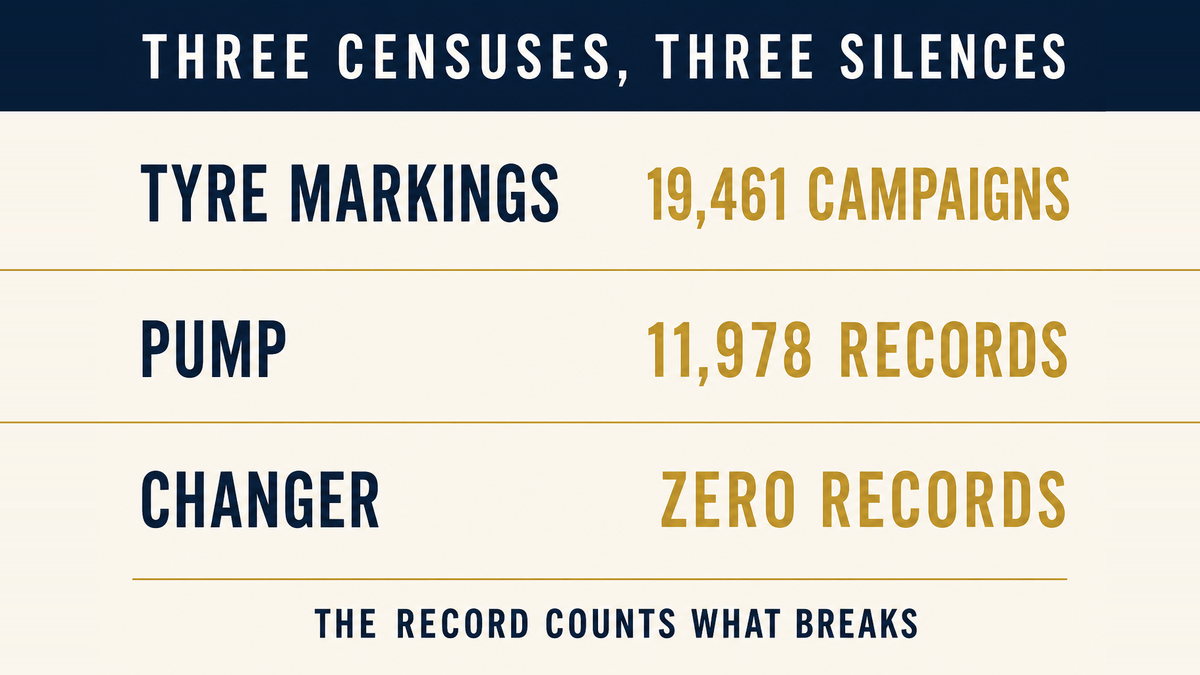
Read together, those three results say something a buyer can act on. The record counts what breaks, and it counts it in the vocabulary of the system that failed. It does not count what must be said about a product before it ships, and it does not carry the words a workshop uses for a part that is merely bad. So a recall search can tell you whether a model has a history. It cannot tell you which document governs the part, whether the marking is in the right place, or what the seal does at temperature.
6. Where the Price Difference Comes From
Two quotations for the same part number, thirty per cent apart, are almost never the same product. Across the families this site has now read, the gap sits in five places, and none of them is the labour rate.
The material. Cast or stamped, stainless or mild steel, virgin or regrind. The worn component. Every part has one: a seal in a pump, a rubber strip on a blade, a fibre packing in a muffler. It is the cheapest item in the bill and the one that decides the warranty. The tolerance. A machined face that is checked costs more than a cast face that is brushed. The test. Somebody has to run it and sign it, and that is a line item. The paperwork. A label that is stitched rather than printed, a sheet at two point sizes, a marking moulded into a tool — all of it is cost, and all of it is invisible in a price.
There is one technique that turns this list into a negotiation. Ask the same supplier to price the part twice: once exactly as quoted, and once with the better material, the better worn component and the checked tolerance. The difference is the cost of the design, isolated from labour, packaging and freight. It is almost always smaller than buyers expect, and it is the single most useful number in a sourcing conversation.
7. How to Place a Part You Have Never Bought
A map is only useful if you can find your position on it. The four steps below take a part you have never sourced and land it in one of the five positions, in order, without reading the whole code. Each step is a search, and each one either answers the question or tells you to move on.
Step one: search the function, not the product name. The vehicle standards are written about what a system does to the vehicle, so the part's own name is often absent from the clause that governs it. A wiper blade is the clearest case: the rule covers the wiping and washing system, defines the swept area and the frequency, and never uses the word blade. Search for the verb and the noun of the system — wiping, washing, braking, lighting — and you will find the clause. Search for the part and you will conclude, wrongly, that none exists.
Step two: look for a sentence addressed to the maker. Some parts have no performance standard of their own and are still governed, because a vehicle standard tells the manufacturer of that part to put something on it. A wheel is the example this series used: the vehicle standards that control wheels fix the marking, the items to be marked, the letter height and the depth of the impression, and none of that is a test of the wheel. When you find a duty like that, the part is in the second position, and the evidence you want is a photograph of the mark on a production piece rather than a test report.
Step three: ask who is holding the part. If the vehicle code is silent, the rule that reaches the product is often written for the person who uses it at work. A jack carries a rated load that has to be marked; a tire changer sits behind a guard and a set of operating limits; a fire extinguisher is a workplace article whose label records a rating earned in a fire test. All three are addressed to an employer and an operator, not to a vehicle. That changes what you ask for: the marking and its method, the guard and the cycle it covers, the test result printed on the label.
Step four: if all three are silent, the document does not exist. A water pump answers to no marking duty, no vehicle standard, no listing and no workplace rule. There is no clause to find because no agency has written one. At that point the exercise changes shape: instead of reading a document you commission one, and the only place it can live is the order and a signed bench report.
One warning about the method. The position belongs to the thing being regulated, not to the product category, and the same object can sit in two places depending on what is being asked. A tyre is a position-one product, because its specification is moulded into its sidewalls. The machine that mounts that tyre is a position-four article, because the rule that reaches it is about a person's hands. This is why the two questions — what governs this part and what governs the work around it — have to be asked separately, and why a supplier who builds a perfect tyre can still ship a machine with no guard on it.
8. The Map, With Names On It
Here is the whole catalogue, sorted by position. Every family in the list was read for this series, and the document named against it is the one that actually governs the product rather than the one most often quoted in a brochure.
| Position | The document | Families in this series |
|---|---|---|
| 1. A standard of its own | 49 CFR 571.109, 571.139 and the identification rule at 574.5 | Tyres, bias and radial. Seven items on both sidewalls in the older rule; four on each wall and five on one in the modern one, plus a thirteen-symbol identification number |
| 2. A marking duty | 49 CFR 571.110 and 571.120, marking sections | Wheels and rims. No performance standard of their own, but a duty that fixes the items, the letter height and the depth of the impression |
| 3. A system standard | 49 CFR 571.104 | Wiper blades. The rule governs the wiping and washing system, sets the swept area and the frequency, and never names the blade |
| 4. A workplace rule | 29 CFR 1910.244, 1910.212, 1910.157 | Jacks, tire changers and fire extinguishers. Addressed to the operator: a marked rated load, a guard and its cycle, a rating earned in a fire test |
| Between 4 and 5 | 49 CFR 393.104 and 393.106; 40 CFR 205.169 to 205.174 | Cargo nets, where the rule is arithmetic — a working load limit that counts for half or all of itself, and a quarter of its strength if nobody marked it. Motorcycle exhausts, where the rule is a printed sentence |
| 5. Nothing at all | — | Water pumps. No mark, no rating, no listing, no workplace rule, and no component heading in the recall file |
Read down the middle column and the pattern is hard to miss. The further a part sits from a document of its own, the more of the specification has to be written by the buyer, and the more the evidence has to be manufactured rather than collected. In the first position you photograph what the factory already moulded. In the fifth you write the test, pay for it and read the report.
Every family named above has its own article in the Auto Part Products category, with the clause numbers, the census figures and the questions to send, family by family. What follows is the part that applies to all of them at once.
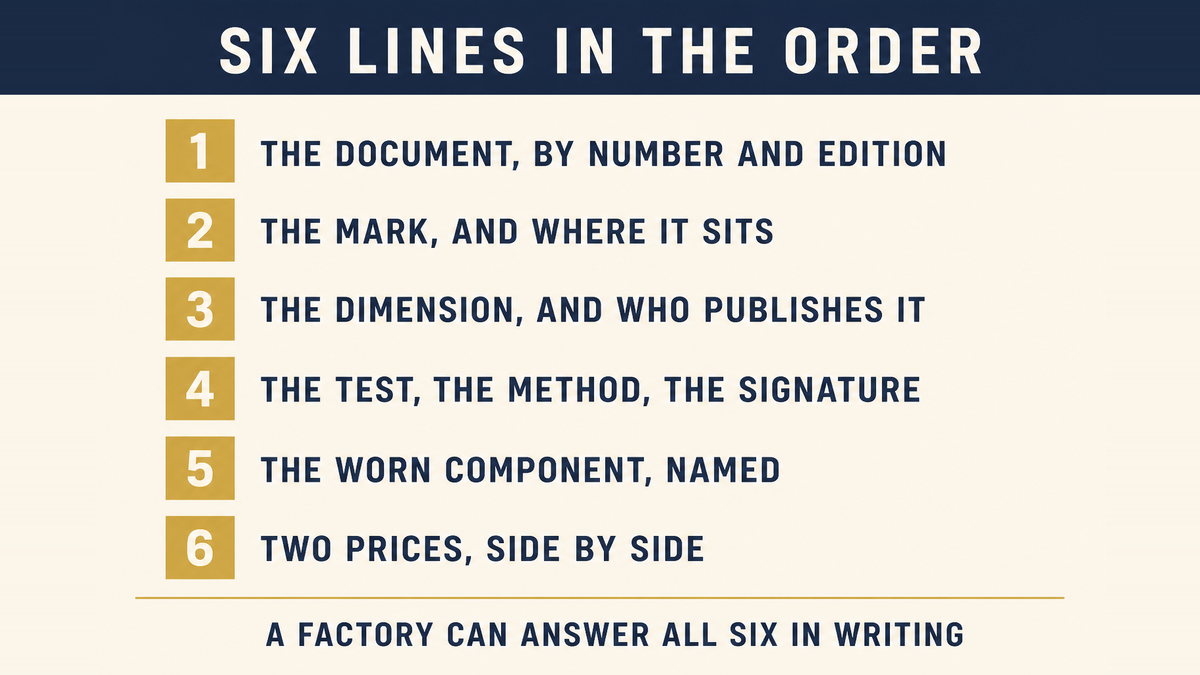
9. Six Lines to Put in the Order
Whatever position a part holds, the order document is where a specification stops being a conversation. Six lines cover the whole map, and every one of them is something a factory can answer in writing before a sample is made.
- The document, by number and edition. Not the standard — the edition. A rule with three editions in the field is three documents, and the one in the quotation is the one you can hold a supplier to.
- The mark, and where it sits. The content, the letter height and the position on the part. A mark in the wrong place is not a mark, and a photograph of a production piece is the only proof that survives a container.
- The dimension that decides fitment, and who publishes the list. A bead seat, an offset, a blade length, a pulley diameter. If the number comes from a listing rather than from a test, name the publisher, because a list published by the seller is a claim and a list published by a vehicle maker is a fact.
- The test, the method and the signature. Which property, measured how, at what temperature, and who signed the page. A report without a signature is a table with a claim around it.
- The worn component, named. Every part has one: a seal, a rubber strip, a fibre packing, a friction material. It is the cheapest item in the bill and the one that decides the warranty.
- Two prices, side by side. Once as quoted, once with the better material, the better worn component and the checked tolerance. The difference is the design cost, isolated from labour, packaging and freight, and it is usually smaller than buyers expect.
There is a reason to keep the list short. A specification with forty lines gets negotiated line by line and ends up with twenty; a specification with six gets answered. What makes the six work is that each one produces a noun — a number, a photograph, a signature, a price — and nouns can be checked, while adjectives cannot. That is the whole difference between the two kinds of supplier this series has described, and it is the only test that works in every position on the map, including the one where no document exists.
Two of the six lines live outside the part itself. A bench report is only evidence if the audit that reads it is looking at the right page, and how an audit reads a report is where a claimed test becomes a fact. The other is the carton: a marked part that arrives with the mark worn off a machined face is a part that fails at the port, and the pre-shipment checklist is where that is settled, with how the packed volume decides the freight worth pricing at the same moment, because a container of castings is heavier than it looks.
Frequently Asked Questions
Is there one document that governs every car part?
No, and that is the point of the map. A tyre is governed by a standard of its own, a wheel by a marking duty inside a vehicle standard, a wiper blade by a system standard that never names it, a jack and a tire changer and an extinguisher by workplace rules, and a water pump by nothing at all. Five positions, five kinds of evidence, and a buyer who assumes one position for everything will ask the wrong question in four of them.
What is the difference between a standard and a marking duty?
A standard says what the part has to do: how much it must hold, how far it must stop, how long it must run. A marking duty says what the maker has to put on the part, in what size and where. A wheel is the clean example — it has no performance standard of its own, and it is still governed, because the vehicle standards that control wheels tell the maker what to mould into the rim and how deep. So the evidence you want is a photograph of the mark, not a test report.
Can a supplier's certificate replace the document?
A certificate is issued against a document, so it cannot stand in for one. Ask for the document number and its edition first, then for the certificate that names both. A certificate with no document number on it is a letterhead with a seal on it, and it tells you nothing about which clause was applied, which revision, or which factory the audit actually visited.
Why is a recall search not enough to check a supplier?
Because the file counts what breaks, not what must be said. Across 245,845 records, the largest component heading in the whole series is tyre markings at 19,461 campaigns — the writing on a product, counted more heavily than any mechanical failure. The word pump appears 11,978 times and almost all of it is fuel pumps, while the three words for how a coolant pump fails come back at zero. And in the tire-changer family, changer, balancer and demount are four zeros in a quarter of a million rows. A recall search tells you whether a model has a history. It cannot tell you which document governs a part or what a seal does at temperature.
Which position on the map is hardest to buy from?
The fifth, because there is no external check at all. In the first four positions somebody else has already decided what the product must do, and your job is to read it. In the fifth position nobody has, so the specification, the test method and the acceptance limit all have to come from you, and the only evidence available is a report you paid for. The second position is the one most often misread: a wheel looks like a simple casting with no rule behind it, and the rule exists but is filed under the vehicle rather than under the wheel.
What should the first message to a new supplier contain?
Six lines and one request. The document by number and edition, the mark and where it sits, the dimension that decides fitment and who publishes the list, the test with its method and signature, the worn component named, and two prices. Then ask the supplier to reply with the document number before anything else. The reply tells you more than a factory tour: a factory answers with a number, an edition, a drawing and a signature, and a trader answers with adjectives.
The useful question for a buyer is not whether a part is regulated but which of five positions it occupies. A part can have its own standard, hide inside a vehicle standard, appear only as an inspection item, carry an operator duty, or have no document at all.
Position decides what a supplier can be asked to prove. A tyre and a water pump both ship by the container, and only one of them can answer a certificate request. Knowing which is which before the quotation arrives saves the argument after it.
What a Quote Should Arrive With
A cover note naming the standard invoked, the evidence attached, and the party that signs the declaration. One page, no prose.
Assemble My Quote Pack
Questions & Comments
We read every one and reply within 24 hoursCar parts fall into five regulatory positions, and the position decides what a supplier can prove. Send your category list, and we will place each line and the question to ask.