
Bushing Manufacturer: The Part That Is Supposed to Move
 ·
Updated October 22, 2026
·
11 min read
Every part in this series so far has had the same job: hold a position. A ball joint holds the knuckle. A tie rod holds the steering angle. A wheel holds the tyre. The bushing is the first part whose job is the opposite — it has to allow movement, in a controlled amount and in a controlled direction, and then stop.
That inversion is why the federal text about it is so thin, and why it is so easy to buy badly. A part that holds a position can be checked with a clearance. A part that allows movement has to be checked with a stiffness, and stiffness is not a word the regulation uses anywhere.
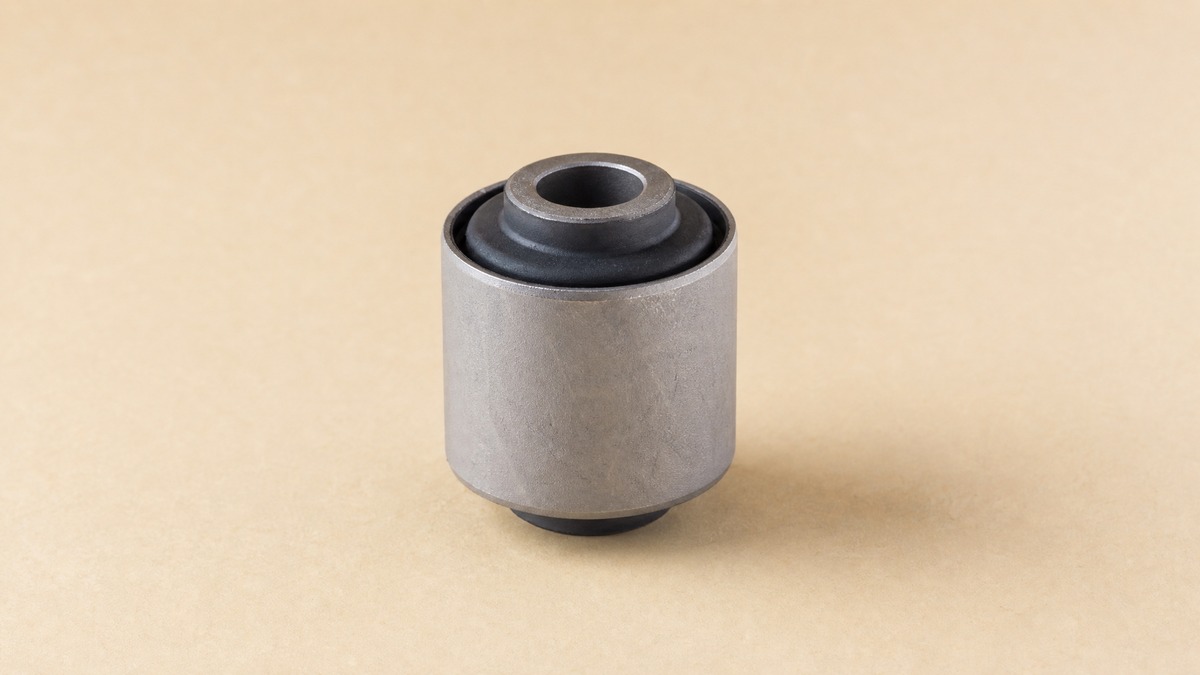
1. Three Conditions, One Seat
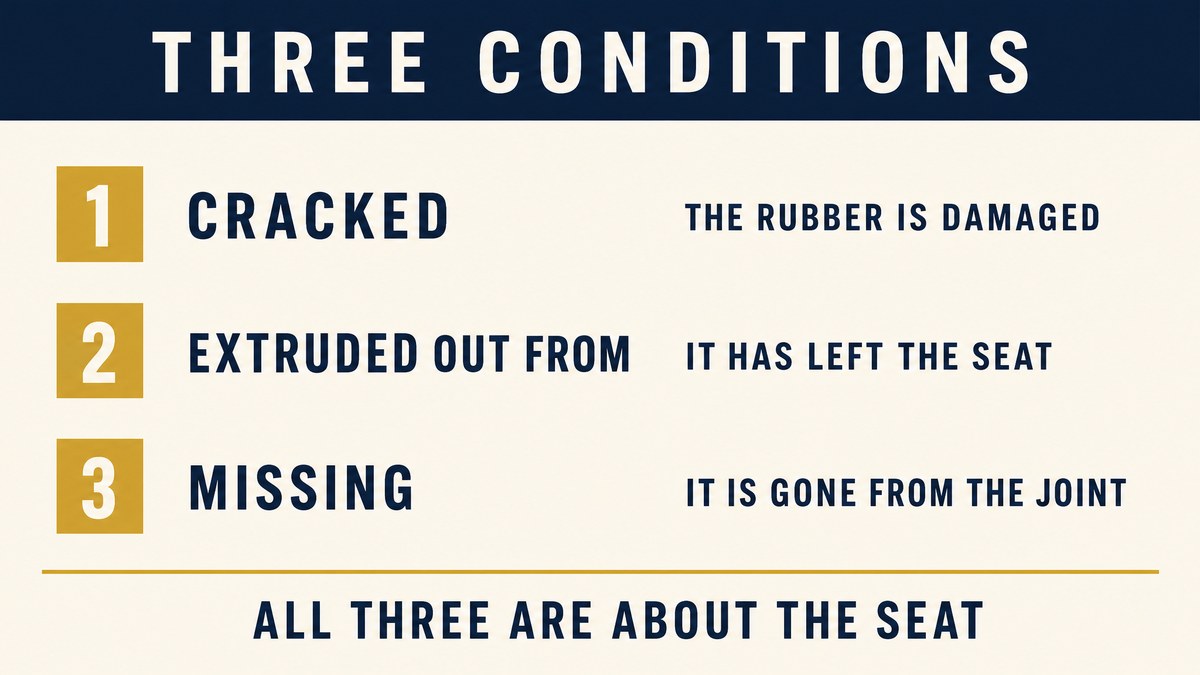
The sentence appears twice in Part 570, once for vehicles up to 10,000 pounds and once above it, and it is the whole of the federal text about the part: rubber bushings shall not be cracked, extruded out from or missing from suspension joints.
Three conditions, and they have something in common that is easy to miss. None of them is about the rubber’s stiffness, its age or its appearance. Each one describes the seat: the rubber is damaged (cracked), the rubber has left the seat (extruded out from), or the rubber is gone from the seat (missing). The regulation does not ask how well the bushing works. It asks whether it is still in the hole.
For a supplier, that is both narrower and more useful than it sounds. Narrower, because a bushing can be far outside the vehicle maker’s stiffness window and still pass every word of the clause. More useful, because the three conditions describe exactly what a cheap bushing does first: it loses its bond, walks out of the shell under load, and then there is nothing in the hole at all. A sectioned sample shows the bond in one cut, which is why it belongs on any factory audit for a rubber part.
2. A Part Whose Job Is to Move
Look at what a suspension bushing is asked to do and the specification problem appears immediately. It connects two parts that move relative to each other. It must transmit the loads that keep the geometry — cornering force, braking force — and it must not transmit the small, high-frequency movements that would otherwise reach the cabin as noise.
Those two requirements pull in opposite directions, and the answer is a window rather than a figure. Too soft, and the arm moves under load: alignment changes as you corner, and the tyre wears on one edge. Too hard, and every road input goes through: the cabin gets a harshness complaint, and the shell and the bond see higher peaks. The correct bushing is the one whose stiffness sits inside the window the vehicle maker chose, in all three directions, at the frequencies that matter.
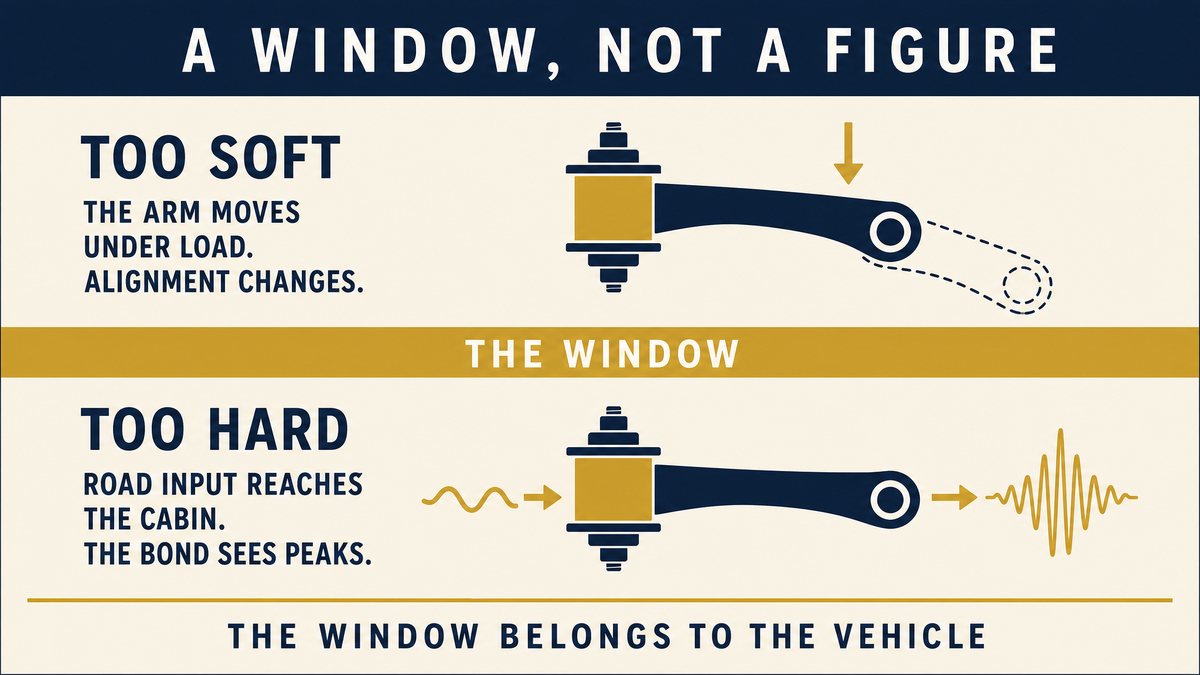
No federal document states that window for any vehicle. It exists in the vehicle maker’s drawing, in a durometer reading and a set of static and dynamic rates, and it is the only number that decides whether a replacement bushing is a replacement or a redesign.
A drawing for a bonded bushing usually carries four numbers, and the first one is the only one most quotations mention. Hardness is a material property measured on a flat sample; it says almost nothing about the rate of a shaped part.
| What the drawing asks for | What it means | Why one number is not enough |
|---|---|---|
| Durometer, Shore A | hardness of the compound | the same hardness in two shapes gives two rates |
| Static radial rate | force per millimetre at a stated load | set by the voids, not by the rubber |
| Dynamic to static ratio | how much stiffer it becomes when oscillating | the number ride and noise are tuned on |
| Torsional rate | resistance to twisting about the bore | the one that shows up as steering feel |
Rubber is also amplitude and frequency dependent. The same bushing is a soft spring for a small, fast input and a stiffer one for a large, slow input, which is exactly why it can isolate road noise and still locate the arm. A supplier who quotes a durometer and nothing else has quoted one point on a surface, and the point is not the one the vehicle was designed around.
3. What "Extruded Out From" Means
The middle condition is the interesting one, because it describes a failure that is specific to the way a bushing is built. The rubber element sits inside a steel shell, held either by a press fit, by a bonding agent applied during vulcanisation, or by both. Under axial load the rubber is pushed along the bore, and under radial load it is squeezed.
A bushing that is bonded properly and sized correctly takes those loads in compression and shear and stays put. One that is not walks: the rubber migrates toward the end of the shell, appears as a lip beyond the steel, and eventually separates. That is what an inspector is looking at when the clause says extruded out from — not a worn bushing, a bushing that has started to leave.
The clause is also the reason a shell dimension matters as much as a rubber one. If the shell is short, or the bore is off, or the bond was applied to a contaminated surface, the part fails the only federal sentence that exists for it, and it fails it while the rubber is still new.
4. Rubber, Polyurethane, and the Wrong Upgrade
The aftermarket’s favourite bushing story is that polyurethane is an upgrade. It is a different material with different properties, and whether it is an upgrade depends entirely on which side of the window it lands.
Polyurethane is generally harder for the same shape, resists oils and ozone better, and can be moulded in colours that sell. It also transmits more of what rubber absorbs, and it does not bond to a shell the same way — many polyurethane bushings are retained by a shoulder and a washer rather than a vulcanised bond, which changes what extruded out from looks like.
For a replacement part sold against an original, the question is not which material is better. It is whether the rate sits in the same window, and the honest answer is that a harder bushing never does: it is a different spring. That may be exactly what a track car wants and exactly what a warranty claim does not.
5. Where the Price Difference Comes From
Two bushings that press into the same hole differ in five places, and only one of them is visible.
The compound. Natural rubber, a blend, and a filled compound behave differently at minus thirty and at ninety degrees. The cheap version is usually the one that hardens first in cold, which is when the noise complaints arrive.
The bond. Vulcanised bonding to a prepared, primed shell is a process, not a step. A bond that is applied to a surface with release agent on it will look perfect and separate in service.
The shell. Wall thickness, bore tolerance and the surface finish inside the shell decide whether the rubber stays. A thin shell deforms under press-fit and loses the interference that holds the part. What happens to the part between the press and the fitting is the other half of the problem, and the packaging checklist covers compression set and storage.
The voids. The shaped gaps moulded into the rubber set the rate in each direction. Their size and position are the tuning, and they are the first thing a copy gets wrong.
The shoulder. The lip that stops the bushing walking out. On a bonded part it is belt and braces; on a retained part it is the whole retention.
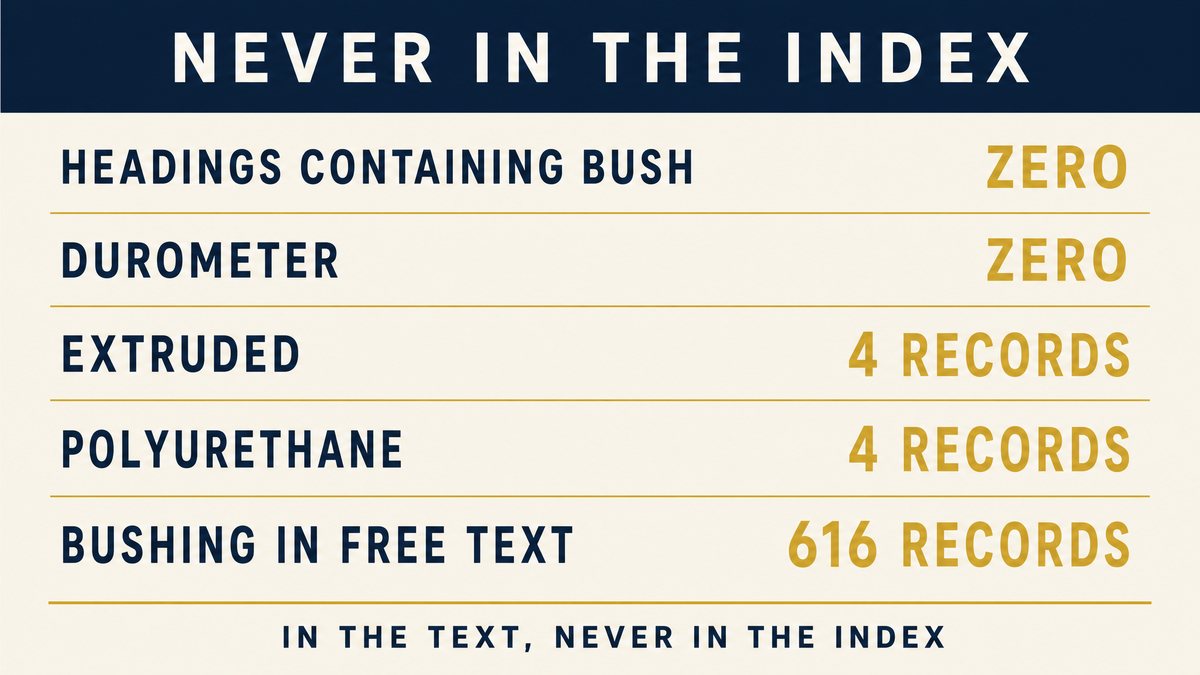
6. The Word Is in the Text and Never in the Index
Method unchanged. The federal recall file holds 245,845 records across 15,305 campaigns, no header row, every field scanned, twenty-five terms each with its own pattern. Controls: brake 28,639, air bag 16,162.
The part appears in the free text: bushing in 616 records across 43 campaigns. What it never appears in is the component index. A scan of every heading in the file for the string BUSH returns zero headings — there is no bushing column at all. The taxonomy files the part under the assembly it sits in, which is why the suspension headings are full of control arms and leaf springs and silent about the rubber between them.
| Term | Records | What it would have described |
|---|---|---|
| durometer | 0 | the only figure that specifies the part |
| squeak | 0 | the complaint |
| clunk | 0 | the complaint, louder |
| extruded | 4 | the failure the regulation names |
| polyurethane | 4 | the material half the aftermarket sells |
| void | 8 | the feature that sets the rate |
Three zeros and three near-zeros, and they are all the same kind of absence. The record can file a bushing’s symptoms under the assembly that contains it — a control arm campaign, a leaf spring campaign — but it has no vocabulary for the part itself: not the number that specifies it, not the two words a driver uses, not the failure mode the regulator chose, barely even the material.
The campaigns that do contain the word are a warning about word searches. The three largest are a Ford shift linkage covering 2,925,968 vehicles, a Ford automatic transmission lever covering 504,182 and a Dodge transmission lever covering 298,439 — all of them power-train bushings, none of them suspension. The word is shared with another system, exactly as belt is shared with seat belts and converter with torque converters.
7. Seven Questions a Bushing Quote Should Answer
A quotation in this category is a photograph, a diameter and a price. The seven questions below are the ones that decide whether the part that arrives is the spring the vehicle was designed around.
- Position, and which way it is loaded. Front or rear, which arm, and whether the bore axis runs fore-and-aft or across the car. The same rubber in a different orientation is a different rate.
- Durometer and rate, in each direction. A single hardness number is a start; static and dynamic rates in radial, axial and torsional directions are the specification.
- Bonded or retained. Vulcanised to the shell, or held by a shoulder and washer. The answer decides what the part does when it starts to move.
- Shell dimensions and bore tolerance. Outside diameter, wall thickness and the interference that holds the rubber in place.
- Compound and cold behaviour. What it does at minus thirty, not only at room temperature.
- The voids. Shape, size and position. This is the tuning, and it is the first thing a copy gets wrong.
- Two prices. One as quoted, one with the six items below written into it.
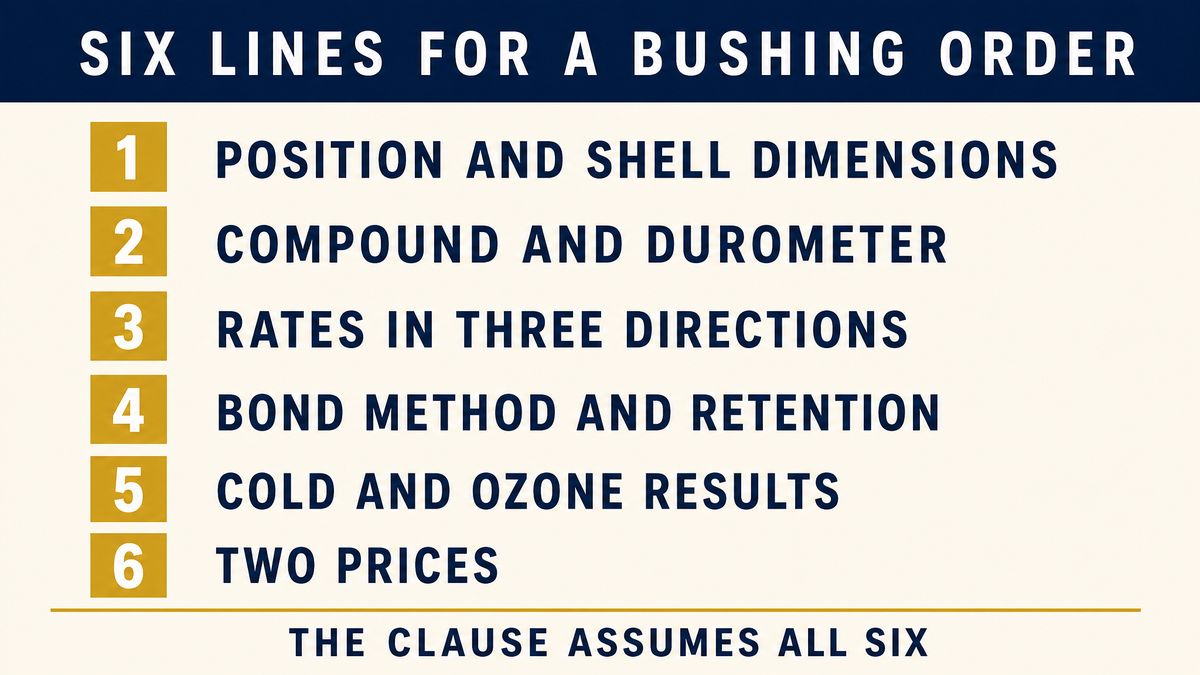
8. Six Lines to Put in the Order
None of these is in any federal text. Each of them is a property the inspection clause assumes when it asks whether the rubber is still in the hole.
- Position and the bore and shell dimensions.
- Compound and durometer.
- Static and dynamic rate, three directions.
- Bond method, and what retains it.
- Cold and ozone test results.
- Two prices: as quoted, and with the five items above written into it.
A bushing is the one part in this segment whose inspection words describe movement rather than damage: cracked, extruded out from, missing. Extrusion is what happens when the rubber is asked to travel further than the window it was designed for.
So the specification is a window, not a durometer. A harder compound in the wrong window fails the way a soft one does, which is why the drawing needs travel limits beside the material callout.
The Seat, the Interference, and the Number Between
We return the bore and outside diameter with the interference range, plus the durometer the application was designed around.
Draw My Bushing SeatFrequently Asked Questions
Is there a federal standard for suspension bushings?
Not for the part. The only federal text is a condition clause in 49 CFR 570.8 and 570.61: rubber bushings shall not be cracked, extruded out from or missing from suspension joints.
Why does the regulation not give a stiffness figure?
Because the window belongs to the vehicle, not the part. Each platform has its own rates in three directions, published on the maker’s drawing, and a single federal number would be wrong for almost every car.
What does “extruded out from” mean in practice?
Rubber that has migrated along the bore and now stands proud of the steel shell, usually at one end. It is the stage before separation, and it is what a bonded bushing does when the bond or the shell interference is wrong.
Is polyurethane an upgrade?
It is a different spring. Harder for the same shape, better against oil and ozone, and usually retained rather than bonded. Whether that helps depends on the window the vehicle was built around.
Why is there no bushing heading in the recall data?
Because the taxonomy files the part under its assembly — control arm, leaf spring, axle — and a scan of every heading for “bush” returns nothing. The word appears in free text instead.
What fails first on a cheap bushing?
The bond or the shell interference. The rubber can still look new when the part has already begun to walk out of the hole, which is the condition the inspection clause exists to catch.
Questions & Comments
We read every one and reply within 24 hoursA bushing fails by travelling further than its window allows, which no durometer reading will show. Send the layout, and we will define the travel limits before the compound.