
Air Spring Manufacturer: The Only Rule Says Deflated
 ·
Updated October 22, 2026
·
11 min read
Fifteen items make up the commercial vehicle inspection appendix. One of them mentions air suspension, and the sentence it uses is about pressure: deflated air suspension, i.e., system failure, leak, etc. The inspector looks for a vehicle sitting low. Nothing in any federal document looks at the spring.
That is the whole regulatory position on this part, and it is worth more to a buyer than it first appears. A rule that checks pressure is telling you where the failures actually are: not in the rubber, in the system around it. Read the three recalls below and the same thing shows up from the other side.
1. Five Records
Method unchanged. The federal recall file holds 245,845 records across 15,305 campaigns, no header row, every field scanned. Controls: brake 28,639, air bag 16,162.
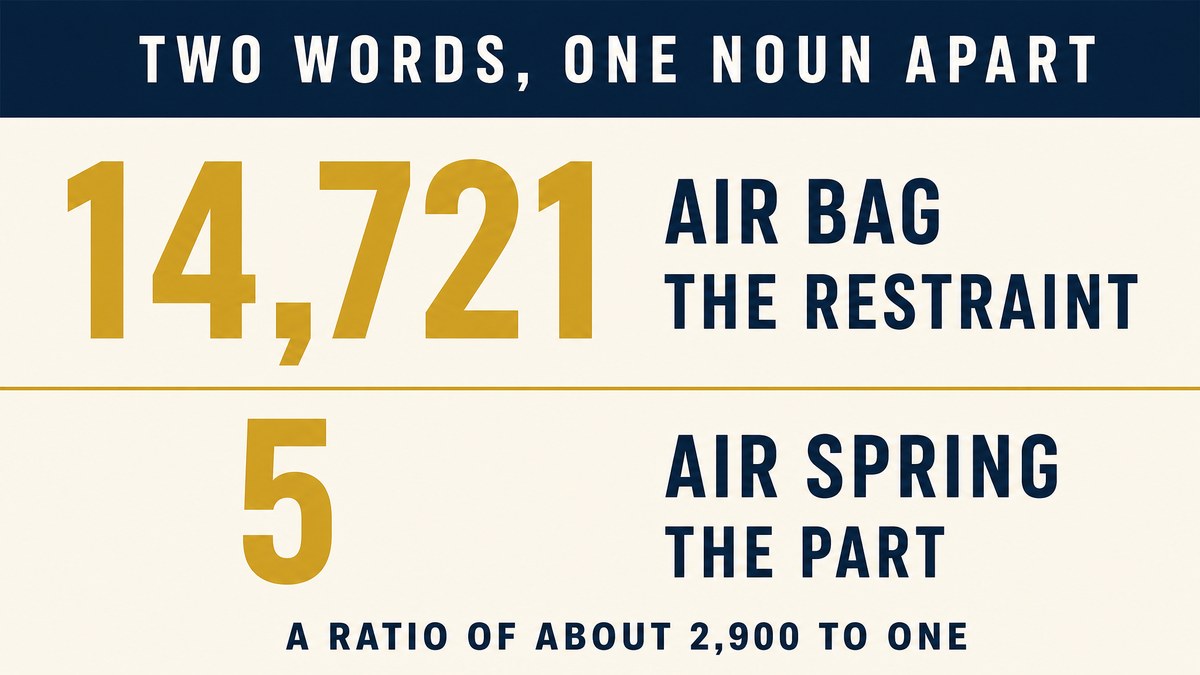
And here the control is the story. air bag — the restraint — appears in 14,721 records across 896 campaigns. air spring appears in five. Two words that differ by one noun, and a ratio of roughly 2,900 to one.
| Term | Records | Campaigns | What it actually counts |
|---|---|---|---|
air bag | 14,721 | 896 | the restraint, not the spring |
air suspension | 644 | 21 | mostly wiring, software and brake hoses |
bellows | 95 | 3 | the rubber itself |
ride height | 50 | 9 | the height control loop |
air spring | 5 | 3 | the part, named |
deflated | 0 | 0 | the word the inspection uses |
Two of those rows are worth dwelling on. The air suspension count is 644 and it is not about springs: the largest campaigns under it are an electronically controlled suspension losing communication, a software update and a brake hose chafing on an axle. And deflated, the single word the federal inspection rule uses for this failure, appears in none of the 245,845 records.
One more count, because it catches people out: compressor returns 583 records. The two component headings that carry the word hold ten records between them, six for the air-conditioning compressor and four for the air-brake supply compressor. The other 573 are mentions inside summaries, and nothing in a count tells you which compressor a sentence meant.
2. Three Campaigns, and Two Are Brackets
All three campaigns are small: 51 vehicles, 10 and 9. All three are worth reading because none of them is a rubber failure.
Newell, 51 coaches. The steer axle air spring base may crack. The base is a bracket, not the bellows.
Spartan, 10 vehicles. The upper mounting fasteners for the air spring may protrude, possibly resulting in the air spring bag being punctured. A bolt that is too long, or seated too high, wears through a bellows from the inside of the mounting face.
Nova Bus, 9 buses. The front air spring suspension hardware may separate from the attachment plate, causing a sudden loss of suspension. Again the hardware, and the outcome is not a slow sag but a sudden drop.
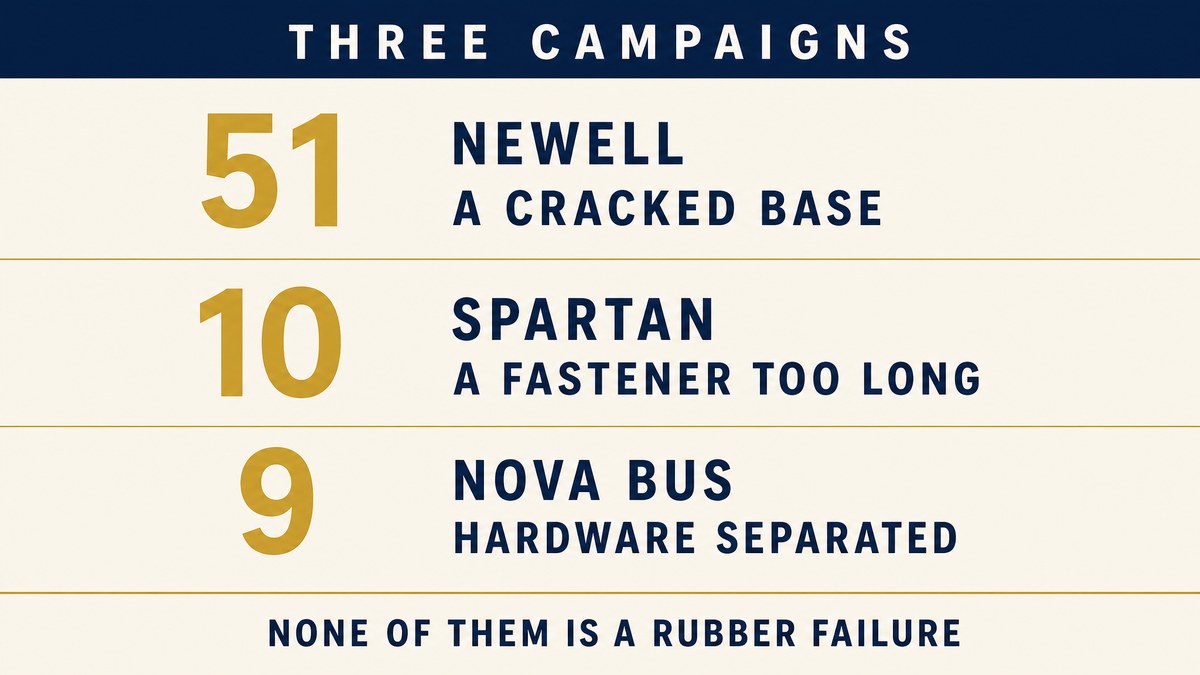
That is a sample of five records, so treat it as a pointer rather than a statistic. The pointer is consistent with the inspection rule: the part is rarely the origin. The bracket cracks, the fastener is too long, the plate lets go, and the bellows is the last thing in the chain.
3. What the Two Inspection Documents Check
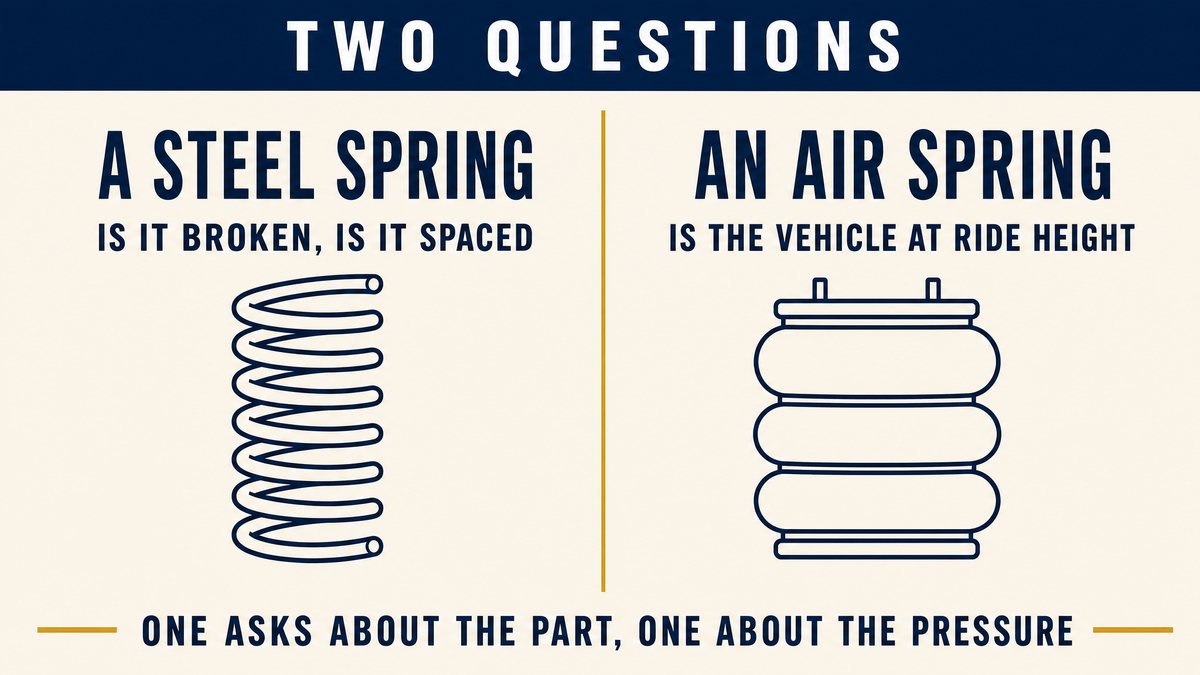
Part 570, the light-vehicle and heavy-vehicle inspection. Searched in full: air spring zero, air suspension zero, deflated zero. What it does regulate is steel: springs shall not be broken and coil springs shall not be extended by spacers. A coil spring gets a rule about its condition. An air spring gets nothing.
Appendix A to Part 396. Fifteen numbered items for the annual commercial inspection, and under suspension there is a single line: deflated air suspension, i.e., system failure, leak, etc.
Set the two beside each other and the difference is not an omission, it is a decision. For a steel spring the inspector is asked about the part: is it broken, is it spaced. For an air spring the inspector is asked about the system: is it holding air. The rule assumes that if the vehicle is at ride height, the part is doing its job, and if it is not, the cause could be anywhere in a chain of five components.
For a supplier that cuts both ways. It means no test report and no marking will settle a dispute about an air spring, because there is no requirement to measure against. It also means the honest specification has to describe the system interface the spring is expected to seal against — the plate, the piston seat, the fitting — because that is where the failures in the file actually sit.
4. What the Part Actually Is
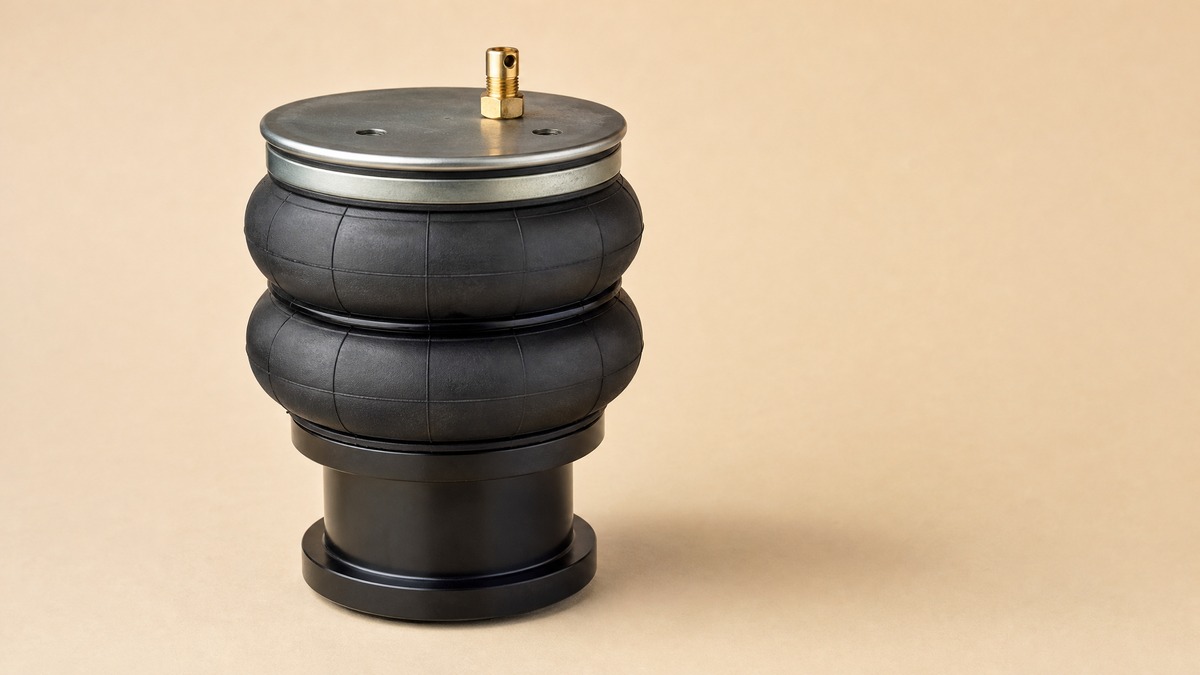
An air spring is a rubber pressure vessel that carries load. It does not have a spring rate in the way a coil has one, because the load it carries is set by the pressure inside it, and the pressure is set by a level valve or an electronic height control loop. Add load, add pressure, ride height stays where the designer put it.
Two shapes do most of the work. The rolling lobe bellows rolls over a piston as it compresses; the piston profile sets how the effective area changes through the stroke, and therefore the shape of the rate curve. The convoluted bellows has one or more fixed folds that open and close. A rolling lobe is the common choice for ride height control on a vehicle with a variable load; a convoluted spring suits a fixed installation.
Four parts decide how long it lasts.
The bellows. Rubber, with fabric layers inside it. The compound sets resistance to ozone, to oil and to the salt that accumulates on a winter road, and the fabric sets burst strength.
The bead plates. The steel rings the bellows is crimped onto. This is where a bellows is held, and where corrosion turns into a leak path.
The piston. The surface the lobe rolls on. Its finish and its taper set both the rate curve and how the rubber wears.
The bumper. A rubber stop inside the spring that carries the vehicle when pressure is lost. It is the reason a deflated air spring is a hard ride rather than a scrape.
5. Four Ways It Fails, and What Each One Looks Like
Chafe. The bellows rubs against a bracket, a line or a body seam. It shows as a polished patch and then a hole on one side. Chafe is an installation fault more often than a manufacturing one, and it is the failure a buyer can prevent with a drawing rather than a material specification.
Weather cracking at the fold. The fold is where the rubber flexes the most, so it is where ozone and UV do the most damage. It shows as fine cracks in the crease, then a leak.
Bead plate corrosion. Salt and water sit in the crevice between rubber and steel, the crimp loses its grip, and the leak is at the seal rather than in the wall. This one is invisible until the spring is removed.
Puncture from mounting hardware. The Spartan case in section 2: a fastener that protrudes into the bellows. It is a bracket problem with a rubber outcome.
The diagnostic signature is worth writing down, because it tells a supplier which complaint is theirs. A spring that is flat after standing overnight has a leak at rest — bag, line, fitting or valve. A vehicle that sags only when loaded, and recovers when the load comes off, has a height control problem — valve, sensor or compressor. The first is a part or a joint. The second is rarely the part at all, and a buyer who ships replacements for the second complaint will see the same vehicle twice.
6. The Other Four Components in the Chain
If the inspection checks pressure rather than the part, then the specification has to cover the four things that hold the pressure. A buyer who names only the bellows has specified one fifth of the system and will be blamed for all of it.
The height control valve, or the sensor and valve block. A mechanical valve is linked to the axle and adds or releases air as the link moves; an electronic system reads a height sensor and drives a solenoid block. Either way this is the component that decides ride height, and it is the one that produces a vehicle sitting at the wrong height while every spring holds pressure.
The compressor and the dryer. The supply side. A dryer that has taken up all the moisture it can hold passes water into the lines, and water in a line freezes at a valve on a cold morning. The vehicle sits down overnight in winter and comes back up when the day warms — a symptom that looks like a leaking bag and is a dryer.
The lines and fittings. Push-to-connect fittings are the standard, and a fitting that is inserted almost all the way leaks slowly enough to pass a soap test on the day and fail over a week. This is the joint most often left out of an order specification because it is ordered as a line, not as a spring.
The valve block. The only component that can hold one corner down while the other three are correct. A single-corner sag with three good springs is a block or a line, not a bellows.
There is a cheap way to split the chain that costs one gauge. Measure at the spring and again at the block: pressure at the spring but not at the block is a line or a fitting, pressure at both and still low is the spring, and pressure nowhere is supply. That test takes ten minutes and it prevents the most expensive mistake in this category, which is replacing four springs to fix one valve.
7. Where the Price Difference Sits
The compound. Natural rubber, neoprene or an EPDM blend. This is the difference between a spring that survives five winters of road salt and one that cracks in the fold in two.
The fabric. Layers and angle. It is not visible from outside and it is the whole of the burst strength.
The crimp. How the bead plate is closed onto the bellows. A crimp is a process, and a process is the one thing a factory audit can watch.
The plate coating. Paint, zinc or nothing. Corrosion at the bead is the failure that most looks like a rubber failure and is not.
The piston. Steel with a coating, or moulded plastic. The finish decides how the lobe wears.
The test. A leak test on the finished assembly, held long enough to catch a slow leak, plus a proof test above working pressure. A bellows that is tested before crimping has not been tested at the only joint that matters. The same joint can be lost after the test — a bellows packed against a sharp edge arrives with a leak it did not have at the factory, which is what an export packaging check is for.
8. Seven Questions, Six Lines
A sample air spring tells you nothing about its life. It tells you it holds air today. These are the questions that decide the rest.
- Bellows compound and fabric layup, and which of them was tested against salt spray and ozone?
- Bead plate coating, and how the crimp is closed and checked?
- Piston material and surface finish, and the rate curve it produces?
- Bumper present, and rated for what load with the spring deflated?
- Leak test on the finished assembly: method, pressure, hold time.
- Proof pressure above working pressure, and what happens at it.
- Two prices: as quoted, and with the six lines below written into it.
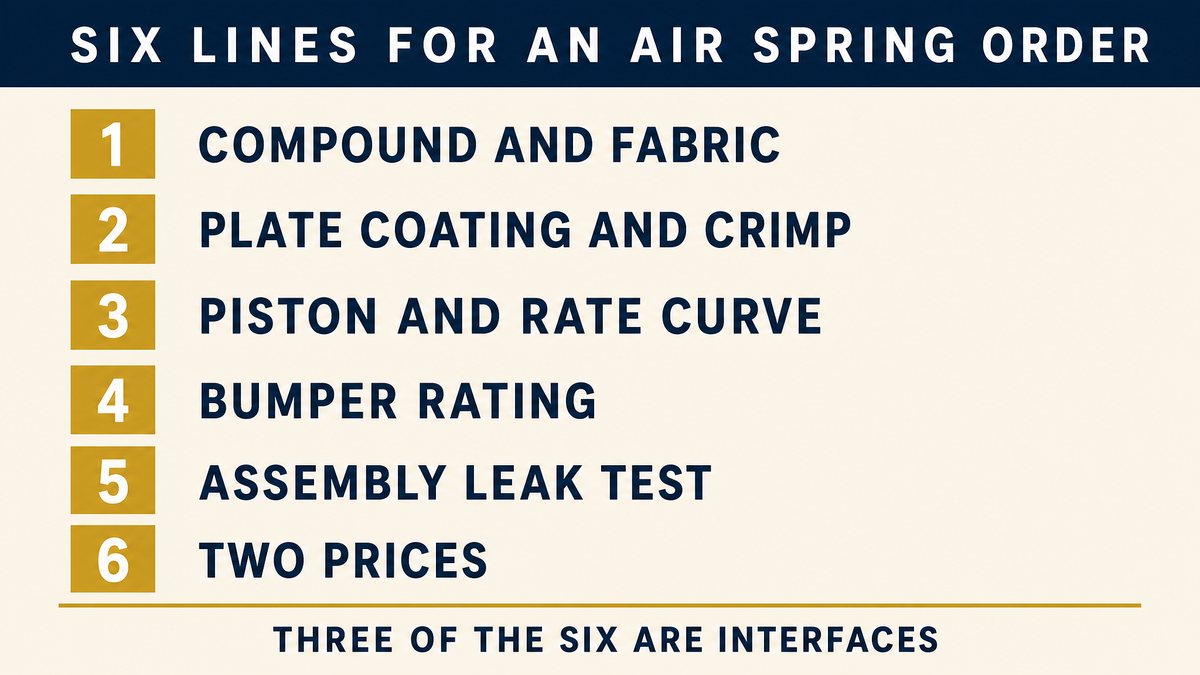
Then put six lines in the order. There is no standard to point at, so these six lines are the specification — and note that three of them are about interfaces rather than rubber, which is where the file says the failures are.
- Compound and fabric layup.
- Bead plate coating and crimp process.
- Piston finish and rate curve.
- Bumper and its deflated rating.
- Assembly leak test: method, pressure, hold.
- Two prices: as quoted, and with the five items above written into it.
Five records and three campaigns, none of them a rubber failure: a cracked base, a fastener that was too long, hardware that separated from its plate. The bag is the largest object in the system and the last thing that actually breaks.
The inspection reflects that. One line in a fifteen-item appendix asks whether the suspension is deflated, which is a question about pressure rather than about the part. So the specification has to cover the other four components, or the spring will be blamed for all five.
A Leak-Down Log You Can Hand an Inspector
We return the pressure held at each interval, the fitting that lost it and the date, in the shape a roadside check expects to see.
Build My Leak LogFrequently Asked Questions
Is there a federal standard for air springs?
No. Part 570 does not mention air springs or air suspension at all. The commercial inspection appendix has one line about deflated air suspension, which is a check on pressure rather than on the part.
Why does the recall file have so few records for it?
Five records across three campaigns, and all three are small: 51 coaches, 10 vehicles, 9 buses. A sagging spring is a repair, not a recall, so the file only catches the cases where something separated or was punctured.
What does deflated air suspension mean in the inspection?
It means the vehicle is not at ride height. The inspector does not assess the bellows, because the cause could be the bag, a line, a fitting, the valve block or the compressor.
Why do the recalls mention brackets rather than rubber?
Because that is where the failures are. A cracked base, a fastener protruding into the bag, hardware separating from an attachment plate. The bellows is usually the last thing in the chain.
What is the difference between a rolling lobe and a convoluted spring?
A rolling lobe rolls over a piston, and the piston profile sets the rate curve. A convoluted spring has fixed folds that open and close. Rolling lobe suits variable load and ride height control.
Why does a vehicle sag overnight but sit level when loaded?
Those are different faults. Flat after standing is a leak at rest. Sagging only under load, and recovering when unloaded, points at the height control loop rather than the spring.
Questions & Comments
We read every one and reply within 24 hoursAn air spring is inspected by asking whether the vehicle is deflated, which is a question about pressure. Send the layout, and we will specify the chain rather than the bag alone.