
U-Bolt Manufacturer: The Rule Says Securely Attached
 ·
Updated October 22, 2026
·
12 min read
The federal inspection standard names this part, and then spends three words on it: securely attached. No torque, no grade, no thread engagement, no limit on re-use. Then you open the recall file and find thirty-four campaigns about exactly the thing the rule does not mention.
That gap is the whole buying problem. A U-bolt is a clamp, and a clamp either holds its preload or it does not; the inspection can only see whether it is still there. Everything that decides whether it will still be there in three years is in the specification, and none of it is in the rule.
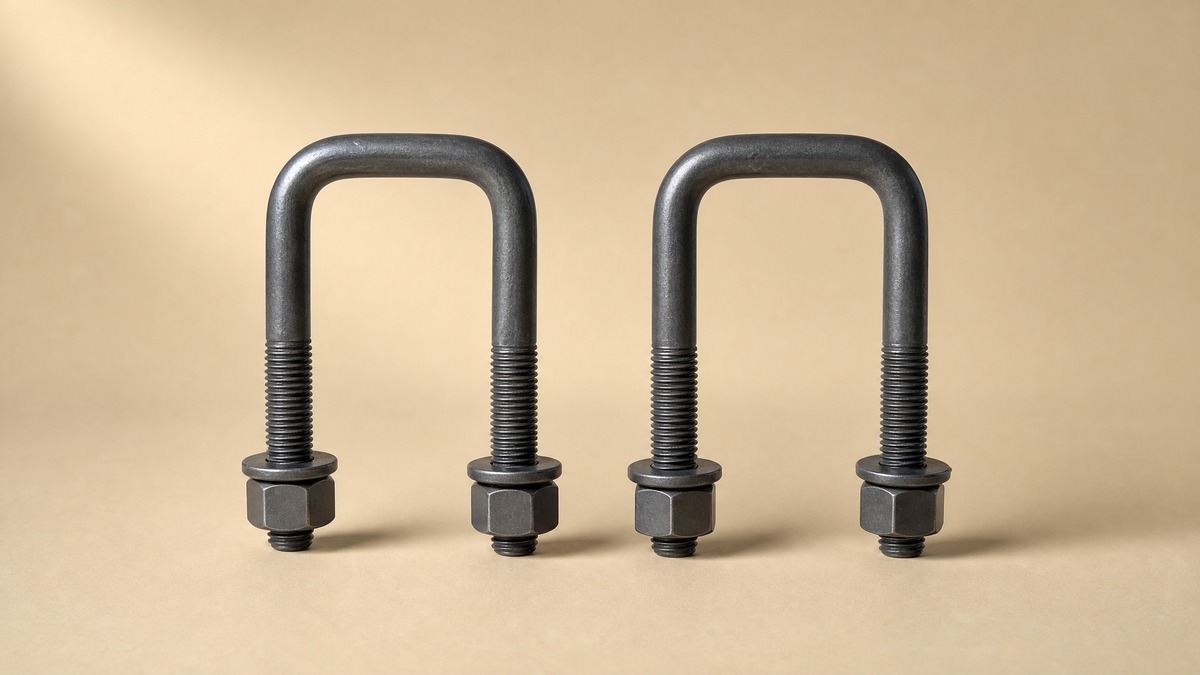
1. A Heading That Ends in the Part's Name
Method unchanged. The federal recall file holds 245,845 records across 15,305 campaigns, no header row, every field scanned. Controls: brake 28,639, air bag 16,162.
| Term | Records | Campaigns |
|---|---|---|
u-bolt and u-bolts | 479 / 362 | 27 / 31 |
| unique campaigns mentioning either | — | 34 |
leaf spring | 598 | 54 |
clamp | 1,448 | 169 |
torque | 2,253 | 279 |
preload | 161 | 10 |
The interesting field is not the count, it is the component heading. Two headings carry most of these records, and one of them reads:
SUSPENSION:FRONT:SPRINGS:LEAF SPRING ASSEMBLY:U-BOLT, LEAF SPRING TO AXLE
Eleven records sit under that front heading and ten under the rear one. The part is not described inside a paragraph about the axle; it has its own slot at the end of the tree. That makes it the opposite of the thermostat, which had no heading anywhere in 245,845 records, and the opposite of the bull bar, which had no name.
2. The Three-Word Rule
Part 570 is the federal inspection standard, and it names the part twice — once for light vehicles in §570.8 and once for heavier ones in §570.61. Both sentences are the same, and this is all of it:
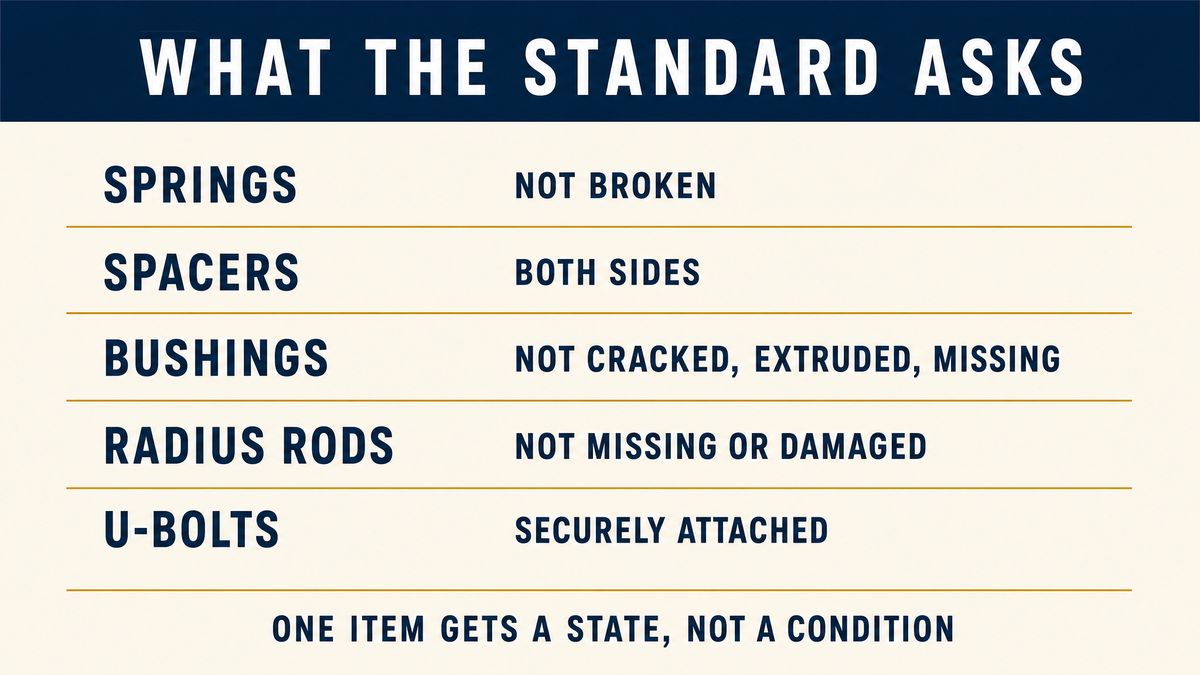
Shock absorber mountings, shackles, and U-bolts shall be securely attached.
Read the sentences around it and the contrast sharpens. In the same paragraph the standard says springs shall not be broken, spacers must be fitted on both sides, rubber bushings shall not be cracked, extruded out from or missing from suspension joints, and radius rods shall not be missing or damaged. Every other item gets a condition to look for. The U-bolt gets a state: attached, or not.
That is a sensible inspection rule, because a tester with a lift sees a U-bolt from below and can see whether it is there. It is a useless purchasing rule, because a U-bolt that is present and loose looks identical to one that is present and correct.
3. The Archive Records Torque, in Both Directions
Thirty-four campaigns mention a U-bolt, and reading them in order of size shows the same failure written two ways.
| Campaign | Make | Units | What the file says |
|---|---|---|---|
| 23E050000 | Lippert | 13,997 | U-bolts improperly tightened, axle can move out of position |
| 26V044000 | Grand Design | 7,585 | U-bolt may loosen from inadequate preload and preload losses |
| 23V490000 | Grand Design | 6,270 | same Curt axles, improperly tightened |
| 20V075000 | Forest River | 4,464 | spare carrier U-bolts may fail, carrier and tyre detach |
| 15V208000 | Hino | 1,951 | U-bolt may have been overtightened |
Under-tightened, and over-tightened, in the same file, on the same part, within a few years of each other. That is not a contradiction; it is the signature of a joint where the clamp load is the entire function and the only control is a torque wrench.
Note also the two trailer campaigns. Lippert builds the axles, Grand Design builds the trailer, and the same part appears in both files because it sits on the boundary between two companies' processes. When a clamp is installed by one company on another company's axle, the torque specification is the only thing that travels between them.
4. What the Bolt Actually Does
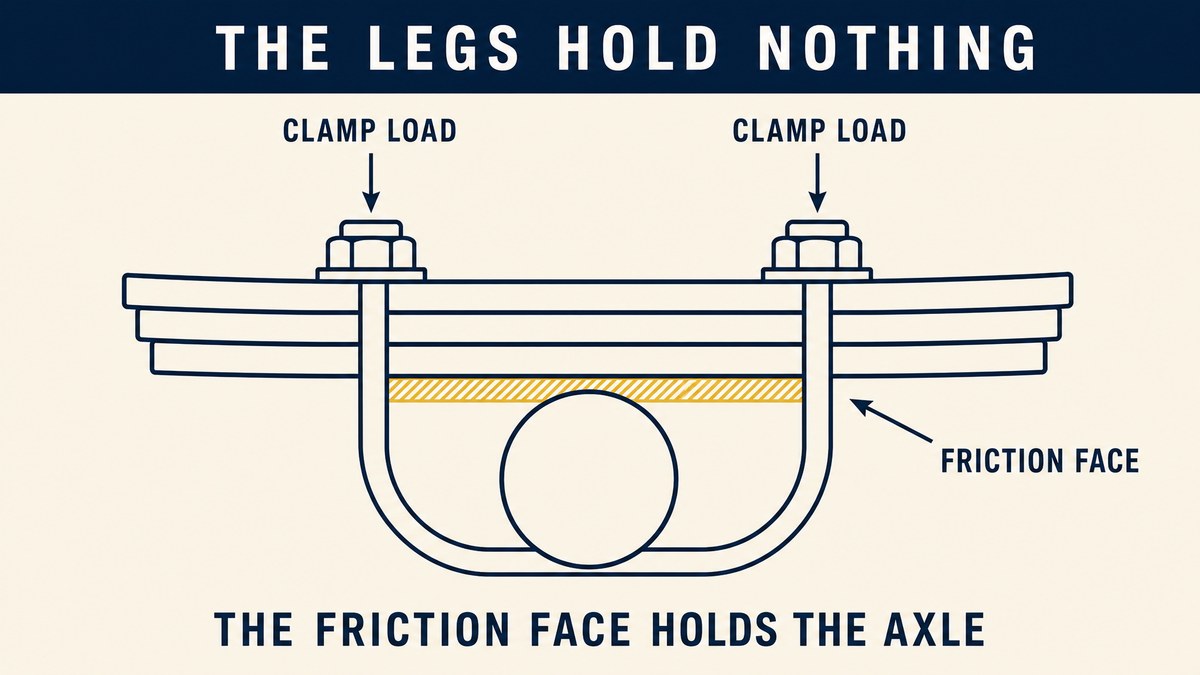
A U-bolt carries almost no load along its legs. Its job is to hold the leaf spring pack against the axle seat with enough force that friction between the two faces carries the axle location. Loosen the clamp and the axle starts to walk: the spring centre bolt takes the load instead, and it was never sized for it.
Three consequences follow, and they explain why the archive reads the way it does.
The joint is friction, so preload is the part. Not tensile strength, not grade, not finish. A Grade 8 bolt that was torqued to nothing is a worse clamp than a Grade 5 that was torqued correctly, and only one of those two facts is printed on the part.
Preload is lost before anything breaks. Which is why the Grand Design campaign talks about preload losses rather than fractures. A joint that has gone soft is invisible from underneath, and the first symptom is usually a tyre wearing on one edge.
The two failure directions are different failures. Under-torque loses clamp and the axle moves. Over-torque yields the thread, necks the leg at the bend, and leaves a bolt that will never hold its preload again, even though it was tight when it left.
5. Torque Is a Proxy, Not a Measurement
A torque wrench measures the resistance to turning, and what the joint needs is tension in the legs. The relationship between the two depends on friction in the thread and under the nut, which depends on coating, lubrication, thread condition and whether the thread was rolled or cut.
That is why two factories can both claim the same torque figure and deliver different clamp loads. Put the condition on the drawing next to the figure: dry, oiled, or with a named lubricant, and the number means something. It is also why a torque specification without a thread condition is an incomplete specification: the same number on a dry zinc-plated bolt and on a lubricated one does not produce the same tension.
For a buyer the practical answer is not a better torque figure. It is a torque figure plus a thread condition plus a check that the joint still holds after a settling period, because a spring pack beds in and the clamp load drops after the first few hundred kilometres.
6. Five Things That Decide the Clamp
The radius. The bend has to match the axle tube it clamps. A radius that is too tight contacts on two points and leaves a gap at the sides; the clamp load is then carried by a fraction of the face, and the joint frets.
The thread. Rolled threads are formed and cut threads are removed, and the difference shows up in fatigue life at the root rather than in a catalogue. A rolled thread on the same material lasts longer under the same clamp.
The grade and the marking. A U-bolt is usually a quenched and tempered medium-carbon steel, and the grade should be marked on the part or on the nut. A supplier who cannot say which grade is being shipped is quoting a shape, not a part.
Nut engagement. The nut must be fully engaged on the thread, which means the leg length has to suit the spring pack plus the seat plus the washer, not a standard length. Short engagement strips; long engagement leaves thread outside the nut doing nothing.
The coating. Electroplating on a high-strength part brings a hydrogen embrittlement risk that a specification should address directly, and the bake after plating is a process step a factory audit can see. Plain oiled finish avoids the risk and corrodes; zinc flake sits between the two at a price.
7. It Is Usually a One-Time Part
A U-bolt that has been torqued has taken a set: the legs have stretched and the bend has opened slightly. Re-torquing it to the same figure does not restore the same clamp, because the elastic range it was designed for has already been used.
This is why service procedures on light vehicles commonly call for new U-bolts when a spring is replaced, and why a buyer who ships them in pairs is selling the right unit. It is also the reason a recall that replaces a spring has to replace the bolts with it: putting the old clamp back on a new pack is how the second campaign happens.
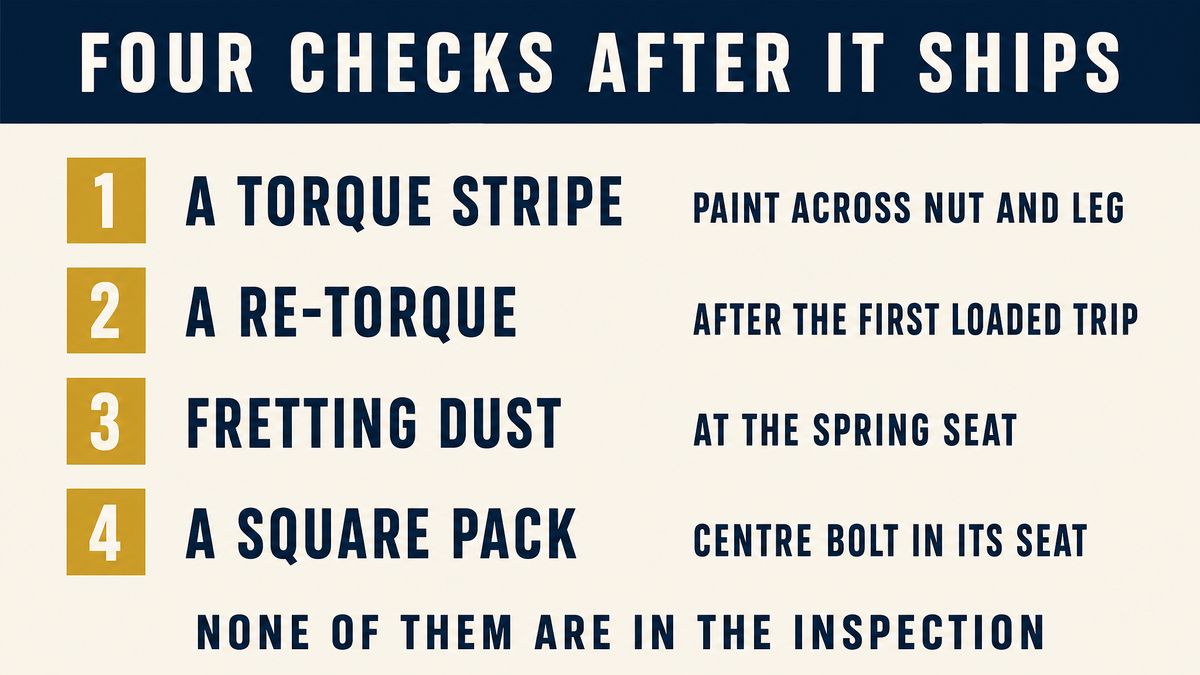
8. How the Joint Is Checked After It Ships
If the inspection can only see whether the bolt is there, the check that matters has to happen somewhere else: at the first service, and on the trailer that sits loaded for a season.
A torque stripe. Paint a line across the nut and the leg after torquing. It costs nothing, it takes a second, and it turns an invisible preload loss into a visible misalignment. This is the single cheapest control in the category and almost nobody ships it as an instruction.
A re-torque after the first loaded trip. A spring pack beds in and the clamp load drops. The joint that was correct in the yard is often under-torqued after a few hundred kilometres, which is why the second check matters more than the first.
A look for fretting. Where the spring seat and the axle tube meet, a joint that has been moving leaves a fine rust-coloured dust. It is the earliest evidence that the clamp is gone, and it appears long before the axle walks.
An alignment check on the pack. The centre bolt should sit in its seat with the pack square to the axle. A pack that has shifted sideways is telling you the clamp has already released and the centre bolt is carrying the load.
Trailers deserve their own line. A trailer sits loaded and travels less, so the joint corrodes at the seat and in the thread between trips, and it has less damping above it than a truck. That is why so many of the campaigns in this file are trailers and fifth wheels rather than pickups: the same clamp, in a harder place to keep it.
9. Where the Price Difference Sits
Material and heat treatment, stated as a grade rather than as steel.
Thread method, rolled or cut, which is invisible after plating.
Radius control, measured against a gauge rather than by eye.
Leg length and thread length, which decide whether the nut engages fully on the actual pack.
Coating and the bake, if plated, plus the corrosion hours behind the claim.
Whether the nuts and washers are in the box, at the right grade, which is the cheapest place to lose a customer and the one an export packing check catches before the carton is sealed.
10. Seven Questions, Six Lines
The inspection standard will not help you, so the questions are the specification.
- Grade and heat treatment, stated on the drawing and marked on the part?
- Rolled or cut thread, and where the thread stops relative to the nut?
- Bend radius, and the gauge used to check it against the axle tube?
- Torque figure with a thread condition, not a torque figure alone?
- Coating type, and the bake cycle if the part is electroplated?
- Nuts and washers in the box, at the same grade, one set per bolt?
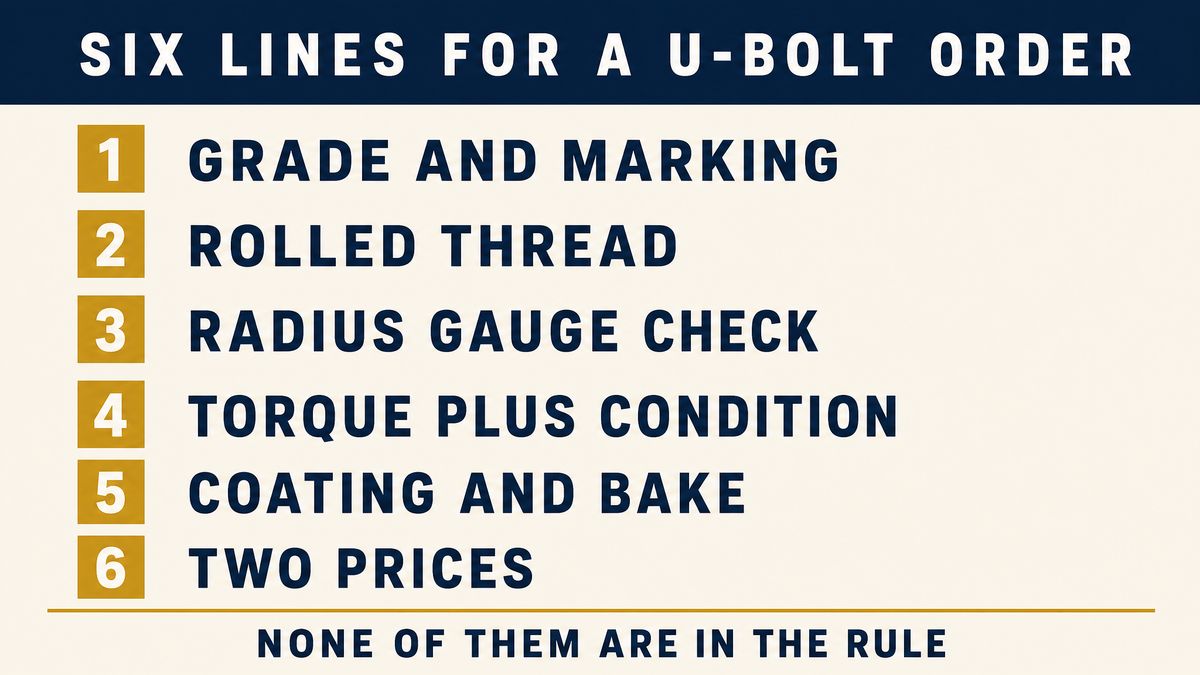
- Two prices: as quoted, and with the five lines below written into it.
- Grade and marking.
- Rolled thread.
- Radius gauge check.
- Torque plus thread condition.
- Coating and bake.
- Two prices, plus nuts and washers per bolt.
Thirty-four campaigns turn on torque, and the inspection standard spends three words on the part: securely attached. It can see whether a bolt is there and cannot see how tightly it holds, which is the only thing the archive is about.
So the clamp load has to be written by the buyer, and torque alone will not carry it. Grade, thread form, bend radius, a torque figure with its thread condition attached, and a coating that was baked: five lines, and a price that reflects all five.
Both Directions, Recorded at Assembly
We return the torque figure, the thread lubricant it assumed, the preload it produces, and the two failure directions in the archive.
Record My TorqueFrequently Asked Questions
What does the federal inspection say about U-bolts?
One sentence, in both §570.8 and §570.61: shock absorber mountings, shackles, and U-bolts shall be securely attached. There is no torque figure, no grade and no re-use rule.
How many recalls involve U-bolts?
34 campaigns in a file of 245,845 records, and most concern torque rather than fracture: Lippert 13,997 units improperly tightened, Grand Design 7,585 with inadequate preload, Hino 1,951 overtightened.
Can a U-bolt be re-used?
Generally no. Once torqued it takes a set and the legs have used their elastic range, so re-torquing does not restore the original clamp. Service procedures commonly call for new bolts with a new spring pack.
Why does torque alone not define the joint?
Because torque measures friction as much as tension. Coating, lubrication, thread condition and whether the thread was rolled all change the tension produced by the same reading.
Why does the bend radius matter?
A radius that does not match the axle tube contacts on two points and leaves gaps, so the clamp load is carried by part of the face and the joint frets loose.
Is electroplating a problem on a U-bolt?
It carries a hydrogen embrittlement risk on high-strength parts. A bake after plating is the usual control, and it is a process step a buyer can ask about rather than a claim to take on trust.
Questions & Comments
We read every one and reply within 24 hoursA U-bolt is inspected for being attached and recalled for being tight, and the gap between those two is the specification. Send the axle list, and we will write the clamp load.