
Tire Changer Manufacturer: The Machine the List Leaves Out
 ·
Updated October 22, 2026
·
12 min read
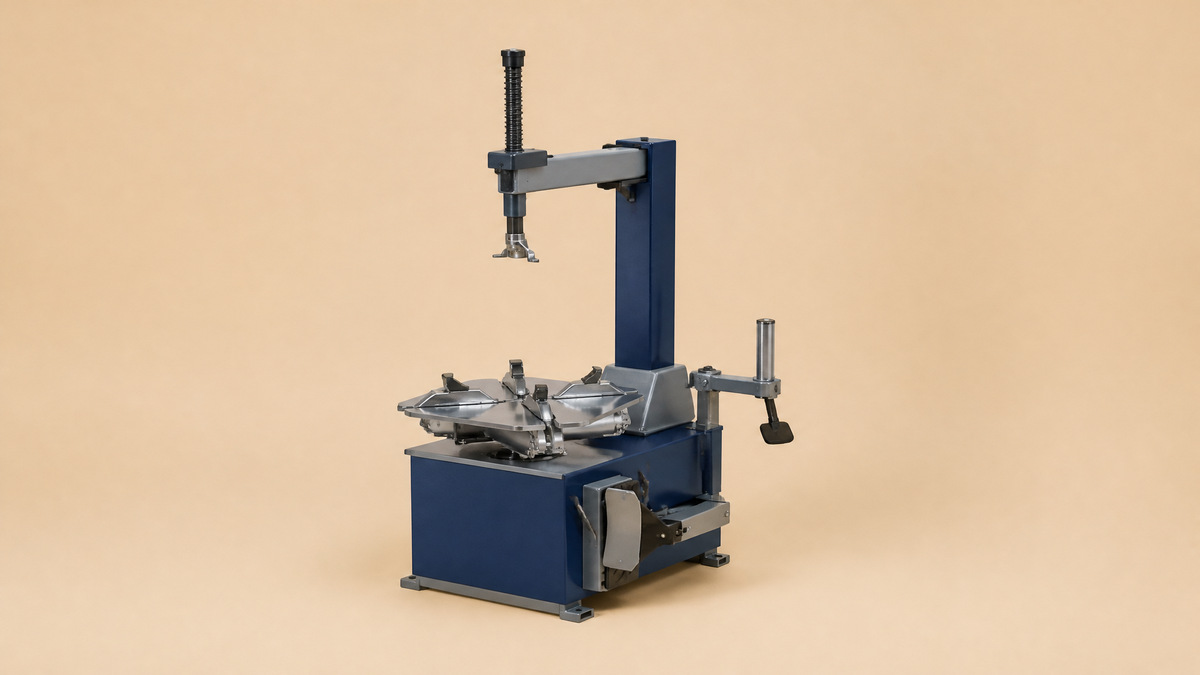
A tire changer is the first machine in this series. The wheel, the wiper blade and the jack were all parts a workshop holds in one hand; this is a powered machine with a clamp, a turret and a bead breaker, and the federal text that reaches it is written about the machine's hazard rather than about a marking. It is 29 CFR 1910.212, five short paragraphs, and its centre is one sentence: the point of operation shall be guarded so that the operator cannot have any part of his body in the danger zone during the operating cycle. A second sentence decides the base of the machine, and a set of electrical definitions decides what the mark on the panel means. This article reads all three, maps them onto what a buyer can ask for, and turns the answer into six lines for an order document.
1. The First Machine in This Series
The four articles before this one were decided by documents about parts: a rim marking, a wiping system, a fitment list, a rated load. A tire changer is a different animal. It has a motor, a rotating table, jaws that clamp a wheel, and an arm that breaks a bead, and the reason a buyer cares about any of that is that a person stands next to it with both hands on the wheel while it turns.
That is why the applicable federal text changes shape. It is not in the vehicle-safety title and it is not a marking rule. It sits in Part 1910, Subpart O, § 1910.212, headed General requirements for all machines, and it is five paragraphs long. The first three are about guarding, the fourth is about drums that revolve, the fifth is about fan blades, and the last one is about anchoring a machine to the floor.
Short as it is, the section has one feature that matters for a sourcing conversation. It does not approve anything, certify anything or register anything. It states an outcome — a body must not be able to reach the danger zone — and leaves the method to whoever builds the machine. That makes it the opposite of the jack article before it, where the only federal sentence was about a stamp, and it makes it closer to the wheel article, where the number belonged to somebody else's publication. Here the burden is on the design, and the buyer's job is to see the design before the container is loaded.
2. What the Guarding Rule Asks For
The opening paragraph names the hazards in a way that is worth reading slowly, because the list reads like a description of a tire changer's working day:
“(a) Machine guarding — (1) Types of guarding. One or more methods of machine guarding shall be provided to protect the operator and other employees in the machine area from hazards such as those created by point of operation, ingoing nip points, rotating parts, flying chips and sparks. Examples of guarding methods are — barrier guards, two-hand tripping devices, electronic safety devices, etc.” — 29 CFR § 1910.212(a)(1)
Four hazard words, and every one of them has a place on this machine. The point of operation is where the work happens, which on a tire changer is the clamp jaws and the bead breaker. Ingoing nip points are where two surfaces close on each other, which is what a bead breaker does to a tire. Rotating parts are the table and the wheel on it. And the example list of methods — barrier guards, two-hand tripping devices, electronic safety devices — is deliberately open, because the paragraph asks for an outcome and offers patterns.
The next paragraph adds a rule that is easy to overlook and expensive to get wrong. A guard has to be affixed to the machine where possible, secured elsewhere only if attachment is impossible, and the guard itself shall not offer an accident hazard. That last clause is the one that separates a guard from a bracket. A sheet-metal cover with a raw edge, or a bar that creates a new pinch point, is a guard that fails the paragraph it was built to satisfy.
Then comes the sentence that decides the whole design. Point of operation guarding is required, and where there is no applicable specific standard the guarding device
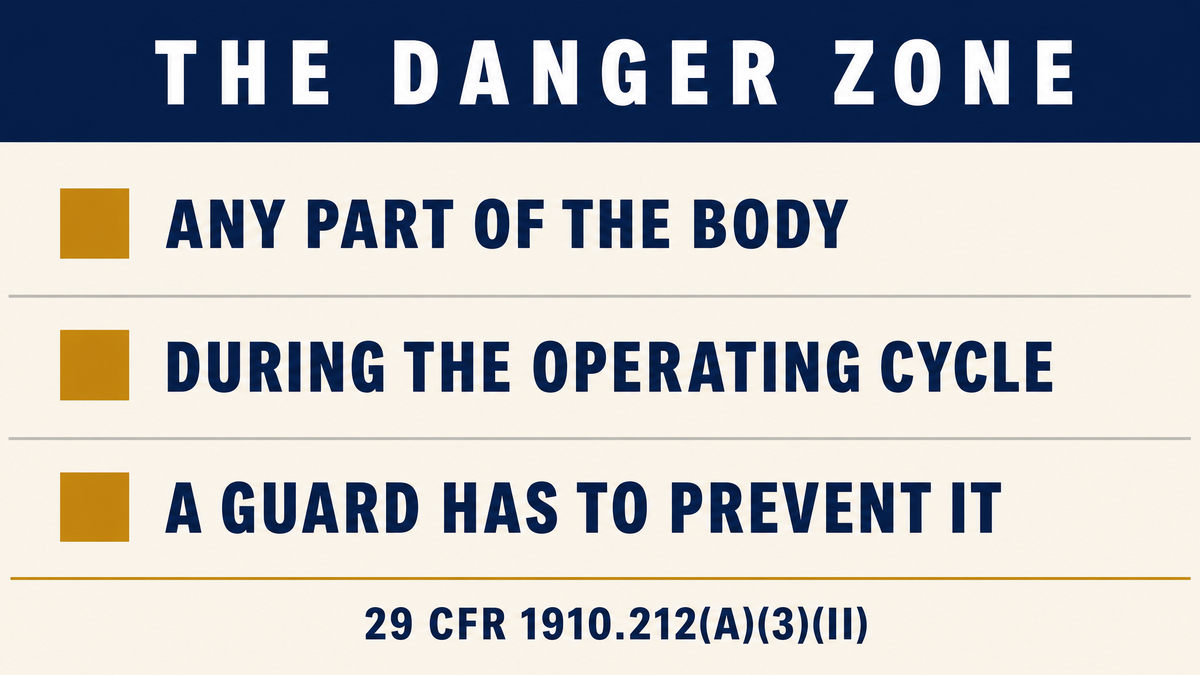
“… shall be so designed and constructed as to prevent the operator from having any part of his body in the danger zone during the operating cycle.” — 29 CFR § 1910.212(a)(3)(ii)
Read it as a buyer and the sentence turns into a specification. Any part of the body. During the operating cycle. Not a warning label, not a training session, not a sticker on the arm. A machine that requires the operator to hold a bead in place while the table turns is a machine whose design depends on the operator behaving, and behaviour is the one thing this paragraph does not accept as a guard.
3. The List That Never Names a Tire Changer
The paragraph that follows the danger-zone sentence contains a list, and the list is where a supplier will try to stand. It reads:
“The following are some of the machines which usually require point of operation guarding: (a) Guillotine cutters. (b) Shears. (c) Alligator shears. (d) Power presses. (e) Milling machines. (f) Power saws. (g) Jointers. (h) Portable power tools. (i) Forming rolls and calenders.” — 29 CFR § 1910.212(a)(3)(iv)
Nine machines are named, and a tire changer is not one of them. That looks like an opening, and it is not, for two reasons that sit in the wording itself. The list is introduced as some of the machines, so it is illustrative rather than exhaustive, and the duty in the previous subparagraph is written about machines whose operation exposes an employee to injury — a category defined by the hazard, not by the list.
What the omission does change is which branch of the guarding sentence applies. If a machine were covered by a specific standard, the guard would have to conform to that standard. Because no such standard is named for a tire changer in this section, the second branch is the live one: the guard must be designed and constructed so that no part of the body can reach the danger zone during the cycle. The requirement shifts from a document to a drawing.
That shift has a commercial consequence a buyer should hear plainly. When a rule points at a named standard, a supplier can answer with a certificate. When a rule points at an outcome, the only answers are the machine itself, the guard on it, and the manual that describes the cycle. A quotation that says CE marked or guarded is not an answer to this paragraph. A photograph of the guard in place, with the cycle described, is closer, and a demonstration that the clamp cannot turn while a hand is in the bead area is closer still.
One more paragraph in the section deserves a line here, because it is the only place the words interlocked appear. Revolving drums, barrels and containers must be guarded by an enclosure interlocked with the drive mechanism, so that the drum cannot revolve unless the guard is in place. A tire changer is not a drum, and the paragraph does not apply to it by its own terms. But it shows what the section means by a guard that works without the operator's cooperation, and that is the standard of proof a buyer should hold the machine to.
4. Anchored, Not Moving
The last paragraph of the section is one sentence long, and it is the only product line in the whole rule that a buyer can check from a PDF:
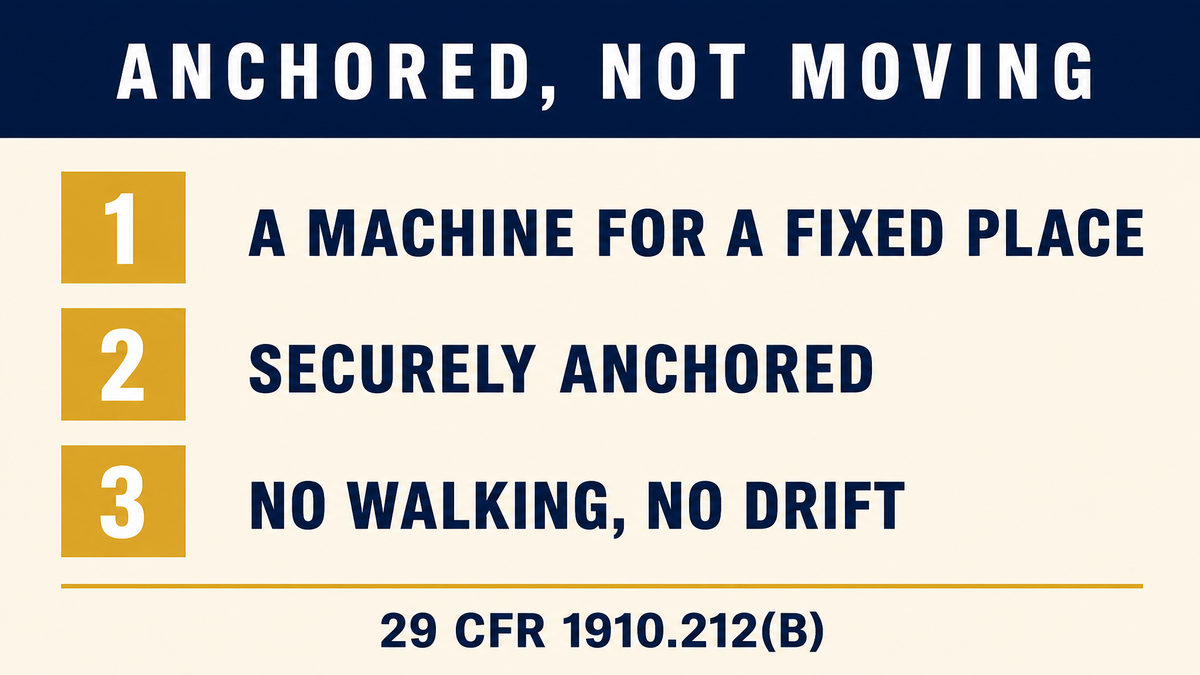
“(b) Anchoring fixed machinery. Machines designed for a fixed location shall be securely anchored to prevent walking or moving.” — 29 CFR § 1910.212(b)
A tire changer is a machine for a fixed place. It stands in one bay, it takes a wheel at shoulder height, and its bead breaker pushes sideways against a tire while a motor turns a table. Everything about that description argues for a base that is fixed to the floor, and the paragraph says the fixings must be secure enough that the machine neither walks nor moves.
What that means on a drawing is concrete, and a buyer can look for it before ordering. The base should show anchor points and a bolt pattern, not just a footprint outline. The manual should state how the machine is fixed and what size of fixing the base takes. And the machine should be sold as one that expects to be fixed, because a supplier who ships a free-standing unit has moved the paragraph onto the customer, who will read it only if somebody tells them to.
There is a second reason this paragraph deserves its own section, and it is about the shape of the whole series. The wheel article found a number in a tyre maker's listing; the wiper article found a fitment in a vehicle; the jack article found a mark that had to survive the paint. Here the requirement is a hole in a base plate. Of all the federal sentences this series has read, it is the least glamorous and the easiest to check, and it is the one most often missing from a quotation that leads with cycle time.
5. Three Words on the Machine
Nothing in Subpart O says anything about a mark. The electrical side of the same part does, and it does it through a chain of definitions that a buyer should be able to follow in one pass. These are the definitions in § 1910.399, and they apply within Subpart S, so they govern the electrical equipment rather than the guarding:
“Acceptable. An installation or equipment is acceptable to the Assistant Secretary of Labor, and approved within the meaning of this subpart S: (1) If it is accepted, or certified, or listed, or labeled, or otherwise determined to be safe by a nationally recognized testing laboratory recognized pursuant to § 1910.7 …” — 29 CFR § 1910.399
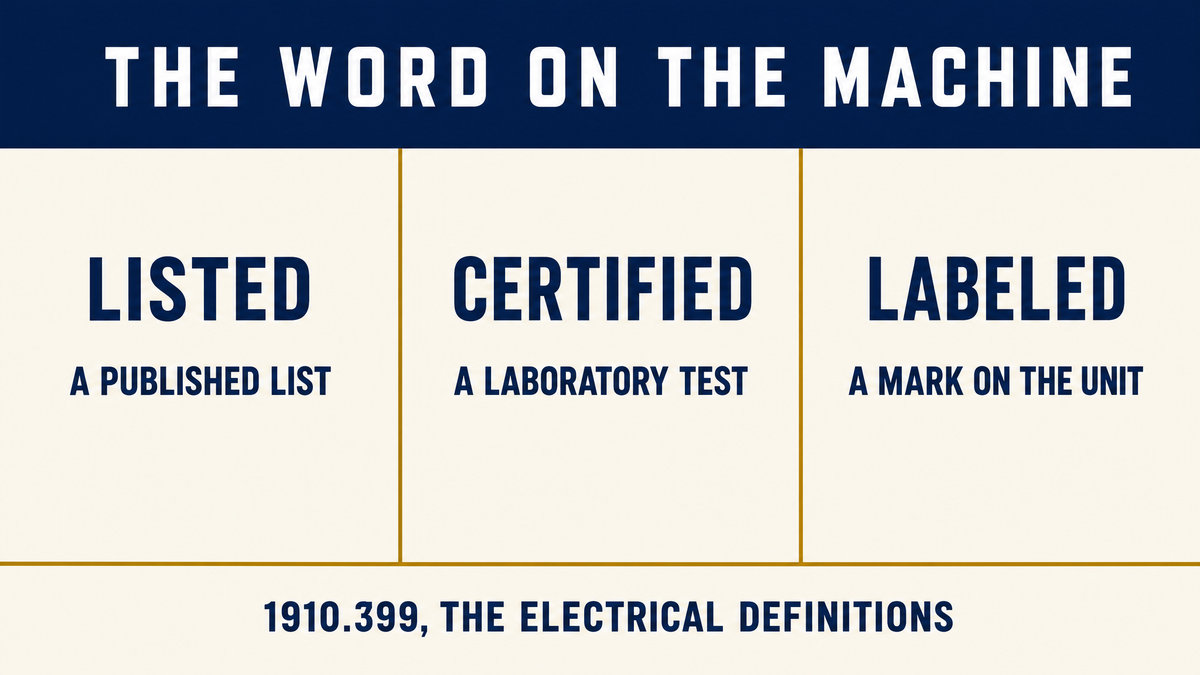
The definitions behind those words are short enough to quote one by one. Approved means acceptable to the authority enforcing the subpart, which the definition names as the Assistant Secretary of Labor. Certified means the equipment bears a label, tag or other record of certification that it has been tested and found by a nationally recognized testing laboratory to meet nationally recognized standards or to be safe for use in a specified manner, or that its production is periodically inspected by such a laboratory. Listed means the equipment is of a kind mentioned in a list published by a nationally recognized laboratory that makes periodic inspection of the production. Labeled means the mark of such a laboratory is attached to it.
Put together, the chain runs in one direction. A laboratory recognized under § 1910.7 tests or lists or labels the equipment; that determination is what makes it acceptable; and approved is simply the word for acceptable in the eyes of the enforcing authority. So the mark on a control panel is not an agency's approval of a machine. It is a laboratory's statement about a scope, and the scope is the thing a buyer has to ask about.
Three words, and what each one is worth asking for
| Word | What it establishes | What to ask for |
|---|---|---|
| Acceptable | A laboratory found it safe | The laboratory and its scope |
| Certified | Tested, or production inspected | The record and what it covers |
| Listed | A published list, re-inspected | The list entry, by model |
Three cautions come with that table, and each one has cost a buyer a shipment at some point. The scope is not the machine. A listing that covers a control panel is not a statement about the guarding, and a buyer who reads the mark as a whole-machine approval has read it wrong. The mark is not a certificate of the design. Nothing in this chain addresses the danger-zone sentence in section 2, which is why the two have to be checked separately. And the word in the catalogue is not the word on the machine: a listing is a document about a model, and a model name that was never listed is a claim, not a listing.
6. What the Record Says
Method first. The federal recall file holds 245,845 records, has no header row, and every field is scanned. Controls: brake 28,639, air bag 16,162. Twenty-five terms were counted, and four came back at zero.
| Term | Records | Campaigns |
|---|---|---|
tire | 29,586 | 1,048 |
tires | 24,210 | 722 |
tyre | 32 | 12 |
wheel | 12,289 | 1,273 |
rim | 1,712 | 115 |
bead | 139 | 19 |
machine | 354 | 34 |
changer | 0 | 0 |
changers | 0 | 0 |
balancer | 0 | 0 |
demount | 0 | 0 |
clamp | 1,448 | 169 |
turret | 11 | 2 |
chuck | 3 | 1 |
guard | 383 | 50 |
interlock | 900 | 117 |
pinch | 198 | 41 |
rotating | 88 | 24 |
rotation | 240 | 52 |
hydraulic | 9,711 | 963 |
pneumatic | 20,019 | 137 |
pedal | 3,282 | 378 |
arm | 4,612 | 429 |
mount | 1,274 | 175 |
swing | 108 | 32 |
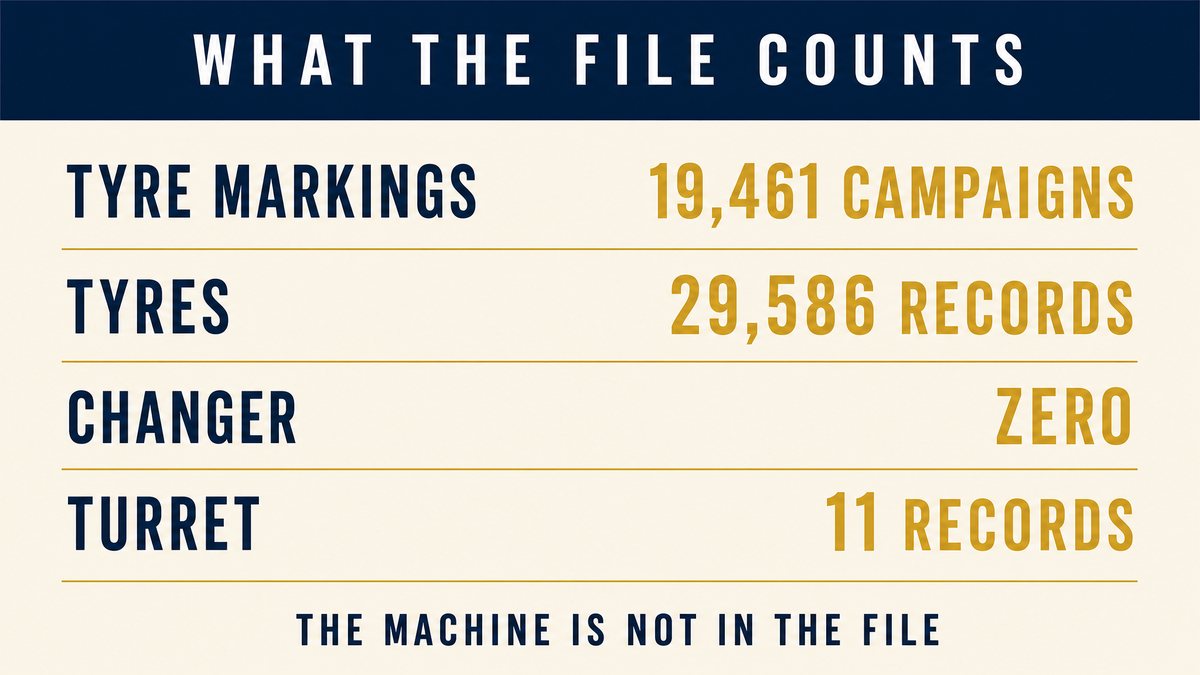
The four zeros are the product's own names. changer, changers, balancer and demount return nothing at all across a quarter of a million records. That is the sharpest version of the pattern this series has been recording for six articles: the wiper blade was thin, the jack's own word was the thinnest in its table, and here the machine's name is absent while the thing it works on appears in tens of thousands of rows.
The file counts the tyre exhaustively, and it counts it by its markings. The component headings make the point without any counting of prose: TIRES:MARKINGS carries 19,461 campaigns, then TIRES at 1,368, TIRES:VALVE at 653, TIRES:TREAD/BELT at 458, TIRES:SIDEWALL at 316, the pressure monitoring heading at 271, the temporary spare heading at 187, TIRES:BEAD at 86 and TIRES:TUBE at 1. One equipment row sits at the bottom with 7 campaigns: a spare tire mount or rack. So the taxonomy runs from the marking on the sidewall down to the tube inside, and it stops at the machine that puts the tyre on the rim.
The machine's vocabulary belongs to other things. clamp reaches 1,448 records, and the largest rows are battery hold-downs and hose clamps: a Toyota RAV4 campaign at 1,853,568 units filed under the battery heading, then fuel-line and power-steering rows. interlock at 900 records is mostly brake-light switches and shift interlocks, led by a Hyundai Genesis Coupe campaign at 1,712,336 and a Ram 2500 campaign at 1,482,874. guard at 383 is mud guards and a floor liner. turret appears eleven times in two campaigns: a Ford Bronco Sport body row with 23 units and a crane with 4. chuck appears three times. The words a machine builder uses every day are all in the file, and not one of them is doing the same job.
One ratio worth keeping. pneumatic reaches 20,019 records but only 137 campaigns, which is 146 records per campaign — the highest density in the table by a wide margin, because the word sits inside long suspension and brake descriptions rather than in headings. The machine in this article is largely pneumatic, and the word that describes it is present in volume while pointing at something else entirely. tire by contrast runs 28 records per campaign, spread across 1,048 campaigns, which is what a word with its own taxonomy looks like.
The spelling finding repeats exactly. tire 29,586 against tyre 32 is the same pair and the same ratio recorded at row 44 — roughly 925 to 1. It is the widest split in the series, and it has now appeared twice because the two articles sit on the same word. For a machine sold into the United States, the catalogue, the manual and the control panel all take the American spelling.
The finding. The record carries the tyre from its marking to its tube and does not carry the machine that fits it. That is not a gap in the data; it is a fact about where the risk is filed. A tyre defect is a highway defect with a recall number, and a machine that mangles a hand in a workshop is a workplace matter with a citation, not a campaign. So for this product the record is silent by design, and the only documents that speak are the guarding rule, the electrical definitions and the manual the factory writes.
7. Five Questions a Tire Changer Quote Should Answer
A machine quotation usually arrives with a cycle time, a clamping range, a motor rating and a price. Those are the four numbers a buyer compares, and none of them answers the paragraph that decides whether the machine can be used in the customer's shop. Five questions do.
- Show the guard, and describe the cycle it guards. Where can a hand reach while the table turns? The rule is written as an outcome: no part of the body in the danger zone during the operating cycle. A photograph of the guard in place answers more than a word in a brochure.
- Does the drawing show anchor points and a bolt pattern? A fixed machine has to be anchored so it will not walk. If the base has no provision for fixings, the paragraph has been handed to the customer.
- Which laboratory's mark is on the panel, under which standard, and what does the scope cover? A listing that covers a control panel is not a statement about the guarding, and the two have to be checked separately.
- Is the guard affixed to the machine, and does it create a hazard of its own? The rule asks for a guard that is attached where possible and that does not offer an accident hazard in itself. A raw edge or a new pinch point fails both halves of that sentence.
- Which exact model is listed, and is that the model in the catalogue? A listing is a document about a model. A model name that was never listed is a claim, and it is the commonest mismatch between a quotation and a machine.
8. Six Lines to Put in the Order
Everything above reduces to six lines that belong in the order document rather than in a message thread.
| Line | What to write | Why it is on the list |
|---|---|---|
| 1 | The guard, its position, and what it prevents during the cycle | The rule is an outcome, and the outcome is a body kept out |
| 2 | The anchor points and the bolt pattern, on the drawing | A fixed machine has to be anchored against walking |
| 3 | The laboratory, the standard and the scope of the mark | The chain of words in the electrical subpart |
| 4 | The model name that appears on the listing | A catalogue word is not a listing entry |
| 5 | The manual's description of the operating cycle | The outcome is proved by the cycle, not by a label |
| 6 | The parts list for the guards and the clamp jaws | Guards wear, and a removed guard is a missing one |
Look at what is missing from that list: there is no certificate line and no rated-capacity line. The jack article ended with two of each, because a mark and a number were the whole of its federal surface. Here the surface is a guard, a hole in a base plate and a laboratory's scope, which is to say the specification sits in the machine rather than in a document.com/factory-audit-checklist-guide/" target="_blank" rel="noopener">how an audit tests a claimed listing is where the paperwork meets the floor, and the checks made before a machine is crated are where a guard survives the trip — with how a machine's volume decides the freight worth settling at the same time, because a tire changer bills on the space it takes rather than the mass it carries.
Frequently Asked Questions
Does a tire changer need a certificate in the United States?
No agency approves the machine. The federal text that reaches it states an outcome: the point of operation must be guarded so the operator cannot get any part of the body into the danger zone during the operating cycle. The electrical side runs through a different set of words, where equipment is acceptable when a nationally recognized testing laboratory has accepted, certified, listed or labeled it.
What does 29 CFR 1910.212 require of a tire changer?
Guarding against the hazards the section names, which include the point of operation, ingoing nip points, rotating parts, flying chips and sparks. Guards must be affixed to the machine where possible and must not create a hazard of their own. The point of operation must be guarded so no part of the body can reach the danger zone during the cycle, and a machine designed for a fixed location must be securely anchored.
Is a tire changer on the list of machines that need point-of-operation guarding?
The list names nine machines — guillotine cutters, shears, alligator shears, power presses, milling machines, power saws, jointers, portable power tools, and forming rolls and calenders — and a tire changer is not one of them. The list is introduced as some of the machines, and the duty in the paragraph before it is written about any machine whose operation exposes an employee to injury, so the omission does not remove the requirement.
Is a CE mark enough for the US market?
CE is a European marking and it is not one of the words the electrical subpart uses. Those words are acceptable, approved, certified, listed and labeled, and they point at a nationally recognized testing laboratory recognized under the relevant section. A buyer comparing a European and a Chinese machine for the United States should ask which mark is on the panel and what its scope covers.
What does listed mean in this context?
Equipment is listed if it is of a kind mentioned in a list published by a nationally recognized laboratory that makes periodic inspection of the production of such equipment. Certified means it bears a record that a laboratory tested it, or that its production is periodically inspected. Labeled means the laboratory's mark is attached. All three are statements about a scope, not about the whole machine.
Why does anchoring matter on a tire changer?
Because the rule says a machine designed for a fixed location shall be securely anchored to prevent walking or moving. A tire changer's bead breaker pushes sideways and its table turns a wheel, so the base is part of the specification rather than a detail of installation. A drawing with anchor points and a manual that names the fixing are the two things a buyer can check before ordering.
A tire changer is not regulated as a tire changer. It is regulated as a machine with a rotating table and a bead breaker, which puts it under the general guarding rule in 1910.212, a rule that never mentions tires.
The gap is where the commercial risk sits. The buyer asks for a mark or a certificate, and the honest answer is that the duty falls on the employer who installs the machine rather than the factory that welds it. What the order can carry is the guard, the interlock and the plate, specified rather than assumed.
Anchored, Not Moving: The Figure You Need
We return the guard dimension, the anchoring specification, and the three words that have to appear on the machine itself.
Note My Anchoring
Questions & Comments
We read every one and reply within 24 hoursA tire changer is a machine under 1910.212 before it is a garage tool. Send the model and the destination, and we will separate the factory's guarding duty from the installer's.