
Intercooler Manufacturer: One Record, No Rule
 ·
Updated October 22, 2026
·
10 min read
Twenty-three articles in this series have opened with the question of which document governs a part. For an intercooler the answer takes one sentence, because there is no document at all: not a standard, not a marking duty, not a category in the aftermarket parts subpart, not even an inspection clause. The federal text mentions the word eleven times and never once about the part.
What makes it worth a row is what the record does with it. Everything else in this series has had a footprint — thousands of campaigns for a seat belt, hundreds for a tie rod, nine for a coil, none at all for an air cleaner. The intercooler has one. A single campaign in 245,845 records contains the word, and it is a Volkswagen radiator recall where the intercooler appears in passing.
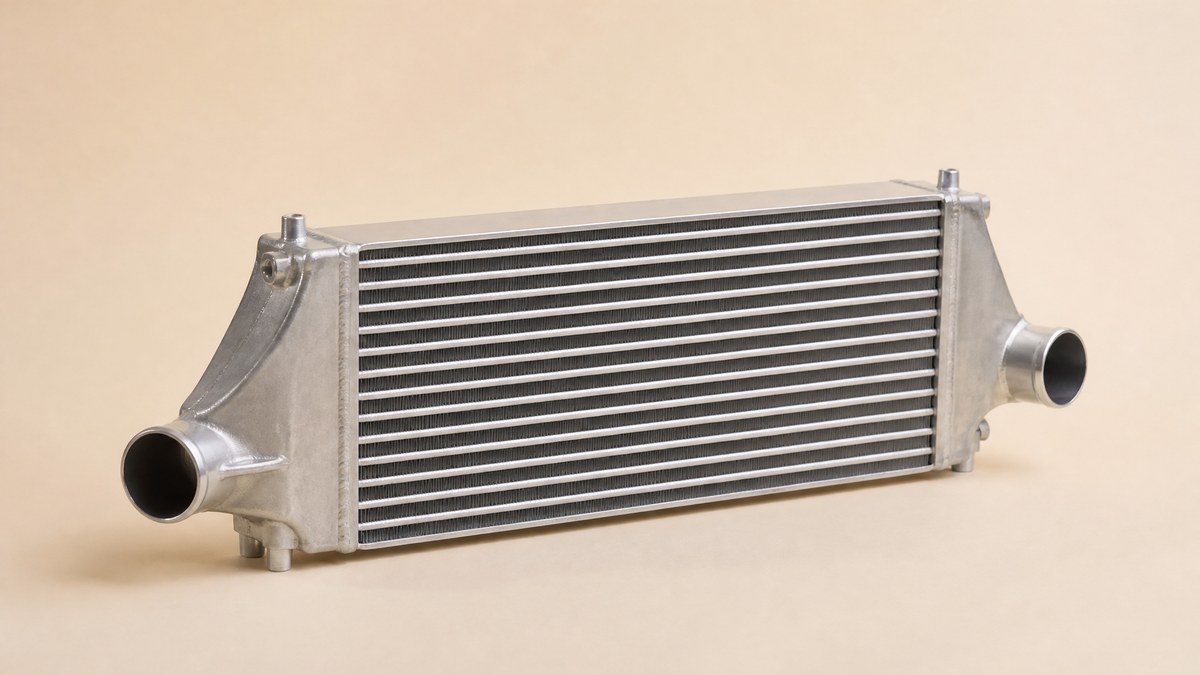
1. One Campaign in a Quarter of a Million Records
Method unchanged. The federal recall file holds 245,845 records across 15,305 campaigns, no header row, every field scanned, twenty-five terms each with its own pattern. Controls: brake 28,639, air bag 16,162.
Alongside the twenty-five terms, two facts about the index matter more than the counts. There is no intercooler heading: the nearest are ENGINE AND ENGINE COOLING:ENGINE:GASOLINE:TURBO/SUPERCHARGER with 181 campaigns and COOLING SYSTEM:RADIATOR, which is where the one intercooler record was filed. And the word itself is rare in free text — 16 records, one campaign, a Volkswagen radiator recall covering 8,038 vehicles.
| Measure | Value |
|---|---|
Records containing intercooler | 16 |
| Campaigns containing it | 1 |
| Headings naming it | 0 |
Records containing charge, the generic word | 239,004 — 14,348 campaigns, almost all of them battery charging |
Records containing turbo | 2,356 across 127 campaigns |
The generic word is the trap this series has hit four times now. Charge appears in 239,004 records and almost every one of them is a charging-system fault, not charge air. A supplier researching the field by keyword would conclude the part is everywhere; it is nowhere.

2. Eleven Mentions, None About the Part
A full-text search of the Code of Federal Regulations for intercooler returns eleven matches. They sit in Title 14 Part 23, which is aircraft; Title 40 Part 89, which is nonroad engines; and Title 40 Part 86, in the emissions test procedures and the on-board diagnostic rules. Not one of them specifies the part.
That is a different kind of silence from the ones already mapped. The oil filter had no parameter but had a measuring method. The air cleaner had a parameter list and no column. The intercooler has neither: it is named only as a component that happens to be present while something else is being measured, and the test procedures that name it are about exhaust emissions, not about a heat exchanger.
For a buyer, that has one practical consequence and it is not a small one. There is no external document to appeal to when a core arrives that does not cool. The specification has to be built and written, and the only feedback is a bench test the buyer commissions.
3. Two Numbers That Pull Against Each Other
An intercooler sits between the turbocharger and the engine and does one thing: it removes heat from compressed air. Compressing air raises its temperature, hot air is less dense, and less dense air means less oxygen in the cylinder. Cooling it back down recovers the density, and density is the whole point of a turbocharger.
So the performance of the part is two numbers: how much temperature it removes, and how much pressure it costs. They are not independent. Every row of fins, every millimetre of core thickness and every bend in the end tank that improves cooling also adds restriction, and restriction is lost boost. A larger core cools better and spools later; a thinner one spools sooner and heat-soaks faster.
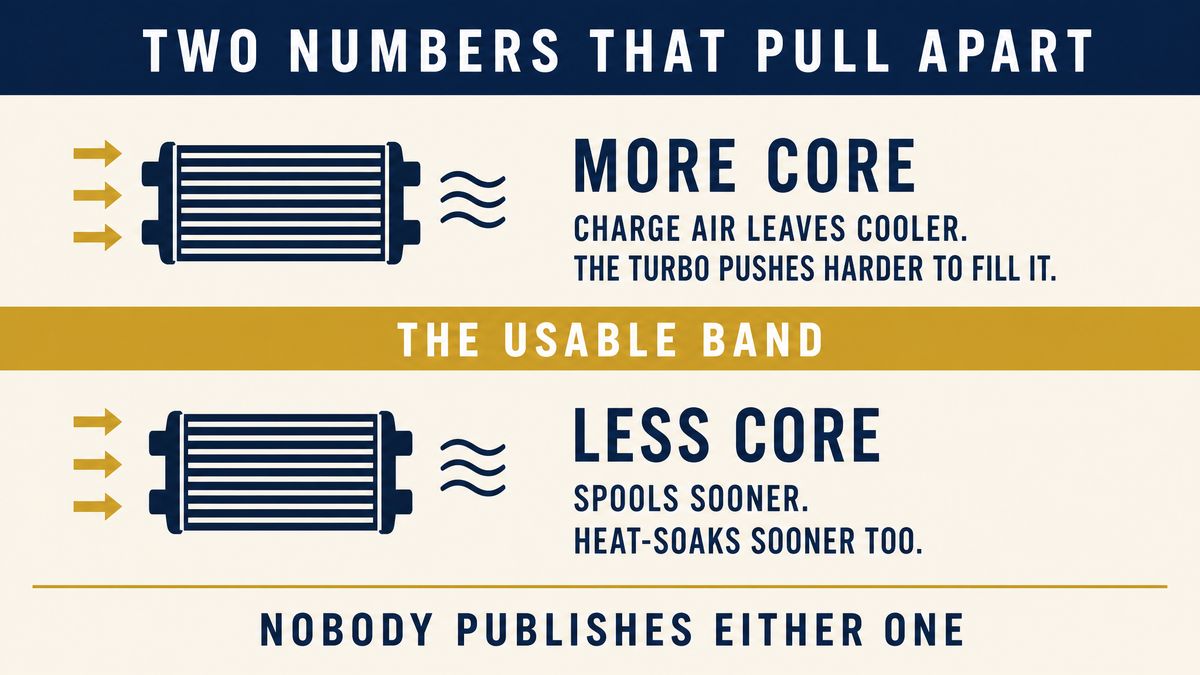
No federal document supplies either figure for any vehicle, and no industry standard is cited in one. What the vehicle maker publishes is a target outlet temperature and an acceptable pressure drop at a stated mass flow, both of which live on a drawing.
Sizing is where a supplier and a buyer usually talk past each other. Face area and core thickness are not interchangeable: area lowers the velocity through the core, which lowers restriction for a given cooling, while thickness adds cooling and adds restriction at the same time. A core sized for twice the power of the engine it is fitted to is worse everywhere except on a dyno pull, because the charge air spends longer inside it at low flow and the turbocharger has to push harder to fill it.
4. Where the Part Sits Matters More Than What It Is Made Of
Three placement problems decide whether a good core performs badly.
Airflow. A front-mounted core gets clean, cool air; a top-mounted one gets what comes through the bonnet, and at low speed that is nothing. The same core in the two positions behaves like two different parts.
Heat soak. Stopped in traffic, a front-mounted core absorbs heat from the radiator and the engine bay until it is no cooler than the manifold. The first hard acceleration after that is worse than no intercooler at all, because the core has to be cooled before it can cool anything.
Condensation. Cooling compressed air condenses water out of it. A core that collects that water at the lowest point of the end tank will, on a cold start, ingest it. The fix is a drain or a geometry that keeps the outlet above the low point, and it is a design decision nobody can inspect from outside.
One practical test follows from those three. A supplier who offers a single core for both a front-mount and a top-mount application is selling a shape rather than a part: the tank orientation, the mounting points and the drain all differ between the two, and a core that claims to fit both fits neither well.
5. What Kills a Core
Five failures account for almost everything, and none of them is a manufacturing defect in the sense a drawing would catch.
Fins. The external fins are the cooling surface and the first thing to crush. A stone, a pressure washer held too close, or a mounting that lets the core flex will flatten a band of fins and remove that area from service permanently. Some of that damage happens before the part is fitted, which is why the packaging checklist belongs with the drawing.
Tubes. Internal tubes carry the charge air. A tube that is pinched at the header, or a braze that is starved at one joint, becomes a leak that shows up as a boost fault long before it shows as a stain.
Brazing. Aluminium cores are joined in a furnace braze. The process is sensitive to fit-up, to the clad layer and to the temperature profile, and a core that is under-brazed at one corner will pass a pressure test when new and weep after a thousand thermal cycles.
Oil. Turbo seals pass a film of oil into the charge air, and oil coats the inside of the tubes. It insulates, it collects dust, and over time it reduces the heat transfer of the whole core without blocking it.
Debris. Anything that gets past the air filter arrives at the core. A blocked core behaves like a restricted one: pressure drop rises and charge temperature climbs, and the driver reports a power loss rather than a cooling problem.
6. How to Check One Without a Wind Tunnel
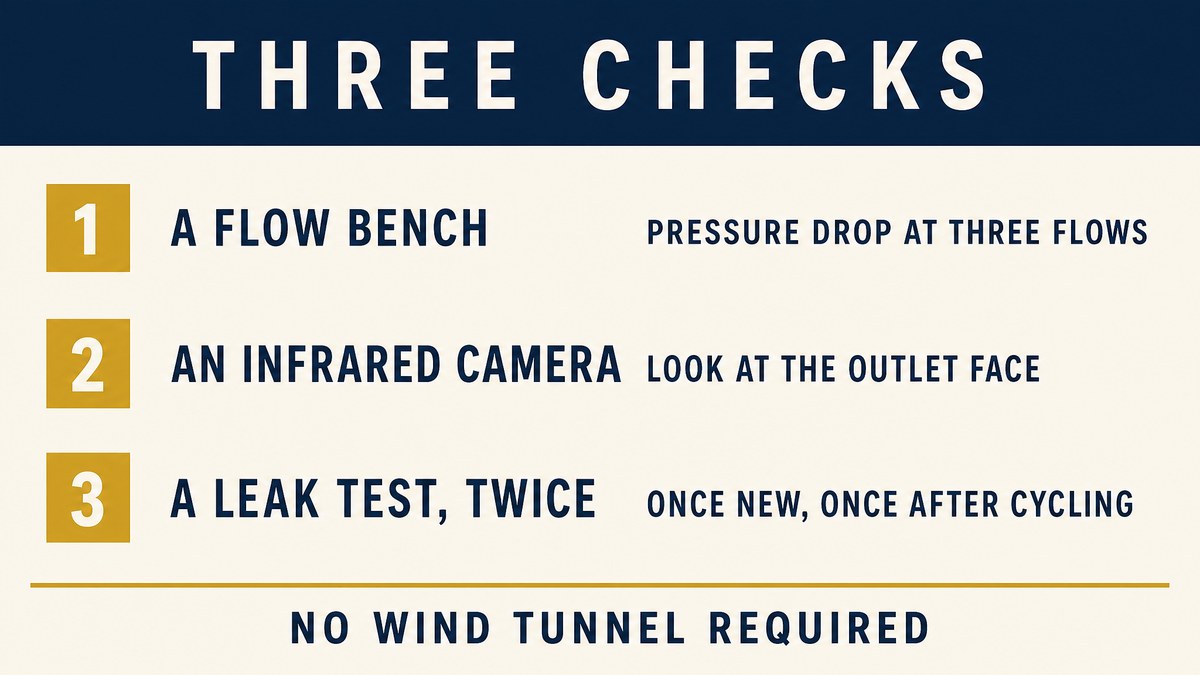
Because no document supplies a figure, a buyer who wants evidence has to commission it, and three checks cover most of the risk without a test cell.
A flow bench, not a pressure washer. Measure the pressure drop across the core at the mass flow the engine will actually see, and do it with the inlet at a realistic temperature. A restriction curve at one point tells you less than a curve at three, and a bench report that carries the method is the kind of evidence a factory audit can actually check.
An infrared camera across the face. Run the core up to temperature and look at the outlet face. A core that is hot in one corner and cold in the rest has a distribution problem in the end tank, and no amount of fin density will fix it.
A leak test after thermal cycling. Pressure-test the core, cycle it between cold and operating temperature a few dozen times, and pressure-test it again. A joint that was starved of braze will show up in the second test and not the first.
7. Where the Price Difference Comes From
Two cores that fit the same space differ in four places, and only one of them is visible in a photograph.
The core itself. Bar-and-plate and tube-and-fin are different constructions with different failure modes. Within either, the fin density and the tube wall thickness set the trade between cooling and restriction.
The braze. Clad thickness, furnace profile and the cleanliness of the assembly decide the joint. It is the least visible and the most expensive to get wrong.
The end tanks. Cast or fabricated, and shaped so the air enters the whole face rather than the near corner. A tank that distributes badly wastes a third of the core.
The mounting. Rubber isolators and the way the core is held decide whether vibration cracks a tank or a header. On a part with no warranty document behind it, the mounting is where the field failure usually starts.
8. Seven Questions an Intercooler Quote Should Answer
A quotation in this category is a photograph, a core dimension and a price. The seven questions below are the ones that decide whether the core that arrives does the job the turbocharger was fitted for.
- Pressure drop at what mass flow? A restriction figure without a flow rate is not a specification. Ask for the flow, the inlet temperature and the boost at which it was measured.
- What outlet temperature, at what ambient? The cooling claim has to be tied to an ambient temperature and an inlet condition, or it describes a bench on a cold morning.
- Which construction, and what fin density? Bar-and-plate or tube-and-fin, with fins per inch and tube wall thickness. This is the trade, written down.
- How is it brazed, and was it leak-tested after thermal cycling? A pressure test when new proves very little about a furnace-brazed aluminium joint.
- Cast or fabricated tanks, and how do they distribute? A tank that feeds the near corner wastes core area.
- What holds it, and to what? Isolators, brackets and the points they attach to decide how long a tank lasts.
- Two prices. One as quoted, one with the six items below written into it.
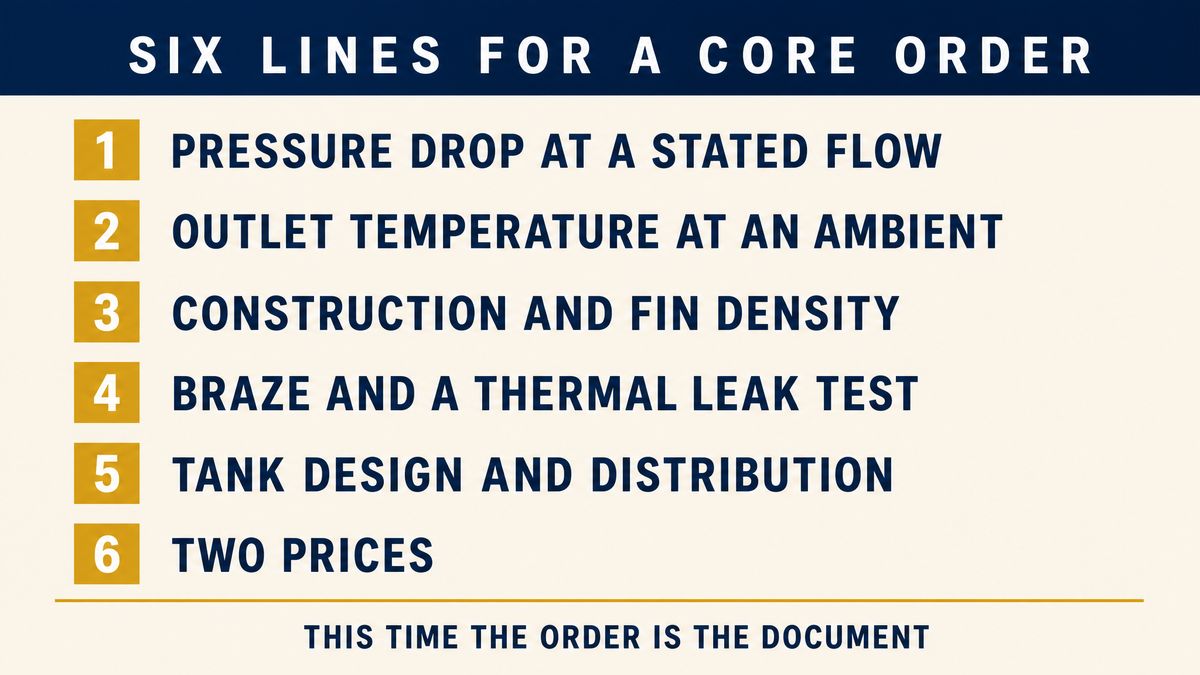
9. Six Lines to Put in the Order
There is no document to attach to this order, which is the point of the row. These six lines are the document.
- Pressure drop at a stated mass flow, inlet temperature and boost.
- Outlet temperature at a stated ambient.
- Construction, fin density and tube wall thickness.
- Braze process and a leak test after thermal cycling.
- Tank design and how it distributes.
- Two prices: as quoted, and with the five items above written into it.
An intercooler is a heat exchanger with no document behind it. Sixteen records in a file of a quarter of a million, one campaign, and eleven mentions of the word across the CFR that all belong to something else.
What remains is a trade-off rather than a rule: cooling on one side, pressure drop on the other, and an operating band that has to be found on a flow bench because no clause will hand it to you.
Where the Braze Was Checked, Photographed
A photo set of every tube-to-header joint at magnification, with the leak test pressure written on the frame and the date. Every frame is numbered so the photo matches the core it came from.
Photograph My JointsFrequently Asked Questions
Is there a federal standard for intercoolers?
No. A full-text search of the Code of Federal Regulations returns eleven matches for the word, in aircraft rules, nonroad engine rules and emissions test procedures, and none of them specifies the part.
What does an intercooler actually do?
It removes heat from the air the turbocharger compressed. Cooler air is denser, denser air carries more oxygen into the cylinder, and that is where the power comes from.
Why does pressure drop matter as much as cooling?
Because every restriction costs boost. A core that cools beautifully but drops two pounds of pressure has given back some of what the turbocharger produced, and the two effects have to be judged together.
Why is there only one recall record for the part?
Because the recall taxonomy files it under the systems around it, such as radiator or turbocharger, and there is no intercooler heading at all. The word appears in sixteen records, all in one campaign.
Front-mounted or top-mounted?
Front-mounted gets cooler air and heat-soaks in traffic; top-mounted gets hot bay air and is fed by the bonnet scoop. The same core behaves like a different part in each position.
What fails first on a cheap core?
The external fins, then the mounting. Crushed fins remove cooling area permanently, and a mounting that lets the core flex cracks a tank at the header long before the braze gives way.
Questions & Comments
We read every one and reply within 24 hoursAn intercooler has no clause to appeal to, only a trade-off between cooling and pressure drop. Send the engine data, and we will put both claims on one flow basis.