
Cargo Net Manufacturer: The Number That Gets Divided
 ·
Updated October 22, 2026
·
12 min read
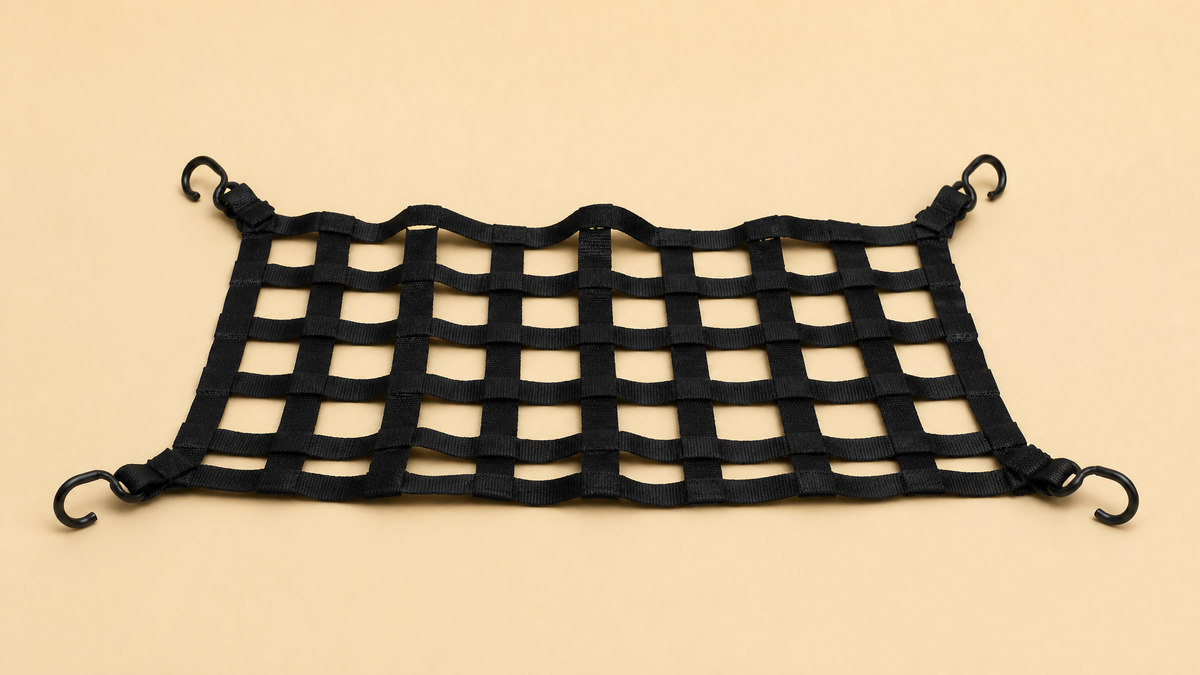
Every article in this series has ended with a number to pin, and most of those numbers were meant to be read. A rim size, a fitment, a rated load, a laboratory scope, a fire rating. This one is different in a way that catches buyers out: the working load limit on a tie-down is a number that gets divided. The federal rule does not require a strap to be strong enough for the load. It requires the aggregate of everything securing the article to reach half the weight of that article, and how much of a strap's marked limit counts depends entirely on how the strap is routed. The same 10,000 pound tiedown contributes five thousand or ten thousand, and the difference is a drawing rather than a material. This article reads the arithmetic, the standards the section names by material, and what all of it means for a net that arrives as one part with many legs.
1. The Number Is a Divisor
Start with the sentence that governs the whole category, because it is short and it changes what a specification is for:
“(d) Aggregate working load limit for tiedowns. The aggregate working load limit of tiedowns used to secure an article or group of articles against movement must be at least one-half times the weight of the article or group of articles.” — 49 CFR § 393.106(d)
Half the weight is the target, and the next three paragraphs say what counts towards it. They are worth reading twice, because they are the most consequential three sentences in this article:
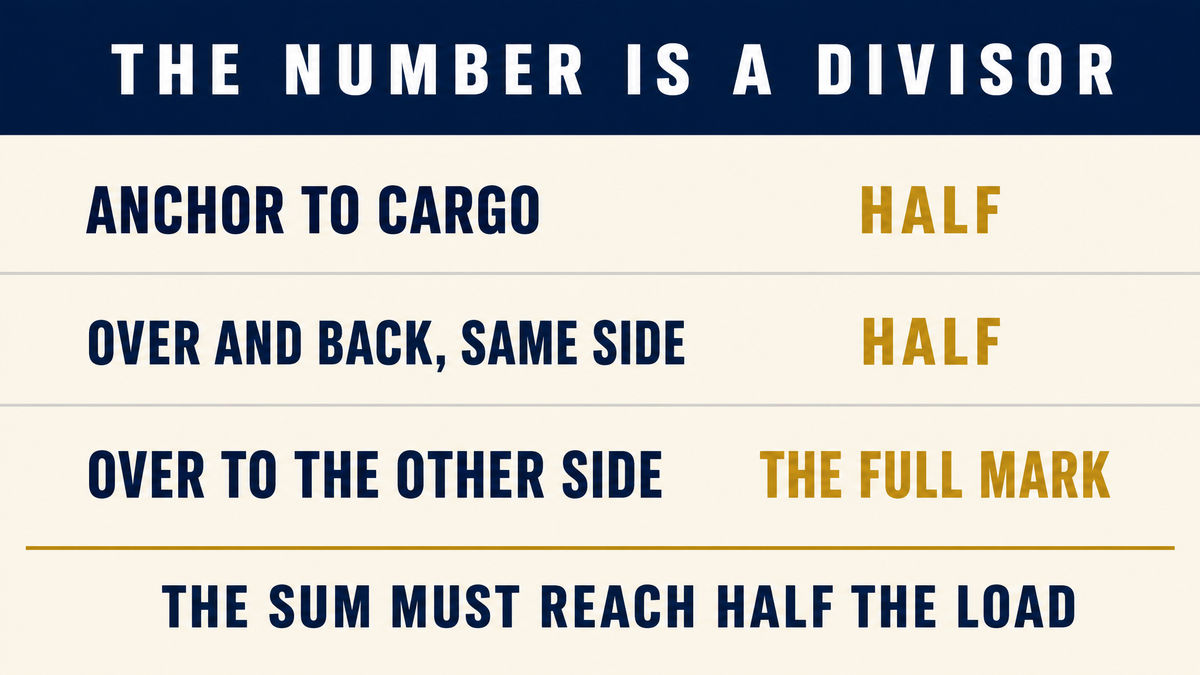
“(1) One-half the working load limit of each tiedown that goes from an anchor point on the vehicle to an anchor point on an article of cargo; (2) one-half the working load limit of each tiedown that is attached to an anchor point on the vehicle, passes through, over, or around the article of cargo, and is then attached to an anchor point on the same side of the vehicle; (3) the working load limit for each tiedown that goes from an anchor point on the vehicle, through, over, or around the article of cargo, and then attaches to another anchor point on the other side of the vehicle.” — 49 CFR § 393.106(d)(1)–(3)
Work one example and the shape of the problem appears. Take an article weighing 20,000 pounds. The aggregate has to reach 10,000 pounds. Four tiedowns rated at 5,000 pounds, each running from a vehicle anchor to an anchor on the cargo, contribute four times 2,500, which is exactly 10,000. Two of the same 5,000 pound tiedowns, each crossing over the cargo to an anchor on the other side of the vehicle, contribute two times 5,000, which is also 10,000. Same devices, same load, half the count — because the routing changed.
That is why this number is a divisor rather than a cut-off. A supplier who quotes a strap by its rated limit has quoted half a fact. The other half is the route, and the route belongs to the vehicle, the cargo and the drawing, not to the webbing.
2. What the Section Names, and What It Does Not
The same section carries a table of manufacturing standards, and it is the closest thing in this part of the code to a material specification. It works by naming an assembly component and then naming the standard that component has to conform to:
| Component | Standard the section names |
|---|---|
| Steel strapping | ASTM D3953-97, Standard Specification for Strapping, Flat Steel and Seals, February 1998 |
| Chain | National Association of Chain Manufacturers' Welded Steel Chain Specifications, September 28, 2005 |
| Webbing | Web Sling and Tiedown Association's Recommended Standard Specification for Synthetic Web Tiedowns, WSTDA-T1, 1998 |
| Wire rope | Wire Rope Technical Board's Wire Rope Users Manual, 2nd edition, November 1985 |
| Cordage | Five Cordage Institute standards: PETRS-2 (1993), PPRS-2 (1992), CRS-1 (1979), NRS-1 (1979) and C-1 (1984) |
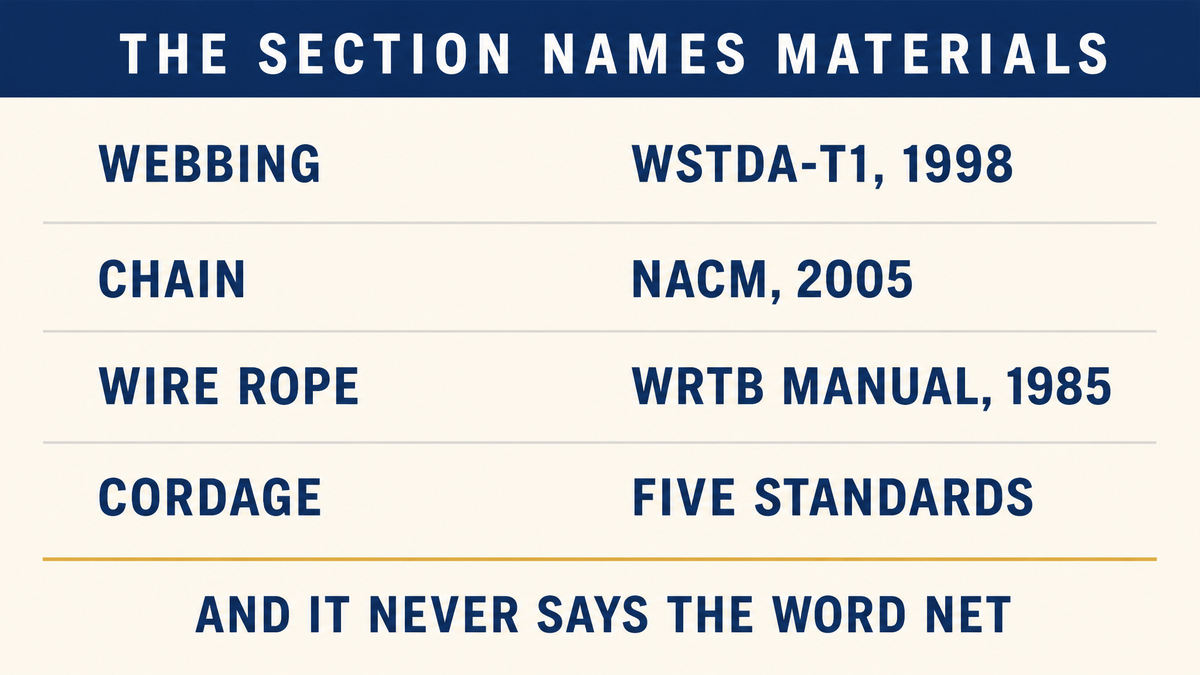
Now the part that matters for this article. The word net does not appear in the section. What appears is a list of materials, and a net is made of one of them: either synthetic webbing, if it is woven flat, or cordage, if it is twisted rope. So a cargo net reaches the regulation through its material rather than through its name, and the standard it has to conform to is decided by what it is woven from.
That is not a technicality; it is the whole specification problem in one sentence. A buyer ordering a net is ordering an assembly, and the section regulates components. The bridge between the two is a number the assembly has to carry — its working load limit — and a material the components have to meet. Ask for one without the other and the quotation will be complete on paper and silent where it matters.
Four use rules in the same section belong on the same page, because all four are things a factory can get wrong without noticing. Tiedowns must not contain knots. If one is repaired, the repair has to follow the standards in the table or the manufacturer's instructions. Each tiedown has to be attached so that it cannot become loose, unfasten, open or release while the vehicle is in transit. And where a tiedown touches cargo in a way that could abrade or cut it, edge protection must be used and must itself resist abrasion, cutting and crushing.
Read those four together and a net's design brief writes itself. A knot in a net is a defect rather than a field repair. A hook that can open under vibration fails the third rule. A leg that crosses a steel edge fails the fourth unless the net carries a sleeve there. None of those are visible in a photograph of the product, and all of them are visible in the first month of use.
3. The Unmarked Quarter
Two footnotes in that table carry a commercial consequence that most buyers never see, and they are the reason a marking agent is not cosmetic.
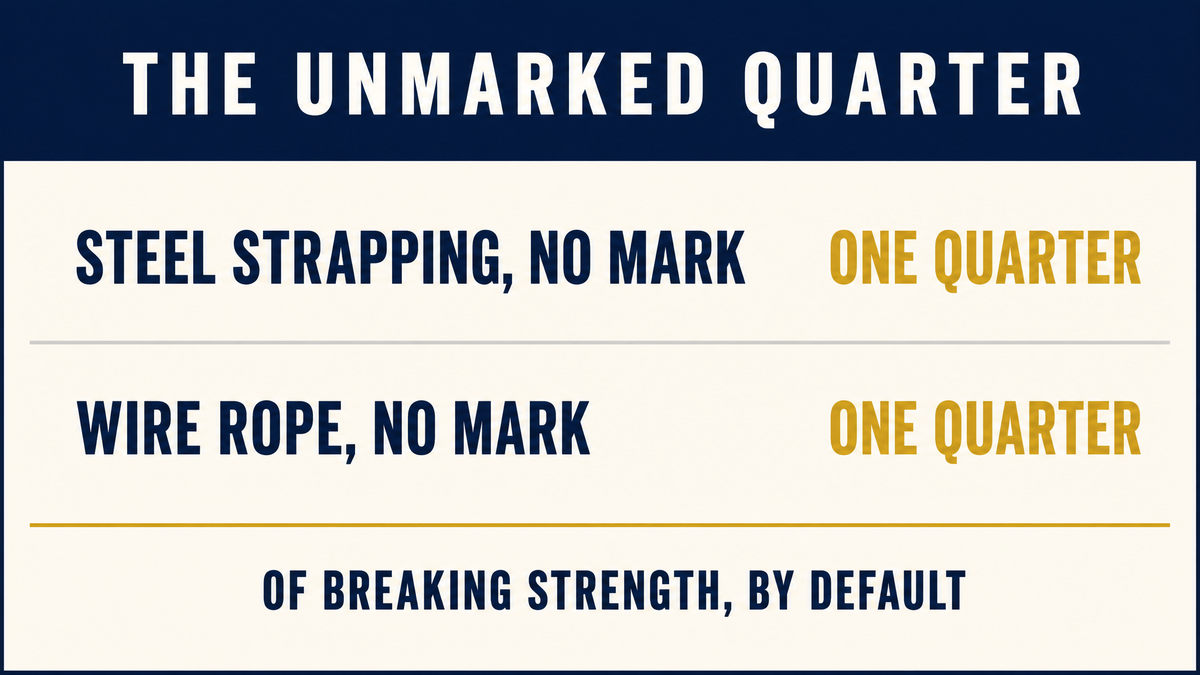
“Steel strapping not marked by the manufacturer with a working load limit will be considered to have a working load limit equal to one-fourth of the breaking strength listed in ASTM D3953-97. … Wire rope which is not marked by the manufacturer with a working load limit shall be considered to have a working load limit equal to one-fourth of the nominal strength.” — 49 CFR § 393.104(e), footnotes 1 and 3
Read that as arithmetic and it is severe. A tie-down that could have been counted at 5,000 pounds is counted at 1,250 if nobody marked it. The customer then needs four times as many devices to reach the same aggregate, or a stronger device to do the same job, and the saving that made the unmarked product attractive disappears in the load plan. The code does not ban the unmarked device. It prices it.
For webbing, the code takes a different route: instead of writing a default, it incorporates WSTDA-T1, 1998 by reference. So the marking question for a net moves into the standard rather than staying in the regulation, and a buyer's check becomes a question about the tag on the assembly: what limit does it state, on what basis, and does the number survive the first season of use.
There is a second, quieter consequence. A mark is only useful if it is readable at the point of use, and the section's own opening paragraph says a tiedown must be in proper working order with no cracks or cuts that reduce the working load limit. A tag that has weathered away, or a stencil that the webbing has absorbed, leaves the customer in the same position as an unmarked device — with a number nobody can point to. That is why the best suppliers in this category stitch a label into the webbing rather than printing on it, and why the same suppliers put the limit on the label in whole pounds rather than in a code.
4. A Net Is Not a Strap
A strap is one leg with two ends. A net is a mesh with several legs, and that difference is where the aggregate arithmetic becomes a sourcing problem rather than a maths exercise. The regulation sums tiedowns, and it does not say whether a net is one tiedown or as many as it has legs. So a buyer is left with a question that has to be settled in the document: what is the working load limit of this assembly, and on how many attachment points is it claimed?
The routing rules from section 1 then do the rest, and the table below is the same three paragraphs expressed as a purchasing question.
Three routes, and what each one counts
| Route | Share of the mark | What it asks of the product |
|---|---|---|
| Anchor to cargo | One half | A rated end fitting |
| Over, back, same side | One half | A mark that survives contact |
| Over to the other side | The full mark | Length enough to cross |
Two of those three routes halve the number, which is why a net sold into flatbed work is often specified longer than the cargo is wide. A net that can reach the anchor on the far side counts at full value; the same net tied back to the near side counts at half, and the customer needs twice as many of them. That is a design decision that belongs in the catalogue, and it is invisible unless somebody asks how the customer intends to route it.
The assembly also has to answer the four use rules from section 2 in a way a strap does not. No knots means the mesh has to be joined by splicing, stitching or hardware, not by tying two legs together when a corner is short. No opening in transit means the hooks have to be closed or locking rather than open, because a net's whole advantage is that it is loaded and unloaded quickly. Edge protection means the legs that cross a steel edge need a sleeve, and the sleeve is a line item. And no weakened components means a cut leg retires the assembly rather than the leg, because the aggregate was a property of the whole.
5. What a Quote Has to Carry
Put the arithmetic and the material list together and the quotation for a net has five things to state, none of which is a price. They are worth listing because a net is the one product in this series where the customer's own calculation depends on the supplier's drawing rather than on a certificate.
The assembly limit, and the basis of it. One number for the net as delivered, and a statement of whether it is claimed for four attachment points or for the whole mesh. If the limit is claimed per leg, say so, because the aggregate is a sum and the customer will add them up.
The material and the standard behind it. Synthetic webbing to WSTDA-T1, or cordage to one of the five Cordage Institute standards, or both if the net mixes a webbing border with a rope mesh. A net described only as nylon has told the buyer a fibre and nothing about the standard the code names.
The tag, and where it lives. Stitched rather than printed, on the assembly rather than the carton, and stating whole pounds rather than a colour code. For strapping and wire rope the code supplies a default for silence, and the default is a quarter. For webbing the standard is incorporated by reference, so the tag is the only visible evidence a checker will find.
The hooks, and whether they can open. A net is loaded and unloaded dozens of times a shift, so an open hook is the natural choice and the wrong one. The rule asks that a tiedown cannot unfasten or release in transit, which puts closed or locking fittings in the specification rather than in the options list.
The sleeves at the edges. Edge protection is required where a tiedown meets cargo in a way that could abrade or cut it, and it has to resist abrasion, cutting and crushing itself. On a net that is used over steel, the sleeve is the part that decides how long the assembly keeps its number.
6. What the Record Says
Method first. The federal recall file holds 245,845 records, has no header row, and every field is scanned. Controls: brake 28,639, air bag 16,162. Twenty-five terms were counted, and three came back at zero.
| Term | Records | Campaigns |
|---|---|---|
cargo | 2,069 | 220 |
load | 3,092 | 369 |
strap | 565 | 93 |
straps | 304 | 35 |
tiedown | 1 | 1 |
net | 10 | 4 |
nets | 0 | 0 |
ratchet | 4 | 4 |
winch | 524 | 40 |
webbing | 410 | 46 |
chain | 508 | 54 |
binder | 2 | 1 |
securement | 600 | 48 |
tie | 1,871 | 176 |
hook | 331 | 38 |
anchor | 1,932 | 152 |
tarp | 11 | 3 |
mesh | 10 | 3 |
knot | 0 | 0 |
dunnage | 0 | 0 |
chock | 2 | 1 |
coil | 217 | 41 |
pipe | 1,461 | 201 |
container | 71 | 24 |
rail | 3,606 | 239 |
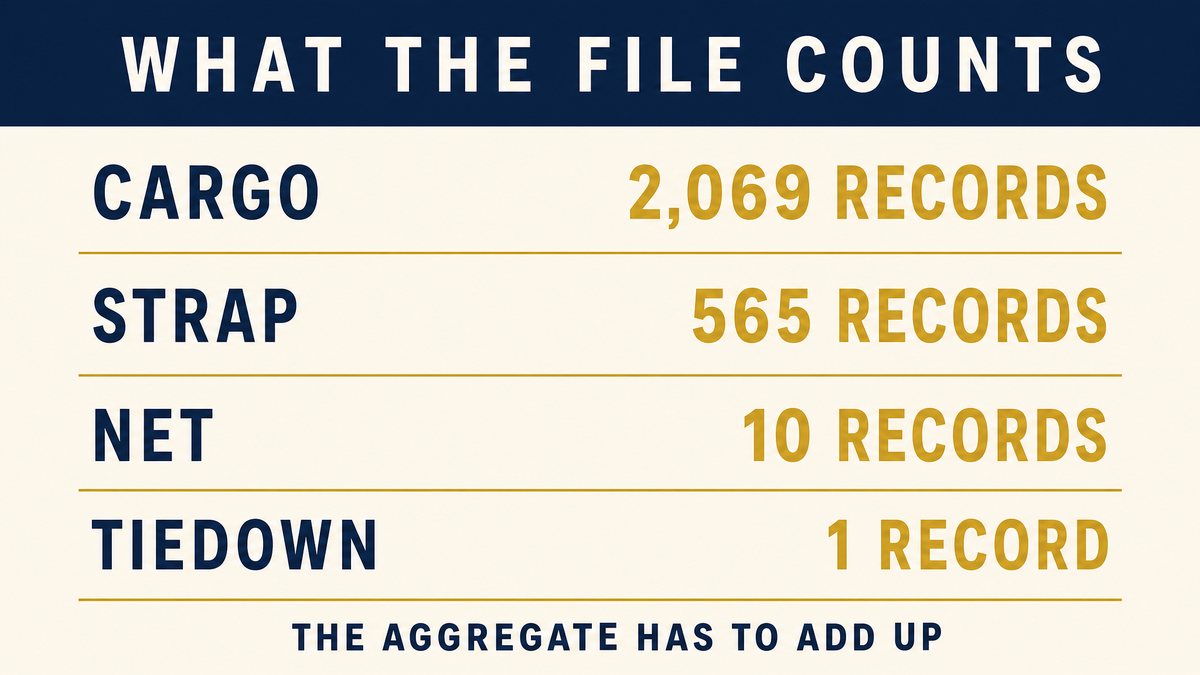
The category's own word appears once. tiedown reaches 1 record in 1 campaign across a quarter of a million rows. That is the single word the regulation uses for the thing this article is about, and it is the thinnest term in the whole table. nets returns nothing, net reaches ten records in four campaigns, and ratchet reaches four. The vocabulary a buyer uses to describe the product is almost entirely absent from the file that records what goes wrong with vehicles.
The only heading that contains the word tie is a steering part. A scan of the component field returns one heading family with tie in it: tie rod assembly, 857 campaigns. There is no securement heading, and the word cargo does not appear in a heading at all. So the words exist in the file and the category does not: a tie is a rod, a cargo is a bed, and a tiedown is a thing that happened once.
What the borrowed words are doing. strap reaches 93 campaigns and they are fuel tank straps and child seat harnesses: a Ford F-150 fuel tank strap campaign at 1,100,000 units, a parking brake campaign at 870,701, a child seat harness strap and webbing campaign at 794,247, and an air bag campaign at 443,442. anchor reaches 152 campaigns, and the five largest are seat belt anchorages: a Ram 1500 at 1,271,294, a Sonata Hybrid at 977,778, a child seat latch anchor at 668,187. The word the regulation uses for a vehicle's mounting points is, in this file, a seat belt part.
The two technical words are at zero. knot and dunnage return nothing, and both are terms the section uses for a failure and for a material. securement reaches 600 records in 48 campaigns, which is the only word in the table that appears in its regulatory sense at any scale.
The finding. This is the thinnest product vocabulary in the series so far, and the reason is structural. A tie-down failure does not become a recall; it becomes a load shift, a citation and, at worst, a crash report. The file records defects in vehicles, and a net that was never marked, never rated or repaired with a knot is not a vehicle defect. So the specification has to be built from the two documents that do speak — the section's arithmetic and its table of standards — and from a tag that the file would never record.
7. Five Questions a Net Quote Should Answer
A net quotation usually arrives with a size, a mesh size, a colour and a price. Four facts a buyer can act on are missing from that list, and a fifth decides how many units to order. Five questions close it.
- What is the working load limit of the assembly, and is it claimed for every corner? The rule sums tiedowns, so a limit that belongs to a leg is not the same as a limit that belongs to the net. Ask which one is being quoted.
- Which material standard does it meet? WSTDA-T1, 1998 for synthetic webbing; one of the five Cordage Institute standards for rope. A fibre name is not a standard, and the code names standards.
- How does the customer intend to route it — back to the same side, or across to the far side? The same assembly counts at half or at full depending on the answer, so the count in the quotation depends on it too.
- Are the hooks closed or locking, and can they open under vibration? A net is handled constantly, which is exactly why the fitting that saves a second at each corner is the one that fails the requirement.
- Is the tag stitched into the assembly, and does it state whole pounds? For two of the materials in the table, silence means a quarter. A printed label on a carton is not a mark on a tiedown.
8. Six Lines to Put in the Order
Everything above reduces to six lines. Each one is checkable on arrival, and each one changes a number the customer will later have to defend.
| Line | What to write | Why it is on the list |
|---|---|---|
| 1 | The assembly limit, and whether it covers four corners or the mesh | The aggregate is a sum, and the customer will add it up |
| 2 | The material standard, by number and year | The section regulates the component, not the net |
| 3 | The leg length, and whether it reaches the far-side anchor | The far side counts at full value, the near side at half |
| 4 | Closed or locking hooks | A tiedown must not release while the vehicle moves |
| 5 | A stitched tag, in whole pounds | Two materials default to a quarter when the mark is missing |
| 6 | The sleeves, and the edge they cover | Edge protection has to resist cutting as well as abrasion |
Five of those six lines are about information rather than material, which is the opposite of the fire extinguisher article before this one. There the specification was a shell and a decade; here it is a number, a route and a tag, and all three can be settled before a sample is sewn.com/factory-audit-checklist-guide/" target="_blank" rel="noopener">the audit question behind a stitched tag is where a claimed limit meets a production line, and the loading check before a truck leaves is where a net's first real test happens — with how a net's packed volume decides the freight worth settling at the same time, because a carton of nets is bulky and light.
Frequently Asked Questions
Does the FMCSA regulate cargo nets directly?
The securement rules regulate with tiedown assemblies and with the materials they are made from, and the word net does not appear in the section. A net reaches the rule through its webbing or cordage, which is why the material standard and the assembly's working load limit both have to be stated. The duty to secure the cargo itself sits on the motor carrier.
What is the aggregate working load limit?
It is the sum of what each tiedown contributes, and it has to reach at least one-half of the weight of the article or group of articles being secured. A tiedown running from a vehicle anchor to an anchor on the cargo contributes half of its mark; one that passes over the cargo and returns to the same side contributes half; one that crosses to an anchor on the other side contributes its full mark.
How much of a strap counts if it goes over the cargo and back to the same side?
Half of its working load limit. The full value is reserved for a tiedown that crosses the cargo and attaches to an anchor point on the opposite side of the vehicle. That is why the same strap can be worth twice as much in a load plan, and why the route belongs in the specification.
What happens if a tiedown is not marked with a working load limit?
For steel strapping the code treats it as one-fourth of the breaking strength listed in the referenced ASTM standard, and for wire rope as one-fourth of the strength the referenced manual names. For synthetic webbing the code incorporates WSTDA-T1 rather than setting a default, so an unreadable or missing tag leaves the customer with the same practical problem: a number nobody can point to.
Do knots matter on a tiedown?
Yes. The section says tiedowns and securing devices must not contain knots, which turns a field repair into a defect. On a net that rule decides how a short leg is dealt with: it is joined by stitching, splicing or hardware, not by tying two legs together.
Can a damaged net be repaired?
A repaired tiedown has to follow the manufacturing standards named in the section or the manufacturer's instructions, and damaged components may not be used in the first place because cracks or cuts reduce the working load limit. On a net the aggregate was a property of the assembly, so a cut leg retires the assembly rather than the leg.
A cargo net is not sold by strength. It is sold by an aggregate working load limit, and 393.106 requires that aggregate to be at least half the weight of the load it secures. The buyer has to do that arithmetic before the net is sewn.
The net then carries the result. Every hook, every stitch line and every strap end divides the total, which is why a quotation listing only a mesh size and a price cannot be checked against anything at all.
A Quote Line With the Divided Figure On It
We return the aggregate rating, the quarter applied to it, and the anchorage count, so your quote survives a load check at the dock.
Rewrite My Quote Line
Questions & Comments
We read every one and reply within 24 hoursA cargo net is rated by an aggregate rather than by a mesh size, and 393.106 turns that aggregate into a figure you can show. Send the load and the anchors.